Introduction
René Descartes was a
French philosopher, mathematician, and scientist.
Dubbed the father of modern western philosophy,
much of subsequent Western philosophy is a response
to his writings, which are studied closely to this
day. A native of the Kingdom of France, he spent
about 20 years (1629–49) of his life in the Dutch
Republic after serving for a while in the Dutch
States Army of Maurice of Nassau, Prince of
Orange and the Stadtholder of the United
Provinces.
Descartes was born in La Haye en Touraine
(now Descartes, Indre-et-Loire), France,
on 31 March 1596. When he was one year
old, his mother Jeanne Brochard died
after trying to give birth to another
child who also died. His father Joachim
was a member of the Parlement of
Brittany at Rennes.René lived with his
grandmother and with his great-uncle.
Some personal stats.
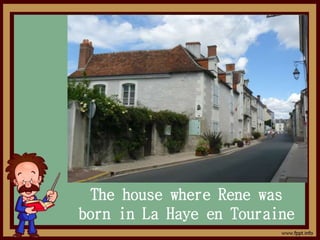
The house where Rene was
born in La Haye en Touraine
Stats continues..
In 1607, late because of his fragile health,
he entered the Jesuit College Royal Henry-Le-
Grand at La Flèche where he was introduced to
mathematics and physics, including Galileo's
work. After graduation in 1614, he studied
two years (1615–16) at the University of
Poitiers, earning
a Baccalauréat and Licence in Canon and Civil
Law, in accordance with his father's wishes
that he should become a lawyer. From there
he moved to Paris.
Stats continues..
• Given his ambition to become a professional
military officer, in 1618, Descartes joined, as
a mercenary, the Protestant Dutch States Army in
Breda under the command of Maurice of Nassau, and
undertook a formal study of military engineering,
as established by Simon Stevin. Descartes,
therefore, received much encouragement in Breda to
advance his knowledge of mathematics. In this way,
he became acquainted with Isaac Beeckman,
principal of a Dordrecht school, for whom he wrote
the Compendium of Music. Together they worked
on free fall, catenary, conic section, and fluid
statics. Both believed that it was necessary to
create a method that thoroughly linked mathematics
and physics.
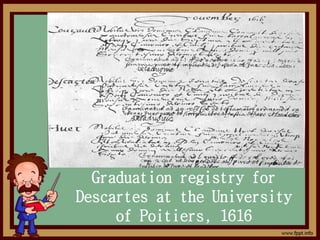
Graduation registry for
Descartes at the University
of Poitiers, 1616
Mathematical legacy
•In mathematics, his contribution lies
chiefly in geometry that’s why today he is
known as father of analytical geometry. His
main achievement was to bridge the gulf
between algebra and geometry. Thus he is
widely acclaimed as first mathematician who
laid the foundation of modern geometry that
resulted in development of analysis and
calculus. With regard to algebra, he
explained in detail that how algebric
equations can be expressed and explained
through use of geometrical shapes.
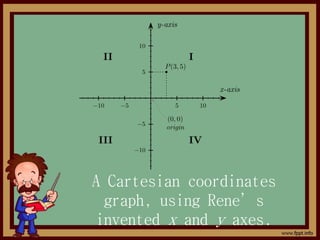
A Cartesian coordinates
graph, using Rene’s
invented x and y axes.
Influence on Newton's mathematics
• Descartes had the most influence of
anyone on the young Newton, and this is
arguably one of Descartes' most important
contributions. Newton continued
Descartes' work on cubic equations, which
freed the subject from the fetters of the
Greek perspectives. The most important
concept was his very modern treatment of
independent variables
Notion of innate ideas
• Rationalism can be
acquired by a priori
means.
• Descartes emphasized the
important of a priori
ideas and argument in
establishing genuine
knowledge on a firm
foundation.
Problemof Skepticismin epistemology
• Knowledge is not possible due to the
fact that all knowledge remains
uncertain.
• No knowledge is definite
• No knowledge can be justified
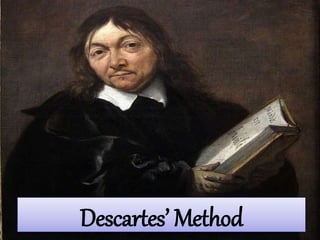
Descartes’ Method
Descartes’ Method: Background
•The real turning point came
on November 10, 1619.He
found he can doubt pretty
much everything. Descartes
claim he has also developed
a set of scientific
principles that had allowed
him to make many
discoveries.
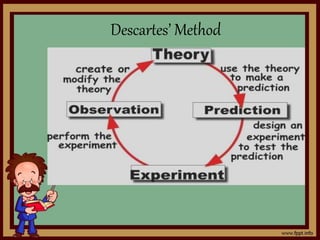
Descartes’ Method
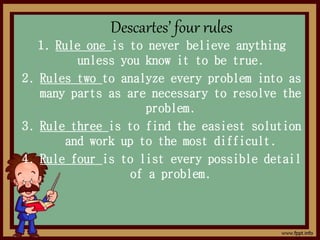
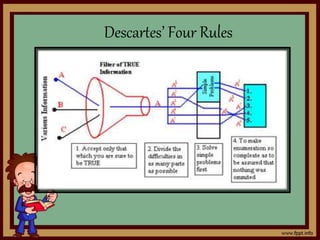
Descartes’ four rules
1. Rule one is to never believe anything
unless you know it to be true.
2. Rules two to analyze every problem into as
many parts as are necessary to resolve the
problem.
3. Rule three is to find the easiest solution
and work up to the most difficult.
4. Rule four is to list every possible detail
of a problem.
Descartes’ Four Rules
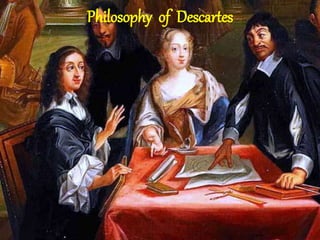
Philosophy of Descartes
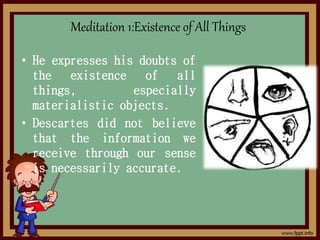
• He expresses his doubts of
the existence of all
things, especially
materialistic objects.
• Descartes did not believe
that the information we
receive through our sense
is necessarily accurate.
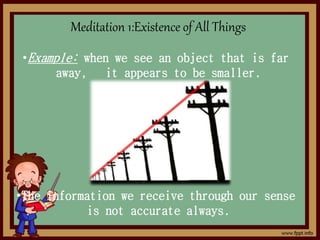
Meditation 1:Existence of All Things
•Example: when we see an object that is far
away, it appears to be smaller.
•The information we receive through our sense
is not accurate always.
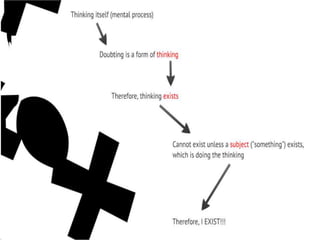
Meditation 2 :Absolute Certainty
• He Tried to express absolute certainty,
through his phrase, "I think, therefore I
am”.
• This includes the belief that I have a body
with sensory organs. “No”, because he had
convinced himself that his beliefs are false,
and then there must be an “I” convince.
Meditation 3 The Existence of God
•Casual Principle: That something cannot come
from nothing.
•P1: I have the clear idea of God (a most
perfect being: infinite, eternal,
omnipotent, benevolent).
•P2: A cause must be at least as real as its
effect.
•C: This idea of God (P1) can’t be imperfect
to me (P2). Its cause must be God greater.
So God exists.
God is not formally an extended
thing, but rather a thinking
thing.
Meditation 3 The Existence of God
Meditation 4: Possibility of Error
•Judgement is a faculty of the mind,
resulting from the interaction of will and
intellect.
•When our will to make decisions, exceeds the
ability to understand, error arises.
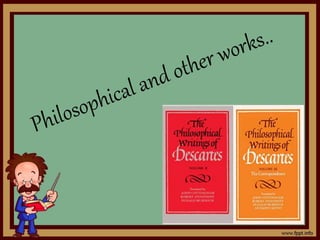
Writings.
1. Discourse on the Method
2. La Géométrie
3. The Passions of the Soul
4. Rules for the Direction of the Mind
5. Musicae Compendium
6. Meditations and Other Metaphysical
Writings
7. Treatise of Man
and 18 more such books..
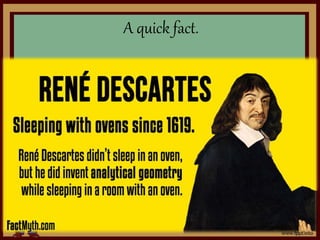
A quick fact.
Sources.
Rene Descartes

Rene Descartes

  • 2.
    Introduction René Descartes wasa French philosopher, mathematician, and scientist. Dubbed the father of modern western philosophy, much of subsequent Western philosophy is a response to his writings, which are studied closely to this day. A native of the Kingdom of France, he spent about 20 years (1629–49) of his life in the Dutch Republic after serving for a while in the Dutch States Army of Maurice of Nassau, Prince of Orange and the Stadtholder of the United Provinces.
  • 3.
    Descartes was bornin La Haye en Touraine (now Descartes, Indre-et-Loire), France, on 31 March 1596. When he was one year old, his mother Jeanne Brochard died after trying to give birth to another child who also died. His father Joachim was a member of the Parlement of Brittany at Rennes.René lived with his grandmother and with his great-uncle. Some personal stats.
  • 4.
    The house whereRene was born in La Haye en Touraine
  • 5.
    Stats continues.. In 1607,late because of his fragile health, he entered the Jesuit College Royal Henry-Le- Grand at La Flèche where he was introduced to mathematics and physics, including Galileo's work. After graduation in 1614, he studied two years (1615–16) at the University of Poitiers, earning a Baccalauréat and Licence in Canon and Civil Law, in accordance with his father's wishes that he should become a lawyer. From there he moved to Paris.
  • 6.
    Stats continues.. • Givenhis ambition to become a professional military officer, in 1618, Descartes joined, as a mercenary, the Protestant Dutch States Army in Breda under the command of Maurice of Nassau, and undertook a formal study of military engineering, as established by Simon Stevin. Descartes, therefore, received much encouragement in Breda to advance his knowledge of mathematics. In this way, he became acquainted with Isaac Beeckman, principal of a Dordrecht school, for whom he wrote the Compendium of Music. Together they worked on free fall, catenary, conic section, and fluid statics. Both believed that it was necessary to create a method that thoroughly linked mathematics and physics.
  • 7.
    Graduation registry for Descartesat the University of Poitiers, 1616
  • 8.
    Mathematical legacy •In mathematics,his contribution lies chiefly in geometry that’s why today he is known as father of analytical geometry. His main achievement was to bridge the gulf between algebra and geometry. Thus he is widely acclaimed as first mathematician who laid the foundation of modern geometry that resulted in development of analysis and calculus. With regard to algebra, he explained in detail that how algebric equations can be expressed and explained through use of geometrical shapes.
  • 9.
    A Cartesian coordinates graph,using Rene’s invented x and y axes.
  • 10.
    Influence on Newton'smathematics • Descartes had the most influence of anyone on the young Newton, and this is arguably one of Descartes' most important contributions. Newton continued Descartes' work on cubic equations, which freed the subject from the fetters of the Greek perspectives. The most important concept was his very modern treatment of independent variables
  • 12.
    Notion of innateideas • Rationalism can be acquired by a priori means. • Descartes emphasized the important of a priori ideas and argument in establishing genuine knowledge on a firm foundation.
  • 13.
    Problemof Skepticismin epistemology •Knowledge is not possible due to the fact that all knowledge remains uncertain. • No knowledge is definite • No knowledge can be justified
  • 14.
  • 15.
    Descartes’ Method: Background •Thereal turning point came on November 10, 1619.He found he can doubt pretty much everything. Descartes claim he has also developed a set of scientific principles that had allowed him to make many discoveries.
  • 16.
  • 17.
    Descartes’ four rules 1.Rule one is to never believe anything unless you know it to be true. 2. Rules two to analyze every problem into as many parts as are necessary to resolve the problem. 3. Rule three is to find the easiest solution and work up to the most difficult. 4. Rule four is to list every possible detail of a problem.
  • 18.
  • 19.
  • 20.
    • He expresseshis doubts of the existence of all things, especially materialistic objects. • Descartes did not believe that the information we receive through our sense is necessarily accurate. Meditation 1:Existence of All Things
  • 21.
    Meditation 1:Existence ofAll Things •Example: when we see an object that is far away, it appears to be smaller. •The information we receive through our sense is not accurate always.
  • 22.
    Meditation 2 :AbsoluteCertainty • He Tried to express absolute certainty, through his phrase, "I think, therefore I am”. • This includes the belief that I have a body with sensory organs. “No”, because he had convinced himself that his beliefs are false, and then there must be an “I” convince.
  • 24.
    Meditation 3 TheExistence of God •Casual Principle: That something cannot come from nothing. •P1: I have the clear idea of God (a most perfect being: infinite, eternal, omnipotent, benevolent). •P2: A cause must be at least as real as its effect. •C: This idea of God (P1) can’t be imperfect to me (P2). Its cause must be God greater. So God exists.
  • 25.
    God is notformally an extended thing, but rather a thinking thing. Meditation 3 The Existence of God
  • 26.
    Meditation 4: Possibilityof Error •Judgement is a faculty of the mind, resulting from the interaction of will and intellect. •When our will to make decisions, exceeds the ability to understand, error arises.
  • 27.
    Writings. 1. Discourse onthe Method 2. La Géométrie 3. The Passions of the Soul 4. Rules for the Direction of the Mind 5. Musicae Compendium 6. Meditations and Other Metaphysical Writings 7. Treatise of Man and 18 more such books..
  • 28.
  • 29.