Copyright © 2011 Pearson Education, Inc.
All rights reserved.
Chapter 3
What Can We Know?
What is the Structure of the Cosmos?
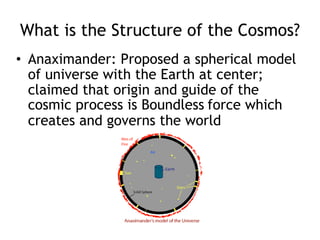
• Anaximander: Proposed a spherical model
of universe with the Earth at center;
claimed that origin and guide of the
cosmic process is Boundless force which
creates and governs the world
3
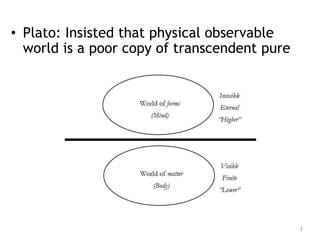
• Plato: Insisted that physical observable
world is a poor copy of transcendent pure
4
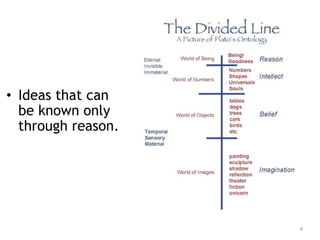
• Ideas that can
be known only
through reason.
What is the Structure of the Cosmos?
• Solomon: “There is nothing new under the
Sun”; nothing really changes
• Parmenides: There is no motion or change;
everything remains the same; all changes
we suppose we observe are illusory
• Heraclitus: We “cannot step twice into the
same river,” for everything is constantly
changing; “nothing endures but change”
Skepticism
• Doubts our ability to answer metaphysical
questions
• Argues against the possibility of real
knowledge, whether gained by the sense
or by reason
• Promoted by followers of Pyrrho of Elis
– Because we can never attain certain
knowledge, our best path is to live quietly and
modestly and seek peace of mind.
Epistemology
• Comprises the study of knowledge and the
conditions for knowledge
• Term is based on the Greek word for
knowledge, episteme
The Copernican Revolution
• Served as a powerful source of skepticism
• Shattered the astronomical system of
Ptolemy which theorized that Earth is
fixed, unmoving, and the sun orbits Earth
• In turn, collapsed the Aristotelian
conception of physics that was wedded to
the Ptolemaic system
• Was also in conflict with the Christian
cosmology
Outcomes of the
Copernican Revolution
• Our most cherished and obvious truths may in
fact be false.
• Before we can draw a reliable observation about
what we see, we must take into account the
effects of our own observational position and
faculties.
• Before we can ask what really exists, we must
consider whether we have any legitimate and
reliable method for knowing.
10
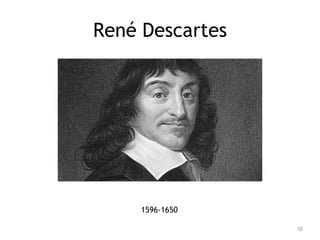
René Descartes
1596-1650
Descartes
• Brought about major shift in how
philosophy was done
• Profoundly influenced how we think about
knowledge and the pursuit of knowledge
• Asked How can we know? (rather than
What do we know?)
12
Descartes in 3-Minutes
Descartes
• Turned to his own capacity for gaining
knowledge (rather than the Church, the
King, the Ancients)
• Insisted that if knowledge were to be
gained, there would have to be a reliable
method of gaining it
• Like other before him, believed that
genuine knowledge must be certain
Descartes and Reason
• Descartes asserts that only the pure
knowledge known by the resources of
reason can be totally reliable.
• “Clear and Distinct Ideas”
• Method of Doubt
15
Discourse on the Method
1. “The first was never to accept anything for true which I did not
clearly know to be such; that is to say, carefully to avoid precipitancy
and prejudice, and to comprise nothing more in my judgment than
what was presented to my mind so clearly and distinctly as to
exclude all ground of doubt.”
2. “divide each of the difficulties under examination into as many
parts as possible, and as might be necessary for its adequate
solution.”
3. “conduct my thoughts in such order that, by commencing with
objects the simplest and easiest to know, I might ascend by little and
little, and, as it were, step by step, to the knowledge of the more
complex”
4. “to make enumerations so complete, and reviews so general, that
I might be assured that nothing was omitted."
Types of Knowledge
• A priori knowledge
– Knowledge of pure reason, i.e. the truths of
mathematics and geometry
– Knowledge that exists prior to experience
• A posteriori knowledge
– Knowledge gained by (after) experience, i.e.
knowledge of the weather, or physics, or
astronomy
Descartes’ Method of Doubt
• Begins by dismissing what most of us might
regard as the best and most obvious
candidates for indubitable truth
• Proposes a “malevolent demon” with
awesome powers who devotes all his
enormous skills and strengths to deceiving
us
I Think, Therefore I Exist
• Descartes asserts that there is one
bedrock certainty, an item of knowledge
that each of us can confidently and
assuredly know, no matter what some
powerful deceiver uses against us.
• That absolutely certain and indubitable
truth is: I exist, as a thinking thing—
cogito, ergo sum.

Waller ch 03

  • 1.
    Copyright © 2011Pearson Education, Inc. All rights reserved. Chapter 3 What Can We Know?
  • 2.
    What is theStructure of the Cosmos? • Anaximander: Proposed a spherical model of universe with the Earth at center; claimed that origin and guide of the cosmic process is Boundless force which creates and governs the world
  • 3.
    3 • Plato: Insistedthat physical observable world is a poor copy of transcendent pure
  • 4.
    4 • Ideas thatcan be known only through reason.
  • 5.
    What is theStructure of the Cosmos? • Solomon: “There is nothing new under the Sun”; nothing really changes • Parmenides: There is no motion or change; everything remains the same; all changes we suppose we observe are illusory • Heraclitus: We “cannot step twice into the same river,” for everything is constantly changing; “nothing endures but change”
  • 6.
    Skepticism • Doubts ourability to answer metaphysical questions • Argues against the possibility of real knowledge, whether gained by the sense or by reason • Promoted by followers of Pyrrho of Elis – Because we can never attain certain knowledge, our best path is to live quietly and modestly and seek peace of mind.
  • 7.
    Epistemology • Comprises thestudy of knowledge and the conditions for knowledge • Term is based on the Greek word for knowledge, episteme
  • 8.
    The Copernican Revolution •Served as a powerful source of skepticism • Shattered the astronomical system of Ptolemy which theorized that Earth is fixed, unmoving, and the sun orbits Earth • In turn, collapsed the Aristotelian conception of physics that was wedded to the Ptolemaic system • Was also in conflict with the Christian cosmology
  • 9.
    Outcomes of the CopernicanRevolution • Our most cherished and obvious truths may in fact be false. • Before we can draw a reliable observation about what we see, we must take into account the effects of our own observational position and faculties. • Before we can ask what really exists, we must consider whether we have any legitimate and reliable method for knowing.
  • 10.
  • 11.
    Descartes • Brought aboutmajor shift in how philosophy was done • Profoundly influenced how we think about knowledge and the pursuit of knowledge • Asked How can we know? (rather than What do we know?)
  • 12.
  • 13.
    Descartes • Turned tohis own capacity for gaining knowledge (rather than the Church, the King, the Ancients) • Insisted that if knowledge were to be gained, there would have to be a reliable method of gaining it • Like other before him, believed that genuine knowledge must be certain
  • 14.
    Descartes and Reason •Descartes asserts that only the pure knowledge known by the resources of reason can be totally reliable. • “Clear and Distinct Ideas” • Method of Doubt
  • 15.
    15 Discourse on theMethod 1. “The first was never to accept anything for true which I did not clearly know to be such; that is to say, carefully to avoid precipitancy and prejudice, and to comprise nothing more in my judgment than what was presented to my mind so clearly and distinctly as to exclude all ground of doubt.” 2. “divide each of the difficulties under examination into as many parts as possible, and as might be necessary for its adequate solution.” 3. “conduct my thoughts in such order that, by commencing with objects the simplest and easiest to know, I might ascend by little and little, and, as it were, step by step, to the knowledge of the more complex” 4. “to make enumerations so complete, and reviews so general, that I might be assured that nothing was omitted."
  • 16.
    Types of Knowledge •A priori knowledge – Knowledge of pure reason, i.e. the truths of mathematics and geometry – Knowledge that exists prior to experience • A posteriori knowledge – Knowledge gained by (after) experience, i.e. knowledge of the weather, or physics, or astronomy
  • 17.
    Descartes’ Method ofDoubt • Begins by dismissing what most of us might regard as the best and most obvious candidates for indubitable truth • Proposes a “malevolent demon” with awesome powers who devotes all his enormous skills and strengths to deceiving us
  • 18.
    I Think, ThereforeI Exist • Descartes asserts that there is one bedrock certainty, an item of knowledge that each of us can confidently and assuredly know, no matter what some powerful deceiver uses against us. • That absolutely certain and indubitable truth is: I exist, as a thinking thing— cogito, ergo sum.