IJRET: International Journal of Research in Engineering and Technology eISSN: 2319-1163 | pISSN: 2321-7308
_______________________________________________________________________________________
Volume: 04 Issue: 04 | Apr-2015, Available @ http://www.ijret.org 349
REMOVAL OF FLUORIDE FROM DRINKING WATER BY USING
LOW COST ADSORBENT
Sheetal Bandewar1
, S. J. Mane2
, S. N. Tirthakar3
1
Student, D. Y. Patil College of Engineering, Akurdi
2
Assistant Professor, D. Y. Patil College of Engineering, Akurdi
3
Assistant Professor, College of Military Engineering, Pune-31
Abstract
Millions of people rely on drinking water that contains excess fluoride. In fluoride endemic areas, especially small communities
with staggered habitat, defluoridation of potable water supply is still a problem. In this study, adsorption potential of granular
activated carbon (GAC) from charcoal and coconut shell is investigated for defluoridation of drinking water using continuous
fixed bed column. The influence of various operative parameters such as concentration of fluoride, bed height, flow rate, and
adsorption capacity of both the adsorbent is carried out.The fluoride removal from synthetic sample is found up to 72% for
fluoride ion concentration of 4mg/L.
Keywords: Adsorption, Defluoridation, fixed bed column study, Granular charcoal, and coconut shell activated
carbon.
--------------------------------------------------------------------***------------------------------------------------------------------
1. INTRODUCTION
Fluoride is known to be a natural contaminant for ground
water resources globally. Fluorine, a fairly common element
of earth crust, is present in the form of fluorides in a number
of minerals and in many rocks [1]. The ingestion of excess
fluoride can cause fluorosis which affects the teeth and
bones. Moderate amounts lead to dental effects, but long-
term ingestion of large amounts can lead to potentially
severe skeletalproblems. Paradoxically, low levels of
fluoride intake help to prevent dental caries [3].Research of
several researchers during the last 5–6 years has proved that
life-long impact and accumulation of fluorides cause not
only human skeletal and teeth damage, but also changes in
the DNA-structure, paralysis of volition, cancer, etc. [2].
Mainly two factors are responsible for contamination of
ground water with fluoride:one is geological and second is
anthropogenic. Although both geological and manmade
sources contribute to the occurrence of fluoride in water, the
major contribution comes from geological resources [4]. In
the 3rd edition of the World Health Organization (WHO)
guidelines on drinking water, it maintains its guideline on
the appropriate fluoride concentration at 1.5 mg/L (WHO
2008). “It is estimated that around 260 million people
worldwide (in 30 countries) are drinking water withFluoride
content more than 1.0 mg/L. In India alone, endemic
Fluorosis is thought to affect around one million people and
is a major problem in 17 of the 25states, especially
Rajasthan, Andhra Pradesh, Tamil Nadu, Gujarat, and Uttar
Pradesh [6]. So Fluoride removal from water is an important
mission of Environmental Engineers.
Activated carbon is a good adsorbent to remove fluoride as
it has a large surface area and hence a large surface for the
adsorption of fluoride. The more will be the surface, the
more will be adsorption, and more will be the removal.
Activated carbon is usually formed from charcoal. The main
raw material used for activated carbon is any organic
material with higher carbon content (coal, peat, wood,
coconut shells). Granular activated carbon media is
commonly produced by grinding the raw material, adding an
appropriate binder to give it re-compacting, hardness and
crushing to the correct size [11]. The carbon-based material
is transformed to activated carbon by thermal decomposition
in a furnace by using a controlled heat and atmosphere. The
resultant product has an extremely large surface area /
volume, and a network of submicroscopic pores where
adsorption takes place. The walls of the pores give the
surface layer molecules that are essential for adsorption.
Remarkably, one pound of carbon (a quart container) gives a
surface area equivalent to six football fields [12].
Adsorption is one of the significant techniques in which
fluoride adsorbed onto a membrane, or a fixed bed, is
packed with resin or other mineral particles [5]. This method
is mainly used because it is cost effective, easy to operate
and eco-friendly in nature [7]. The technique is also popular
due to its availability of a wide range of adsorbent.This
paper is an attempt to explore a possibility to utilize waste
material adsorbents coconut shell and charcoal to remove
fluoride from aqueous solution. The effects of contact time,
particle size, GAC dosage and flow rate on fluoride removal
are studied.
2. MATERIALS AND METHODS
The raw materials, reagents, and preparation method used in
experimentation work are discussed below:
IJRET: International Journal of Research in Engineering and Technology eISSN: 2319-1163 | pISSN: 2321-7308
_______________________________________________________________________________________
Volume: 04 Issue: 04 | Apr-2015, Available @ http://www.ijret.org 350
2.1 Reagents and Chemical Used
The SPANDS reagent is of AR (Analytical Reagents) grade
and procured from Savant Instruments Pvt. Ltd, Hyderabad.
Chemical NAF and Charcoal and coconut shell GAC are
procured from LOBA Chemie, Mumbai. All chemicals are
used as received in all experiment and distilled water is
used.
2.2 Adsorbent
The coconut shell and charcoal is utilized as adsorbent in the
study. Activated carbon of size less than 150 mm is used for
column studies.
2.3 Preparation of Stock Solution
Stock solution of fluoride is prepared by dissolving 0.221
gm of standard sodium fluoride in one liter of distilled
water. This stock solution is used to prepare required
concentration of fluoride solution.
2.4 Equipment
The equipment used to detect fluoride ions is
spectrophotometer. (Chemito UV2100)
2.5 Fixed-Bed Column Studies
The sorption studies are carried out in a glass column of 2.5
cm diameter and bed height of 25 cm. Four sets of column
study are performed. A glass-wool plug is used in the
bottom of the column to support the adsorbent bed and
prevent the outflow of particles. In each set, for a given
initial fluoride concentrations (2, 4, 6 and 8 mg/L) the
downward flow rates are varied and maintained at (2
ml/min, 4ml/min, 6ml/min, and 8ml/min) corresponding to
each of the various concentration values. The GAC of both
the material is filled in the glass column in equal amount as
2+2 cm, 3+3cm, 4+4 cm. The top of the column is
connected to an overhead tank containing the feed solution.
The effluent is collected and analyzed for fluoride
concentration. Packed bed experiments are carried out at
room temperature.
3. RESULTS AND DISCUSSIONS
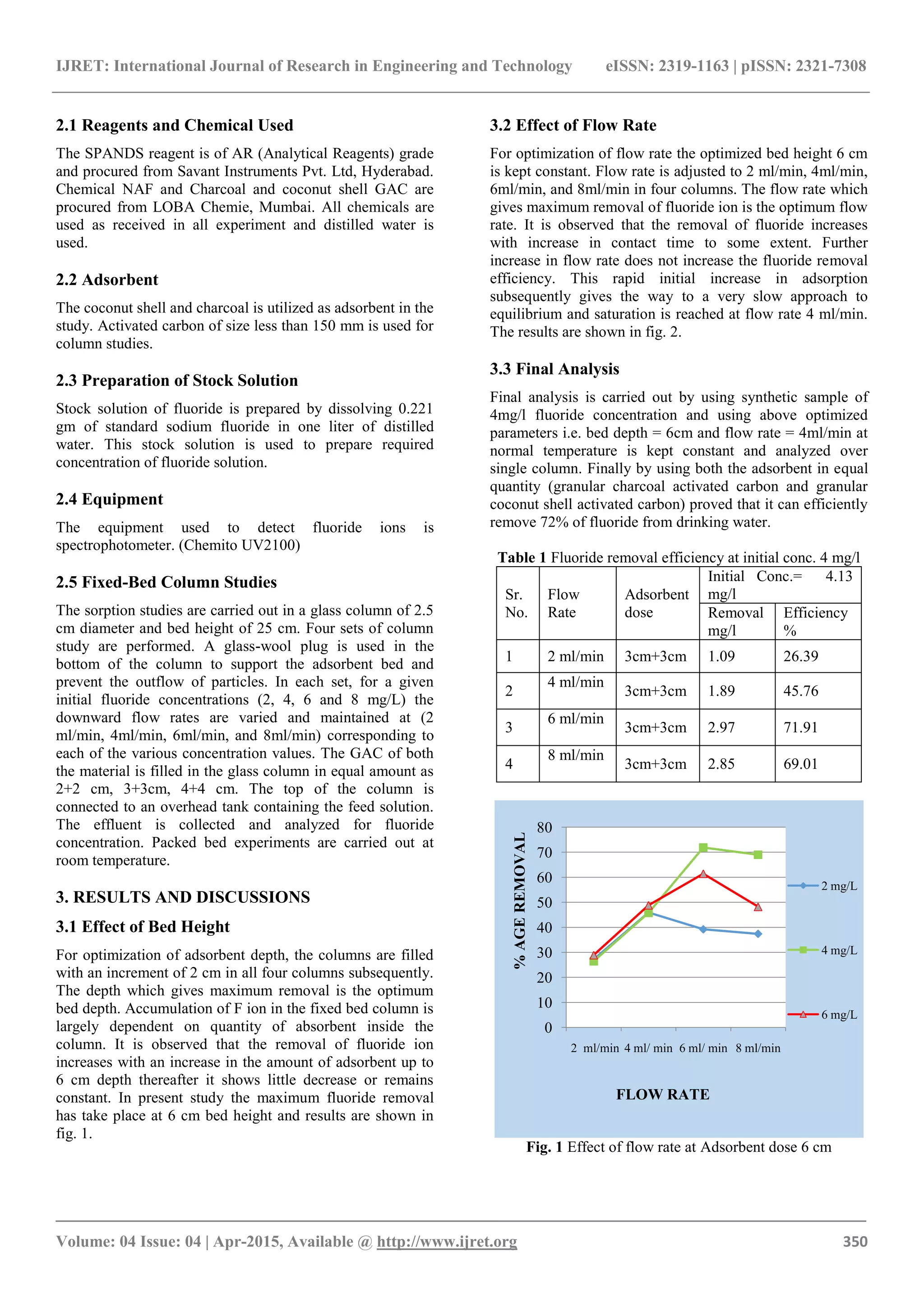
3.1 Effect of Bed Height
For optimization of adsorbent depth, the columns are filled
with an increment of 2 cm in all four columns subsequently.
The depth which gives maximum removal is the optimum
bed depth. Accumulation of F ion in the fixed bed column is
largely dependent on quantity of absorbent inside the
column. It is observed that the removal of fluoride ion
increases with an increase in the amount of adsorbent up to
6 cm depth thereafter it shows little decrease or remains
constant. In present study the maximum fluoride removal
has take place at 6 cm bed height and results are shown in
fig. 1.
3.2 Effect of Flow Rate
For optimization of flow rate the optimized bed height 6 cm
is kept constant. Flow rate is adjusted to 2 ml/min, 4ml/min,
6ml/min, and 8ml/min in four columns. The flow rate which
gives maximum removal of fluoride ion is the optimum flow
rate. It is observed that the removal of fluoride increases
with increase in contact time to some extent. Further
increase in flow rate does not increase the fluoride removal
efficiency. This rapid initial increase in adsorption
subsequently gives the way to a very slow approach to
equilibrium and saturation is reached at flow rate 4 ml/min.
The results are shown in fig. 2.
3.3 Final Analysis
Final analysis is carried out by using synthetic sample of
4mg/l fluoride concentration and using above optimized
parameters i.e. bed depth = 6cm and flow rate = 4ml/min at
normal temperature is kept constant and analyzed over
single column. Finally by using both the adsorbent in equal
quantity (granular charcoal activated carbon and granular
coconut shell activated carbon) proved that it can efficiently
remove 72% of fluoride from drinking water.
Table 1 Fluoride removal efficiency at initial conc. 4 mg/l
Sr.
No.
Flow
Rate
Adsorbent
dose
Initial Conc.= 4.13
mg/l
Removal
mg/l
Efficiency
%
1 2 ml/min 3cm+3cm 1.09 26.39
2
4 ml/min
3cm+3cm 1.89 45.76
3
6 ml/min
3cm+3cm 2.97 71.91
4
8 ml/min
3cm+3cm 2.85 69.01
Fig. 1 Effect of flow rate at Adsorbent dose 6 cm
0
10
20
30
40
50
60
70
80
2 ml/min 4 ml/ min 6 ml/ min 8 ml/min
%AGEREMOVAL
FLOW RATE
2 mg/L
4 mg/L
6 mg/L
IJRET: International Journal of Research in Engineering and Technology eISSN: 2319-1163 | pISSN: 2321-7308
_______________________________________________________________________________________
Volume: 04 Issue: 04 | Apr-2015, Available @ http://www.ijret.org 351
Table 2 Fluoride removal efficiency at varying adsorbent
dose and flow rate
Sr.
No.
Flow
Rate
Adsorbent dose
2cm +
2cm
3cm+
3cm
4cm + 4cm
Removal Efficiency %
1 2 ml/min 34.87 26.39 23.92
2
4 ml/min 38.60 44.76 44.27
3
6 ml/min 43.64 71.91 60.81
4 8 ml/min 45.18 69.01
57.51
Fig. 2 Effect of adsorbent dose at initial concentration of 4
mg/L
4. CONCLUSION
Maximum fluoride removal from synthetic solution is found
to be 72% by using granular charcoal and coconut shell
activated carbon. Percentage removal is different for
different fluoride concentrations best removal is observed at
fluoride concentration of 4 mg/l and adsorbent dose of
6cm at 4ml/ min flow rate.
REFERENCES
[1] Chidambaram, S. Ramanathan, Vasudevan S,
Fluoride removal studies in water using natural
material. Water, air and soil pollution, 29, p. 0378-
473, 2001..
[2] Veressinina Y., Trapido M., Ahelik V., and Munter
R., Fluoride in drinking water: The problem and its
possible solution. Proc. Estonian Acad. Sci. Chem.,
50(2), P. 81-88, 2001.
[3] SEHN, P. Fluoride removal with extra low energy
reverse osmosis membranes: three years of large
scale field experience in Finland. Desalination, 223,
p. 73–84,2008.
[4] NATH, S.K. and DUTTA, R.K. Fluoride removal
from water using crushed limestone, Indian Journal
Chemical Technology, 17, p. 120-125, 2010.
[5] ALAGUMUTHU, G. and RAJAN, M.Equilibrium
and kinetics of adsorption of fluoride onto zirconium
impregnated cashew nut shell carbon. Chem. Eng. J.,
158, p. 451–457, 2010.
[6] VARDHAN, C.M.V. and KARTHIKEYAN, J.2011.
Removal of Fluoride from Water Using Low-Cost
Materials. Fifteenth International Water Technology
Conference, IWTC-15, Alexandria, Egypt,2011.
[7] Chen N., Z. Zhang, C. Feng, investigation on the
batch and fixed bed column performance of fluoride
adsorption by Kanuma mud. Desalination, 286, 76-
82, 2011.
[8] D.S. Bhargava, Economical technology of fluoride
removal using fishbone charcoal columns at domestic
level, 2nd
international workshop on fluorosis
prevention and defluoridation of water, p. 118-122,
2011.
[9] P. B. Bhagwati, C. B. Shivayogimath, M. N.
Hiremath, Column investigation of fluoride on
activated carbon prepared from Almond shell,
IJPHE, vol. 2012-13,July 2012.
[10] Sonila Awasthi, S. K. Gupta, Defluoridation of sub
soil water by using Ground nut husk carbon, Water,
and wastewater: perspectives of developing
countries, 1075-1079.
[11] B. Saha, M. H. Tai, M. Streat, Process safety and
environmental protection Volume 79, 211-217,2 001.
[12] Jasmin Kaur, Haripada Bhunia, Removal of fluoride
from drinking water by activated carbon, VSRD
international journal of technical and non-technical
research, Vol. IV, Issue VIII, August 2013.
0
10
20
30
40
50
60
70
80
2 ml/min 4 ml/min 6 ml/min 8 ml/min
%AGEREMOVAL
FLOW RATE
AD dose
4cm
AD dose
6cm
AD dose
8cm

Removal of fluoride from drinking water by using low cost adsorbent

  • 1.
    IJRET: International Journalof Research in Engineering and Technology eISSN: 2319-1163 | pISSN: 2321-7308 _______________________________________________________________________________________ Volume: 04 Issue: 04 | Apr-2015, Available @ http://www.ijret.org 349 REMOVAL OF FLUORIDE FROM DRINKING WATER BY USING LOW COST ADSORBENT Sheetal Bandewar1 , S. J. Mane2 , S. N. Tirthakar3 1 Student, D. Y. Patil College of Engineering, Akurdi 2 Assistant Professor, D. Y. Patil College of Engineering, Akurdi 3 Assistant Professor, College of Military Engineering, Pune-31 Abstract Millions of people rely on drinking water that contains excess fluoride. In fluoride endemic areas, especially small communities with staggered habitat, defluoridation of potable water supply is still a problem. In this study, adsorption potential of granular activated carbon (GAC) from charcoal and coconut shell is investigated for defluoridation of drinking water using continuous fixed bed column. The influence of various operative parameters such as concentration of fluoride, bed height, flow rate, and adsorption capacity of both the adsorbent is carried out.The fluoride removal from synthetic sample is found up to 72% for fluoride ion concentration of 4mg/L. Keywords: Adsorption, Defluoridation, fixed bed column study, Granular charcoal, and coconut shell activated carbon. --------------------------------------------------------------------***------------------------------------------------------------------ 1. INTRODUCTION Fluoride is known to be a natural contaminant for ground water resources globally. Fluorine, a fairly common element of earth crust, is present in the form of fluorides in a number of minerals and in many rocks [1]. The ingestion of excess fluoride can cause fluorosis which affects the teeth and bones. Moderate amounts lead to dental effects, but long- term ingestion of large amounts can lead to potentially severe skeletalproblems. Paradoxically, low levels of fluoride intake help to prevent dental caries [3].Research of several researchers during the last 5–6 years has proved that life-long impact and accumulation of fluorides cause not only human skeletal and teeth damage, but also changes in the DNA-structure, paralysis of volition, cancer, etc. [2]. Mainly two factors are responsible for contamination of ground water with fluoride:one is geological and second is anthropogenic. Although both geological and manmade sources contribute to the occurrence of fluoride in water, the major contribution comes from geological resources [4]. In the 3rd edition of the World Health Organization (WHO) guidelines on drinking water, it maintains its guideline on the appropriate fluoride concentration at 1.5 mg/L (WHO 2008). “It is estimated that around 260 million people worldwide (in 30 countries) are drinking water withFluoride content more than 1.0 mg/L. In India alone, endemic Fluorosis is thought to affect around one million people and is a major problem in 17 of the 25states, especially Rajasthan, Andhra Pradesh, Tamil Nadu, Gujarat, and Uttar Pradesh [6]. So Fluoride removal from water is an important mission of Environmental Engineers. Activated carbon is a good adsorbent to remove fluoride as it has a large surface area and hence a large surface for the adsorption of fluoride. The more will be the surface, the more will be adsorption, and more will be the removal. Activated carbon is usually formed from charcoal. The main raw material used for activated carbon is any organic material with higher carbon content (coal, peat, wood, coconut shells). Granular activated carbon media is commonly produced by grinding the raw material, adding an appropriate binder to give it re-compacting, hardness and crushing to the correct size [11]. The carbon-based material is transformed to activated carbon by thermal decomposition in a furnace by using a controlled heat and atmosphere. The resultant product has an extremely large surface area / volume, and a network of submicroscopic pores where adsorption takes place. The walls of the pores give the surface layer molecules that are essential for adsorption. Remarkably, one pound of carbon (a quart container) gives a surface area equivalent to six football fields [12]. Adsorption is one of the significant techniques in which fluoride adsorbed onto a membrane, or a fixed bed, is packed with resin or other mineral particles [5]. This method is mainly used because it is cost effective, easy to operate and eco-friendly in nature [7]. The technique is also popular due to its availability of a wide range of adsorbent.This paper is an attempt to explore a possibility to utilize waste material adsorbents coconut shell and charcoal to remove fluoride from aqueous solution. The effects of contact time, particle size, GAC dosage and flow rate on fluoride removal are studied. 2. MATERIALS AND METHODS The raw materials, reagents, and preparation method used in experimentation work are discussed below:
  • 2.
    IJRET: International Journalof Research in Engineering and Technology eISSN: 2319-1163 | pISSN: 2321-7308 _______________________________________________________________________________________ Volume: 04 Issue: 04 | Apr-2015, Available @ http://www.ijret.org 350 2.1 Reagents and Chemical Used The SPANDS reagent is of AR (Analytical Reagents) grade and procured from Savant Instruments Pvt. Ltd, Hyderabad. Chemical NAF and Charcoal and coconut shell GAC are procured from LOBA Chemie, Mumbai. All chemicals are used as received in all experiment and distilled water is used. 2.2 Adsorbent The coconut shell and charcoal is utilized as adsorbent in the study. Activated carbon of size less than 150 mm is used for column studies. 2.3 Preparation of Stock Solution Stock solution of fluoride is prepared by dissolving 0.221 gm of standard sodium fluoride in one liter of distilled water. This stock solution is used to prepare required concentration of fluoride solution. 2.4 Equipment The equipment used to detect fluoride ions is spectrophotometer. (Chemito UV2100) 2.5 Fixed-Bed Column Studies The sorption studies are carried out in a glass column of 2.5 cm diameter and bed height of 25 cm. Four sets of column study are performed. A glass-wool plug is used in the bottom of the column to support the adsorbent bed and prevent the outflow of particles. In each set, for a given initial fluoride concentrations (2, 4, 6 and 8 mg/L) the downward flow rates are varied and maintained at (2 ml/min, 4ml/min, 6ml/min, and 8ml/min) corresponding to each of the various concentration values. The GAC of both the material is filled in the glass column in equal amount as 2+2 cm, 3+3cm, 4+4 cm. The top of the column is connected to an overhead tank containing the feed solution. The effluent is collected and analyzed for fluoride concentration. Packed bed experiments are carried out at room temperature. 3. RESULTS AND DISCUSSIONS 3.1 Effect of Bed Height For optimization of adsorbent depth, the columns are filled with an increment of 2 cm in all four columns subsequently. The depth which gives maximum removal is the optimum bed depth. Accumulation of F ion in the fixed bed column is largely dependent on quantity of absorbent inside the column. It is observed that the removal of fluoride ion increases with an increase in the amount of adsorbent up to 6 cm depth thereafter it shows little decrease or remains constant. In present study the maximum fluoride removal has take place at 6 cm bed height and results are shown in fig. 1. 3.2 Effect of Flow Rate For optimization of flow rate the optimized bed height 6 cm is kept constant. Flow rate is adjusted to 2 ml/min, 4ml/min, 6ml/min, and 8ml/min in four columns. The flow rate which gives maximum removal of fluoride ion is the optimum flow rate. It is observed that the removal of fluoride increases with increase in contact time to some extent. Further increase in flow rate does not increase the fluoride removal efficiency. This rapid initial increase in adsorption subsequently gives the way to a very slow approach to equilibrium and saturation is reached at flow rate 4 ml/min. The results are shown in fig. 2. 3.3 Final Analysis Final analysis is carried out by using synthetic sample of 4mg/l fluoride concentration and using above optimized parameters i.e. bed depth = 6cm and flow rate = 4ml/min at normal temperature is kept constant and analyzed over single column. Finally by using both the adsorbent in equal quantity (granular charcoal activated carbon and granular coconut shell activated carbon) proved that it can efficiently remove 72% of fluoride from drinking water. Table 1 Fluoride removal efficiency at initial conc. 4 mg/l Sr. No. Flow Rate Adsorbent dose Initial Conc.= 4.13 mg/l Removal mg/l Efficiency % 1 2 ml/min 3cm+3cm 1.09 26.39 2 4 ml/min 3cm+3cm 1.89 45.76 3 6 ml/min 3cm+3cm 2.97 71.91 4 8 ml/min 3cm+3cm 2.85 69.01 Fig. 1 Effect of flow rate at Adsorbent dose 6 cm 0 10 20 30 40 50 60 70 80 2 ml/min 4 ml/ min 6 ml/ min 8 ml/min %AGEREMOVAL FLOW RATE 2 mg/L 4 mg/L 6 mg/L
  • 3.
    IJRET: International Journalof Research in Engineering and Technology eISSN: 2319-1163 | pISSN: 2321-7308 _______________________________________________________________________________________ Volume: 04 Issue: 04 | Apr-2015, Available @ http://www.ijret.org 351 Table 2 Fluoride removal efficiency at varying adsorbent dose and flow rate Sr. No. Flow Rate Adsorbent dose 2cm + 2cm 3cm+ 3cm 4cm + 4cm Removal Efficiency % 1 2 ml/min 34.87 26.39 23.92 2 4 ml/min 38.60 44.76 44.27 3 6 ml/min 43.64 71.91 60.81 4 8 ml/min 45.18 69.01 57.51 Fig. 2 Effect of adsorbent dose at initial concentration of 4 mg/L 4. CONCLUSION Maximum fluoride removal from synthetic solution is found to be 72% by using granular charcoal and coconut shell activated carbon. Percentage removal is different for different fluoride concentrations best removal is observed at fluoride concentration of 4 mg/l and adsorbent dose of 6cm at 4ml/ min flow rate. REFERENCES [1] Chidambaram, S. Ramanathan, Vasudevan S, Fluoride removal studies in water using natural material. Water, air and soil pollution, 29, p. 0378- 473, 2001.. [2] Veressinina Y., Trapido M., Ahelik V., and Munter R., Fluoride in drinking water: The problem and its possible solution. Proc. Estonian Acad. Sci. Chem., 50(2), P. 81-88, 2001. [3] SEHN, P. Fluoride removal with extra low energy reverse osmosis membranes: three years of large scale field experience in Finland. Desalination, 223, p. 73–84,2008. [4] NATH, S.K. and DUTTA, R.K. Fluoride removal from water using crushed limestone, Indian Journal Chemical Technology, 17, p. 120-125, 2010. [5] ALAGUMUTHU, G. and RAJAN, M.Equilibrium and kinetics of adsorption of fluoride onto zirconium impregnated cashew nut shell carbon. Chem. Eng. J., 158, p. 451–457, 2010. [6] VARDHAN, C.M.V. and KARTHIKEYAN, J.2011. Removal of Fluoride from Water Using Low-Cost Materials. Fifteenth International Water Technology Conference, IWTC-15, Alexandria, Egypt,2011. [7] Chen N., Z. Zhang, C. Feng, investigation on the batch and fixed bed column performance of fluoride adsorption by Kanuma mud. Desalination, 286, 76- 82, 2011. [8] D.S. Bhargava, Economical technology of fluoride removal using fishbone charcoal columns at domestic level, 2nd international workshop on fluorosis prevention and defluoridation of water, p. 118-122, 2011. [9] P. B. Bhagwati, C. B. Shivayogimath, M. N. Hiremath, Column investigation of fluoride on activated carbon prepared from Almond shell, IJPHE, vol. 2012-13,July 2012. [10] Sonila Awasthi, S. K. Gupta, Defluoridation of sub soil water by using Ground nut husk carbon, Water, and wastewater: perspectives of developing countries, 1075-1079. [11] B. Saha, M. H. Tai, M. Streat, Process safety and environmental protection Volume 79, 211-217,2 001. [12] Jasmin Kaur, Haripada Bhunia, Removal of fluoride from drinking water by activated carbon, VSRD international journal of technical and non-technical research, Vol. IV, Issue VIII, August 2013. 0 10 20 30 40 50 60 70 80 2 ml/min 4 ml/min 6 ml/min 8 ml/min %AGEREMOVAL FLOW RATE AD dose 4cm AD dose 6cm AD dose 8cm