MASS BALANCING –
MIDAS APPROACH
Metallurgical Accounting Course, South Africa 2015
MIDASTech International
THE ADVANTAGES OF
DETAILED MASS BALANCE
• Units process particles
• So understanding the complex response of particles to units
processes facilitates the basis of accurate simulation; rather
than fictional simulation which is all too common.
• Metallurgical accounting focuses on assays, and is therefore
a 1D Balance and inappropriate for simulation or
understanding metallurgical processing of the ore
MASS BALANCING LEVELS
• 0D Balance – Solid flows and Water flows
• 1D Balance - Size, OR bulk assays, OR elements OR density
classes OR Minerals
• 2D Balance i.e. Size/assay
• 3D Balance Size, Particle Types (i.e. density class), Properties
of particle types (i.e. multimineral composition)
MIDASTech International
DATA STRUCTURES FOR
MASS BALANCING
THE VARIOUS LEVELS OF
MASS BALANCING
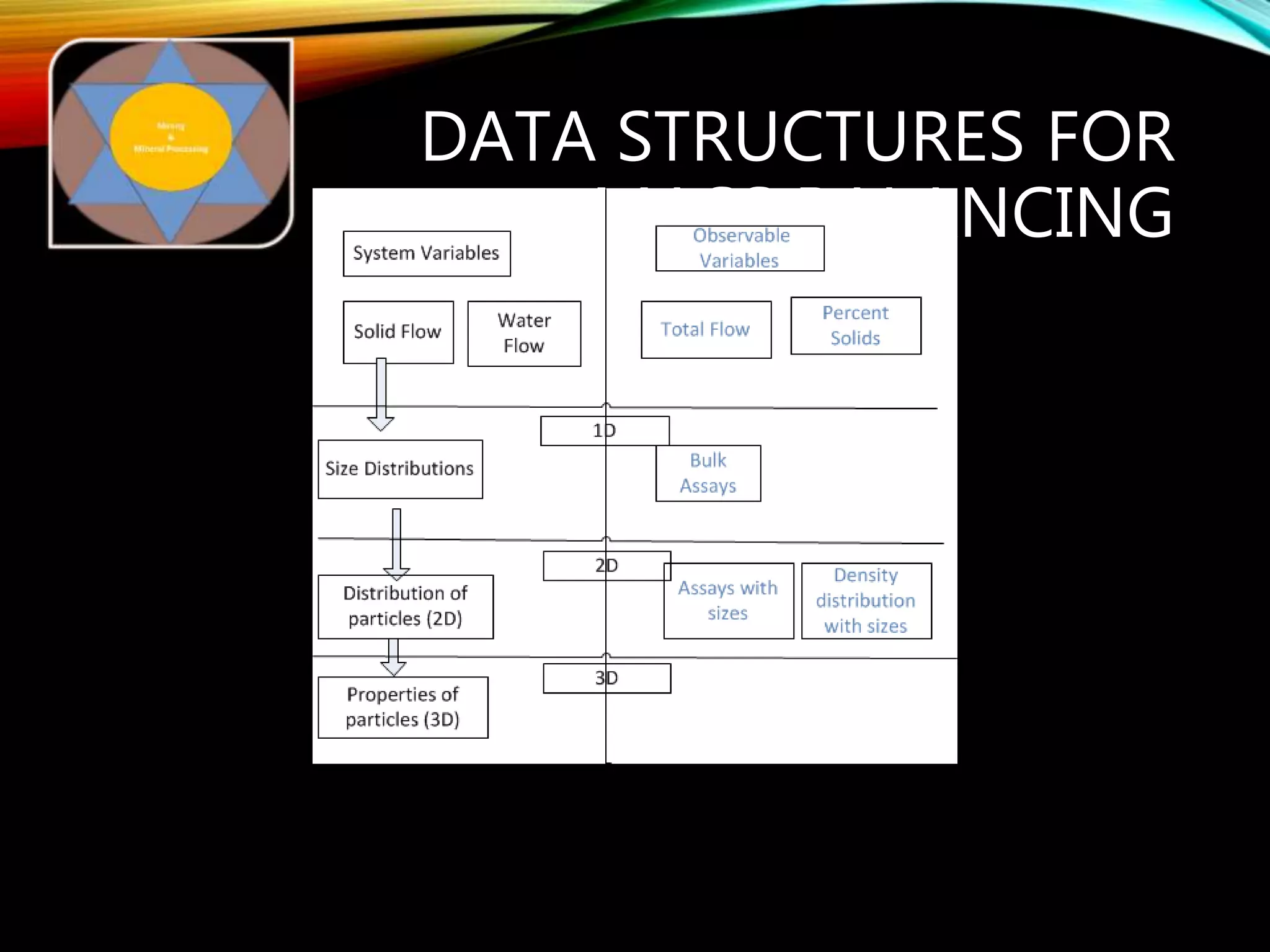
• The diagram shows the general structure of ore
information. Measurement of information and
structure are not the same.
• A poorly constructed simulator will be based on
measurable information only rather than the actual ore
structure.
• An intelligent simulator will use the measured
information to identify the actual ore properties.
LEVELS OF MASS
BALANCING CONTINUED
• Hence it is not necessarily required to obtain the detail information
(3D); only to infer it from the 2D information. Hence there is a
hierarchical approach to mass balancing. Generally 1D first to
ensure solid flows are estimated; then 2D to ensure general mass
balance consistency.
• The 2D information can actually be used to infer the 3D, which is
also mass balanced, but not necessarily based on 3D
measurement. On the other hand a user can directly measure 3D
data via float-sink tests – and then elemental composition in each
density class, or mineralogical analysis.
• However the fundamental object remains – to identify the flow of
particles through the circuit
ACTUAL MINERAL
PROCESSING DATA
STRUCTURE
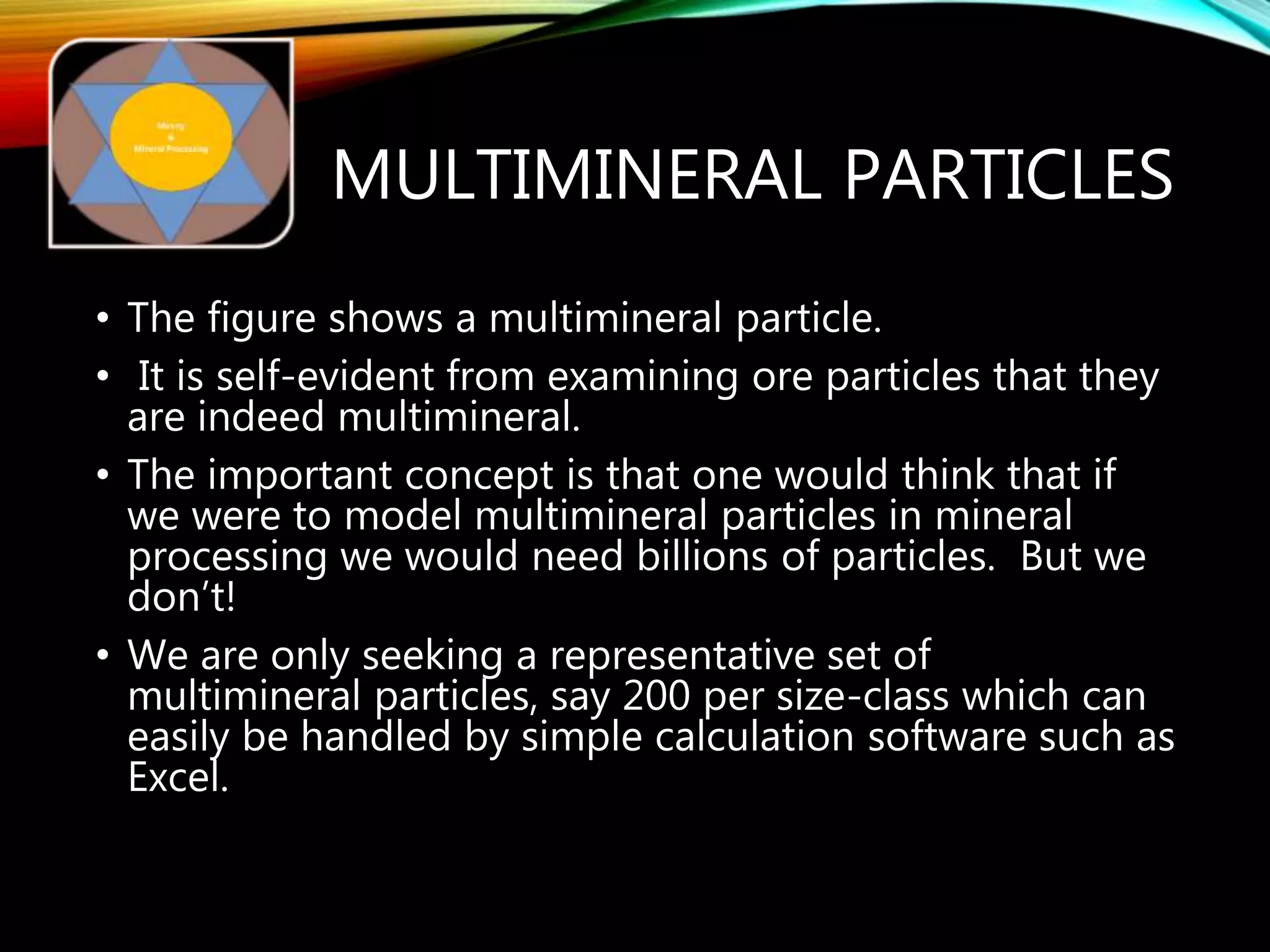
• Particles are multimineral
MULTIMINERAL PARTICLES
• The figure shows a multimineral particle.
• It is self-evident from examining ore particles that they
are indeed multimineral.
• The important concept is that one would think that if
we were to model multimineral particles in mineral
processing we would need billions of particles. But we
don’t!
• We are only seeking a representative set of
multimineral particles, say 200 per size-class which can
easily be handled by simple calculation software such as
Excel.
PARTICLE RECOVERY
BASED ON A FLOAT CELL
• Particles goes into a
flotation cell, and based on
their composition will have
a probability of going to the
concentrate.
• Hence high grade floatable
particles will be more likely
to go the concentrate than
low grade non-floatable
minerals.
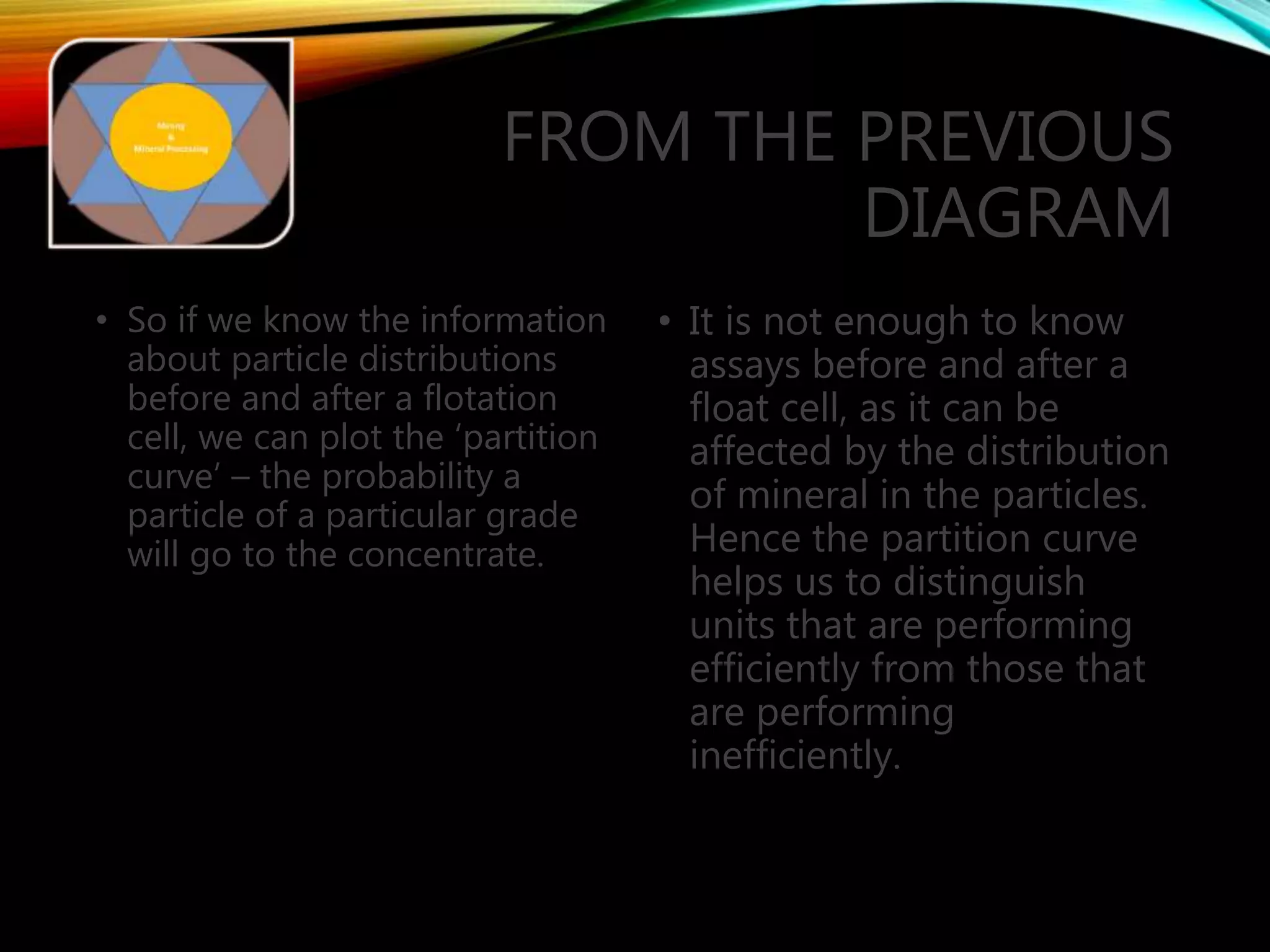
PARTITION CURVES FOR
UNDERSTANDING EFFICIENCY
Mineral Composition
Probability of
particle going
to concentrate
Inefficient
Efficient
FROM THE PREVIOUS
DIAGRAM
• So if we know the information
about particle distributions
before and after a flotation
cell, we can plot the ‘partition
curve’ – the probability a
particle of a particular grade
will go to the concentrate.
• It is not enough to know
assays before and after a
float cell, as it can be
affected by the distribution
of mineral in the particles.
Hence the partition curve
helps us to distinguish
units that are performing
efficiently from those that
are performing
inefficiently.
COMPOSITION OF A MINERAL
IS INSUFFICIENT TO DEVELOP
A MODEL
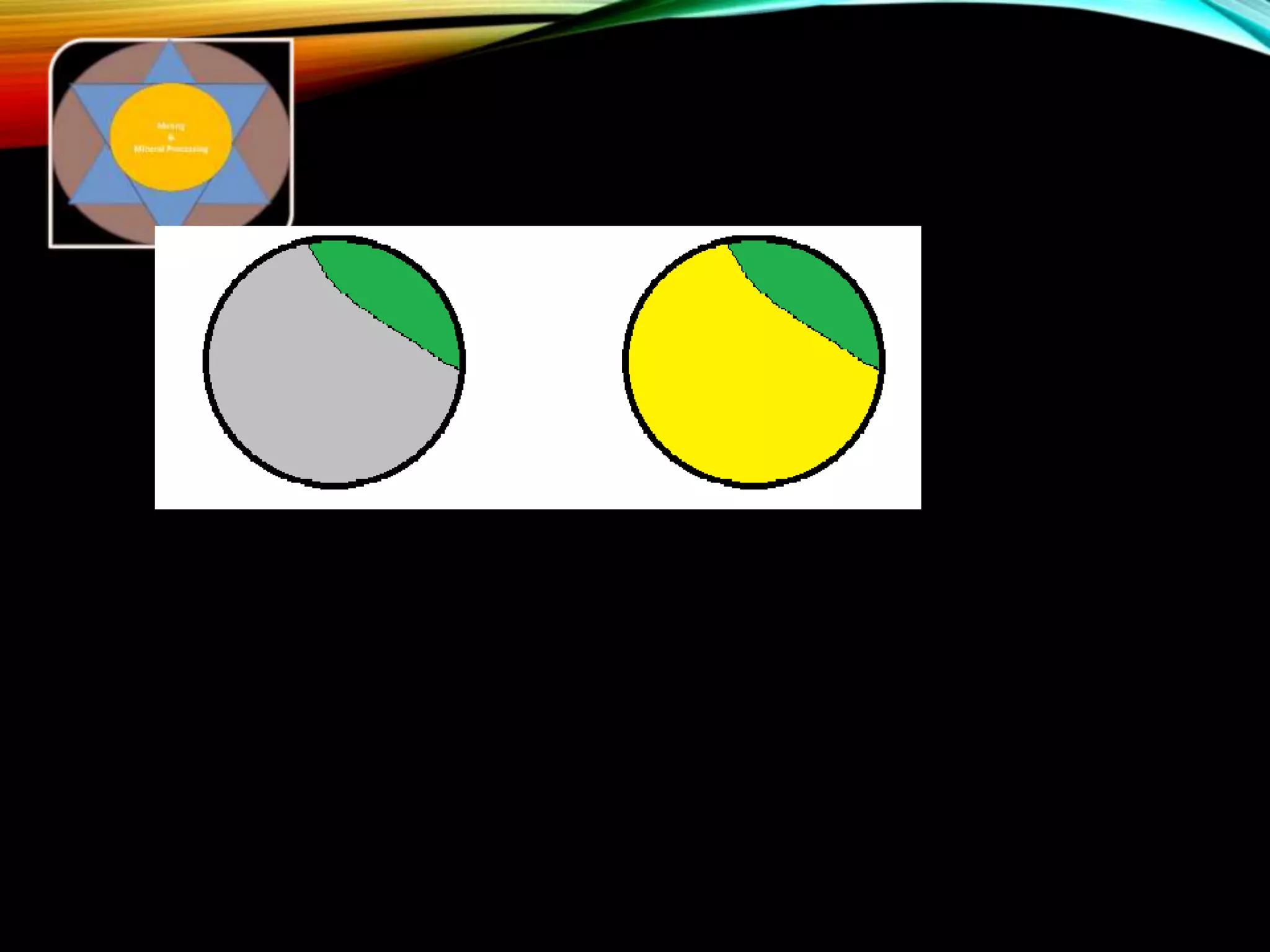
Two particles both with the same composition of valuable mineral
(say chalcopyrite). In a simple model they would be presumed to
have the same properties
LOOKING AT MINERAL
PARTICLES…
• But looking at the mineral composition of just one mineral is
not good enough!
• Here we see two particles – both have the same grade of
valuable mineral interest. All other minerals are combined to
form the respective ‘gangue’ mineral. An inexperienced
metallurgist would think that the two particles have the same
properties and therefore should float the same.
• But if you think a little bit deeper, you might want to think
about the ‘gangue’ phase
LOOK A BIT DEEPER
The gangue mineral may be different i.e. quartz for particle 1 and
pyrite for particle 2. The belief the two particles will have the same
properties (particularly in flotation) is at best a work of fiction.
Clearly we need to recognise the existence of multiminerals
FAILURE TO RECOGNISE THE
EXISTENCE OF MULTIPLE
MINERALS
• Impractical models
• Fictional models
• Inordinate amount of laboratory analysis
• Lack of trust in simulation
• Invalid assay to mineral algorithms
• General confusion
BENEFITS OF DETAILED
MODELLING
• One can identify whether units are performing efficiently for a given
ore type
• Essential for plant trouble shooting
• Essential for plant simulation
• Essential for identifying how operational changes affect final grades
and recoveries
• Use of multiple mineral particles is essential for accuracy of models –
particularly separation of associated minerals such as pyrite,
chalcopyrite
THE SOLUTION!
• Recognise the existence of multiminerals (where they exist)
• Use software that incorporates modern mathematical methods to
deal with the real datastructure (Advanced simulation course,
inclusive of advanced mass balancing methods)
• Such methods are only available through MIDASTech
QUANTITATIVE
ADVANTAGES
• The MIDAS approach (Mass balancing together with simulation )
would target 5% operational improvement
• Leading to millions of dollars of savings per plant.
MIDAS TECH’S SET OF
MASS BALANCE SYSTEMS
• 1. MMVisioBal1D – 1D Mass Balance system,
• 2. MMVisioBal2D – 2D Mass Balance system,
• 3. MMVisioBal3D – 3D Mass Balance system
• 4. MMVisioBal2DPlus - inferring detailed 3D information
from 2D data (patented approach)
MASS BALANCING
METHODS
Two main approaches of mass balancing
• Conventional: Least squares – requires variances of
estimates; and is therefore a flawed approach if variances are
not known
• Modern: Information theory – appropriate when variances
are known; and can also be used when variances are known.
Fast, efficient and allows inference (MMVisioBalPlus)
MMVISIOBAL1D
• Entry point software (contact Stephen@MIDASTech.net)
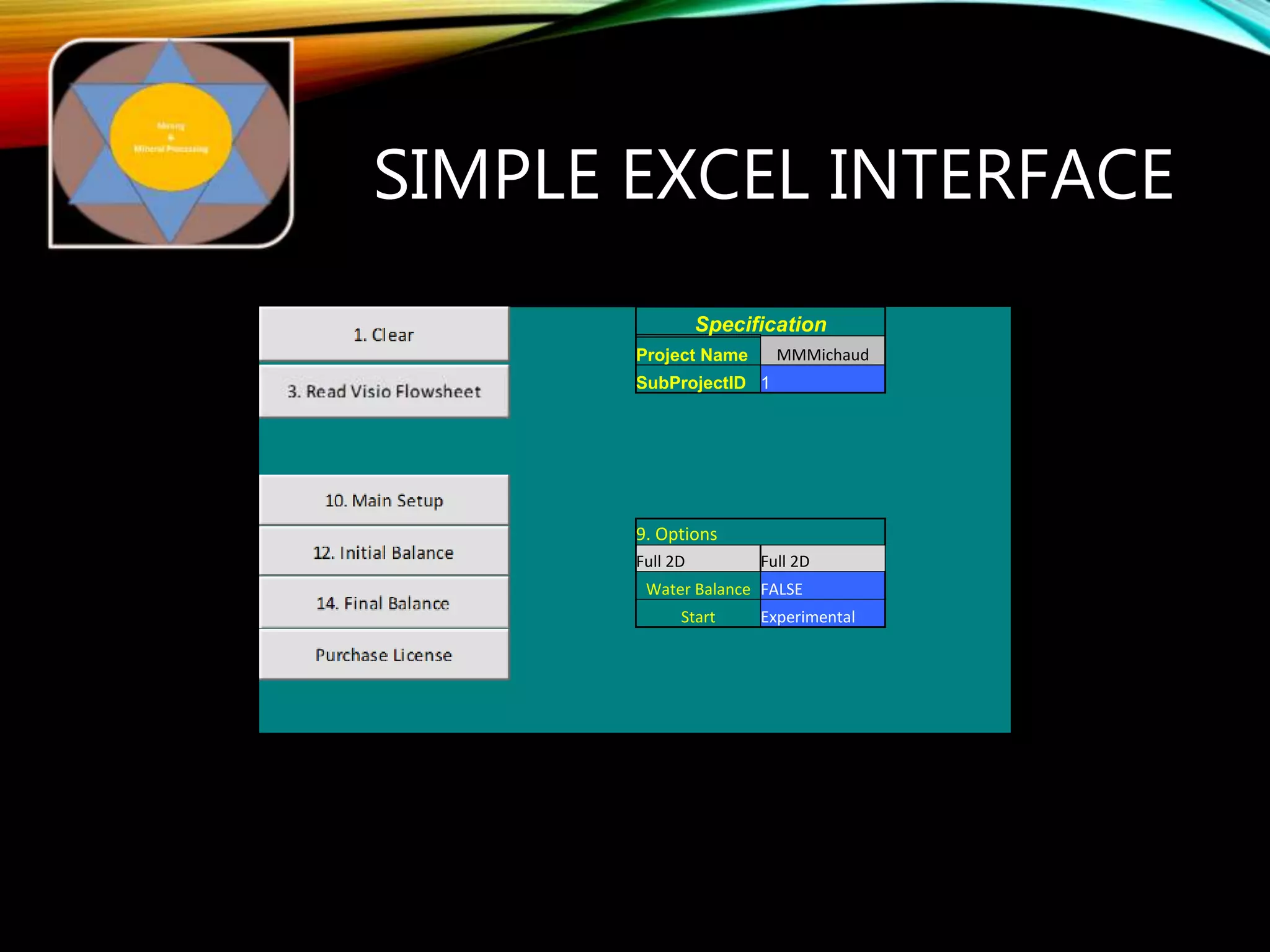
• Uses Visio flowsheet system and Excel interface. System
largely automated. Once an Excel template is created and
data are inputted – press of a button yields mass balance
results
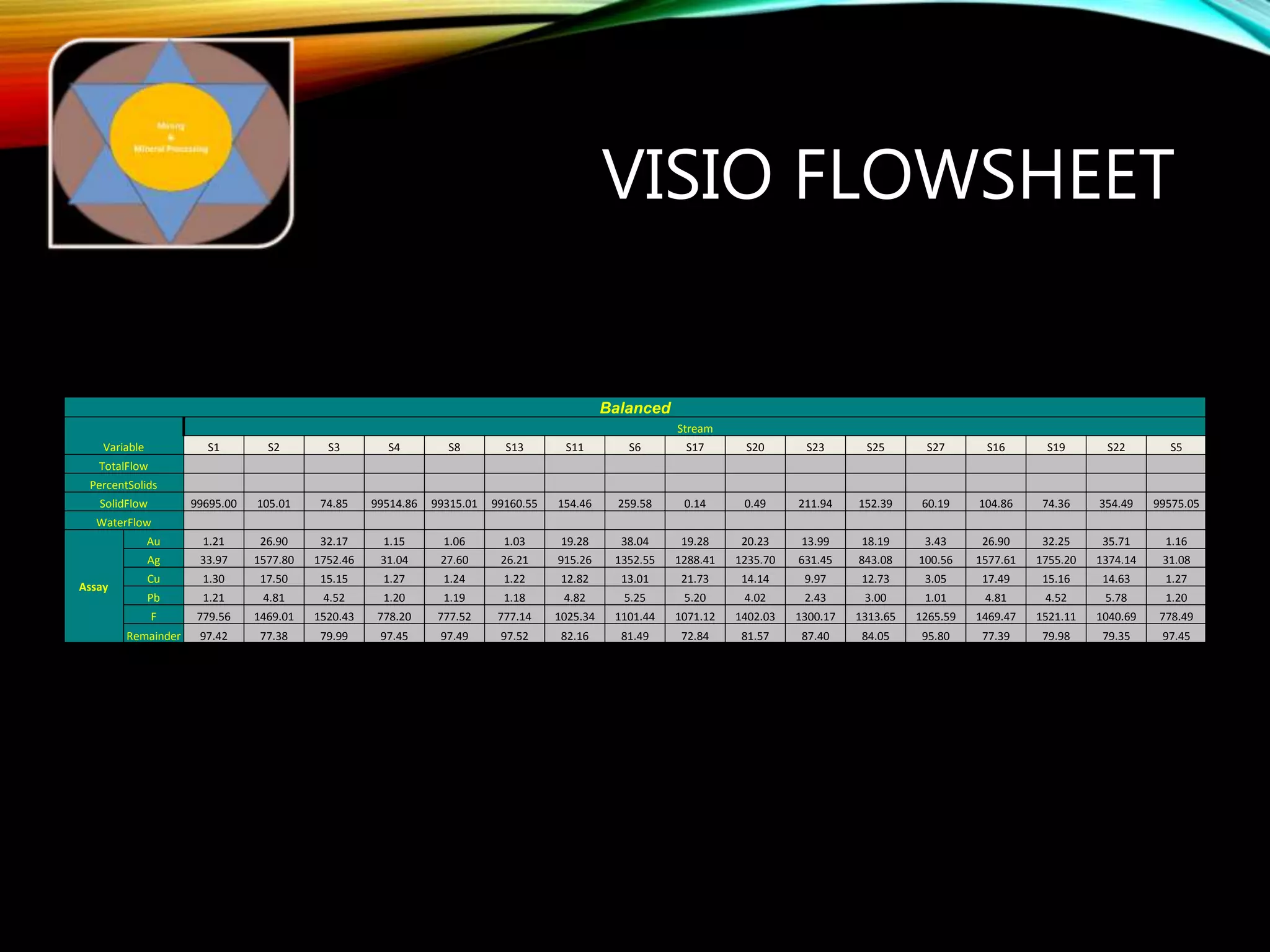
VISIO FLOWSHEET
Balanced
Variable
Stream
S1 S2 S3 S4 S8 S13 S11 S6 S17 S20 S23 S25 S27 S16 S19 S22 S5
TotalFlow
PercentSolids
SolidFlow 99695.00 105.01 74.85 99514.86 99315.01 99160.55 154.46 259.58 0.14 0.49 211.94 152.39 60.19 104.86 74.36 354.49 99575.05
WaterFlow
Assay
Au 1.21 26.90 32.17 1.15 1.06 1.03 19.28 38.04 19.28 20.23 13.99 18.19 3.43 26.90 32.25 35.71 1.16
Ag 33.97 1577.80 1752.46 31.04 27.60 26.21 915.26 1352.55 1288.41 1235.70 631.45 843.08 100.56 1577.61 1755.20 1374.14 31.08
Cu 1.30 17.50 15.15 1.27 1.24 1.22 12.82 13.01 21.73 14.14 9.97 12.73 3.05 17.49 15.16 14.63 1.27
Pb 1.21 4.81 4.52 1.20 1.19 1.18 4.82 5.25 5.20 4.02 2.43 3.00 1.01 4.81 4.52 5.78 1.20
F 779.56 1469.01 1520.43 778.20 777.52 777.14 1025.34 1101.44 1071.12 1402.03 1300.17 1313.65 1265.59 1469.47 1521.11 1040.69 778.49
Remainder 97.42 77.38 79.99 97.45 97.49 97.52 82.16 81.49 72.84 81.57 87.40 84.05 95.80 77.39 79.98 79.35 97.45
SIMPLE EXCEL INTERFACE
False Specification
Project Name MMMichaud
False SubProjectID 1
False False
False False
9. Options
Full 2D Full 2D
Water Balance FALSE
Start Experimental
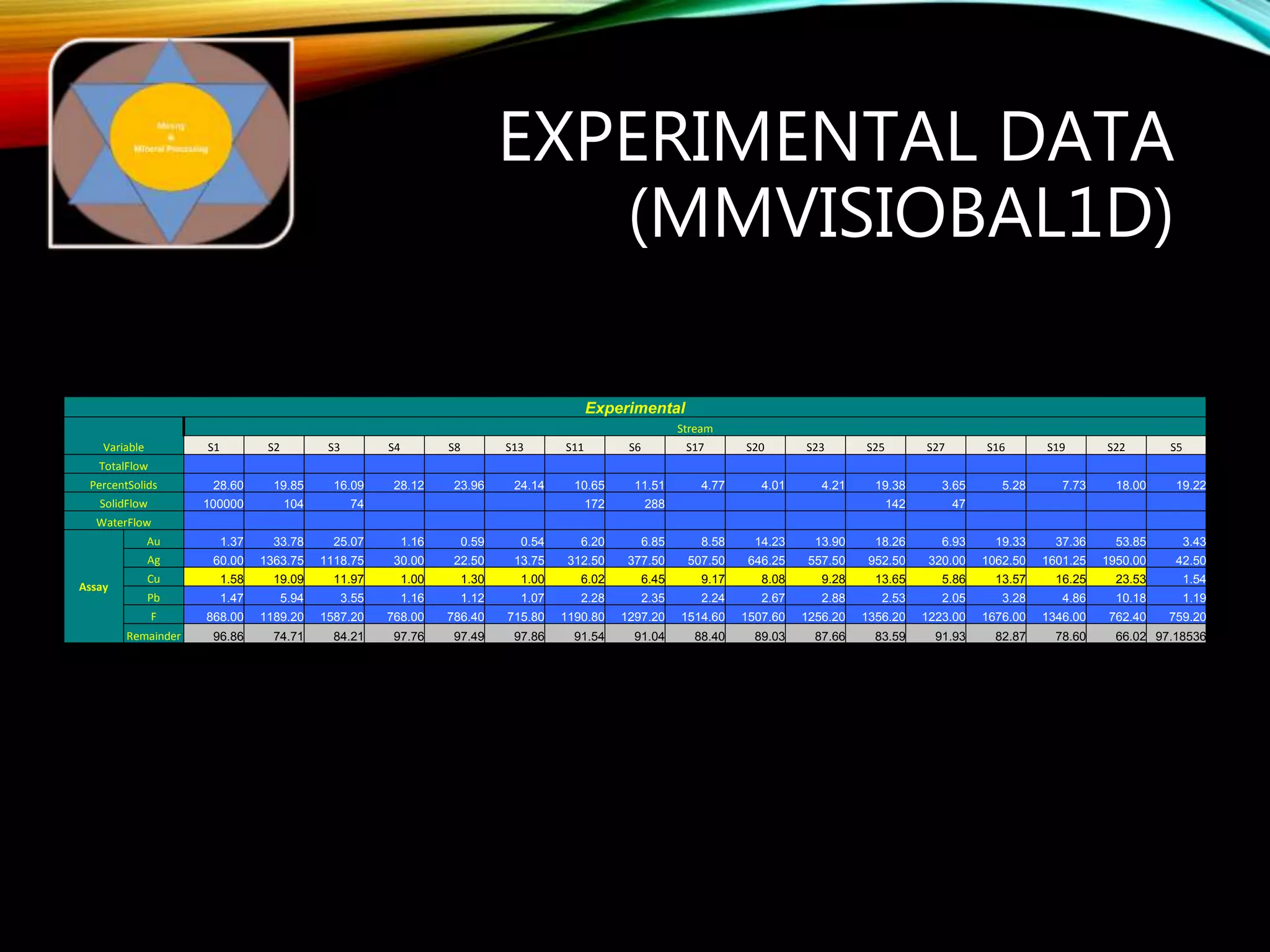
EXPERIMENTAL DATA
(MMVISIOBAL1D)
Experimental
Variable
Stream
S1 S2 S3 S4 S8 S13 S11 S6 S17 S20 S23 S25 S27 S16 S19 S22 S5
TotalFlow
PercentSolids 28.60 19.85 16.09 28.12 23.96 24.14 10.65 11.51 4.77 4.01 4.21 19.38 3.65 5.28 7.73 18.00 19.22
SolidFlow 100000 104 74 172 288 142 47
WaterFlow
Assay
Au 1.37 33.78 25.07 1.16 0.59 0.54 6.20 6.85 8.58 14.23 13.90 18.26 6.93 19.33 37.36 53.85 3.43
Ag 60.00 1363.75 1118.75 30.00 22.50 13.75 312.50 377.50 507.50 646.25 557.50 952.50 320.00 1062.50 1601.25 1950.00 42.50
Cu 1.58 19.09 11.97 1.00 1.30 1.00 6.02 6.45 9.17 8.08 9.28 13.65 5.86 13.57 16.25 23.53 1.54
Pb 1.47 5.94 3.55 1.16 1.12 1.07 2.28 2.35 2.24 2.67 2.88 2.53 2.05 3.28 4.86 10.18 1.19
F 868.00 1189.20 1587.20 768.00 786.40 715.80 1190.80 1297.20 1514.60 1507.60 1256.20 1356.20 1223.00 1676.00 1346.00 762.40 759.20
Remainder 96.86 74.71 84.21 97.76 97.49 97.86 91.54 91.04 88.40 89.03 87.66 83.59 91.93 82.87 78.60 66.02 97.18536
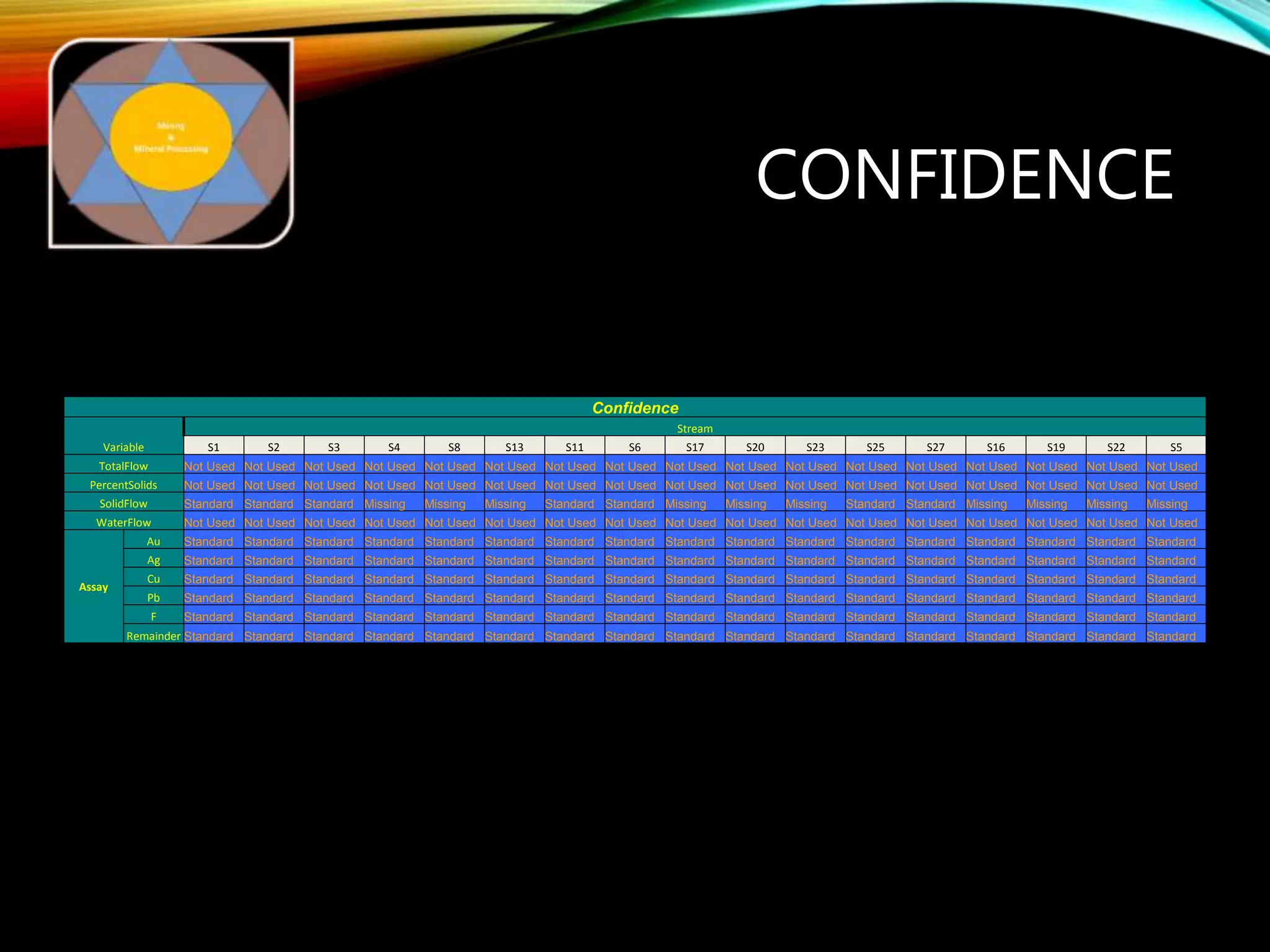
CONFIDENCE
Confidence
Variable
Stream
S1 S2 S3 S4 S8 S13 S11 S6 S17 S20 S23 S25 S27 S16 S19 S22 S5
TotalFlow Not Used Not Used Not Used Not Used Not Used Not Used Not Used Not Used Not Used Not Used Not Used Not Used Not Used Not Used Not Used Not Used Not Used
PercentSolids Not Used Not Used Not Used Not Used Not Used Not Used Not Used Not Used Not Used Not Used Not Used Not Used Not Used Not Used Not Used Not Used Not Used
SolidFlow Standard Standard Standard Missing Missing Missing Standard Standard Missing Missing Missing Standard Standard Missing Missing Missing Missing
WaterFlow Not Used Not Used Not Used Not Used Not Used Not Used Not Used Not Used Not Used Not Used Not Used Not Used Not Used Not Used Not Used Not Used Not Used
Assay
Au Standard Standard Standard Standard Standard Standard Standard Standard Standard Standard Standard Standard Standard Standard Standard Standard Standard
Ag Standard Standard Standard Standard Standard Standard Standard Standard Standard Standard Standard Standard Standard Standard Standard Standard Standard
Cu Standard Standard Standard Standard Standard Standard Standard Standard Standard Standard Standard Standard Standard Standard Standard Standard Standard
Pb Standard Standard Standard Standard Standard Standard Standard Standard Standard Standard Standard Standard Standard Standard Standard Standard Standard
F Standard Standard Standard Standard Standard Standard Standard Standard Standard Standard Standard Standard Standard Standard Standard Standard Standard
Remainder Standard Standard Standard Standard Standard Standard Standard Standard Standard Standard Standard Standard Standard Standard Standard Standard Standard
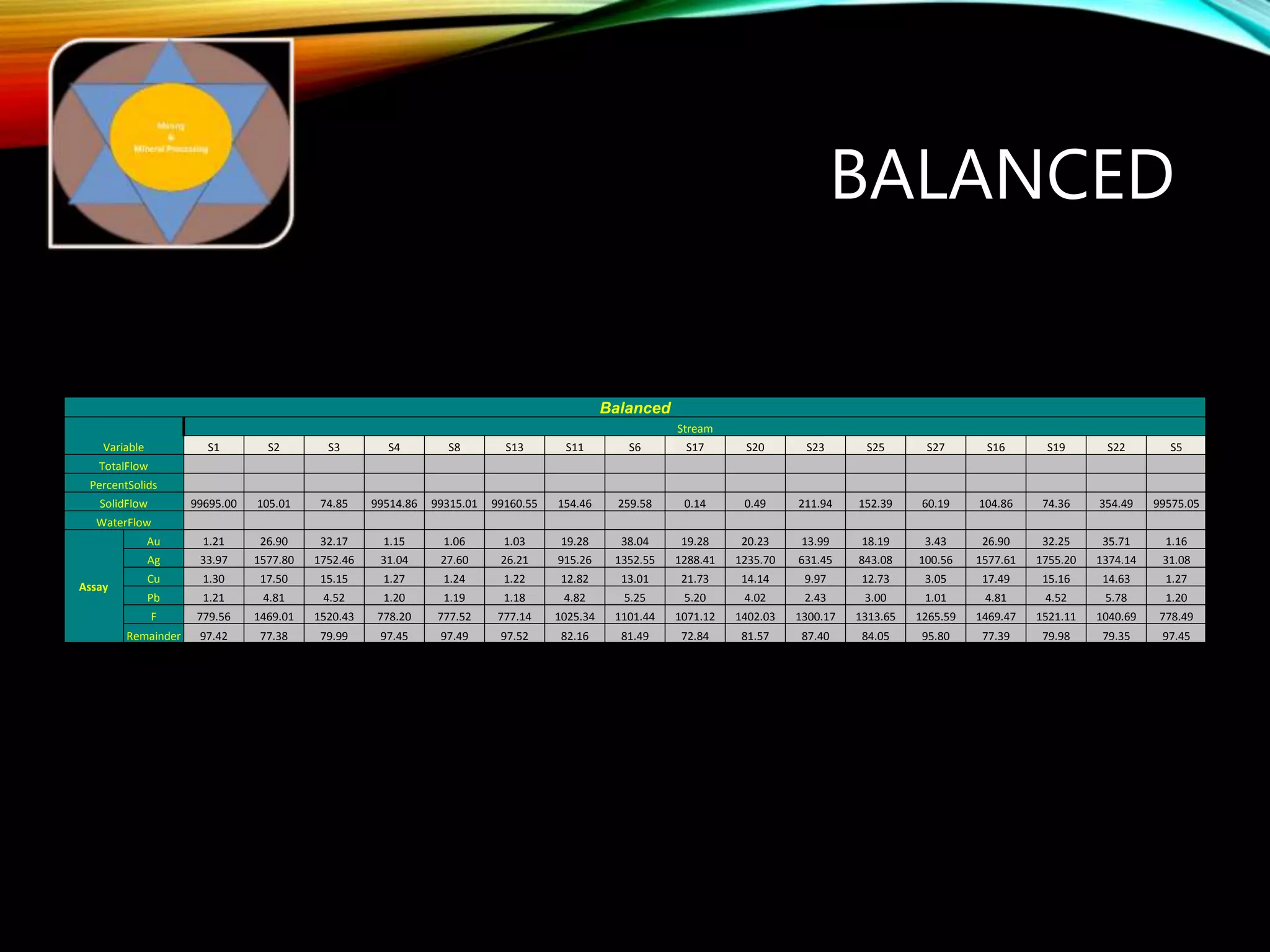
BALANCED
Balanced
Variable
Stream
S1 S2 S3 S4 S8 S13 S11 S6 S17 S20 S23 S25 S27 S16 S19 S22 S5
TotalFlow
PercentSolids
SolidFlow 99695.00 105.01 74.85 99514.86 99315.01 99160.55 154.46 259.58 0.14 0.49 211.94 152.39 60.19 104.86 74.36 354.49 99575.05
WaterFlow
Assay
Au 1.21 26.90 32.17 1.15 1.06 1.03 19.28 38.04 19.28 20.23 13.99 18.19 3.43 26.90 32.25 35.71 1.16
Ag 33.97 1577.80 1752.46 31.04 27.60 26.21 915.26 1352.55 1288.41 1235.70 631.45 843.08 100.56 1577.61 1755.20 1374.14 31.08
Cu 1.30 17.50 15.15 1.27 1.24 1.22 12.82 13.01 21.73 14.14 9.97 12.73 3.05 17.49 15.16 14.63 1.27
Pb 1.21 4.81 4.52 1.20 1.19 1.18 4.82 5.25 5.20 4.02 2.43 3.00 1.01 4.81 4.52 5.78 1.20
F 779.56 1469.01 1520.43 778.20 777.52 777.14 1025.34 1101.44 1071.12 1402.03 1300.17 1313.65 1265.59 1469.47 1521.11 1040.69 778.49
Remainder 97.42 77.38 79.99 97.45 97.49 97.52 82.16 81.49 72.84 81.57 87.40 84.05 95.80 77.39 79.98 79.35 97.45
MMVISIOBAL3D
• Only used by sophisticated Mining Companies that are
focused on technically-enable profit strategies
Example:
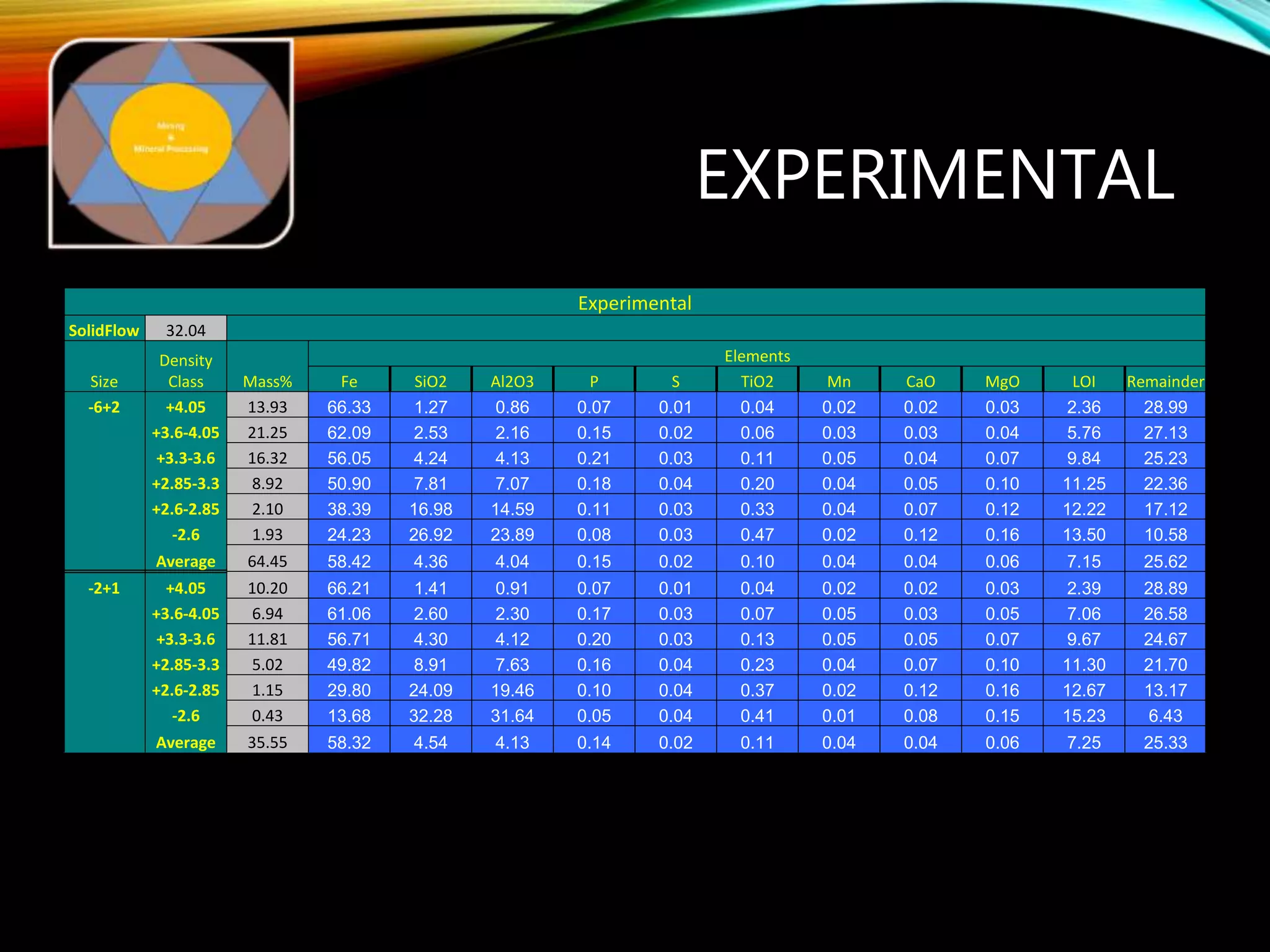
EXPERIMENTAL
Experimental
SolidFlow 32.04
Size
Density
Class Mass%
Elements
Fe SiO2 Al2O3 P S TiO2 Mn CaO MgO LOI Remainder
-6+2 +4.05 13.93 66.33 1.27 0.86 0.07 0.01 0.04 0.02 0.02 0.03 2.36 28.99
+3.6-4.05 21.25 62.09 2.53 2.16 0.15 0.02 0.06 0.03 0.03 0.04 5.76 27.13
+3.3-3.6 16.32 56.05 4.24 4.13 0.21 0.03 0.11 0.05 0.04 0.07 9.84 25.23
+2.85-3.3 8.92 50.90 7.81 7.07 0.18 0.04 0.20 0.04 0.05 0.10 11.25 22.36
+2.6-2.85 2.10 38.39 16.98 14.59 0.11 0.03 0.33 0.04 0.07 0.12 12.22 17.12
-2.6 1.93 24.23 26.92 23.89 0.08 0.03 0.47 0.02 0.12 0.16 13.50 10.58
Average 64.45 58.42 4.36 4.04 0.15 0.02 0.10 0.04 0.04 0.06 7.15 25.62
-2+1 +4.05 10.20 66.21 1.41 0.91 0.07 0.01 0.04 0.02 0.02 0.03 2.39 28.89
+3.6-4.05 6.94 61.06 2.60 2.30 0.17 0.03 0.07 0.05 0.03 0.05 7.06 26.58
+3.3-3.6 11.81 56.71 4.30 4.12 0.20 0.03 0.13 0.05 0.05 0.07 9.67 24.67
+2.85-3.3 5.02 49.82 8.91 7.63 0.16 0.04 0.23 0.04 0.07 0.10 11.30 21.70
+2.6-2.85 1.15 29.80 24.09 19.46 0.10 0.04 0.37 0.02 0.12 0.16 12.67 13.17
-2.6 0.43 13.68 32.28 31.64 0.05 0.04 0.41 0.01 0.08 0.15 15.23 6.43
Average 35.55 58.32 4.54 4.13 0.14 0.02 0.11 0.04 0.04 0.06 7.25 25.33
BALANCED
Balanced
SolidFlow
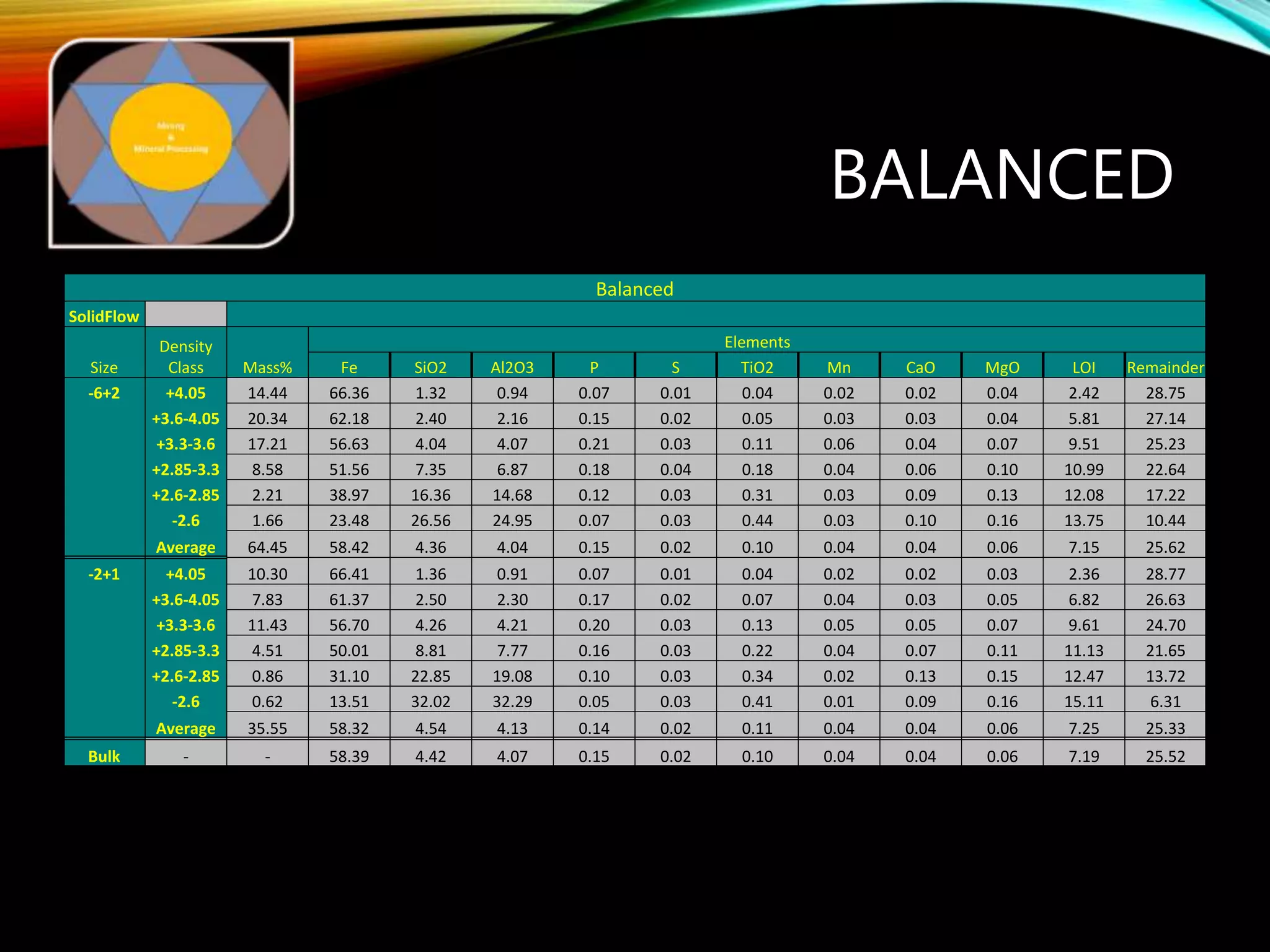
Size
Density
Class Mass%
Elements
Fe SiO2 Al2O3 P S TiO2 Mn CaO MgO LOI Remainder
-6+2 +4.05 14.44 66.36 1.32 0.94 0.07 0.01 0.04 0.02 0.02 0.04 2.42 28.75
+3.6-4.05 20.34 62.18 2.40 2.16 0.15 0.02 0.05 0.03 0.03 0.04 5.81 27.14
+3.3-3.6 17.21 56.63 4.04 4.07 0.21 0.03 0.11 0.06 0.04 0.07 9.51 25.23
+2.85-3.3 8.58 51.56 7.35 6.87 0.18 0.04 0.18 0.04 0.06 0.10 10.99 22.64
+2.6-2.85 2.21 38.97 16.36 14.68 0.12 0.03 0.31 0.03 0.09 0.13 12.08 17.22
-2.6 1.66 23.48 26.56 24.95 0.07 0.03 0.44 0.03 0.10 0.16 13.75 10.44
Average 64.45 58.42 4.36 4.04 0.15 0.02 0.10 0.04 0.04 0.06 7.15 25.62
-2+1 +4.05 10.30 66.41 1.36 0.91 0.07 0.01 0.04 0.02 0.02 0.03 2.36 28.77
+3.6-4.05 7.83 61.37 2.50 2.30 0.17 0.02 0.07 0.04 0.03 0.05 6.82 26.63
+3.3-3.6 11.43 56.70 4.26 4.21 0.20 0.03 0.13 0.05 0.05 0.07 9.61 24.70
+2.85-3.3 4.51 50.01 8.81 7.77 0.16 0.03 0.22 0.04 0.07 0.11 11.13 21.65
+2.6-2.85 0.86 31.10 22.85 19.08 0.10 0.03 0.34 0.02 0.13 0.15 12.47 13.72
-2.6 0.62 13.51 32.02 32.29 0.05 0.03 0.41 0.01 0.09 0.16 15.11 6.31
Average 35.55 58.32 4.54 4.13 0.14 0.02 0.11 0.04 0.04 0.06 7.25 25.33
Bulk - - 58.39 4.42 4.07 0.15 0.02 0.10 0.04 0.04 0.06 7.19 25.52
INTEGRATED SOFTWARE
• All software, including simulation are integrated into a
system called MMPlantMonitor.
• A course (Advanced Simulation) is available. Next scheduled
course in South Africa in November via MEI (Flotation 15)
• Stephen Gay Stephen@MIDASTech.net
MIDASTech International

Mass balancing techniques The Midas approach

  • 1.
    MASS BALANCING – MIDASAPPROACH Metallurgical Accounting Course, South Africa 2015 MIDASTech International
  • 2.
    THE ADVANTAGES OF DETAILEDMASS BALANCE • Units process particles • So understanding the complex response of particles to units processes facilitates the basis of accurate simulation; rather than fictional simulation which is all too common. • Metallurgical accounting focuses on assays, and is therefore a 1D Balance and inappropriate for simulation or understanding metallurgical processing of the ore
  • 3.
    MASS BALANCING LEVELS •0D Balance – Solid flows and Water flows • 1D Balance - Size, OR bulk assays, OR elements OR density classes OR Minerals • 2D Balance i.e. Size/assay • 3D Balance Size, Particle Types (i.e. density class), Properties of particle types (i.e. multimineral composition) MIDASTech International
  • 4.
  • 5.
    THE VARIOUS LEVELSOF MASS BALANCING • The diagram shows the general structure of ore information. Measurement of information and structure are not the same. • A poorly constructed simulator will be based on measurable information only rather than the actual ore structure. • An intelligent simulator will use the measured information to identify the actual ore properties.
  • 6.
    LEVELS OF MASS BALANCINGCONTINUED • Hence it is not necessarily required to obtain the detail information (3D); only to infer it from the 2D information. Hence there is a hierarchical approach to mass balancing. Generally 1D first to ensure solid flows are estimated; then 2D to ensure general mass balance consistency. • The 2D information can actually be used to infer the 3D, which is also mass balanced, but not necessarily based on 3D measurement. On the other hand a user can directly measure 3D data via float-sink tests – and then elemental composition in each density class, or mineralogical analysis. • However the fundamental object remains – to identify the flow of particles through the circuit
  • 7.
  • 8.
    MULTIMINERAL PARTICLES • Thefigure shows a multimineral particle. • It is self-evident from examining ore particles that they are indeed multimineral. • The important concept is that one would think that if we were to model multimineral particles in mineral processing we would need billions of particles. But we don’t! • We are only seeking a representative set of multimineral particles, say 200 per size-class which can easily be handled by simple calculation software such as Excel.
  • 9.
  • 10.
    BASED ON AFLOAT CELL • Particles goes into a flotation cell, and based on their composition will have a probability of going to the concentrate. • Hence high grade floatable particles will be more likely to go the concentrate than low grade non-floatable minerals.
  • 11.
    PARTITION CURVES FOR UNDERSTANDINGEFFICIENCY Mineral Composition Probability of particle going to concentrate Inefficient Efficient
  • 12.
    FROM THE PREVIOUS DIAGRAM •So if we know the information about particle distributions before and after a flotation cell, we can plot the ‘partition curve’ – the probability a particle of a particular grade will go to the concentrate. • It is not enough to know assays before and after a float cell, as it can be affected by the distribution of mineral in the particles. Hence the partition curve helps us to distinguish units that are performing efficiently from those that are performing inefficiently.
  • 13.
    COMPOSITION OF AMINERAL IS INSUFFICIENT TO DEVELOP A MODEL Two particles both with the same composition of valuable mineral (say chalcopyrite). In a simple model they would be presumed to have the same properties
  • 14.
    LOOKING AT MINERAL PARTICLES… •But looking at the mineral composition of just one mineral is not good enough! • Here we see two particles – both have the same grade of valuable mineral interest. All other minerals are combined to form the respective ‘gangue’ mineral. An inexperienced metallurgist would think that the two particles have the same properties and therefore should float the same. • But if you think a little bit deeper, you might want to think about the ‘gangue’ phase
  • 15.
    LOOK A BITDEEPER The gangue mineral may be different i.e. quartz for particle 1 and pyrite for particle 2. The belief the two particles will have the same properties (particularly in flotation) is at best a work of fiction. Clearly we need to recognise the existence of multiminerals
  • 16.
    FAILURE TO RECOGNISETHE EXISTENCE OF MULTIPLE MINERALS • Impractical models • Fictional models • Inordinate amount of laboratory analysis • Lack of trust in simulation • Invalid assay to mineral algorithms • General confusion
  • 17.
    BENEFITS OF DETAILED MODELLING •One can identify whether units are performing efficiently for a given ore type • Essential for plant trouble shooting • Essential for plant simulation • Essential for identifying how operational changes affect final grades and recoveries • Use of multiple mineral particles is essential for accuracy of models – particularly separation of associated minerals such as pyrite, chalcopyrite
  • 18.
    THE SOLUTION! • Recognisethe existence of multiminerals (where they exist) • Use software that incorporates modern mathematical methods to deal with the real datastructure (Advanced simulation course, inclusive of advanced mass balancing methods) • Such methods are only available through MIDASTech
  • 19.
    QUANTITATIVE ADVANTAGES • The MIDASapproach (Mass balancing together with simulation ) would target 5% operational improvement • Leading to millions of dollars of savings per plant.
  • 20.
    MIDAS TECH’S SETOF MASS BALANCE SYSTEMS • 1. MMVisioBal1D – 1D Mass Balance system, • 2. MMVisioBal2D – 2D Mass Balance system, • 3. MMVisioBal3D – 3D Mass Balance system • 4. MMVisioBal2DPlus - inferring detailed 3D information from 2D data (patented approach)
  • 21.
    MASS BALANCING METHODS Two mainapproaches of mass balancing • Conventional: Least squares – requires variances of estimates; and is therefore a flawed approach if variances are not known • Modern: Information theory – appropriate when variances are known; and can also be used when variances are known. Fast, efficient and allows inference (MMVisioBalPlus)
  • 22.
    MMVISIOBAL1D • Entry pointsoftware (contact Stephen@MIDASTech.net) • Uses Visio flowsheet system and Excel interface. System largely automated. Once an Excel template is created and data are inputted – press of a button yields mass balance results
  • 23.
    VISIO FLOWSHEET Balanced Variable Stream S1 S2S3 S4 S8 S13 S11 S6 S17 S20 S23 S25 S27 S16 S19 S22 S5 TotalFlow PercentSolids SolidFlow 99695.00 105.01 74.85 99514.86 99315.01 99160.55 154.46 259.58 0.14 0.49 211.94 152.39 60.19 104.86 74.36 354.49 99575.05 WaterFlow Assay Au 1.21 26.90 32.17 1.15 1.06 1.03 19.28 38.04 19.28 20.23 13.99 18.19 3.43 26.90 32.25 35.71 1.16 Ag 33.97 1577.80 1752.46 31.04 27.60 26.21 915.26 1352.55 1288.41 1235.70 631.45 843.08 100.56 1577.61 1755.20 1374.14 31.08 Cu 1.30 17.50 15.15 1.27 1.24 1.22 12.82 13.01 21.73 14.14 9.97 12.73 3.05 17.49 15.16 14.63 1.27 Pb 1.21 4.81 4.52 1.20 1.19 1.18 4.82 5.25 5.20 4.02 2.43 3.00 1.01 4.81 4.52 5.78 1.20 F 779.56 1469.01 1520.43 778.20 777.52 777.14 1025.34 1101.44 1071.12 1402.03 1300.17 1313.65 1265.59 1469.47 1521.11 1040.69 778.49 Remainder 97.42 77.38 79.99 97.45 97.49 97.52 82.16 81.49 72.84 81.57 87.40 84.05 95.80 77.39 79.98 79.35 97.45
  • 24.
    SIMPLE EXCEL INTERFACE FalseSpecification Project Name MMMichaud False SubProjectID 1 False False False False 9. Options Full 2D Full 2D Water Balance FALSE Start Experimental
  • 25.
    EXPERIMENTAL DATA (MMVISIOBAL1D) Experimental Variable Stream S1 S2S3 S4 S8 S13 S11 S6 S17 S20 S23 S25 S27 S16 S19 S22 S5 TotalFlow PercentSolids 28.60 19.85 16.09 28.12 23.96 24.14 10.65 11.51 4.77 4.01 4.21 19.38 3.65 5.28 7.73 18.00 19.22 SolidFlow 100000 104 74 172 288 142 47 WaterFlow Assay Au 1.37 33.78 25.07 1.16 0.59 0.54 6.20 6.85 8.58 14.23 13.90 18.26 6.93 19.33 37.36 53.85 3.43 Ag 60.00 1363.75 1118.75 30.00 22.50 13.75 312.50 377.50 507.50 646.25 557.50 952.50 320.00 1062.50 1601.25 1950.00 42.50 Cu 1.58 19.09 11.97 1.00 1.30 1.00 6.02 6.45 9.17 8.08 9.28 13.65 5.86 13.57 16.25 23.53 1.54 Pb 1.47 5.94 3.55 1.16 1.12 1.07 2.28 2.35 2.24 2.67 2.88 2.53 2.05 3.28 4.86 10.18 1.19 F 868.00 1189.20 1587.20 768.00 786.40 715.80 1190.80 1297.20 1514.60 1507.60 1256.20 1356.20 1223.00 1676.00 1346.00 762.40 759.20 Remainder 96.86 74.71 84.21 97.76 97.49 97.86 91.54 91.04 88.40 89.03 87.66 83.59 91.93 82.87 78.60 66.02 97.18536
  • 26.
    CONFIDENCE Confidence Variable Stream S1 S2 S3S4 S8 S13 S11 S6 S17 S20 S23 S25 S27 S16 S19 S22 S5 TotalFlow Not Used Not Used Not Used Not Used Not Used Not Used Not Used Not Used Not Used Not Used Not Used Not Used Not Used Not Used Not Used Not Used Not Used PercentSolids Not Used Not Used Not Used Not Used Not Used Not Used Not Used Not Used Not Used Not Used Not Used Not Used Not Used Not Used Not Used Not Used Not Used SolidFlow Standard Standard Standard Missing Missing Missing Standard Standard Missing Missing Missing Standard Standard Missing Missing Missing Missing WaterFlow Not Used Not Used Not Used Not Used Not Used Not Used Not Used Not Used Not Used Not Used Not Used Not Used Not Used Not Used Not Used Not Used Not Used Assay Au Standard Standard Standard Standard Standard Standard Standard Standard Standard Standard Standard Standard Standard Standard Standard Standard Standard Ag Standard Standard Standard Standard Standard Standard Standard Standard Standard Standard Standard Standard Standard Standard Standard Standard Standard Cu Standard Standard Standard Standard Standard Standard Standard Standard Standard Standard Standard Standard Standard Standard Standard Standard Standard Pb Standard Standard Standard Standard Standard Standard Standard Standard Standard Standard Standard Standard Standard Standard Standard Standard Standard F Standard Standard Standard Standard Standard Standard Standard Standard Standard Standard Standard Standard Standard Standard Standard Standard Standard Remainder Standard Standard Standard Standard Standard Standard Standard Standard Standard Standard Standard Standard Standard Standard Standard Standard Standard
  • 27.
    BALANCED Balanced Variable Stream S1 S2 S3S4 S8 S13 S11 S6 S17 S20 S23 S25 S27 S16 S19 S22 S5 TotalFlow PercentSolids SolidFlow 99695.00 105.01 74.85 99514.86 99315.01 99160.55 154.46 259.58 0.14 0.49 211.94 152.39 60.19 104.86 74.36 354.49 99575.05 WaterFlow Assay Au 1.21 26.90 32.17 1.15 1.06 1.03 19.28 38.04 19.28 20.23 13.99 18.19 3.43 26.90 32.25 35.71 1.16 Ag 33.97 1577.80 1752.46 31.04 27.60 26.21 915.26 1352.55 1288.41 1235.70 631.45 843.08 100.56 1577.61 1755.20 1374.14 31.08 Cu 1.30 17.50 15.15 1.27 1.24 1.22 12.82 13.01 21.73 14.14 9.97 12.73 3.05 17.49 15.16 14.63 1.27 Pb 1.21 4.81 4.52 1.20 1.19 1.18 4.82 5.25 5.20 4.02 2.43 3.00 1.01 4.81 4.52 5.78 1.20 F 779.56 1469.01 1520.43 778.20 777.52 777.14 1025.34 1101.44 1071.12 1402.03 1300.17 1313.65 1265.59 1469.47 1521.11 1040.69 778.49 Remainder 97.42 77.38 79.99 97.45 97.49 97.52 82.16 81.49 72.84 81.57 87.40 84.05 95.80 77.39 79.98 79.35 97.45
  • 28.
    MMVISIOBAL3D • Only usedby sophisticated Mining Companies that are focused on technically-enable profit strategies Example:
  • 29.
    EXPERIMENTAL Experimental SolidFlow 32.04 Size Density Class Mass% Elements FeSiO2 Al2O3 P S TiO2 Mn CaO MgO LOI Remainder -6+2 +4.05 13.93 66.33 1.27 0.86 0.07 0.01 0.04 0.02 0.02 0.03 2.36 28.99 +3.6-4.05 21.25 62.09 2.53 2.16 0.15 0.02 0.06 0.03 0.03 0.04 5.76 27.13 +3.3-3.6 16.32 56.05 4.24 4.13 0.21 0.03 0.11 0.05 0.04 0.07 9.84 25.23 +2.85-3.3 8.92 50.90 7.81 7.07 0.18 0.04 0.20 0.04 0.05 0.10 11.25 22.36 +2.6-2.85 2.10 38.39 16.98 14.59 0.11 0.03 0.33 0.04 0.07 0.12 12.22 17.12 -2.6 1.93 24.23 26.92 23.89 0.08 0.03 0.47 0.02 0.12 0.16 13.50 10.58 Average 64.45 58.42 4.36 4.04 0.15 0.02 0.10 0.04 0.04 0.06 7.15 25.62 -2+1 +4.05 10.20 66.21 1.41 0.91 0.07 0.01 0.04 0.02 0.02 0.03 2.39 28.89 +3.6-4.05 6.94 61.06 2.60 2.30 0.17 0.03 0.07 0.05 0.03 0.05 7.06 26.58 +3.3-3.6 11.81 56.71 4.30 4.12 0.20 0.03 0.13 0.05 0.05 0.07 9.67 24.67 +2.85-3.3 5.02 49.82 8.91 7.63 0.16 0.04 0.23 0.04 0.07 0.10 11.30 21.70 +2.6-2.85 1.15 29.80 24.09 19.46 0.10 0.04 0.37 0.02 0.12 0.16 12.67 13.17 -2.6 0.43 13.68 32.28 31.64 0.05 0.04 0.41 0.01 0.08 0.15 15.23 6.43 Average 35.55 58.32 4.54 4.13 0.14 0.02 0.11 0.04 0.04 0.06 7.25 25.33
  • 30.
    BALANCED Balanced SolidFlow Size Density Class Mass% Elements Fe SiO2Al2O3 P S TiO2 Mn CaO MgO LOI Remainder -6+2 +4.05 14.44 66.36 1.32 0.94 0.07 0.01 0.04 0.02 0.02 0.04 2.42 28.75 +3.6-4.05 20.34 62.18 2.40 2.16 0.15 0.02 0.05 0.03 0.03 0.04 5.81 27.14 +3.3-3.6 17.21 56.63 4.04 4.07 0.21 0.03 0.11 0.06 0.04 0.07 9.51 25.23 +2.85-3.3 8.58 51.56 7.35 6.87 0.18 0.04 0.18 0.04 0.06 0.10 10.99 22.64 +2.6-2.85 2.21 38.97 16.36 14.68 0.12 0.03 0.31 0.03 0.09 0.13 12.08 17.22 -2.6 1.66 23.48 26.56 24.95 0.07 0.03 0.44 0.03 0.10 0.16 13.75 10.44 Average 64.45 58.42 4.36 4.04 0.15 0.02 0.10 0.04 0.04 0.06 7.15 25.62 -2+1 +4.05 10.30 66.41 1.36 0.91 0.07 0.01 0.04 0.02 0.02 0.03 2.36 28.77 +3.6-4.05 7.83 61.37 2.50 2.30 0.17 0.02 0.07 0.04 0.03 0.05 6.82 26.63 +3.3-3.6 11.43 56.70 4.26 4.21 0.20 0.03 0.13 0.05 0.05 0.07 9.61 24.70 +2.85-3.3 4.51 50.01 8.81 7.77 0.16 0.03 0.22 0.04 0.07 0.11 11.13 21.65 +2.6-2.85 0.86 31.10 22.85 19.08 0.10 0.03 0.34 0.02 0.13 0.15 12.47 13.72 -2.6 0.62 13.51 32.02 32.29 0.05 0.03 0.41 0.01 0.09 0.16 15.11 6.31 Average 35.55 58.32 4.54 4.13 0.14 0.02 0.11 0.04 0.04 0.06 7.25 25.33 Bulk - - 58.39 4.42 4.07 0.15 0.02 0.10 0.04 0.04 0.06 7.19 25.52
  • 31.
    INTEGRATED SOFTWARE • Allsoftware, including simulation are integrated into a system called MMPlantMonitor. • A course (Advanced Simulation) is available. Next scheduled course in South Africa in November via MEI (Flotation 15) • Stephen Gay Stephen@MIDASTech.net MIDASTech International

Editor's Notes

  • #5 The diagram shows the general structure of ore information. Measurement of information and structure are not the same. A poorly constructed simulator will be based on measurable information only rather than the actual ore structure. An intelligent simulator will use the measured information to identify the actual ore properties. Hence it is not necessarily required to obtain the detail information (3D); only to infer it from the 2D information. Hence there is a hierarchical approach to mass balancing. Generally 1D first to ensure solid flows are estimated; then 2D to ensure general mass balance consistency. The 2D information can actually be used to infer the 3D, which is also mass balanced, but not necessarily based on 3D measurement. On the other hand a user can directly measure 3D data via float-sink tests – and then elemental composition in each density class, or mineralogical analysis. However the fundamental object remains – to identify the flow of particles through the circuit
  • #8 The figure shows a multimineral particle. It is self-evident from examining ore particles that they are indeed multimineral. The important concept is that one would think that if we were to model multimineral particles in mineral processing we would need billions of particles. But we don’t! We are only seeking a representative set of multimineral particles, say 200 per size-class which can easily be handled by simple calculation software such as Excel.
  • #10 Particles goes into a flotation cell, and based on their composition will have a probability of going to the concentrate. Hence high grade floatable particles will be more likely to go the concentrate than low grade non-floatable minerals.
  • #12 So if we know the information about particle distributions before and after a flotation cell, we can plot the ‘partition curve’ – the probability a particle of a particular grade will go to the concentrate. It is not enough to know assays before and after a float cell, as it can be affected by the distribution of mineral in the particles. Hence the partition curve helps us to distinguish units that are performing efficiently from those that are performing inefficiently.
  • #14 But looking at the mineral composition of just one mineral is not good enough! Here we see two particles – both have the same grade of valuable mineral interest. All other minerals are combined to form the respective ‘gangue’ mineral. An inexperienced metallurgist would think that the two particles have the same properties and therefore should float the same. But if you think a little bit deeper, you might want to think about the ‘gangue’ phase.
  • #16 The ‘gangue’ mineral may infact be totally different.