ELEMENTS OF CIVIL ENGINEERING
SAGAR DOBARIYA
Asst. professor
Civil Engineering Department
Om Engineering College, Junagadh
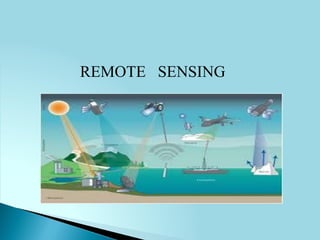
REMOTE SENSING
1.1 Introduction to Remote sensing
Remote sensing is the science and art of obtaining information
about an object , area or phenomena, thought the analysis of data
acquired by a device
 that is not in contact with the object, area or phenomena under
investigation.
Remote sensing is the acquiring of data about an object without
touching it.
Remote sensing is the non-contact recording of information from
the ultraviolet, visible, infrared and microwave regions of the
ectromagnetic spectrum by instrument such as camera , scanners,
lasers area located on platforms such as platforms on aircraft or
spacecraft.
Remote sensing is the acquiring of data about an object without
touching it.
Remote sensing includes aerial photography and satellite imagery.
This technology firs use in the united states in the 1960.
The first earth observation satellite was launched in 1972.
 now remote sensing has become widely used.
Today most natural resource mapping is done using remote
sensing.
It is used topographical maps like forest map, geological map,
soil map, land map etc. with help of aerial survey.
1.2 Principle to Remote sensing
Basic Principle to Remote sensing :
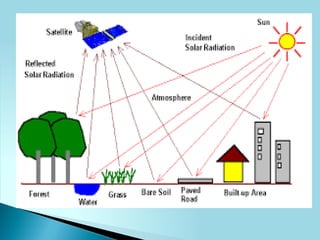
The sun and various artificial sources radiate electromagnetic
energy of variable wavelength.
All object on the surface of the earth have spectral signatures. A
spectral signature of an object or ground surface feature is a set of
value for the reflectance or radiance of the feature.
The electromagnetic energy interact with earth surface and various
feature like building, soil, grass, water, paved road, forest.
The response of ground surface material to incident radiation is the
reflectance and the energy emitted by all object as a function of
their temperature and structure is emittance.
The reflectance and emittance determine the signatures.
The knowledge of spectral signature is essential for exploiting the
potential of the remote sensing techniques. This knowledge
enables one to identify and classify objects.
When radiation is incident on a surface it is reflected, absorbed,
scattered and transmitted.
All the process are strongly dependent on the wavelength of the
incident radiation, as well as the atomic and molecular structure
of material.
1.3 Advantages of Remote sensing system
Main Advantages of Remote sensing system :
Satellite images are permanent records it providing useful
information in various wavelengths.
Large area coverage enables regional surveys on a variety of them
and identification of large features.
Respective coverage allows monitoring of dynamic them like water
agriculture etc.
Easy data identify at diff. scales and resolution.
A single remote sensor image can be analyses and interpreted for
diff. purpose and applications.
A remotely sensed data for fast processing using a computer.
It is using a natural source of energy.
The images are analysed in the laboratory thus reducing the
amount of field work.
Map revision at medium to small scales is economical and faster.
Floods over a large region or forest fire can be located from above
and rescue planning can be immediately arranged.
The data generated by remote sensing techniques can be used for
land use planning, forest development, geological surveys, urban
planning, disaster management etc.
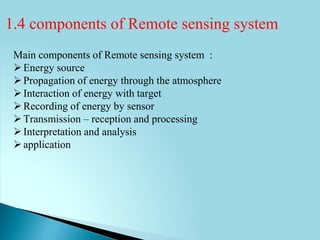
1.4 components of Remote sensing system
Main components of Remote sensing system :
Energy source
Propagation of energy through the atmosphere
Interaction of energy with target
Recording of energy by sensor
Transmission – reception and processing
Interpretation and analysis
application
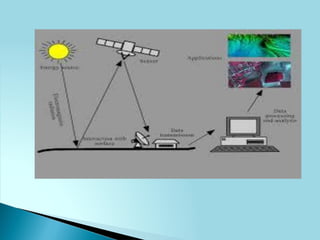
1.Energy source : the sun is the sources of energy is passive remote
sensing. The sun produces electromagnetic energy.
2. Propagation of energy through the atmosphere : the energy from
the sources propagates through the atmosphere. Modifies the
wavelength and spectral distribution of energy to some extent.
3. Interaction of energy with target : the energy received by the target
interact where it is either transmitted, absorbed, scattered, emitted or
reflected from the target
4. Recording of energy by sensor : the return signal is set to the
sensor which response to all wavelength. Sensor are mounted on
satellites.
5. Transmission – reception and processing : the energy recorded by
the sensor has to be transmitted. Often in electronic from to a
receiving and processing station on the ground where the data are
processed into an images. the data products are mainly two types
1. Photographic product
2. Digital product.
6. Interpretation and analysis : the processed image are interpreted,
visually or digitally or electronically to extract information about the
target of interest
7. Application : the information about the target obtained from the
remote sensing is made available to the users in the desired from.
1.5 energy interaction with object
 Remote sensing

Remote sensing

  • 1.
    ELEMENTS OF CIVILENGINEERING SAGAR DOBARIYA Asst. professor Civil Engineering Department Om Engineering College, Junagadh
  • 2.
  • 3.
    1.1 Introduction toRemote sensing Remote sensing is the science and art of obtaining information about an object , area or phenomena, thought the analysis of data acquired by a device  that is not in contact with the object, area or phenomena under investigation. Remote sensing is the acquiring of data about an object without touching it. Remote sensing is the non-contact recording of information from the ultraviolet, visible, infrared and microwave regions of the ectromagnetic spectrum by instrument such as camera , scanners, lasers area located on platforms such as platforms on aircraft or spacecraft.
  • 4.
    Remote sensing isthe acquiring of data about an object without touching it. Remote sensing includes aerial photography and satellite imagery. This technology firs use in the united states in the 1960. The first earth observation satellite was launched in 1972.  now remote sensing has become widely used. Today most natural resource mapping is done using remote sensing. It is used topographical maps like forest map, geological map, soil map, land map etc. with help of aerial survey.
  • 5.
    1.2 Principle toRemote sensing Basic Principle to Remote sensing : The sun and various artificial sources radiate electromagnetic energy of variable wavelength. All object on the surface of the earth have spectral signatures. A spectral signature of an object or ground surface feature is a set of value for the reflectance or radiance of the feature. The electromagnetic energy interact with earth surface and various feature like building, soil, grass, water, paved road, forest. The response of ground surface material to incident radiation is the reflectance and the energy emitted by all object as a function of their temperature and structure is emittance. The reflectance and emittance determine the signatures.
  • 6.
    The knowledge ofspectral signature is essential for exploiting the potential of the remote sensing techniques. This knowledge enables one to identify and classify objects. When radiation is incident on a surface it is reflected, absorbed, scattered and transmitted. All the process are strongly dependent on the wavelength of the incident radiation, as well as the atomic and molecular structure of material.
  • 8.
    1.3 Advantages ofRemote sensing system Main Advantages of Remote sensing system : Satellite images are permanent records it providing useful information in various wavelengths. Large area coverage enables regional surveys on a variety of them and identification of large features. Respective coverage allows monitoring of dynamic them like water agriculture etc. Easy data identify at diff. scales and resolution. A single remote sensor image can be analyses and interpreted for diff. purpose and applications. A remotely sensed data for fast processing using a computer. It is using a natural source of energy.
  • 9.
    The images areanalysed in the laboratory thus reducing the amount of field work. Map revision at medium to small scales is economical and faster. Floods over a large region or forest fire can be located from above and rescue planning can be immediately arranged. The data generated by remote sensing techniques can be used for land use planning, forest development, geological surveys, urban planning, disaster management etc.
  • 10.
    1.4 components ofRemote sensing system Main components of Remote sensing system : Energy source Propagation of energy through the atmosphere Interaction of energy with target Recording of energy by sensor Transmission – reception and processing Interpretation and analysis application
  • 11.
    1.Energy source :the sun is the sources of energy is passive remote sensing. The sun produces electromagnetic energy. 2. Propagation of energy through the atmosphere : the energy from the sources propagates through the atmosphere. Modifies the wavelength and spectral distribution of energy to some extent. 3. Interaction of energy with target : the energy received by the target interact where it is either transmitted, absorbed, scattered, emitted or reflected from the target 4. Recording of energy by sensor : the return signal is set to the sensor which response to all wavelength. Sensor are mounted on satellites.
  • 12.
    5. Transmission –reception and processing : the energy recorded by the sensor has to be transmitted. Often in electronic from to a receiving and processing station on the ground where the data are processed into an images. the data products are mainly two types 1. Photographic product 2. Digital product. 6. Interpretation and analysis : the processed image are interpreted, visually or digitally or electronically to extract information about the target of interest 7. Application : the information about the target obtained from the remote sensing is made available to the users in the desired from.
  • 14.