relinquishing control:
creating space for open innovation
         thomas.sutton@frogdesign.com
Design is the conscious
       and intuitive e ort to
       impose meaningful order
       - Victor Papanek


so how can it be open?
1. what is innovation?
2. open delivery
3. open experiences
4. open design
5. putting it back together
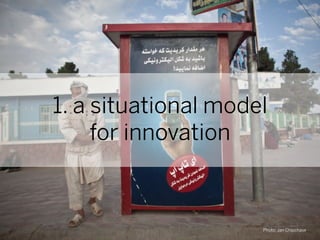
1. a situational model
     for innovation


                     Photo: Jan Chipchase
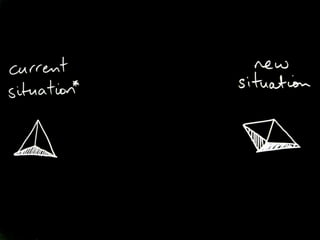
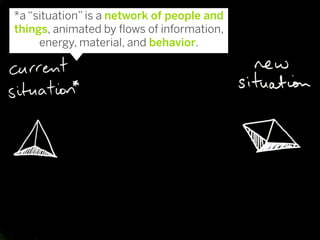
*a “situation” is a network of people and
things, animated by flows of information,
     energy, material, and behavior.
*a “situation” is a network of people and
things, animated by flows of information,
     energy, material, and behavior.


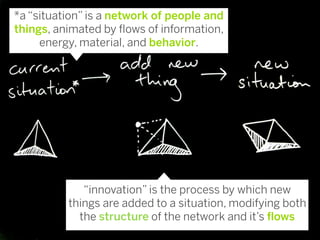
             “innovation” is the process by which new
          things are added to a situation, modifying both
            the structure of the network and it’s flows
2. open delivery:
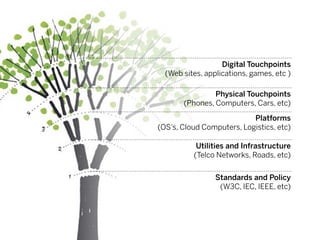
  the delivery tree


                      Carl Fredrik Hill [Public domain],
                         via Wikimedia Commons
Digital Touchpoints
  (Web sites, applications, games, etc )

                Physical Touchpoints
       (Phones, Computers, Cars, etc)

                           Platforms
(OS’s, Cloud Computers, Logistics, etc)

           Utilities and Infrastructure
          (Telco Networks, Roads, etc)


                 Standards and Policy
                  (W3C, IEC, IEEE, etc)
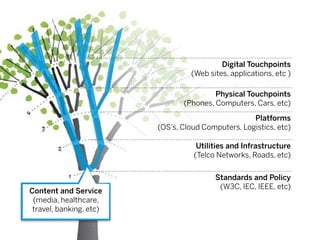
Digital Touchpoints
                                  (Web sites, applications, etc )

                                         Physical Touchpoints
                                (Phones, Computers, Cars, etc)

                                                    Platforms
                         (OS’s, Cloud Computers, Logistics, etc)

                                    Utilities and Infrastructure
                                   (Telco Networks, Roads, etc)


                                         Standards and Policy
                                          (W3C, IEC, IEEE, etc)
Content and Service
 (media, healthcare,
 travel, banking, etc)
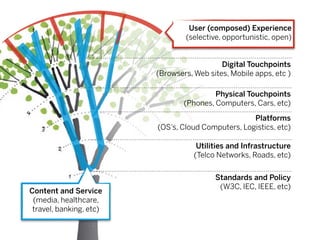
User (composed) Experience
                                 (selective, opportunistic, open)


                                            Digital Touchpoints
                         (Browsers, Web sites, Mobile apps, etc )

                                          Physical Touchpoints
                                 (Phones, Computers, Cars, etc)

                                                    Platforms
                         (OS’s, Cloud Computers, Logistics, etc)

                                     Utilities and Infrastructure
                                    (Telco Networks, Roads, etc)


                                          Standards and Policy
                                           (W3C, IEC, IEEE, etc)
Content and Service
 (media, healthcare,
 travel, banking, etc)
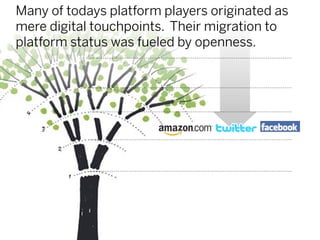
Many of todays platform players originated as
mere digital touchpoints. Their migration to
platform status was fueled by openness.
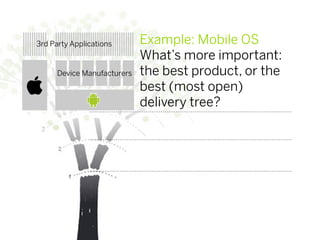
3rd Party Applications       Example: Mobile OS
                             What’s more important:
      Device Manufacturers   the best product, or the
                             best (most open)
                             delivery tree?
3. open experiences:
        multichannel ecosystems
kindly lent by Gianluca Brugnoli (http://twitter.com/lowresolution)
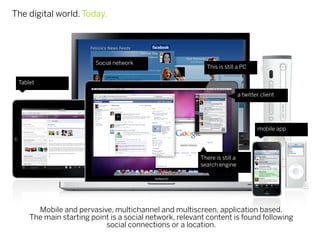
The digital world. Today.


                         Social network
                                                          This is still a PC

 Tablet

                                                                           a twitter client


                                                                                   mobile app


                                                        There is still a
                                                        search engine


       Mobile and pervasive, multichannel and multiscreen, application based.
     The main starting point is a social network, relevant content is found following
                           social connections or a location.
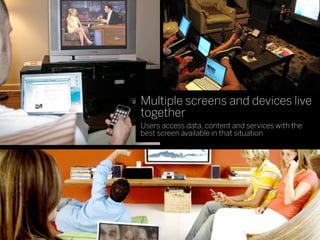
Multiple screens and devices live
together
Users access data, content and services with the
best screen available in that situation
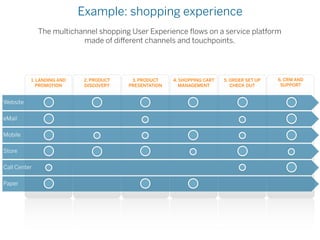
Example: shopping experience
              The multichannel shopping User Experience flows on a service platform
                          made of di erent channels and touchpoints.


          1. LANDING AND    2. PRODUCT    3. PRODUCT    4. SHOPPING CART   5. ORDER SET UP   6. CRM AND
             PROMOTION      DISCOVERY    PRESENTATION      MANAGEMENT         CHECK OUT       SUPPORT


Website

eMail

Mobile

Store

Call Center

Paper
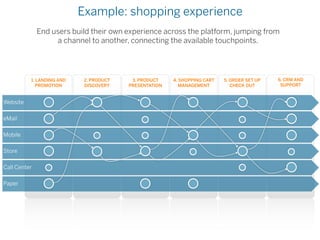
Example: shopping experience
              End users build their own experience across the platform, jumping from
                   a channel to another, connecting the available touchpoints.


          1. LANDING AND    2. PRODUCT    3. PRODUCT    4. SHOPPING CART   5. ORDER SET UP   6. CRM AND
             PROMOTION      DISCOVERY    PRESENTATION      MANAGEMENT         CHECK OUT       SUPPORT


Website

eMail

Mobile

Store

Call Center

Paper
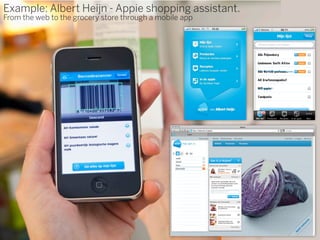
Example: Albert Heijn - Appie shopping assistant.
From the web to the grocery store through a mobile app
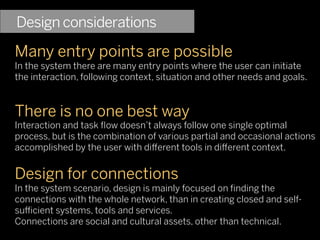
Design considerations
Many entry points are possible
In the system there are many entry points where the user can initiate
the interaction, following context, situation and other needs and goals.


There is no one best way
Interaction and task flow doesn’t always follow one single optimal
process, but is the combination of various partial and occasional actions
accomplished by the user with di erent tools in di erent context.


Design for connections
In the system scenario, design is mainly focused on finding the
connections with the whole network, than in creating closed and self-
su cient systems, tools and services.
Connections are social and cultural assets, other than technical.
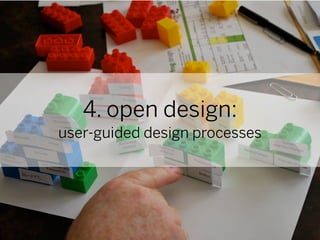
4. open design:
user-guided design processes
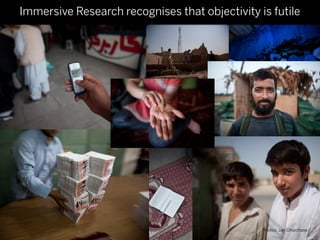
Immersive Research recognises that objectivity is futile


        user research slide


                                                                        3


                                                Photos: Jan Chipchase
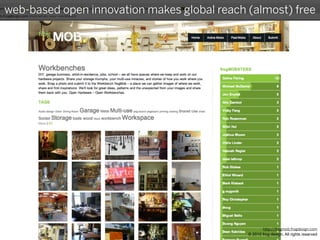
web-based open innovation makes global reach (almost) free


                                                     http://frogmob.frogdesign.com
                                             © 2010 frog design. All rights reserved
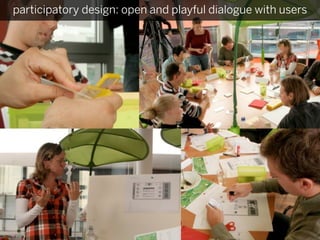
participatory design: open and playful dialogue with users
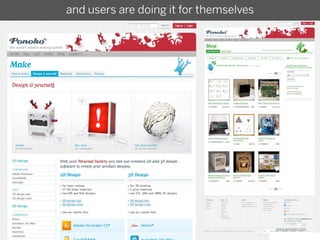
and users are doing it for themselves


                                        www.ponoko.com
5. putting it back together


                     photo: Einsamer Schütze CC BY-SA 3.0
Innovation
 Potential
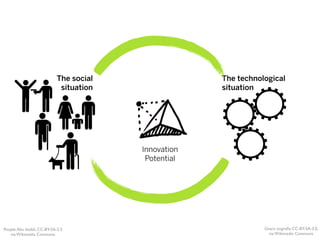
The social                The technological
                             situation                situation


                                         Innovation
                                          Potential


People: Abu badali, CC-BY-SA-2.5                                 Gears: eugrafia CC-BY-SA-3.0,
   via Wikimedia Commons                                           via Wikimedia Commons
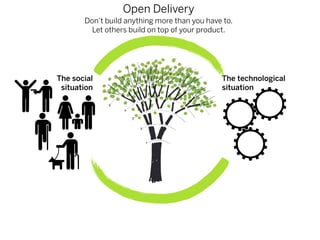
Open Delivery
       Don’t build anything more than you have to.
         Let others build on top of your product.


The social                                    The technological
 situation                                    situation
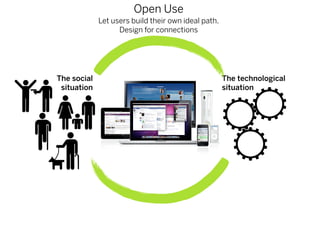
Open Use
             Let users build their own ideal path.
                   Design for connections


The social                                           The technological
 situation                                           situation
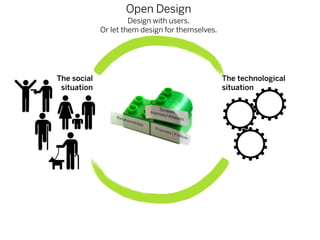
Open Design
                      Design with users.
             Or let them design for themselves.


The social                                        The technological
 situation                                        situation
Thanks / Merci
thomas.sutton@frogdesign.com

Relinquishing Control: Creating Space for Open Innovation

  • 1.
    relinquishing control: creating spacefor open innovation thomas.sutton@frogdesign.com
  • 2.
    Design is theconscious and intuitive e ort to impose meaningful order - Victor Papanek so how can it be open?
  • 3.
    1. what isinnovation? 2. open delivery 3. open experiences 4. open design 5. putting it back together
  • 4.
    1. a situationalmodel for innovation Photo: Jan Chipchase
  • 6.
    *a “situation” isa network of people and things, animated by flows of information, energy, material, and behavior.
  • 7.
    *a “situation” isa network of people and things, animated by flows of information, energy, material, and behavior. “innovation” is the process by which new things are added to a situation, modifying both the structure of the network and it’s flows
  • 8.
    2. open delivery: the delivery tree Carl Fredrik Hill [Public domain], via Wikimedia Commons
  • 9.
    Digital Touchpoints (Web sites, applications, games, etc ) Physical Touchpoints (Phones, Computers, Cars, etc) Platforms (OS’s, Cloud Computers, Logistics, etc) Utilities and Infrastructure (Telco Networks, Roads, etc) Standards and Policy (W3C, IEC, IEEE, etc)
  • 10.
    Digital Touchpoints (Web sites, applications, etc ) Physical Touchpoints (Phones, Computers, Cars, etc) Platforms (OS’s, Cloud Computers, Logistics, etc) Utilities and Infrastructure (Telco Networks, Roads, etc) Standards and Policy (W3C, IEC, IEEE, etc) Content and Service (media, healthcare, travel, banking, etc)
  • 11.
    User (composed) Experience (selective, opportunistic, open) Digital Touchpoints (Browsers, Web sites, Mobile apps, etc ) Physical Touchpoints (Phones, Computers, Cars, etc) Platforms (OS’s, Cloud Computers, Logistics, etc) Utilities and Infrastructure (Telco Networks, Roads, etc) Standards and Policy (W3C, IEC, IEEE, etc) Content and Service (media, healthcare, travel, banking, etc)
  • 12.
    Many of todaysplatform players originated as mere digital touchpoints. Their migration to platform status was fueled by openness.
  • 13.
    3rd Party Applications Example: Mobile OS What’s more important: Device Manufacturers the best product, or the best (most open) delivery tree?
  • 14.
    3. open experiences: multichannel ecosystems kindly lent by Gianluca Brugnoli (http://twitter.com/lowresolution)
  • 15.
    The digital world.Today. Social network This is still a PC Tablet a twitter client mobile app There is still a search engine Mobile and pervasive, multichannel and multiscreen, application based. The main starting point is a social network, relevant content is found following social connections or a location.
  • 16.
    Multiple screens anddevices live together Users access data, content and services with the best screen available in that situation
  • 17.
    Example: shopping experience The multichannel shopping User Experience flows on a service platform made of di erent channels and touchpoints. 1. LANDING AND 2. PRODUCT 3. PRODUCT 4. SHOPPING CART 5. ORDER SET UP 6. CRM AND PROMOTION DISCOVERY PRESENTATION MANAGEMENT CHECK OUT SUPPORT Website eMail Mobile Store Call Center Paper
  • 18.
    Example: shopping experience End users build their own experience across the platform, jumping from a channel to another, connecting the available touchpoints. 1. LANDING AND 2. PRODUCT 3. PRODUCT 4. SHOPPING CART 5. ORDER SET UP 6. CRM AND PROMOTION DISCOVERY PRESENTATION MANAGEMENT CHECK OUT SUPPORT Website eMail Mobile Store Call Center Paper
  • 19.
    Example: Albert Heijn- Appie shopping assistant. From the web to the grocery store through a mobile app
  • 20.
    Design considerations Many entrypoints are possible In the system there are many entry points where the user can initiate the interaction, following context, situation and other needs and goals. There is no one best way Interaction and task flow doesn’t always follow one single optimal process, but is the combination of various partial and occasional actions accomplished by the user with di erent tools in di erent context. Design for connections In the system scenario, design is mainly focused on finding the connections with the whole network, than in creating closed and self- su cient systems, tools and services. Connections are social and cultural assets, other than technical.
  • 21.
  • 22.
    Immersive Research recognisesthat objectivity is futile user research slide 3 Photos: Jan Chipchase
  • 23.
    web-based open innovationmakes global reach (almost) free http://frogmob.frogdesign.com © 2010 frog design. All rights reserved
  • 24.
    participatory design: openand playful dialogue with users
  • 25.
    and users aredoing it for themselves www.ponoko.com
  • 26.
    5. putting itback together photo: Einsamer Schütze CC BY-SA 3.0
  • 27.
  • 28.
    The social The technological situation situation Innovation Potential People: Abu badali, CC-BY-SA-2.5 Gears: eugrafia CC-BY-SA-3.0, via Wikimedia Commons via Wikimedia Commons
  • 29.
    Open Delivery Don’t build anything more than you have to. Let others build on top of your product. The social The technological situation situation
  • 30.
    Open Use Let users build their own ideal path. Design for connections The social The technological situation situation
  • 31.
    Open Design Design with users. Or let them design for themselves. The social The technological situation situation
  • 33.