METHOD OF MEASURING
TEST RELIABILITY
Presented by-
Namrata gupta
153128,B,Ed.
Room no.-56
EDM-202
RELIABILITY
• Reliability is the degree to which an assessment tool
produces stable and consistent results.
• Reliability is a measure of the consistency of a test.
Here are the some most common ways of measuring
reliability for any empirical method or metric:
 inter-rater reliability
 test-retest reliability
 parallel forms reliability
 internal consistency reliability
 Split half method
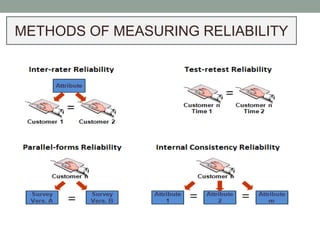
METHODS OF MEASURING RELIABILITY
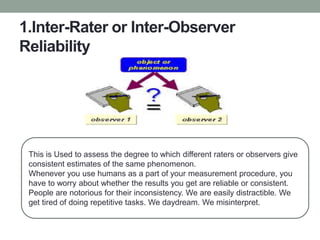
1.Inter-Rater or Inter-Observer
Reliability
This is Used to assess the degree to which different raters or observers give
consistent estimates of the same phenomenon.
Whenever you use humans as a part of your measurement procedure, you
have to worry about whether the results you get are reliable or consistent.
People are notorious for their inconsistency. We are easily distractible. We
get tired of doing repetitive tasks. We daydream. We misinterpret.
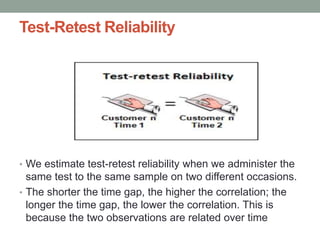
Test-Retest Reliability
• We estimate test-retest reliability when we administer the
same test to the same sample on two different occasions.
• The shorter the time gap, the higher the correlation; the
longer the time gap, the lower the correlation. This is
because the two observations are related over time
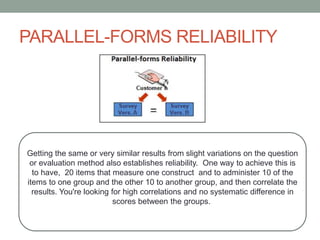
PARALLEL-FORMS RELIABILITY
Getting the same or very similar results from slight variations on the question
or evaluation method also establishes reliability. One way to achieve this is
to have, 20 items that measure one construct and to administer 10 of the
items to one group and the other 10 to another group, and then correlate the
results. You're looking for high correlations and no systematic difference in
scores between the groups.
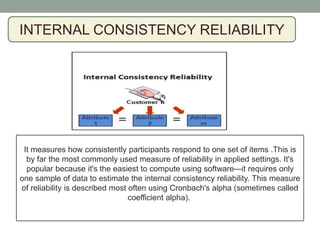
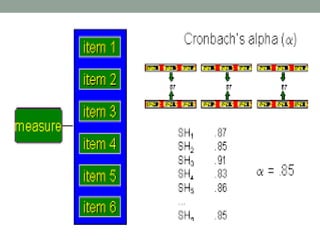
It measures how consistently participants respond to one set of items .This is
by far the most commonly used measure of reliability in applied settings. It's
popular because it's the easiest to compute using software—it requires only
one sample of data to estimate the internal consistency reliability. This measure
of reliability is described most often using Cronbach's alpha (sometimes called
coefficient alpha).
INTERNAL CONSISTENCY RELIABILITY
SPLIT HALF METHOD
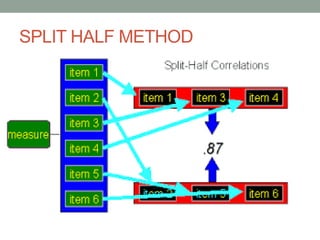
The split-half method assesses the internal consistency of
a test, such as psychometric tests and questionnaires.
There, it measures the extent to which all parts of the test
contribute equally to what is being measured. This is done
by comparing the results of one half of a test with the
results from the other half.
It involves:
• Administering a test to a group of individuals
• Splitting the test in half
• Correlating scores on one half of the test with scores on
the other half of the test
SPLIT HALF METHOD
Edm 202
Edm 202

Edm 202

  • 1.
    METHOD OF MEASURING TESTRELIABILITY Presented by- Namrata gupta 153128,B,Ed. Room no.-56 EDM-202
  • 2.
    RELIABILITY • Reliability isthe degree to which an assessment tool produces stable and consistent results. • Reliability is a measure of the consistency of a test. Here are the some most common ways of measuring reliability for any empirical method or metric:  inter-rater reliability  test-retest reliability  parallel forms reliability  internal consistency reliability  Split half method
  • 3.
  • 4.
    1.Inter-Rater or Inter-Observer Reliability Thisis Used to assess the degree to which different raters or observers give consistent estimates of the same phenomenon. Whenever you use humans as a part of your measurement procedure, you have to worry about whether the results you get are reliable or consistent. People are notorious for their inconsistency. We are easily distractible. We get tired of doing repetitive tasks. We daydream. We misinterpret.
  • 5.
    Test-Retest Reliability • Weestimate test-retest reliability when we administer the same test to the same sample on two different occasions. • The shorter the time gap, the higher the correlation; the longer the time gap, the lower the correlation. This is because the two observations are related over time
  • 6.
    PARALLEL-FORMS RELIABILITY Getting thesame or very similar results from slight variations on the question or evaluation method also establishes reliability. One way to achieve this is to have, 20 items that measure one construct and to administer 10 of the items to one group and the other 10 to another group, and then correlate the results. You're looking for high correlations and no systematic difference in scores between the groups.
  • 7.
    It measures howconsistently participants respond to one set of items .This is by far the most commonly used measure of reliability in applied settings. It's popular because it's the easiest to compute using software—it requires only one sample of data to estimate the internal consistency reliability. This measure of reliability is described most often using Cronbach's alpha (sometimes called coefficient alpha). INTERNAL CONSISTENCY RELIABILITY
  • 8.
    SPLIT HALF METHOD Thesplit-half method assesses the internal consistency of a test, such as psychometric tests and questionnaires. There, it measures the extent to which all parts of the test contribute equally to what is being measured. This is done by comparing the results of one half of a test with the results from the other half. It involves: • Administering a test to a group of individuals • Splitting the test in half • Correlating scores on one half of the test with scores on the other half of the test
  • 9.