WELCOME TO LEVEL 6
Comencemos con el primer tema que te ayudara a explicar el propósito para
el cual se hacen ciertas actividades, a utilizar ciertos verbos de manera
correcta, a combinar verbos entre si, a utilizar de manera correcta los verbos
con los modal auxiliaries, y a utilizar de manera correcta los verbos en una
estructura causativa
Infinitives and Gerunds
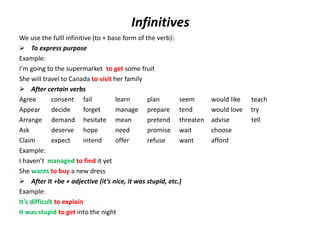
Infinitives
We use the fulll infinitive (to + base form of the verb):
 To express purpose
Example:
I’m going to the supermarket to get some fruit
She will travel to Canada to visit her family
 After certain verbs
Agree consent fail learn plan seem would like teach
Appear decide forget manage prepare tend would love try
Arrange demand hesitate mean pretend threaten advise tell
Ask deserve hope need promise wait choose
Claim expect intend offer refuse want afford
Example:
I haven’t managed to find it yet
She wants to buy a new dress
 After It +be + adjective (it’s nice, it was stupid, etc.)
Example:
It’s difficult to explain
It was stupid to get into the night
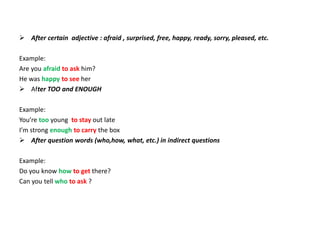
 After certain adjective : afraid , surprised, free, happy, ready, sorry, pleased, etc.
Example:
Are you afraid to ask him?
He was happy to see her
 After TOO and ENOUGH
Example:
You’re too young to stay out late
I’m strong enough to carry the box
 After question words (who,how, what, etc.) in indirect questions
Example:
Do you know how to get there?
Can you tell who to ask ?
Infinitives
We use the bare infinitive (base form of verb without to):
 After modal verbs (can, could, will, would, shall, should, may, might, must).
Example:
Could you give me a glass of water
You must visit the doctor today
 After the verbs LET and Make ( in the active voice).
Example:
She makes me study all the time
My father hardly ever lets me drive his car
 Infinitives as a noun
Example:
To have good health we need to eat vegetables
To be happy is the main goal in life
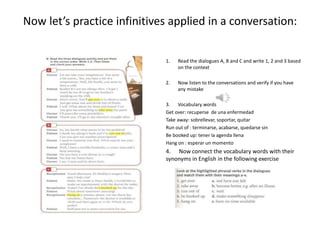
Now let’s practice infinitives applied in a conversation:
1. Read the dialogues A, B and C and write 1, 2 and 3 based
on the context
2. Now listen to the conversations and verify if you have
any mistake
3. Vocabulary words
Get over: recuperse de una enfermedad
Take away: sobrellevar, soportar, quitar
Run out of : terminarse, acabarse, quedarse sin
Be booked up: tener la agenda llena
Hang on : esperar un momento
4. Now connect the vocabulary words with their
synonyms in English in the following exercise
Gerunds
We use the –ing form:
 After certain verbs:
Admit delay keep quit stop
Appreciate deny mention recall suggest
Avoid discuss miss recommend tolerate
Complete enjoy postpone regret understand
Consider finish practice risk like
Love hate enjoy prefer start
Continue begin imagine spend
Examples:
I hate studying Maths
I like listening to music, but I hate dancing
 As the subject of a verb.
Examples:
Traveling is great fun
Swimming is an excelent sport
After certain expressions : (don’t mind, can’t stand,be interested in, it’s worth,
How/What about..? I look forward to, etc.
Examples:
I look forward to seeing you
They are interested in painting
After prepositions
Examples:
I’m so excited about going on this trip
He was thinking on buying a new house
After the verb go to indicate activities:
go swimming go shopping go fishing
Examples:
I’m going shopping this Saturday
They went fishing in the lake last weekend
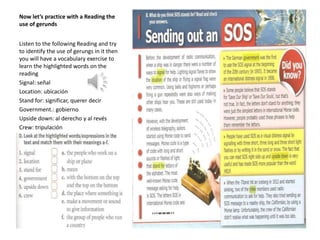
Now let’s practice with a Reading the
use of gerunds
Listen to the following Reading and try
to identify the use of gerungs in it then
you will have a vocabulary exercise to
learn the highlighted words on the
reading
Signal: señal
Location: ubicación
Stand for: significar, querer decir
Government.: gobierno
Upside down: al derecho y al revés
Crew: tripulación
Hola chicos como se sintieron de regreso al siguiente nivel, antes que todo
felicidades por haber aprobado el Nivel 5, esperamos que este nuevo nivel no
se les complique mucho ya que estaremos vendo algunos temas que aun no
imposibles s son un poco complicados, recuerden que siempre cuentan con el
apoyo del profesor a cargo del grupo quien con gusto podrá apoyarlos y explicar
cualquier duda que pueda surgir.
Bueno ahora bien acaban de ver el tema de infinitivos y gerundios, recuerden
que existen dos tipo de infinitivos, los que llevan la partícula To y los que no la
llevan, y los gerundios son los verbos con terminación ING ambas formas de los
verbos como pudieron ver son muy importantes ya que es la manera en la que
debemos usar los verbos conjugados en el idioma Inglés por lo que es muy
importante que identifiquen cuando debemos usar los verbos y de que forma
por ahora espero que les haya sido claro la explicación sobre los infinitivos y
gerundios.
Aquí les dejo las respuestas para los ejercicios que se asignaron en la
presentación. SUERTE EN SU PROXIMA LECCIÓN !
Primer ejercicio: c,b,a / 1.b 2.d 3.a 4.e 5.c Segundo ejercicio 1-e 2.d 3.b 4.f 5.c 6.a
TECNOLÓGICO DE ESTUDIOS SUPERORES DE
CUAUTITLAN IZCALLI (TESCI)

Infinitives and Gerunds

  • 1.
    WELCOME TO LEVEL6 Comencemos con el primer tema que te ayudara a explicar el propósito para el cual se hacen ciertas actividades, a utilizar ciertos verbos de manera correcta, a combinar verbos entre si, a utilizar de manera correcta los verbos con los modal auxiliaries, y a utilizar de manera correcta los verbos en una estructura causativa Infinitives and Gerunds
  • 2.
    Infinitives We use thefulll infinitive (to + base form of the verb):  To express purpose Example: I’m going to the supermarket to get some fruit She will travel to Canada to visit her family  After certain verbs Agree consent fail learn plan seem would like teach Appear decide forget manage prepare tend would love try Arrange demand hesitate mean pretend threaten advise tell Ask deserve hope need promise wait choose Claim expect intend offer refuse want afford Example: I haven’t managed to find it yet She wants to buy a new dress  After It +be + adjective (it’s nice, it was stupid, etc.) Example: It’s difficult to explain It was stupid to get into the night
  • 3.
     After certainadjective : afraid , surprised, free, happy, ready, sorry, pleased, etc. Example: Are you afraid to ask him? He was happy to see her  After TOO and ENOUGH Example: You’re too young to stay out late I’m strong enough to carry the box  After question words (who,how, what, etc.) in indirect questions Example: Do you know how to get there? Can you tell who to ask ?
  • 4.
    Infinitives We use thebare infinitive (base form of verb without to):  After modal verbs (can, could, will, would, shall, should, may, might, must). Example: Could you give me a glass of water You must visit the doctor today  After the verbs LET and Make ( in the active voice). Example: She makes me study all the time My father hardly ever lets me drive his car  Infinitives as a noun Example: To have good health we need to eat vegetables To be happy is the main goal in life
  • 5.
    Now let’s practiceinfinitives applied in a conversation: 1. Read the dialogues A, B and C and write 1, 2 and 3 based on the context 2. Now listen to the conversations and verify if you have any mistake 3. Vocabulary words Get over: recuperse de una enfermedad Take away: sobrellevar, soportar, quitar Run out of : terminarse, acabarse, quedarse sin Be booked up: tener la agenda llena Hang on : esperar un momento 4. Now connect the vocabulary words with their synonyms in English in the following exercise
  • 6.
    Gerunds We use the–ing form:  After certain verbs: Admit delay keep quit stop Appreciate deny mention recall suggest Avoid discuss miss recommend tolerate Complete enjoy postpone regret understand Consider finish practice risk like Love hate enjoy prefer start Continue begin imagine spend Examples: I hate studying Maths I like listening to music, but I hate dancing  As the subject of a verb. Examples: Traveling is great fun Swimming is an excelent sport
  • 7.
    After certain expressions: (don’t mind, can’t stand,be interested in, it’s worth, How/What about..? I look forward to, etc. Examples: I look forward to seeing you They are interested in painting After prepositions Examples: I’m so excited about going on this trip He was thinking on buying a new house After the verb go to indicate activities: go swimming go shopping go fishing Examples: I’m going shopping this Saturday They went fishing in the lake last weekend
  • 8.
    Now let’s practicewith a Reading the use of gerunds Listen to the following Reading and try to identify the use of gerungs in it then you will have a vocabulary exercise to learn the highlighted words on the reading Signal: señal Location: ubicación Stand for: significar, querer decir Government.: gobierno Upside down: al derecho y al revés Crew: tripulación
  • 9.
    Hola chicos comose sintieron de regreso al siguiente nivel, antes que todo felicidades por haber aprobado el Nivel 5, esperamos que este nuevo nivel no se les complique mucho ya que estaremos vendo algunos temas que aun no imposibles s son un poco complicados, recuerden que siempre cuentan con el apoyo del profesor a cargo del grupo quien con gusto podrá apoyarlos y explicar cualquier duda que pueda surgir. Bueno ahora bien acaban de ver el tema de infinitivos y gerundios, recuerden que existen dos tipo de infinitivos, los que llevan la partícula To y los que no la llevan, y los gerundios son los verbos con terminación ING ambas formas de los verbos como pudieron ver son muy importantes ya que es la manera en la que debemos usar los verbos conjugados en el idioma Inglés por lo que es muy importante que identifiquen cuando debemos usar los verbos y de que forma por ahora espero que les haya sido claro la explicación sobre los infinitivos y gerundios. Aquí les dejo las respuestas para los ejercicios que se asignaron en la presentación. SUERTE EN SU PROXIMA LECCIÓN ! Primer ejercicio: c,b,a / 1.b 2.d 3.a 4.e 5.c Segundo ejercicio 1-e 2.d 3.b 4.f 5.c 6.a
  • 10.
    TECNOLÓGICO DE ESTUDIOSSUPERORES DE CUAUTITLAN IZCALLI (TESCI)