Relative
Motion
Beah Mae N. Nonaillada
Discussant
Do you feel like you are motionless
right now?
ALL Motion is RELATIVE!
The only way to define motion is by changing position…
The question is changing position relative to WHAT?!?
You are moving at about 1000 miles per hour relative to the
center of the Earth!
The Earth is hurtling around the Sun at over
66,000 miles per hour!
MORE MOTION!!!
•Relative motion refers to the movement of an
object in relation to another object. It is the
perception of motion from a particular frame of
reference. Understanding relative motion is
essential in various fields, including physics,
astronomy, and transportation.
To understand relative motion, it is crucial to
identify the frame of reference. A frame of
reference is a coordinate system or a set of
axes used to describe the position and motion
of objects. It provides a fixed point against
which the motion of other objects can be
measured.
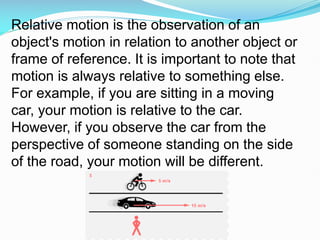
Relative motion is the observation of an
object's motion in relation to another object or
frame of reference. It is important to note that
motion is always relative to something else.
For example, if you are sitting in a moving
car, your motion is relative to the car.
However, if you observe the car from the
perspective of someone standing on the side
of the road, your motion will be different.
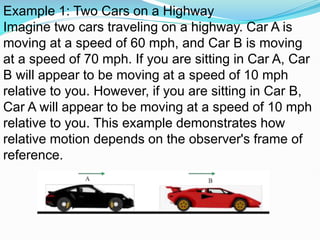
Example 1: Two Cars on a Highway
Imagine two cars traveling on a highway. Car A is
moving at a speed of 60 mph, and Car B is moving
at a speed of 70 mph. If you are sitting in Car A, Car
B will appear to be moving at a speed of 10 mph
relative to you. However, if you are sitting in Car B,
Car A will appear to be moving at a speed of 10 mph
relative to you. This example demonstrates how
relative motion depends on the observer's frame of
reference.
Example 2: Earth's Rotation and Orbit
The concept of relative motion is also evident in the
movement of celestial bodies. The Earth rotates on its
axis, completing one rotation in approximately 24 hours.
This rotation gives us the perception of the Sun rising
and setting. However, from a broader perspective, we
know that the Earth's rotation is relative to the Sun. The
Earth also orbits around the Sun, completing one
revolution in approximately 365 days. This orbital motion
is relative to the other planets in our solar system.
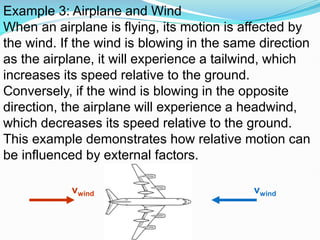
Example 3: Airplane and Wind
When an airplane is flying, its motion is affected by
the wind. If the wind is blowing in the same direction
as the airplane, it will experience a tailwind, which
increases its speed relative to the ground.
Conversely, if the wind is blowing in the opposite
direction, the airplane will experience a headwind,
which decreases its speed relative to the ground.
This example demonstrates how relative motion can
be influenced by external factors.
vwind vwind
Relative motion is the perception of an object's
motion in relation to another object or frame of
reference. It is crucial to consider the observer's
perspective and the chosen frame of reference
when analyzing relative motion. Understanding
this concept is essential in various scientific fields
and helps us explain the motion of objects in our
everyday lives.
Relative Motion .pdf

Relative Motion .pdf

  • 1.
    Relative Motion Beah Mae N.Nonaillada Discussant
  • 2.
    Do you feellike you are motionless right now? ALL Motion is RELATIVE! The only way to define motion is by changing position… The question is changing position relative to WHAT?!? You are moving at about 1000 miles per hour relative to the center of the Earth! The Earth is hurtling around the Sun at over 66,000 miles per hour! MORE MOTION!!!
  • 3.
    •Relative motion refersto the movement of an object in relation to another object. It is the perception of motion from a particular frame of reference. Understanding relative motion is essential in various fields, including physics, astronomy, and transportation.
  • 4.
    To understand relativemotion, it is crucial to identify the frame of reference. A frame of reference is a coordinate system or a set of axes used to describe the position and motion of objects. It provides a fixed point against which the motion of other objects can be measured.
  • 5.
    Relative motion isthe observation of an object's motion in relation to another object or frame of reference. It is important to note that motion is always relative to something else. For example, if you are sitting in a moving car, your motion is relative to the car. However, if you observe the car from the perspective of someone standing on the side of the road, your motion will be different.
  • 6.
    Example 1: TwoCars on a Highway Imagine two cars traveling on a highway. Car A is moving at a speed of 60 mph, and Car B is moving at a speed of 70 mph. If you are sitting in Car A, Car B will appear to be moving at a speed of 10 mph relative to you. However, if you are sitting in Car B, Car A will appear to be moving at a speed of 10 mph relative to you. This example demonstrates how relative motion depends on the observer's frame of reference.
  • 7.
    Example 2: Earth'sRotation and Orbit The concept of relative motion is also evident in the movement of celestial bodies. The Earth rotates on its axis, completing one rotation in approximately 24 hours. This rotation gives us the perception of the Sun rising and setting. However, from a broader perspective, we know that the Earth's rotation is relative to the Sun. The Earth also orbits around the Sun, completing one revolution in approximately 365 days. This orbital motion is relative to the other planets in our solar system.
  • 8.
    Example 3: Airplaneand Wind When an airplane is flying, its motion is affected by the wind. If the wind is blowing in the same direction as the airplane, it will experience a tailwind, which increases its speed relative to the ground. Conversely, if the wind is blowing in the opposite direction, the airplane will experience a headwind, which decreases its speed relative to the ground. This example demonstrates how relative motion can be influenced by external factors. vwind vwind
  • 9.
    Relative motion isthe perception of an object's motion in relation to another object or frame of reference. It is crucial to consider the observer's perspective and the chosen frame of reference when analyzing relative motion. Understanding this concept is essential in various scientific fields and helps us explain the motion of objects in our everyday lives.