
RELATIVE CLAUSESDefiningrelativeclausesNon-definingrelativeclausesAna Ángeles López RodríguezIES Julio Caro BarojaFuenlabrada   MadridAbril 2010
Definingrelativeclauses
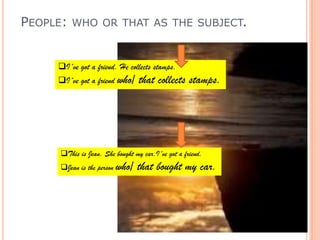
People: whoorthat as thesubject.I´vegot a friend. He collectsstamps.
I´vegot a friendwho/ thatcollectsstamps.
Thisis Jean. Shebought my car.I´vegot a friend.
Jean isthepersonwho/ thatbought my car.People: whoorthat as thesubject.Whenwetalkaboutpeople, that can beusedinstead of who. Thisislesscommon, butwestill do it, especially in speech.HaveyoumettheboythatSueisgoingtomarry.
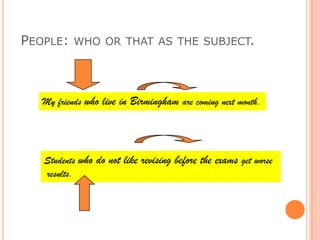
People: whoorthat as thesubject.My friendswholive in Birminghamare comingnextmonth.Studentswho do notlikerevisingbeforetheexamsgetworseresults.
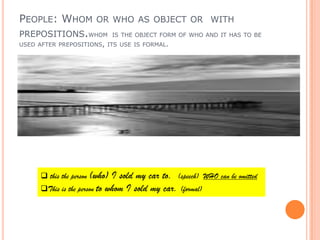
People: Whomorwho as objectorwithprepositions.whomistheobjectform of who and it has tobeusedafterprepositions, its use is formal.thistheperson(who) I sold my car to.(speech)  WHO can beomitted
Thisisthepersontowhom I sold my car. (formal)Things & Animals: whichorthat.
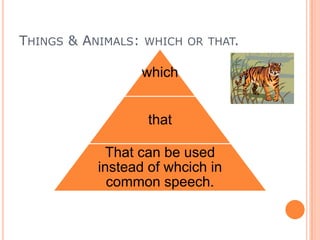
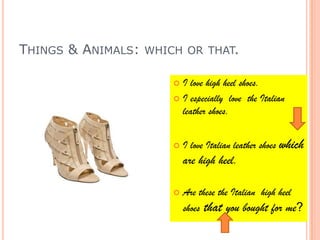
Things & Animals: whichorthat.I lovehighheelshoes.I especiallylovetheItalianleathershoes.I loveItalianleathershoeswhich are highheel.Are thesetheItalianhighheelshoesthatyouboughtfor me?
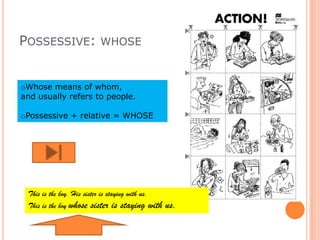
Possessive: whoseWhosemeans of whom, and usuallyreferstopeople.Possessive + relative = WHOSEThisistheboy. Hissisterisstayingwithus.Thisistheboywhosesisterisstayingwithus.
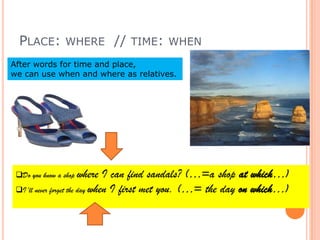
Place: where  // time: whenAfterwordsfor time and place, we can use when and where as relatives.Do youknow a shop where I can findsandals? (…=a shop at which…)
I´llneverforgetthedaywhen I firstmetyou. (…= thedayonwhich…)Non-definingrelativeclauses
Differences : Defining or Non-definingDEFINING RELATIVE CLAUSESThey give relevant and important information to complete the meaning of the main clause. When the relative pronoun is the object or goes with a preposition, it can be omitted.We don´t use the commas to separate the relative clause.NON-DEFINIG RELATIVE CLAUSESThey give extra information but not essential to understand the meaning of the main clause.They go between commas.The relative pronouns are never omitted. That is never used with the non-defining relative clauses.

Relative clauses5ª sesion

  • 1.
    RELATIVE CLAUSESDefiningrelativeclausesNon-definingrelativeclausesAna ÁngelesLópez RodríguezIES Julio Caro BarojaFuenlabrada MadridAbril 2010
  • 2.
  • 3.
    People: whoorthat asthesubject.I´vegot a friend. He collectsstamps.
  • 4.
    I´vegot a friendwho/thatcollectsstamps.
  • 5.
    Thisis Jean. Sheboughtmy car.I´vegot a friend.
  • 6.
    Jean isthepersonwho/ thatboughtmy car.People: whoorthat as thesubject.Whenwetalkaboutpeople, that can beusedinstead of who. Thisislesscommon, butwestill do it, especially in speech.HaveyoumettheboythatSueisgoingtomarry.
  • 7.
    People: whoorthat asthesubject.My friendswholive in Birminghamare comingnextmonth.Studentswho do notlikerevisingbeforetheexamsgetworseresults.
  • 8.
    People: Whomorwho asobjectorwithprepositions.whomistheobjectform of who and it has tobeusedafterprepositions, its use is formal.thistheperson(who) I sold my car to.(speech) WHO can beomitted
  • 9.
    Thisisthepersontowhom I soldmy car. (formal)Things & Animals: whichorthat.
  • 10.
    Things & Animals:whichorthat.I lovehighheelshoes.I especiallylovetheItalianleathershoes.I loveItalianleathershoeswhich are highheel.Are thesetheItalianhighheelshoesthatyouboughtfor me?
  • 11.
    Possessive: whoseWhosemeans ofwhom, and usuallyreferstopeople.Possessive + relative = WHOSEThisistheboy. Hissisterisstayingwithus.Thisistheboywhosesisterisstayingwithus.
  • 12.
    Place: where // time: whenAfterwordsfor time and place, we can use when and where as relatives.Do youknow a shop where I can findsandals? (…=a shop at which…)
  • 13.
    I´llneverforgetthedaywhen I firstmetyou.(…= thedayonwhich…)Non-definingrelativeclauses
  • 14.
    Differences : Definingor Non-definingDEFINING RELATIVE CLAUSESThey give relevant and important information to complete the meaning of the main clause. When the relative pronoun is the object or goes with a preposition, it can be omitted.We don´t use the commas to separate the relative clause.NON-DEFINIG RELATIVE CLAUSESThey give extra information but not essential to understand the meaning of the main clause.They go between commas.The relative pronouns are never omitted. That is never used with the non-defining relative clauses.