RELATIVE CLAUSES DEFINING NON-DEFINING By  Cristina  Andreu
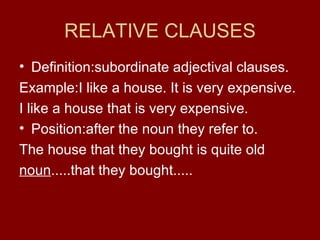
RELATIVE CLAUSES Definition:subordinate adjectival clauses. Example:I like a house. It is very expensive. I like a house that is very expensive. Position:after the noun they refer to. The house that they bought is quite old noun .....that they bought.....
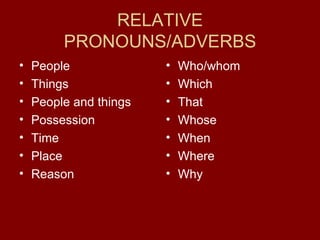
RELATIVE PRONOUNS/ADVERBS People Things People and things Possession Time Place Reason Who/whom Which That Whose When Where Why
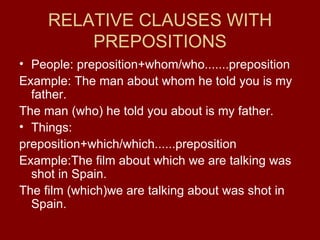
RELATIVE CLAUSES WITH PREPOSITIONS People: preposition+whom/who.......preposition Example: The man about whom he told you is my father. The man (who) he told you about is my father. Things: preposition+which/which......preposition Example:The film about which we are talking was shot in Spain. The film (which)we are talking about was shot in Spain.
OMISSION OF THE RELATIVE PRONOUN   The pronoun can be omitted if it is not the subject of the relative clause.   The bus  [ which/that  goes to Cairo ]  leaves from here. The bus  [ ( which/that )  we took ] stopped at three stations. The woman [   who/that  teaches us music ]  plays in a orchestra. The woman  [ ( who/whom/that )  you have just met ]  is our music teacher   SUBJECT(THINGS) OBJECT(THINGS) SUBJECT(PEOPLE) OBJECT(PEOPLE)
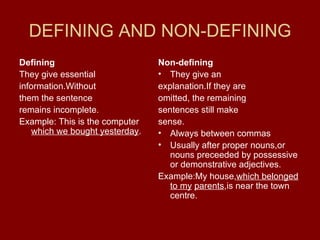
DEFINING AND NON-DEFINING Defining They give essential information.Without them the sentence remains incomplete. Example: This is the computer  which we bought yesterday . Non-defining They give an explanation.If they are omitted, the remaining sentences still make sense. Always between commas Usually after proper nouns,or nouns preceeded by possessive or demonstrative adjectives. Example:My house, which belonged   to my   parents ,is near the town centre.
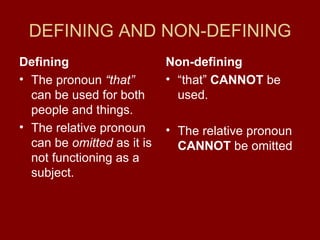
DEFINING AND NON-DEFINING Defining The pronoun  “that”  can be used for both people and things. The relative pronoun can be  omitted  as it is not functioning as a subject. Non-defining “ that”  CANNOT  be used. The relative pronoun  CANNOT  be omitted
PRACTICE Combine the following sentences using relative pronouns and adding commas when necessary. John bought a DVD player. It was made in Korea. John bought a  DVD player which/that was made in Korea. My new shop is very successful. You saw it last week. My new shop, which you saw last week, is very successful.
PRACTICE Freddie Mercury died in 1992.He was a famous singer. Freddie Mercury, who was a famous singer,died in 1992. There’s the woman. I met her last night. There’s the woman(who/that) I met last night. John is my friend.His car was stolen from the car park. John,whose car was stolen from the car park, is my friend. The director is very demanding.Jean works for him. The director for whom Jean works is very demanding. The director (who/that) Jean works for is very demanding

Relative clauses

  • 1.
    RELATIVE CLAUSES DEFININGNON-DEFINING By Cristina Andreu
  • 2.
    RELATIVE CLAUSES Definition:subordinateadjectival clauses. Example:I like a house. It is very expensive. I like a house that is very expensive. Position:after the noun they refer to. The house that they bought is quite old noun .....that they bought.....
  • 3.
    RELATIVE PRONOUNS/ADVERBS PeopleThings People and things Possession Time Place Reason Who/whom Which That Whose When Where Why
  • 4.
    RELATIVE CLAUSES WITHPREPOSITIONS People: preposition+whom/who.......preposition Example: The man about whom he told you is my father. The man (who) he told you about is my father. Things: preposition+which/which......preposition Example:The film about which we are talking was shot in Spain. The film (which)we are talking about was shot in Spain.
  • 5.
    OMISSION OF THERELATIVE PRONOUN The pronoun can be omitted if it is not the subject of the relative clause. The bus [ which/that goes to Cairo ] leaves from here. The bus [ ( which/that ) we took ] stopped at three stations. The woman [ who/that teaches us music ] plays in a orchestra. The woman [ ( who/whom/that ) you have just met ] is our music teacher SUBJECT(THINGS) OBJECT(THINGS) SUBJECT(PEOPLE) OBJECT(PEOPLE)
  • 6.
    DEFINING AND NON-DEFININGDefining They give essential information.Without them the sentence remains incomplete. Example: This is the computer which we bought yesterday . Non-defining They give an explanation.If they are omitted, the remaining sentences still make sense. Always between commas Usually after proper nouns,or nouns preceeded by possessive or demonstrative adjectives. Example:My house, which belonged to my parents ,is near the town centre.
  • 7.
    DEFINING AND NON-DEFININGDefining The pronoun “that” can be used for both people and things. The relative pronoun can be omitted as it is not functioning as a subject. Non-defining “ that” CANNOT be used. The relative pronoun CANNOT be omitted
  • 8.
    PRACTICE Combine thefollowing sentences using relative pronouns and adding commas when necessary. John bought a DVD player. It was made in Korea. John bought a DVD player which/that was made in Korea. My new shop is very successful. You saw it last week. My new shop, which you saw last week, is very successful.
  • 9.
    PRACTICE Freddie Mercurydied in 1992.He was a famous singer. Freddie Mercury, who was a famous singer,died in 1992. There’s the woman. I met her last night. There’s the woman(who/that) I met last night. John is my friend.His car was stolen from the car park. John,whose car was stolen from the car park, is my friend. The director is very demanding.Jean works for him. The director for whom Jean works is very demanding. The director (who/that) Jean works for is very demanding