Gerunds and InfinitivesPart II
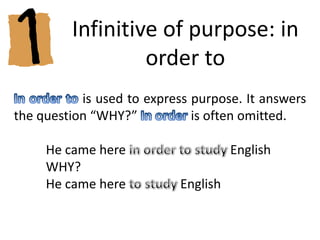
Infinitive of purpose: in ordertoIn order to is used to express purpose. It answers the question “WHY?” In order is often omitted.	He came here in order to study English	WHY? 	He came here to study English
To express purpose, use (in order) to, not for, with a verb*	INCORRECT: He came here for studying English	INCORRECT: He came here for to study English	INCORRECT: He came here for study EnglishFor can be used to express purpose, but it is a preposition and is followed by a noun object.	I went to the store for some bread.	I went to the store to boy some bread.To express purpose, use (in order) to, not for, with a verb*	INCORRECT: He came here for studying English	INCORRECT: He came here for to study English	INCORRECT: He came here for study EnglishFor can be used to express purpose, but it is a preposition and is followed by a noun object.	I went to the store for some bread.	I went to the store to boy some bread.
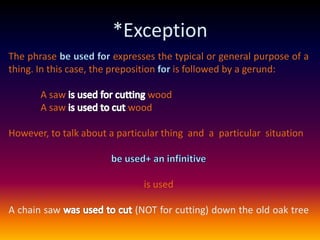
*ExceptionThe phrase be used for expresses the typical or general purpose of a thing. In this case, the preposition for is followed by a gerund:A saw is used for cutting woodA saw is used to cut woodHowever, to talk about a particular thing  and  a  particular  situationbe used+ an infinitive is usedA chain saw was used to cut(NOT for cutting) down the old oak tree
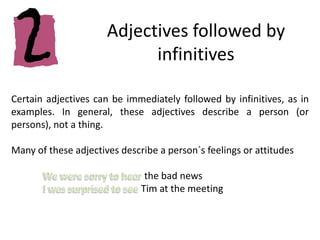
Adjectives followed by infinitivesCertain adjectives can be immediately followed by infinitives, as in examples. In general, these adjectives describe a person (or persons), not a thing.Many of these adjectives describe a person´s feelings or attitudes We were sorry to hear the bad newsI was surprised to see Tim at the meeting
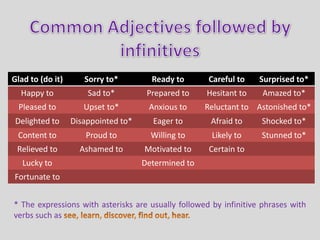
Common Adjectives followed by infinitives* The expressions with asterisks are usually followed by infinitive phrases with verbs such as see, learn, discover, find out, hear.
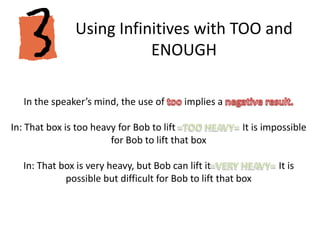
Using Infinitives with TOO and ENOUGHIn the speaker’s mind, the use of too implies a negative result.In: That box is too heavy for Bob to lift =TOO HEAVY= It is impossible for Bob to lift that boxIn: That box is very heavy, but Bob can lift it=VERY HEAVY= It is possible but difficult for Bob to lift that box
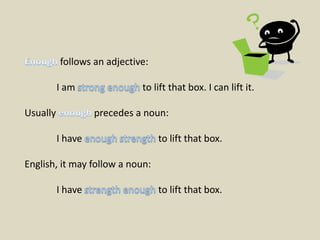
Enough follows an adjective:	I am strong enough to lift that box. I can lift it.Usually enough precedes a noun:	I have enough strength to lift that box.English, it may follow a noun:	I have strength enough to lift that box.
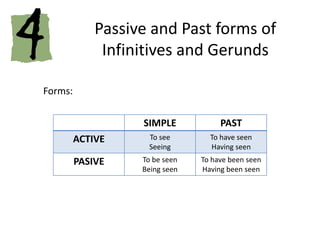
Passive and Past forms of Infinitives and GerundsForms:
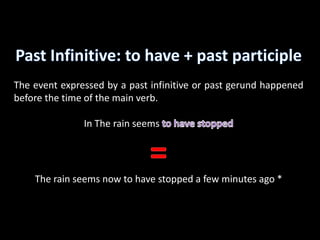
Past Infinitive: to have + past participleThe event expressed by a past infinitive or past gerund happened before the time of the main verb.In The rain seems to have stopped=The rain seems now to have stopped a few minutes ago *
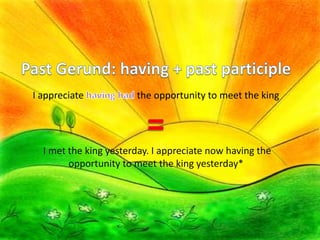
Past Gerund: having + past participleI appreciate having had the opportunity to meet the king= I met the king yesterday. I appreciate now having the opportunity to meet the king yesterday*Past Gerund: having + past participleI appreciate having had the opportunity to meet the king= I met the king yesterday. I appreciate now having the opportunity to meet the king yesterday*
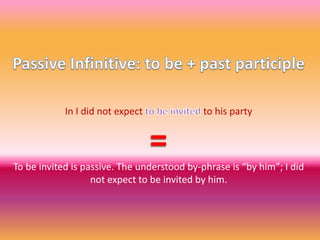
Passive Infinitive: to be + past participleIn I did not expect to be invited to his party=To be invited is passive. The understood by-phrase is “by him”; I did not expect to be invited by him.
Past-Passive Infinitive: to have been + past participleIn Nadia is fortunate to have been given a scholarship=Nadia was given a scholarship last month by her government. She is fortunate. Nadia is fortunate now to have been given a scholarship last month by her government.Passive Gerund: being + past participleIn I appreciated being invited to your home=Being invited is passive. The understood by-phrase is “by you”: I appreciated being invited by you
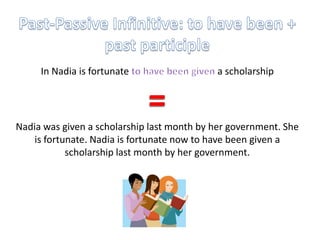
Past-Passive Infinitive: to have been + past participleIn Nadia is fortunate to have been given a scholarship=Nadia was given a scholarship last month by her government. She is fortunate. Nadia is fortunate now to have been given a scholarship last month by her government.
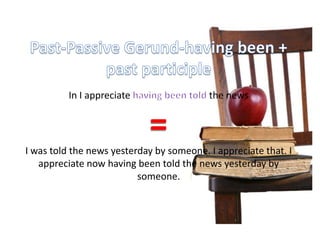
Past-Passive Gerund-having been + past participle In I appreciate having been told the news=I was told the news yesterday by someone. I appreciate that. I appreciate now having been told the news yesterday by someone.
Using Gerunds or Passive Infinitives following NEEDUsually an infinitive follows need, as:	I need to borrow some money	John needs to be told the truth
In certain circumstances, a gerund may follow need. In this case, the gerund carries a passive meaning. Usually the situations involve fixing or improving something.The house needs paintingThe house needs to be painted
Using a possessive to modify a GerundIn formalenglish, a possessive adjective is used to modify a gerund as in the first example. Also the object form of a pronoun is frequently used as in the second example.We came to class late. Mr. Lee complained about that factFormal: Mr. Lee complained about our coming to class late.*Informal: Mr. Lee complained about us coming to class late.Example:
In very formal English, a possessive noun is used to modify a gerund. The possessive form is often not used in informal EnglishFormal:  Mr. Lee complained about Mary’s coming to class late.Informal: Mr. Lee complained about Mary coming to class late.*Coming to class late occurred before Mr. Lee complained, so a past Gerund is also possible: Mr. Lee complained about our having come to class late.Example
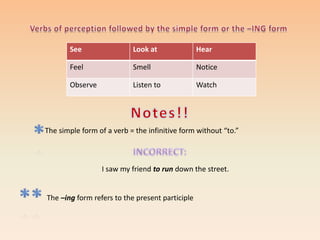
Using verbs of perceptionCertain verbs of perception are followed by either the simple form* or the –ingform** of a verb. There is often little difference in meaning between the two forms, except the –ingform usually gives the idea of “while.” In: I saw my friend while she was running down the street.I saw my friend run down the street.
I saw my friend running down the street .
I heard the rain fall on the roof.
I heard the rain falling on the roof.Example
Sometimes (not always) there is a clear difference between using the simple form or the –ing form. The use of the –ing form gives the idea that an activity is already in progress when it is perceived.When I walked into the apartment, I heard my roommate I heard my roommate singing in the shower.I heard a famous opera star sing at the concert last night.EXAMPLE
Verbs of perception followed by the simple form or the –ING form Notes!!* The simple form of a verb = the infinitive form without “to.” I saw my friend to run down the street.  The –ingform refers to the present participleINCORRECT:**
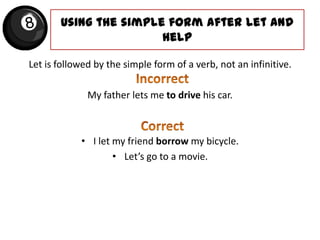
Using the simple form after Let and HelpLet is followed by the simple form of a verb, not an infinitive.My father lets me to drive his car.I let my friend borrow my bicycle.Let’s go to a movie.IncorrectCorrect
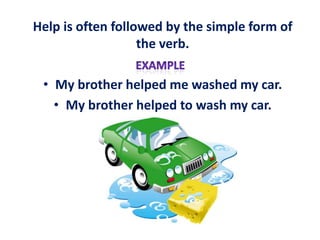
Help is often followed by the simple form of the verb.My brother helped me washed my car.My brother helped to wash my car.EXAMPLE
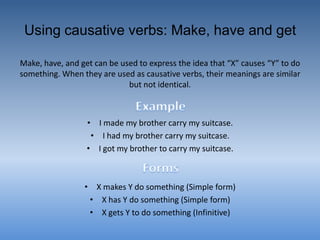
Using causative verbs: Make, have and getMake, have, and get can be used to express the idea that “X” causes “Y” to do something. When they are used as causative verbs, their meanings are similar but not identical. I made my brother carry my suitcase.I had my brother carry my suitcase.I got my brother to carry my suitcase.X makes Y do something (Simple form)X has Y do something (Simple form)X gets Y to do something (Infinitive)ExampleForms
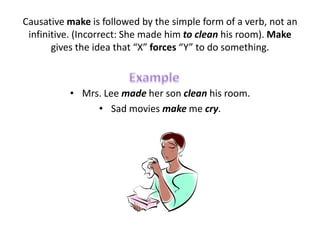
Causative make is followed by the simple form of a verb, not an infinitive. (Incorrect: She made him to clean his room). Make gives the idea that “X” forces “Y” to do something.Mrs. Lee made her son clean his room.Sad movies make me cry.Example
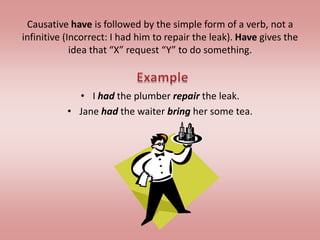
Causative have is followed by the simple form of a verb, not a infinitive (Incorrect: I had him to repair the leak). Have gives the idea that “X” request “Y” to do something.I had the plumber repair the leak.Jane had the waiter bring her some tea.Example

Gerunds and infinitives part 2

  • 1.
  • 2.
    Infinitive of purpose:in ordertoIn order to is used to express purpose. It answers the question “WHY?” In order is often omitted. He came here in order to study English WHY? He came here to study English
  • 3.
    To express purpose,use (in order) to, not for, with a verb* INCORRECT: He came here for studying English INCORRECT: He came here for to study English INCORRECT: He came here for study EnglishFor can be used to express purpose, but it is a preposition and is followed by a noun object. I went to the store for some bread. I went to the store to boy some bread.To express purpose, use (in order) to, not for, with a verb* INCORRECT: He came here for studying English INCORRECT: He came here for to study English INCORRECT: He came here for study EnglishFor can be used to express purpose, but it is a preposition and is followed by a noun object. I went to the store for some bread. I went to the store to boy some bread.
  • 4.
    *ExceptionThe phrase beused for expresses the typical or general purpose of a thing. In this case, the preposition for is followed by a gerund:A saw is used for cutting woodA saw is used to cut woodHowever, to talk about a particular thing and a particular situationbe used+ an infinitive is usedA chain saw was used to cut(NOT for cutting) down the old oak tree
  • 5.
    Adjectives followed byinfinitivesCertain adjectives can be immediately followed by infinitives, as in examples. In general, these adjectives describe a person (or persons), not a thing.Many of these adjectives describe a person´s feelings or attitudes We were sorry to hear the bad newsI was surprised to see Tim at the meeting
  • 6.
    Common Adjectives followedby infinitives* The expressions with asterisks are usually followed by infinitive phrases with verbs such as see, learn, discover, find out, hear.
  • 7.
    Using Infinitives withTOO and ENOUGHIn the speaker’s mind, the use of too implies a negative result.In: That box is too heavy for Bob to lift =TOO HEAVY= It is impossible for Bob to lift that boxIn: That box is very heavy, but Bob can lift it=VERY HEAVY= It is possible but difficult for Bob to lift that box
  • 8.
    Enough follows anadjective: I am strong enough to lift that box. I can lift it.Usually enough precedes a noun: I have enough strength to lift that box.English, it may follow a noun: I have strength enough to lift that box.
  • 9.
    Passive and Pastforms of Infinitives and GerundsForms:
  • 10.
    Past Infinitive: tohave + past participleThe event expressed by a past infinitive or past gerund happened before the time of the main verb.In The rain seems to have stopped=The rain seems now to have stopped a few minutes ago *
  • 11.
    Past Gerund: having+ past participleI appreciate having had the opportunity to meet the king= I met the king yesterday. I appreciate now having the opportunity to meet the king yesterday*Past Gerund: having + past participleI appreciate having had the opportunity to meet the king= I met the king yesterday. I appreciate now having the opportunity to meet the king yesterday*
  • 12.
    Passive Infinitive: tobe + past participleIn I did not expect to be invited to his party=To be invited is passive. The understood by-phrase is “by him”; I did not expect to be invited by him.
  • 13.
    Past-Passive Infinitive: tohave been + past participleIn Nadia is fortunate to have been given a scholarship=Nadia was given a scholarship last month by her government. She is fortunate. Nadia is fortunate now to have been given a scholarship last month by her government.Passive Gerund: being + past participleIn I appreciated being invited to your home=Being invited is passive. The understood by-phrase is “by you”: I appreciated being invited by you
  • 14.
    Past-Passive Infinitive: tohave been + past participleIn Nadia is fortunate to have been given a scholarship=Nadia was given a scholarship last month by her government. She is fortunate. Nadia is fortunate now to have been given a scholarship last month by her government.
  • 15.
    Past-Passive Gerund-having been+ past participle In I appreciate having been told the news=I was told the news yesterday by someone. I appreciate that. I appreciate now having been told the news yesterday by someone.
  • 16.
    Using Gerunds orPassive Infinitives following NEEDUsually an infinitive follows need, as: I need to borrow some money John needs to be told the truth
  • 17.
    In certain circumstances,a gerund may follow need. In this case, the gerund carries a passive meaning. Usually the situations involve fixing or improving something.The house needs paintingThe house needs to be painted
  • 18.
    Using a possessiveto modify a GerundIn formalenglish, a possessive adjective is used to modify a gerund as in the first example. Also the object form of a pronoun is frequently used as in the second example.We came to class late. Mr. Lee complained about that factFormal: Mr. Lee complained about our coming to class late.*Informal: Mr. Lee complained about us coming to class late.Example:
  • 19.
    In very formalEnglish, a possessive noun is used to modify a gerund. The possessive form is often not used in informal EnglishFormal: Mr. Lee complained about Mary’s coming to class late.Informal: Mr. Lee complained about Mary coming to class late.*Coming to class late occurred before Mr. Lee complained, so a past Gerund is also possible: Mr. Lee complained about our having come to class late.Example
  • 20.
    Using verbs ofperceptionCertain verbs of perception are followed by either the simple form* or the –ingform** of a verb. There is often little difference in meaning between the two forms, except the –ingform usually gives the idea of “while.” In: I saw my friend while she was running down the street.I saw my friend run down the street.
  • 21.
    I saw myfriend running down the street .
  • 22.
    I heard therain fall on the roof.
  • 23.
    I heard therain falling on the roof.Example
  • 24.
    Sometimes (not always)there is a clear difference between using the simple form or the –ing form. The use of the –ing form gives the idea that an activity is already in progress when it is perceived.When I walked into the apartment, I heard my roommate I heard my roommate singing in the shower.I heard a famous opera star sing at the concert last night.EXAMPLE
  • 25.
    Verbs of perceptionfollowed by the simple form or the –ING form Notes!!* The simple form of a verb = the infinitive form without “to.” I saw my friend to run down the street. The –ingform refers to the present participleINCORRECT:**
  • 26.
    Using the simpleform after Let and HelpLet is followed by the simple form of a verb, not an infinitive.My father lets me to drive his car.I let my friend borrow my bicycle.Let’s go to a movie.IncorrectCorrect
  • 27.
    Help is oftenfollowed by the simple form of the verb.My brother helped me washed my car.My brother helped to wash my car.EXAMPLE
  • 28.
    Using causative verbs:Make, have and getMake, have, and get can be used to express the idea that “X” causes “Y” to do something. When they are used as causative verbs, their meanings are similar but not identical. I made my brother carry my suitcase.I had my brother carry my suitcase.I got my brother to carry my suitcase.X makes Y do something (Simple form)X has Y do something (Simple form)X gets Y to do something (Infinitive)ExampleForms
  • 29.
    Causative make isfollowed by the simple form of a verb, not an infinitive. (Incorrect: She made him to clean his room). Make gives the idea that “X” forces “Y” to do something.Mrs. Lee made her son clean his room.Sad movies make me cry.Example
  • 30.
    Causative have isfollowed by the simple form of a verb, not a infinitive (Incorrect: I had him to repair the leak). Have gives the idea that “X” request “Y” to do something.I had the plumber repair the leak.Jane had the waiter bring her some tea.Example
  • 31.
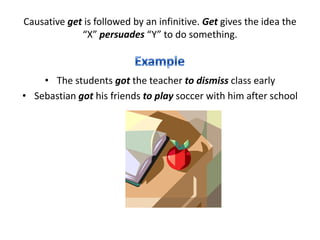
    Causative get isfollowed by an infinitive. Get gives the idea the “X” persuades “Y” to do something.The students got the teacher to dismiss class earlySebastian got his friends to play soccer with him after schoolExample
  • 32.
    The past participleis used after have and get to give passive meaning. In this case, there is usually little or no difference in meaning between have and get.I had my watch repaired (by someone).I got my watch repaired (by someone).Example
  • 33.