SERVICE MARKETING
Recommended Book:- Zeithaml, Bitner & Gremlar
PGDM (IIM Raipur)
Bakhresa FMCG (South Africa)
Relationship Manager (HDFC Bank)
MD- Shyam Hospital
Faculty(MBA)- GLA University, Mathura
Swarit Yadav
Topics to be covered
 CRM in services
 Relationship marketing
 Customer profitability segment
 Relationship- tools and strategies
 Use of information and technology for CRM
 Marketing of financial services
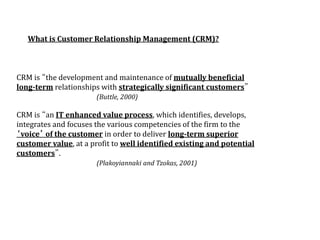
What is Customer Relationship Management (CRM)?
CRM is “the development and maintenance of mutually beneficial
long-term relationships with strategically significant customers”
(Buttle, 2000)
CRM is “an IT enhanced value process, which identifies, develops,
integrates and focuses the various competencies of the firm to the
‘voice’ of the customer in order to deliver long-term superior
customer value, at a profit to well identified existing and potential
customers”.
(Plakoyiannaki and Tzokas, 2001)
Understanding Customer Relationship Management (CRM)?
CRM is a business philosophy based on upon individual customers
and customised products and services supported by open lines
of communication and feedback from the participating firms that
mutually benefit both buying and selling organisations.
The buying and selling firms enter into a “learning relationship”,
with the customer being willing to collaborate with the seller and
grow as a loyal customer. In return,, the seller works to maximize
the value of the relationship for the customer’s benefit.
In short, CRM provides selling organisations with the platform
to obtain a competitive advantage by embracing customer needs
and building value-driven long-term relationships.
Determinants of CRM
Trust
The willingness to rely on the ability, integrity, and motivation of
one company to serve the needs of the other company as agreed
upon implicitly and explicitly.
Value
The ability of a selling organisation to satisfy the needs of the
customer at a comparatively lower cost or higher benefit than
that offered by competitors and measured in monetary,
temporal, functional and psychological terms.
Determinants of CRM
In addition to trust and value, salespeople must:
Understand customer needs and problems;
Meet their commitments;
Provide superior after sales support;
Make sure that the customer is always told the truth
(must be honest); and
Have a passionate interest in establishing and retaining a long-
term relationship (e.g., have long-term perspective).
Stages in the development of a Customer Relationship
The Pre-relationship Stage
The event that triggers a buyer to seek a new business partner.
The Early Stage
Experience is accumulated between the buyer and seller although a great
degree of uncertainty and distance exists.
The Development Stage
Increased levels of transactions lead to a higher degree of commitment and
the distance is reduced to a social exchange.
The Long-term Stage
Characterised by the companies’ mutual importance to each other.
The Final Stage
The interaction between the companies becomes institutionalized.
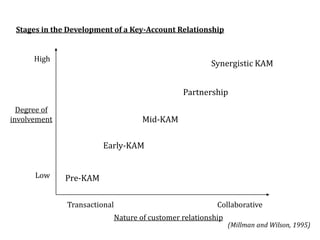
Stages in the Development of a Key-Account Relationship
Degree of
involvement
High
Low
Nature of customer relationship
Transactional Collaborative
Pre-KAM
Early-KAM
Mid-KAM
Partnership
Synergistic KAM
(Millman and Wilson, 1995)
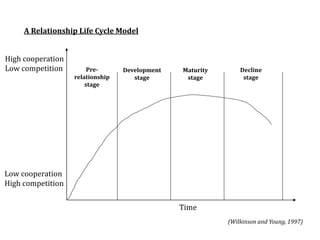
A Relationship Life Cycle Model
High cooperation
Low competition
Low cooperation
High competition
Time
Pre-
relationship
stage
Development
stage
Maturity
stage
Decline
stage
(Wilkinson and Young, 1997)
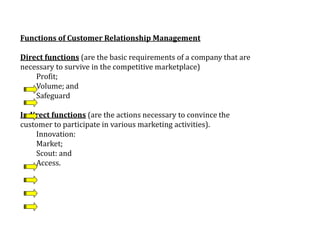
Functions of Customer Relationship Management
Direct functions (are the basic requirements of a company that are
necessary to survive in the competitive marketplace)
Profit;
Volume; and
Safeguard
Indirect functions (are the actions necessary to convince the
customer to participate in various marketing activities).
Innovation:
Market;
Scout: and
Access.
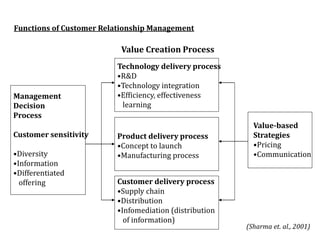
Functions of Customer Relationship Management
Management
Decision
Process
Customer sensitivity
•Diversity
•Information
•Differentiated
offering
Value Creation Process
Technology delivery process
•R&D
•Technology integration
•Efficiency, effectiveness
learning
Product delivery process
•Concept to launch
•Manufacturing process
Customer delivery process
•Supply chain
•Distribution
•Infomediation (distribution
of information)
Value-based
Strategies
•Pricing
•Communication
(Sharma et. al., 2001)
The role of salespeople as relationship builders and promoters
Salespeople by:
identifying potential customers and their needs;
approaching key decision makers in the buying firm;
negotiating and advancing dialogue and mutual trust;
coordinating the cooperation between the customers and
their company;
encouraging the inter-organisational learning process;
contributing to constructive resolution of existing conflicts; and
leading the customer relationship development team
are the individuals in any organisation who act both as relationship
builders and as relationship promoters.
Models of Customer Relationship Management
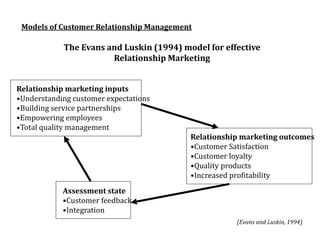
The Evans and Luskin (1994) model for effective
Relationship Marketing
Relationship marketing inputs
•Understanding customer expectations
•Building service partnerships
•Empowering employees
•Total quality management
Relationship marketing outcomes
•Customer Satisfaction
•Customer loyalty
•Quality products
•Increased profitability
Assessment state
•Customer feedback
•Integration
(Evans and Luskin, 1994)
Models of Customer Relationship Management
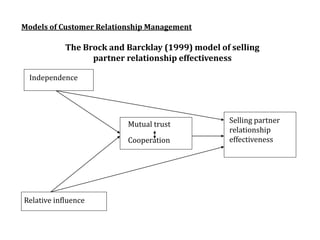
The Brock and Barcklay (1999) model of selling
partner relationship effectiveness
Independence
Relative influence
Mutual trust
Cooperation
Selling partner
relationship
effectiveness
Managing Customer Relationships
The global salesperson must be involved in the following activities in order to initiate,
develop and enhance the process that is aimed at building trust and commitment with
the customer.
Initiating the relationship
Engage in strategic prospecting and qualifying;
Gather and study pre-call information;
Identify buying influences;
Plan the initial sales call;
Demonstrate an understanding of the customer’s needs;
Identify opportunities to build a relationship; and
Illustrate the value of a relationship with the customer
Managing Customer Relationships
The global salesperson must be involved in the following activities in order to initiate,
develop and enhance the process that is aimed at building trust and commitment with
the customer.
Developing the relationship
Select an appropriate offering;
Customise the relationship;
Link the solutions with the customer’s needs;
Discuss customer concerns;
Summarize the solution to confirm benefits; and
Secure commitment.
Chapter 15: Customer Relationship Management (CRM)
Managing Customer Relationships
The global salesperson must be involved in the following activities in order to initiate,
develop and enhance the process that is aimed at building trust and commitment
with the customer.
Enhancing the relationship
Assess customer satisfaction;
Take action to ensure satisfaction;
Maintain open, two-way communication; and
Work to add value and enhance mutual opportunities.
Managing Customer Relationships
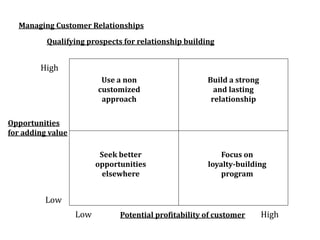
Qualifying prospects for relationship building
Opportunities
for adding value
Potential profitability of customer
High
Low
Low High
Use a non
customized
approach
Seek better
opportunities
elsewhere
Build a strong
and lasting
relationship
Focus on
loyalty-building
program
Relationship networks
The ultimate outcome of a successful CRM strategy is the creation
of a unique company asset known as a relationship network.
A relationship network consists of the company and its major
customers with whom the company has established long and
enduring business relationships.
The additional aspects of a global salesperson’s job are to:
Manage customer value;
Act as customer advocate; and
Enhance customer loyalty and build a “health” and
profitable network of relationships.
Summary
CRM is a new business philosophy based on trust and value;
The core function of CRM is the value creation process;
Customer relationships develop over time;
The role of global salespeople in the process is that of both
relationship builders and relationship promoters; and
The basic premise of CRM is to offer superior value to
customers in an effort to turn prospects into
customers, customers into loyal customers, and
loyal customers into partners.
Relationship Marketing
 is a philosophy of doing business, a strategic orientation,
that focuses on keeping current customers and
improving relationships with them
 does not necessarily emphasize acquiring new
customers
 is usually cheaper (for the firm)
 keeping a current customer costs less than attracting a new one
 thus, the focus is less on attraction, and more on
retention and enhancement of customer relationships
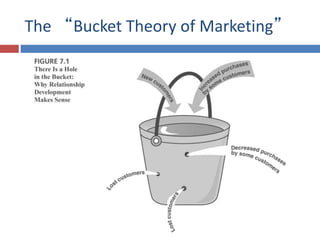
The “Bucket Theory of Marketing”
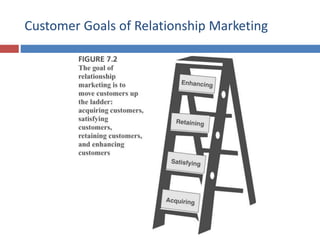
Customer Goals of Relationship Marketing
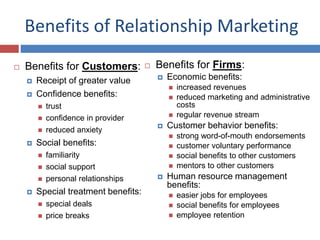
Benefits of Relationship Marketing
 Benefits for Customers:
 Receipt of greater value
 Confidence benefits:
 trust
 confidence in provider
 reduced anxiety
 Social benefits:
 familiarity
 social support
 personal relationships
 Special treatment benefits:
 special deals
 price breaks
 Benefits for Firms:
 Economic benefits:
 increased revenues
 reduced marketing and administrative
costs
 regular revenue stream
 Customer behavior benefits:
 strong word-of-mouth endorsements
 customer voluntary performance
 social benefits to other customers
 mentors to other customers
 Human resource management
benefits:
 easier jobs for employees
 social benefits for employees
 employee retention
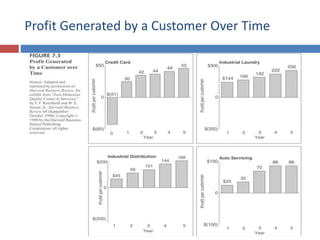
Profit Generated by a Customer Over Time
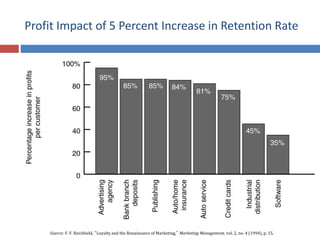
Profit Impact of 5 Percent Increase in Retention Rate
Source: F. F. Reichheld, “Loyalty and the Renaissance of Marketing,” Marketing Management, vol. 2, no. 4 (1994), p. 15.
Customer Loyalty Exercise
 Think of a service provider to whom you are
loyal.
 What do you do (your behaviors, actions,
feelings) that indicates you are loyal?
 Why are you loyal to this provider?
 What factors have influenced the formation of
your loyalty?
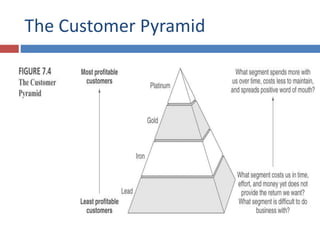
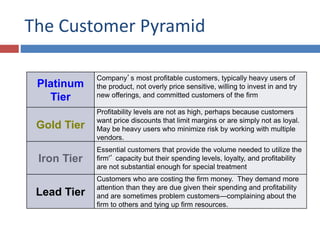
The Customer Pyramid
Platinum
Tier
Company’s most profitable customers, typically heavy users of
the product, not overly price sensitive, willing to invest in and try
new offerings, and committed customers of the firm
Gold Tier
Profitability levels are not as high, perhaps because customers
want price discounts that limit margins or are simply not as loyal.
May be heavy users who minimize risk by working with multiple
vendors.
Iron Tier
Essential customers that provide the volume needed to utilize the
firm'’ capacity but their spending levels, loyalty, and profitability
are not substantial enough for special treatment
Lead Tier
Customers who are costing the firm money. They demand more
attention than they are due given their spending and profitability
and are sometimes problem customers—complaining about the
firm to others and tying up firm resources.
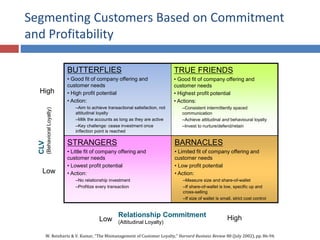
TRUE FRIENDS
• Good fit of company offering and
customer needs
• Highest profit potential
• Actions:
–Consistent intermittently spaced
communication
–Achieve attitudinal and behavioural loyalty
–Invest to nurture/defend/retain
CLV
(BehavioralLoyalty)
Low High
Low
High
BUTTERFLIES
• Good fit of company offering and
customer needs
• High profit potential
• Action:
–Aim to achieve transactional satisfaction, not
attitudinal loyalty
–Milk the accounts as long as they are active
–Key challenge: cease investment once
inflection point is reached
STRANGERS
• Little fit of company offering and
customer needs
• Lowest profit potential
• Action:
–No relationship investment
–Profitize every transaction
BARNACLES
• Limited fit of company offering and
customer needs
• Low profit potential
• Action:
–Measure size and share-of-wallet
–If share-of-wallet is low, specific up and
cross-selling
–If size of wallet is small, strict cost control
Segmenting Customers Based on Commitment
and Profitability
Relationship Commitment
(Attitudinal Loyalty)
W. Reinhartz & V. Kumar, "The Mismanagement of Customer Loyalty," Harvard Business Review 80 (July 2002), pp. 86-94.
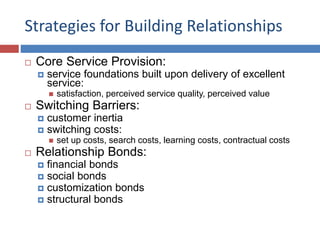
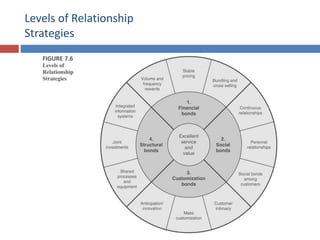
Strategies for Building Relationships
 Core Service Provision:
 service foundations built upon delivery of excellent
service:
 satisfaction, perceived service quality, perceived value
 Switching Barriers:
 customer inertia
 switching costs:
 set up costs, search costs, learning costs, contractual costs
 Relationship Bonds:
 financial bonds
 social bonds
 customization bonds
 structural bonds
Levels of Relationship
Strategies
“The Customer Is NOT Always
Right”
 Not all customers are good relationship
customers:
 wrong segment
 not profitable in the long term
 difficult customers
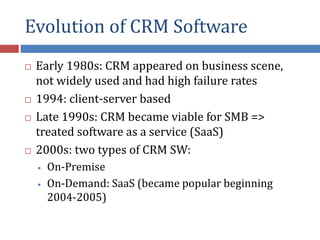
Evolution of CRM Software
 Early 1980s: CRM appeared on business scene,
not widely used and had high failure rates
 1994: client-server based
 Late 1990s: CRM became viable for SMB =>
treated software as a service (SaaS)
 2000s: two types of CRM SW:
• On-Premise
• On-Demand: SaaS (became popular beginning
2004-2005)
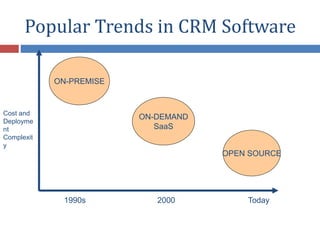
Popular Trends in CRM Software
ON-PREMISE
ON-DEMAND
SaaS
OPEN SOURCE
20001990s Today
Cost and
Deployme
nt
Complexit
y
On-Premise and On-Demand
 On-Premise: implementation, administration and maintenance
of CRM systems in-house, needs HW
• Siebel
• Oracle
• SAP
• PeopleSoft
• Microsoft
 On-Demand (SaaS): subscription-based (pay as much as you
use) with low cost and no HW requirements
• Sales force
• Siebel OD
• NetSuite
• SugarCRM
On-Demand CRM SW
 Advantages
• Low cost due to elimination of capital expenditures (HW)
• Shorter implementation time because no installation needed
• More powerful and secure IT infrastructure
• Much lower risk due to outsourced expertise
• Modification without IT bottleneck
• Automatic and frequent upgrades
• Vested vendor interest: vendor has to take care about IT infrastructure
 Disadvantages
• Third party involvement: vendor controls your software, security and
data
• User’s control over the application is restricted
• Might be costly in the long run
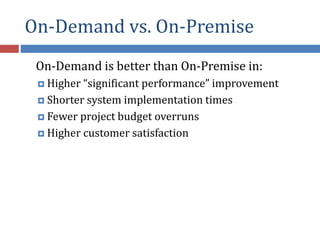
On-Demand vs. On-Premise
On-Demand is better than On-Premise in:
 Higher “significant performance” improvement
 Shorter system implementation times
 Fewer project budget overruns
 Higher customer satisfaction
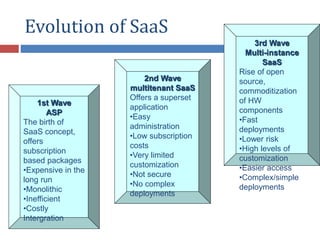
Evolution of SaaS
1st Wave
ASP
The birth of
SaaS concept,
offers
subscription
based packages
•Expensive in the
long run
•Monolithic
•Inefficient
•Costly
Intergration
2nd Wave
multitenant SaaS
Offers a superset
application
•Easy
administration
•Low subscription
costs
•Very limited
customization
•Not secure
•No complex
deployments
3rd Wave
Multi-instance
SaaS
Rise of open
source,
commoditization
of HW
components
•Fast
deployments
•Lower risk
•High levels of
customization
•Easier access
•Complex/simple
deployments
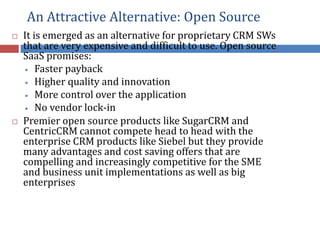
An Attractive Alternative: Open Source
 It is emerged as an alternative for proprietary CRM SWs
that are very expensive and difficult to use. Open source
SaaS promises:
• Faster payback
• Higher quality and innovation
• More control over the application
• No vendor lock-in
 Premier open source products like SugarCRM and
CentricCRM cannot compete head to head with the
enterprise CRM products like Siebel but they provide
many advantages and cost saving offers that are
compelling and increasingly competitive for the SME
and business unit implementations as well as big
enterprises
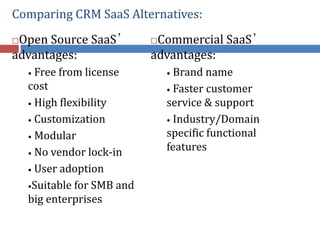
Comparing CRM SaaS Alternatives:
Open Source SaaS’
advantages:
• Free from license
cost
• High flexibility
• Customization
• Modular
• No vendor lock-in
• User adoption
•Suitable for SMB and
big enterprises
Commercial SaaS’
advantages:
• Brand name
• Faster customer
service & support
• Industry/Domain
specific functional
features
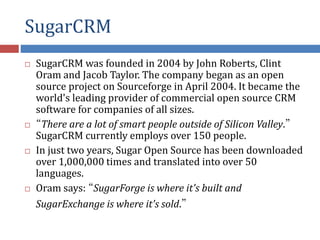
SugarCRM
 SugarCRM was founded in 2004 by John Roberts, Clint
Oram and Jacob Taylor. The company began as an open
source project on Sourceforge in April 2004. It became the
world's leading provider of commercial open source CRM
software for companies of all sizes.
 “There are a lot of smart people outside of Silicon Valley.”
SugarCRM currently employs over 150 people.
 In just two years, Sugar Open Source has been downloaded
over 1,000,000 times and translated into over 50
languages.
 Oram says: “SugarForge is where it's built and
SugarExchange is where it's sold.”
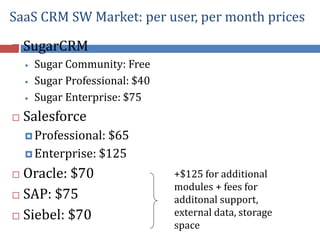
SaaS CRM SW Market: per user, per month prices
 SugarCRM
• Sugar Community: Free
• Sugar Professional: $40
• Sugar Enterprise: $75
 Salesforce
 Professional: $65
 Enterprise: $125
 Oracle: $70
 SAP: $75
 Siebel: $70
+$125 for additional
modules + fees for
additonal support,
external data, storage
space
On-Premise CRM SW Market: per user, per year
prices
 PeopleSoft: $13,500
 Siebel: $11,513 + $25,939 for initial
deployment
FINANCIAL SERVICES
MARKETING
services: an offering in which the dominant part is
intangible, which is the case in most financial services.
Marketing: the process of creating, distributing,
promoting, and pricing goods, services, and ideas to
facilitate satisfying exchange relationships with
customers and to develop and maintain favorable
relationships with stakeholders in a dynamic
environment
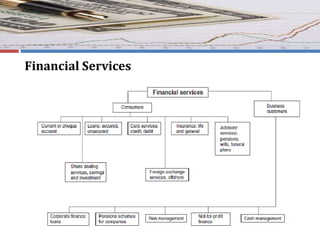
Financial Services
Financial Services Institutions:
Retail, corporate, investment and private banks
• Mutual funds, investment trusts
• Personal and group pensions
• Life and general insurance and reinsurance companies
• Credit card issuers
• Specialist lending companies
• Stock exchanges
• Leasing companies
• Government saving institutions
• Brokers and agents
Financial Services Environment:
A number of external forces have exerted influence on
the sector, including:
1- Socio-economic factors: play an important rule
in determining the demand for financial services.
Ex. Changes in the distribution of income and
wealth and patterns of consumption.
2- Regulatory environment: Regulations have
played a major role in shaping the behavior of
suppliers and offering increased protection to
consumers. Serve to strengthen the procedures
and practices already set in place.
Financial Services Environment:
3- Technology: Traditionally paper-based systems
have become fully automated, providing greater
flexibility and scope for expansion. Without a
doubt, technology holds the key to future long-
term success for financial institutions, from
innovative distribution channels, which are both
cost efficient and effective at delivering customer
service, to customer databases, which enable
better use of target marketing.

Service marketing5

  • 1.
    SERVICE MARKETING Recommended Book:-Zeithaml, Bitner & Gremlar
  • 2.
    PGDM (IIM Raipur) BakhresaFMCG (South Africa) Relationship Manager (HDFC Bank) MD- Shyam Hospital Faculty(MBA)- GLA University, Mathura Swarit Yadav
  • 3.
    Topics to becovered  CRM in services  Relationship marketing  Customer profitability segment  Relationship- tools and strategies  Use of information and technology for CRM  Marketing of financial services
  • 4.
    What is CustomerRelationship Management (CRM)? CRM is “the development and maintenance of mutually beneficial long-term relationships with strategically significant customers” (Buttle, 2000) CRM is “an IT enhanced value process, which identifies, develops, integrates and focuses the various competencies of the firm to the ‘voice’ of the customer in order to deliver long-term superior customer value, at a profit to well identified existing and potential customers”. (Plakoyiannaki and Tzokas, 2001)
  • 5.
    Understanding Customer RelationshipManagement (CRM)? CRM is a business philosophy based on upon individual customers and customised products and services supported by open lines of communication and feedback from the participating firms that mutually benefit both buying and selling organisations. The buying and selling firms enter into a “learning relationship”, with the customer being willing to collaborate with the seller and grow as a loyal customer. In return,, the seller works to maximize the value of the relationship for the customer’s benefit. In short, CRM provides selling organisations with the platform to obtain a competitive advantage by embracing customer needs and building value-driven long-term relationships.
  • 6.
    Determinants of CRM Trust Thewillingness to rely on the ability, integrity, and motivation of one company to serve the needs of the other company as agreed upon implicitly and explicitly. Value The ability of a selling organisation to satisfy the needs of the customer at a comparatively lower cost or higher benefit than that offered by competitors and measured in monetary, temporal, functional and psychological terms.
  • 7.
    Determinants of CRM Inaddition to trust and value, salespeople must: Understand customer needs and problems; Meet their commitments; Provide superior after sales support; Make sure that the customer is always told the truth (must be honest); and Have a passionate interest in establishing and retaining a long- term relationship (e.g., have long-term perspective).
  • 8.
    Stages in thedevelopment of a Customer Relationship The Pre-relationship Stage The event that triggers a buyer to seek a new business partner. The Early Stage Experience is accumulated between the buyer and seller although a great degree of uncertainty and distance exists. The Development Stage Increased levels of transactions lead to a higher degree of commitment and the distance is reduced to a social exchange. The Long-term Stage Characterised by the companies’ mutual importance to each other. The Final Stage The interaction between the companies becomes institutionalized.
  • 9.
    Stages in theDevelopment of a Key-Account Relationship Degree of involvement High Low Nature of customer relationship Transactional Collaborative Pre-KAM Early-KAM Mid-KAM Partnership Synergistic KAM (Millman and Wilson, 1995)
  • 10.
    A Relationship LifeCycle Model High cooperation Low competition Low cooperation High competition Time Pre- relationship stage Development stage Maturity stage Decline stage (Wilkinson and Young, 1997)
  • 11.
    Functions of CustomerRelationship Management Direct functions (are the basic requirements of a company that are necessary to survive in the competitive marketplace) Profit; Volume; and Safeguard Indirect functions (are the actions necessary to convince the customer to participate in various marketing activities). Innovation: Market; Scout: and Access.
  • 12.
    Functions of CustomerRelationship Management Management Decision Process Customer sensitivity •Diversity •Information •Differentiated offering Value Creation Process Technology delivery process •R&D •Technology integration •Efficiency, effectiveness learning Product delivery process •Concept to launch •Manufacturing process Customer delivery process •Supply chain •Distribution •Infomediation (distribution of information) Value-based Strategies •Pricing •Communication (Sharma et. al., 2001)
  • 13.
    The role ofsalespeople as relationship builders and promoters Salespeople by: identifying potential customers and their needs; approaching key decision makers in the buying firm; negotiating and advancing dialogue and mutual trust; coordinating the cooperation between the customers and their company; encouraging the inter-organisational learning process; contributing to constructive resolution of existing conflicts; and leading the customer relationship development team are the individuals in any organisation who act both as relationship builders and as relationship promoters.
  • 14.
    Models of CustomerRelationship Management The Evans and Luskin (1994) model for effective Relationship Marketing Relationship marketing inputs •Understanding customer expectations •Building service partnerships •Empowering employees •Total quality management Relationship marketing outcomes •Customer Satisfaction •Customer loyalty •Quality products •Increased profitability Assessment state •Customer feedback •Integration (Evans and Luskin, 1994)
  • 15.
    Models of CustomerRelationship Management The Brock and Barcklay (1999) model of selling partner relationship effectiveness Independence Relative influence Mutual trust Cooperation Selling partner relationship effectiveness
  • 16.
    Managing Customer Relationships Theglobal salesperson must be involved in the following activities in order to initiate, develop and enhance the process that is aimed at building trust and commitment with the customer. Initiating the relationship Engage in strategic prospecting and qualifying; Gather and study pre-call information; Identify buying influences; Plan the initial sales call; Demonstrate an understanding of the customer’s needs; Identify opportunities to build a relationship; and Illustrate the value of a relationship with the customer
  • 17.
    Managing Customer Relationships Theglobal salesperson must be involved in the following activities in order to initiate, develop and enhance the process that is aimed at building trust and commitment with the customer. Developing the relationship Select an appropriate offering; Customise the relationship; Link the solutions with the customer’s needs; Discuss customer concerns; Summarize the solution to confirm benefits; and Secure commitment.
  • 18.
    Chapter 15: CustomerRelationship Management (CRM) Managing Customer Relationships The global salesperson must be involved in the following activities in order to initiate, develop and enhance the process that is aimed at building trust and commitment with the customer. Enhancing the relationship Assess customer satisfaction; Take action to ensure satisfaction; Maintain open, two-way communication; and Work to add value and enhance mutual opportunities.
  • 19.
    Managing Customer Relationships Qualifyingprospects for relationship building Opportunities for adding value Potential profitability of customer High Low Low High Use a non customized approach Seek better opportunities elsewhere Build a strong and lasting relationship Focus on loyalty-building program
  • 20.
    Relationship networks The ultimateoutcome of a successful CRM strategy is the creation of a unique company asset known as a relationship network. A relationship network consists of the company and its major customers with whom the company has established long and enduring business relationships. The additional aspects of a global salesperson’s job are to: Manage customer value; Act as customer advocate; and Enhance customer loyalty and build a “health” and profitable network of relationships.
  • 21.
    Summary CRM is anew business philosophy based on trust and value; The core function of CRM is the value creation process; Customer relationships develop over time; The role of global salespeople in the process is that of both relationship builders and relationship promoters; and The basic premise of CRM is to offer superior value to customers in an effort to turn prospects into customers, customers into loyal customers, and loyal customers into partners.
  • 22.
    Relationship Marketing  isa philosophy of doing business, a strategic orientation, that focuses on keeping current customers and improving relationships with them  does not necessarily emphasize acquiring new customers  is usually cheaper (for the firm)  keeping a current customer costs less than attracting a new one  thus, the focus is less on attraction, and more on retention and enhancement of customer relationships
  • 23.
    The “Bucket Theoryof Marketing”
  • 24.
    Customer Goals ofRelationship Marketing
  • 25.
    Benefits of RelationshipMarketing  Benefits for Customers:  Receipt of greater value  Confidence benefits:  trust  confidence in provider  reduced anxiety  Social benefits:  familiarity  social support  personal relationships  Special treatment benefits:  special deals  price breaks  Benefits for Firms:  Economic benefits:  increased revenues  reduced marketing and administrative costs  regular revenue stream  Customer behavior benefits:  strong word-of-mouth endorsements  customer voluntary performance  social benefits to other customers  mentors to other customers  Human resource management benefits:  easier jobs for employees  social benefits for employees  employee retention
  • 26.
    Profit Generated bya Customer Over Time
  • 27.
    Profit Impact of5 Percent Increase in Retention Rate Source: F. F. Reichheld, “Loyalty and the Renaissance of Marketing,” Marketing Management, vol. 2, no. 4 (1994), p. 15.
  • 28.
    Customer Loyalty Exercise Think of a service provider to whom you are loyal.  What do you do (your behaviors, actions, feelings) that indicates you are loyal?  Why are you loyal to this provider?  What factors have influenced the formation of your loyalty?
  • 29.
  • 30.
    The Customer Pyramid Platinum Tier Company’smost profitable customers, typically heavy users of the product, not overly price sensitive, willing to invest in and try new offerings, and committed customers of the firm Gold Tier Profitability levels are not as high, perhaps because customers want price discounts that limit margins or are simply not as loyal. May be heavy users who minimize risk by working with multiple vendors. Iron Tier Essential customers that provide the volume needed to utilize the firm'’ capacity but their spending levels, loyalty, and profitability are not substantial enough for special treatment Lead Tier Customers who are costing the firm money. They demand more attention than they are due given their spending and profitability and are sometimes problem customers—complaining about the firm to others and tying up firm resources.
  • 31.
    TRUE FRIENDS • Goodfit of company offering and customer needs • Highest profit potential • Actions: –Consistent intermittently spaced communication –Achieve attitudinal and behavioural loyalty –Invest to nurture/defend/retain CLV (BehavioralLoyalty) Low High Low High BUTTERFLIES • Good fit of company offering and customer needs • High profit potential • Action: –Aim to achieve transactional satisfaction, not attitudinal loyalty –Milk the accounts as long as they are active –Key challenge: cease investment once inflection point is reached STRANGERS • Little fit of company offering and customer needs • Lowest profit potential • Action: –No relationship investment –Profitize every transaction BARNACLES • Limited fit of company offering and customer needs • Low profit potential • Action: –Measure size and share-of-wallet –If share-of-wallet is low, specific up and cross-selling –If size of wallet is small, strict cost control Segmenting Customers Based on Commitment and Profitability Relationship Commitment (Attitudinal Loyalty) W. Reinhartz & V. Kumar, "The Mismanagement of Customer Loyalty," Harvard Business Review 80 (July 2002), pp. 86-94.
  • 32.
    Strategies for BuildingRelationships  Core Service Provision:  service foundations built upon delivery of excellent service:  satisfaction, perceived service quality, perceived value  Switching Barriers:  customer inertia  switching costs:  set up costs, search costs, learning costs, contractual costs  Relationship Bonds:  financial bonds  social bonds  customization bonds  structural bonds
  • 33.
  • 34.
    “The Customer IsNOT Always Right”  Not all customers are good relationship customers:  wrong segment  not profitable in the long term  difficult customers
  • 35.
    Evolution of CRMSoftware  Early 1980s: CRM appeared on business scene, not widely used and had high failure rates  1994: client-server based  Late 1990s: CRM became viable for SMB => treated software as a service (SaaS)  2000s: two types of CRM SW: • On-Premise • On-Demand: SaaS (became popular beginning 2004-2005)
  • 36.
    Popular Trends inCRM Software ON-PREMISE ON-DEMAND SaaS OPEN SOURCE 20001990s Today Cost and Deployme nt Complexit y
  • 37.
    On-Premise and On-Demand On-Premise: implementation, administration and maintenance of CRM systems in-house, needs HW • Siebel • Oracle • SAP • PeopleSoft • Microsoft  On-Demand (SaaS): subscription-based (pay as much as you use) with low cost and no HW requirements • Sales force • Siebel OD • NetSuite • SugarCRM
  • 38.
    On-Demand CRM SW Advantages • Low cost due to elimination of capital expenditures (HW) • Shorter implementation time because no installation needed • More powerful and secure IT infrastructure • Much lower risk due to outsourced expertise • Modification without IT bottleneck • Automatic and frequent upgrades • Vested vendor interest: vendor has to take care about IT infrastructure  Disadvantages • Third party involvement: vendor controls your software, security and data • User’s control over the application is restricted • Might be costly in the long run
  • 39.
    On-Demand vs. On-Premise On-Demandis better than On-Premise in:  Higher “significant performance” improvement  Shorter system implementation times  Fewer project budget overruns  Higher customer satisfaction
  • 40.
    Evolution of SaaS 1stWave ASP The birth of SaaS concept, offers subscription based packages •Expensive in the long run •Monolithic •Inefficient •Costly Intergration 2nd Wave multitenant SaaS Offers a superset application •Easy administration •Low subscription costs •Very limited customization •Not secure •No complex deployments 3rd Wave Multi-instance SaaS Rise of open source, commoditization of HW components •Fast deployments •Lower risk •High levels of customization •Easier access •Complex/simple deployments
  • 41.
    An Attractive Alternative:Open Source  It is emerged as an alternative for proprietary CRM SWs that are very expensive and difficult to use. Open source SaaS promises: • Faster payback • Higher quality and innovation • More control over the application • No vendor lock-in  Premier open source products like SugarCRM and CentricCRM cannot compete head to head with the enterprise CRM products like Siebel but they provide many advantages and cost saving offers that are compelling and increasingly competitive for the SME and business unit implementations as well as big enterprises
  • 42.
    Comparing CRM SaaSAlternatives: Open Source SaaS’ advantages: • Free from license cost • High flexibility • Customization • Modular • No vendor lock-in • User adoption •Suitable for SMB and big enterprises Commercial SaaS’ advantages: • Brand name • Faster customer service & support • Industry/Domain specific functional features
  • 43.
    SugarCRM  SugarCRM wasfounded in 2004 by John Roberts, Clint Oram and Jacob Taylor. The company began as an open source project on Sourceforge in April 2004. It became the world's leading provider of commercial open source CRM software for companies of all sizes.  “There are a lot of smart people outside of Silicon Valley.” SugarCRM currently employs over 150 people.  In just two years, Sugar Open Source has been downloaded over 1,000,000 times and translated into over 50 languages.  Oram says: “SugarForge is where it's built and SugarExchange is where it's sold.”
  • 44.
    SaaS CRM SWMarket: per user, per month prices  SugarCRM • Sugar Community: Free • Sugar Professional: $40 • Sugar Enterprise: $75  Salesforce  Professional: $65  Enterprise: $125  Oracle: $70  SAP: $75  Siebel: $70 +$125 for additional modules + fees for additonal support, external data, storage space
  • 45.
    On-Premise CRM SWMarket: per user, per year prices  PeopleSoft: $13,500  Siebel: $11,513 + $25,939 for initial deployment
  • 46.
    FINANCIAL SERVICES MARKETING services: anoffering in which the dominant part is intangible, which is the case in most financial services. Marketing: the process of creating, distributing, promoting, and pricing goods, services, and ideas to facilitate satisfying exchange relationships with customers and to develop and maintain favorable relationships with stakeholders in a dynamic environment
  • 47.
  • 48.
    Financial Services Institutions: Retail,corporate, investment and private banks • Mutual funds, investment trusts • Personal and group pensions • Life and general insurance and reinsurance companies • Credit card issuers • Specialist lending companies • Stock exchanges • Leasing companies • Government saving institutions • Brokers and agents
  • 49.
    Financial Services Environment: Anumber of external forces have exerted influence on the sector, including: 1- Socio-economic factors: play an important rule in determining the demand for financial services. Ex. Changes in the distribution of income and wealth and patterns of consumption. 2- Regulatory environment: Regulations have played a major role in shaping the behavior of suppliers and offering increased protection to consumers. Serve to strengthen the procedures and practices already set in place.
  • 50.
    Financial Services Environment: 3-Technology: Traditionally paper-based systems have become fully automated, providing greater flexibility and scope for expansion. Without a doubt, technology holds the key to future long- term success for financial institutions, from innovative distribution channels, which are both cost efficient and effective at delivering customer service, to customer databases, which enable better use of target marketing.