CUSTOMER
RELATIONSHIPS:
Relationship
Marketing
www.reallygreatsite.com
CUSTOMER VALUE, SATISFACTION
AND RELATIONSHIPS
To be successful, a brand must have a value proposition to its
customers.
• This is seen as the brand’s promise to the customers to provide
benefits that would satisfy their needs or wants.
Customer Value – the unique combination of benefits targeted
buyers receive, including quality, price, convenience, on-time
delivery, and both before and after service.
Alternative Ways for
Creating Value
Increasing the benefits
• means adding something to the
product that customers would
find meaningful, important,
useful, and unique.
Best price – ex. Cebu Pacific
Best Product – ex. Apple
Best service – ex. Starbucks
Reducing the Sacrifice – ex. On-time
home delivery, installment schemes
CUSTOMER SATISFACTION
• The marketer’s job is to satisfy or
even exceed customers’ expectations,
as high satisfaction levels have
been found to lead to higher levels
of loyalty.
• A relationship with happy, loyal
customers is something that all
companies would wants to work for.
CUSTOMER RELATIONSHIPS
• Every marketer aspires to have
a relationship with their target
market that is characterized by
a high level of customer loyalty.
• Many marketers even try their
best to go beyond just loyalty
and work hard to earn the love
of their existing customers.
• They know that brands that are
loved usually command a deeper
level of loyalty and this kind of
loyalty then becomes a huge
sustainable advantage over
competition.
• Ex. Nike, Coke
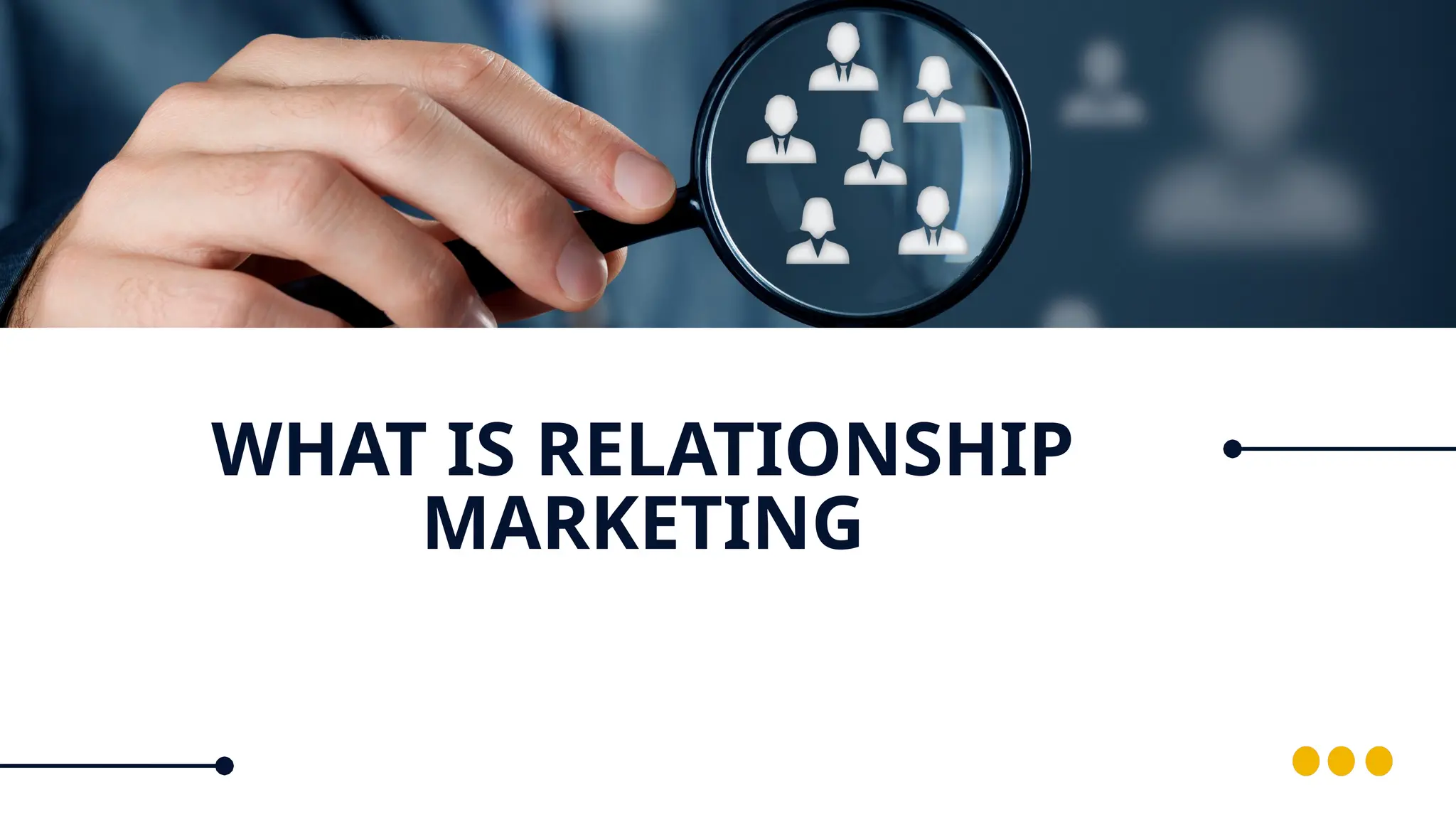
WHAT IS RELATIONSHIP
MARKETING
It is the development of a
marketing program with the
right marketing mix that seeks
to establish closer links with the
customer.
It is seen as the key to
developing and maintaining
close relationships with targeted
customers.
RELATIONSHIP MARKETING
• It is simply building and
managing relationships. This
would involve developing
personal and ongoing ties
between company and the
customers.
• It is a perspective in marketing
that recognizes that customers no
longer buy just goods; they also
consider the service that comes
with the product.
RELATIONSHIP MARKETING
• The shift to relationship
marketing represents a move
from short-term transaction-
oriented goals toward a long-
term relationship-building
goal.
• Relationship marketing focuses on
value-creating processes.
• There are two key elements of
relationship marketing: promise
and trust.
TYPES OF RELATIONSHIP MARKETING
• Experiential marketing –
allows the consumer to
experience the brand, usually
by utilizing multiple touch
points and targeting multiple
senses.
• Ex. Contest, online activities;
Milo conducting a Sports clinic
• Permission marketing – to
encourage customers to be a part
of a longer-term marketing
campaign by inviting them to join
and providing an incentive for
them to remain within the
campaign.
TYPES OF RELATIONSHIP MARKETING
• One-to-one marketing –
focuses more on the individual
consumer with the company
customizing its products and
services for that individual.
• Ex. SM Advantage card holders
give exclusive sales for them.
Customer Relationship Management
• It is the process of identifying
prospective buyers, understanding
them intimately, and developing
favorable long-term perceptions of
the organization and its offerings so
that buyers will choose them in the
marketplace.
Customer Relationship Management
• This is more
complicated than it
sounds as this implies
the involvement and
commitment of all
employees in the
organization in order to
make this work from top
management to rank
and file.
• This also requires the
use of technology that
would be necessary to
gather essential
information, process
this information in a
meaningful way, and
assign this information
to the different offices
that would maximize
the use of this.
Customer Relationship Management
• This is more
complicated than it
sounds as this implies
the involvement and
commitment of all
employees in the
organization in order to
make this work from top
management to rank
and file.
• This also requires the
use of technology that
would be necessary to
gather essential
information, process
this information in a
meaningful way, and
assign this information
to the different offices
that would maximize
the use of this.
MARKETING PROCESS
Target Market
Information on needs/wants
Discover specific needs/wants
Develop concepts for products
Design a marketing program for 4
Ps
Goods, services, experiences or
ideas
Customer Relationships and Its
Changing Nature
• Modern marketing
emphasize the need to
create more involved
customers with a sense
of commonality with the
brand.
• The idea is that the
brand or the product
must be made a part of
the life of the consumer
and their conversations.
• The new orientation
toward the customer
would also mean that
promotions should
become more of a 2-way
communication process
instead of just 1-way.
• Constant dialogue with
the market is now seen
a requirements,
necessitating
establishment of a
systematic, interactive
process of asking and
answering questions.
LEARNING ACTIVITY (Individual)
• Share specific instances when you were
dissatisfied or disappointed with a brand.
• Discuss possible actions that the brand can do to
reestablish a good relationship with you.

Customer Relationship Management for ABM

  • 1.
  • 2.
  • 3.
    To be successful,a brand must have a value proposition to its customers. • This is seen as the brand’s promise to the customers to provide benefits that would satisfy their needs or wants. Customer Value – the unique combination of benefits targeted buyers receive, including quality, price, convenience, on-time delivery, and both before and after service.
  • 4.
    Alternative Ways for CreatingValue Increasing the benefits • means adding something to the product that customers would find meaningful, important, useful, and unique. Best price – ex. Cebu Pacific Best Product – ex. Apple Best service – ex. Starbucks Reducing the Sacrifice – ex. On-time home delivery, installment schemes
  • 5.
    CUSTOMER SATISFACTION • Themarketer’s job is to satisfy or even exceed customers’ expectations, as high satisfaction levels have been found to lead to higher levels of loyalty. • A relationship with happy, loyal customers is something that all companies would wants to work for.
  • 6.
    CUSTOMER RELATIONSHIPS • Everymarketer aspires to have a relationship with their target market that is characterized by a high level of customer loyalty. • Many marketers even try their best to go beyond just loyalty and work hard to earn the love of their existing customers. • They know that brands that are loved usually command a deeper level of loyalty and this kind of loyalty then becomes a huge sustainable advantage over competition. • Ex. Nike, Coke
  • 7.
  • 8.
    It is thedevelopment of a marketing program with the right marketing mix that seeks to establish closer links with the customer. It is seen as the key to developing and maintaining close relationships with targeted customers.
  • 9.
    RELATIONSHIP MARKETING • Itis simply building and managing relationships. This would involve developing personal and ongoing ties between company and the customers. • It is a perspective in marketing that recognizes that customers no longer buy just goods; they also consider the service that comes with the product.
  • 10.
    RELATIONSHIP MARKETING • Theshift to relationship marketing represents a move from short-term transaction- oriented goals toward a long- term relationship-building goal. • Relationship marketing focuses on value-creating processes. • There are two key elements of relationship marketing: promise and trust.
  • 11.
    TYPES OF RELATIONSHIPMARKETING • Experiential marketing – allows the consumer to experience the brand, usually by utilizing multiple touch points and targeting multiple senses. • Ex. Contest, online activities; Milo conducting a Sports clinic • Permission marketing – to encourage customers to be a part of a longer-term marketing campaign by inviting them to join and providing an incentive for them to remain within the campaign.
  • 12.
    TYPES OF RELATIONSHIPMARKETING • One-to-one marketing – focuses more on the individual consumer with the company customizing its products and services for that individual. • Ex. SM Advantage card holders give exclusive sales for them.
  • 13.
    Customer Relationship Management •It is the process of identifying prospective buyers, understanding them intimately, and developing favorable long-term perceptions of the organization and its offerings so that buyers will choose them in the marketplace.
  • 14.
    Customer Relationship Management •This is more complicated than it sounds as this implies the involvement and commitment of all employees in the organization in order to make this work from top management to rank and file. • This also requires the use of technology that would be necessary to gather essential information, process this information in a meaningful way, and assign this information to the different offices that would maximize the use of this.
  • 15.
    Customer Relationship Management •This is more complicated than it sounds as this implies the involvement and commitment of all employees in the organization in order to make this work from top management to rank and file. • This also requires the use of technology that would be necessary to gather essential information, process this information in a meaningful way, and assign this information to the different offices that would maximize the use of this.
  • 16.
    MARKETING PROCESS Target Market Informationon needs/wants Discover specific needs/wants Develop concepts for products Design a marketing program for 4 Ps Goods, services, experiences or ideas
  • 17.
    Customer Relationships andIts Changing Nature • Modern marketing emphasize the need to create more involved customers with a sense of commonality with the brand. • The idea is that the brand or the product must be made a part of the life of the consumer and their conversations. • The new orientation toward the customer would also mean that promotions should become more of a 2-way communication process instead of just 1-way. • Constant dialogue with the market is now seen a requirements, necessitating establishment of a systematic, interactive process of asking and answering questions.
  • 18.
    LEARNING ACTIVITY (Individual) •Share specific instances when you were dissatisfied or disappointed with a brand. • Discuss possible actions that the brand can do to reestablish a good relationship with you.