Muhammad Rabbani
rabbanimuhammad559@gmail.com
Lecture overview
 Five Basic Operators of Relational
Algebra:
 Select
 Project
 Union
 Intersection
 Cartesian product
6) Formulating queries
Relational Algebra
 The relational algebra is a procedural
query language
 It consists of a set of operations that
take one or two relations as input and
produce a new relation as their result
 There are five basic operations of
relational algebra.
Unary Operations
 These are those operations, which
involve only one relation or table
 These are:
 Select
 Project
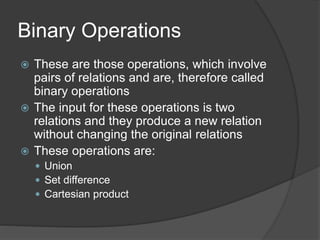
Binary Operations
 These are those operations, which involve
pairs of relations and are, therefore called
binary operations
 The input for these operations is two
relations and they produce a new relation
without changing the original relations
 These operations are:
 Union
 Set difference
 Cartesian product
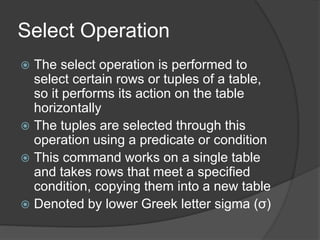
Select Operation
 The select operation is performed to
select certain rows or tuples of a table,
so it performs its action on the table
horizontally
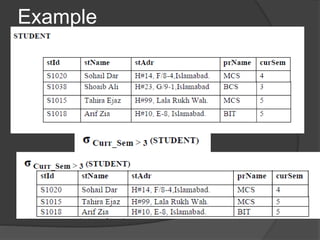
 The tuples are selected through this
operation using a predicate or condition
 This command works on a single table
and takes rows that meet a specified
condition, copying them into a new table
 Denoted by lower Greek letter sigma (σ)
Example
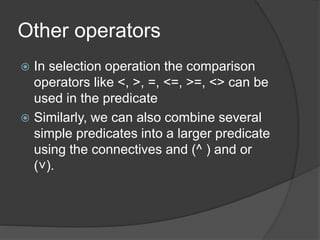
Other operators
 In selection operation the comparison
operators like <, >, =, <=, >=, <> can be
used in the predicate
 Similarly, we can also combine several
simple predicates into a larger predicate
using the connectives and (^ ) and or
(˅).
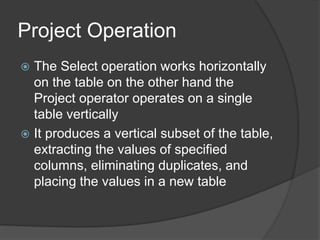
Project Operation
 The Select operation works horizontally
on the table on the other hand the
Project operator operates on a single
table vertically
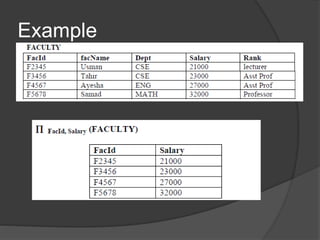
 It produces a vertical subset of the table,
extracting the values of specified
columns, eliminating duplicates, and
placing the values in a new table
Project Operation
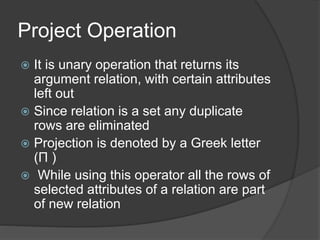
 It is unary operation that returns its
argument relation, with certain attributes
left out
 Since relation is a set any duplicate
rows are eliminated
 Projection is denoted by a Greek letter
(Π )
 While using this operator all the rows of
selected attributes of a relation are part
of new relation
Example
Composition of relational
operators
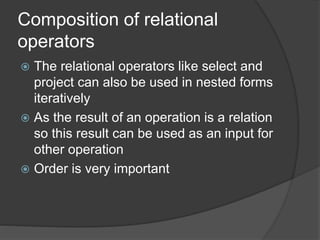
 The relational operators like select and
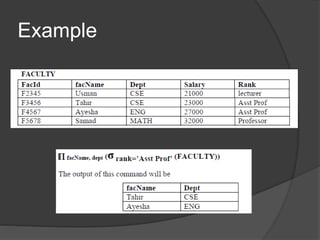
project can also be used in nested forms
iteratively
 As the result of an operation is a relation
so this result can be used as an input for
other operation
 Order is very important
Example
Binary Operations
 These are those operations, which involve
pairs of relations and are, therefore called
binary operations
 The input for these operations is two
relations and they produce a new relation
without changing the original relations
 These operations are:
 Union
 Set difference
 Cartesian product
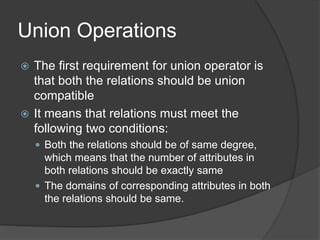
Union Operations
 The first requirement for union operator is
that both the relations should be union
compatible
 It means that relations must meet the
following two conditions:
 Both the relations should be of same degree,
which means that the number of attributes in
both relations should be exactly same
 The domains of corresponding attributes in both
the relations should be same.
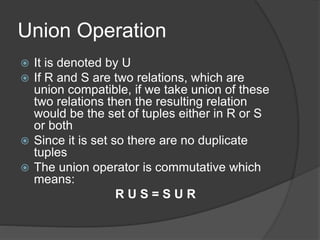
Union Operation
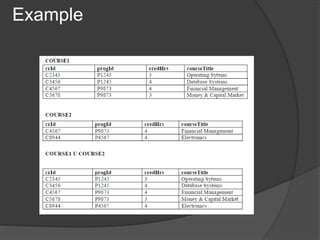
 It is denoted by U
 If R and S are two relations, which are
union compatible, if we take union of these
two relations then the resulting relation
would be the set of tuples either in R or S
or both
 Since it is set so there are no duplicate
tuples
 The union operator is commutative which
means:
R U S = S U R
Example
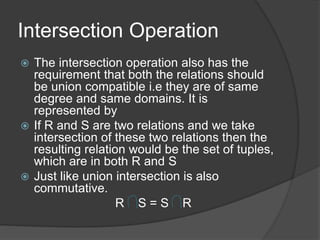
Intersection Operation
 The intersection operation also has the
requirement that both the relations should
be union compatible i.e they are of same
degree and same domains. It is
represented by
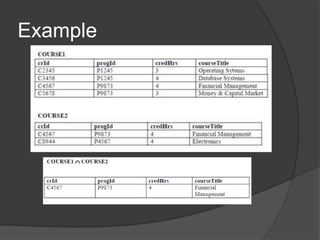
 If R and S are two relations and we take
intersection of these two relations then the
resulting relation would be the set of tuples,
which are in both R and S
 Just like union intersection is also
commutative.
R S = S R
Example
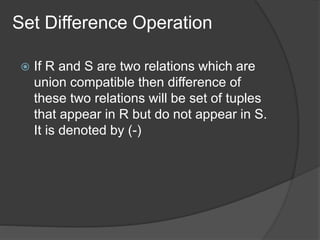
Set Difference Operation
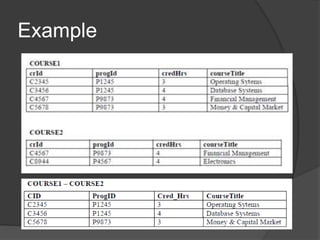
 If R and S are two relations which are
union compatible then difference of
these two relations will be set of tuples
that appear in R but do not appear in S.
It is denoted by (-)
Example
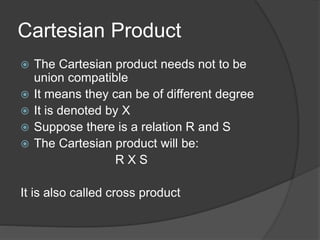
Cartesian Product
 The Cartesian product needs not to be
union compatible
 It means they can be of different degree
 It is denoted by X
 Suppose there is a relation R and S
 The Cartesian product will be:
R X S
It is also called cross product
Example
Lab Activity-10
 Hide columns
 Create relationships
Next Lecture
 Relational Algebra 2 (Joins)

relational algebra-(basics)

  • 1.
  • 2.
    Lecture overview  FiveBasic Operators of Relational Algebra:  Select  Project  Union  Intersection  Cartesian product 6) Formulating queries
  • 3.
    Relational Algebra  Therelational algebra is a procedural query language  It consists of a set of operations that take one or two relations as input and produce a new relation as their result  There are five basic operations of relational algebra.
  • 4.
    Unary Operations  Theseare those operations, which involve only one relation or table  These are:  Select  Project
  • 5.
    Binary Operations  Theseare those operations, which involve pairs of relations and are, therefore called binary operations  The input for these operations is two relations and they produce a new relation without changing the original relations  These operations are:  Union  Set difference  Cartesian product
  • 6.
    Select Operation  Theselect operation is performed to select certain rows or tuples of a table, so it performs its action on the table horizontally  The tuples are selected through this operation using a predicate or condition  This command works on a single table and takes rows that meet a specified condition, copying them into a new table  Denoted by lower Greek letter sigma (σ)
  • 7.
  • 8.
    Other operators  Inselection operation the comparison operators like <, >, =, <=, >=, <> can be used in the predicate  Similarly, we can also combine several simple predicates into a larger predicate using the connectives and (^ ) and or (˅).
  • 9.
    Project Operation  TheSelect operation works horizontally on the table on the other hand the Project operator operates on a single table vertically  It produces a vertical subset of the table, extracting the values of specified columns, eliminating duplicates, and placing the values in a new table
  • 10.
    Project Operation  Itis unary operation that returns its argument relation, with certain attributes left out  Since relation is a set any duplicate rows are eliminated  Projection is denoted by a Greek letter (Π )  While using this operator all the rows of selected attributes of a relation are part of new relation
  • 11.
  • 12.
    Composition of relational operators The relational operators like select and project can also be used in nested forms iteratively  As the result of an operation is a relation so this result can be used as an input for other operation  Order is very important
  • 13.
  • 14.
    Binary Operations  Theseare those operations, which involve pairs of relations and are, therefore called binary operations  The input for these operations is two relations and they produce a new relation without changing the original relations  These operations are:  Union  Set difference  Cartesian product
  • 15.
    Union Operations  Thefirst requirement for union operator is that both the relations should be union compatible  It means that relations must meet the following two conditions:  Both the relations should be of same degree, which means that the number of attributes in both relations should be exactly same  The domains of corresponding attributes in both the relations should be same.
  • 16.
    Union Operation  Itis denoted by U  If R and S are two relations, which are union compatible, if we take union of these two relations then the resulting relation would be the set of tuples either in R or S or both  Since it is set so there are no duplicate tuples  The union operator is commutative which means: R U S = S U R
  • 17.
  • 18.
    Intersection Operation  Theintersection operation also has the requirement that both the relations should be union compatible i.e they are of same degree and same domains. It is represented by  If R and S are two relations and we take intersection of these two relations then the resulting relation would be the set of tuples, which are in both R and S  Just like union intersection is also commutative. R S = S R
  • 19.
  • 20.
    Set Difference Operation If R and S are two relations which are union compatible then difference of these two relations will be set of tuples that appear in R but do not appear in S. It is denoted by (-)
  • 21.
  • 22.
    Cartesian Product  TheCartesian product needs not to be union compatible  It means they can be of different degree  It is denoted by X  Suppose there is a relation R and S  The Cartesian product will be: R X S It is also called cross product
  • 23.
  • 24.
    Lab Activity-10  Hidecolumns  Create relationships
  • 25.
    Next Lecture  RelationalAlgebra 2 (Joins)