Relational Algebra
• RelationalAlgebra is procedural query language,
which takes Relation as input and generates
relation as output.
• Relational algebra mainly provides theoretical
foundation for relational databases and SQL.
• Relational algebra is a procedural query language.
• It gives a step by step process to obtain the result
of the query. It uses operators to perform queries.
3.
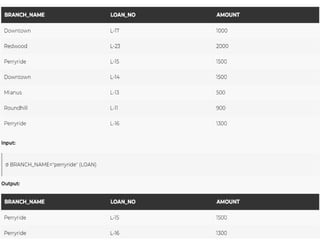
1. Select Operation:
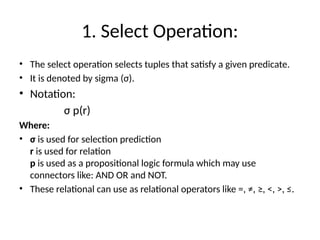
•The select operation selects tuples that satisfy a given predicate.
• It is denoted by sigma (σ).
• Notation:
σ p(r)
Where:
• σ is used for selection prediction
r is used for relation
p is used as a propositional logic formula which may use
connectors like: AND OR and NOT.
• These relational can use as relational operators like =, ≠, ≥, <, >, ≤.
5.
2. Project Operation
•This operation shows the list of those attributes
that we wish to appear in the result. Rest of the
attributes are eliminated from the table.
• It is denoted by ∏.
• Notation: ∏ A1, A2, An (r)
• Where
• A1, A2, A3 is used as an attribute name of
relation r.
6.
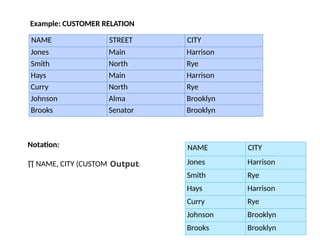
NAME STREET CITY
JonesMain Harrison
Smith North Rye
Hays Main Harrison
Curry North Rye
Johnson Alma Brooklyn
Brooks Senator Brooklyn
Example: CUSTOMER RELATION
Notation:
∏ NAME, CITY (CUSTOMER)
NAME CITY
Jones Harrison
Smith Rye
Hays Harrison
Curry Rye
Johnson Brooklyn
Brooks Brooklyn
Output:
7.
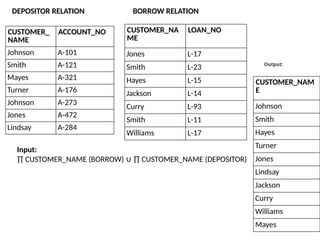
3. Union Operation
•Suppose there are two tuples R and S. The union
operation contains all the tuples that are either in R
or S or both in R & S.
• It eliminates the duplicate tuples. It is denoted by .
∪
• Notation: R S
∪
• A union operation must hold the following condition:
• R and S must have the attribute of the same number.
• Duplicate tuples are eliminated automatically.
8.
CUSTOMER_
NAME
ACCOUNT_NO
Johnson A-101
Smith A-121
MayesA-321
Turner A-176
Johnson A-273
Jones A-472
Lindsay A-284
DEPOSITOR RELATION
CUSTOMER_NA
ME
LOAN_NO
Jones L-17
Smith L-23
Hayes L-15
Jackson L-14
Curry L-93
Smith L-11
Williams L-17
BORROW RELATION
Input:
∏ CUSTOMER_NAME (BORROW) ∏ CUSTOMER_NAME (DEPOSITOR)
∪
CUSTOMER_NAM
E
Johnson
Smith
Hayes
Turner
Jones
Lindsay
Jackson
Curry
Williams
Mayes
Output:
9.
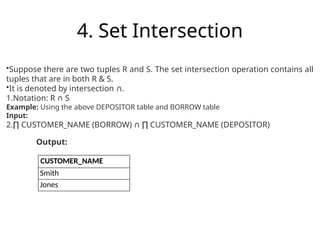
4. Set Intersection
CUSTOMER_NAME
Smith
Jones
•Supposethere are two tuples R and S. The set intersection operation contains all
tuples that are in both R & S.
•It is denoted by intersection .
∩
1.Notation: R S
∩
Example: Using the above DEPOSITOR table and BORROW table
Input:
2.∏ CUSTOMER_NAME (BORROW) CUSTOMER_NAME (DEPOSITOR)
∩ ∏
Output:
10.
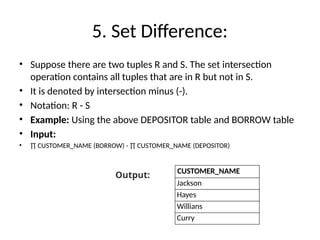
5. Set Difference:
•Suppose there are two tuples R and S. The set intersection
operation contains all tuples that are in R but not in S.
• It is denoted by intersection minus (-).
• Notation: R - S
• Example: Using the above DEPOSITOR table and BORROW table
• Input:
• ∏ CUSTOMER_NAME (BORROW) - ∏ CUSTOMER_NAME (DEPOSITOR)
CUSTOMER_NAME
Jackson
Hayes
Willians
Curry
Output:
11.
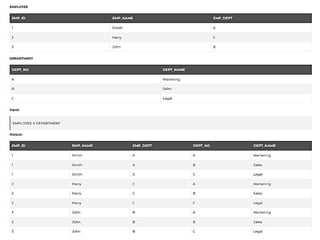
6. Cartesian product
•The Cartesian product is used to combine each
row in one table with each row in the other
table. It is also known as a cross product.
• It is denoted by X.
• Notation: E X D
13.
7. Rename Operation
•The rename operation is used to rename the
output relation. It is denoted by rho (ρ).
• Example: We can use the rename operator to
rename STUDENT relation to STUDENT1.
• ρ(STUDENT1, STUDENT)