What is echo?

By- Master Rohan Chakraborty
Dictionary meaning of echo?
• ech·o/ˈekō/
• Noun: A sound or series of sounds caused by
  the reflection of sound waves from a surface
  back to the listener: "the walls threw back
  echoes".
What’s exactly an ECHO?
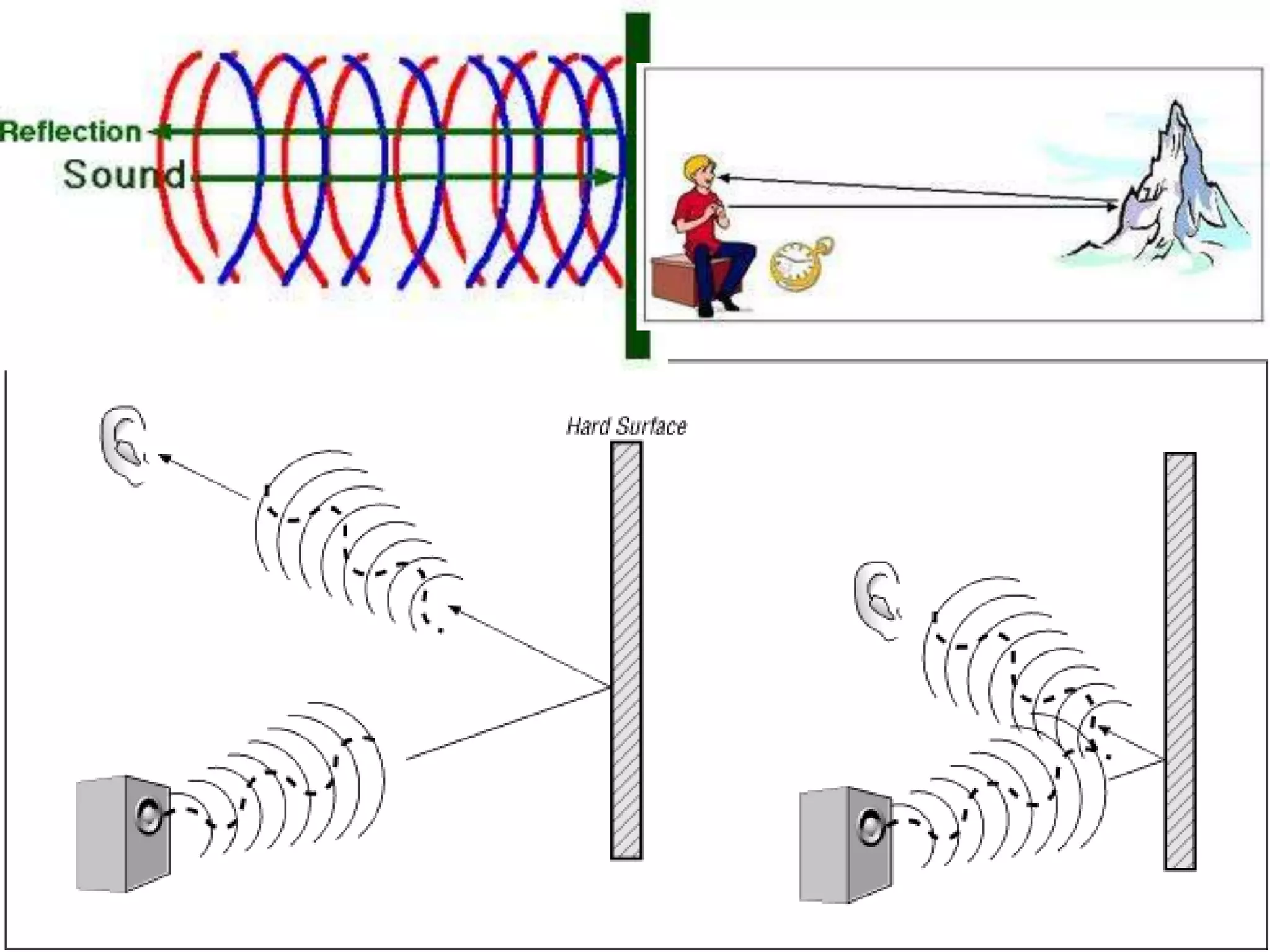
• An echo Is a reflection of sound.
• Typical examples are the echo produced by
  the bottom of a well, by a building, or by the
  walls of an enclosed room and an empty
  room. A true echo is a single reflection of the
  sound source. The time delay is the extra
  distance divided by the speed of sound.
• Echoes happen because sound bounces off
  things.
• You probably knew that already. But
  something else has to happen as well; just
  bouncing won't make an echo.
• After all, you don't hear an echo when you yell
  in your bedroom, even though the sound is
  bouncing off the walls.
• The first requirement for an echo is distance.
• Sound travels fast ... about 300 metres in one second.

• A really good echo will return to you after several long
  seconds ... that's what makes it eerie.

• For our purposes, let's suppose that any sound that
  returns within half a second will overlap with your own
  voice and not make a distinguishable echo.

     So how far must an echo travel in order to return at
    least half a second later?
•
Remember that it must go out and then come
back to you. At 300 meters per second, or 150
meters per half-second, it needs to travel at least
150 meters in total ... or 75 meters out and 75
meters back.
As a result, to get a good echo, the sound must
bounce off something at least 75 meters away.
Otherwise, it will return in less than half a second,
and won't make a good echo.

What is echo

  • 1.
    What is echo? By-Master Rohan Chakraborty
  • 2.
    Dictionary meaning ofecho? • ech·o/ˈekō/ • Noun: A sound or series of sounds caused by the reflection of sound waves from a surface back to the listener: "the walls threw back echoes".
  • 4.
    What’s exactly anECHO? • An echo Is a reflection of sound. • Typical examples are the echo produced by the bottom of a well, by a building, or by the walls of an enclosed room and an empty room. A true echo is a single reflection of the sound source. The time delay is the extra distance divided by the speed of sound.
  • 5.
    • Echoes happenbecause sound bounces off things. • You probably knew that already. But something else has to happen as well; just bouncing won't make an echo. • After all, you don't hear an echo when you yell in your bedroom, even though the sound is bouncing off the walls.
  • 6.
    • The firstrequirement for an echo is distance. • Sound travels fast ... about 300 metres in one second. • A really good echo will return to you after several long seconds ... that's what makes it eerie. • For our purposes, let's suppose that any sound that returns within half a second will overlap with your own voice and not make a distinguishable echo. So how far must an echo travel in order to return at least half a second later? •
  • 7.
    Remember that itmust go out and then come back to you. At 300 meters per second, or 150 meters per half-second, it needs to travel at least 150 meters in total ... or 75 meters out and 75 meters back. As a result, to get a good echo, the sound must bounce off something at least 75 meters away. Otherwise, it will return in less than half a second, and won't make a good echo.