REGULATORY AFFAIRS
Prepared by;
Kusuma Latha Beera,
M.Pharmacy ,1st sem
GITAM Institute Of Pharmacy,
GITAM [ Deemed to be university ]
 Master Formula Record (MFR)
 Drug Master File (DMF)
REGULATORY
AFFAIRS
 Regulatory Affairs is a new profession which developed from
the desire of government to protect public health by
controlling the safety and efficacy of the products in areas
including Pharmaceuticals, Veterinary medicines, medical
devices, pesticides, agrochemicals, cosmetics and
complementary medicines.
 It is an interference between the pharmaceutical company
and regulatory agencies across the world.
Role of Regulatory Affairs :
 Responsible for the presentation of registration documents to
regulatory agencies and carry all the subsequent negotiations
necessary to obtain and maintain marketing authorization for
the products concerned.
 To give the strategic and technical advice to R & D,
production, QC departments.
 Manages the scientific data.
 Provides guidance for development through wisdom
collected from previous experience, marketing
precedence and helps to reduce the number of
development failures.
 Regulations are put in order to develop the most
efficient, safe and quality pharmaceutical products.
 REGULATORY AFFAIRS is a rewarding, intellectually
simulating and highly regarded profession with
pharmaceutical companies.
“ If it isn’t Documented,
it didn’t happened ”
Document :
 Any written statement or proof.
Documentation :
 Any communicable material that is used to describe, explain
or instruct some attributes.
 It is an essential part of Quality Assurance and Quality Control
system and it is related to all aspects of Good Manufacturing
Practices.
MASTER FORMULA RECORD
 Master Formula Record is a product specific document
compiled, checked, authorized and approved by
competent technical personnel from different
departments.
 Provides complete description of;
• Development
• Manufacturing
• Production
• Packaging
• Quality
• Purity
• Identity
• Strength of each dose
throughout the shelf life
 Master Formula Record is prepared to achieve uniformity
within batch to batch.
 A Master Formula Record shall ;
• Maintain separate master copy
• Should be prepared and endorsed by head of
manufacturing department.
•W.H.O – Master Production / Controlling Record
(According to GDP)
 Role of Master Formula Record [MFR] according to the
guidelines from different countries;
• European Guidelines : MFR is not only for every batch
but it includes manufacturing formula and
instructions to be maintained for each product that to
be manufactured in one document.
• Canadian Guidelines : MFR is set of documents
specifying the raw materials with quantities and
packaging materials with detailed descriptions of
manufacturing procedures and precautions required
to produce the specified quantity.
• US Guidelines : MFR is written to ensure uniformity from
batch to batch and consists of Master Production Control
for each batch size where as it should be dated and
signed by one, checked by one, again dated , signed and
checked by another persons for approval.
Structure Of Master Formula Record :
 Patent or proprietary name of the product
 Pharmacopoeial or Generic name of the product & its strength
 Dosage form & physical characteristics of the product
 Sufficient detailed information of product pack & primary
packing of materials.
 Identity, quality & quantity of every ingredient including assay
values based quantities.
 Brief description of Raw materials.
 Broad outline of the process for manufacture.
 Brief description of equipment or machinery used for
manufacturing the product.
 Step-wise manufacturing process.
 Theoretical and practical yields at different stages of
manufacture.
 Sufficient details on precautions to be taken during
manufacturing to ensure good product quality & personnel
safety.
 Analytical controls including limits, thereof applicable to
finished product.
 Stability test results covering the assigned shelf life.
 Ensures the product history data giving references in
manufacturing or packaging introduced over the year.
 Availability of samples of printed packaging components.
Components :
 Name of the product along with its reference code.
 Patent or proprietary name of the product along with its generic
name.
 Dosage form name.
 Specifications for all starting materials used.
 Methods or reference to methods used for preparing and
operating the equipments.
 Dispensing instructions
 Step-wise processing instructions.
 Instructions for in-process control.
 Instructions for storage conditions of product including
container labelling and special storage conditions.
 Packing details with specimen labels.
 Precautions to be taken.
 Finished products specification.
 Expiry Date
Procedure :
 A Master Formula Record is either prepared based upon
experience of competent qualified staff [ Analytical Chemist /
Manufacturing Chemist ] or prepared based upon on the
manufacturing record of a batch size.
 Master Formula Record cannot be ignored. Once it is prepared
it is transferred to previous staff to new staff.
 It is followed as a standard document for processing a batch
Conclusion:
 These documents are prepared to achieve uniformity
within batch to batch and to minimise errors.
DRUG MASTER FILE
Drug Master File :
 It is a document prepared by Pharmaceutical Manufacturer and
submitted solely at its discretion to appropriate regulatory
authority in the intended drug market. [ followed by submission
of information to FDA ]
 It provides the regulatory authority with ;
 Confidential detailed information [ Chemistry, Manufacturing &
Control
 Process or articles used in manufacturing
 Complete information of API or Finished dosage form
 Processing
 Stability
 Purity
 Impurity profile
 Packaging
 Storage
 c-GMP status
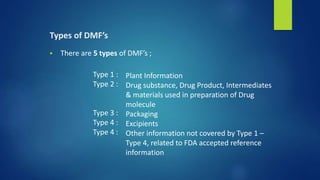
Types of DMF’s
 There are 5 types of DMF’s ;
Type 1 :
Type 2 :
Type 3 :
Type 4 :
Type 4 :
Plant Information
Drug substance, Drug Product, Intermediates
& materials used in preparation of Drug
molecule
Packaging
Excipients
Other information not covered by Type 1 –
Type 4, related to FDA accepted reference
information
Type 1 : Plant Information ;
 Includes .,
• Manufacturing site
• Equipment Capabilities
• Operational layout
• Site Address
• Head Quarters
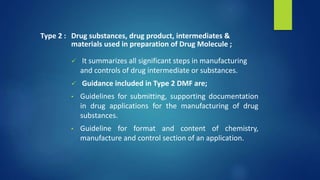
 It summarizes all significant steps in manufacturing
and controls of drug intermediate or substances.
 Guidance included in Type 2 DMF are;
• Guidelines for submitting, supporting documentation
in drug applications for the manufacturing of drug
substances.
• Guideline for format and content of chemistry,
manufacture and control section of an application.
Type 2 : Drug substances, drug product, intermediates &
materials used in preparation of Drug Molecule ;
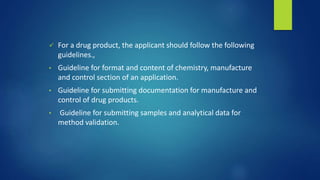
 For a drug product, the applicant should follow the following
guidelines.,
• Guideline for format and content of chemistry, manufacture
and control section of an application.
• Guideline for submitting documentation for manufacture and
control of drug products.
• Guideline for submitting samples and analytical data for
method validation.
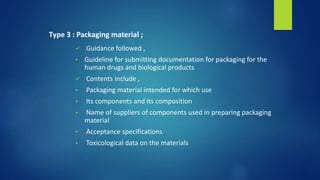
Type 3 : Packaging material ;
 Guidance followed ,
• Guideline for submitting documentation for packaging for the
human drugs and biological products
 Contents include ,
• Packaging material intended for which use
• Its components and its composition
• Name of suppliers of components used in preparing packaging
material
• Acceptance specifications
• Toxicological data on the materials
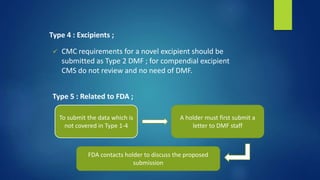
Type 4 : Excipients ;
 CMC requirements for a novel excipient should be
submitted as Type 2 DMF ; for compendial excipient
CMS do not review and no need of DMF.
Type 5 : Related to FDA ;
To submit the data which is
not covered in Type 1-4
A holder must first submit a
letter to DMF staff
FDA contacts holder to discuss the proposed
submission
Submission of DMF :
 Each DMF submission must contain ;
o Transmittal Letter
o Administrative information
o Technical information
 Transmittal Letter :
 Original submissions and amendments ;
 Identification of submission [ original / supportive to original
DMF
 Type of DMF & Subject [ update, revised formula or revised
process ]
 Name & address of each sponsor, applicant / holder & all
document numbers
 Signature of holder
 Type written name & title of signer
 Administrative information :
 Original Submissions ;
 Name and address of DMF folder, head quarters,
manufacturing facility, contact for FDA correspondence,
agents.
 Specific responsibilities of each person listed above
 Statement of commitment
 Amendments ;
 Name of DMF folder, DMF number, name & address for
correspondence, page no.
 Name of person authorized to incorporate information in
DMF by reference.
 Number of each IND, NDA, ANDA ,DMF that relies on
submission of amendment for support.
 Specific products covered by DMF.
 Statement of commitment when DMF is existing currently
and DMF folder will complain with statement given.
 Particular items within IND, NDA, ANDA,DMF and export
application that are affected, if known.
 Signature of authorizing commission.
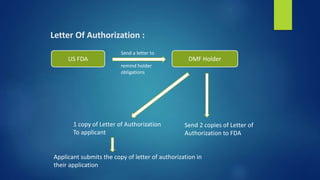
Letter Of Authorization :
US FDA DMF Holder
Send a letter to
remind holder
obligations
1 copy of Letter of Authorization
To applicant
Applicant submits the copy of letter of authorization in
their application
Send 2 copies of Letter of
Authorization to FDA
Importance of LOA :
 Sending LOA is the only mechanism which triggers the review
procedure of DMF
 A letter of authorization permits the FDA to reference the DMF
Applicable laws :
 Food Drug and Cosmetic Act [ FD & C Act ]
 Food Drug and Administration Safety Information Act [
FDASIA ]
 The Generic Drug User Fee Act [ GDUFA ]
 Prescription Drug User Fee Act [ PDUFA ]
Applicable Regulation :
 314 New Drug Application [NDA] and
Abbreviated NDA [ANDA]
• 314.50 Content and Format of an application
• 314.70 Changes to an Approved Application
• 314.420 Drug Master Files
Annual Update Of DMF :
 The holder should provide an annual report on the
anniversary date of original submission.
 If the subject matters of DMF is unchanged, DMF holder
should provide a statement that the subject matter of
DMF is current.
 Failure to update can cause delays in FDA review of
pending IND, NDA, ANDA or any supplement to such
application and FDA can initiate for closure of DMF.
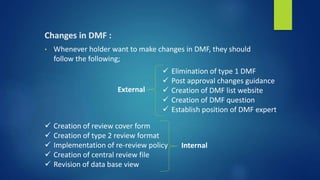
Changes in DMF :
• Whenever holder want to make changes in DMF, they should
follow the following;
 Elimination of type 1 DMF
 Post approval changes guidance
 Creation of DMF list website
 Creation of DMF question
 Establish position of DMF expert
External
 Creation of review cover form
 Creation of type 2 review format
 Implementation of re-review policy
 Creation of central review file
 Revision of data base view
Internal
 To make changes, notice should be given.
 Once change is made in DMF, authorised persons list should be
there for approval.
 Whenever there is updation in annual record the holder should
mention that DMF is updated & should include the holder name,
date of updation & DMF number.
 Holder should always give to the same authorized person to
make work easy.
 If authorized person has left, new person should be nominated.
 If there is no updation, DMF should be named as current DMF.
 If there is no updation, then NDA, INDA, ANDA process will slow
down.
 Any transfer of NDA / ANDA, the aim of transferring should be
mentioned as.,
• The name of the transfer
• Address of the transfer
• Name of responsible official for transferring
• Effective date of transferring
• Signature of the transferring official
• Title of the person
• Letter of acceptance [ Information given should be updated
after acceptance]
 Re-organisation of DMF, sufficient time is given to
individuals.
 Closure of DMF should be noticed to authorities, that
holder want to close the DMF
Conclusion :
 The DMF system present challenges for both the industry and
FDA.
 This system minimises the problems with full understanding
of their responsibilities and adherence to guidelines on part
of holders and applicants.
References:
https://www.fda.gov/drugs/guidancecomplianceregulatoryinformation/guidan
ces/ucm122886.htm
https://www.pharmaguideline.com/2016/07/preparation-of-mfr-for-
pharmaceuticals.html
http://www.who.int/immunization_standards/vaccine_quality/guide_to_master_
formulae_final_2012.pdf
Regulatory affairs

Regulatory affairs

  • 1.
    REGULATORY AFFAIRS Prepared by; KusumaLatha Beera, M.Pharmacy ,1st sem GITAM Institute Of Pharmacy, GITAM [ Deemed to be university ]  Master Formula Record (MFR)  Drug Master File (DMF)
  • 2.
  • 3.
     Regulatory Affairsis a new profession which developed from the desire of government to protect public health by controlling the safety and efficacy of the products in areas including Pharmaceuticals, Veterinary medicines, medical devices, pesticides, agrochemicals, cosmetics and complementary medicines.  It is an interference between the pharmaceutical company and regulatory agencies across the world.
  • 4.
    Role of RegulatoryAffairs :  Responsible for the presentation of registration documents to regulatory agencies and carry all the subsequent negotiations necessary to obtain and maintain marketing authorization for the products concerned.  To give the strategic and technical advice to R & D, production, QC departments.  Manages the scientific data.
  • 5.
     Provides guidancefor development through wisdom collected from previous experience, marketing precedence and helps to reduce the number of development failures.  Regulations are put in order to develop the most efficient, safe and quality pharmaceutical products.  REGULATORY AFFAIRS is a rewarding, intellectually simulating and highly regarded profession with pharmaceutical companies.
  • 6.
    “ If itisn’t Documented, it didn’t happened ”
  • 7.
    Document :  Anywritten statement or proof. Documentation :  Any communicable material that is used to describe, explain or instruct some attributes.  It is an essential part of Quality Assurance and Quality Control system and it is related to all aspects of Good Manufacturing Practices.
  • 8.
  • 9.
     Master FormulaRecord is a product specific document compiled, checked, authorized and approved by competent technical personnel from different departments.  Provides complete description of; • Development • Manufacturing • Production • Packaging • Quality • Purity • Identity • Strength of each dose throughout the shelf life
  • 10.
     Master FormulaRecord is prepared to achieve uniformity within batch to batch.  A Master Formula Record shall ; • Maintain separate master copy • Should be prepared and endorsed by head of manufacturing department. •W.H.O – Master Production / Controlling Record (According to GDP)
  • 11.
     Role ofMaster Formula Record [MFR] according to the guidelines from different countries; • European Guidelines : MFR is not only for every batch but it includes manufacturing formula and instructions to be maintained for each product that to be manufactured in one document. • Canadian Guidelines : MFR is set of documents specifying the raw materials with quantities and packaging materials with detailed descriptions of manufacturing procedures and precautions required to produce the specified quantity.
  • 12.
    • US Guidelines: MFR is written to ensure uniformity from batch to batch and consists of Master Production Control for each batch size where as it should be dated and signed by one, checked by one, again dated , signed and checked by another persons for approval.
  • 13.
    Structure Of MasterFormula Record :  Patent or proprietary name of the product  Pharmacopoeial or Generic name of the product & its strength  Dosage form & physical characteristics of the product  Sufficient detailed information of product pack & primary packing of materials.  Identity, quality & quantity of every ingredient including assay values based quantities.  Brief description of Raw materials.  Broad outline of the process for manufacture.
  • 14.
     Brief descriptionof equipment or machinery used for manufacturing the product.  Step-wise manufacturing process.  Theoretical and practical yields at different stages of manufacture.  Sufficient details on precautions to be taken during manufacturing to ensure good product quality & personnel safety.  Analytical controls including limits, thereof applicable to finished product.  Stability test results covering the assigned shelf life.
  • 15.
     Ensures theproduct history data giving references in manufacturing or packaging introduced over the year.  Availability of samples of printed packaging components.
  • 16.
    Components :  Nameof the product along with its reference code.  Patent or proprietary name of the product along with its generic name.  Dosage form name.  Specifications for all starting materials used.  Methods or reference to methods used for preparing and operating the equipments.  Dispensing instructions
  • 17.
     Step-wise processinginstructions.  Instructions for in-process control.  Instructions for storage conditions of product including container labelling and special storage conditions.  Packing details with specimen labels.  Precautions to be taken.  Finished products specification.  Expiry Date
  • 18.
    Procedure :  AMaster Formula Record is either prepared based upon experience of competent qualified staff [ Analytical Chemist / Manufacturing Chemist ] or prepared based upon on the manufacturing record of a batch size.  Master Formula Record cannot be ignored. Once it is prepared it is transferred to previous staff to new staff.  It is followed as a standard document for processing a batch
  • 19.
    Conclusion:  These documentsare prepared to achieve uniformity within batch to batch and to minimise errors.
  • 20.
  • 21.
    Drug Master File:  It is a document prepared by Pharmaceutical Manufacturer and submitted solely at its discretion to appropriate regulatory authority in the intended drug market. [ followed by submission of information to FDA ]  It provides the regulatory authority with ;  Confidential detailed information [ Chemistry, Manufacturing & Control  Process or articles used in manufacturing  Complete information of API or Finished dosage form
  • 22.
     Processing  Stability Purity  Impurity profile  Packaging  Storage  c-GMP status
  • 23.
    Types of DMF’s There are 5 types of DMF’s ; Type 1 : Type 2 : Type 3 : Type 4 : Type 4 : Plant Information Drug substance, Drug Product, Intermediates & materials used in preparation of Drug molecule Packaging Excipients Other information not covered by Type 1 – Type 4, related to FDA accepted reference information
  • 24.
    Type 1 :Plant Information ;  Includes ., • Manufacturing site • Equipment Capabilities • Operational layout • Site Address • Head Quarters
  • 25.
     It summarizesall significant steps in manufacturing and controls of drug intermediate or substances.  Guidance included in Type 2 DMF are; • Guidelines for submitting, supporting documentation in drug applications for the manufacturing of drug substances. • Guideline for format and content of chemistry, manufacture and control section of an application. Type 2 : Drug substances, drug product, intermediates & materials used in preparation of Drug Molecule ;
  • 26.
     For adrug product, the applicant should follow the following guidelines., • Guideline for format and content of chemistry, manufacture and control section of an application. • Guideline for submitting documentation for manufacture and control of drug products. • Guideline for submitting samples and analytical data for method validation.
  • 27.
    Type 3 :Packaging material ;  Guidance followed , • Guideline for submitting documentation for packaging for the human drugs and biological products  Contents include , • Packaging material intended for which use • Its components and its composition • Name of suppliers of components used in preparing packaging material • Acceptance specifications • Toxicological data on the materials
  • 28.
    Type 4 :Excipients ;  CMC requirements for a novel excipient should be submitted as Type 2 DMF ; for compendial excipient CMS do not review and no need of DMF. Type 5 : Related to FDA ; To submit the data which is not covered in Type 1-4 A holder must first submit a letter to DMF staff FDA contacts holder to discuss the proposed submission
  • 29.
    Submission of DMF:  Each DMF submission must contain ; o Transmittal Letter o Administrative information o Technical information
  • 30.
     Transmittal Letter:  Original submissions and amendments ;  Identification of submission [ original / supportive to original DMF  Type of DMF & Subject [ update, revised formula or revised process ]  Name & address of each sponsor, applicant / holder & all document numbers  Signature of holder  Type written name & title of signer
  • 31.
     Administrative information:  Original Submissions ;  Name and address of DMF folder, head quarters, manufacturing facility, contact for FDA correspondence, agents.  Specific responsibilities of each person listed above  Statement of commitment  Amendments ;  Name of DMF folder, DMF number, name & address for correspondence, page no.
  • 32.
     Name ofperson authorized to incorporate information in DMF by reference.  Number of each IND, NDA, ANDA ,DMF that relies on submission of amendment for support.  Specific products covered by DMF.  Statement of commitment when DMF is existing currently and DMF folder will complain with statement given.  Particular items within IND, NDA, ANDA,DMF and export application that are affected, if known.  Signature of authorizing commission.
  • 33.
    Letter Of Authorization: US FDA DMF Holder Send a letter to remind holder obligations 1 copy of Letter of Authorization To applicant Applicant submits the copy of letter of authorization in their application Send 2 copies of Letter of Authorization to FDA
  • 34.
    Importance of LOA:  Sending LOA is the only mechanism which triggers the review procedure of DMF  A letter of authorization permits the FDA to reference the DMF
  • 35.
    Applicable laws : Food Drug and Cosmetic Act [ FD & C Act ]  Food Drug and Administration Safety Information Act [ FDASIA ]  The Generic Drug User Fee Act [ GDUFA ]  Prescription Drug User Fee Act [ PDUFA ] Applicable Regulation :  314 New Drug Application [NDA] and Abbreviated NDA [ANDA] • 314.50 Content and Format of an application • 314.70 Changes to an Approved Application • 314.420 Drug Master Files
  • 36.
    Annual Update OfDMF :  The holder should provide an annual report on the anniversary date of original submission.  If the subject matters of DMF is unchanged, DMF holder should provide a statement that the subject matter of DMF is current.  Failure to update can cause delays in FDA review of pending IND, NDA, ANDA or any supplement to such application and FDA can initiate for closure of DMF.
  • 37.
    Changes in DMF: • Whenever holder want to make changes in DMF, they should follow the following;  Elimination of type 1 DMF  Post approval changes guidance  Creation of DMF list website  Creation of DMF question  Establish position of DMF expert External  Creation of review cover form  Creation of type 2 review format  Implementation of re-review policy  Creation of central review file  Revision of data base view Internal
  • 38.
     To makechanges, notice should be given.  Once change is made in DMF, authorised persons list should be there for approval.  Whenever there is updation in annual record the holder should mention that DMF is updated & should include the holder name, date of updation & DMF number.  Holder should always give to the same authorized person to make work easy.  If authorized person has left, new person should be nominated.  If there is no updation, DMF should be named as current DMF.
  • 39.
     If thereis no updation, then NDA, INDA, ANDA process will slow down.  Any transfer of NDA / ANDA, the aim of transferring should be mentioned as., • The name of the transfer • Address of the transfer • Name of responsible official for transferring • Effective date of transferring • Signature of the transferring official • Title of the person • Letter of acceptance [ Information given should be updated after acceptance]
  • 40.
     Re-organisation ofDMF, sufficient time is given to individuals.  Closure of DMF should be noticed to authorities, that holder want to close the DMF
  • 41.
    Conclusion :  TheDMF system present challenges for both the industry and FDA.  This system minimises the problems with full understanding of their responsibilities and adherence to guidelines on part of holders and applicants.
  • 42.