Refractometry
Madhuri Shelar (M pharm)
Assistant Professor
Alard College of Pharmacy
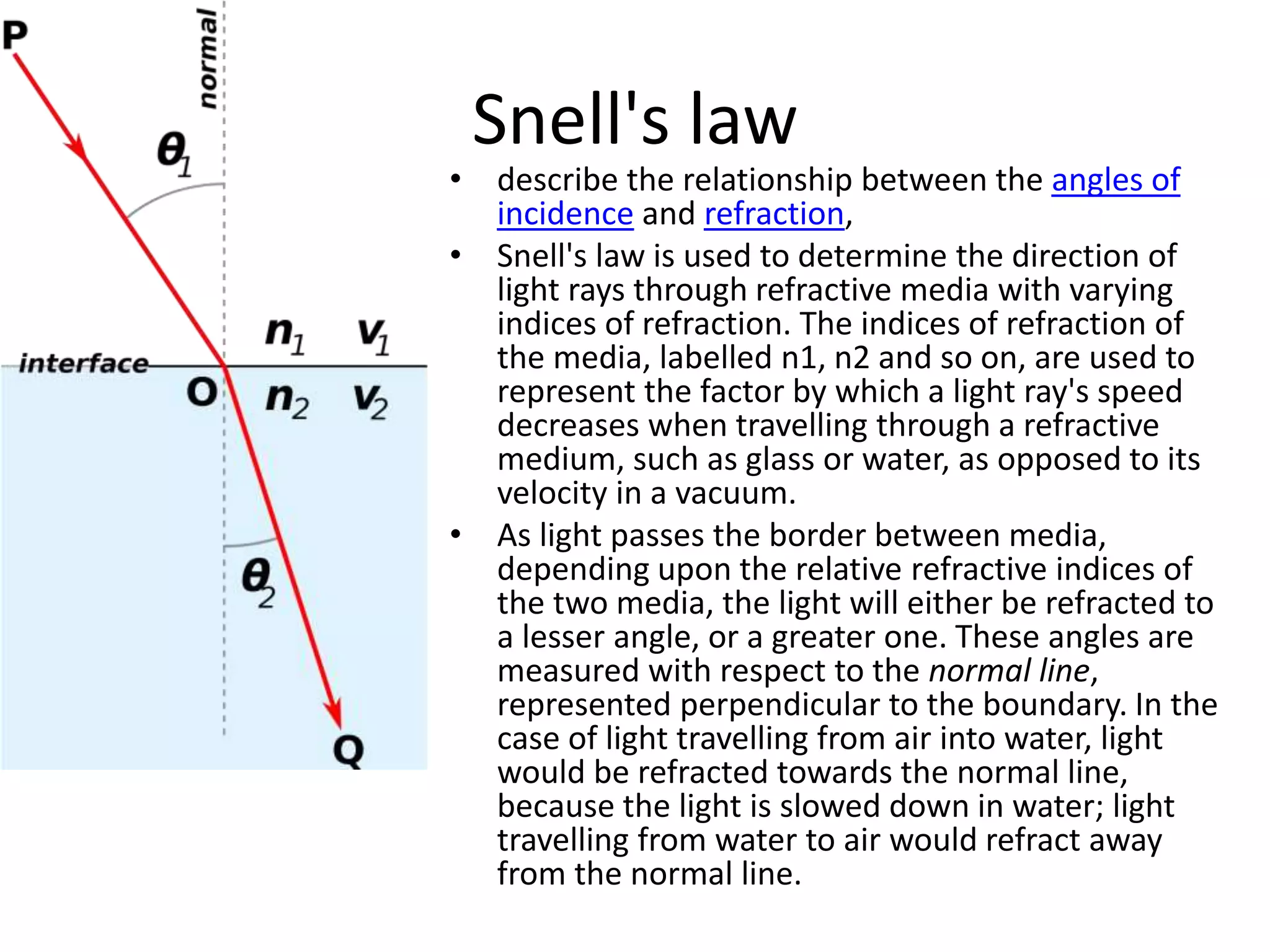
Snell's law
• describe the relationship between the angles of
incidence and refraction,
• Snell's law is used to determine the direction of
light rays through refractive media with varying
indices of refraction. The indices of refraction of
the media, labelled n1, n2 and so on, are used to
represent the factor by which a light ray's speed
decreases when travelling through a refractive
medium, such as glass or water, as opposed to its
velocity in a vacuum.
• As light passes the border between media,
depending upon the relative refractive indices of
the two media, the light will either be refracted to
a lesser angle, or a greater one. These angles are
measured with respect to the normal line,
represented perpendicular to the boundary. In the
case of light travelling from air into water, light
would be refracted towards the normal line,
because the light is slowed down in water; light
travelling from water to air would refract away
from the normal line.
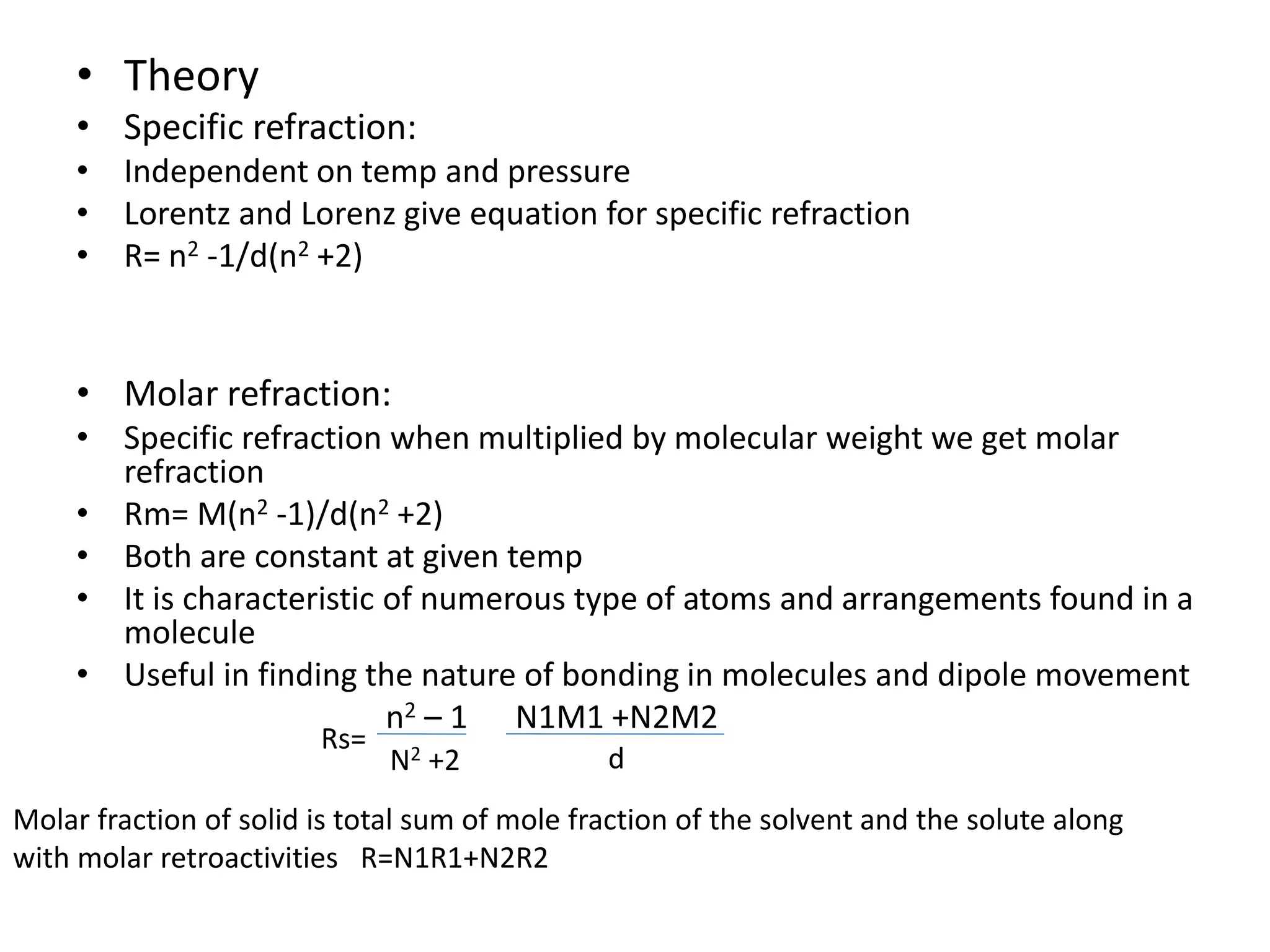
• Theory
• Specific refraction:
• Independent on temp and pressure
• Lorentz and Lorenz give equation for specific refraction
• R= n2 -1/d(n2 +2)
• Molar refraction:
• Specific refraction when multiplied by molecular weight we get molar
refraction
• Rm= M(n2 -1)/d(n2 +2)
• Both are constant at given temp
• It is characteristic of numerous type of atoms and arrangements found in a
molecule
• Useful in finding the nature of bonding in molecules and dipole movement
n2 – 1 N1M1 +N2M2
N2 +2
Rs=
d
Molar fraction of solid is total sum of mole fraction of the solvent and the solute along
with molar retroactivities R=N1R1+N2R2
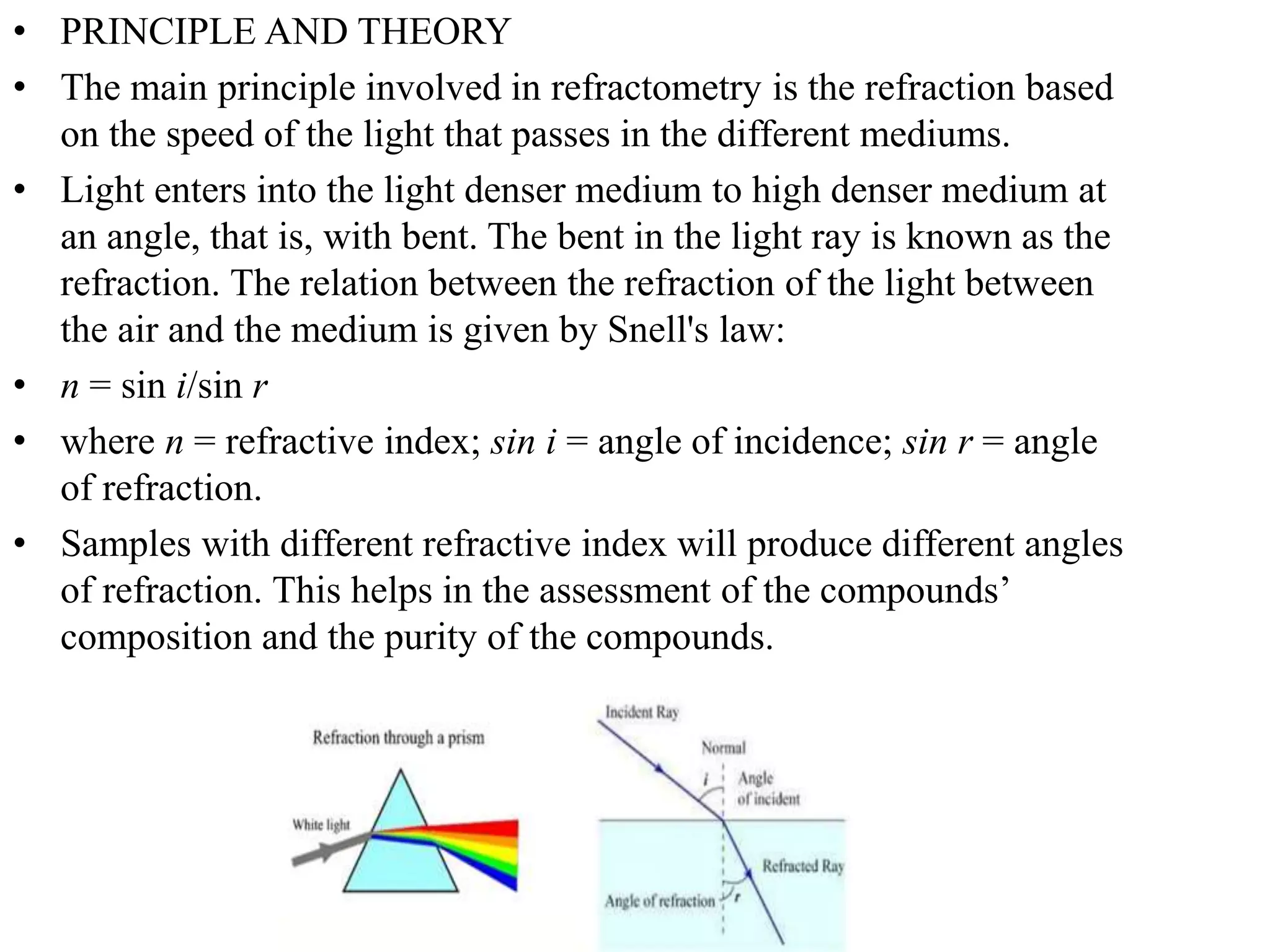
• PRINCIPLE AND THEORY
• The main principle involved in refractometry is the refraction based
on the speed of the light that passes in the different mediums.
• Light enters into the light denser medium to high denser medium at
an angle, that is, with bent. The bent in the light ray is known as the
refraction. The relation between the refraction of the light between
the air and the medium is given by Snell's law:
• n = sin i/sin r
• where n = refractive index; sin i = angle of incidence; sin r = angle
of refraction.
• Samples with different refractive index will produce different angles
of refraction. This helps in the assessment of the compounds’
composition and the purity of the compounds.
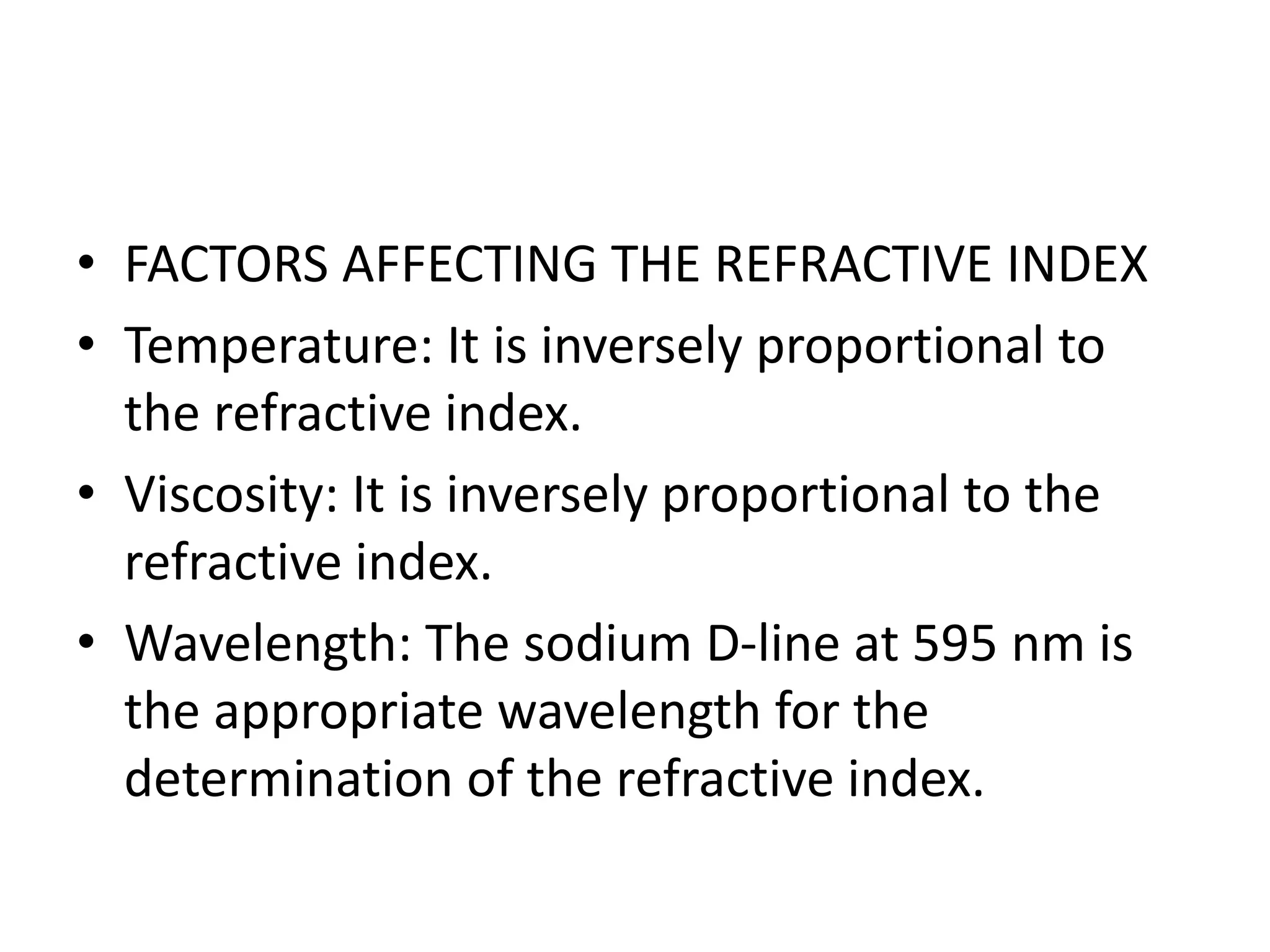
• FACTORS AFFECTING THE REFRACTIVE INDEX
• Temperature: It is inversely proportional to
the refractive index.
• Viscosity: It is inversely proportional to the
refractive index.
• Wavelength: The sodium D-line at 595 nm is
the appropriate wavelength for the
determination of the refractive index.
Measurement of RI
• Two types of instruments
1. Refractometer
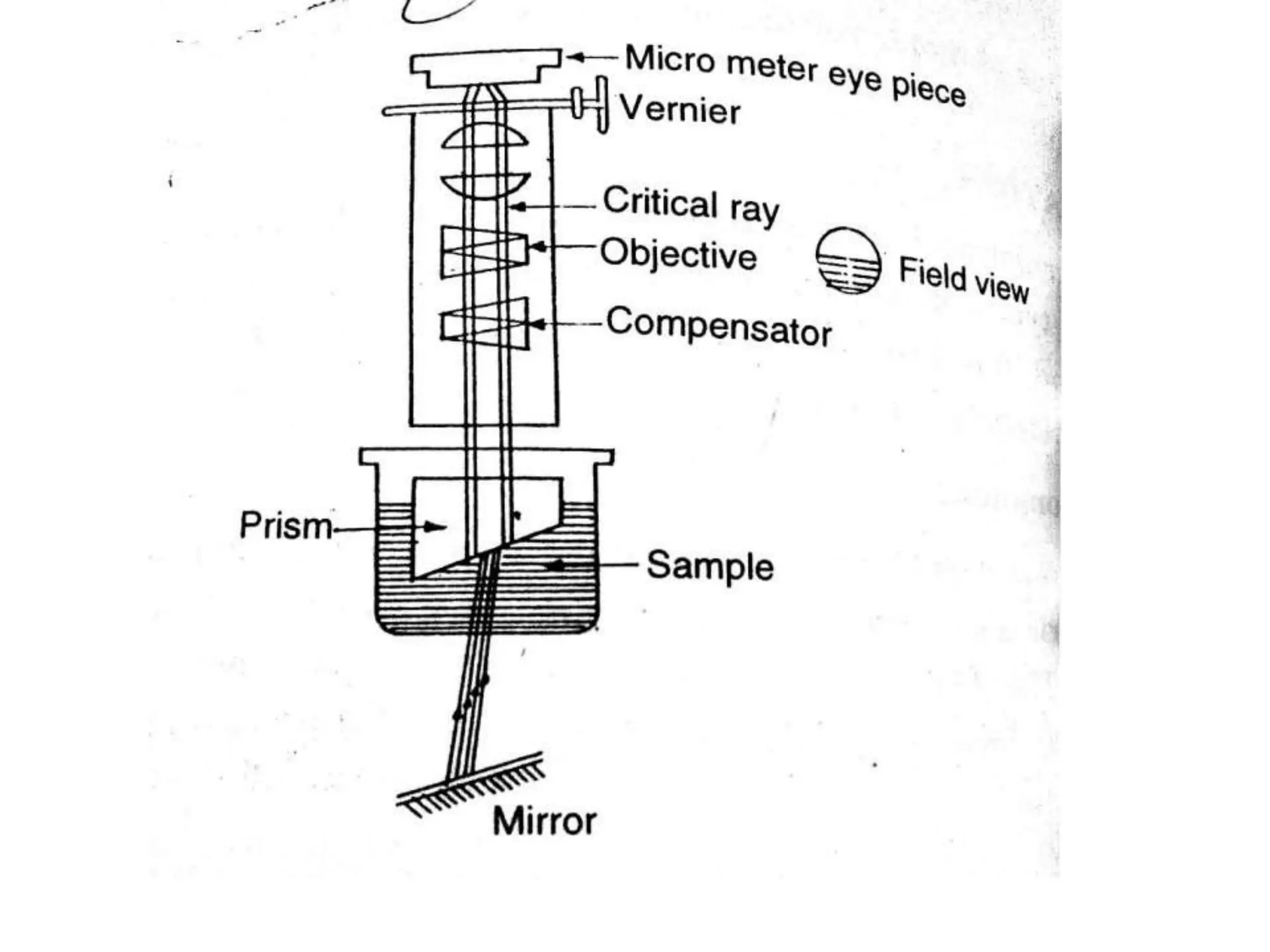
Based on measurement of critical ray (angle) or
by displacement of image
2. Interferometer
Use interference phenomenon to find out RI
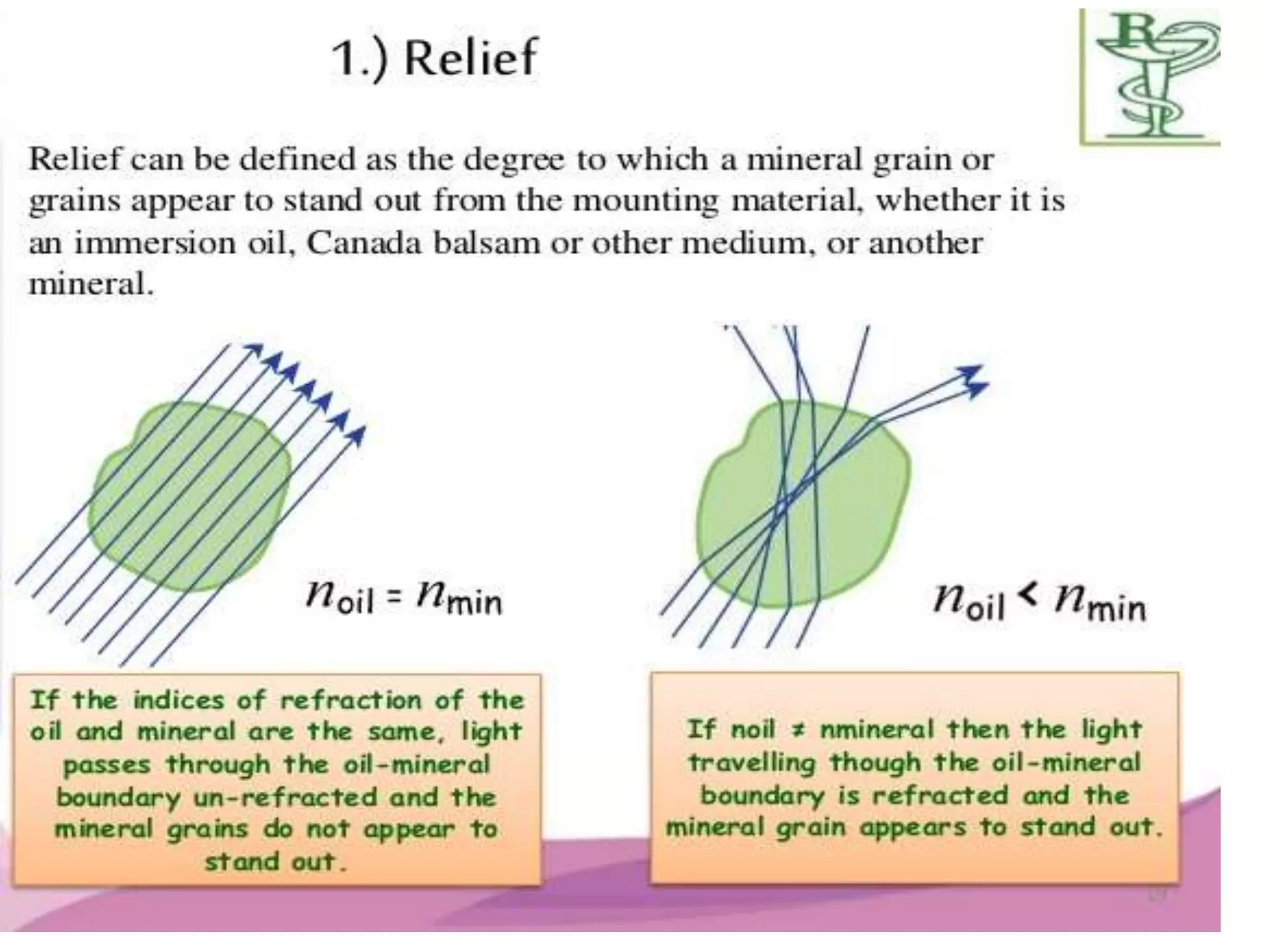
+ve or –ve relief
A mineral may exhibit positive or negative relief:
• +ve relief - index of refraction for the material
is greater than the index of the oil.
e.g. garnet 1.76
• -ve relief nmin < noil
e.g. fluorite 1.433
Variation in Relief
Strong +ve
Moderate to strong +ve
Low +ve
Moderate to strong -ve
Low -ve
RI quartz = RI medium
“Invisible”
RI Mounting
Medium = 1.54
Becke Lines
• To determine whether a mineral has positive or negative
relief, the Becke Line method is used.
• Becke Lines are a band or rim of light visible along the grain
boundary in plane light when the grain mount is slightly out of
focus.
• The Becke line may lie inside or outside the mineral grain
depending on how the microscope is focused
• Becke lines are interpreted to be produced as a result of:
– the lens effect and/or
– internal reflection effect.
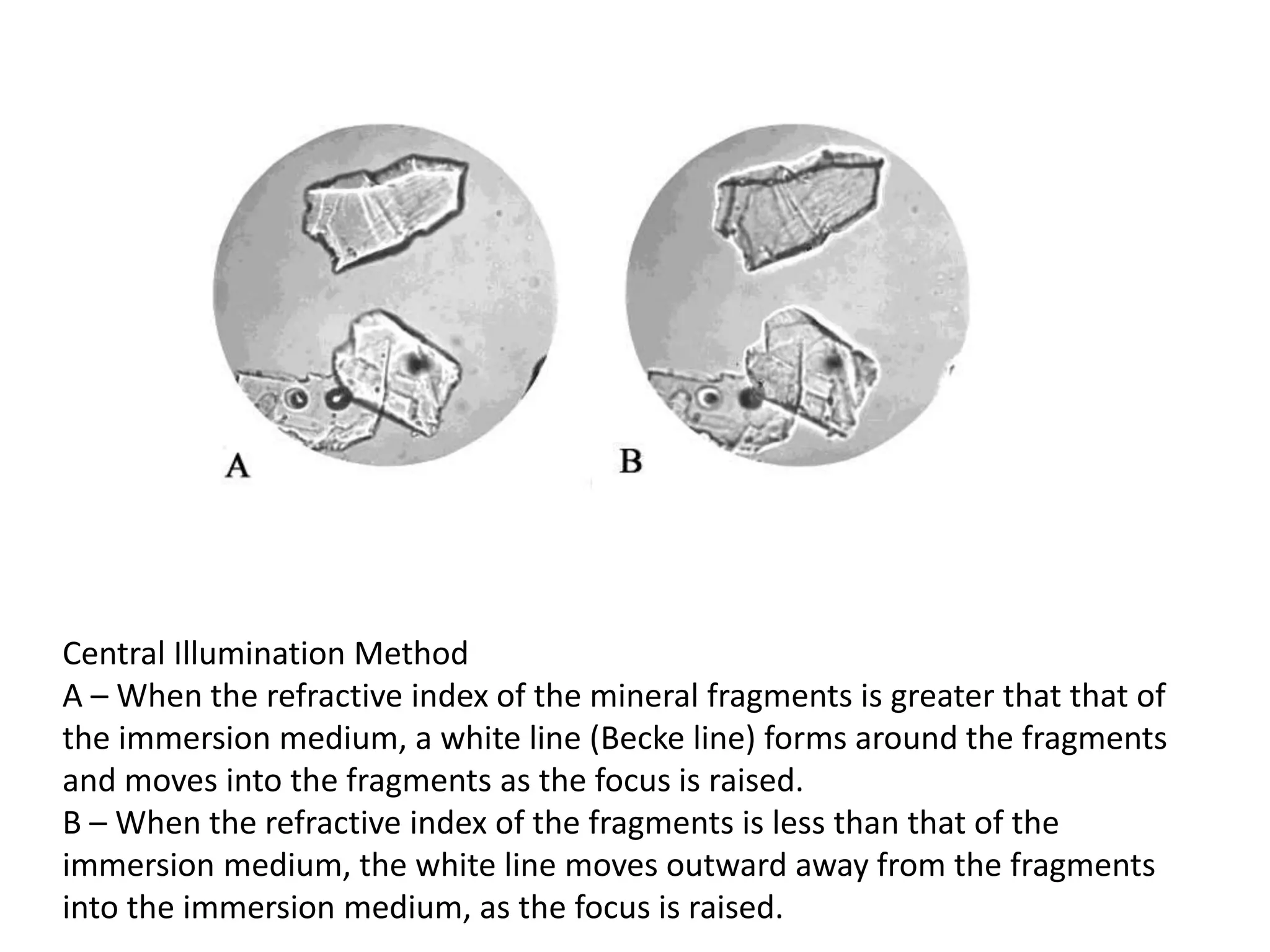
Central Illumination Method
A – When the refractive index of the mineral fragments is greater that that of
the immersion medium, a white line (Becke line) forms around the fragments
and moves into the fragments as the focus is raised.
B – When the refractive index of the fragments is less than that of the
immersion medium, the white line moves outward away from the fragments
into the immersion medium, as the focus is raised.
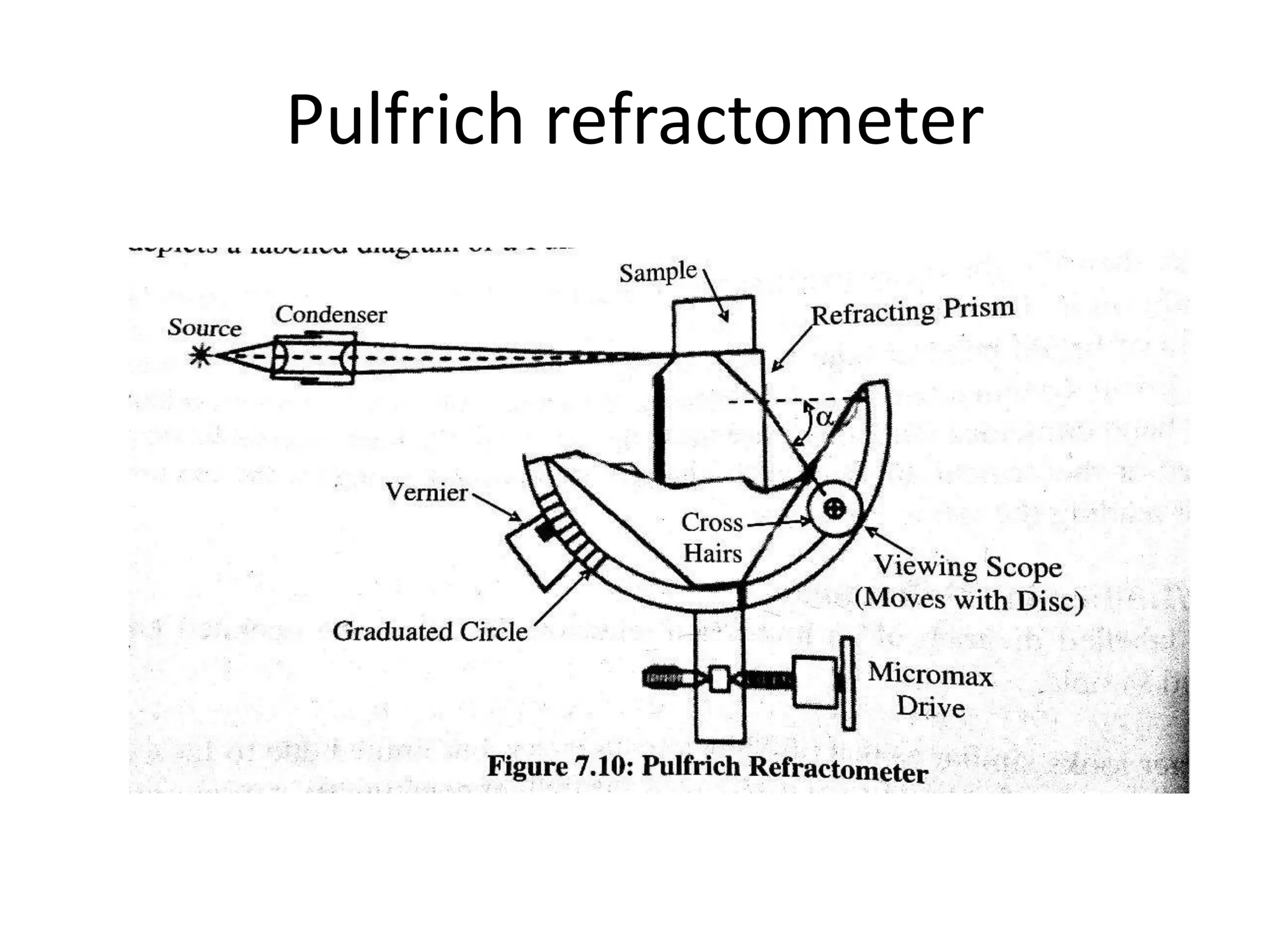
Pulfrich refractometer
Image displacement refractometer
• Any prism spectrometer is refractometer
• Prism shaped vessel containing sample Is used instead
of prism of spectroscope, the image of slit will be
displaced proportional to RI of sample prism
• Refractive index is read from graduated arc provided to
a movable telescope arm
• Accuracy is about ± 10-6 in unit of n.
• Large range of wavelength from UV or IR can be used
as source of radiation
• Used in gel permeation chromatoghraphy
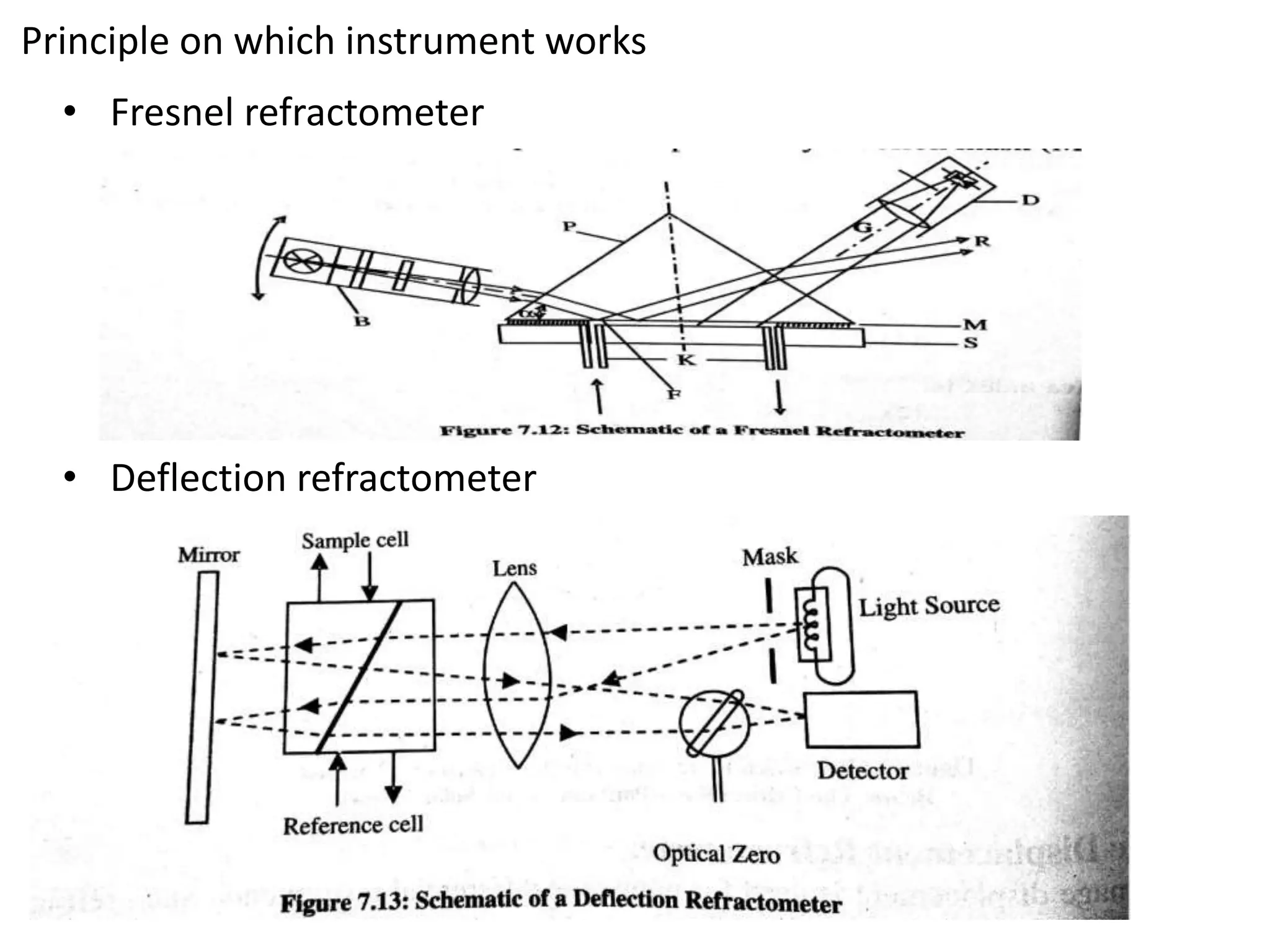
Principle on which instrument works
• Fresnel refractometer
• Deflection refractometer
Advantages and disadvantages

Refractometry

  • 1.
    Refractometry Madhuri Shelar (Mpharm) Assistant Professor Alard College of Pharmacy
  • 4.
    Snell's law • describethe relationship between the angles of incidence and refraction, • Snell's law is used to determine the direction of light rays through refractive media with varying indices of refraction. The indices of refraction of the media, labelled n1, n2 and so on, are used to represent the factor by which a light ray's speed decreases when travelling through a refractive medium, such as glass or water, as opposed to its velocity in a vacuum. • As light passes the border between media, depending upon the relative refractive indices of the two media, the light will either be refracted to a lesser angle, or a greater one. These angles are measured with respect to the normal line, represented perpendicular to the boundary. In the case of light travelling from air into water, light would be refracted towards the normal line, because the light is slowed down in water; light travelling from water to air would refract away from the normal line.
  • 7.
    • Theory • Specificrefraction: • Independent on temp and pressure • Lorentz and Lorenz give equation for specific refraction • R= n2 -1/d(n2 +2) • Molar refraction: • Specific refraction when multiplied by molecular weight we get molar refraction • Rm= M(n2 -1)/d(n2 +2) • Both are constant at given temp • It is characteristic of numerous type of atoms and arrangements found in a molecule • Useful in finding the nature of bonding in molecules and dipole movement n2 – 1 N1M1 +N2M2 N2 +2 Rs= d Molar fraction of solid is total sum of mole fraction of the solvent and the solute along with molar retroactivities R=N1R1+N2R2
  • 8.
    • PRINCIPLE ANDTHEORY • The main principle involved in refractometry is the refraction based on the speed of the light that passes in the different mediums. • Light enters into the light denser medium to high denser medium at an angle, that is, with bent. The bent in the light ray is known as the refraction. The relation between the refraction of the light between the air and the medium is given by Snell's law: • n = sin i/sin r • where n = refractive index; sin i = angle of incidence; sin r = angle of refraction. • Samples with different refractive index will produce different angles of refraction. This helps in the assessment of the compounds’ composition and the purity of the compounds.
  • 9.
    • FACTORS AFFECTINGTHE REFRACTIVE INDEX • Temperature: It is inversely proportional to the refractive index. • Viscosity: It is inversely proportional to the refractive index. • Wavelength: The sodium D-line at 595 nm is the appropriate wavelength for the determination of the refractive index.
  • 10.
    Measurement of RI •Two types of instruments 1. Refractometer Based on measurement of critical ray (angle) or by displacement of image 2. Interferometer Use interference phenomenon to find out RI
  • 24.
    +ve or –verelief A mineral may exhibit positive or negative relief: • +ve relief - index of refraction for the material is greater than the index of the oil. e.g. garnet 1.76 • -ve relief nmin < noil e.g. fluorite 1.433
  • 25.
    Variation in Relief Strong+ve Moderate to strong +ve Low +ve Moderate to strong -ve Low -ve RI quartz = RI medium “Invisible” RI Mounting Medium = 1.54
  • 26.
    Becke Lines • Todetermine whether a mineral has positive or negative relief, the Becke Line method is used. • Becke Lines are a band or rim of light visible along the grain boundary in plane light when the grain mount is slightly out of focus. • The Becke line may lie inside or outside the mineral grain depending on how the microscope is focused • Becke lines are interpreted to be produced as a result of: – the lens effect and/or – internal reflection effect.
  • 27.
    Central Illumination Method A– When the refractive index of the mineral fragments is greater that that of the immersion medium, a white line (Becke line) forms around the fragments and moves into the fragments as the focus is raised. B – When the refractive index of the fragments is less than that of the immersion medium, the white line moves outward away from the fragments into the immersion medium, as the focus is raised.
  • 28.
  • 29.
    Image displacement refractometer •Any prism spectrometer is refractometer • Prism shaped vessel containing sample Is used instead of prism of spectroscope, the image of slit will be displaced proportional to RI of sample prism • Refractive index is read from graduated arc provided to a movable telescope arm • Accuracy is about ± 10-6 in unit of n. • Large range of wavelength from UV or IR can be used as source of radiation • Used in gel permeation chromatoghraphy
  • 30.
    Principle on whichinstrument works • Fresnel refractometer • Deflection refractometer
  • 32.