Presented By
Sujit Sanjay Tiwari
Guided By
K. B. Gabhane
Vidhyabharti Collage of Pharmacy, Amravati
SEMINAR ON REFRACTOMETER
INDEX
Sr. No. Content Page no.
1 Introduction
2 Principle
3 Refractometer
4 Refractometer index
5 Instrumentation
6 Conclusion
7 Reference
● INTRODUCTION
• Refractometry is the method of measuring the refractive index of
substances. Refractive index is defined as the ratio of the speed of light in
a vacuum to the speed of light in another substance is defined as the index
of refraction or refractive index (n) for the substance.
• The refractive index is a useful physical property of liqiuid
• Often a liquid can be identified from a measurements of its refractive index.
PRINCIPLE
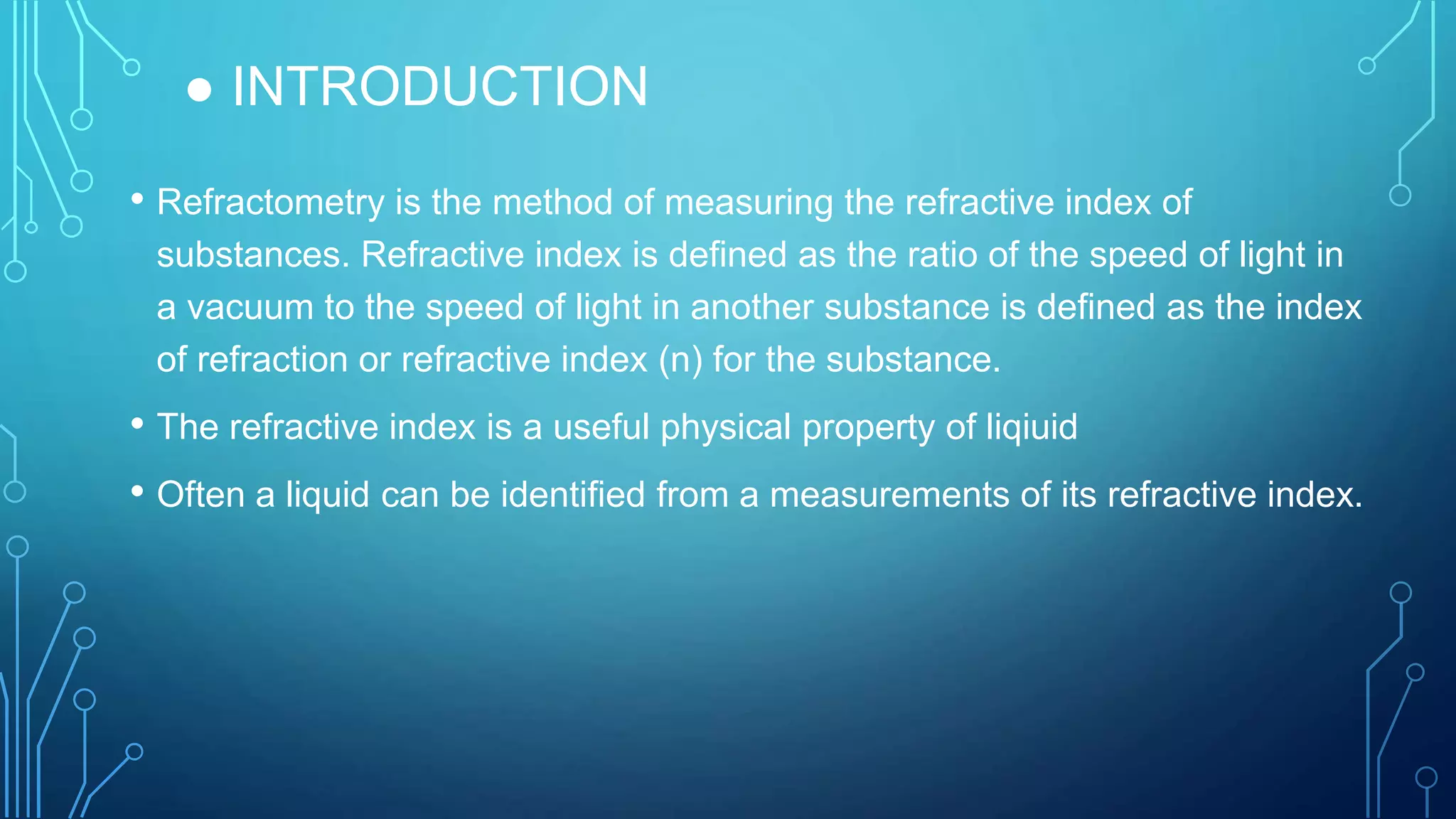
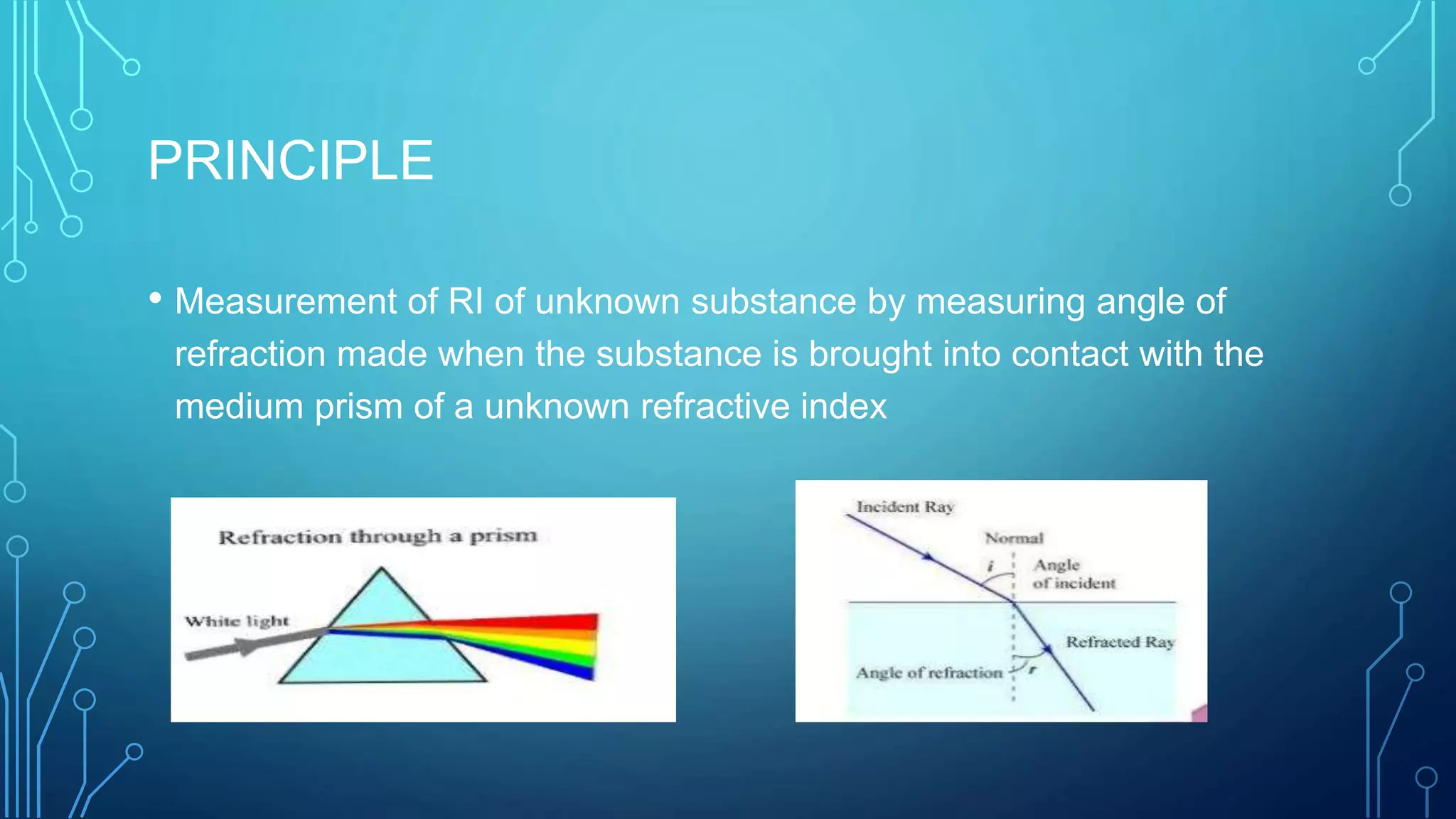
• Measurement of RI of unknown substance by measuring angle of
refraction made when the substance is brought into contact with the
medium prism of a unknown refractive index
REFRACTIVE INDEX
• Measurement of the refractive index can be used to characterize liquid
and solid sample
• Measure the concentration of solutions.
• the refractive index allows you to control the quality of multi-
component mixtures and check samples for purity
• The refractive index of a substance is dependent on the wavelength λ
of the light and the temperature T of the substance.
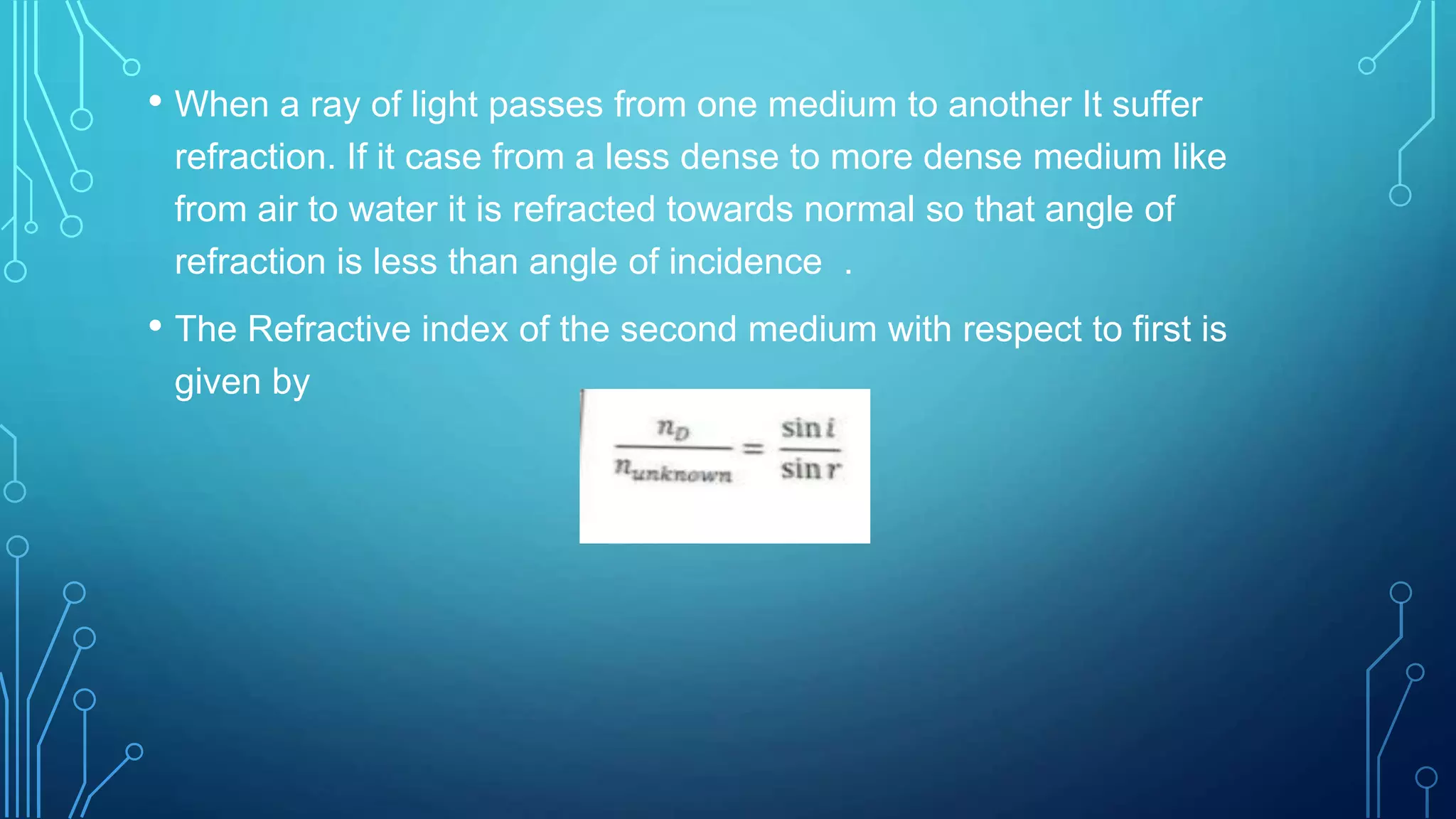
• When a ray of light passes from one medium to another It suffer
refraction. If it case from a less dense to more dense medium like
from air to water it is refracted towards normal so that angle of
refraction is less than angle of incidence .
• The Refractive index of the second medium with respect to first is
given by
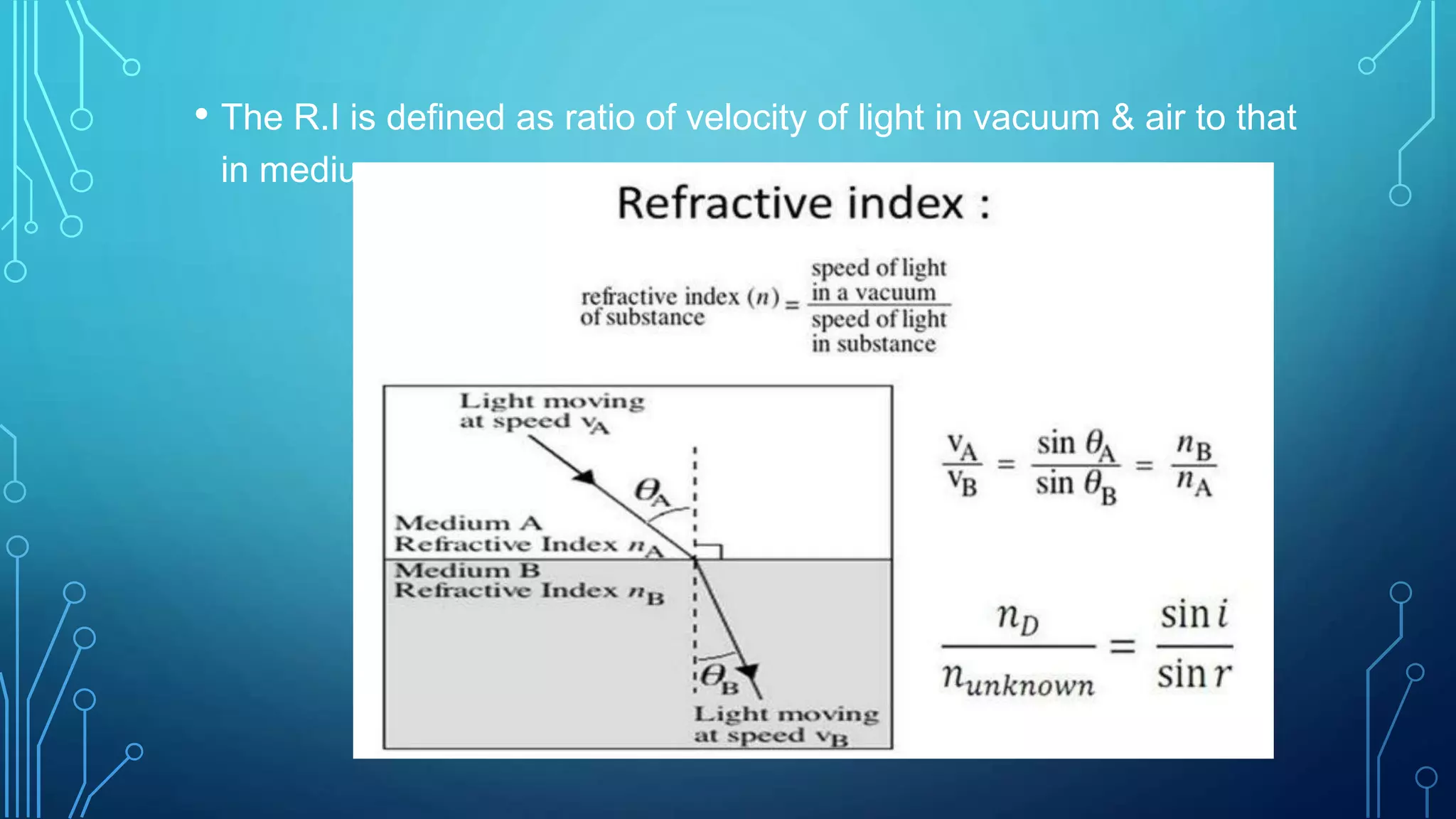
• The R.I is defined as ratio of velocity of light in vacuum & air to that
in medium
INSTRUMENTATION
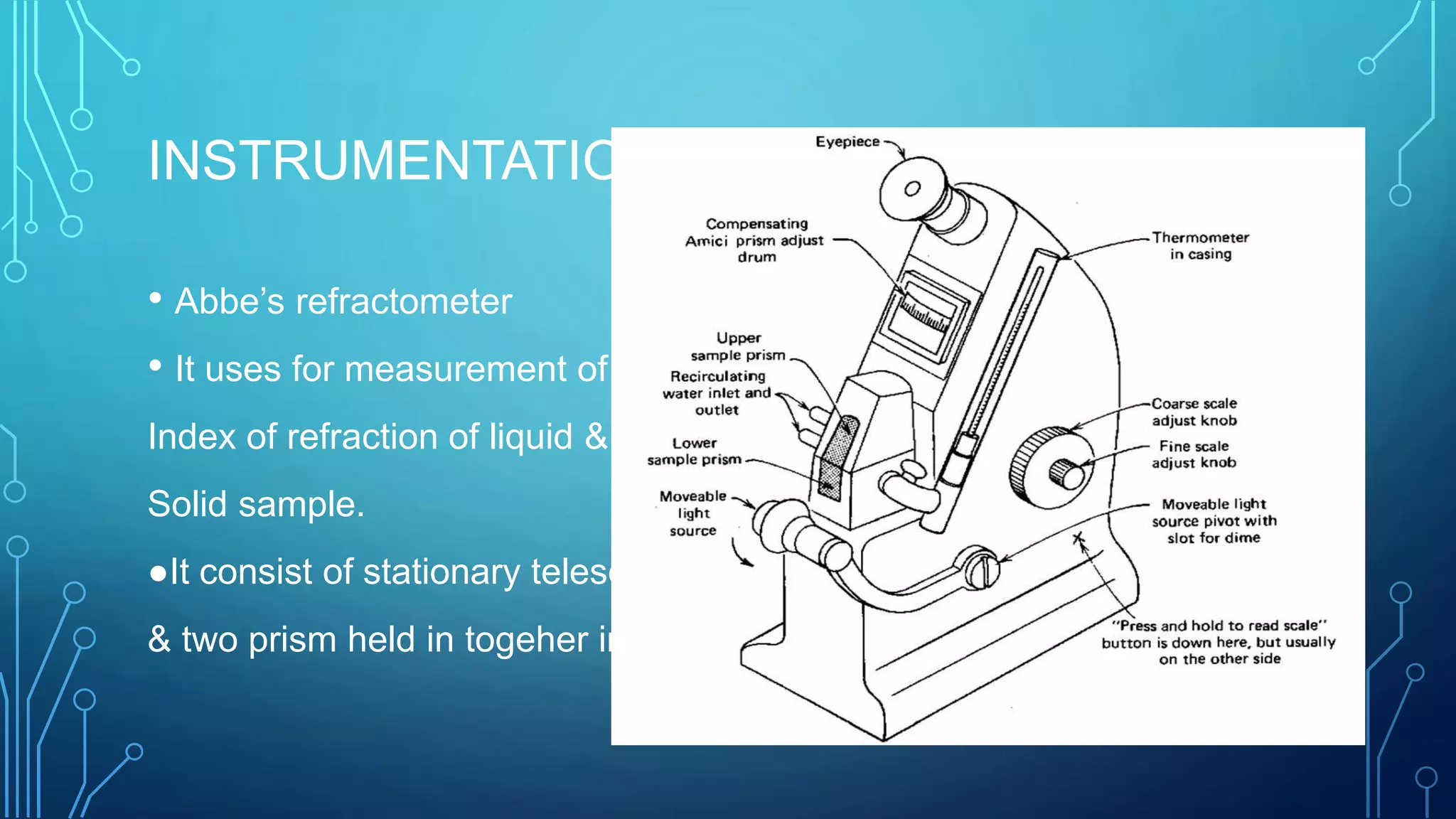
• Abbe’s refractometer
• It uses for measurement of an
Index of refraction of liquid &
Solid sample.
●It consist of stationary telescop
& two prism held in togeher in
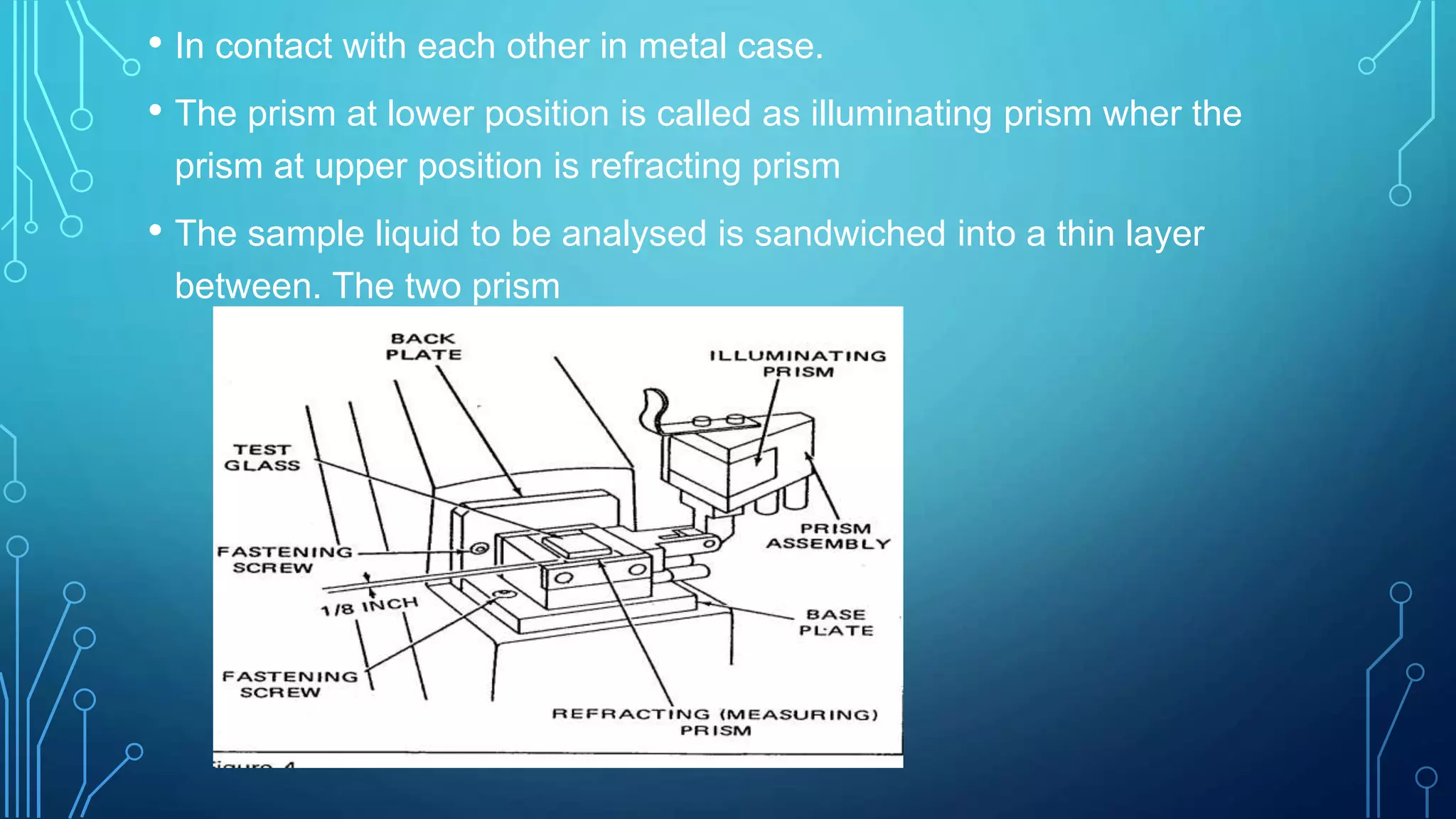
• In contact with each other in metal case.
• The prism at lower position is called as illuminating prism wher the
prism at upper position is refracting prism
• The sample liquid to be analysed is sandwiched into a thin layer
between. The two prism
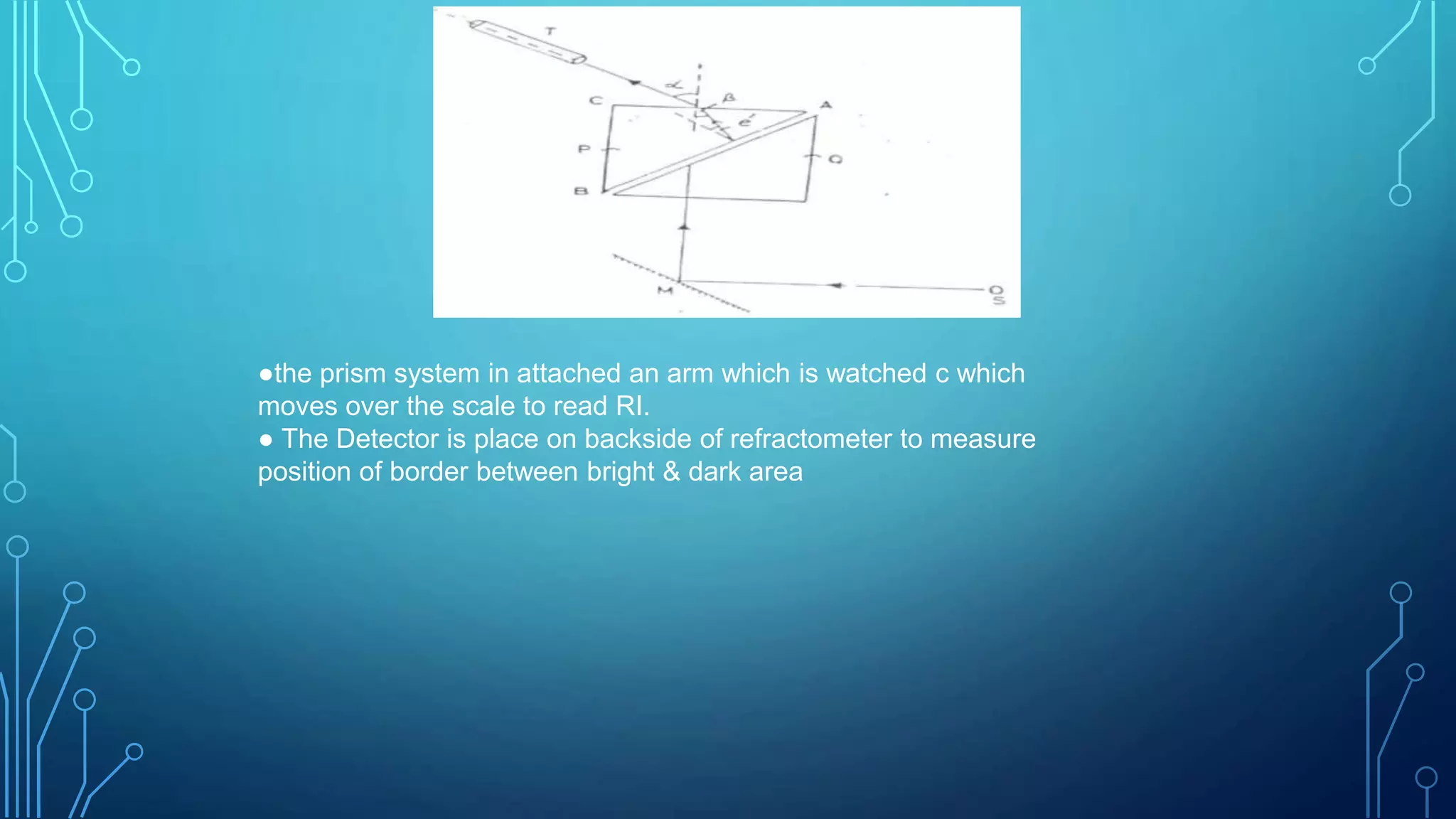
●the prism system in attached an arm which is watched c which
moves over the scale to read RI.
● The Detector is place on backside of refractometer to measure
position of border between bright & dark area
APPLICATION
• The RI measurement can be used for qualitative & quantitative
analysis as well as in structural analysis.
• It is determining the concentration of Aqueous & Alcohol solution
• Detemination of sugar content alcohol contentto fermentation is
Routinely carried out by Refractometer.
CASE STUDY
• A Refractometer is most often used to determine the characteristics of a liquid
sample.
• By calculating the refractive index, a researcher may be able to identify a liquid
sample, assess the sample's purity, and determine the concentration of solute (that is,
dissolved materials) in a liquid solution
• . A secondary scale used in Refractometry is the Brix scale--this scale relates the
concentration of sucrose in water at a certain temperature to the refractive index of
the solution.
MEASUREMENT OF TOTAL SOLUBLE SOLIDS (TSS)
OF GRAPES AND MUST
• Refractometry
• Refractometers are instruments that measure the refractive index of grape must
using the phenomenon of light refraction or of total internal reflection of light.
• The sugar content of grapes is determined by measuring the refractive index of their
juice.
• The refractometer reading can then be converted to the required units using a
standard curve (calibration) based on the concentration of sucrose in sucrose-water
solutions
• Like hydrometers, refractometers can also be purchased with a variety of
scales.
• Equipment: Refractometer – hand-held or bench type
• Calibration: Use made-up standard solutions of sucrose in water
• Services: Wash up area, electricity for bench-type
Space required: Minimal bench space for hand-held, small bench area for
bench-typ
ABSTRACT
• Grape pomace (Vitis vinifera L.), Benitaka variety, grown in the semiarid
region of Northeast Brazil was evaluated in relation to chemical composition,
and content of minerals and functional properties.
• Neutral pH (3.82)
• Moisture (3.33g/100g)
• Acidity of (0.64g of citric acid/100g),
• Ash (4.65 g/100g)
• The minerals iron, potassium, zinc, manganese, and calcium were present in
higher concentrations.
CHEMICAL ANALYSIS
• Acidity, pH, moisture, and ash.
• Acidity was determined by titration with 0.1 N NaOH, and the results were
expressed in grams of citric acid/100g
The pH was determined by direct reading on the potentiometer, (MS Tecnopon,
model mPA210) calibrated in buffer solutions of pH 4.0 and 7.0.
Moisture determination was performed by drying the sample in an air
circulation oven (Tecnal, model TE-394 /L) at 105°C to constant weight.
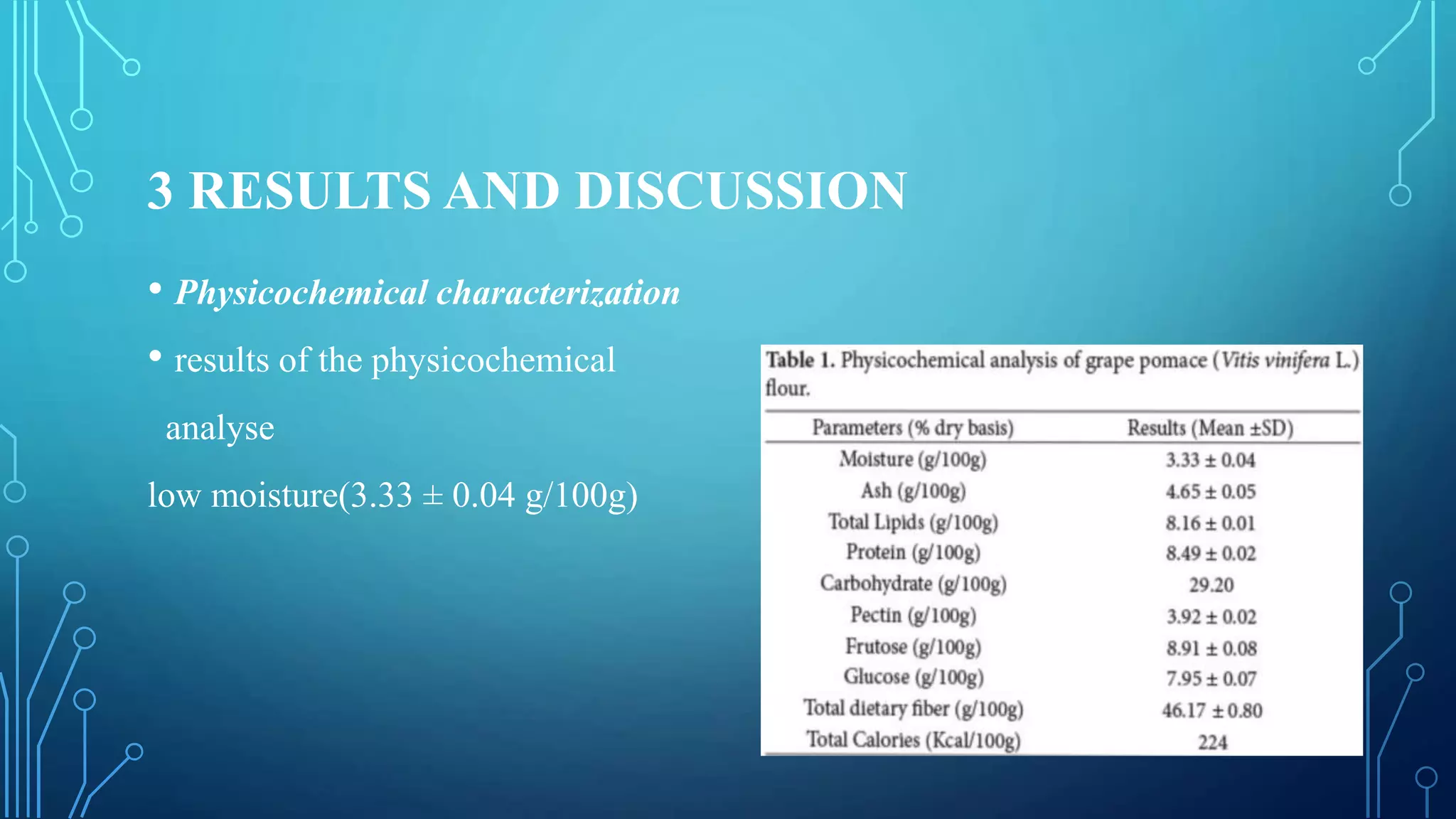
3 RESULTS AND DISCUSSION
• Physicochemical characterization
• results of the physicochemical
analyse
low moisture(3.33 ± 0.04 g/100g)
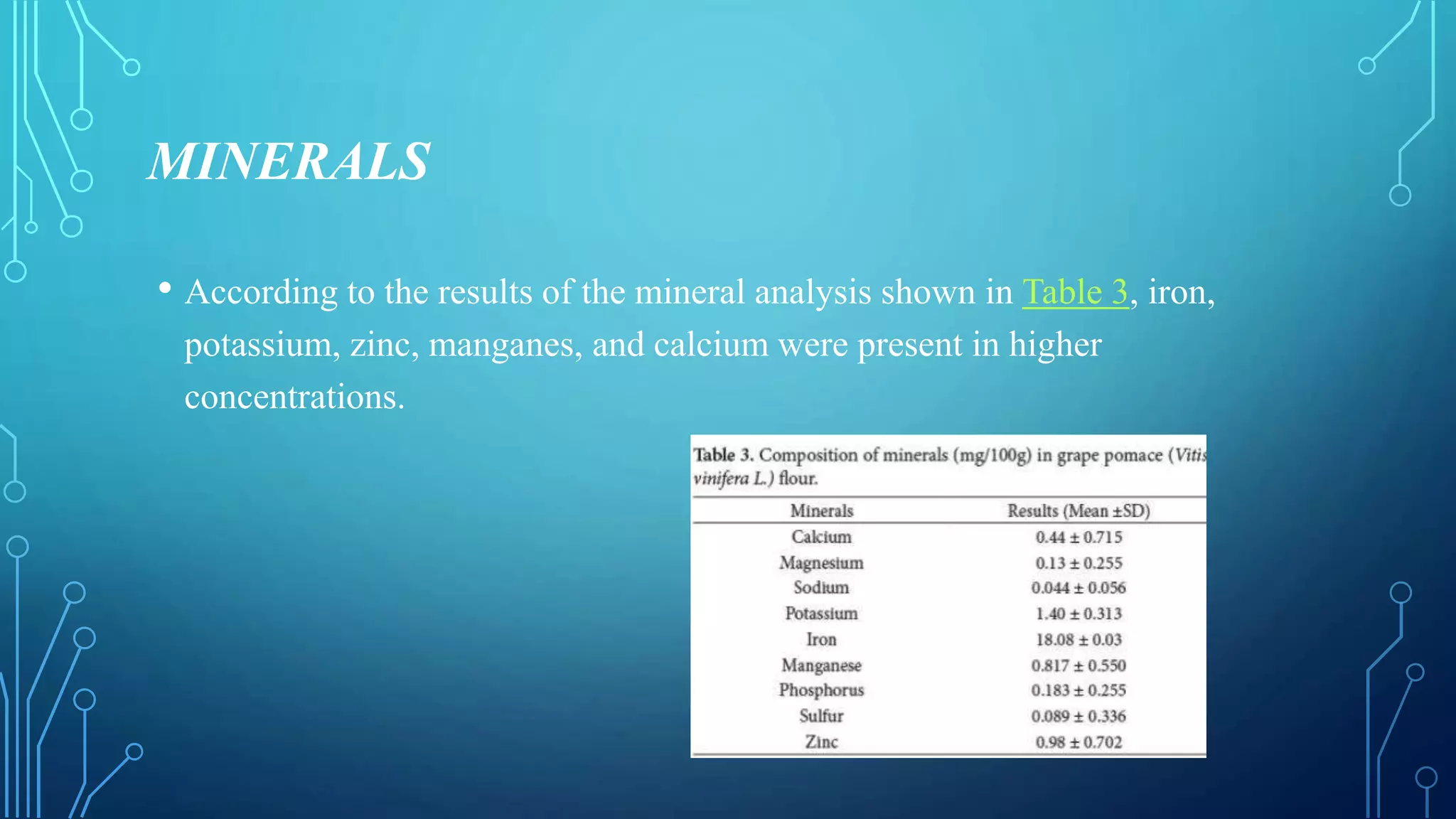
MINERALS
• According to the results of the mineral analysis shown in Table 3, iron,
potassium, zinc, manganes, and calcium were present in higher
concentrations.
CONCLUSIONS
• The results show that it is an important source of nutrients and compounds
with functional properties. The grape pomace flour obtained showed low and
pH below neutral, which can help prevent growth of pathogenic
microorganisms. The amount of total dietary fiber is quantitatively greater
compared to that of carbohydrates, proteins, and lipids, indicating that this
residue could be included in the daily diet as a source of fiber and food
supplement.
REFERENCE
1. http://www.refractometer.pl/hand-held-refractometer
2. http://www.refractometer.pl/
3. https://www.colorado.edu/physics/phys1230/phys1230.../6
4. http://www.markedbyteachers.com/gcse/science/refractrometry-aim-using-
a-model-pulfrich-refractometer-determine-the-refractive-index-of-a-range-
of-sugar-solutions-and-hence-determine-the-refractive-index-of-some-
sugar-solutions-with-an-unknown-concentration.html
5. https://www.researchgate.net/publication/26625252_

Refractometer

  • 1.
    Presented By Sujit SanjayTiwari Guided By K. B. Gabhane Vidhyabharti Collage of Pharmacy, Amravati SEMINAR ON REFRACTOMETER
  • 2.
    INDEX Sr. No. ContentPage no. 1 Introduction 2 Principle 3 Refractometer 4 Refractometer index 5 Instrumentation 6 Conclusion 7 Reference
  • 3.
    ● INTRODUCTION • Refractometryis the method of measuring the refractive index of substances. Refractive index is defined as the ratio of the speed of light in a vacuum to the speed of light in another substance is defined as the index of refraction or refractive index (n) for the substance. • The refractive index is a useful physical property of liqiuid • Often a liquid can be identified from a measurements of its refractive index.
  • 4.
    PRINCIPLE • Measurement ofRI of unknown substance by measuring angle of refraction made when the substance is brought into contact with the medium prism of a unknown refractive index
  • 5.
    REFRACTIVE INDEX • Measurementof the refractive index can be used to characterize liquid and solid sample • Measure the concentration of solutions. • the refractive index allows you to control the quality of multi- component mixtures and check samples for purity • The refractive index of a substance is dependent on the wavelength λ of the light and the temperature T of the substance.
  • 6.
    • When aray of light passes from one medium to another It suffer refraction. If it case from a less dense to more dense medium like from air to water it is refracted towards normal so that angle of refraction is less than angle of incidence . • The Refractive index of the second medium with respect to first is given by
  • 7.
    • The R.Iis defined as ratio of velocity of light in vacuum & air to that in medium
  • 8.
    INSTRUMENTATION • Abbe’s refractometer •It uses for measurement of an Index of refraction of liquid & Solid sample. ●It consist of stationary telescop & two prism held in togeher in
  • 9.
    • In contactwith each other in metal case. • The prism at lower position is called as illuminating prism wher the prism at upper position is refracting prism • The sample liquid to be analysed is sandwiched into a thin layer between. The two prism
  • 10.
    ●the prism systemin attached an arm which is watched c which moves over the scale to read RI. ● The Detector is place on backside of refractometer to measure position of border between bright & dark area
  • 11.
    APPLICATION • The RImeasurement can be used for qualitative & quantitative analysis as well as in structural analysis. • It is determining the concentration of Aqueous & Alcohol solution • Detemination of sugar content alcohol contentto fermentation is Routinely carried out by Refractometer.
  • 12.
    CASE STUDY • ARefractometer is most often used to determine the characteristics of a liquid sample. • By calculating the refractive index, a researcher may be able to identify a liquid sample, assess the sample's purity, and determine the concentration of solute (that is, dissolved materials) in a liquid solution • . A secondary scale used in Refractometry is the Brix scale--this scale relates the concentration of sucrose in water at a certain temperature to the refractive index of the solution.
  • 13.
    MEASUREMENT OF TOTALSOLUBLE SOLIDS (TSS) OF GRAPES AND MUST • Refractometry • Refractometers are instruments that measure the refractive index of grape must using the phenomenon of light refraction or of total internal reflection of light. • The sugar content of grapes is determined by measuring the refractive index of their juice. • The refractometer reading can then be converted to the required units using a standard curve (calibration) based on the concentration of sucrose in sucrose-water solutions
  • 14.
    • Like hydrometers,refractometers can also be purchased with a variety of scales. • Equipment: Refractometer – hand-held or bench type • Calibration: Use made-up standard solutions of sucrose in water • Services: Wash up area, electricity for bench-type Space required: Minimal bench space for hand-held, small bench area for bench-typ
  • 15.
    ABSTRACT • Grape pomace(Vitis vinifera L.), Benitaka variety, grown in the semiarid region of Northeast Brazil was evaluated in relation to chemical composition, and content of minerals and functional properties. • Neutral pH (3.82) • Moisture (3.33g/100g) • Acidity of (0.64g of citric acid/100g), • Ash (4.65 g/100g) • The minerals iron, potassium, zinc, manganese, and calcium were present in higher concentrations.
  • 16.
    CHEMICAL ANALYSIS • Acidity,pH, moisture, and ash. • Acidity was determined by titration with 0.1 N NaOH, and the results were expressed in grams of citric acid/100g The pH was determined by direct reading on the potentiometer, (MS Tecnopon, model mPA210) calibrated in buffer solutions of pH 4.0 and 7.0. Moisture determination was performed by drying the sample in an air circulation oven (Tecnal, model TE-394 /L) at 105°C to constant weight.
  • 17.
    3 RESULTS ANDDISCUSSION • Physicochemical characterization • results of the physicochemical analyse low moisture(3.33 ± 0.04 g/100g)
  • 18.
    MINERALS • According tothe results of the mineral analysis shown in Table 3, iron, potassium, zinc, manganes, and calcium were present in higher concentrations.
  • 19.
    CONCLUSIONS • The resultsshow that it is an important source of nutrients and compounds with functional properties. The grape pomace flour obtained showed low and pH below neutral, which can help prevent growth of pathogenic microorganisms. The amount of total dietary fiber is quantitatively greater compared to that of carbohydrates, proteins, and lipids, indicating that this residue could be included in the daily diet as a source of fiber and food supplement.
  • 20.
    REFERENCE 1. http://www.refractometer.pl/hand-held-refractometer 2. http://www.refractometer.pl/ 3.https://www.colorado.edu/physics/phys1230/phys1230.../6 4. http://www.markedbyteachers.com/gcse/science/refractrometry-aim-using- a-model-pulfrich-refractometer-determine-the-refractive-index-of-a-range- of-sugar-solutions-and-hence-determine-the-refractive-index-of-some- sugar-solutions-with-an-unknown-concentration.html 5. https://www.researchgate.net/publication/26625252_