Stroke is a type of cardiovascular disease.
It affects the arteries leading to and within the
brain. A stroke occurs when a blood vessel that
carries oxygen and nutrients to the brain is either
blocked by a clot or bursts. When that happens,
part of the brain cannot get the blood and oxygen it
needs, so it starts to die.
WHAT IS A STROKE?
Ischemic stroke is caused by a lack of blood reaching part of
the brain and is the most common type, accounting for over 80
percent of all strokes:
• Symptoms develop over a few minutes or worsen over hours.
• Ischemic strokes are typically preceded by symptoms or
warning signs that may include loss of strength or sensation on
one side of the body, problems with speech and language or
changes in vision or balance.
• Ischemic strokes usually occur at night or first thing in the
morning.
• Often a TIA (transient ischemic attack) or “mini stroke” may
give some warning of a major ischemic stroke.
TYPES OF STROKE
Fifteen to 20 percent of strokes happen when a blood vessel
ruptures in or near the brain. This is called a hemorrhagic or
bleeding stroke:
• In hemorrhagic strokes, the fatality rate is higher and overall
prognosis is poorer.
• People who have hemorrhagic strokes are younger.
• This kind of stroke is often associated with a very severe
headache, nausea and vomiting, and usually the symptoms appear
suddenly.
• A transient ischemic attack (TIA) or any other stroke warning
sign may not precede this type of stroke.
TYPES OF STROKE
What are the risk factors I can’t control?
Increasing age – stroke affects people of all ages, from young
children to elderly individuals. But the older you are, the greater
your stroke risk.
Gender – in most age groups, more men than women have stroke,
but more women die from stroke.
Heredity and race – people whose close blood relations have had a
stroke have a higher risk of stroke themselves. Certain races have a
higher risk of death and disability from stroke than others, because
they have high blood pressure more often.
Prior stroke – someone who has had a stroke is at a higher risk of
having another one.
RISK FACTORS FOR STROKE
Knowing your risk factors is the key to prevention - some can be
changed or treated, others can’t.
What risk factors can I change or treat?
High blood pressure – this is the single most important risk factor
for stroke. Know your blood pressure and have it checked at least
once every two years. If it’s 140/90 or about, it’s high. Talk to your
doctor about how to control it and take your medicine as directed;
Diet - improve your eating habits by avoiding foods which are high
in fat and cholesterol, cut down on saturated fat, sugar and salt. Eat
more fruit, vegetables, cereals, dried peas and beans, pasta, fish,
poultry and lean meats;
RISK FACTORS FOR STROKE
6
Tobacco use – don’t smoke cigarettes or use other forms of
tobacco;
Diabetes – while diabetes is treatable, having it increases your
risk of stroke. Work with your doctor to manage diabetes and
reduce other risk factors;
RISK FACTORS FOR STROKE
Carotid or other artery disease – the carotid arteries in your neck supply blood
to your brain. A carotid artery damaged by a fatty build-up of plaque inside the artery wall
may become blocked by a blood clot, causing a stroke;
TIAs – Transient ischemic attacks (TIAs) are “mini strokes” that produce stroke-like
symptoms but no lasting effects. Recognizing and treating TIAs can reduce the risk of a
major stroke. Know the warning signs of a TIA and seek emergency medical treatment
immediately;
Atrial fibrillation or other heart disease – in atrial fibrillation the heart’s upper chambers
quiver rather than beat effectively, causing the blood to pool and clot, increasing the risk of
stroke. People with other types of heart disease have a higher risk of stroke too;
Certain blood disorders – a high red blood cell count makes clots more likely, raising the
risk of stroke. Sickle cell anemia increases stroke risk because the “sickled” cells stick to
blood vessel walls and may block arteries;
High blood cholesterol – high blood cholesterol increases the risk of clogged arteries. If
an artery leading to the brain becomes blocked, a stroke results.
RISK FACTORS FOR STROKE
Physical inactivity and obesity - being inactive, obese or both
can increase your risk of cardiovascular disease. Exercise
regularly – check with your doctor before you start. Start slowly
and build up to at least 30 minutes a session at least three to four
times per week. Try to maintain a healthy weight;
Excessive alcohol intake – drinking an average of more than
one drink per day for women or more than two drinks a day for
men raises blood pressure. Binge drinking can lead to stroke, so
limit your alcohol intake.
Stress – decrease your stress level as much as possible and seek
emotional support when it’s needed.
RISK FACTORS FOR STROKE
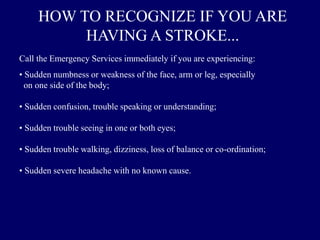
HOW TO RECOGNIZE IF YOU ARE
HAVING A STROKE...
Call the Emergency Services immediately if you are experiencing:
• Sudden numbness or weakness of the face, arm or leg, especially
on one side of the body;
• Sudden confusion, trouble speaking or understanding;
• Sudden trouble seeing in one or both eyes;
• Sudden trouble walking, dizziness, loss of balance or co-ordination;
• Sudden severe headache with no known cause.
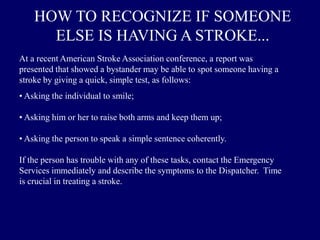
HOW TO RECOGNIZE IF SOMEONE
ELSE IS HAVING A STROKE...
At a recent American Stroke Association conference, a report was
presented that showed a bystander may be able to spot someone having a
stroke by giving a quick, simple test, as follows:
• Asking the individual to smile;
• Asking him or her to raise both arms and keep them up;
• Asking the person to speak a simple sentence coherently.
If the person has trouble with any of these tasks, contact the Emergency
Services immediately and describe the symptoms to the Dispatcher. Time
is crucial in treating a stroke.
History of Cerebrovascular Disease
Where have we been?
Where are we now?
Where should we go in the
future?
04/04/2017 11
400 BC-1700 AD
Emphasis on Prognosis and early
Exploration of Brain Anatomy and
Function
Hippocrates- circa 400 BC
Galen 130-200 AD
Andre Vesalius 1514-1564
Johann Wepfer 1620-1695
Sir Thomas Willis 1621-1675
The Past
Johann Jakob Wepfer 1620-1695
Observationes Anatomicae, ex Cadaveribus
Eorum, quos Sustulit Apoplexia (1658)
Performed necropsies and showed that bleeding
into the brain was an important cause of
apoplexy
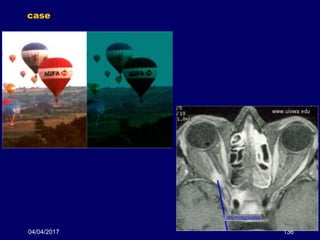
Described the anatomy and presence of
hardening and occlusions within the intracranial
Carotid and Middle Cerebral Arteries
The Past-Pathology
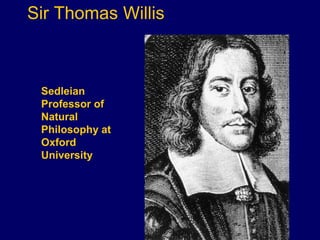
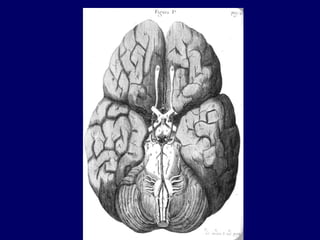
Sir Thomas Willis 1621-1675
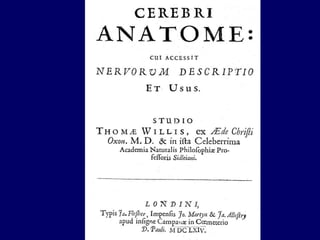
Dissections described and illustrated by Sir
Christopher Wrenn in Cerebri Anatomi (1664)
Clarified anatomy of the Brain and Cranial Nerves
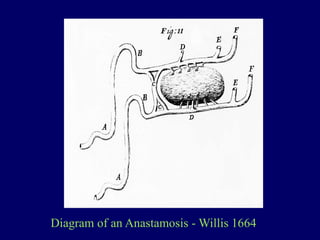
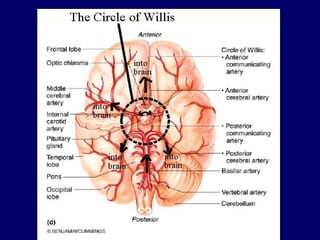
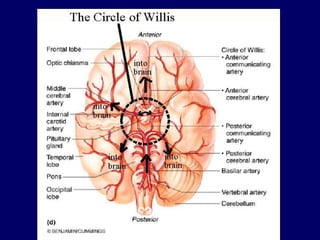
Dissected cranial arteries and described
connections at the base of the Brain (Circle of
Willis)
Respected clinician who described TIAs and
Migraine
The Past- Anatomy and Clinical
Sir Thomas Willis
Sedleian
Professor of
Natural
Philosophy at
Oxford
University
Diagram of an Anastamosis - Willis 1664
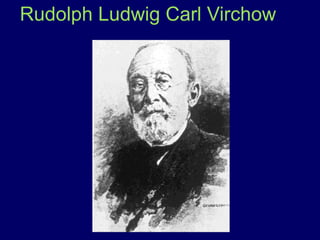
Rudolph Ludwig Carl Virchow (1821-1902)
Clearly showed that vascular occlusion
caused infarction
Described the phenomenology of
arterial thrombosis
Recognized the important interaction
between the vascular wall and the blood
Described embolism
The Past-Pathology & pathophysiology
Rudolph Ludwig Carl Virchow
Vieusseux -1810
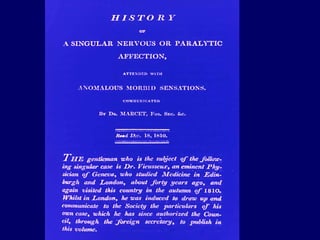
Dec 29, 1807 Vieusseux developed an unusual
and severe pain in the left gum and jaw. 5 days
later the pain recurred along with severe pain in
the left eye.
He then developed severe vertigo. “A peculiar and
inexpressible perturbation in all his sensations” a
giddiness that affected his vision and “occasioned
feelings similar to those produced by a ship
violently agitated.”
He then lost his voice, had difficulty swallowing,
and felt that his left side was weak.
Vieusseux -1810
He then examined himself and found that “the whole
of his right side was so insensible that he could be
scratched or pinched without experiencing any pain
and that this insensibility abruptly terminated at a
line dividing the whole body in a vertical direction”
The sensations of heat and cold were totally different
from normal on his right side but he was puzzled to
find that he had not lost the perception of touch on
his right side.
The left side of the head and face were also
insensible to pricking or scratching over the left
forehead, nose, lips, chin, and ear.
Vieusseux -1810
The whole of the left side of the body
preserved its usual degree of sensibility.”
He also noted that his left eye was partially
shut and the left corner of the mouth was
drawn downward.
His left leg dragged when he walked.
During the next weeks the dysarthria and
dysphagia improved but he developed
hiccups
“His intellectual faculties remained quite
unimpaired so that he could accurately
observe the whole succession of symptoms.”
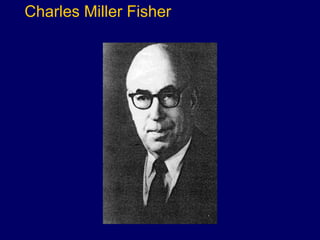
Charles Miller Fisher
Pathology and Clinical Features of ICH (1961-71)
Clinical features (1951-4) and pathology (1986) of
Carotid Artery Disease
Clinical features of Vertebral artery disease (1971)
and Vascular lesions in Lateral Medullary Infarcts
(1961)
Clinical and pathological features of Lacunar
infarction (1965-present)
Charles Miller Fisher
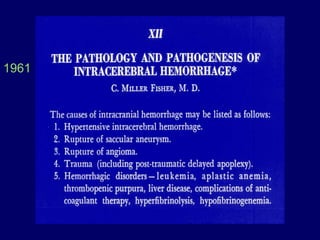
1961
1951
Technology is rapidly improving and still
developing. CT and MRI allow delineation of the
location and type of lesion and CTA and CT
perfusion, MRA, and extracranial and
transcranial ultrasound (TCD) allow definition of
arterial lesions. Echocardiography, cardiac
rhythm monitoring, and blood analysis detect
cardiac, aortic, and hematological causes of
stroke. Neurologists of today can quickly and
safely define the cause and extent of
cerebrovascular disease.
Cerebrovascular
Accident
(Stroke)
I.Definition of Terms:
Cerebrovascular Accident
- Also know as stroke and brain attacks
-is a sudden loss of neurological
function caused by an interruption of the
blood flow to the brain
I. Definition of terms
-It is a non-traumatic brain injury caused
by occlusion or rupture of cerebral blood
vessel that results in sudden
neurological deficit characterized by
loss of motor control.
I. Definition of Terms
Aneurysm
-It is a localized dilatation or bulging of
the blood vessels especially arteries
- It promotes rupture of the vessel as it
continues to bulge.
I. Definition of Terms
APOPLEXY – sudden strike of paralysis,
dumbness or fainting, from which victim
is frequently failed to recover
o Atherosclerosis
-Formation of multiple plaques within
the blood vessels.
I. Definition of Terms
Embolus
- an object that migrates from one part
of the body to causes blockage or
occlusion to another part of the body.
I. Definition of terms
Hematocrit
-Also know as Packed Cell Volume
(PCV) or Erythrocyte Volume Fraction
(EVF)
-is the proportion of the blood volume,
which is occupied by red blood cell.
I. Definition of Terms
Hemorrhage
-Is the loss of blood at the circulatory system
or excessive presence of blood outside the
circulation
- Can be internally or externally.
I. Definition of Terms
Hypertension
 Also referred to as high blood pressure
(HTN or HPN.)
 It is a medical condition in which the blood
pressure is chronically elevated
Infarction
-A process of anoxic death of tissue due to loss of
blood supply because of occlusion or blockage of the
artery
I. Definition of Terms
Ischemic
-Insufficient blood flow to an organ
cause by the blockage of the artery.
Transient Ischemic Attack
-(Mini Stroke) Caused by changes in
blood supply in the brain produces
same manifestation as stroke within 24
hours.
I. Definition of Terms
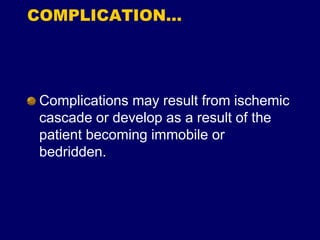
Thrombus
- Is the final product of the blood
coagulation step in hemostasis It is
achieved via the aggregation of
platelets that form a platelet plug. It is
physiologic in injury but pathologic in
case of thrombosis
II. Epidemiology
Stroke is the third leading cause of
death.
The most common cause of disability
among adults at the United States
It is approximately 700,000 individuals
was affected each year.
II. Epidemiology
About 500,000 are new strokes and
200,000 are recurrent strokes (Usually
people older than 65 y/o).
In United States, in 1960’s 200 per
100,000 are affected by stroke and it
was decreased as it reached to late
1960’s –1970’s.
II. Epidemiology
In 1980’s the stroke is flattened
because of the improvement of cranial
computed tomography (CT) and
Magnetic Resonance imaging (MRI).
According to age, 28% higher
possibilities in people older than 65 y/o
than younger ones
II. Epidemiology
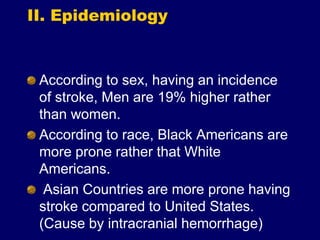
According to sex, having an incidence
of stroke, Men are 19% higher rather
than women.
According to race, Black Americans are
more prone rather that White
Americans.
Asian Countries are more prone having
stroke compared to United States.
(Cause by intracranial hemorrhage)
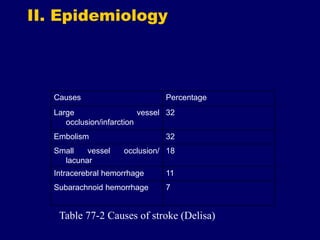
Causes Percentage
Large vessel
occlusion/infarction
32
Embolism 32
Small vessel occlusion/
lacunar
18
Intracerebral hemorrhage 11
Subarachnoid hemorrhage 7
II. Epidemiology
Table 77-2 Causes of stroke (Delisa)
II. Epidemiology
Most of the patients who die from acute
stroke succumb in the first 30 days.
Survival in the first 30 days of new
stroke reported to be 70- 85%
dependent on the stroke type.
II. Epidemiology
In Intracerebral Hemorrhage is only 20-
50% , cause death usually occur in first
3 days.
In Cerebral infraction is 85%.
After 30 days of survival, the death rate
declines.
III. Epidemiology
Stroke is most commonly cause of
chronic disability.
II. Etiology
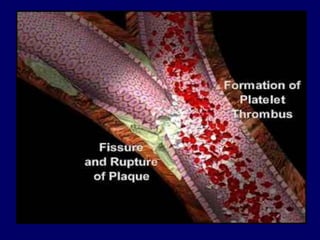
A. Atherosclerosis
-Major contributory factor of Cerebrovascular
Accident.
-accumulation of lipids, fibrins, complex
carbohydrates and calcium deposit on the arterial
walls that leads to progressive narrowing of blood
vessels.
Found in the bifurcations of vessels.
II. Etiology
B. Ischemic Strokes
-Results from a thrombus, embolism or
conditions that produce low systemic
perfusions pressures.
II. Etiology
C. Cerebral Thrombosis
 Refers to the formation of development of
a blood clot within the arteries and their
branches.
 Moving thrombus is called embolus.
II. Etiology
Thrombosis  Ischemia  Infarction
IntraCerebral Hemorrhage
 Is cause by the ruptured of cerebral vessel
with subsequent bleeding to brain
Types of IntraCerebral Hemorrhage
II. Etiology
-Primary CEREBRAL Hemorrhage
-occurs in small blood vessels
weakened by atherosclerosis produces
aneurysm.
-SUBARACHNOID hemorrhage
-hemorrhage occurs at the sub arachnid
space typically from a saccular or berry
aneurysm affecting primary vessels.
II. Etiology
E. Artriovenous malformation
 Is a congenital defect that can cause
stroke.
-The arteries and veins are tortuous
tangled with interposing capillaries
system.
III. Risk Factors of Stroke
Hypertension- Is the most important
risk factors
 It is define as a blood pressure higher
than 160/95 mmHg.
 Among the survivors of stroke, 67% of
them have chronic hypertension
 It gives risk in cerebral infarction,
thrombotic, lacunars and hemorrhagic
stroke.
III. Risk Factors of Stroke
2. Heart disease
 Is an important risk factor for stroke
 Atrial fibrillation and valvular heart disease
increase the risk of cerebral infarction
because of presence of cerebral emboli.
III. Risk Factors of Stroke
3.Diabetes Mellitus
 Independent risk factor that doubles the
risk of stroke.
 It increases the risk of ischemic stroke
to three to six times.
 The prevalence of diabetes among
stroke survivors is 20%.
III. Risk Factors of Stroke
4. Hyperlipidemia
 Poses only small additional risk for strokes
mainly for individuals younger at age of 55.
 Increase in blood viscosity, hematocrit and
serum fibrinogen have been implied the
risk factor of stroke.
Risk Factors of stroke
Smoking
 It is an important factor for cardiovascular
disease but influence for stroke is not
cleared.
 The risk for heavy smokers (>40
cigarettes) is twice than light smokers (<10
cigarettes).
III. Risk Factors Of Stroke
- Some studies that smoking to an
increased risk of hemorrhagic stroke in
addition to ischemic cerebral infarction.
III. Risk factor of stroke
6. Transient Ischemic Attack
-Is another important risk factor.
- An About 10 % of individuals with TIA
will go on to have a major stroke within
90 days and 5 % will have a major
stroke within 2 days.
III. Risk Factors of stroke
7. Obesity
 Hypertension and diabetes mellitus are in
common in obese and strong influences
risk of stroke.
 Some studies says that weight loss has
positive influences on blood pressure and
diabetic control and also helps in reduction
of risk of strokes.
IV. Stroke Prevention
Active promotions of lifestyle changes
by physicians have the best potential to
decrease the annual rate of new stroke
occurrence.
IV. Stroke Prevention
To the individuals who have a stroke in
the past history additional intervention
and medication was given like:
-Antiplatelet therapy
- Anticoagulation
-Carotid Endarterectomy.
IV. Stroke Prevention
Antiplatelet Therapy
-Aspirin is the most frequently prescribe
antiplatelet agent.
-Aspirin achieves a significant anti
platelet effect at fairly low serum
concentrations.
IV. Stroke Prevention
Anticoagulation
-The use of Warfarin anticoagulation for
primary stroke prevention in non-
valvular atrial fibrillation.
-Warfarin reduces relative stroke risk by
58%to 86%over that in control subjects.
IV. Stroke Prevention
Carotid Endarterectomy
 Is a surgical procedure that use to correct
the carotid stenosis
 It is the removal of material inside the
artery.
PATHOPHYSIOLOGY
CEREBRAL BLOOD FLOW
(CBF)
Controlled by auto-regulatory
mechanism that modulates a constant
rate of blood flow through the brain.
These mechanisms provide
homeostatic balance.
ISCHEMIC CASCADE
Within seconds to minutes of the loss
of perfusion to a portion of the brain, an
ischemic cascade is unleashed.
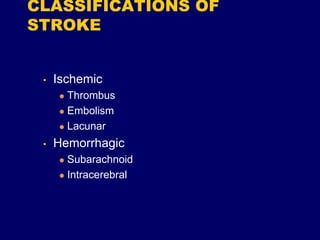
CLASSIFICATIONS OF
STROKE
• Ischemic
 Thrombus
 Embolism
 Lacunar
• Hemorrhagic
 Subarachnoid
 Intracerebral
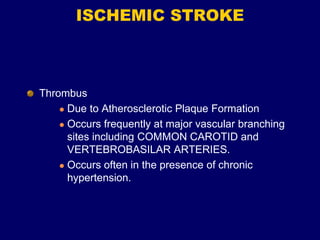
ISCHEMIC STROKE
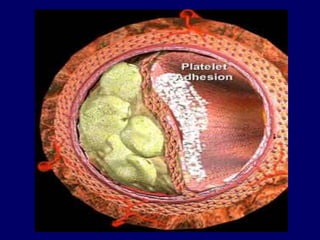
Thrombus
 Due to Atherosclerotic Plaque Formation
 Occurs frequently at major vascular branching
sites including COMMON CAROTID and
VERTEBROBASILAR ARTERIES.
 Occurs often in the presence of chronic
hypertension.
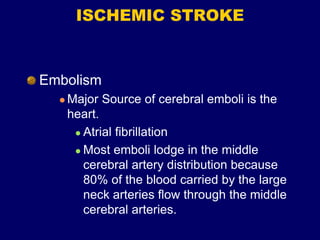
ISCHEMIC STROKE
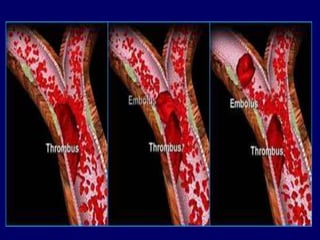
Embolism
 Major Source of cerebral emboli is the
heart.
 Atrial fibrillation
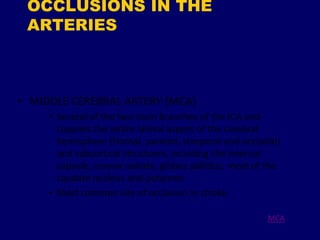
 Most emboli lodge in the middle
cerebral artery distribution because
80% of the blood carried by the large
neck arteries flow through the middle
cerebral arteries.
ISCHEMIC STROKE
 Most Frequent Target:
 Superficial branches of cerebral and
cerebellar arteries.
ISCHEMIC STROKE
ISCHEMIC STROKE
ISCHEMIC STROKE
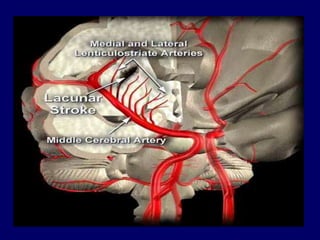
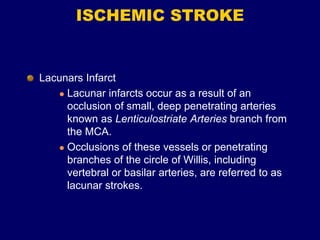
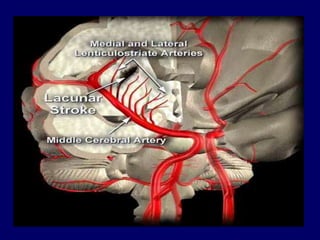
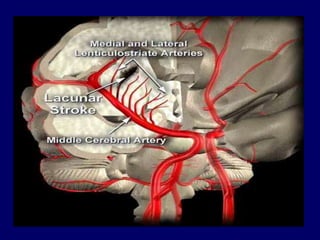
Lacunars Infarct
 Lacunar infarcts occur as a result of an
occlusion of small, deep penetrating arteries
known as Lenticulostriate Arteries branch from
the MCA.
 Occlusions of these vessels or penetrating
branches of the circle of Willis, including
vertebral or basilar arteries, are referred to as
lacunar strokes.
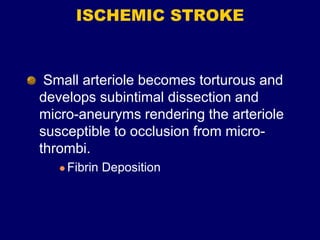
ISCHEMIC STROKE
Small arteriole becomes torturous and
develops subintimal dissection and
micro-aneuryms rendering the arteriole
susceptible to occlusion from micro-
thrombi.
 Fibrin Deposition
HEMORRHAGIC STROKE
Subarachnoid Hemorrhage
 Bleeding that occurs between the Dura
and Pia Mater.
 Commonly caused by:
1.ARTERIOVENOUS MALFORMATION
(AVM)
1. ANEURYSMS
HEMORRHAGIC STROKE
1. AVM
• Tangled, dilated blood vessels in which arteries flow
directly into veins.
• Occur most often at the junction of cerebral arteries,
usually within the parenchyma of the frontal-parietal
region, frontal lobe, lateral cerebellum, or overlying
occipital lobe.
• Results to seizures.
HEMORRHAGIC STROKE
2. Aneurysms
• Focal dilations in the artery
• Found in the anterior region of the Circle of Willis,
particularly near branches of the Anterior Communicating
Artery, ICA, MCA and junctions of almost any branch site.
• Contributing factors include atherosclerosis and
hypertension.
HEMORRHAGIC STROKE
Intracerebral Hemorrhage
 Originates from deep penetrating vessels and
causes injury to the brain tissue by disrupting
connecting pathways and causing localized
pressure injury.
 Bleeding in the surrounding brain tissue.
 Also caused by AVM and aneurysms.
OCCLUSIONS IN THE
ARTERIES
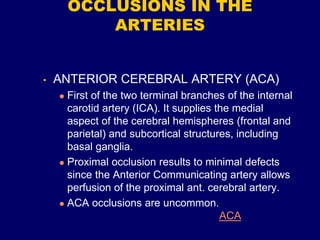
• ANTERIOR CEREBRAL ARTERY (ACA)
 First of the two terminal branches of the internal
carotid artery (ICA). It supplies the medial
aspect of the cerebral hemispheres (frontal and
parietal) and subcortical structures, including
basal ganglia.
 Proximal occlusion results to minimal defects
since the Anterior Communicating artery allows
perfusion of the proximal ant. cerebral artery.
 ACA occlusions are uncommon.
ACA
OCCLUSIONS IN THE
ARTERIES
OCCLUSIONS IN THE
ARTERIES
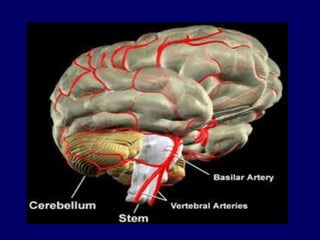
• VERTEBROBASILAR ARTERY
 Arise from the subclavian arteries and travel
into the brain along the medulla where they
merge at the inferior border of the pons to form
the basilar artery. The basilar artery eventually
gives rise to two Posterior Communicating
Artery.
SIGN AND SYMPTOMS
SIGN AND SYMPTOMS…
Symptoms of stroke depend on the
type and which area of the brain is
affected. Signs of ischemic stroke
usually occur suddenly, and signs of
hemorrhagic stroke usually develop
gradually. Symptoms include the
following:
SIGN AND SYMPTOMS…
Difficulty speaking or understanding
speech (aphasia)
Difficulty walking
Dizziness or lightheadedness (vertigo)
Numbness, paralysis, or weakness,
usually on one side of the body
Seizure (relatively rare)
Severe headache with no known cause
Sudden confusion
SIGN AND SYMPTOMS…
Sudden decrease in the level of
consciousness
Sudden loss of balance or coordination
Sudden vision problems (e.g., blurry
vision, blindness in one eye)
Vomiting
COMPLICATION
COMPLICATION…
Complications may result from ischemic
cascade or develop as a result of the
patient becoming immobile or
bedridden.
COMPLICATION…
Complications that may occur within 72
hours of stroke include the following:
Cerebral swelling (edema)
Increased intracranial pressure (ICP)
Intracerebral hemorrhage
Seizures
MUSCULOSKELETAL
loss of voluntary movement and
immobility result in loss of range of
movement and contractures.
UE: limitations in shoulder motions of
flexion, abduction, and external rotation
Contructure
Disuse atrophy and muscle weakness
Impairments in gait, balance, falls
Osteoporosis
NEUROLOGICAL
SEIZURES- common right after stroke
during the acute phase and late-onset
seizures can also occur several month
after stroke
Common in occlusive carotid disease
(17%)
HYDROCEPHALUS- may experience
headache, nausea, vomiting, ↑ lethargy,
and ataxia.
CARDIOVASCULAR/
PULMONARY
THROMBOPHLEBITIS/DVT
-complication for all immobilized
patients
DVT signs:
- rapid onset of unilateral leg
swelling with dependent edema
- tenderness, dull ache, or tight
feeling in calf; not severe pain
CARDIOVASCULAR/PULMONA
RY
CARDIAC FUNCTION
- impaired cardiac output
- cardiac decompensation
- serious rhythm disorders
- directly alter cerebral perfusion and produce
additional focal signs
- exhibit low work capacities result acute illness,
bedrest, and limited activities level.
- ↓ activity levels may also related to depression
CARDIOVASCULAR/PULMONA
RY
PULMONARY FUNCTION
- ↓lung volume
- ↓pulmonary perfusion
- ↓vital signs
- altered chest wall excursion
- ↑fatigue
- ↓endurance
CARDIOVASCULAR
PULMONARY
ASPIRATION- more common during
any phase of recovery and can occur
during any phase of swallowing
DYSPHAGIA- lead to dehydration and
compromised nutrition
INTEGUMENTARY
Ischemic damage and subsequent
necrosis of the skin results in skin
breakdown and decubitus ulcer
Skin breakdown typically over bony
prominence from pressure, friction,
shearing and/or maceration
Differential Diagnosis
Lethargy
Dizziness/Vertigo
Slurred speech
Loss of coordination
Uncontrollable eye movements
Behavioral changes
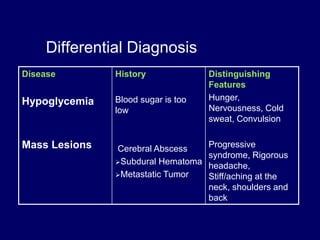
Differential Diagnosis
Disease
Hypoglycemia
Mass Lesions
History
Blood sugar is too
low
Cerebral Abscess
Subdural Hematoma
Metastatic Tumor
Distinguishing
Features
Hunger,
Nervousness, Cold
sweat, Convulsion
Progressive
syndrome, Rigorous
headache,
Stiff/aching at the
neck, shoulders and
back
Differential Diagnosis
Disease
Multiple
Sclerosis
Epilepsy
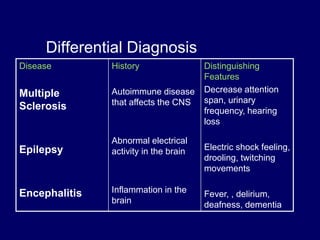
Encephalitis
History
Autoimmune disease
that affects the CNS
Abnormal electrical
activity in the brain
Inflammation in the
brain
Distinguishing
Features
Decrease attention
span, urinary
frequency, hearing
loss
Electric shock feeling,
drooling, twitching
movements
Fever, , delirium,
deafness, dementia
LABORATORY TEST AND
DIAGNOSTIC TOOLS
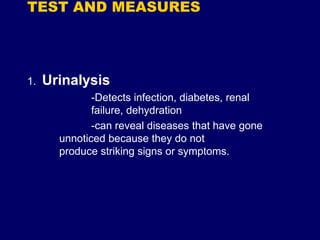
TEST AND MEASURES
1. Urinalysis
-Detects infection, diabetes, renal
failure, dehydration
-can reveal diseases that have gone
unnoticed because they do not
produce striking signs or symptoms.
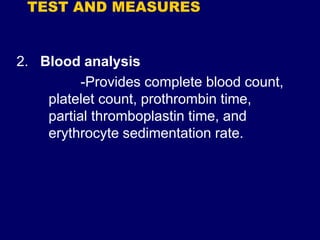
TEST AND MEASURES
2. Blood analysis
-Provides complete blood count,
platelet count, prothrombin time,
partial thromboplastin time, and
erythrocyte sedimentation rate.
TEST AND MEASURES
3. Fasting blood glucose level
-Is used to screen for and diagnose
diabetes and pre-diabetes.
-Collected after an 8 to 10 hr fast
4. Blood chemistry profile
-Test measures the value of a different
substance in the blood. These values
provide information on the function of
different organ systems (kidney, liver,
etc.) or the risk for
TEST AND MEASURES
5. Blood cholesterol and lipid profile
-Is a group of simple blood tests that
reveal important information about the
types, amount and distribution of the
various types of fats (lipids) in the
bloodstream.
6. Thyroid function tests
-A collective term for blood tests
used to check the function of the thyroid
TEST AND MEASURES
7. Full cardiac evaluation
-Includes electrocardiograph to detect
arrhythmias as source of emboli or
coincidental heart disease.
8. Echocardiography
-Also known as a cardiac
ultrasound
-It uses standard ultrasound
techniques to image two-dimensional
slices of the heart. The latest ultrasound
systems now employ 3D real-time imaging.
TEST AND MEASURES
9. Lumbar puncture
-diagnostic and at times therapeutic
procedure that is performed in order to
collect a sample of cerebrospinal fluid
(CSF) for biochemical, microbiological,
and cytological analysis, or occasionally
as a treatment ("therapeutic lumbar
puncture") to relieve increased
intracranial pressure.
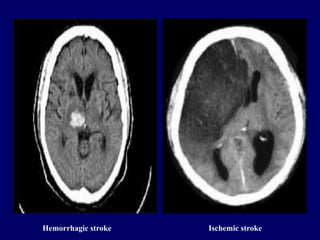
IMAGING
1. Computerized Tomography
-Commonly used imaging technique
-Allows identification of large arteries
and vein, and venous sinuses
-Used to rule out other brain lesions
Hemorrhagic stroke Ischemic stroke
2. Magnetic Resonance Imaging
-Measures nuclear particles as
they interact with powerful
magnetic field
IMAGING
IMAGING
3. Positron Emission Tomography
-Allows imaging of regional blood
flow and localized cerebral
metabolism
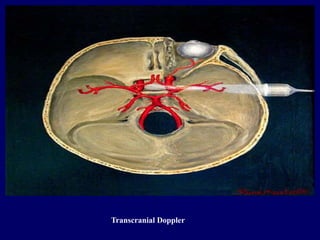
4. Transcranial and Carotid Doppler
-Used for noninvasive imaging of
the neck and chest level.
Transcranial Doppler
IMAGING
5. Cerebral Angiography
-Invasive and involves the
injection of radiopaque dye into
blood vessels with subsequent
radiography
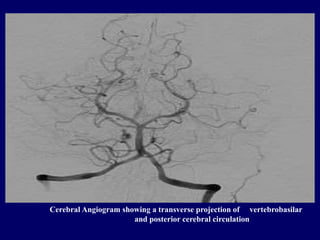
Cerebral Angiogram showing a transverse projection of vertebrobasilar
and posterior cerebral circulation
PT Management
Recovery begins as people get better from the
immediate effects of a stroke. Over months and even years,
other areas of the brain might learn to take over from the dead
areas.
Rehabilitation is the process of overcoming or
learning to cope with the damage the stroke has caused.
Stroke can cause weakness or paralysis in one side
of the body and problem with balance or coordination.
Helps regain as much mobility and muscle
control as possible.
Assess the stroke survivor’s strength,
endurance, ROM, gait abnormalities and
sensory deficits to design individualized
rehabilitation program.
Work at patient bedside assuring adequate
ROM and teaching bed mobilities, rolling and
sitting.
Helps survivors regain the use of stroke
impaired limbs, teach compensatory
strategies to reduce the effect of remaining
deficits and establish ongoing program to help
people retain their newly learned skills.
Positioning
The room should be arranged to maximize
patient awareness of the hemiplegic side. Affected
side should be towards the main part of the room.
Since patient spends significant time on bed, we
have to prevent undesirable posture which can lead to
contractures or pressure sores.
BE PATIENT. REHABILITATION IS A
SLOW AND OFTEN FRUSTRATING PROCESS.
DON’T WORRY IF THERE ARE DAYS WHEN
LITTLE PROGRESS SEEMS TO BE MADE.
BE POSITIVE. CONSTANT
ENCOURAGEMENT AND PRAISE ARE
NEEDED TO KEEP UP EVRYONE’S
SPIRITS.
NO PROGRAM CAN SUCCEED WITHOUT
A STRONG DESIRE BY THE PATIENT
TO BE INDEPENDENT.NEVERTHELESS;
FAMILY INVOLVEMENT IS ALSO A KEY
INGREDIENT IN A SUCCESSFUL
REHABILITATION PROGRAM.
134
Neuro-ophthalmology:
•Visual field abnormalities…primarily those
related to neuro-ophthalmic problems
•Case
•Field defect in relation to anatomical location
•Importance of the history and examination
04/04/2017 135
case
A 43y woman complains of a mild headache
(left forehead). The headache has been
present 2 months, and is not getting better.
As you listen she tells you the sight is dim in left
eye.
Examination confirms red colours in the left eye
are not as bright as when seen with the right
eye.
Further examination shows a pale optic disk
and afferent pupillary defect, and visual field
defect, but even without these findings a CT
scan is needed. CT scan details:
04/04/2017 136
case
04/04/2017 137
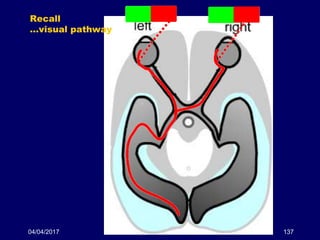
Recall
…visual pathway
04/04/2017 138
Recall
…disease of the eye itself causes various visual
symptoms
04/04/2017 139
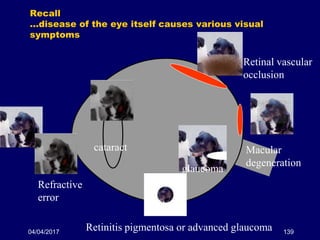
Recall
…disease of the eye itself causes various visual
symptoms
cataract
glaucoma
Retinitis pigmentosa or advanced glaucoma
Macular
degeneration
Retinal vascular
occlusion
Refractive
error
04/04/2017 140
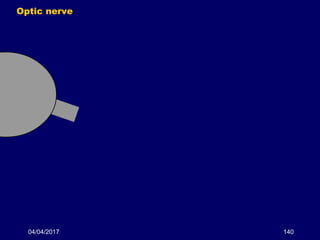
Optic nerve
04/04/2017 141
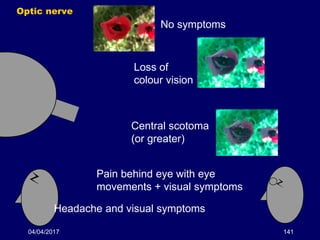
Optic nerve
No symptoms
Loss of
colour vision
Central scotoma
(or greater)
Pain behind eye with eye
movements + visual symptoms
Headache and visual symptoms
04/04/2017 142
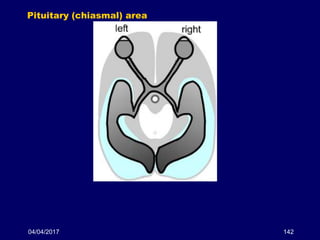
Pituitary (chiasmal) area
04/04/2017 143
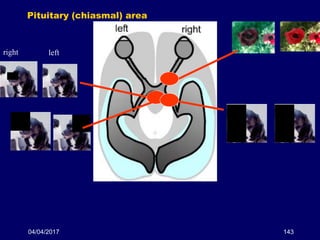
Pituitary (chiasmal) area
right left
04/04/2017 144
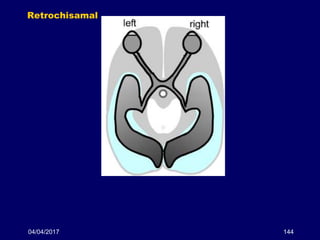
Retrochisamal
04/04/2017 145
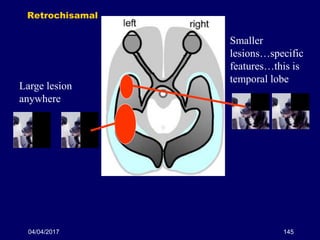
Retrochisamal
Large lesion
anywhere
Smaller
lesions…specific
features…this is
temporal lobe
04/04/2017 146
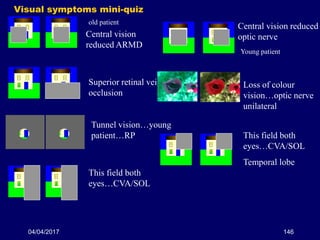
Visual symptoms mini-quiz
Central vision
reduced ARMD
Superior retinal vein
occlusion
Tunnel vision…young
patient…RP
This field both
eyes…CVA/SOL
Loss of colour
vision…optic nerve
unilateral
This field both
eyes…CVA/SOL
Temporal lobe
Central vision reduced
optic nerve
Young patient
old patient
04/04/2017 147
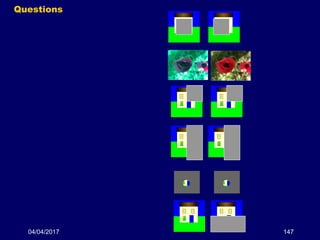
Questions
04/04/2017 148
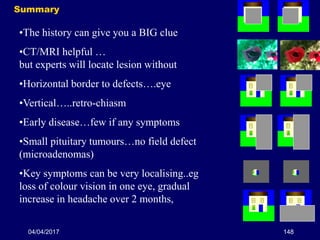
Summary
•The history can give you a BIG clue
•CT/MRI helpful …
but experts will locate lesion without
•Horizontal border to defects….eye
•Vertical…..retro-chiasm
•Early disease…few if any symptoms
•Small pituitary tumours…no field defect
(microadenomas)
•Key symptoms can be very localising..eg
loss of colour vision in one eye, gradual
increase in headache over 2 months,
Cardioembolic
Stroke:
Diagnosis and
Management
Treatment
of Acute
Cardioembolic
Stroke
 Recent trial results
 Risk factors for early stroke recurrence
 Risk of hemorrhagic complications
 Risk factors for sympotomatic ICH
 Recommendations for therapy
Treatment of Acute
Cardioembolic Stroke
Risk of Early Stroke Recurrence
 Multiple recent emboli
 Mechanical heart valve
 Atrial fibrillation + high risk features
 Established intra-cardiac thrombus
Treatment of Acute
Cardioembolic Stroke
Acute Medical
Stroke Therapy
Acute Medical
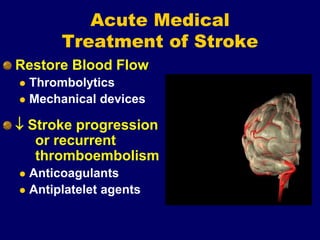
Treatment of Stroke
Restore Blood Flow
 Thrombolytics
 Mechanical devices
 Stroke progression
or recurrent
thromboembolism
 Anticoagulants
 Antiplatelet agents
Stroke Code
Who is eligible for tPA?
What needs to be checked
before starting the tPA infusion?
Common errors to avoid
Stroke Code
Who is eligible for tPA?
What needs to be checked
before starting the tPA infusion?
Common errors to avoid
Guidelines for
Anticoagulant Therapy
Urgent administration of anticoagulants
has not yet been associated with
lessening the risk of early recurrent
stroke or improving outcomes. Because
it can increase the risk of brain
hemorrhage, routine use cannot be
recommended.
American Heart Association, 2003
Guidelines for
Anticoagulant Therapy
Anticoagulants are not recommended for
any subgroup of patients with acute stroke
based on any presumed mechanism or
location (e.g., cardioembolic, large vessel
atherosclerotic, vertebrobasilar, or
“progressing” stroke) because data are
insufficient.
American Academy of Neurology / AHA, 2003
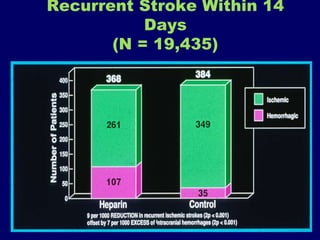
Recurrent Stroke Within 14
Days
(N = 19,435)
Treatment
of Acute
Cardioembolic
Stroke
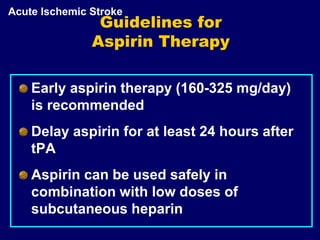
Guidelines for
Aspirin Therapy
Early aspirin therapy (160-325 mg/day)
is recommended
Delay aspirin for at least 24 hours after
tPA
Aspirin can be used safely in
combination with low doses of
subcutaneous heparin
Acute Ischemic Stroke
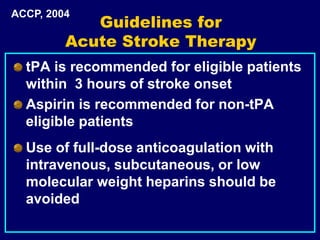
Guidelines for
Acute Stroke Therapy
tPA is recommended for eligible patients
within 3 hours of stroke onset
Aspirin is recommended for non-tPA
eligible patients
Use of full-dose anticoagulation with
intravenous, subcutaneous, or low
molecular weight heparins should be
avoided
ACCP, 2004
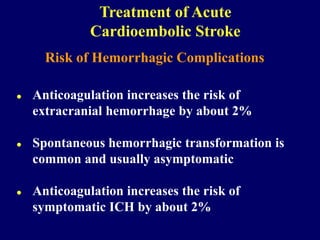
Risk of Hemorrhagic Complications
 Anticoagulation increases the risk of
extracranial hemorrhage by about 2%
 Spontaneous hemorrhagic transformation is
common and usually asymptomatic
 Anticoagulation increases the risk of
symptomatic ICH by about 2%
Treatment of Acute
Cardioembolic Stroke
Risk Factors for Symptomatic ICH
 Infarct size
 Timing of reperfusion (12 - 48 hours)
 Excesssive anticoagulation / tPA
 Heparin bolus?
 Severe hypertension?
Treatment of Acute
Cardioembolic Stroke
Recommendations for Therapy
 Aspirin for acute therapy (t-PA if eligible)
 If low risk for early recurrence:
begin warfarin (days to weeks)
 If high risk of early recurrence:
consider early anticoagulation if low risk for
symptomatic hemorrhage
Treatment of Acute
Cardioembolic Stroke
 Diagnostic criteria for cardioembolism
 Clinical and neuroimaging features
 Aortic atheroma
 Patent foramen ovale
 Treatment of cardioembolic stroke
Cardioembolic Stroke:
Diagnosis and Management

Stroke, CVA, Cerebrovascular accident talk

  • 1.
    Stroke is atype of cardiovascular disease. It affects the arteries leading to and within the brain. A stroke occurs when a blood vessel that carries oxygen and nutrients to the brain is either blocked by a clot or bursts. When that happens, part of the brain cannot get the blood and oxygen it needs, so it starts to die. WHAT IS A STROKE?
  • 2.
    Ischemic stroke iscaused by a lack of blood reaching part of the brain and is the most common type, accounting for over 80 percent of all strokes: • Symptoms develop over a few minutes or worsen over hours. • Ischemic strokes are typically preceded by symptoms or warning signs that may include loss of strength or sensation on one side of the body, problems with speech and language or changes in vision or balance. • Ischemic strokes usually occur at night or first thing in the morning. • Often a TIA (transient ischemic attack) or “mini stroke” may give some warning of a major ischemic stroke. TYPES OF STROKE
  • 3.
    Fifteen to 20percent of strokes happen when a blood vessel ruptures in or near the brain. This is called a hemorrhagic or bleeding stroke: • In hemorrhagic strokes, the fatality rate is higher and overall prognosis is poorer. • People who have hemorrhagic strokes are younger. • This kind of stroke is often associated with a very severe headache, nausea and vomiting, and usually the symptoms appear suddenly. • A transient ischemic attack (TIA) or any other stroke warning sign may not precede this type of stroke. TYPES OF STROKE
  • 4.
    What are therisk factors I can’t control? Increasing age – stroke affects people of all ages, from young children to elderly individuals. But the older you are, the greater your stroke risk. Gender – in most age groups, more men than women have stroke, but more women die from stroke. Heredity and race – people whose close blood relations have had a stroke have a higher risk of stroke themselves. Certain races have a higher risk of death and disability from stroke than others, because they have high blood pressure more often. Prior stroke – someone who has had a stroke is at a higher risk of having another one. RISK FACTORS FOR STROKE
  • 5.
    Knowing your riskfactors is the key to prevention - some can be changed or treated, others can’t. What risk factors can I change or treat? High blood pressure – this is the single most important risk factor for stroke. Know your blood pressure and have it checked at least once every two years. If it’s 140/90 or about, it’s high. Talk to your doctor about how to control it and take your medicine as directed; Diet - improve your eating habits by avoiding foods which are high in fat and cholesterol, cut down on saturated fat, sugar and salt. Eat more fruit, vegetables, cereals, dried peas and beans, pasta, fish, poultry and lean meats; RISK FACTORS FOR STROKE
  • 6.
    6 Tobacco use –don’t smoke cigarettes or use other forms of tobacco; Diabetes – while diabetes is treatable, having it increases your risk of stroke. Work with your doctor to manage diabetes and reduce other risk factors; RISK FACTORS FOR STROKE
  • 7.
    Carotid or otherartery disease – the carotid arteries in your neck supply blood to your brain. A carotid artery damaged by a fatty build-up of plaque inside the artery wall may become blocked by a blood clot, causing a stroke; TIAs – Transient ischemic attacks (TIAs) are “mini strokes” that produce stroke-like symptoms but no lasting effects. Recognizing and treating TIAs can reduce the risk of a major stroke. Know the warning signs of a TIA and seek emergency medical treatment immediately; Atrial fibrillation or other heart disease – in atrial fibrillation the heart’s upper chambers quiver rather than beat effectively, causing the blood to pool and clot, increasing the risk of stroke. People with other types of heart disease have a higher risk of stroke too; Certain blood disorders – a high red blood cell count makes clots more likely, raising the risk of stroke. Sickle cell anemia increases stroke risk because the “sickled” cells stick to blood vessel walls and may block arteries; High blood cholesterol – high blood cholesterol increases the risk of clogged arteries. If an artery leading to the brain becomes blocked, a stroke results. RISK FACTORS FOR STROKE
  • 8.
    Physical inactivity andobesity - being inactive, obese or both can increase your risk of cardiovascular disease. Exercise regularly – check with your doctor before you start. Start slowly and build up to at least 30 minutes a session at least three to four times per week. Try to maintain a healthy weight; Excessive alcohol intake – drinking an average of more than one drink per day for women or more than two drinks a day for men raises blood pressure. Binge drinking can lead to stroke, so limit your alcohol intake. Stress – decrease your stress level as much as possible and seek emotional support when it’s needed. RISK FACTORS FOR STROKE
  • 9.
    HOW TO RECOGNIZEIF YOU ARE HAVING A STROKE... Call the Emergency Services immediately if you are experiencing: • Sudden numbness or weakness of the face, arm or leg, especially on one side of the body; • Sudden confusion, trouble speaking or understanding; • Sudden trouble seeing in one or both eyes; • Sudden trouble walking, dizziness, loss of balance or co-ordination; • Sudden severe headache with no known cause.
  • 10.
    HOW TO RECOGNIZEIF SOMEONE ELSE IS HAVING A STROKE... At a recent American Stroke Association conference, a report was presented that showed a bystander may be able to spot someone having a stroke by giving a quick, simple test, as follows: • Asking the individual to smile; • Asking him or her to raise both arms and keep them up; • Asking the person to speak a simple sentence coherently. If the person has trouble with any of these tasks, contact the Emergency Services immediately and describe the symptoms to the Dispatcher. Time is crucial in treating a stroke.
  • 11.
    History of CerebrovascularDisease Where have we been? Where are we now? Where should we go in the future? 04/04/2017 11
  • 12.
    400 BC-1700 AD Emphasison Prognosis and early Exploration of Brain Anatomy and Function Hippocrates- circa 400 BC Galen 130-200 AD Andre Vesalius 1514-1564 Johann Wepfer 1620-1695 Sir Thomas Willis 1621-1675 The Past
  • 13.
    Johann Jakob Wepfer1620-1695 Observationes Anatomicae, ex Cadaveribus Eorum, quos Sustulit Apoplexia (1658) Performed necropsies and showed that bleeding into the brain was an important cause of apoplexy Described the anatomy and presence of hardening and occlusions within the intracranial Carotid and Middle Cerebral Arteries The Past-Pathology
  • 14.
    Sir Thomas Willis1621-1675 Dissections described and illustrated by Sir Christopher Wrenn in Cerebri Anatomi (1664) Clarified anatomy of the Brain and Cranial Nerves Dissected cranial arteries and described connections at the base of the Brain (Circle of Willis) Respected clinician who described TIAs and Migraine The Past- Anatomy and Clinical
  • 15.
    Sir Thomas Willis Sedleian Professorof Natural Philosophy at Oxford University
  • 18.
    Diagram of anAnastamosis - Willis 1664
  • 19.
    Rudolph Ludwig CarlVirchow (1821-1902) Clearly showed that vascular occlusion caused infarction Described the phenomenology of arterial thrombosis Recognized the important interaction between the vascular wall and the blood Described embolism The Past-Pathology & pathophysiology
  • 20.
  • 22.
    Vieusseux -1810 Dec 29,1807 Vieusseux developed an unusual and severe pain in the left gum and jaw. 5 days later the pain recurred along with severe pain in the left eye. He then developed severe vertigo. “A peculiar and inexpressible perturbation in all his sensations” a giddiness that affected his vision and “occasioned feelings similar to those produced by a ship violently agitated.” He then lost his voice, had difficulty swallowing, and felt that his left side was weak.
  • 23.
    Vieusseux -1810 He thenexamined himself and found that “the whole of his right side was so insensible that he could be scratched or pinched without experiencing any pain and that this insensibility abruptly terminated at a line dividing the whole body in a vertical direction” The sensations of heat and cold were totally different from normal on his right side but he was puzzled to find that he had not lost the perception of touch on his right side. The left side of the head and face were also insensible to pricking or scratching over the left forehead, nose, lips, chin, and ear.
  • 24.
    Vieusseux -1810 The wholeof the left side of the body preserved its usual degree of sensibility.” He also noted that his left eye was partially shut and the left corner of the mouth was drawn downward. His left leg dragged when he walked. During the next weeks the dysarthria and dysphagia improved but he developed hiccups “His intellectual faculties remained quite unimpaired so that he could accurately observe the whole succession of symptoms.”
  • 25.
    Charles Miller Fisher Pathologyand Clinical Features of ICH (1961-71) Clinical features (1951-4) and pathology (1986) of Carotid Artery Disease Clinical features of Vertebral artery disease (1971) and Vascular lesions in Lateral Medullary Infarcts (1961) Clinical and pathological features of Lacunar infarction (1965-present)
  • 26.
  • 27.
  • 28.
    1951 Technology is rapidlyimproving and still developing. CT and MRI allow delineation of the location and type of lesion and CTA and CT perfusion, MRA, and extracranial and transcranial ultrasound (TCD) allow definition of arterial lesions. Echocardiography, cardiac rhythm monitoring, and blood analysis detect cardiac, aortic, and hematological causes of stroke. Neurologists of today can quickly and safely define the cause and extent of cerebrovascular disease.
  • 29.
  • 30.
    I.Definition of Terms: CerebrovascularAccident - Also know as stroke and brain attacks -is a sudden loss of neurological function caused by an interruption of the blood flow to the brain
  • 31.
    I. Definition ofterms -It is a non-traumatic brain injury caused by occlusion or rupture of cerebral blood vessel that results in sudden neurological deficit characterized by loss of motor control.
  • 32.
    I. Definition ofTerms Aneurysm -It is a localized dilatation or bulging of the blood vessels especially arteries - It promotes rupture of the vessel as it continues to bulge.
  • 33.
    I. Definition ofTerms APOPLEXY – sudden strike of paralysis, dumbness or fainting, from which victim is frequently failed to recover o Atherosclerosis -Formation of multiple plaques within the blood vessels.
  • 34.
    I. Definition ofTerms Embolus - an object that migrates from one part of the body to causes blockage or occlusion to another part of the body.
  • 35.
    I. Definition ofterms Hematocrit -Also know as Packed Cell Volume (PCV) or Erythrocyte Volume Fraction (EVF) -is the proportion of the blood volume, which is occupied by red blood cell.
  • 36.
    I. Definition ofTerms Hemorrhage -Is the loss of blood at the circulatory system or excessive presence of blood outside the circulation - Can be internally or externally.
  • 37.
    I. Definition ofTerms Hypertension  Also referred to as high blood pressure (HTN or HPN.)  It is a medical condition in which the blood pressure is chronically elevated Infarction -A process of anoxic death of tissue due to loss of blood supply because of occlusion or blockage of the artery
  • 38.
    I. Definition ofTerms Ischemic -Insufficient blood flow to an organ cause by the blockage of the artery. Transient Ischemic Attack -(Mini Stroke) Caused by changes in blood supply in the brain produces same manifestation as stroke within 24 hours.
  • 39.
    I. Definition ofTerms Thrombus - Is the final product of the blood coagulation step in hemostasis It is achieved via the aggregation of platelets that form a platelet plug. It is physiologic in injury but pathologic in case of thrombosis
  • 40.
    II. Epidemiology Stroke isthe third leading cause of death. The most common cause of disability among adults at the United States It is approximately 700,000 individuals was affected each year.
  • 41.
    II. Epidemiology About 500,000are new strokes and 200,000 are recurrent strokes (Usually people older than 65 y/o). In United States, in 1960’s 200 per 100,000 are affected by stroke and it was decreased as it reached to late 1960’s –1970’s.
  • 42.
    II. Epidemiology In 1980’sthe stroke is flattened because of the improvement of cranial computed tomography (CT) and Magnetic Resonance imaging (MRI). According to age, 28% higher possibilities in people older than 65 y/o than younger ones
  • 43.
    II. Epidemiology According tosex, having an incidence of stroke, Men are 19% higher rather than women. According to race, Black Americans are more prone rather that White Americans. Asian Countries are more prone having stroke compared to United States. (Cause by intracranial hemorrhage)
  • 44.
    Causes Percentage Large vessel occlusion/infarction 32 Embolism32 Small vessel occlusion/ lacunar 18 Intracerebral hemorrhage 11 Subarachnoid hemorrhage 7 II. Epidemiology Table 77-2 Causes of stroke (Delisa)
  • 47.
    II. Epidemiology Most ofthe patients who die from acute stroke succumb in the first 30 days. Survival in the first 30 days of new stroke reported to be 70- 85% dependent on the stroke type.
  • 48.
    II. Epidemiology In IntracerebralHemorrhage is only 20- 50% , cause death usually occur in first 3 days. In Cerebral infraction is 85%. After 30 days of survival, the death rate declines.
  • 49.
    III. Epidemiology Stroke ismost commonly cause of chronic disability.
  • 50.
    II. Etiology A. Atherosclerosis -Majorcontributory factor of Cerebrovascular Accident. -accumulation of lipids, fibrins, complex carbohydrates and calcium deposit on the arterial walls that leads to progressive narrowing of blood vessels. Found in the bifurcations of vessels.
  • 51.
    II. Etiology B. IschemicStrokes -Results from a thrombus, embolism or conditions that produce low systemic perfusions pressures.
  • 52.
    II. Etiology C. CerebralThrombosis  Refers to the formation of development of a blood clot within the arteries and their branches.  Moving thrombus is called embolus.
  • 53.
    II. Etiology Thrombosis Ischemia  Infarction IntraCerebral Hemorrhage  Is cause by the ruptured of cerebral vessel with subsequent bleeding to brain Types of IntraCerebral Hemorrhage
  • 54.
    II. Etiology -Primary CEREBRALHemorrhage -occurs in small blood vessels weakened by atherosclerosis produces aneurysm. -SUBARACHNOID hemorrhage -hemorrhage occurs at the sub arachnid space typically from a saccular or berry aneurysm affecting primary vessels.
  • 55.
    II. Etiology E. Artriovenousmalformation  Is a congenital defect that can cause stroke. -The arteries and veins are tortuous tangled with interposing capillaries system.
  • 56.
    III. Risk Factorsof Stroke Hypertension- Is the most important risk factors  It is define as a blood pressure higher than 160/95 mmHg.  Among the survivors of stroke, 67% of them have chronic hypertension  It gives risk in cerebral infarction, thrombotic, lacunars and hemorrhagic stroke.
  • 57.
    III. Risk Factorsof Stroke 2. Heart disease  Is an important risk factor for stroke  Atrial fibrillation and valvular heart disease increase the risk of cerebral infarction because of presence of cerebral emboli.
  • 58.
    III. Risk Factorsof Stroke 3.Diabetes Mellitus  Independent risk factor that doubles the risk of stroke.  It increases the risk of ischemic stroke to three to six times.  The prevalence of diabetes among stroke survivors is 20%.
  • 59.
    III. Risk Factorsof Stroke 4. Hyperlipidemia  Poses only small additional risk for strokes mainly for individuals younger at age of 55.  Increase in blood viscosity, hematocrit and serum fibrinogen have been implied the risk factor of stroke.
  • 60.
    Risk Factors ofstroke Smoking  It is an important factor for cardiovascular disease but influence for stroke is not cleared.  The risk for heavy smokers (>40 cigarettes) is twice than light smokers (<10 cigarettes).
  • 61.
    III. Risk FactorsOf Stroke - Some studies that smoking to an increased risk of hemorrhagic stroke in addition to ischemic cerebral infarction.
  • 62.
    III. Risk factorof stroke 6. Transient Ischemic Attack -Is another important risk factor. - An About 10 % of individuals with TIA will go on to have a major stroke within 90 days and 5 % will have a major stroke within 2 days.
  • 63.
    III. Risk Factorsof stroke 7. Obesity  Hypertension and diabetes mellitus are in common in obese and strong influences risk of stroke.  Some studies says that weight loss has positive influences on blood pressure and diabetic control and also helps in reduction of risk of strokes.
  • 64.
    IV. Stroke Prevention Activepromotions of lifestyle changes by physicians have the best potential to decrease the annual rate of new stroke occurrence.
  • 65.
    IV. Stroke Prevention Tothe individuals who have a stroke in the past history additional intervention and medication was given like: -Antiplatelet therapy - Anticoagulation -Carotid Endarterectomy.
  • 66.
    IV. Stroke Prevention AntiplateletTherapy -Aspirin is the most frequently prescribe antiplatelet agent. -Aspirin achieves a significant anti platelet effect at fairly low serum concentrations.
  • 67.
    IV. Stroke Prevention Anticoagulation -Theuse of Warfarin anticoagulation for primary stroke prevention in non- valvular atrial fibrillation. -Warfarin reduces relative stroke risk by 58%to 86%over that in control subjects.
  • 68.
    IV. Stroke Prevention CarotidEndarterectomy  Is a surgical procedure that use to correct the carotid stenosis  It is the removal of material inside the artery.
  • 69.
  • 70.
    CEREBRAL BLOOD FLOW (CBF) Controlledby auto-regulatory mechanism that modulates a constant rate of blood flow through the brain. These mechanisms provide homeostatic balance.
  • 71.
    ISCHEMIC CASCADE Within secondsto minutes of the loss of perfusion to a portion of the brain, an ischemic cascade is unleashed.
  • 72.
    CLASSIFICATIONS OF STROKE • Ischemic Thrombus  Embolism  Lacunar • Hemorrhagic  Subarachnoid  Intracerebral
  • 73.
    ISCHEMIC STROKE Thrombus  Dueto Atherosclerotic Plaque Formation  Occurs frequently at major vascular branching sites including COMMON CAROTID and VERTEBROBASILAR ARTERIES.  Occurs often in the presence of chronic hypertension.
  • 75.
    ISCHEMIC STROKE Embolism  MajorSource of cerebral emboli is the heart.  Atrial fibrillation  Most emboli lodge in the middle cerebral artery distribution because 80% of the blood carried by the large neck arteries flow through the middle cerebral arteries.
  • 76.
    ISCHEMIC STROKE  MostFrequent Target:  Superficial branches of cerebral and cerebellar arteries.
  • 77.
  • 78.
  • 80.
    ISCHEMIC STROKE Lacunars Infarct Lacunar infarcts occur as a result of an occlusion of small, deep penetrating arteries known as Lenticulostriate Arteries branch from the MCA.  Occlusions of these vessels or penetrating branches of the circle of Willis, including vertebral or basilar arteries, are referred to as lacunar strokes.
  • 81.
    ISCHEMIC STROKE Small arteriolebecomes torturous and develops subintimal dissection and micro-aneuryms rendering the arteriole susceptible to occlusion from micro- thrombi.  Fibrin Deposition
  • 84.
    HEMORRHAGIC STROKE Subarachnoid Hemorrhage Bleeding that occurs between the Dura and Pia Mater.  Commonly caused by: 1.ARTERIOVENOUS MALFORMATION (AVM) 1. ANEURYSMS
  • 85.
    HEMORRHAGIC STROKE 1. AVM •Tangled, dilated blood vessels in which arteries flow directly into veins. • Occur most often at the junction of cerebral arteries, usually within the parenchyma of the frontal-parietal region, frontal lobe, lateral cerebellum, or overlying occipital lobe. • Results to seizures.
  • 86.
    HEMORRHAGIC STROKE 2. Aneurysms •Focal dilations in the artery • Found in the anterior region of the Circle of Willis, particularly near branches of the Anterior Communicating Artery, ICA, MCA and junctions of almost any branch site. • Contributing factors include atherosclerosis and hypertension.
  • 87.
    HEMORRHAGIC STROKE Intracerebral Hemorrhage Originates from deep penetrating vessels and causes injury to the brain tissue by disrupting connecting pathways and causing localized pressure injury.  Bleeding in the surrounding brain tissue.  Also caused by AVM and aneurysms.
  • 90.
    OCCLUSIONS IN THE ARTERIES •ANTERIOR CEREBRAL ARTERY (ACA)  First of the two terminal branches of the internal carotid artery (ICA). It supplies the medial aspect of the cerebral hemispheres (frontal and parietal) and subcortical structures, including basal ganglia.  Proximal occlusion results to minimal defects since the Anterior Communicating artery allows perfusion of the proximal ant. cerebral artery.  ACA occlusions are uncommon. ACA
  • 91.
  • 92.
    OCCLUSIONS IN THE ARTERIES •VERTEBROBASILAR ARTERY  Arise from the subclavian arteries and travel into the brain along the medulla where they merge at the inferior border of the pons to form the basilar artery. The basilar artery eventually gives rise to two Posterior Communicating Artery.
  • 94.
  • 95.
    SIGN AND SYMPTOMS… Symptomsof stroke depend on the type and which area of the brain is affected. Signs of ischemic stroke usually occur suddenly, and signs of hemorrhagic stroke usually develop gradually. Symptoms include the following:
  • 96.
    SIGN AND SYMPTOMS… Difficultyspeaking or understanding speech (aphasia) Difficulty walking Dizziness or lightheadedness (vertigo) Numbness, paralysis, or weakness, usually on one side of the body Seizure (relatively rare) Severe headache with no known cause Sudden confusion
  • 97.
    SIGN AND SYMPTOMS… Suddendecrease in the level of consciousness Sudden loss of balance or coordination Sudden vision problems (e.g., blurry vision, blindness in one eye) Vomiting
  • 98.
  • 99.
    COMPLICATION… Complications may resultfrom ischemic cascade or develop as a result of the patient becoming immobile or bedridden.
  • 100.
    COMPLICATION… Complications that mayoccur within 72 hours of stroke include the following: Cerebral swelling (edema) Increased intracranial pressure (ICP) Intracerebral hemorrhage Seizures
  • 101.
    MUSCULOSKELETAL loss of voluntarymovement and immobility result in loss of range of movement and contractures. UE: limitations in shoulder motions of flexion, abduction, and external rotation Contructure Disuse atrophy and muscle weakness Impairments in gait, balance, falls Osteoporosis
  • 102.
    NEUROLOGICAL SEIZURES- common rightafter stroke during the acute phase and late-onset seizures can also occur several month after stroke Common in occlusive carotid disease (17%) HYDROCEPHALUS- may experience headache, nausea, vomiting, ↑ lethargy, and ataxia.
  • 103.
    CARDIOVASCULAR/ PULMONARY THROMBOPHLEBITIS/DVT -complication for allimmobilized patients DVT signs: - rapid onset of unilateral leg swelling with dependent edema - tenderness, dull ache, or tight feeling in calf; not severe pain
  • 104.
    CARDIOVASCULAR/PULMONA RY CARDIAC FUNCTION - impairedcardiac output - cardiac decompensation - serious rhythm disorders - directly alter cerebral perfusion and produce additional focal signs - exhibit low work capacities result acute illness, bedrest, and limited activities level. - ↓ activity levels may also related to depression
  • 105.
    CARDIOVASCULAR/PULMONA RY PULMONARY FUNCTION - ↓lungvolume - ↓pulmonary perfusion - ↓vital signs - altered chest wall excursion - ↑fatigue - ↓endurance
  • 106.
    CARDIOVASCULAR PULMONARY ASPIRATION- more commonduring any phase of recovery and can occur during any phase of swallowing DYSPHAGIA- lead to dehydration and compromised nutrition
  • 107.
    INTEGUMENTARY Ischemic damage andsubsequent necrosis of the skin results in skin breakdown and decubitus ulcer Skin breakdown typically over bony prominence from pressure, friction, shearing and/or maceration
  • 108.
  • 109.
    Differential Diagnosis Lethargy Dizziness/Vertigo Slurred speech Lossof coordination Uncontrollable eye movements Behavioral changes
  • 110.
    Differential Diagnosis Disease Hypoglycemia Mass Lesions History Bloodsugar is too low Cerebral Abscess Subdural Hematoma Metastatic Tumor Distinguishing Features Hunger, Nervousness, Cold sweat, Convulsion Progressive syndrome, Rigorous headache, Stiff/aching at the neck, shoulders and back
  • 111.
    Differential Diagnosis Disease Multiple Sclerosis Epilepsy Encephalitis History Autoimmune disease thataffects the CNS Abnormal electrical activity in the brain Inflammation in the brain Distinguishing Features Decrease attention span, urinary frequency, hearing loss Electric shock feeling, drooling, twitching movements Fever, , delirium, deafness, dementia
  • 112.
  • 113.
    TEST AND MEASURES 1.Urinalysis -Detects infection, diabetes, renal failure, dehydration -can reveal diseases that have gone unnoticed because they do not produce striking signs or symptoms.
  • 114.
    TEST AND MEASURES 2.Blood analysis -Provides complete blood count, platelet count, prothrombin time, partial thromboplastin time, and erythrocyte sedimentation rate.
  • 115.
    TEST AND MEASURES 3.Fasting blood glucose level -Is used to screen for and diagnose diabetes and pre-diabetes. -Collected after an 8 to 10 hr fast 4. Blood chemistry profile -Test measures the value of a different substance in the blood. These values provide information on the function of different organ systems (kidney, liver, etc.) or the risk for
  • 116.
    TEST AND MEASURES 5.Blood cholesterol and lipid profile -Is a group of simple blood tests that reveal important information about the types, amount and distribution of the various types of fats (lipids) in the bloodstream. 6. Thyroid function tests -A collective term for blood tests used to check the function of the thyroid
  • 117.
    TEST AND MEASURES 7.Full cardiac evaluation -Includes electrocardiograph to detect arrhythmias as source of emboli or coincidental heart disease. 8. Echocardiography -Also known as a cardiac ultrasound -It uses standard ultrasound techniques to image two-dimensional slices of the heart. The latest ultrasound systems now employ 3D real-time imaging.
  • 118.
    TEST AND MEASURES 9.Lumbar puncture -diagnostic and at times therapeutic procedure that is performed in order to collect a sample of cerebrospinal fluid (CSF) for biochemical, microbiological, and cytological analysis, or occasionally as a treatment ("therapeutic lumbar puncture") to relieve increased intracranial pressure.
  • 119.
    IMAGING 1. Computerized Tomography -Commonlyused imaging technique -Allows identification of large arteries and vein, and venous sinuses -Used to rule out other brain lesions
  • 120.
  • 121.
    2. Magnetic ResonanceImaging -Measures nuclear particles as they interact with powerful magnetic field IMAGING
  • 122.
    IMAGING 3. Positron EmissionTomography -Allows imaging of regional blood flow and localized cerebral metabolism 4. Transcranial and Carotid Doppler -Used for noninvasive imaging of the neck and chest level.
  • 123.
  • 124.
    IMAGING 5. Cerebral Angiography -Invasiveand involves the injection of radiopaque dye into blood vessels with subsequent radiography
  • 125.
    Cerebral Angiogram showinga transverse projection of vertebrobasilar and posterior cerebral circulation
  • 126.
  • 127.
    Recovery begins aspeople get better from the immediate effects of a stroke. Over months and even years, other areas of the brain might learn to take over from the dead areas. Rehabilitation is the process of overcoming or learning to cope with the damage the stroke has caused. Stroke can cause weakness or paralysis in one side of the body and problem with balance or coordination.
  • 128.
    Helps regain asmuch mobility and muscle control as possible. Assess the stroke survivor’s strength, endurance, ROM, gait abnormalities and sensory deficits to design individualized rehabilitation program.
  • 129.
    Work at patientbedside assuring adequate ROM and teaching bed mobilities, rolling and sitting. Helps survivors regain the use of stroke impaired limbs, teach compensatory strategies to reduce the effect of remaining deficits and establish ongoing program to help people retain their newly learned skills.
  • 130.
    Positioning The room shouldbe arranged to maximize patient awareness of the hemiplegic side. Affected side should be towards the main part of the room. Since patient spends significant time on bed, we have to prevent undesirable posture which can lead to contractures or pressure sores.
  • 131.
    BE PATIENT. REHABILITATIONIS A SLOW AND OFTEN FRUSTRATING PROCESS. DON’T WORRY IF THERE ARE DAYS WHEN LITTLE PROGRESS SEEMS TO BE MADE.
  • 132.
    BE POSITIVE. CONSTANT ENCOURAGEMENTAND PRAISE ARE NEEDED TO KEEP UP EVRYONE’S SPIRITS.
  • 133.
    NO PROGRAM CANSUCCEED WITHOUT A STRONG DESIRE BY THE PATIENT TO BE INDEPENDENT.NEVERTHELESS; FAMILY INVOLVEMENT IS ALSO A KEY INGREDIENT IN A SUCCESSFUL REHABILITATION PROGRAM.
  • 134.
    134 Neuro-ophthalmology: •Visual field abnormalities…primarilythose related to neuro-ophthalmic problems •Case •Field defect in relation to anatomical location •Importance of the history and examination
  • 135.
    04/04/2017 135 case A 43ywoman complains of a mild headache (left forehead). The headache has been present 2 months, and is not getting better. As you listen she tells you the sight is dim in left eye. Examination confirms red colours in the left eye are not as bright as when seen with the right eye. Further examination shows a pale optic disk and afferent pupillary defect, and visual field defect, but even without these findings a CT scan is needed. CT scan details:
  • 136.
  • 137.
  • 138.
    04/04/2017 138 Recall …disease ofthe eye itself causes various visual symptoms
  • 139.
    04/04/2017 139 Recall …disease ofthe eye itself causes various visual symptoms cataract glaucoma Retinitis pigmentosa or advanced glaucoma Macular degeneration Retinal vascular occlusion Refractive error
  • 140.
  • 141.
    04/04/2017 141 Optic nerve Nosymptoms Loss of colour vision Central scotoma (or greater) Pain behind eye with eye movements + visual symptoms Headache and visual symptoms
  • 142.
  • 143.
  • 144.
  • 145.
  • 146.
    04/04/2017 146 Visual symptomsmini-quiz Central vision reduced ARMD Superior retinal vein occlusion Tunnel vision…young patient…RP This field both eyes…CVA/SOL Loss of colour vision…optic nerve unilateral This field both eyes…CVA/SOL Temporal lobe Central vision reduced optic nerve Young patient old patient
  • 147.
  • 148.
    04/04/2017 148 Summary •The historycan give you a BIG clue •CT/MRI helpful … but experts will locate lesion without •Horizontal border to defects….eye •Vertical…..retro-chiasm •Early disease…few if any symptoms •Small pituitary tumours…no field defect (microadenomas) •Key symptoms can be very localising..eg loss of colour vision in one eye, gradual increase in headache over 2 months,
  • 149.
  • 150.
  • 151.
     Recent trialresults  Risk factors for early stroke recurrence  Risk of hemorrhagic complications  Risk factors for sympotomatic ICH  Recommendations for therapy Treatment of Acute Cardioembolic Stroke
  • 152.
    Risk of EarlyStroke Recurrence  Multiple recent emboli  Mechanical heart valve  Atrial fibrillation + high risk features  Established intra-cardiac thrombus Treatment of Acute Cardioembolic Stroke
  • 153.
  • 154.
    Acute Medical Treatment ofStroke Restore Blood Flow  Thrombolytics  Mechanical devices  Stroke progression or recurrent thromboembolism  Anticoagulants  Antiplatelet agents
  • 155.
    Stroke Code Who iseligible for tPA? What needs to be checked before starting the tPA infusion? Common errors to avoid
  • 156.
    Stroke Code Who iseligible for tPA? What needs to be checked before starting the tPA infusion? Common errors to avoid
  • 157.
    Guidelines for Anticoagulant Therapy Urgentadministration of anticoagulants has not yet been associated with lessening the risk of early recurrent stroke or improving outcomes. Because it can increase the risk of brain hemorrhage, routine use cannot be recommended. American Heart Association, 2003
  • 158.
    Guidelines for Anticoagulant Therapy Anticoagulantsare not recommended for any subgroup of patients with acute stroke based on any presumed mechanism or location (e.g., cardioembolic, large vessel atherosclerotic, vertebrobasilar, or “progressing” stroke) because data are insufficient. American Academy of Neurology / AHA, 2003
  • 159.
    Recurrent Stroke Within14 Days (N = 19,435)
  • 160.
  • 161.
    Guidelines for Aspirin Therapy Earlyaspirin therapy (160-325 mg/day) is recommended Delay aspirin for at least 24 hours after tPA Aspirin can be used safely in combination with low doses of subcutaneous heparin Acute Ischemic Stroke
  • 162.
    Guidelines for Acute StrokeTherapy tPA is recommended for eligible patients within 3 hours of stroke onset Aspirin is recommended for non-tPA eligible patients Use of full-dose anticoagulation with intravenous, subcutaneous, or low molecular weight heparins should be avoided ACCP, 2004
  • 163.
    Risk of HemorrhagicComplications  Anticoagulation increases the risk of extracranial hemorrhage by about 2%  Spontaneous hemorrhagic transformation is common and usually asymptomatic  Anticoagulation increases the risk of symptomatic ICH by about 2% Treatment of Acute Cardioembolic Stroke
  • 164.
    Risk Factors forSymptomatic ICH  Infarct size  Timing of reperfusion (12 - 48 hours)  Excesssive anticoagulation / tPA  Heparin bolus?  Severe hypertension? Treatment of Acute Cardioembolic Stroke
  • 165.
    Recommendations for Therapy Aspirin for acute therapy (t-PA if eligible)  If low risk for early recurrence: begin warfarin (days to weeks)  If high risk of early recurrence: consider early anticoagulation if low risk for symptomatic hemorrhage Treatment of Acute Cardioembolic Stroke
  • 166.
     Diagnostic criteriafor cardioembolism  Clinical and neuroimaging features  Aortic atheroma  Patent foramen ovale  Treatment of cardioembolic stroke Cardioembolic Stroke: Diagnosis and Management