SALUTATION!             BIENVENUE        DANS LA CLASSE!           PRÉSENTEZ                  PAR        MARIE GLEMAUD
LE VERBE AVOIR      PRESENT DE  L’INDICATIFTHE VERB AVOIR PRESENT TENSE
Les Objectifs ….The ObjectivesBy the end of this lesson you will be able to:Learn the subject pronouns.
Conjugate the verb avoirin the present tense.
Form the negation with the verb avoir in the present tense
Formulate questions using the verb avoir
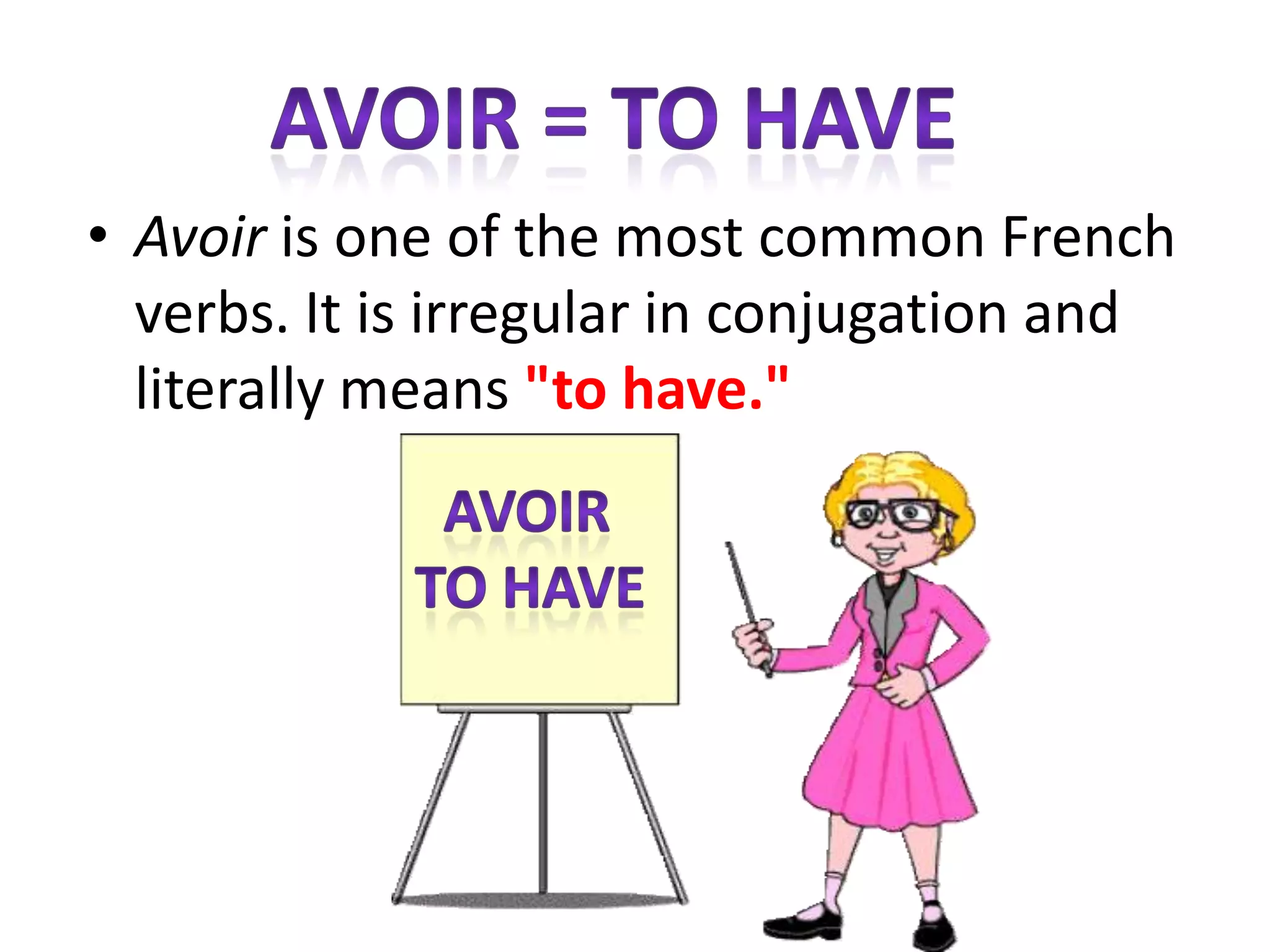
Identify idiomatic expressions  that use  the verb avoirAVOIR = TO HAVEAvoir is one of the most common French verbs. It is irregular in conjugation and literally means "to have."   AVOIRTo have
Formation of the present tense of  the verb Avoir   Formation du present de l’ indicatif du verbeAvoirthe present tense   is composed of two elements: the subject pronouns  or subject  and the form of the verb. It isformed  by:The subjectpronoun+The form of the verbLe canard blanc (il) ades yeux noirs.The form of the verb (avoir)sujet
The subject of a verb is the person or thing which performs the action of that verb.Subject pronoun is a word that can replace the subject in  a sentence . French:  Jean a.               Il a.  English:  Jean has.        He has. FrenchEnglishJe                                TuIl                               Elle                           On                             Nous                         VousIlsEllesI         You (sing. Informal)         He          She         It, we,          we         You (Plur. Formal)        They (mas. Plur.)         They  (fem. Plur.)
You use je to talk about yourself.      e. g. J’ai un crayon.You use tu to address a friend.      e.g. Tu as un crayon.You useilto talk about a boy/a man.       e.g. Il a un crayon.You use elle to talk about a girl /a woman.       e.g.  Ellle a un crayon.Il and elle can be used for things e.g. La table? Elle a troispieds.You use nous when referring to yourself and another person or other people.    e.g. Nous avons un crayon.We use vous when talking to two or more people.We use ilsfor masculine plural/ group of males and femalese.g.Ilsont un crayon.We use Elles for feminine plurale.g.Ellesont un crayon.
Conjugation of the verb Avoir = to have in the present tenseFrenchEnglishj’ai                                       I havetu as                                    You haveil a                                        he haselle a                                    she hasNousavons                            we haveVousavez                              you have (Pl.)Ilsont                                   They have (m. Plur.)Ellesont                                They have (f.plur.)
Conjugation of the verb avoir = To have  In the present tenseavoirJ’aiTu asIl /elle aNous avonsVousavezIls/ellesont
Negation   Negation is formed by placing ne ... pasaround the conjugated verb, which, in this case, is the verb avoir. Jean n’apas  un crayon!.Jean does not have a pencil
Present tense of the verb avoirin the negation (ne…pas) *Note ne becomes n’ before a vowel.Je n’aipas          = I have notTun’aspas          = you have notIl n’apas             = he has notElle n’apas          = she has notNousn’avons pas  = we have notVousn’avezpas    = you have notIlsn’ont pas         = they have not (mas.plur.)Ellesn’ontpas      = they have not (fem. Plur.)
Expressions with AvoirAvoir is used in a number of idiomatic expressions, manyof which are translated by the English verb "to be":You use the verb avoir to express age _____tu as quelâge?French:   avoir + number  +ans. Englsih:   to be  + number + years old.Example: Tu as quelâge? How old are you?Answer:J’ai 18 (dixhuit) ans.                   I am 18 years old.
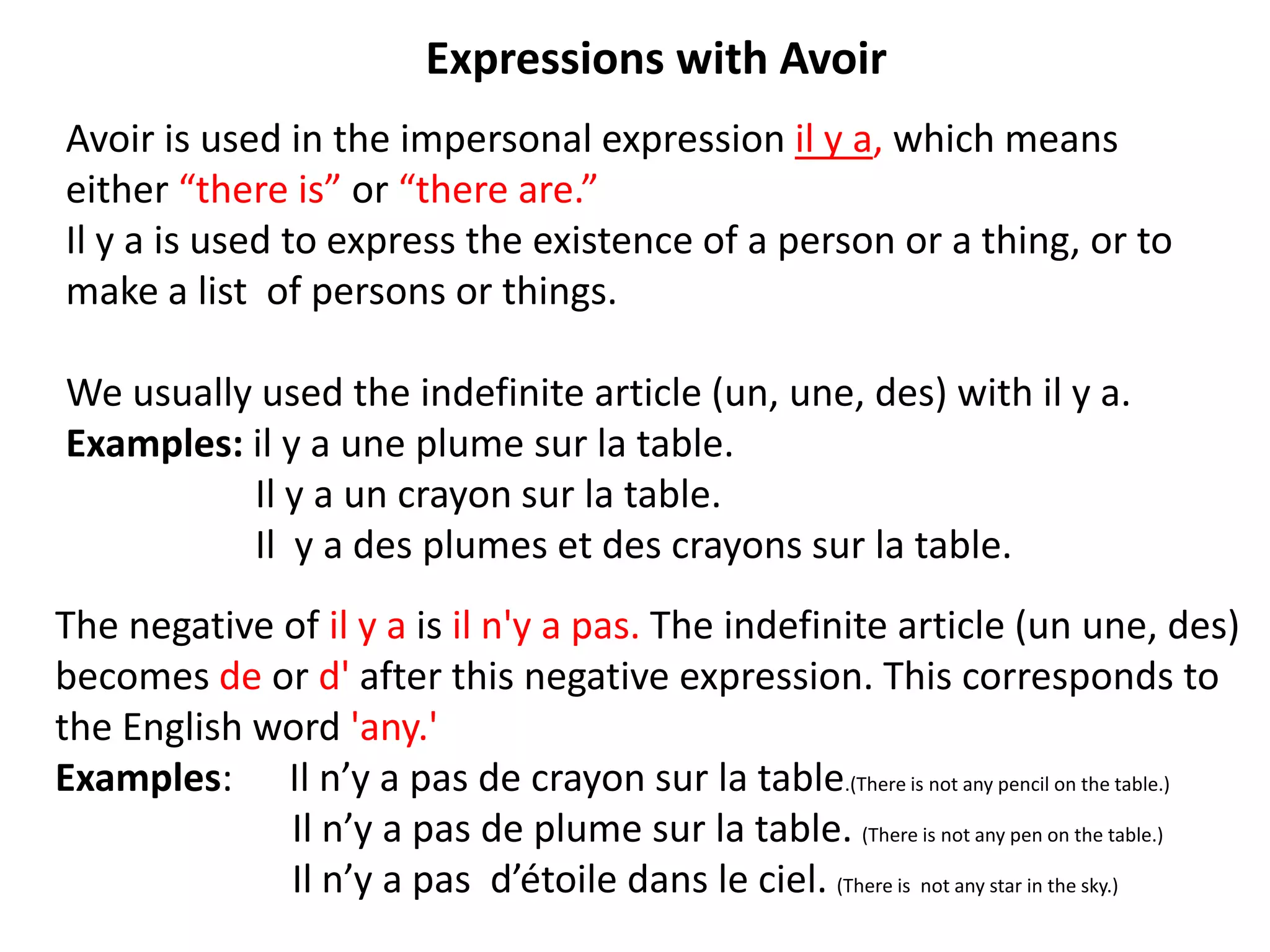
Expressions with AvoirAvoir is used in the impersonal expression il y a, which means either “there is” or “there are.”Il y a is used to express the existence of a person or a thing, or to make a list  of persons or things. We usually used the indefinite article (un, une, des) with il y a.Examples: il y a une plume sur la table.                    Il y a un crayon sur la table.                    Il  y a des plumes et des crayons sur la table.The negative of il y a is iln'y a pas. The indefinite article (un une, des) becomes de or d' after this negative expression. This corresponds to the English word 'any.' Examples:      Il n’y a pas de crayon sur la table.(There is not any pencil on the table.)Il n’y a pas de plume sur la table. (There is not any pen on the table.)Il n’y a pas  d’étoiledans le ciel. (There is  not any star in the sky.)
Expressions with Avoir
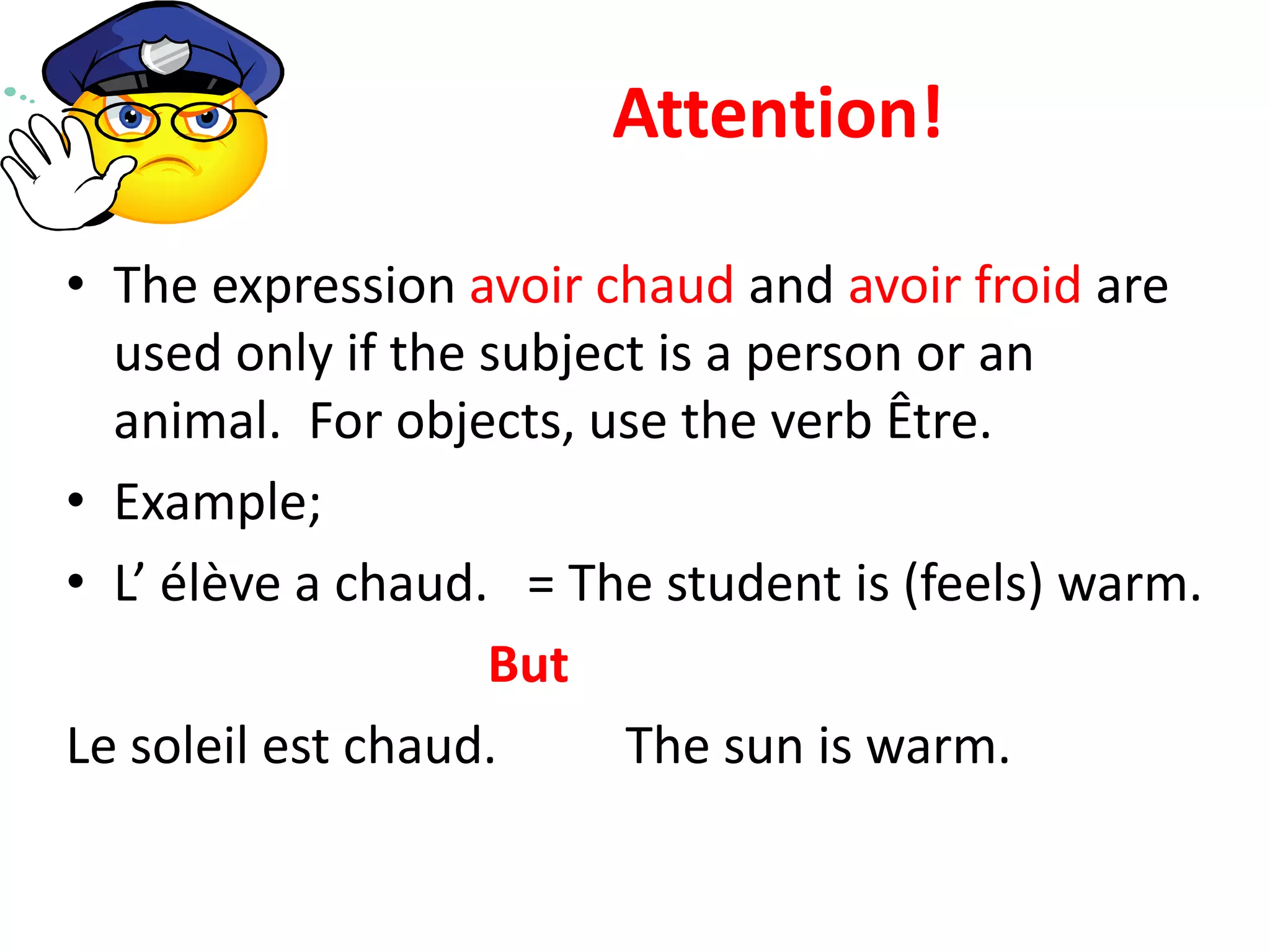
Attention!The expression avoirchaudand avoirfroidare used only if the subject is a person or an animal.  For objects, use the verb Être.Example;L’ élève a chaud.   = The student is (feels) warm.ButLe soleilestchaud.          The sun is warm.
Asking QuestionsReverse the subject pronoun with the verb or you just add a question mark on the affirmative sentence.Ai-je? =have I?                                                J’ai?
as-tu?       (affirmative: tuparles)             OrTu as?
A-t-il ?                                                               il a?
A-t-elle?                                                             elle as?
Avons-nous?                                                    Nous avons?
Avez-vousvousavez?
Ont-ils?                                                             ilsont?
Ont-elles?                                                         Ellesont?Answer      Affirmative                       NegativeOui, j’ai.                        Non, je n’aipas.

FRENCH: VERBE AVOIR PRESENT DE L’INDICATIF

  • 1.
    SALUTATION! BIENVENUE DANS LA CLASSE! PRÉSENTEZ PAR MARIE GLEMAUD
  • 2.
    LE VERBE AVOIR PRESENT DE L’INDICATIFTHE VERB AVOIR PRESENT TENSE
  • 3.
    Les Objectifs ….TheObjectivesBy the end of this lesson you will be able to:Learn the subject pronouns.
  • 4.
    Conjugate the verbavoirin the present tense.
  • 5.
    Form the negationwith the verb avoir in the present tense
  • 6.
  • 7.
    Identify idiomatic expressions that use the verb avoirAVOIR = TO HAVEAvoir is one of the most common French verbs. It is irregular in conjugation and literally means "to have." AVOIRTo have
  • 8.
    Formation of thepresent tense of the verb Avoir Formation du present de l’ indicatif du verbeAvoirthe present tense is composed of two elements: the subject pronouns or subject and the form of the verb. It isformed by:The subjectpronoun+The form of the verbLe canard blanc (il) ades yeux noirs.The form of the verb (avoir)sujet
  • 9.
    The subject ofa verb is the person or thing which performs the action of that verb.Subject pronoun is a word that can replace the subject in a sentence . French: Jean a. Il a. English: Jean has. He has. FrenchEnglishJe TuIl Elle On Nous VousIlsEllesI You (sing. Informal) He She It, we, we You (Plur. Formal) They (mas. Plur.) They (fem. Plur.)
  • 10.
    You use jeto talk about yourself. e. g. J’ai un crayon.You use tu to address a friend. e.g. Tu as un crayon.You useilto talk about a boy/a man. e.g. Il a un crayon.You use elle to talk about a girl /a woman. e.g. Ellle a un crayon.Il and elle can be used for things e.g. La table? Elle a troispieds.You use nous when referring to yourself and another person or other people. e.g. Nous avons un crayon.We use vous when talking to two or more people.We use ilsfor masculine plural/ group of males and femalese.g.Ilsont un crayon.We use Elles for feminine plurale.g.Ellesont un crayon.
  • 11.
    Conjugation of theverb Avoir = to have in the present tenseFrenchEnglishj’ai I havetu as You haveil a he haselle a she hasNousavons we haveVousavez you have (Pl.)Ilsont They have (m. Plur.)Ellesont They have (f.plur.)
  • 12.
    Conjugation of theverb avoir = To have In the present tenseavoirJ’aiTu asIl /elle aNous avonsVousavezIls/ellesont
  • 13.
    Negation Negation is formed by placing ne ... pasaround the conjugated verb, which, in this case, is the verb avoir. Jean n’apas un crayon!.Jean does not have a pencil
  • 14.
    Present tense ofthe verb avoirin the negation (ne…pas) *Note ne becomes n’ before a vowel.Je n’aipas = I have notTun’aspas = you have notIl n’apas = he has notElle n’apas = she has notNousn’avons pas = we have notVousn’avezpas = you have notIlsn’ont pas = they have not (mas.plur.)Ellesn’ontpas = they have not (fem. Plur.)
  • 15.
    Expressions with AvoirAvoiris used in a number of idiomatic expressions, manyof which are translated by the English verb "to be":You use the verb avoir to express age _____tu as quelâge?French: avoir + number +ans. Englsih: to be + number + years old.Example: Tu as quelâge? How old are you?Answer:J’ai 18 (dixhuit) ans. I am 18 years old.
  • 16.
    Expressions with AvoirAvoiris used in the impersonal expression il y a, which means either “there is” or “there are.”Il y a is used to express the existence of a person or a thing, or to make a list of persons or things. We usually used the indefinite article (un, une, des) with il y a.Examples: il y a une plume sur la table. Il y a un crayon sur la table. Il y a des plumes et des crayons sur la table.The negative of il y a is iln'y a pas. The indefinite article (un une, des) becomes de or d' after this negative expression. This corresponds to the English word 'any.' Examples: Il n’y a pas de crayon sur la table.(There is not any pencil on the table.)Il n’y a pas de plume sur la table. (There is not any pen on the table.)Il n’y a pas d’étoiledans le ciel. (There is not any star in the sky.)
  • 17.
  • 18.
    Attention!The expression avoirchaudandavoirfroidare used only if the subject is a person or an animal. For objects, use the verb Être.Example;L’ élève a chaud. = The student is (feels) warm.ButLe soleilestchaud. The sun is warm.
  • 19.
    Asking QuestionsReverse thesubject pronoun with the verb or you just add a question mark on the affirmative sentence.Ai-je? =have I? J’ai?
  • 20.
    as-tu? (affirmative: tuparles) OrTu as?
  • 21.
    A-t-il ? il a?
  • 22.
    A-t-elle? elle as?
  • 23.
    Avons-nous? Nous avons?
  • 24.
  • 25.
    Ont-ils? ilsont?
  • 26.
    Ont-elles? Ellesont?Answer Affirmative NegativeOui, j’ai. Non, je n’aipas.
  • 27.
    Oui, tu as. Non, tun’ as pas.
  • 28.
    Oui, il a Non, iln’apas.CONVERSATIONTex, tuas des frères et des soeurs? Tex: Oui, j'aiunesoeur et un frère. Quelâgeont-ils? Tex: Ma soeur Rita a 30 ans et mon frère Trey a 16 ans.Tex, do you have brothers and sisters? Tex: Yes, I have a sister and a brother. How old are they? Tex: My sister Rita is 30 and my brother Trey is 16.
  • 29.
    Maintenant à votretourWhat subject pronoun disappears?Subject PronounsJe TuIlsElle EllesIl On NousVous
  • 30.
    Maintenantàvotre tourSubject PronounsWhatis the English equivalent for each subject pronoun?FrenchJe _____ Tu _____ Il _____ Elle _____ On _____ Nous _____ Vous _____ Ils _____ Elles _____
  • 31.
    Maintenantàvotre tourWhat comesafter each subject pronoun? The verb AvoiravezVousaIlaiJ’IlsontEllesontTuasNous avons
  • 32.
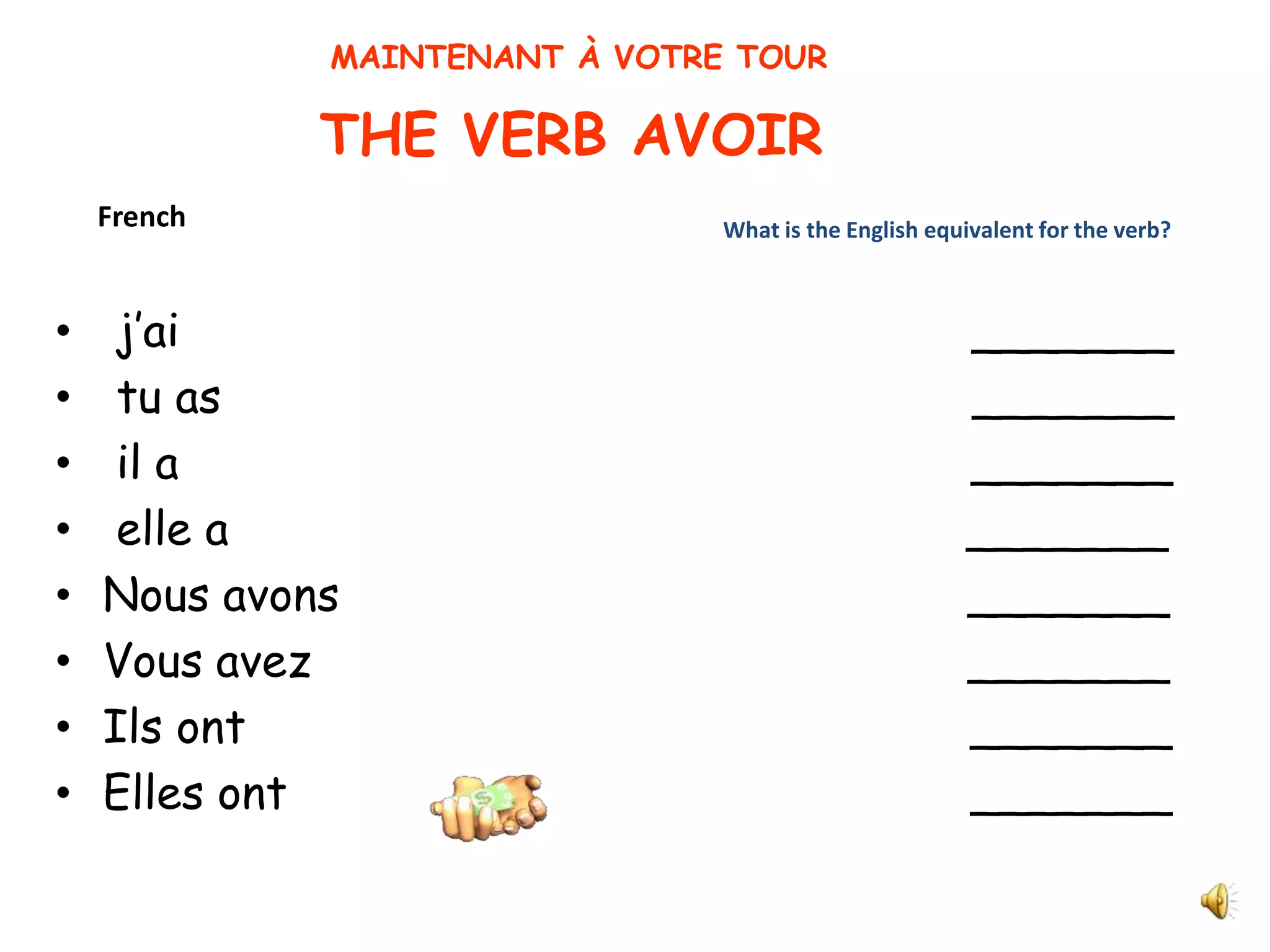
    Maintenantàvotre tourThe verbAVOIRFrenchWhat is the English equivalent for the verb?j’ai _______ tu as _______ il a _______ elle a _______ Nousavons _______ Vousavez _______ Ilsont _______Ellesont _______
  • 33.
    Complétez avec “Avoir”1.J’___une petite famille.2. Marc aussi ____ une petite famille.3. Ma sœur _____ seize ans.4. Vous __________ unemaison5. Et toi, tu _____ une petite maisonaussi?6. J’ ____ deux frères7. Ils _____ treize et Seize ans.8. Mon copain Michel _____ deuxsœurs.
  • 34.
  • 35.
  • 36.
    Your feedback aboutMarie Glemaud: HighestKnowledge Gained in the class: 1-5 Would you recommendthis Presenter to others?yesnoComments:Did you enjoy the lesson?Follow this teacheryes
  • 37.