THE LEARNING
CENTRE
Referencing - Harvard
Learning Outcomes
By the end of this session you should be able to:


Explain the reasons for referencing



Identify the correct format for referencing

different types of information sources


Demonstrate the ability to reference different
types of information sources consistently and
accurately
Definitions




In-text reference – A reference found within the text of the
assignment after a quote or paraphrase (Smith, 2012)
Reference list – This list is found at the end of an assignment
(in alphabet order of the authors‟ surnames). It is the full
version of the in-text reference.

Smith, J. (2013). What is referencing? Southampton: Citycol
Publishing Ltd




Bibliography – This is similar to a reference list except that it
includes every resource you look at for your research, not just
those referenced in text.
Harvard APA
Why Reference?


Referencing acknowledges information sources which
are used whenever you do a piece of work



Referencing allows your reader to find the source of
your information



You can lose marks if you do not reference accurately
and consistently



If you do not use referencing to acknowledge your
sources you will be guilty of plagiarism which can
bring disciplinary action
Plagiarism!
Plagiarism is using someone else‟s work and claiming it as your
own.






Copying and pasting from the Internet and passing it off as your own
work.
Copying directly from a book or journal without acknowledging the
source.
Copying off your fellow students.
The copying and use of anyone else‟s work without acknowledging
them.
Plagiarism is using someone else‟s work and claiming it as your
own.

Avoid plagiarism by:



Using “quotation marks” for direct quotations
Using in-text references, reference lists, and bibliographies
Plagiarism Quiz – is it
plagiarism?


You quote directly from a book word for word into your assignment and do not cite the
source? Y/N



You directly copy some words from a book or website, add a few of your own words and do
not cite the source? Y/N



You find something on a website that directly relates to your assignment, copy and paste it
into your assignment and do not cite the source? Y/N



You find something interesting on a website, paraphrase it into your own words, but do not
mention the website source in your assignment? Y/N



You need to give a historical overview of an event, you read a variety of sources on the topic
that all say similar things so you summarise them all into your own words and do not mention
the sources? Y/N



After doing a decent amount of research on a topic you come up with an original theory on the
topic, which you put into your assignment. You then find out a bit later, that someone has
already come up with this idea a few years previously and published it? Y/N



You find some relevant photographs online and add them into your assignment without citing
Referencing from a Teacher‟s Point
of View....


It determines if the information you have relied on is old or
new, from the UK or abroad



It identifies if you have used subject specialists in the field



It determines whether you have researched the subject
effectively



It can be used to identify whether you have relied heavily on
one type of information source



It identifies if you have relied too much on other peoples work
– or too little!
Referencing Activity One


Attempt to locate the following reference:

Dougherty, D and Murthy, A. „What service
customers really want‟, Harvard Business
Review.
What difficulties did you experience
?
Dougherty, D and Murthy, A. (2009) „What
service customers really want‟, Harvard
Business Review, September 2009, p.22.
What should an in-text Reference
include?
Author surname/corporate author

Year of publication
necessary)

Page number (when

Direct quotation
Parker (2009, p.5) suggests that “referencing is considered to be good academic
etiquette” in her report……
It has been stated that “referencing is considered to be good academic etiquette”
(Parker,2009, p.5)
Paraphrasing:

Parker (2009) suggests that it is academic etiquette to reference within research
assignments.
It has been suggested that it is good academic etiquette to reference (Parker, 2009).
What should a Bibliography /
reference list look like?
Beames, S. and Atencio, M. (2008) „Building social
capital through outdoor education‟, Journal of
Adventure Education and Outdoor Learning, vol. 8, no.
2, pp. 99-112.
Department for Education. (2011) Simple behaviour
checklist to help teachers maintain discipline in school.
Available at:
http://www.education.gov.uk/schools/pupilsupport/beha
viour/a00199412/simple-behaviour-checklist-to-helpteachers-maintain-discipline-in-school (Accessed: 25
January 2012).
Note:
-The different (2009) different resource types a practical guide, 4th
Petty, G. styles for Teaching today:
-It is in alphabetical order by surname/company name
edn, Cheltenham: Nelson Thornes.
-The use of italics and grammatical symbols
Things to remember about
reference lists/bibliographies.


How many references should I include in my
bibliography?



Try to make sure that you have a range of information
sources: books, websites, journals etc – don‟t rely on
one information source



Authors should be listed alphabetically, by author
surname.



Sometimes you will need to use a corporate author.



Websites can be difficult – use „contact us‟ „about us‟
and „home‟ to find the information.
Referencing Activity Two
Use the interactive white board to practice
creating references for a:




Book
Website
Journal article
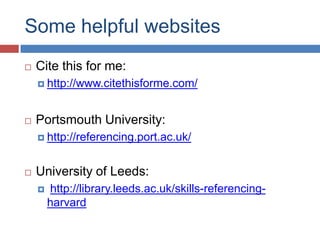
Some helpful websites


Cite this for me:
 http://www.citethisforme.com/



Portsmouth University:
 http://referencing.port.ac.uk/



University of Leeds:


http://library.leeds.ac.uk/skills-referencingharvard
Referencing Activity Three


For the purposes of this exercise you will need
to create a bibliography containing a :
 Reference

to a book
 Reference to a website
 Reference to a journal article

Referencing (kate)

  • 1.
  • 2.
    Learning Outcomes By theend of this session you should be able to:  Explain the reasons for referencing  Identify the correct format for referencing different types of information sources  Demonstrate the ability to reference different types of information sources consistently and accurately
  • 3.
    Definitions   In-text reference –A reference found within the text of the assignment after a quote or paraphrase (Smith, 2012) Reference list – This list is found at the end of an assignment (in alphabet order of the authors‟ surnames). It is the full version of the in-text reference. Smith, J. (2013). What is referencing? Southampton: Citycol Publishing Ltd   Bibliography – This is similar to a reference list except that it includes every resource you look at for your research, not just those referenced in text. Harvard APA
  • 4.
    Why Reference?  Referencing acknowledgesinformation sources which are used whenever you do a piece of work  Referencing allows your reader to find the source of your information  You can lose marks if you do not reference accurately and consistently  If you do not use referencing to acknowledge your sources you will be guilty of plagiarism which can bring disciplinary action
  • 5.
    Plagiarism! Plagiarism is usingsomeone else‟s work and claiming it as your own.      Copying and pasting from the Internet and passing it off as your own work. Copying directly from a book or journal without acknowledging the source. Copying off your fellow students. The copying and use of anyone else‟s work without acknowledging them. Plagiarism is using someone else‟s work and claiming it as your own. Avoid plagiarism by:   Using “quotation marks” for direct quotations Using in-text references, reference lists, and bibliographies
  • 6.
    Plagiarism Quiz –is it plagiarism?  You quote directly from a book word for word into your assignment and do not cite the source? Y/N  You directly copy some words from a book or website, add a few of your own words and do not cite the source? Y/N  You find something on a website that directly relates to your assignment, copy and paste it into your assignment and do not cite the source? Y/N  You find something interesting on a website, paraphrase it into your own words, but do not mention the website source in your assignment? Y/N  You need to give a historical overview of an event, you read a variety of sources on the topic that all say similar things so you summarise them all into your own words and do not mention the sources? Y/N  After doing a decent amount of research on a topic you come up with an original theory on the topic, which you put into your assignment. You then find out a bit later, that someone has already come up with this idea a few years previously and published it? Y/N  You find some relevant photographs online and add them into your assignment without citing
  • 7.
    Referencing from aTeacher‟s Point of View....  It determines if the information you have relied on is old or new, from the UK or abroad  It identifies if you have used subject specialists in the field  It determines whether you have researched the subject effectively  It can be used to identify whether you have relied heavily on one type of information source  It identifies if you have relied too much on other peoples work – or too little!
  • 8.
    Referencing Activity One  Attemptto locate the following reference: Dougherty, D and Murthy, A. „What service customers really want‟, Harvard Business Review.
  • 9.
    What difficulties didyou experience ? Dougherty, D and Murthy, A. (2009) „What service customers really want‟, Harvard Business Review, September 2009, p.22.
  • 10.
    What should anin-text Reference include? Author surname/corporate author Year of publication necessary) Page number (when Direct quotation Parker (2009, p.5) suggests that “referencing is considered to be good academic etiquette” in her report…… It has been stated that “referencing is considered to be good academic etiquette” (Parker,2009, p.5) Paraphrasing: Parker (2009) suggests that it is academic etiquette to reference within research assignments. It has been suggested that it is good academic etiquette to reference (Parker, 2009).
  • 11.
    What should aBibliography / reference list look like? Beames, S. and Atencio, M. (2008) „Building social capital through outdoor education‟, Journal of Adventure Education and Outdoor Learning, vol. 8, no. 2, pp. 99-112. Department for Education. (2011) Simple behaviour checklist to help teachers maintain discipline in school. Available at: http://www.education.gov.uk/schools/pupilsupport/beha viour/a00199412/simple-behaviour-checklist-to-helpteachers-maintain-discipline-in-school (Accessed: 25 January 2012). Note: -The different (2009) different resource types a practical guide, 4th Petty, G. styles for Teaching today: -It is in alphabetical order by surname/company name edn, Cheltenham: Nelson Thornes. -The use of italics and grammatical symbols
  • 12.
    Things to rememberabout reference lists/bibliographies.  How many references should I include in my bibliography?  Try to make sure that you have a range of information sources: books, websites, journals etc – don‟t rely on one information source  Authors should be listed alphabetically, by author surname.  Sometimes you will need to use a corporate author.  Websites can be difficult – use „contact us‟ „about us‟ and „home‟ to find the information.
  • 13.
    Referencing Activity Two Usethe interactive white board to practice creating references for a:    Book Website Journal article
  • 14.
    Some helpful websites  Citethis for me:  http://www.citethisforme.com/  Portsmouth University:  http://referencing.port.ac.uk/  University of Leeds:  http://library.leeds.ac.uk/skills-referencingharvard
  • 15.
    Referencing Activity Three  Forthe purposes of this exercise you will need to create a bibliography containing a :  Reference to a book  Reference to a website  Reference to a journal article