

Saad Abdul Wahab
M.Sc Applied Chemistry & Chemical Technology (Specialization in Petroleum
Technology From University of Karachi)
BE Textile, from Synthetic Fiber Development & Application Center.
IOSH Managing Safely.
Certifications of HSE, EMS-14001, OSHAS-18001, QMS 9001:2008, FSMS-22000:2005,
SSCL (17025) by SGS & NILAT.
IRCA approved Lead Auditor OHSAS 18001:2004 .
HSE Rules & Laws in Industries from SDC.
Authorized Safety Instructor from DG Federal Civil Defence Pakistan.
 Nuclear safety covers the actions taken to prevent
nuclear and radiation accidents or to limit their
consequences. This covers nuclear power plants as well
as all other nuclear facilities, the transportation of
nuclear materials, and the use and storage of nuclear
materials for medical, power, industry, and military
uses.
 The three primary objectives of nuclear safety systems
as defined by the Nuclear Regulatory Commission are
to shut down the reactor, maintain it in a shutdown
condition, and prevent the release of radioactive
material during events and accidents. These objectives
are accomplished using a variety of equipment, which
is part of different systems, of which each performs
specific functions.
Siren
Video Presentation.
Measures taken by reactor personnel
 to control reactivity,
 to cool the fuel and
 to contain radioactive substances.
Measures Taken by public on exposure
 Leave the immediate area on foot—do not take public
transportation.
 Go inside the nearest building. Seeking immediate shelter will
reduce exposure to any radioactive material at the scene of the
explosion.
 Remove clothing as soon as possible and seal it inside a plastic
bag. Save the clothing so that emergency response personnel can
test it. Removing clothing will eliminate 90 percent of the
radioactive contamination, according to the Centers for Disease
Control and Prevention.
 Take a shower or wash yourself as completely as possible. This
will reduce the amount of radioactive contamination.
 Seek more information from emergency response personnel who
respond to the explosion.
 Is evacuation or sheltering the better means of
maintaining safety in the event of a radiological
emergency?
In the event of a nuclear bomb explosion, people
who live nearby, but not in the immediate area of
the blast, may be asked to stay home and take
shelter rather than evacuate. This is called
“sheltering in place” by emergency response
organizations. Staying in your home or office may
be the best safety measure because many
radioactive materials decay rapidly and dissipate.
The thick walls of your home or office will block
much of the harmful radiation.
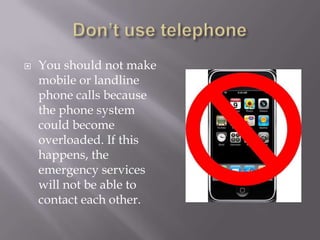
 You should not make
mobile or landline
phone calls because
the phone system
could become
overloaded. If this
happens, the
emergency services
will not be able to
contact each other.
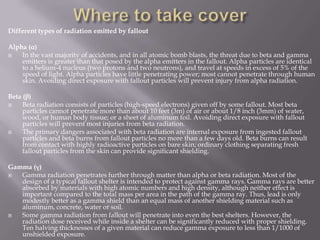
Different types of radiation emitted by fallout
Alpha (α)
 In the vast majority of accidents, and in all atomic bomb blasts, the threat due to beta and gamma
emitters is greater than that posed by the alpha emitters in the fallout. Alpha particles are identical
to a helium-4 nucleus (two protons and two neutrons), and travel at speeds in excess of 5% of the
speed of light. Alpha particles have little penetrating power; most cannot penetrate through human
skin. Avoiding direct exposure with fallout particles will prevent injury from alpha radiation.
Beta (β)
 Beta radiation consists of particles (high-speed electrons) given off by some fallout. Most beta
particles cannot penetrate more than about 10 feet (3m) of air or about 1/8 inch (3mm) of water,
wood, or human body tissue; or a sheet of aluminum foil. Avoiding direct exposure with fallout
particles will prevent most injuries from beta radiation.
 The primary dangers associated with beta radiation are internal exposure from ingested fallout
particles and beta burns from fallout particles no more than a few days old. Beta burns can result
from contact with highly radioactive particles on bare skin; ordinary clothing separating fresh
fallout particles from the skin can provide significant shielding.
Gamma (γ)
 Gamma radiation penetrates further through matter than alpha or beta radiation. Most of the
design of a typical fallout shelter is intended to protect against gamma rays. Gamma rays are better
absorbed by materials with high atomic numbers and high density, although neither effect is
important compared to the total mass per area in the path of the gamma ray. Thus, lead is only
modestly better as a gamma shield than an equal mass of another shielding material such as
aluminum, concrete, water or soil.
 Some gamma radiation from fallout will penetrate into even the best shelters. However, the
radiation dose received while inside a shelter can be significantly reduced with proper shielding.
Ten halving thicknesses of a given material can reduce gamma exposure to less than 1/1000 of
unshielded exposure.
A basic fallout shelter consists of shields that reduce gamma ray exposure by a
factor of 1000. The required shielding can be accomplished with 10 times
the thickness of any quantity of material capable of cutting gamma ray exposure in
half. Shields that reduce gamma ray intensity by 50% (1/2) include 1 cm (0.4 inch)
of lead, 6 cm (2.4 inches) of concrete, 9 cm (3.6 inches) of packed earth or 150 m
(500 ft) of air. When multiple thicknesses are built, the shielding multiplies. Thus, a
practical fallout shield is ten halving-thicknesses of packed earth, reducing gamma
rays by approximately 1024 times (210).
Usually, an expedient purpose-built fallout shelter is a trench; with a strong roof
buried by c. 1 m (3 ft) of earth. The two ends of the trench have ramps or entrances
at right angles to the trench, so that gamma rays cannot enter (they can travel only
in straight lines). To make the overburden waterproof (in case of rain), a plastic
sheet may be buried a few inches below the surface and held down with rocks or
bricks.
Blast doors are designed to absorb the shock wave of a nuclear blast, bending and
then returning to their original shape.
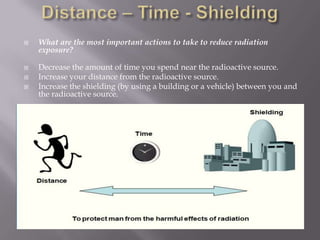
 What are the most important actions to take to reduce radiation
exposure?
 Decrease the amount of time you spend near the radioactive source.
 Increase your distance from the radioactive source.
 Increase the shielding (by using a building or a vehicle) between you and
the radioactive source.
 To “take cover” means to go inside immediately.
The sirens sound when it is not safe to be outside.
Make sure that everyone in your family knows the
safest place to be in your home during an
emergency.
The goals of your family fallout shelter are:
 To maximize the distance away from the fallout
'dusting' outside on the ground, roof and trees.
 To place sufficient mass between your family and
the fallout to absorb the deadly radiation
 To make the shelter tolerable to stay in while the
radiation subsides with every passing hour
 A fallout shelter is an enclosed space specially designed to protect
occupants from radioactive debris or fallout resulting from
a nuclear explosion. Many such shelters were constructed as civil
defense measures during the Cold War.
 During a nuclear explosion, matter vaporized in the resulting
fireball is exposed to neutrons from the explosion, absorbs them,
and becomes radioactive. When this material condenses in the
rain, it forms dust and light sandy materials that resembles
ground pumice. The fallout emits alpha and beta particles, as well
as gamma rays.
 Much of this highly radioactive material then falls to earth,
subjecting anything within the line of sight to radiation, a
significant hazard. A fallout shelter is designed to allow its
occupants to minimize exposure to harmful fallout until
radioactivity has decayed to a safer level.
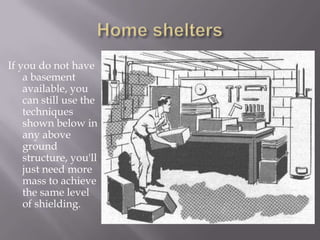
If you do not have
a basement
available, you
can still use the
techniques
shown below in
any above
ground
structure, you'll
just need more
mass to achieve
the same level
of shielding.
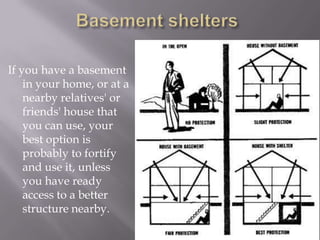
If you have a basement
in your home, or at a
nearby relatives' or
friends' house that
you can use, your
best option is
probably to fortify
and use it, unless
you have ready
access to a better
structure nearby.
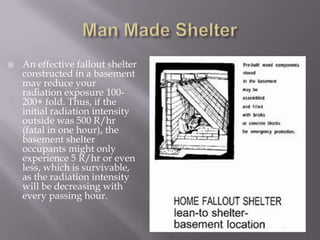
 An effective fallout shelter
constructed in a basement
may reduce your
radiation exposure 100-
200+ fold. Thus, if the
initial radiation intensity
outside was 500 R/hr
(fatal in one hour), the
basement shelter
occupants might only
experience 5 R/hr or even
less, which is survivable,
as the radiation intensity
will be decreasing with
every passing hour.
 Q/A..??
Email: saadawkhan@yahoo.com
Cell: 0333-3235554, 0313-2338340
Join me on Facebook;
 Applied Scientists and Engineers Page
 Health, Safety and Environment

Nuclear protection

  • 1.
    Saad Abdul Wahab M.ScApplied Chemistry & Chemical Technology (Specialization in Petroleum Technology From University of Karachi) BE Textile, from Synthetic Fiber Development & Application Center. IOSH Managing Safely. Certifications of HSE, EMS-14001, OSHAS-18001, QMS 9001:2008, FSMS-22000:2005, SSCL (17025) by SGS & NILAT. IRCA approved Lead Auditor OHSAS 18001:2004 . HSE Rules & Laws in Industries from SDC. Authorized Safety Instructor from DG Federal Civil Defence Pakistan.
  • 2.
     Nuclear safetycovers the actions taken to prevent nuclear and radiation accidents or to limit their consequences. This covers nuclear power plants as well as all other nuclear facilities, the transportation of nuclear materials, and the use and storage of nuclear materials for medical, power, industry, and military uses.  The three primary objectives of nuclear safety systems as defined by the Nuclear Regulatory Commission are to shut down the reactor, maintain it in a shutdown condition, and prevent the release of radioactive material during events and accidents. These objectives are accomplished using a variety of equipment, which is part of different systems, of which each performs specific functions.
  • 3.
  • 5.
    Measures taken byreactor personnel  to control reactivity,  to cool the fuel and  to contain radioactive substances. Measures Taken by public on exposure  Leave the immediate area on foot—do not take public transportation.  Go inside the nearest building. Seeking immediate shelter will reduce exposure to any radioactive material at the scene of the explosion.  Remove clothing as soon as possible and seal it inside a plastic bag. Save the clothing so that emergency response personnel can test it. Removing clothing will eliminate 90 percent of the radioactive contamination, according to the Centers for Disease Control and Prevention.  Take a shower or wash yourself as completely as possible. This will reduce the amount of radioactive contamination.  Seek more information from emergency response personnel who respond to the explosion.
  • 6.
     Is evacuationor sheltering the better means of maintaining safety in the event of a radiological emergency? In the event of a nuclear bomb explosion, people who live nearby, but not in the immediate area of the blast, may be asked to stay home and take shelter rather than evacuate. This is called “sheltering in place” by emergency response organizations. Staying in your home or office may be the best safety measure because many radioactive materials decay rapidly and dissipate. The thick walls of your home or office will block much of the harmful radiation.
  • 7.
     You shouldnot make mobile or landline phone calls because the phone system could become overloaded. If this happens, the emergency services will not be able to contact each other.
  • 8.
    Different types ofradiation emitted by fallout Alpha (α)  In the vast majority of accidents, and in all atomic bomb blasts, the threat due to beta and gamma emitters is greater than that posed by the alpha emitters in the fallout. Alpha particles are identical to a helium-4 nucleus (two protons and two neutrons), and travel at speeds in excess of 5% of the speed of light. Alpha particles have little penetrating power; most cannot penetrate through human skin. Avoiding direct exposure with fallout particles will prevent injury from alpha radiation. Beta (β)  Beta radiation consists of particles (high-speed electrons) given off by some fallout. Most beta particles cannot penetrate more than about 10 feet (3m) of air or about 1/8 inch (3mm) of water, wood, or human body tissue; or a sheet of aluminum foil. Avoiding direct exposure with fallout particles will prevent most injuries from beta radiation.  The primary dangers associated with beta radiation are internal exposure from ingested fallout particles and beta burns from fallout particles no more than a few days old. Beta burns can result from contact with highly radioactive particles on bare skin; ordinary clothing separating fresh fallout particles from the skin can provide significant shielding. Gamma (γ)  Gamma radiation penetrates further through matter than alpha or beta radiation. Most of the design of a typical fallout shelter is intended to protect against gamma rays. Gamma rays are better absorbed by materials with high atomic numbers and high density, although neither effect is important compared to the total mass per area in the path of the gamma ray. Thus, lead is only modestly better as a gamma shield than an equal mass of another shielding material such as aluminum, concrete, water or soil.  Some gamma radiation from fallout will penetrate into even the best shelters. However, the radiation dose received while inside a shelter can be significantly reduced with proper shielding. Ten halving thicknesses of a given material can reduce gamma exposure to less than 1/1000 of unshielded exposure.
  • 10.
    A basic falloutshelter consists of shields that reduce gamma ray exposure by a factor of 1000. The required shielding can be accomplished with 10 times the thickness of any quantity of material capable of cutting gamma ray exposure in half. Shields that reduce gamma ray intensity by 50% (1/2) include 1 cm (0.4 inch) of lead, 6 cm (2.4 inches) of concrete, 9 cm (3.6 inches) of packed earth or 150 m (500 ft) of air. When multiple thicknesses are built, the shielding multiplies. Thus, a practical fallout shield is ten halving-thicknesses of packed earth, reducing gamma rays by approximately 1024 times (210). Usually, an expedient purpose-built fallout shelter is a trench; with a strong roof buried by c. 1 m (3 ft) of earth. The two ends of the trench have ramps or entrances at right angles to the trench, so that gamma rays cannot enter (they can travel only in straight lines). To make the overburden waterproof (in case of rain), a plastic sheet may be buried a few inches below the surface and held down with rocks or bricks. Blast doors are designed to absorb the shock wave of a nuclear blast, bending and then returning to their original shape.
  • 11.
     What arethe most important actions to take to reduce radiation exposure?  Decrease the amount of time you spend near the radioactive source.  Increase your distance from the radioactive source.  Increase the shielding (by using a building or a vehicle) between you and the radioactive source.
  • 12.
     To “takecover” means to go inside immediately. The sirens sound when it is not safe to be outside. Make sure that everyone in your family knows the safest place to be in your home during an emergency. The goals of your family fallout shelter are:  To maximize the distance away from the fallout 'dusting' outside on the ground, roof and trees.  To place sufficient mass between your family and the fallout to absorb the deadly radiation  To make the shelter tolerable to stay in while the radiation subsides with every passing hour
  • 13.
     A falloutshelter is an enclosed space specially designed to protect occupants from radioactive debris or fallout resulting from a nuclear explosion. Many such shelters were constructed as civil defense measures during the Cold War.  During a nuclear explosion, matter vaporized in the resulting fireball is exposed to neutrons from the explosion, absorbs them, and becomes radioactive. When this material condenses in the rain, it forms dust and light sandy materials that resembles ground pumice. The fallout emits alpha and beta particles, as well as gamma rays.  Much of this highly radioactive material then falls to earth, subjecting anything within the line of sight to radiation, a significant hazard. A fallout shelter is designed to allow its occupants to minimize exposure to harmful fallout until radioactivity has decayed to a safer level.
  • 14.
    If you donot have a basement available, you can still use the techniques shown below in any above ground structure, you'll just need more mass to achieve the same level of shielding.
  • 15.
    If you havea basement in your home, or at a nearby relatives' or friends' house that you can use, your best option is probably to fortify and use it, unless you have ready access to a better structure nearby.
  • 16.
     An effectivefallout shelter constructed in a basement may reduce your radiation exposure 100- 200+ fold. Thus, if the initial radiation intensity outside was 500 R/hr (fatal in one hour), the basement shelter occupants might only experience 5 R/hr or even less, which is survivable, as the radiation intensity will be decreasing with every passing hour.
  • 17.
     Q/A..?? Email: saadawkhan@yahoo.com Cell:0333-3235554, 0313-2338340 Join me on Facebook;  Applied Scientists and Engineers Page  Health, Safety and Environment