FB Kh
Mrs. FB Kh
Pronunciation
Final « ed
» Sounds
Today we are going
to work on
pronunciation.
In particular we
are going to focus
on words that end
in “ed”.
« ed » marks the end of
regular verbs in the past
simple tense.
Although all simple past
tense verbs end with an
“ed”, they can have three
different pronunciations.
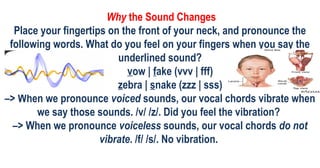
Why the Sound Changes
Place your fingertips on the front of your neck, and pronounce the
following words. What do you feel on your fingers when you say the
underlined sound?
vow | fake (vvv | fff)
zebra | snake (zzz | sss)
–> When we pronounce voiced sounds, our vocal chords vibrate when
we say those sounds. /v/ /z/. Did you feel the vibration?
–> When we pronounce voiceless sounds, our vocal chords do not
vibrate. /f/ /s/. No vibration.
This vibration or lack of vibration
then carries forward to the
following sound in the word.
Therefore, this vibration or lack of
vibration explains why we
pronounce the past tense of verbs
in three voiced or voiceless
ways: /t/, /d/ or /id/.
The “ed” pronunciation is
determined by the final sound of
the verb in the infinitive: Is it a
voiced consonant, an unvoiced
consonant, or a vowel sound?
« ed »
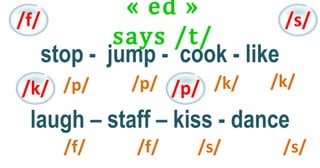
says /t/
stop - jump - cook - like
laugh – staff – kiss - dance
/p/
/f/ /s/ /s/
/p/ /k/ /k/
/f/
/f/
/p/
/s/
/k/
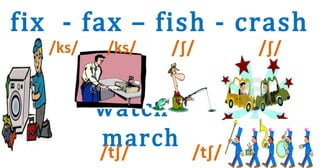
fix - fax – fish - crash
watch -
march
/ks/ /∫/ /∫/
/t∫/
/ks/
/t∫/
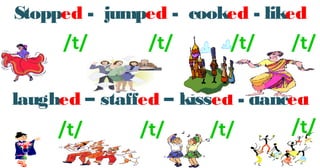
Stopped - jumped - cooked - liked
laughed – staffed – kissed - danced
/t/ /t/ /t/ /t/
/t/ /t/ /t//t/
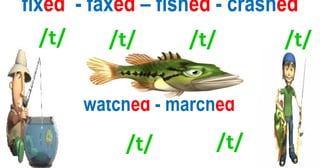
fixed - faxed – fished - crashed
watched - marched
/t/ /t/
/t/ /t/
/t/ /t/
Verbs ending in voiceless
sounds /p, k, θ, f, s,ks, , t / causeʃ ʃ
the “-ed” ending to be
pronounced as the voiceless [t]
(with no vocal chord vibration).
/p/ “He popped a balloon.” /papt/
/k/ “They talked a lot” /takt/
/θ/ “th”: “She frothed a cup of
milk” /frawθt/
/f/ “I laughed at the movie.”/læft/
/s/ “She kissed a frog.” /kist/
/ /ʃ “sh”: “We brushed it off.” /bruʃt/
/t /ʃ “ch”: “I reached around for it.”
/riytʃt/
« ed » says /d/
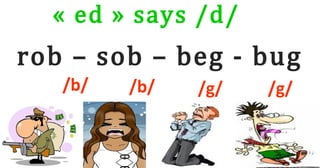
rob – sob – beg - bug
/b/ /b/ /g/ /g/
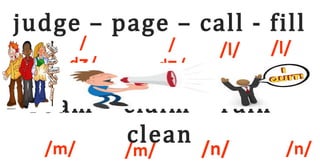
judge – page – call - fill
roam – claim – rain -
clean
/
d /ᴣ
/
d /ᴣ
/l/ /l/
/m/ /n//n//m/
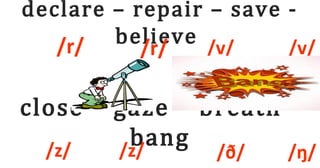
declare – repair – save -
believe
close – gaze – breath -
bang
/r/
/z/ /ð/ /ŋ/
/r/ /v/ /v/
/z/
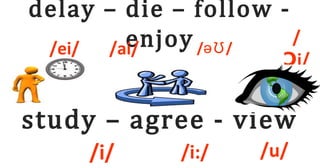
delay – die – follow -
enjoy
study – agree - view
/ei/ /ai/ / /əƱ
/
i/Ↄ
/i/ /u//i:/
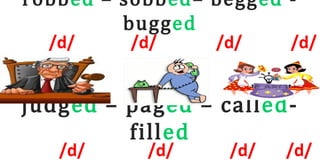
robbed – sobbed– begged -
bugged
judged – paged – called-
filled
/d/ /d/ /d/
/d/ /d/ /d/ /d/
/d/
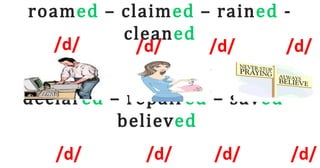
roamed – claimed – rained -
cleaned
declared – repaired – saved -
believed
/d/
/d/ /d/ /d/ /d/
/d/ /d/ /d/
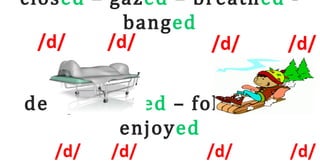
closed – gazed – breathed -
banged
delayed– died – followed -
enjoyed
/d/ /d/ /d/ /d/
/d/ /d/ /d/ /d/
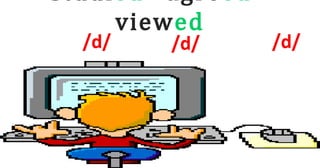
studied– agreed -
viewed
/d/ /d/ /d/
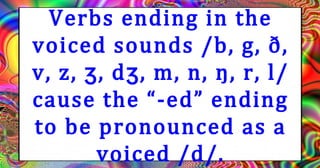
Verbs ending in the
voiced sounds /b, g, ð,
v, z, , d , m, n, ŋ, r, l/ʒ ʒ
cause the “-ed” ending
to be pronounced as a
voiced /d/.
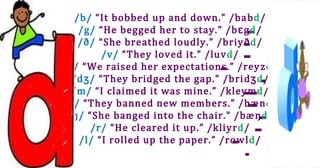
/b/ “It bobbed up and down.” /babd/
/g/ “He begged her to stay.” /bɛgd/
/ð/ “She breathed loudly.” /briyðd/
/v/ “They loved it.” /luvd/
/z/ “We raised her expectations.” /reyzd/
/d /ʒ “They bridged the gap.” /bridʒd/
/m/ “I claimed it was mine.” /kleymd/
/n/ “They banned new members.” /bænd/
/ŋ/ “She banged into the chair.” /bæŋd/
/r/ “He cleared it up.” /kliyrd/
/l/ “I rolled up the paper.” /rowld/
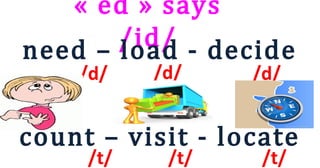
« ed » says
/id/need – load - decide
count – visit - locate
/d/
/t/ /t/ /t/
/d/ /d/
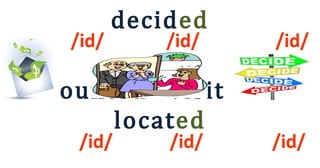
decided
counted– visited -
located
/id/ /id/ /id/
/id/ /id/ /id/
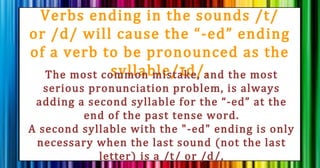
Verbs ending in the sounds /t/
or /d/ will cause the “-ed” ending
of a verb to be pronounced as the
syllable/ d/.ɪThe most common mistake, and the most
serious pronunciation problem, is always
adding a second syllable for the “-ed” at the
end of the past tense word.
A second syllable with the "-ed" ending is only
necessary when the last sound (not the last
letter) is a /t/ or /d/,
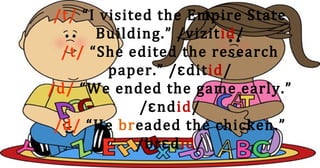
/t/ “I visited the Empire State
Building.” /vizitid/
/t/ “She edited the research
paper.” / ditɛ id/
/d/ “We ended the game early.”
/ ndɛ id/
/d/ “He breaded the chicken.”
/br dɛ id/

Pronunciation final ed sounds ppt

  • 1.
    FB Kh Mrs. FBKh Pronunciation Final « ed » Sounds
  • 2.
    Today we aregoing to work on pronunciation. In particular we are going to focus on words that end in “ed”.
  • 3.
    « ed »marks the end of regular verbs in the past simple tense. Although all simple past tense verbs end with an “ed”, they can have three different pronunciations.
  • 4.
    Why the SoundChanges Place your fingertips on the front of your neck, and pronounce the following words. What do you feel on your fingers when you say the underlined sound? vow | fake (vvv | fff) zebra | snake (zzz | sss) –> When we pronounce voiced sounds, our vocal chords vibrate when we say those sounds. /v/ /z/. Did you feel the vibration? –> When we pronounce voiceless sounds, our vocal chords do not vibrate. /f/ /s/. No vibration.
  • 5.
    This vibration orlack of vibration then carries forward to the following sound in the word. Therefore, this vibration or lack of vibration explains why we pronounce the past tense of verbs in three voiced or voiceless ways: /t/, /d/ or /id/.
  • 6.
    The “ed” pronunciationis determined by the final sound of the verb in the infinitive: Is it a voiced consonant, an unvoiced consonant, or a vowel sound?
  • 7.
    « ed » says/t/ stop - jump - cook - like laugh – staff – kiss - dance /p/ /f/ /s/ /s/ /p/ /k/ /k/ /f/ /f/ /p/ /s/ /k/
  • 8.
    fix - fax– fish - crash watch - march /ks/ /∫/ /∫/ /t∫/ /ks/ /t∫/
  • 9.
    Stopped - jumped- cooked - liked laughed – staffed – kissed - danced /t/ /t/ /t/ /t/ /t/ /t/ /t//t/
  • 10.
    fixed - faxed– fished - crashed watched - marched /t/ /t/ /t/ /t/ /t/ /t/
  • 11.
    Verbs ending invoiceless sounds /p, k, θ, f, s,ks, , t / causeʃ ʃ the “-ed” ending to be pronounced as the voiceless [t] (with no vocal chord vibration).
  • 12.
    /p/ “He poppeda balloon.” /papt/ /k/ “They talked a lot” /takt/ /θ/ “th”: “She frothed a cup of milk” /frawθt/ /f/ “I laughed at the movie.”/læft/ /s/ “She kissed a frog.” /kist/ / /ʃ “sh”: “We brushed it off.” /bruʃt/ /t /ʃ “ch”: “I reached around for it.” /riytʃt/
  • 13.
    « ed »says /d/ rob – sob – beg - bug /b/ /b/ /g/ /g/
  • 14.
    judge – page– call - fill roam – claim – rain - clean / d /ᴣ / d /ᴣ /l/ /l/ /m/ /n//n//m/
  • 15.
    declare – repair– save - believe close – gaze – breath - bang /r/ /z/ /ð/ /ŋ/ /r/ /v/ /v/ /z/
  • 16.
    delay – die– follow - enjoy study – agree - view /ei/ /ai/ / /əƱ / i/Ↄ /i/ /u//i:/
  • 17.
    robbed – sobbed–begged - bugged judged – paged – called- filled /d/ /d/ /d/ /d/ /d/ /d/ /d/ /d/
  • 18.
    roamed – claimed– rained - cleaned declared – repaired – saved - believed /d/ /d/ /d/ /d/ /d/ /d/ /d/ /d/
  • 19.
    closed – gazed– breathed - banged delayed– died – followed - enjoyed /d/ /d/ /d/ /d/ /d/ /d/ /d/ /d/
  • 20.
  • 21.
    Verbs ending inthe voiced sounds /b, g, ð, v, z, , d , m, n, ŋ, r, l/ʒ ʒ cause the “-ed” ending to be pronounced as a voiced /d/.
  • 22.
    /b/ “It bobbedup and down.” /babd/ /g/ “He begged her to stay.” /bɛgd/ /ð/ “She breathed loudly.” /briyðd/ /v/ “They loved it.” /luvd/ /z/ “We raised her expectations.” /reyzd/ /d /ʒ “They bridged the gap.” /bridʒd/ /m/ “I claimed it was mine.” /kleymd/ /n/ “They banned new members.” /bænd/ /ŋ/ “She banged into the chair.” /bæŋd/ /r/ “He cleared it up.” /kliyrd/ /l/ “I rolled up the paper.” /rowld/
  • 23.
    « ed »says /id/need – load - decide count – visit - locate /d/ /t/ /t/ /t/ /d/ /d/
  • 24.
  • 25.
    Verbs ending inthe sounds /t/ or /d/ will cause the “-ed” ending of a verb to be pronounced as the syllable/ d/.ɪThe most common mistake, and the most serious pronunciation problem, is always adding a second syllable for the “-ed” at the end of the past tense word. A second syllable with the "-ed" ending is only necessary when the last sound (not the last letter) is a /t/ or /d/,
  • 26.
    /t/ “I visitedthe Empire State Building.” /vizitid/ /t/ “She edited the research paper.” / ditɛ id/ /d/ “We ended the game early.” / ndɛ id/ /d/ “He breaded the chicken.” /br dɛ id/