WHY SOFTWARE-DEFINED STORAGE
MATTERS
Will McGrath
Red Hat
November 2016
2
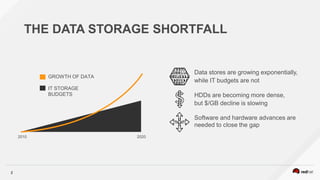
THE DATA STORAGE SHORTFALL
Data stores are growing exponentially,
while IT budgets are not
HDDs are becoming more dense,
but $/GB decline is slowing
Software and hardware advances are
needed to close the gap
GROWTH OF DATA
IT STORAGE
BUDGETS
20202010
3
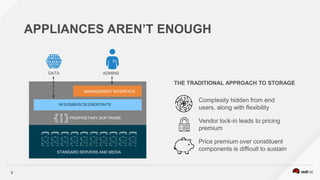
APPLIANCES AREN’T ENOUGH
Complexity hidden from end
users, along with flexibility
Vendor lock-in leads to pricing
premium
Price premium over constituent
components is difficult to sustain
THE TRADITIONAL APPROACH TO STORAGE
ADMINS
MANAGEMENT INTERFACE
DATA
NFS/SMB/ISCSI ENDPOINTS
STANDARD SERVERS AND MEDIA
PROPRIETARY SOFTWARE
4
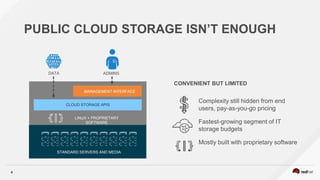
PUBLIC CLOUD STORAGE ISN’T ENOUGH
Complexity still hidden from end
users, pay-as-you-go pricing
Fastest-growing segment of IT
storage budgets
Mostly built with proprietary software
CONVENIENT BUT LIMITED
ADMINS
MANAGEMENT INTERFACE
DATA
CLOUD STORAGE APIS
STANDARD SERVERS AND MEDIA
LINUX + PROPRIETARY
SOFTWARE
5
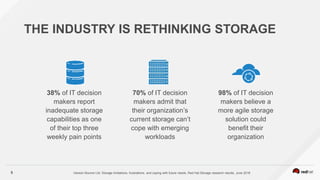
THE INDUSTRY IS RETHINKING STORAGE
38% of IT decision
makers report
inadequate storage
capabilities as one
of their top three
weekly pain points
70% of IT decision
makers admit that
their organization’s
current storage can’t
cope with emerging
workloads
98% of IT decision
makers believe a
more agile storage
solution could
benefit their
organization
Vanson Bourne Ltd: Storage limitations, frustrations, and coping with future needs, Red Hat Storage research results, June 2016
6
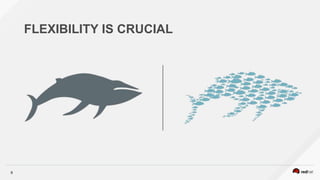
FLEXIBILITY IS CRUCIAL
7
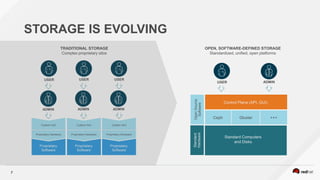
STORAGE IS EVOLVING
OPEN, SOFTWARE-DEFINED STORAGE
Standardized, unified, open platforms
Standard Computers
and Disks
Ceph Gluster +++
Control Plane (API, GUI)
Custom GUI
Proprietary Hardware
Proprietary
Software
Custom GUI
Proprietary Hardware
Proprietary
Software
USER USER USER
ADMIN ADMIN ADMIN
Custom GUI
Proprietary Hardware
Proprietary
Software
USER ADMIN
Standard
Hardware
OpenSource
Software
TRADITIONAL STORAGE
Complex proprietary silos
WHAT IS SOFTWARE-DEFINED
STORAGE?
9
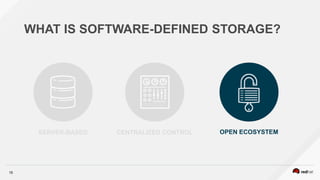
WHAT IS SOFTWARE-DEFINED STORAGE?
SERVER-BASED CENTRALIZED CONTROL OPEN ECOSYSTEM
10
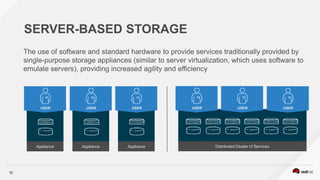
SERVER-BASED STORAGE
The use of software and standard hardware to provide services traditionally provided by
single-purpose storage appliances (similar to server virtualization, which uses software to
emulate servers), providing increased agility and efficiency
Appliance
USER
Appliance
USER
Appliance
USER
Distributed Cluster of Services
USER USER USER
12
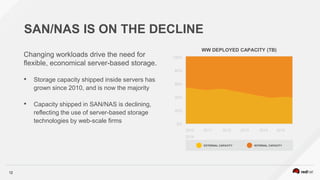
SAN/NAS IS ON THE DECLINE
• Storage capacity shipped inside servers has
grown since 2010, and is now the majority
• Capacity shipped in SAN/NAS is declining,
reflecting the use of server-based storage
technologies by web-scale firms
Changing workloads drive the need for
flexible, economical server-based storage.
WW DEPLOYED CAPACITY (TB)
100%
80%
60%
40%
20%
0%
2010 2011 2012 2013 2014 2015
2016
EXTERNAL CAPACITY INTERNAL CAPACITY
13
WHAT IS SOFTWARE-DEFINED STORAGE?
CENTRALIZED CONTROLSERVER-BASED OPEN ECOSYSTEM
14
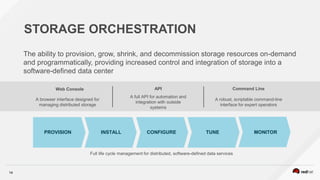
STORAGE ORCHESTRATION
The ability to provision, grow, shrink, and decommission storage resources on-demand
and programmatically, providing increased control and integration of storage into a
software-defined data center
Web Console API Command Line
A browser interface designed for
managing distributed storage
A full API for automation and
integration with outside
systems
A robust, scriptable command-line
interface for expert operators
Full life cycle management for distributed, software-defined data services
PROVISION INSTALL CONFIGURE TUNE MONITOR
15
WHAT IS SOFTWARE-DEFINED STORAGE?
OPEN ECOSYSTEMSERVER-BASED CENTRALIZED CONTROL
WHY SOFTWARE-DEFINED
STORAGE MATTERS
17
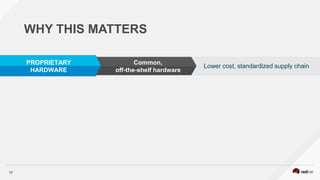
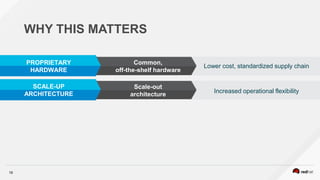
WHY THIS MATTERS
PROPRIETARY
HARDWARE
Common,
off-the-shelf hardware
Lower cost, standardized supply chain
18
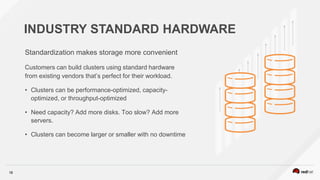
INDUSTRY STANDARD HARDWARE
Standardization makes storage more convenient
Customers can build clusters using standard hardware
from existing vendors that’s perfect for their workload.
• Clusters can be performance-optimized, capacity-
optimized, or throughput-optimized
• Need capacity? Add more disks. Too slow? Add more
servers.
• Clusters can become larger or smaller with no downtime
19
WHY THIS MATTERS
PROPRIETARY
HARDWARE
SCALE-UP
ARCHITECTURE
Common,
off-the-shelf hardware
Scale-out
architecture
Lower cost, standardized supply chain
Increased operational flexibility
20
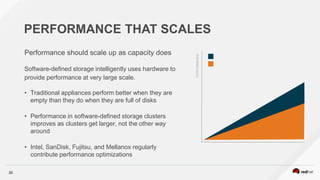
PERFORMANCE THAT SCALES
Performance should scale up as capacity does
Software-defined storage intelligently uses hardware to
provide performance at very large scale.
• Traditional appliances perform better when they are
empty than they do when they are full of disks
• Performance in software-defined storage clusters
improves as clusters get larger, not the other way
around
• Intel, SanDisk, Fujitsu, and Mellanox regularly
contribute performance optimizations
PERFORMANCE
21
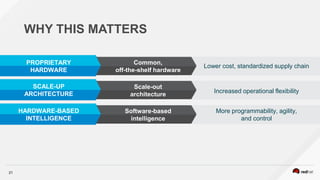
WHY THIS MATTERS
PROPRIETARY
HARDWARE
SCALE-UP
ARCHITECTURE
HARDWARE-BASED
INTELLIGENCE
Common,
off-the-shelf hardware
Scale-out
architecture
Software-based
intelligence
Lower cost, standardized supply chain
Increased operational flexibility
More programmability, agility,
and control
22
THE ROBUSTNESS OF SOFTWARE
Software can do things hardware can’t
Storage services based on software are more flexible
than hardware-based implementations
• Can be deployed on bare metal, inside containers,
inside VMs, or in the public cloud
• Can deploy on a single server, or thousands, and can
be upgraded and reconfigured on the fly
• Grows and shrinks programmatically to meet
changing demands
23
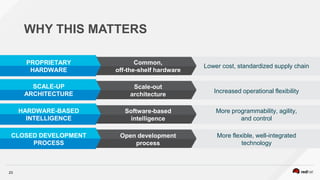
WHY THIS MATTERS
PROPRIETARY
HARDWARE
SCALE-UP
ARCHITECTURE
HARDWARE-BASED
INTELLIGENCE
CLOSED DEVELOPMENT
PROCESS
Common,
off-the-shelf hardware
Scale-out
architecture
Software-based
intelligence
Open development
process
Lower cost, standardized supply chain
Increased operational flexibility
More programmability, agility,
and control
More flexible, well-integrated
technology
24
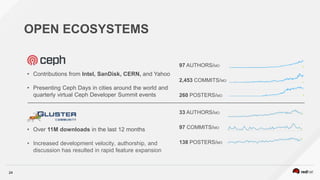
• Contributions from Intel, SanDisk, CERN, and Yahoo
• Presenting Ceph Days in cities around the world and
quarterly virtual Ceph Developer Summit events
• Over 11M downloads in the last 12 months
• Increased development velocity, authorship, and
discussion has resulted in rapid feature expansion
OPEN ECOSYSTEMS
97 AUTHORS/MO
2,453 COMMITS/MO
260 POSTERS/MO
33 AUTHORS/MO
97 COMMITS/MO
138 POSTERS/MO
25
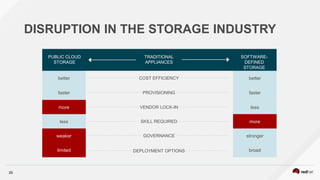
DISRUPTION IN THE STORAGE INDUSTRY
PUBLIC CLOUD
STORAGE
TRADITIONAL
APPLIANCES
SOFTWARE-
DEFINED
STORAGE
better
faster
more
less
weaker
limited
better
faster
less
more
stronger
broad
COST EFFICIENCY
PROVISIONING
VENDOR LOCK-IN
SKILL REQUIRED
GOVERNANCE
DEPLOYMENT OPTIONS
27
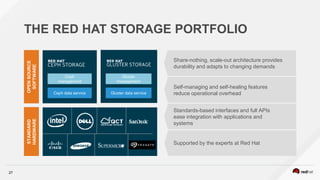
THE RED HAT STORAGE PORTFOLIO
Gluster
management
Ceph data service Gluster data service
Ceph
management
OPENSOURCE
SOFTWARE
STANDARD
HARDWARE
Share-nothing, scale-out architecture provides
durability and adapts to changing demands
Self-managing and self-healing features
reduce operational overhead
Standards-based interfaces and full APIs
ease integration with applications and
systems
Supported by the experts at Red Hat
28
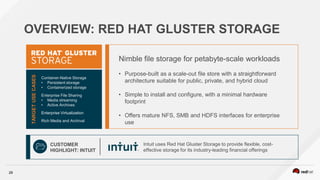
OVERVIEW: RED HAT GLUSTER STORAGE
• Purpose-built as a scale-out file store with a straightforward
architecture suitable for public, private, and hybrid cloud
• Simple to install and configure, with a minimal hardware
footprint
• Offers mature NFS, SMB and HDFS interfaces for enterprise
use
Intuit uses Red Hat Gluster Storage to provide flexible, cost-
effective storage for its industry-leading financial offerings
Nimble file storage for petabyte-scale workloads
Container-Native Storage
• Persistent storage
• Containerized storage
Enterprise File Sharing
• Media streaming
• Active Archives
Enterprise Virtualization
Rich Media and Archival
CUSTOMER
HIGHLIGHT: INTUIT
TARGETUSECASES
29
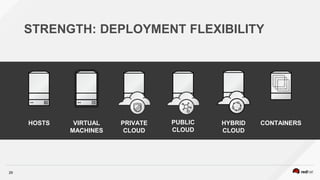
STRENGTH: DEPLOYMENT FLEXIBILITY
HOSTS VIRTUAL
MACHINES
PRIVATE
CLOUD
CONTAINERSPUBLIC
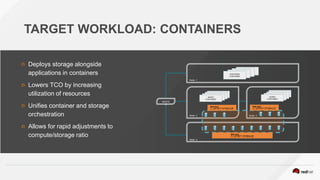
CLOUD
HYBRID
CLOUD
TARGET WORKLOAD: CONTAINERS
30
Deploys storage alongside
applications in containers
Lowers TCO by increasing
utilization of resources
Unifies container and storage
orchestration
Allows for rapid adjustments to
compute/storage ratio
CONTAINER
NGINIX
CONTAINER
MASTE
R
Node 2 Node 3
Node 1
Node 4
NGINIX
CONTAINER
POSTGRES
CONTAINER
31
OVERVIEW: RED HAT CEPH STORAGE
• Built from the ground up as a next-generation storage system, based
on years of research and suitable for powering infrastructure platforms
• Highly tunable, extensible, and configurable, with policy-based control
and no single point of failure
• Offers mature interfaces for block and object storage for the enterprise
Cisco uses Red Hat Ceph Storage to deliver storage for
next-generation cloud services
Powerful distributed storage for the cloud
and beyond
Cloud Infrastructure
• VM storage with
OpenStack® Cinder,
Glance Keystone, Manila,
and Nova
• Object storage for
tenant apps
Rich Media and Archival
S3-compatible object storage
CUSTOMER
HIGHLIGHT: CISCO
TARGETUSECASES
32
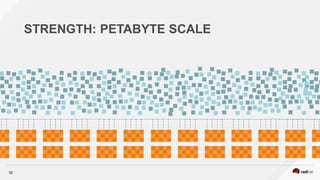
STRENGTH: PETABYTE SCALE
33
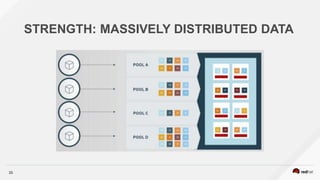
STRENGTH: MASSIVELY DISTRIBUTED DATA
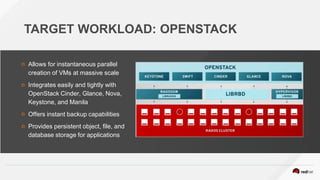
TARGET WORKLOAD: OPENSTACK
34
Allows for instantaneous parallel
creation of VMs at massive scale
Integrates easily and tightly with
OpenStack Cinder, Glance, Nova,
Keystone, and Manila
Offers instant backup capabilities
Provides persistent object, file, and
database storage for applications
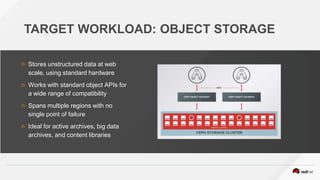
TARGET WORKLOAD: OBJECT STORAGE
35
Stores unstructured data at web
scale, using standard hardware
Works with standard object APIs for
a wide range of compatibility
Spans multiple regions with no
single point of failure
Ideal for active archives, big data
archives, and content libraries
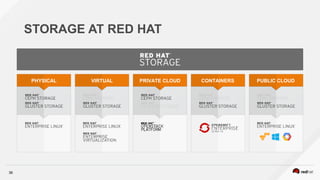
36
STORAGE AT RED HAT
PHYSICAL VIRTUAL PRIVATE CLOUD CONTAINERS PUBLIC CLOUD
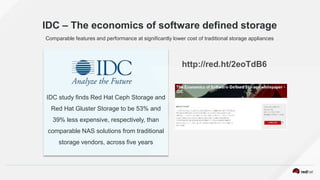
IDC – The economics of software defined storage
Comparable features and performance at significantly lower cost of traditional storage appliances
http://red.ht/2eoTdB6
IDC study finds Red Hat Ceph Storage and
Red Hat Gluster Storage to be 53% and
39% less expensive, respectively, than
comparable NAS solutions from traditional
storage vendors, across five years
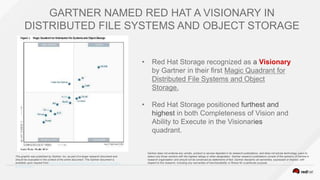
GARTNER NAMED RED HAT A VISIONARY IN
DISTRIBUTED FILE SYSTEMS AND OBJECT STORAGE
Gartner does not endorse any vendor, product or service depicted in its research publications, and does not advise technology users to
select only those vendors with the highest ratings or other designation. Gartner research publications consist of the opinions of Gartner's
research organization and should not be construed as statements of fact. Gartner disclaims all warranties, expressed or implied, with
respect to this research, including any warranties of merchantability or fitness for a particular purpose.
This graphic was published by Gartner, Inc. as part of a larger research document and
should be evaluated in the context of the entire document. The Gartner document is
available upon request from https://engage.redhat.com/gartnermagic-quadrant-storage-s-
201610121525.
• Red Hat Storage recognized as a Visionary
by Gartner in their first Magic Quadrant for
Distributed File Systems and Object
Storage.
• Red Hat Storage positioned furthest and
highest in both Completeness of Vision and
Ability to Execute in the Visionaries
quadrant.
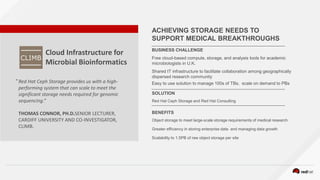
Red Hat Ceph Storage provides us with a high-
performing system that can scale to meet the
significant storage needs required for genomic
sequencing.”
THOMAS CONNOR, PH.D.SENIOR LECTURER,
CARDIFF UNIVERSITY AND CO-INVESTIGATOR,
CLIMB.
“
ACHIEVING STORAGE NEEDS TO
SUPPORT MEDICAL BREAKTHROUGHS
BUSINESS CHALLENGE
Free cloud-based compute, storage, and analysis tools for academic
microbiologists in U.K.
Shared IT infrastructure to facilitate collaboration among geographically
dispersed research community
Easy to use solution to manage 100s of TBs, scale on demand to PBs
SOLUTION
Red Hat Ceph Storage and Red Hat Consulting
BENEFITS
Object storage to meet large-scale storage requirements of medical research
Greater efficiency in storing enterprise data and managing data growth
Scalability to 1.5PB of raw object storage per site
Cloud Infrastructure for
Microbial Bioinformatics
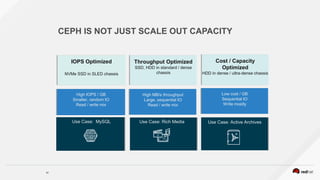
Throughput Optimized
SSD, HDD in standard / dense
chassis
Use Case: Rich Media
41
CEPH IS NOT JUST SCALE OUT CAPACITY
IOPS Optimized
NVMe SSD in SLED chassis
Use Case: MySQL
Cost / Capacity
Optimized
HDD in dense / ultra-dense chassis
Use Case: Active Archives
High MB/s throughput
Large, sequential IO
Read / write mix
High IOPS / GB
Smaller, random IO
Read / write mix
Low cost / GB
Sequential IO
Write mostly

Red Hat Storage Day Boston - Why Software-defined Storage Matters

  • 1.
    WHY SOFTWARE-DEFINED STORAGE MATTERS WillMcGrath Red Hat November 2016
  • 2.
    2 THE DATA STORAGESHORTFALL Data stores are growing exponentially, while IT budgets are not HDDs are becoming more dense, but $/GB decline is slowing Software and hardware advances are needed to close the gap GROWTH OF DATA IT STORAGE BUDGETS 20202010
  • 3.
    3 APPLIANCES AREN’T ENOUGH Complexityhidden from end users, along with flexibility Vendor lock-in leads to pricing premium Price premium over constituent components is difficult to sustain THE TRADITIONAL APPROACH TO STORAGE ADMINS MANAGEMENT INTERFACE DATA NFS/SMB/ISCSI ENDPOINTS STANDARD SERVERS AND MEDIA PROPRIETARY SOFTWARE
  • 4.
    4 PUBLIC CLOUD STORAGEISN’T ENOUGH Complexity still hidden from end users, pay-as-you-go pricing Fastest-growing segment of IT storage budgets Mostly built with proprietary software CONVENIENT BUT LIMITED ADMINS MANAGEMENT INTERFACE DATA CLOUD STORAGE APIS STANDARD SERVERS AND MEDIA LINUX + PROPRIETARY SOFTWARE
  • 5.
    5 THE INDUSTRY ISRETHINKING STORAGE 38% of IT decision makers report inadequate storage capabilities as one of their top three weekly pain points 70% of IT decision makers admit that their organization’s current storage can’t cope with emerging workloads 98% of IT decision makers believe a more agile storage solution could benefit their organization Vanson Bourne Ltd: Storage limitations, frustrations, and coping with future needs, Red Hat Storage research results, June 2016
  • 6.
  • 7.
    7 STORAGE IS EVOLVING OPEN,SOFTWARE-DEFINED STORAGE Standardized, unified, open platforms Standard Computers and Disks Ceph Gluster +++ Control Plane (API, GUI) Custom GUI Proprietary Hardware Proprietary Software Custom GUI Proprietary Hardware Proprietary Software USER USER USER ADMIN ADMIN ADMIN Custom GUI Proprietary Hardware Proprietary Software USER ADMIN Standard Hardware OpenSource Software TRADITIONAL STORAGE Complex proprietary silos
  • 8.
  • 9.
    9 WHAT IS SOFTWARE-DEFINEDSTORAGE? SERVER-BASED CENTRALIZED CONTROL OPEN ECOSYSTEM
  • 10.
    10 SERVER-BASED STORAGE The useof software and standard hardware to provide services traditionally provided by single-purpose storage appliances (similar to server virtualization, which uses software to emulate servers), providing increased agility and efficiency Appliance USER Appliance USER Appliance USER Distributed Cluster of Services USER USER USER
  • 11.
    12 SAN/NAS IS ONTHE DECLINE • Storage capacity shipped inside servers has grown since 2010, and is now the majority • Capacity shipped in SAN/NAS is declining, reflecting the use of server-based storage technologies by web-scale firms Changing workloads drive the need for flexible, economical server-based storage. WW DEPLOYED CAPACITY (TB) 100% 80% 60% 40% 20% 0% 2010 2011 2012 2013 2014 2015 2016 EXTERNAL CAPACITY INTERNAL CAPACITY
  • 12.
    13 WHAT IS SOFTWARE-DEFINEDSTORAGE? CENTRALIZED CONTROLSERVER-BASED OPEN ECOSYSTEM
  • 13.
    14 STORAGE ORCHESTRATION The abilityto provision, grow, shrink, and decommission storage resources on-demand and programmatically, providing increased control and integration of storage into a software-defined data center Web Console API Command Line A browser interface designed for managing distributed storage A full API for automation and integration with outside systems A robust, scriptable command-line interface for expert operators Full life cycle management for distributed, software-defined data services PROVISION INSTALL CONFIGURE TUNE MONITOR
  • 14.
    15 WHAT IS SOFTWARE-DEFINEDSTORAGE? OPEN ECOSYSTEMSERVER-BASED CENTRALIZED CONTROL
  • 15.
  • 16.
    17 WHY THIS MATTERS PROPRIETARY HARDWARE Common, off-the-shelfhardware Lower cost, standardized supply chain
  • 17.
    18 INDUSTRY STANDARD HARDWARE Standardizationmakes storage more convenient Customers can build clusters using standard hardware from existing vendors that’s perfect for their workload. • Clusters can be performance-optimized, capacity- optimized, or throughput-optimized • Need capacity? Add more disks. Too slow? Add more servers. • Clusters can become larger or smaller with no downtime
  • 18.
    19 WHY THIS MATTERS PROPRIETARY HARDWARE SCALE-UP ARCHITECTURE Common, off-the-shelfhardware Scale-out architecture Lower cost, standardized supply chain Increased operational flexibility
  • 19.
    20 PERFORMANCE THAT SCALES Performanceshould scale up as capacity does Software-defined storage intelligently uses hardware to provide performance at very large scale. • Traditional appliances perform better when they are empty than they do when they are full of disks • Performance in software-defined storage clusters improves as clusters get larger, not the other way around • Intel, SanDisk, Fujitsu, and Mellanox regularly contribute performance optimizations PERFORMANCE
  • 20.
    21 WHY THIS MATTERS PROPRIETARY HARDWARE SCALE-UP ARCHITECTURE HARDWARE-BASED INTELLIGENCE Common, off-the-shelfhardware Scale-out architecture Software-based intelligence Lower cost, standardized supply chain Increased operational flexibility More programmability, agility, and control
  • 21.
    22 THE ROBUSTNESS OFSOFTWARE Software can do things hardware can’t Storage services based on software are more flexible than hardware-based implementations • Can be deployed on bare metal, inside containers, inside VMs, or in the public cloud • Can deploy on a single server, or thousands, and can be upgraded and reconfigured on the fly • Grows and shrinks programmatically to meet changing demands
  • 22.
    23 WHY THIS MATTERS PROPRIETARY HARDWARE SCALE-UP ARCHITECTURE HARDWARE-BASED INTELLIGENCE CLOSEDDEVELOPMENT PROCESS Common, off-the-shelf hardware Scale-out architecture Software-based intelligence Open development process Lower cost, standardized supply chain Increased operational flexibility More programmability, agility, and control More flexible, well-integrated technology
  • 23.
    24 • Contributions fromIntel, SanDisk, CERN, and Yahoo • Presenting Ceph Days in cities around the world and quarterly virtual Ceph Developer Summit events • Over 11M downloads in the last 12 months • Increased development velocity, authorship, and discussion has resulted in rapid feature expansion OPEN ECOSYSTEMS 97 AUTHORS/MO 2,453 COMMITS/MO 260 POSTERS/MO 33 AUTHORS/MO 97 COMMITS/MO 138 POSTERS/MO
  • 24.
    25 DISRUPTION IN THESTORAGE INDUSTRY PUBLIC CLOUD STORAGE TRADITIONAL APPLIANCES SOFTWARE- DEFINED STORAGE better faster more less weaker limited better faster less more stronger broad COST EFFICIENCY PROVISIONING VENDOR LOCK-IN SKILL REQUIRED GOVERNANCE DEPLOYMENT OPTIONS
  • 26.
    27 THE RED HATSTORAGE PORTFOLIO Gluster management Ceph data service Gluster data service Ceph management OPENSOURCE SOFTWARE STANDARD HARDWARE Share-nothing, scale-out architecture provides durability and adapts to changing demands Self-managing and self-healing features reduce operational overhead Standards-based interfaces and full APIs ease integration with applications and systems Supported by the experts at Red Hat
  • 27.
    28 OVERVIEW: RED HATGLUSTER STORAGE • Purpose-built as a scale-out file store with a straightforward architecture suitable for public, private, and hybrid cloud • Simple to install and configure, with a minimal hardware footprint • Offers mature NFS, SMB and HDFS interfaces for enterprise use Intuit uses Red Hat Gluster Storage to provide flexible, cost- effective storage for its industry-leading financial offerings Nimble file storage for petabyte-scale workloads Container-Native Storage • Persistent storage • Containerized storage Enterprise File Sharing • Media streaming • Active Archives Enterprise Virtualization Rich Media and Archival CUSTOMER HIGHLIGHT: INTUIT TARGETUSECASES
  • 28.
    29 STRENGTH: DEPLOYMENT FLEXIBILITY HOSTSVIRTUAL MACHINES PRIVATE CLOUD CONTAINERSPUBLIC CLOUD HYBRID CLOUD
  • 29.
    TARGET WORKLOAD: CONTAINERS 30 Deploysstorage alongside applications in containers Lowers TCO by increasing utilization of resources Unifies container and storage orchestration Allows for rapid adjustments to compute/storage ratio CONTAINER NGINIX CONTAINER MASTE R Node 2 Node 3 Node 1 Node 4 NGINIX CONTAINER POSTGRES CONTAINER
  • 30.
    31 OVERVIEW: RED HATCEPH STORAGE • Built from the ground up as a next-generation storage system, based on years of research and suitable for powering infrastructure platforms • Highly tunable, extensible, and configurable, with policy-based control and no single point of failure • Offers mature interfaces for block and object storage for the enterprise Cisco uses Red Hat Ceph Storage to deliver storage for next-generation cloud services Powerful distributed storage for the cloud and beyond Cloud Infrastructure • VM storage with OpenStack® Cinder, Glance Keystone, Manila, and Nova • Object storage for tenant apps Rich Media and Archival S3-compatible object storage CUSTOMER HIGHLIGHT: CISCO TARGETUSECASES
  • 31.
  • 32.
  • 33.
    TARGET WORKLOAD: OPENSTACK 34 Allowsfor instantaneous parallel creation of VMs at massive scale Integrates easily and tightly with OpenStack Cinder, Glance, Nova, Keystone, and Manila Offers instant backup capabilities Provides persistent object, file, and database storage for applications
  • 34.
    TARGET WORKLOAD: OBJECTSTORAGE 35 Stores unstructured data at web scale, using standard hardware Works with standard object APIs for a wide range of compatibility Spans multiple regions with no single point of failure Ideal for active archives, big data archives, and content libraries
  • 35.
    36 STORAGE AT REDHAT PHYSICAL VIRTUAL PRIVATE CLOUD CONTAINERS PUBLIC CLOUD
  • 36.
    IDC – Theeconomics of software defined storage Comparable features and performance at significantly lower cost of traditional storage appliances http://red.ht/2eoTdB6 IDC study finds Red Hat Ceph Storage and Red Hat Gluster Storage to be 53% and 39% less expensive, respectively, than comparable NAS solutions from traditional storage vendors, across five years
  • 37.
    GARTNER NAMED REDHAT A VISIONARY IN DISTRIBUTED FILE SYSTEMS AND OBJECT STORAGE Gartner does not endorse any vendor, product or service depicted in its research publications, and does not advise technology users to select only those vendors with the highest ratings or other designation. Gartner research publications consist of the opinions of Gartner's research organization and should not be construed as statements of fact. Gartner disclaims all warranties, expressed or implied, with respect to this research, including any warranties of merchantability or fitness for a particular purpose. This graphic was published by Gartner, Inc. as part of a larger research document and should be evaluated in the context of the entire document. The Gartner document is available upon request from https://engage.redhat.com/gartnermagic-quadrant-storage-s- 201610121525. • Red Hat Storage recognized as a Visionary by Gartner in their first Magic Quadrant for Distributed File Systems and Object Storage. • Red Hat Storage positioned furthest and highest in both Completeness of Vision and Ability to Execute in the Visionaries quadrant.
  • 39.
    Red Hat CephStorage provides us with a high- performing system that can scale to meet the significant storage needs required for genomic sequencing.” THOMAS CONNOR, PH.D.SENIOR LECTURER, CARDIFF UNIVERSITY AND CO-INVESTIGATOR, CLIMB. “ ACHIEVING STORAGE NEEDS TO SUPPORT MEDICAL BREAKTHROUGHS BUSINESS CHALLENGE Free cloud-based compute, storage, and analysis tools for academic microbiologists in U.K. Shared IT infrastructure to facilitate collaboration among geographically dispersed research community Easy to use solution to manage 100s of TBs, scale on demand to PBs SOLUTION Red Hat Ceph Storage and Red Hat Consulting BENEFITS Object storage to meet large-scale storage requirements of medical research Greater efficiency in storing enterprise data and managing data growth Scalability to 1.5PB of raw object storage per site Cloud Infrastructure for Microbial Bioinformatics
  • 40.
    Throughput Optimized SSD, HDDin standard / dense chassis Use Case: Rich Media 41 CEPH IS NOT JUST SCALE OUT CAPACITY IOPS Optimized NVMe SSD in SLED chassis Use Case: MySQL Cost / Capacity Optimized HDD in dense / ultra-dense chassis Use Case: Active Archives High MB/s throughput Large, sequential IO Read / write mix High IOPS / GB Smaller, random IO Read / write mix Low cost / GB Sequential IO Write mostly