1
High-Performance Virtualization for HPC
Cloud on Xen
Jun Nakajima
Tianyu Lan
2
Legal Disclaimer
 INFORMATION IN THIS DOCUMENT IS PROVIDED IN CONNECTION WITH INTEL® PRODUCTS. NO LICENSE, EXPRESS
OR IMPLIED, BY ESTOPPEL OR OTHERWISE, TO ANY INTELLECTUAL PROPERTY RIGHTS IS GRANTED BY THIS
DOCUMENT. EXCEPT AS PROVIDED IN INTEL’S TERMS AND CONDITIONS OF SALE FOR SUCH PRODUCTS, INTEL
ASSUMES NO LIABILITY WHATSOEVER, AND INTEL DISCLAIMS ANY EXPRESS OR IMPLIED WARRANTY, RELATING TO
SALE AND/OR USE OF INTEL® PRODUCTS INCLUDING LIABILITY OR WARRANTIES RELATING TO FITNESS FOR A
PARTICULAR PURPOSE, MERCHANTABILITY, OR INFRINGEMENT OF ANY PATENT, COPYRIGHT OR OTHER
INTELLECTUAL PROPERTY RIGHT. INTEL PRODUCTS ARE NOT INTENDED FOR USE IN MEDICAL, LIFE SAVING, OR
LIFE SUSTAINING APPLICATIONS.
 Intel may make changes to specifications and product descriptions at any time, without notice.
 All products, dates, and figures specified are preliminary based on current expectations, and are subject to change without
notice.
 Intel, processors, chipsets, and desktop boards may contain design defects or errors known as errata, which may cause the
product to deviate from published specifications. Current characterized errata are available on request.
 Intel and the Intel logo are trademarks or registered trademarks of Intel Corporation or its subsidiaries in the United States and
other countries.
 *Other names and brands may be claimed as the property of others.
 Copyright © 2016 Intel Corporation.
3
Agenda
• Intel® Xeon Phi™ processor
• HPC Cloud usage
• Challenges for Xen
• Achieving high performance
• Call for action
4
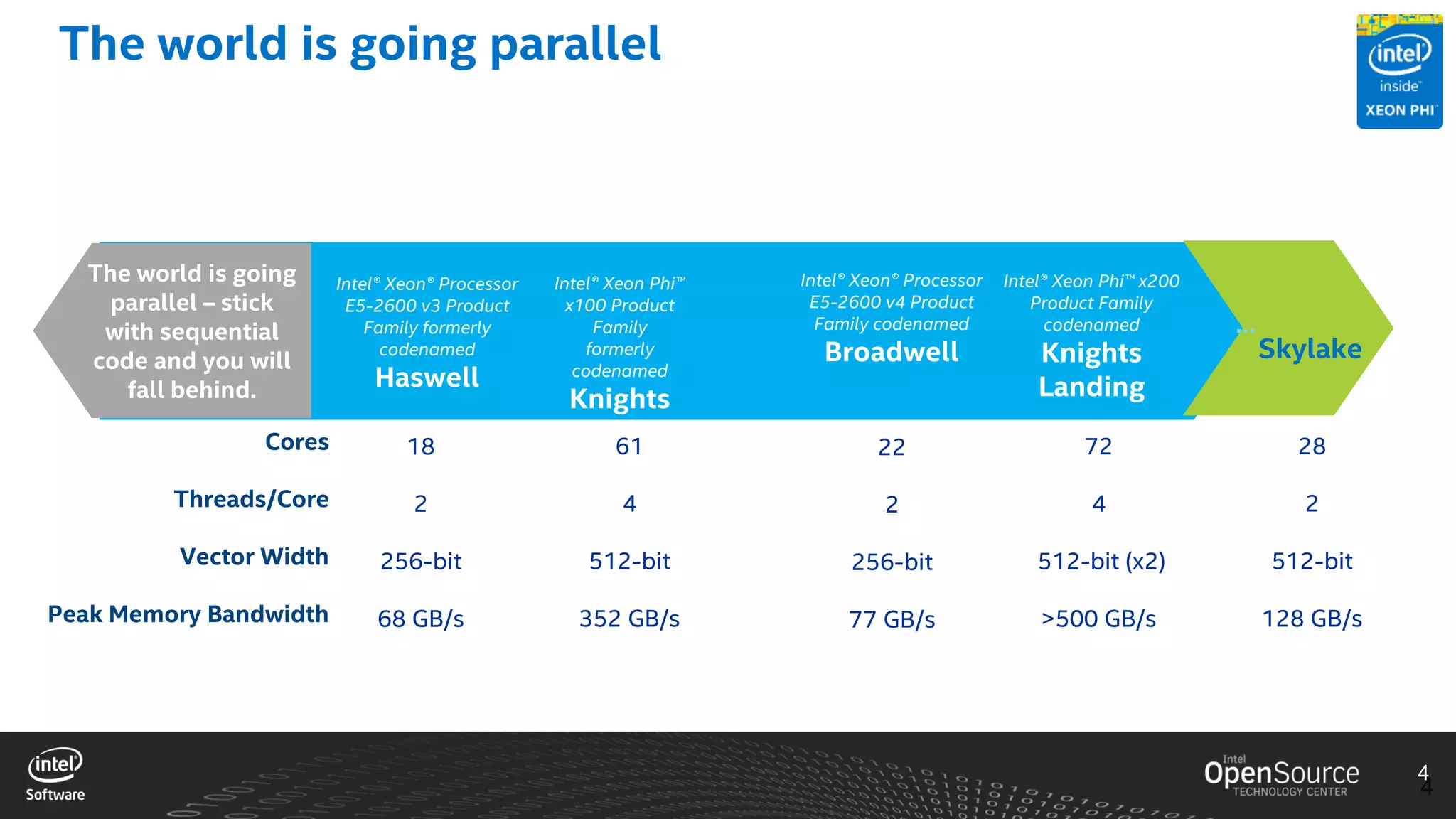
Intel® Xeon Phi™
x100 Product
Family
formerly
codenamed
Knights
Corner
Intel® Xeon Phi™ x200
Product Family
codenamed
Knights
Landing
Skylake
The world is going
parallel – stick
with sequential
code and you will
fall behind.
61
4
512-bit
352 GB/s
Cores
Threads/Core
Vector Width
Peak Memory Bandwidth
18
2
256-bit
68 GB/s
72
4
512-bit (x2)
>500 GB/s
28
2
512-bit
128 GB/s
Intel® Xeon® Processor
E5-2600 v3 Product
Family formerly
codenamed
Haswell
…
Intel® Xeon® Processor
E5-2600 v4 Product
Family codenamed
Broadwell
22
2
256-bit
77 GB/s
The world is going parallel
4
5
Intel® Xeon Phi™ Processor
• Intel’s first bootable host processor specifically designed for HPC
• Binary compatible with Xeon Processor
• Integration of memory on package: Innovative memory architecture for high bandwidth
and high capacity
• Integration of Omni-path Fabric on package
6
*Results will vary. This simplified test is the result of the distillation of the more in-depth programming guide found here: https://software.intel.com/sites/default/files/article/383067/is-xeon-phi-right-for-me.pdf
All products, computer systems, dates and figures specified are preliminary based on current expectations, and are subject to change without notice.
1 Over 3 Teraflops of peak theoretical double-precision performance is preliminary and based on current expectations of cores, clock frequency and floating point operations per cycle. FLOPS = cores x clock frequency x floating-point operations per second per cycle.
2 Host processor only
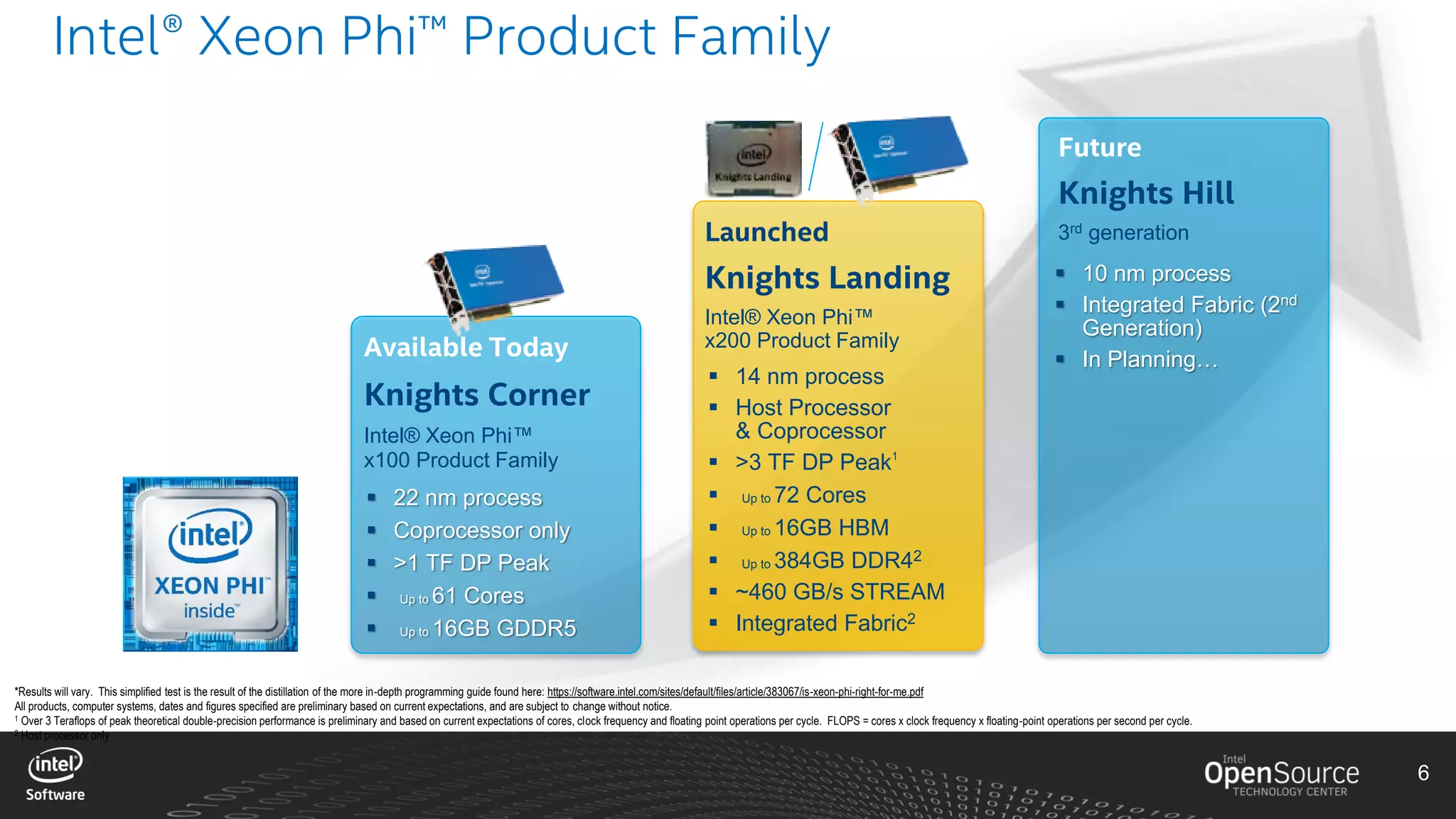
 22 nm process
 Coprocessor only
 >1 TF DP Peak
 Up to 61 Cores
 Up to 16GB GDDR5
Available Today
Knights Corner
Intel® Xeon Phi™
x100 Product Family
Launched
Knights Landing
Intel® Xeon Phi™
x200 Product Family
Future
Knights Hill
3rd generation
 14 nm process
 Host Processor
& Coprocessor
 >3 TF DP Peak1
 Up to 72 Cores
 Up to 16GB HBM
 Up to 384GB DDR42
 ~460 GB/s STREAM
 Integrated Fabric2
 10 nm process
 Integrated Fabric (2nd
Generation)
 In Planning…
Intel® Xeon Phi™ Product Family
7
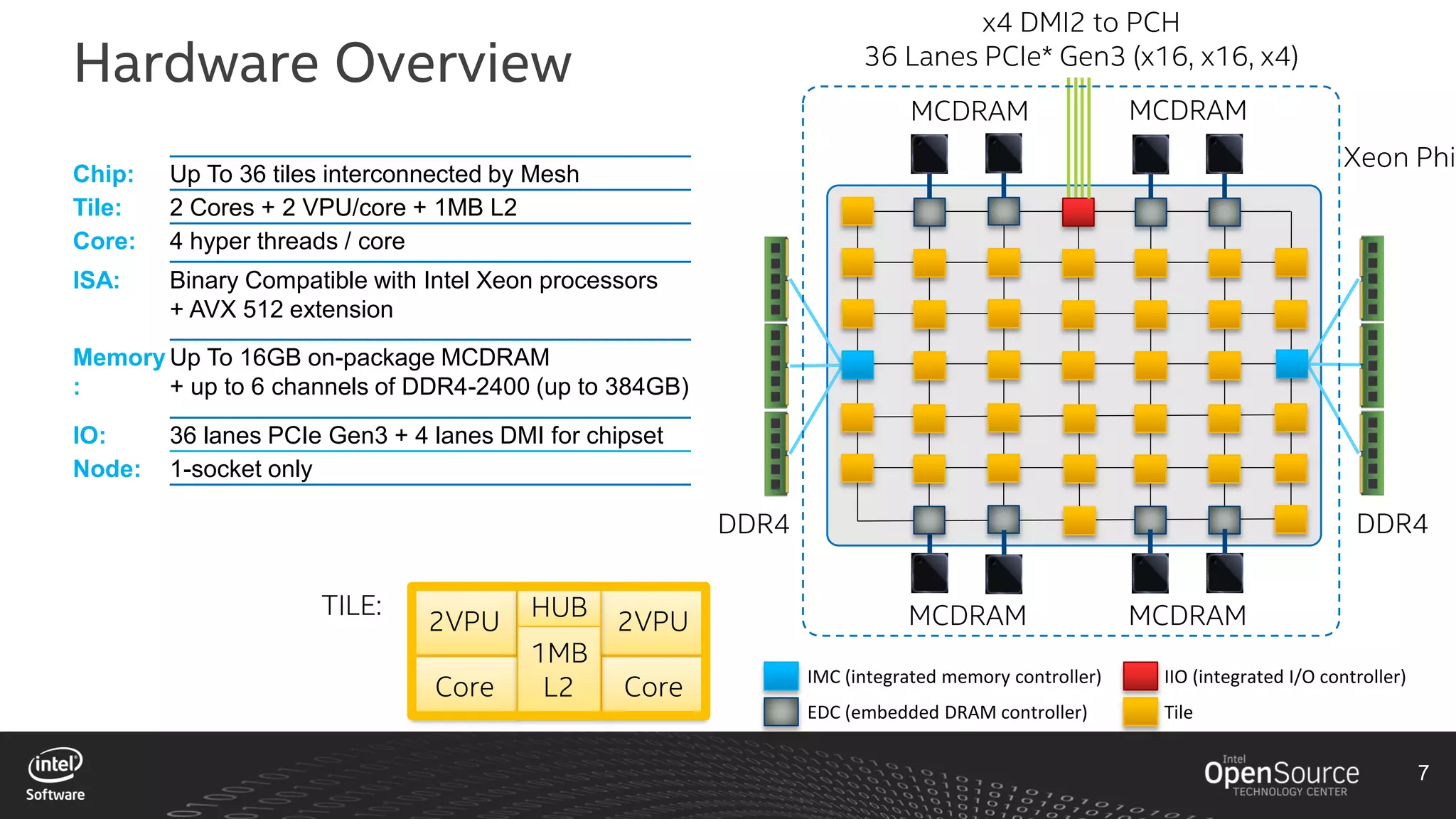
Hardware Overview
Chip: Up To 36 tiles interconnected by Mesh
Tile: 2 Cores + 2 VPU/core + 1MB L2
Core: 4 hyper threads / core
ISA: Binary Compatible with Intel Xeon processors
+ AVX 512 extension
Memory
:
Up To 16GB on-package MCDRAM
+ up to 6 channels of DDR4-2400 (up to 384GB)
IO: 36 lanes PCIe Gen3 + 4 lanes DMI for chipset
Node: 1-socket only
DDR4
x4 DMI2 to PCH
36 Lanes PCIe* Gen3 (x16, x16, x4)
MCDRAM MCDRAM
MCDRAM MCDRAM
DDR4
TILE:
Tile
IMC (integrated memory controller)
EDC (embedded DRAM controller)
IIO (integrated I/O controller)
Xeon Phi
2VPU
Core
2VPU
Core
1MB
L2
HUB
8
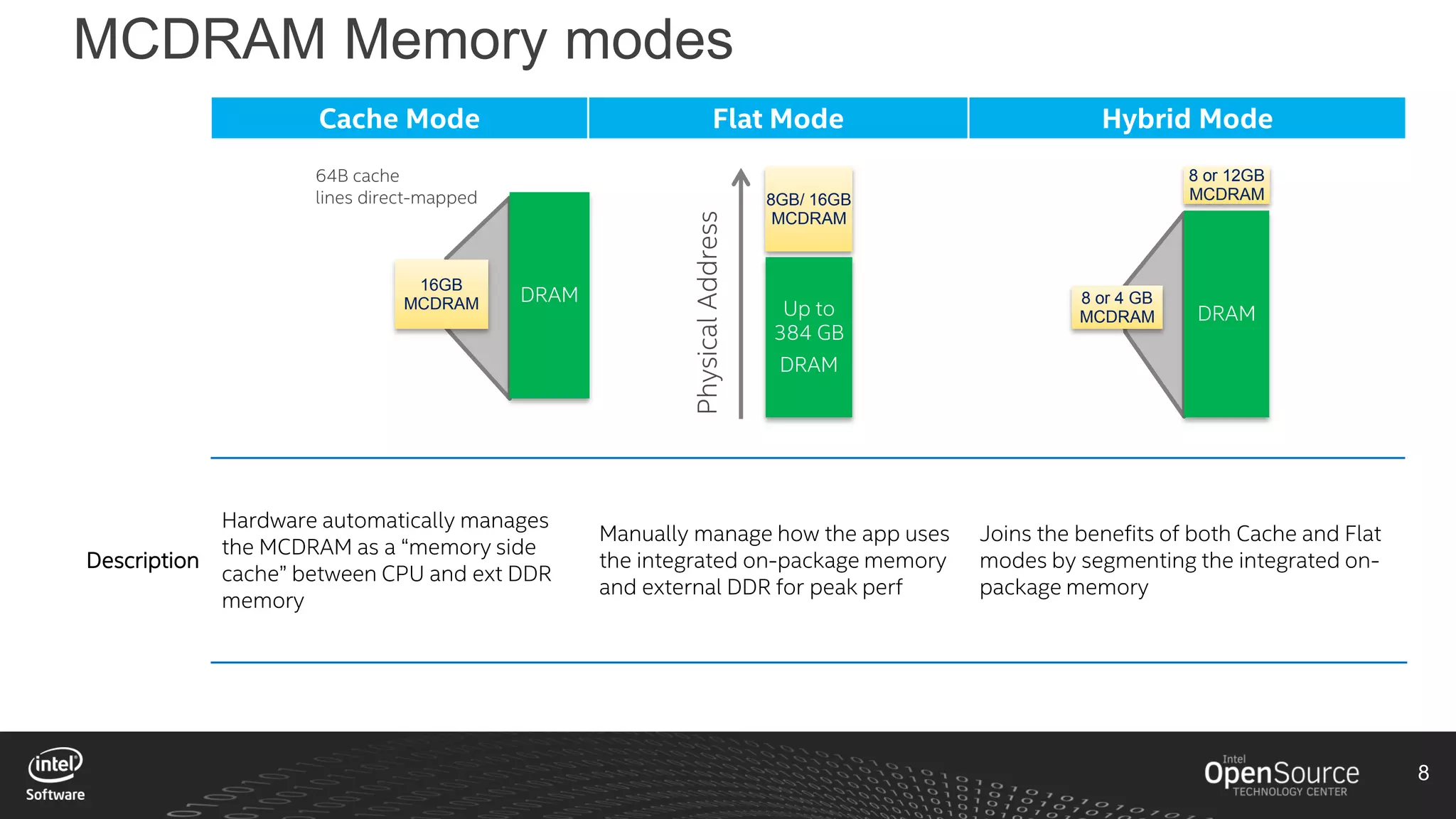
MCDRAM Memory modes
Cache Mode Flat Mode Hybrid Mode
Description
Hardware automatically manages
the MCDRAM as a “memory side
cache” between CPU and ext DDR
memory
Manually manage how the app uses
the integrated on-package memory
and external DDR for peak perf
Joins the benefits of both Cache and Flat
modes by segmenting the integrated on-
package memory
DRAM
8 or 4 GB
MCDRAM
8 or 12GB
MCDRAM8GB/ 16GB
MCDRAM
Up to
384 GB
DRAM
PhysicalAddress
DRAM
16GB
MCDRAM
64B cache
lines direct-mapped
9
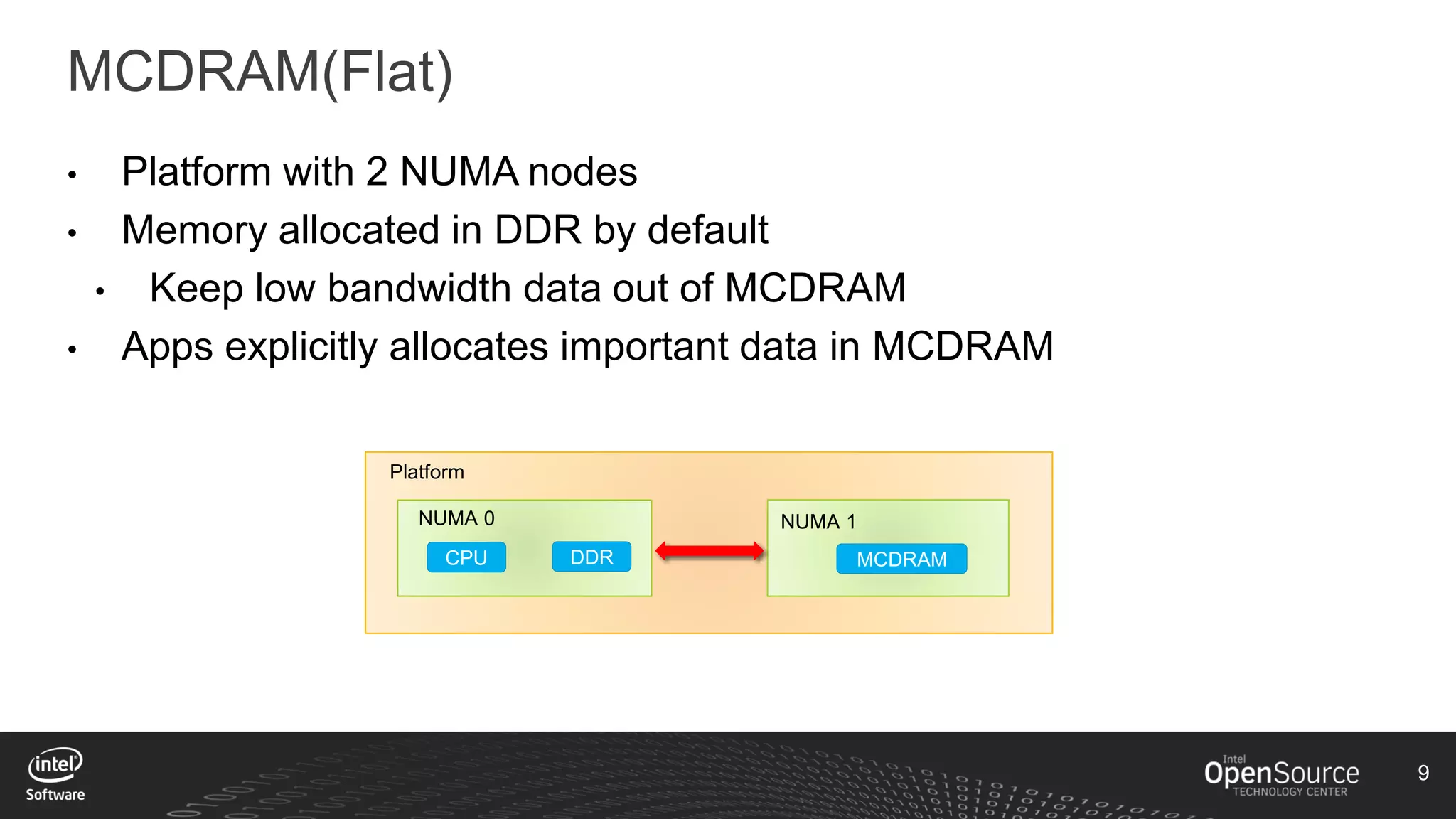
MCDRAM(Flat)
• Platform with 2 NUMA nodes
• Memory allocated in DDR by default
• Keep low bandwidth data out of MCDRAM
• Apps explicitly allocates important data in MCDRAM
NUMA 0
CPU DDR MCDRAM
NUMA 1
Platform
10
Agenda
• Intel® Xeon Phi™ processor
• HPC Cloud usage
• Challenges for Xen
• Achieving high performance
• Call for action
11
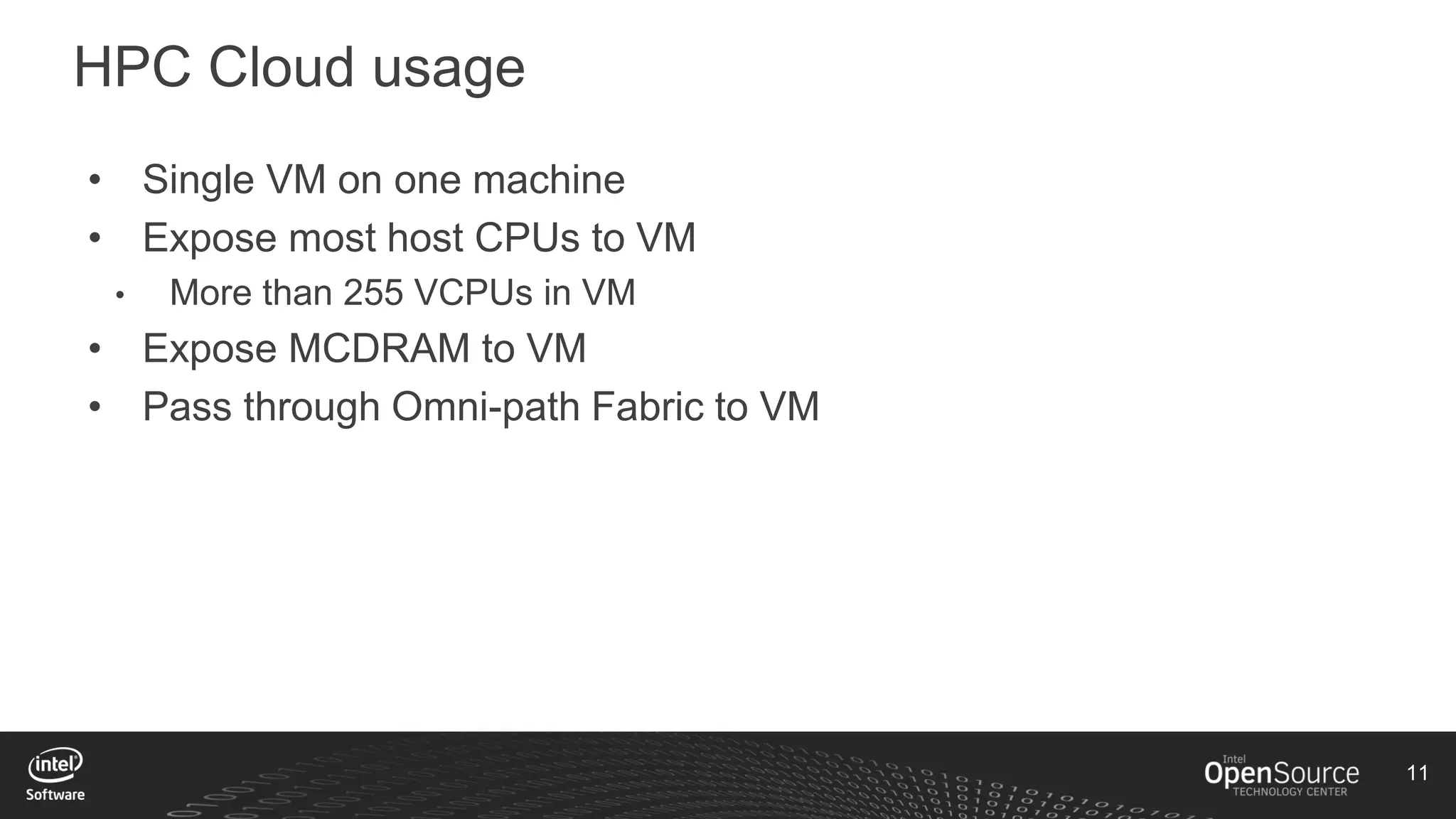
HPC Cloud usage
• Single VM on one machine
• Expose most host CPUs to VM
• More than 255 VCPUs in VM
• Expose MCDRAM to VM
• Pass through Omni-path Fabric to VM
12
Agenda
• Intel® Xeon Phi™ processor
• HPC Cloud usage
• Challenges for Xen
• Achieving high performance
• Call for action
13
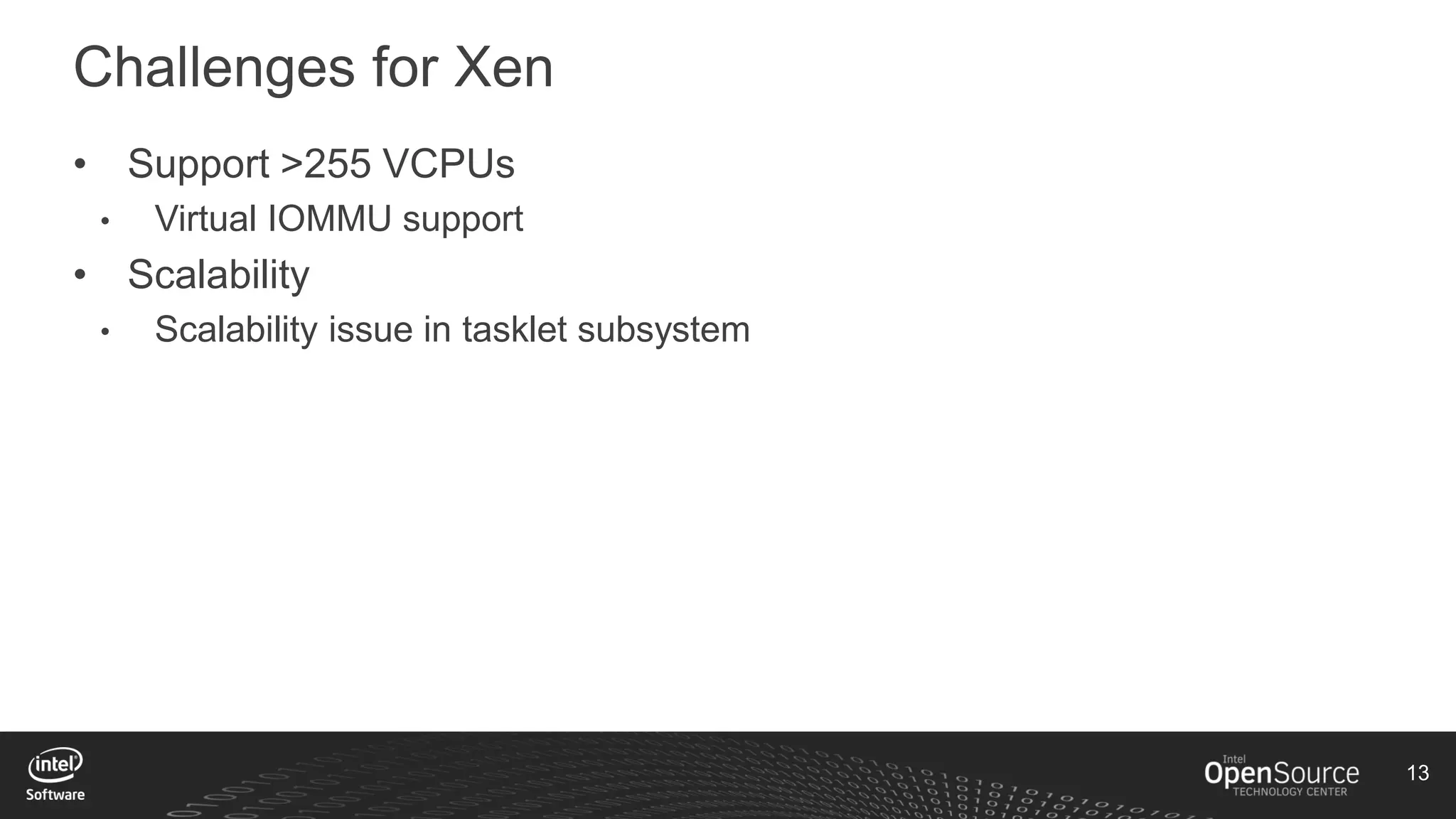
Challenges for Xen
• Support >255 VCPUs
• Virtual IOMMU support
• Scalability
• Scalability issue in tasklet subsystem
14
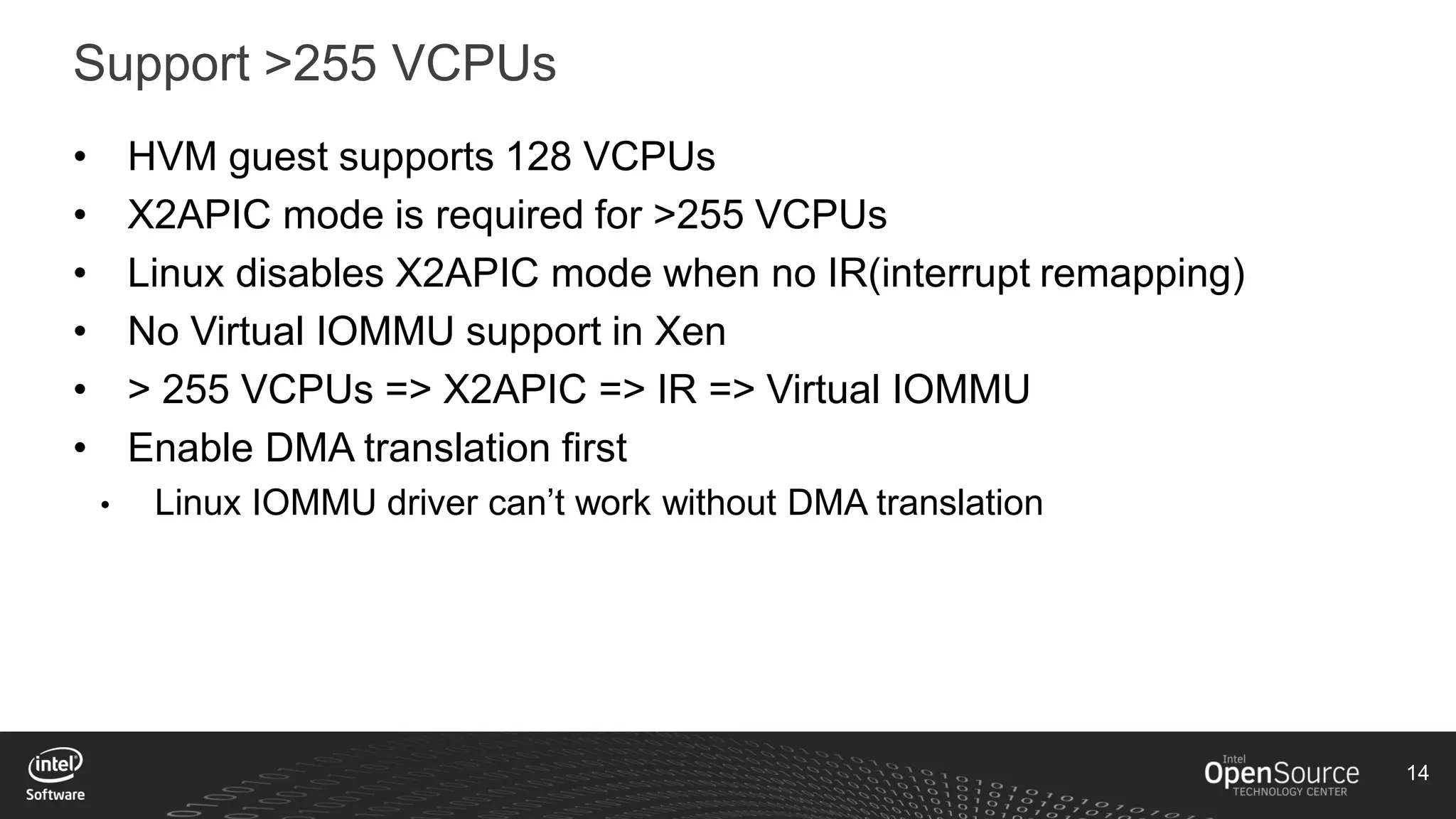
Support >255 VCPUs
• HVM guest supports 128 VCPUs
• X2APIC mode is required for >255 VCPUs
• Linux disables X2APIC mode when no IR(interrupt remapping)
• No Virtual IOMMU support in Xen
• > 255 VCPUs => X2APIC => IR => Virtual IOMMU
• Enable DMA translation first
• Linux IOMMU driver can’t work without DMA translation
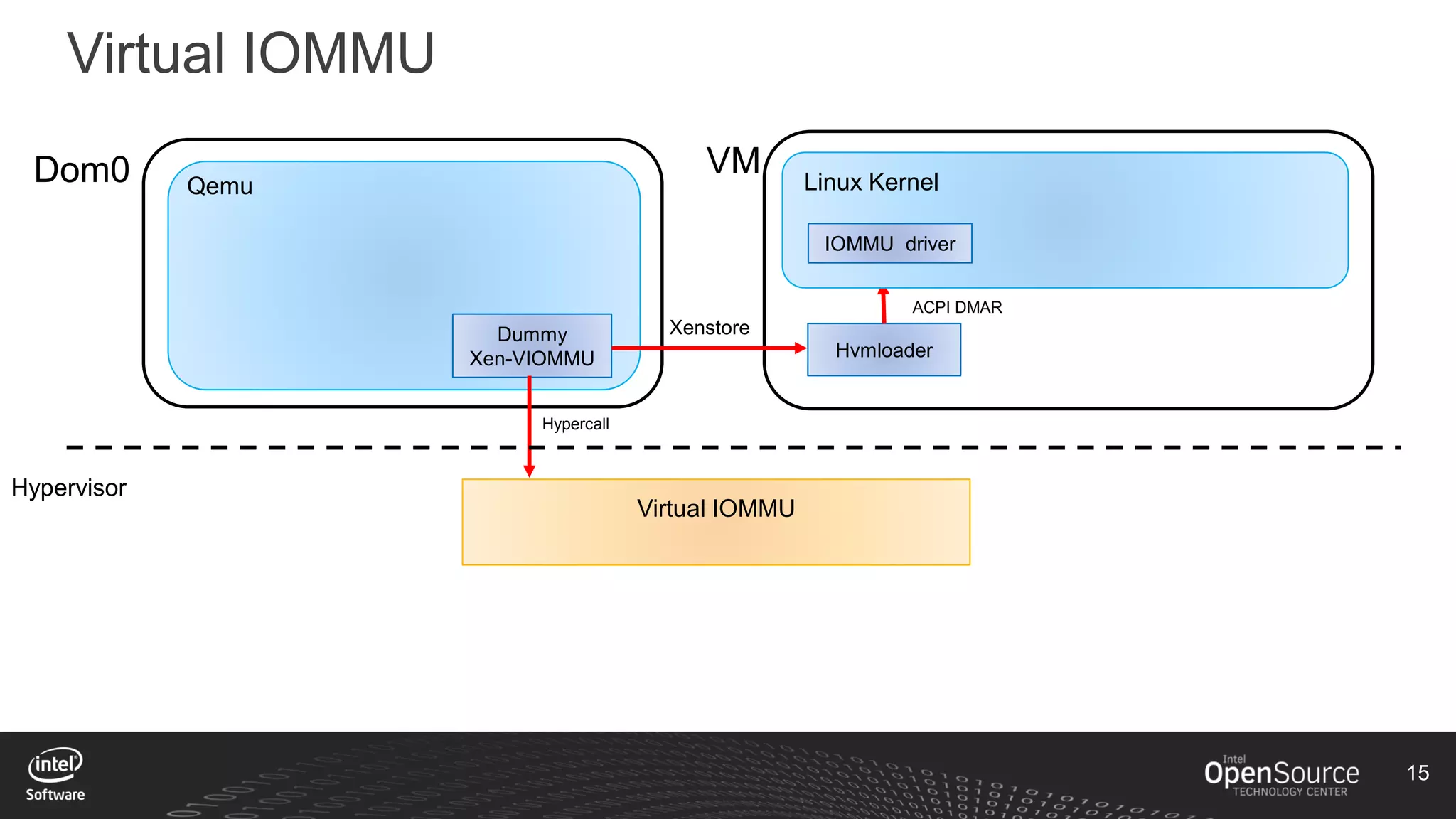
15
Virtual IOMMU
Hvmloader
Virtual IOMMU
Dom0 Qemu
Dummy
Xen-VIOMMU
Hypervisor
VM
Xenstore
Hypercall
Linux Kernel
IOMMU driver
ACPI DMAR
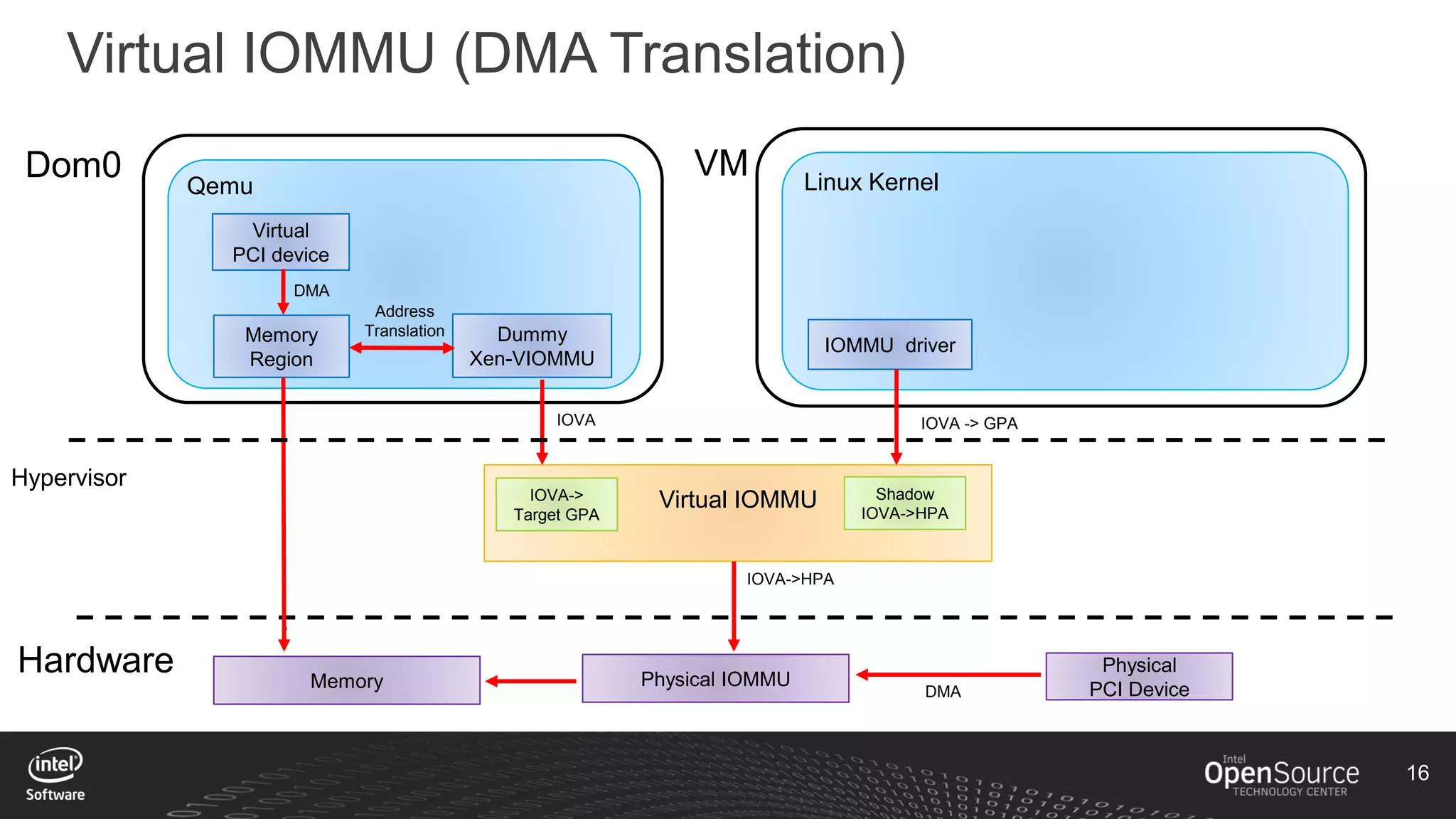
16
Virtual IOMMU (DMA Translation)
Virtual IOMMU
Dom0 Qemu
Dummy
Xen-VIOMMU
Hypervisor
VM Linux Kernel
IOMMU driver
Physical IOMMU
IOVA
Physical
PCI Device
Hardware
Virtual
PCI device
Memory
Region
DMA
Memory
Address
Translation
DMA
IOVA -> GPA
Shadow
IOVA->HPA
IOVA->
Target GPA
IOVA->HPA
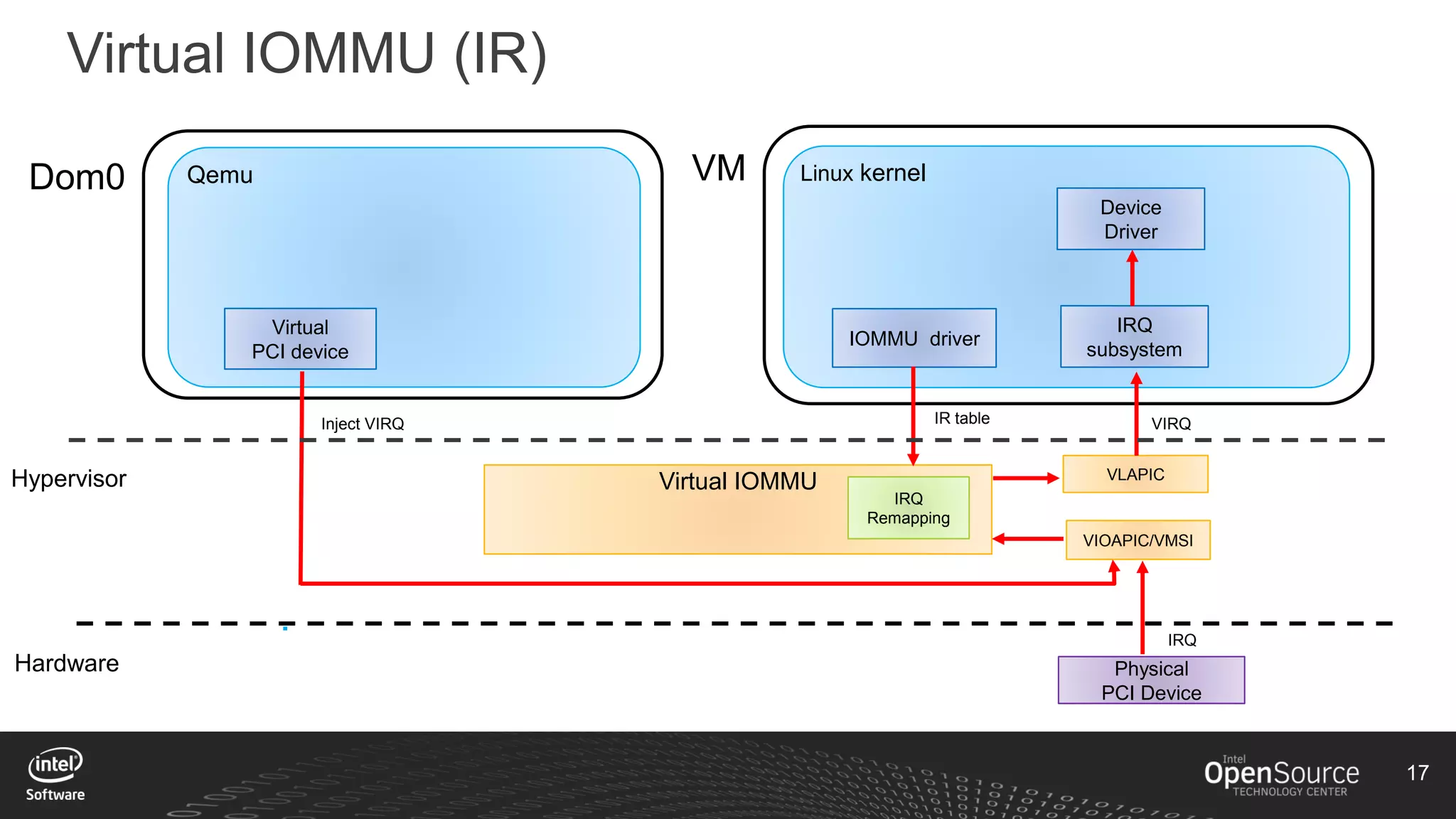
17
Virtual IOMMU (IR)
Dom0 Qemu
Hypervisor
VM Linux kernel
IOMMU driver
VIOAPIC/VMSI
IRQ
VLAPIC
VIRQ
IRQ
subsystem
Hardware
Virtual
PCI device
Virtual IOMMU
Physical
PCI Device
IR table
IRQ
Remapping
Device
Driver
Inject VIRQ
18
Challenge for Xen
• Support >255 VCPUs
• Virtual IOMMU support
• Scalability
• Scalability issue in tasklet subsystem
19
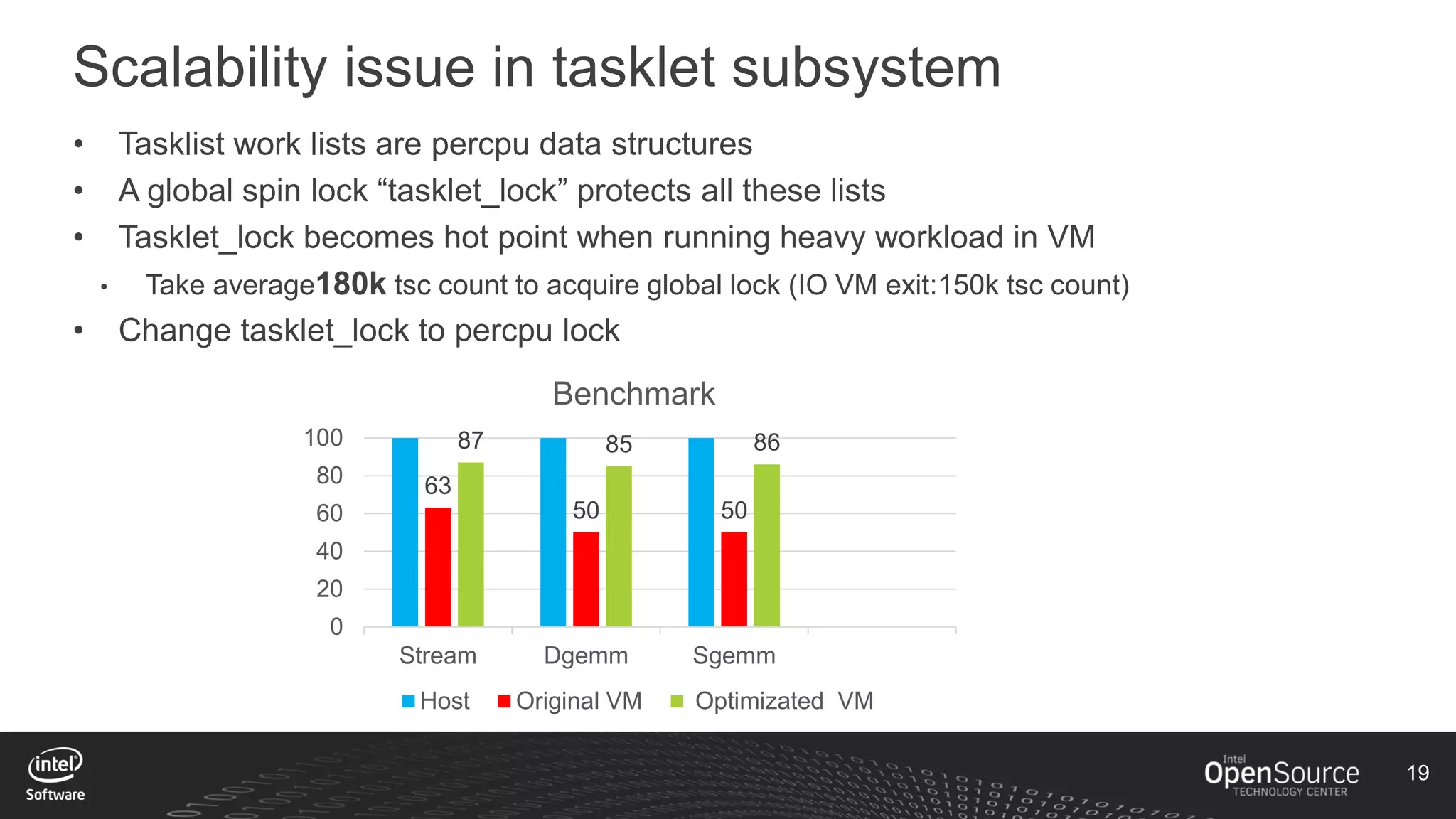
Scalability issue in tasklet subsystem
• Tasklist work lists are percpu data structures
• A global spin lock “tasklet_lock” protects all these lists
• Tasklet_lock becomes hot point when running heavy workload in VM
• Take average180k tsc count to acquire global lock (IO VM exit:150k tsc count)
• Change tasklet_lock to percpu lock
63
50 50
87 85 86
0
20
40
60
80
100
Stream Dgemm Sgemm
Benchmark
Host Original VM Optimizated VM
20
Agenda
• Intel® Xeon Phi™ processor
• HPC Cloud usage
• Challenges for Xen
• Achieving high performance
• Call for action
21
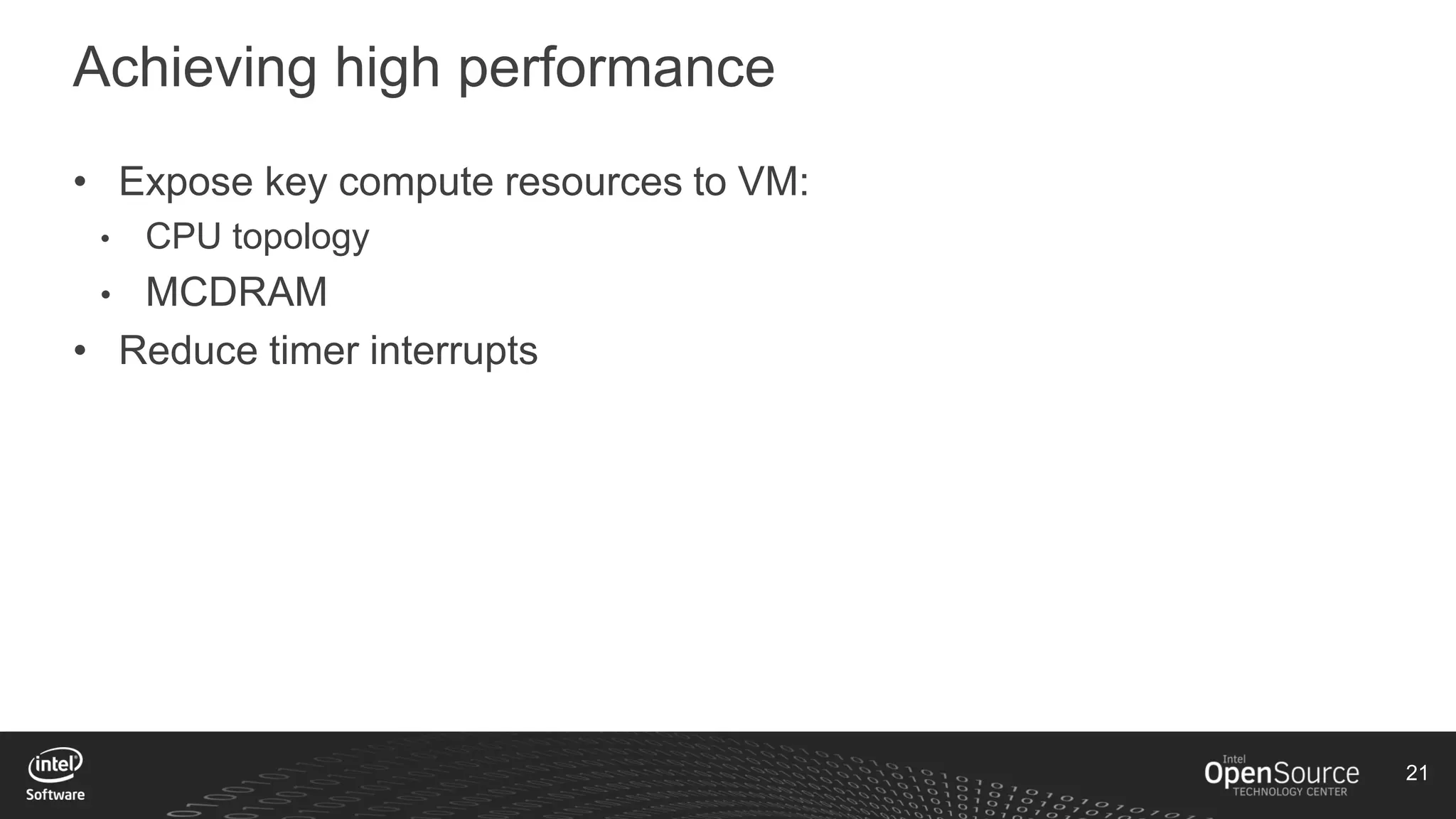
Achieving high performance
• Expose key compute resources to VM:
• CPU topology
• MCDRAM
• Reduce timer interrupts
22
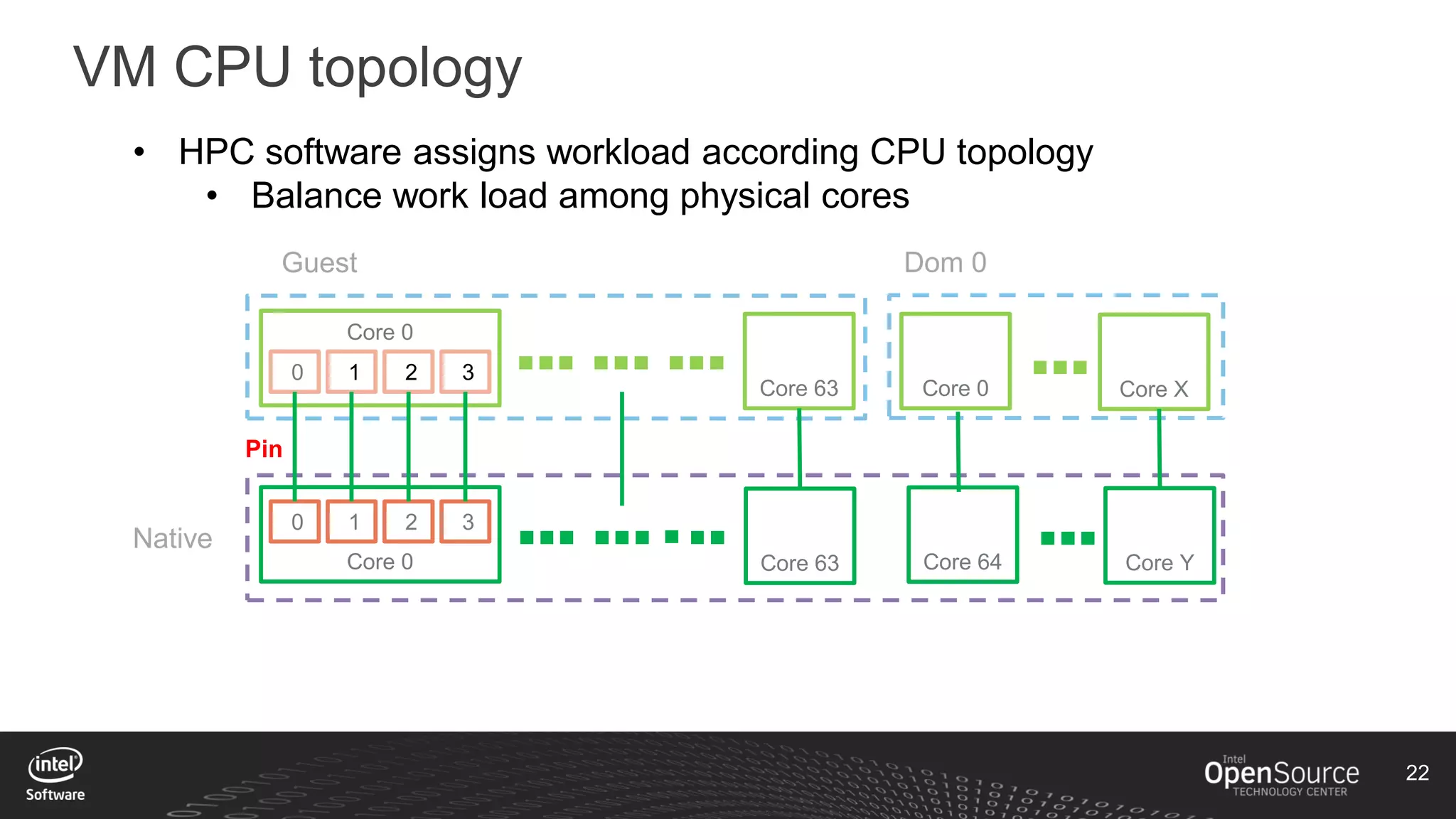
VM CPU topology
Guest
Native
Pin
Core 0
0 1 2 3
Core 0
0 1 2 3
Core 63 Core 64
Core 63 Core XCore 0
Core Y
Dom 0
• HPC software assigns workload according CPU topology
• Balance work load among physical cores
23
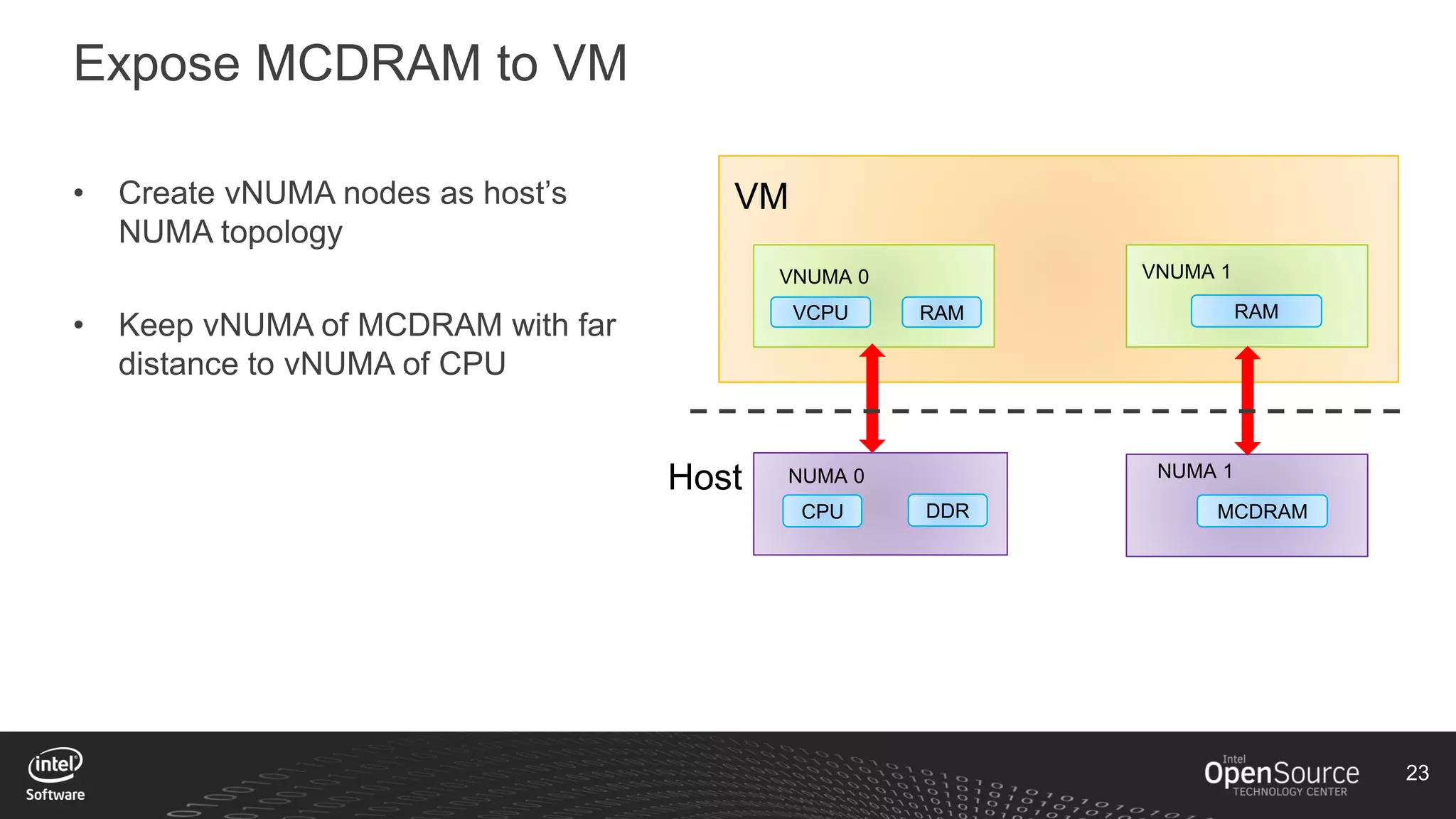
Expose MCDRAM to VM
• Create vNUMA nodes as host’s
NUMA topology
• Keep vNUMA of MCDRAM with far
distance to vNUMA of CPU
Host
VM
NUMA 0
VNUMA 0 VNUMA 1
NUMA 1
CPU DDR MCDRAM
RAMVCPU RAM
24
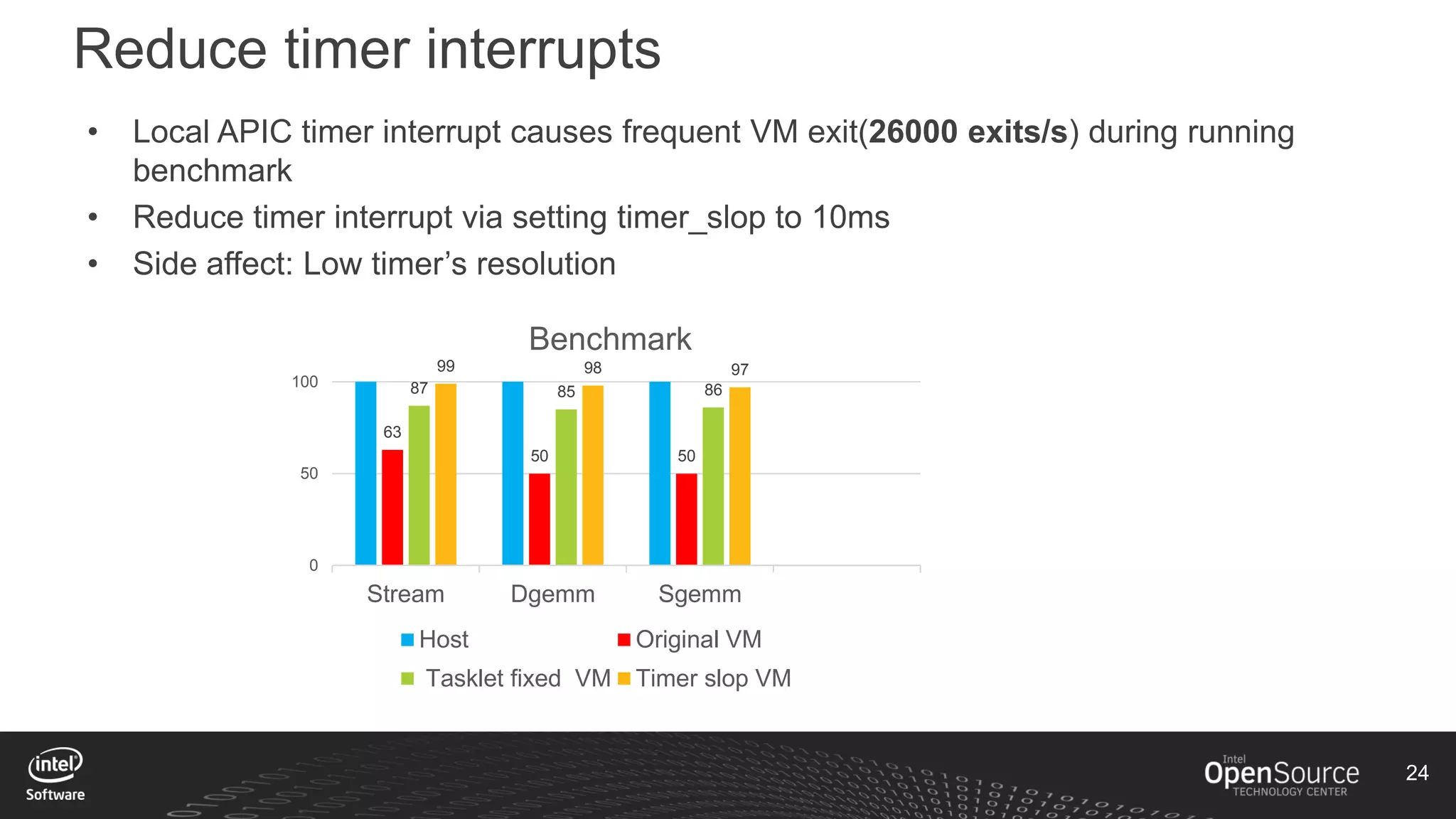
Reduce timer interrupts
• Local APIC timer interrupt causes frequent VM exit(26000 exits/s) during running
benchmark
• Reduce timer interrupt via setting timer_slop to 10ms
• Side affect: Low timer’s resolution
63
50 50
87 85 86
99 98 97
0
50
100
Stream Dgemm Sgemm
Benchmark
Host Original VM
Tasklet fixed VM Timer slop VM
25
25
Reduce timer interrupts(Next to do)
Hypervisor:
• No need scheduler for single VM
Guest:
• Make Guest Linux tickless
26
Agenda
• Intel® Xeon Phi™ processor
• HPC Cloud usage
• Challenges for Xen
• Achieving high performance
• Call for action
27
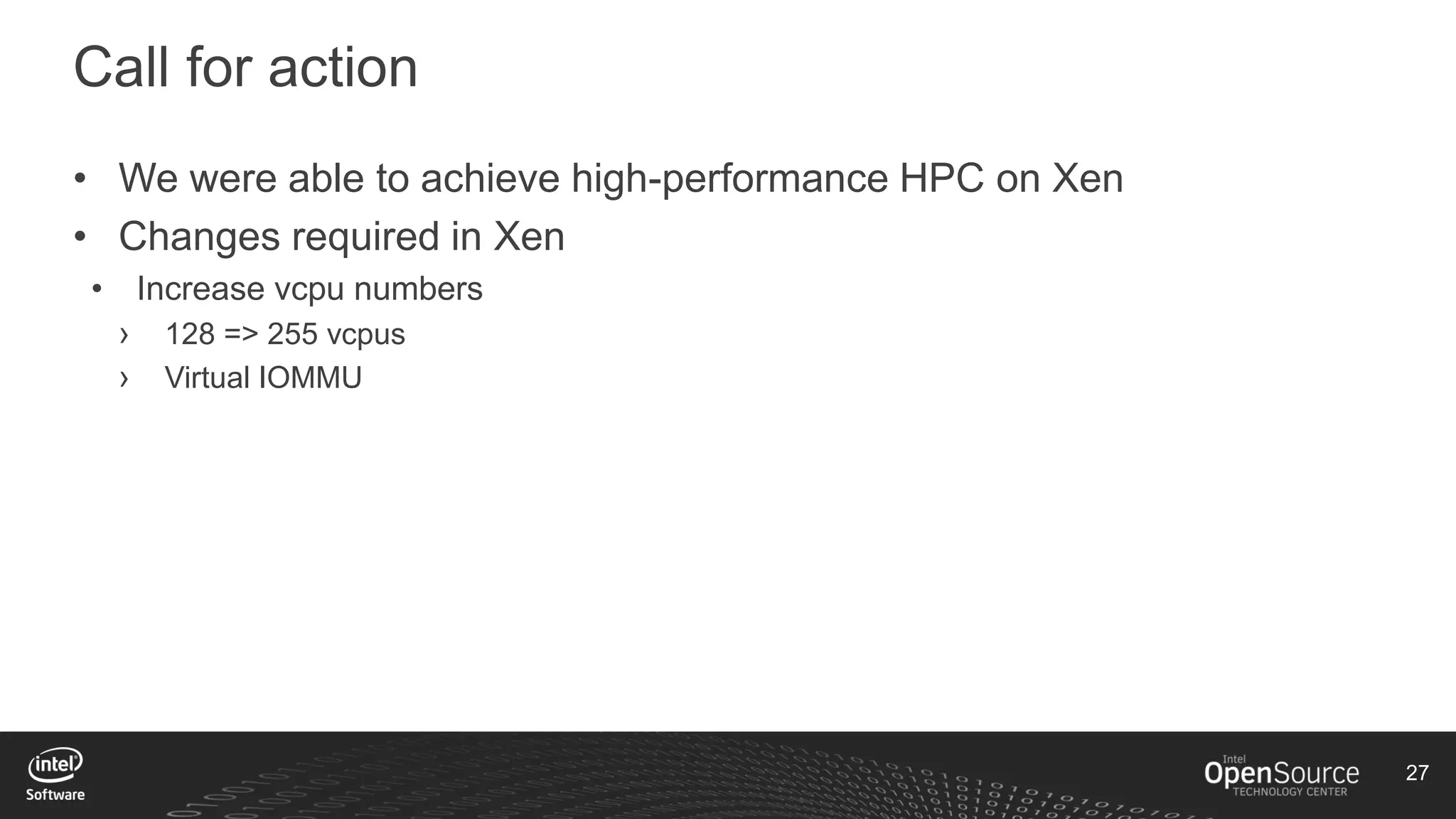
Call for action
• We were able to achieve high-performance HPC on Xen
• Changes required in Xen
• Increase vcpu numbers
› 128 => 255 vcpus
› Virtual IOMMU
Q & A

XPDS16: High-Performance Virtualization for HPC Cloud on Xen - Jun Nakajima & Tianyu Lan, Intel Corp.

  • 1.
    1 High-Performance Virtualization forHPC Cloud on Xen Jun Nakajima Tianyu Lan
  • 2.
    2 Legal Disclaimer  INFORMATIONIN THIS DOCUMENT IS PROVIDED IN CONNECTION WITH INTEL® PRODUCTS. NO LICENSE, EXPRESS OR IMPLIED, BY ESTOPPEL OR OTHERWISE, TO ANY INTELLECTUAL PROPERTY RIGHTS IS GRANTED BY THIS DOCUMENT. EXCEPT AS PROVIDED IN INTEL’S TERMS AND CONDITIONS OF SALE FOR SUCH PRODUCTS, INTEL ASSUMES NO LIABILITY WHATSOEVER, AND INTEL DISCLAIMS ANY EXPRESS OR IMPLIED WARRANTY, RELATING TO SALE AND/OR USE OF INTEL® PRODUCTS INCLUDING LIABILITY OR WARRANTIES RELATING TO FITNESS FOR A PARTICULAR PURPOSE, MERCHANTABILITY, OR INFRINGEMENT OF ANY PATENT, COPYRIGHT OR OTHER INTELLECTUAL PROPERTY RIGHT. INTEL PRODUCTS ARE NOT INTENDED FOR USE IN MEDICAL, LIFE SAVING, OR LIFE SUSTAINING APPLICATIONS.  Intel may make changes to specifications and product descriptions at any time, without notice.  All products, dates, and figures specified are preliminary based on current expectations, and are subject to change without notice.  Intel, processors, chipsets, and desktop boards may contain design defects or errors known as errata, which may cause the product to deviate from published specifications. Current characterized errata are available on request.  Intel and the Intel logo are trademarks or registered trademarks of Intel Corporation or its subsidiaries in the United States and other countries.  *Other names and brands may be claimed as the property of others.  Copyright © 2016 Intel Corporation.
  • 3.
    3 Agenda • Intel® XeonPhi™ processor • HPC Cloud usage • Challenges for Xen • Achieving high performance • Call for action
  • 4.
    4 Intel® Xeon Phi™ x100Product Family formerly codenamed Knights Corner Intel® Xeon Phi™ x200 Product Family codenamed Knights Landing Skylake The world is going parallel – stick with sequential code and you will fall behind. 61 4 512-bit 352 GB/s Cores Threads/Core Vector Width Peak Memory Bandwidth 18 2 256-bit 68 GB/s 72 4 512-bit (x2) >500 GB/s 28 2 512-bit 128 GB/s Intel® Xeon® Processor E5-2600 v3 Product Family formerly codenamed Haswell … Intel® Xeon® Processor E5-2600 v4 Product Family codenamed Broadwell 22 2 256-bit 77 GB/s The world is going parallel 4
  • 5.
    5 Intel® Xeon Phi™Processor • Intel’s first bootable host processor specifically designed for HPC • Binary compatible with Xeon Processor • Integration of memory on package: Innovative memory architecture for high bandwidth and high capacity • Integration of Omni-path Fabric on package
  • 6.
    6 *Results will vary.This simplified test is the result of the distillation of the more in-depth programming guide found here: https://software.intel.com/sites/default/files/article/383067/is-xeon-phi-right-for-me.pdf All products, computer systems, dates and figures specified are preliminary based on current expectations, and are subject to change without notice. 1 Over 3 Teraflops of peak theoretical double-precision performance is preliminary and based on current expectations of cores, clock frequency and floating point operations per cycle. FLOPS = cores x clock frequency x floating-point operations per second per cycle. 2 Host processor only  22 nm process  Coprocessor only  >1 TF DP Peak  Up to 61 Cores  Up to 16GB GDDR5 Available Today Knights Corner Intel® Xeon Phi™ x100 Product Family Launched Knights Landing Intel® Xeon Phi™ x200 Product Family Future Knights Hill 3rd generation  14 nm process  Host Processor & Coprocessor  >3 TF DP Peak1  Up to 72 Cores  Up to 16GB HBM  Up to 384GB DDR42  ~460 GB/s STREAM  Integrated Fabric2  10 nm process  Integrated Fabric (2nd Generation)  In Planning… Intel® Xeon Phi™ Product Family
  • 7.
    7 Hardware Overview Chip: UpTo 36 tiles interconnected by Mesh Tile: 2 Cores + 2 VPU/core + 1MB L2 Core: 4 hyper threads / core ISA: Binary Compatible with Intel Xeon processors + AVX 512 extension Memory : Up To 16GB on-package MCDRAM + up to 6 channels of DDR4-2400 (up to 384GB) IO: 36 lanes PCIe Gen3 + 4 lanes DMI for chipset Node: 1-socket only DDR4 x4 DMI2 to PCH 36 Lanes PCIe* Gen3 (x16, x16, x4) MCDRAM MCDRAM MCDRAM MCDRAM DDR4 TILE: Tile IMC (integrated memory controller) EDC (embedded DRAM controller) IIO (integrated I/O controller) Xeon Phi 2VPU Core 2VPU Core 1MB L2 HUB
  • 8.
    8 MCDRAM Memory modes CacheMode Flat Mode Hybrid Mode Description Hardware automatically manages the MCDRAM as a “memory side cache” between CPU and ext DDR memory Manually manage how the app uses the integrated on-package memory and external DDR for peak perf Joins the benefits of both Cache and Flat modes by segmenting the integrated on- package memory DRAM 8 or 4 GB MCDRAM 8 or 12GB MCDRAM8GB/ 16GB MCDRAM Up to 384 GB DRAM PhysicalAddress DRAM 16GB MCDRAM 64B cache lines direct-mapped
  • 9.
    9 MCDRAM(Flat) • Platform with2 NUMA nodes • Memory allocated in DDR by default • Keep low bandwidth data out of MCDRAM • Apps explicitly allocates important data in MCDRAM NUMA 0 CPU DDR MCDRAM NUMA 1 Platform
  • 10.
    10 Agenda • Intel® XeonPhi™ processor • HPC Cloud usage • Challenges for Xen • Achieving high performance • Call for action
  • 11.
    11 HPC Cloud usage •Single VM on one machine • Expose most host CPUs to VM • More than 255 VCPUs in VM • Expose MCDRAM to VM • Pass through Omni-path Fabric to VM
  • 12.
    12 Agenda • Intel® XeonPhi™ processor • HPC Cloud usage • Challenges for Xen • Achieving high performance • Call for action
  • 13.
    13 Challenges for Xen •Support >255 VCPUs • Virtual IOMMU support • Scalability • Scalability issue in tasklet subsystem
  • 14.
    14 Support >255 VCPUs •HVM guest supports 128 VCPUs • X2APIC mode is required for >255 VCPUs • Linux disables X2APIC mode when no IR(interrupt remapping) • No Virtual IOMMU support in Xen • > 255 VCPUs => X2APIC => IR => Virtual IOMMU • Enable DMA translation first • Linux IOMMU driver can’t work without DMA translation
  • 15.
    15 Virtual IOMMU Hvmloader Virtual IOMMU Dom0Qemu Dummy Xen-VIOMMU Hypervisor VM Xenstore Hypercall Linux Kernel IOMMU driver ACPI DMAR
  • 16.
    16 Virtual IOMMU (DMATranslation) Virtual IOMMU Dom0 Qemu Dummy Xen-VIOMMU Hypervisor VM Linux Kernel IOMMU driver Physical IOMMU IOVA Physical PCI Device Hardware Virtual PCI device Memory Region DMA Memory Address Translation DMA IOVA -> GPA Shadow IOVA->HPA IOVA-> Target GPA IOVA->HPA
  • 17.
    17 Virtual IOMMU (IR) Dom0Qemu Hypervisor VM Linux kernel IOMMU driver VIOAPIC/VMSI IRQ VLAPIC VIRQ IRQ subsystem Hardware Virtual PCI device Virtual IOMMU Physical PCI Device IR table IRQ Remapping Device Driver Inject VIRQ
  • 18.
    18 Challenge for Xen •Support >255 VCPUs • Virtual IOMMU support • Scalability • Scalability issue in tasklet subsystem
  • 19.
    19 Scalability issue intasklet subsystem • Tasklist work lists are percpu data structures • A global spin lock “tasklet_lock” protects all these lists • Tasklet_lock becomes hot point when running heavy workload in VM • Take average180k tsc count to acquire global lock (IO VM exit:150k tsc count) • Change tasklet_lock to percpu lock 63 50 50 87 85 86 0 20 40 60 80 100 Stream Dgemm Sgemm Benchmark Host Original VM Optimizated VM
  • 20.
    20 Agenda • Intel® XeonPhi™ processor • HPC Cloud usage • Challenges for Xen • Achieving high performance • Call for action
  • 21.
    21 Achieving high performance •Expose key compute resources to VM: • CPU topology • MCDRAM • Reduce timer interrupts
  • 22.
    22 VM CPU topology Guest Native Pin Core0 0 1 2 3 Core 0 0 1 2 3 Core 63 Core 64 Core 63 Core XCore 0 Core Y Dom 0 • HPC software assigns workload according CPU topology • Balance work load among physical cores
  • 23.
    23 Expose MCDRAM toVM • Create vNUMA nodes as host’s NUMA topology • Keep vNUMA of MCDRAM with far distance to vNUMA of CPU Host VM NUMA 0 VNUMA 0 VNUMA 1 NUMA 1 CPU DDR MCDRAM RAMVCPU RAM
  • 24.
    24 Reduce timer interrupts •Local APIC timer interrupt causes frequent VM exit(26000 exits/s) during running benchmark • Reduce timer interrupt via setting timer_slop to 10ms • Side affect: Low timer’s resolution 63 50 50 87 85 86 99 98 97 0 50 100 Stream Dgemm Sgemm Benchmark Host Original VM Tasklet fixed VM Timer slop VM
  • 25.
    25 25 Reduce timer interrupts(Nextto do) Hypervisor: • No need scheduler for single VM Guest: • Make Guest Linux tickless
  • 26.
    26 Agenda • Intel® XeonPhi™ processor • HPC Cloud usage • Challenges for Xen • Achieving high performance • Call for action
  • 27.
    27 Call for action •We were able to achieve high-performance HPC on Xen • Changes required in Xen • Increase vcpu numbers › 128 => 255 vcpus › Virtual IOMMU
  • 28.