Red Hat Confidential - NDA Required
OpenStack + Ceph Storage
Federico Lucifredi, Product Management Director, Ceph Storage
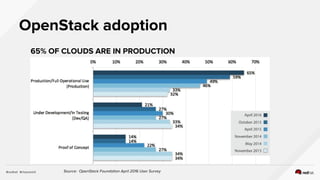
Source: OpenStack Foundation April 2016 User Survey
65% OF CLOUDS ARE IN PRODUCTION
OpenStack adoption
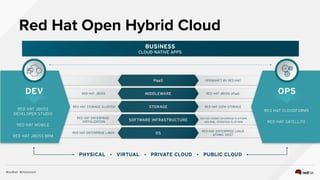
Red Hat Open Hybrid Cloud
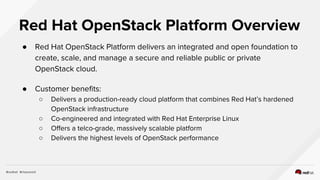
Red Hat OpenStack Platform Overview
● Red Hat OpenStack Platform delivers an integrated and open foundation to
create, scale, and manage a secure and reliable public or private
OpenStack cloud.
● Customer benefits:
○ Delivers a production-ready cloud platform that combines Red Hat’s hardened
OpenStack infrastructure
○ Co-engineered and integrated with Red Hat Enterprise Linux
○ Offers a telco-grade, massively scalable platform
○ Delivers the highest levels of OpenStack performance
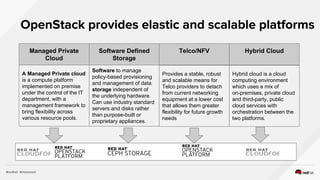
OpenStack provides elastic and scalable platforms
Managed Private
Cloud
A Managed Private cloud
is a compute platform
implemented on premise
under the control of the IT
department, with a
management framework to
bring flexibility across
various resource pools.
Software to manage
policy-based provisioning
and management of data
storage independent of
the underlying hardware.
Can use industry standard
servers and disks rather
than purpose-built or
proprietary appliances.
Software Defined
Storage
Telco/NFV
Provides a stable, robust
and scalable means for
Telco providers to detach
from current networking
equipment at a lower cost
that allows them greater
flexibility for future growth
needs
Hybrid Cloud
Hybrid cloud is a cloud
computing environment
which uses a mix of
on-premises, private cloud
and third-party, public
cloud services with
orchestration between the
two platforms.
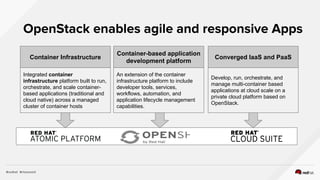
OpenStack enables agile and responsive Apps
Converged IaaS and PaaS
Develop, run, orchestrate, and
manage multi-container based
applications at cloud scale on a
private cloud platform based on
OpenStack.
Container Infrastructure
Integrated container
infrastructure platform built to run,
orchestrate, and scale container-
based applications (traditional and
cloud native) across a managed
cluster of container hosts
Container-based application
development platform
An extension of the container
infrastructure platform to include
developer tools, services,
workflows, automation, and
application lifecycle management
capabilities.
● Over 350+ members since launch in April 2013
● Over 900 certified solutions in partner Marketplace
● Over 4,000 RHEL certified compute servers
Largest Certified Partner Ecosystem
Channel Partners
Cloud Service Providers
Managed Service Providers
OEMs, IHVs,
ISVs
System Integrators
OpenStack: Framework for the Cloud
● Needs to access hardware resources
● Needs an operating environment, hypervisor, services
● Leverages existing code libraries for functionality
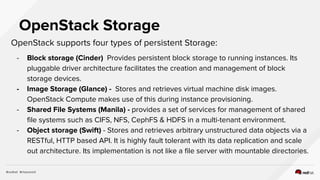
OpenStack Storage
OpenStack supports four types of persistent Storage:
- Block storage (Cinder) Provides persistent block storage to running instances. Its
pluggable driver architecture facilitates the creation and management of block
storage devices.
- Image Storage (Glance) - Stores and retrieves virtual machine disk images.
OpenStack Compute makes use of this during instance provisioning.
- Shared File Systems (Manila) - provides a set of services for management of shared
file systems such as CIFS, NFS, CephFS & HDFS in a multi-tenant environment.
- Object storage (Swift) - Stores and retrieves arbitrary unstructured data objects via a
RESTful, HTTP based API. It is highly fault tolerant with its data replication and scale
out architecture. Its implementation is not like a file server with mountable directories.
Red Hat Confidential - NDA Required
Why Traditional Storage won’t
work
Storage challenges in OpenStack
● Multiple storage interfaces to consume
○ File
○ Block
○ Object
● They don’t all scale at the same pace
● Mixing up storage technologies is painful to manage, requires
additional talent & staff
Scale-out infrastructure demands scale-out storage
Traditional Open, software-defined
Custom GUI
Proprietary Software
Proprietary
Hardware
Standard
computers
and disks
Standard
Hardware
OpenSource
Software
Ceph Gluster +++
Control Plane (API, GUI)
ADMIN USER
The Future of Storage
ADMIN
USER
ADMIN
USER
ADMIN
USER
Custom GUI
Proprietary Software
Proprietary
Hardware
Custom GUI
Proprietary Software
Proprietary
Hardware
Rising tide of software-defined storage
“By 2020, between 70-80% of unstructured
data will be held on lower-cost storage
managed by SDS environments.”
“By 2016, server-based storage solutions will
lower storage hardware costs by 50% or more.”
Gartner: “IT Leaders Can Benefit From Disruptive Innovation in the Storage Industry”
Innovation Insight: Separating Hype From Hope for Software-Defined Storage
~20% CAGR between 2015 and 2019
2013 2014 2015 2016 2017 2018 2019
$1,349M
$1,195M
$1,029M
$859M
$706M
$592M
SDS MARKET SIZE BY SEGMENT
$457M
Block Storage
File Storage
Object Storage
Hyper converged
Source: IDC
“By 2019, 70% of existing storage array products
will also be available as software only versions”
Innovation Insight: Separating Hype From Hope for Software-Defined Storage
Red Hat Confidential - NDA Required
Ceph
● Open, massively-scalable, software-defined
● Flexible, scale-out architecture on clustered commodity hardware
● Single, efficient, unified storage platform
● A vibrant Open Source community
● A thriving ecosystem
What is Ceph?
CRUSH
Controlled Replication Under Scalable Hashing:
● Pseudo-random placement algorithm
● Statistically uniform distribution (hash based)
● Rule-based configuration
● Topology aware
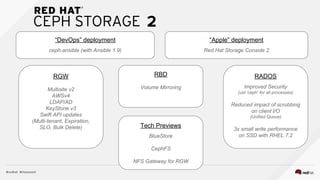
2
RGW
Multisite v2
AWSv4
LDAP/AD
KeyStone v3
Swift API updates
(Multi-tenant, Expiration,
SLO, Bulk Delete)
RBD
Volume Mirroring
“DevOps” deployment
ceph-ansible (with Ansible 1.9)
“Apple” deployment
Red Hat Storage Console 2
RADOS
Improved Security
(uid ‘ceph’ for all processes)
Reduced impact of scrubbing
on client I/O
(Unified Queue)
3x small write performance
on SSD with RHEL 7.2
Tech Previews
BlueStore
CephFS
NFS Gateway for RGW
Red Hat Confidential - NDA Required
OpenStack + Ceph
Ceph adoption in OpenStack
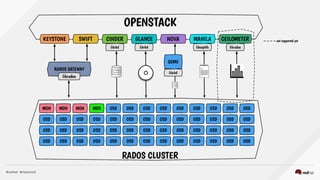
The unified story
● Ongoing effort since OpenStack’s creation
● Ceph is the foundation of the storage stack in OpenStack
● Provides a single and flexible storage layer
● Delivers the complete Open Source stack
● Integrates perfectly with all OpenStack’s components
Red Hat Confidential - NDA Required
Architectures
Hyperconverged
Hypercon… what?
● Co-locate compute and storage resources on the same machine
● Fine control of resources using cgroups, NUMA and CPU pinning
● Enabler for container-based infrastructure
● Can benefit from a local hit when performing an IO from a guest
● Component upgrades made easy with containers
Multi-site with replicated storage
● Re-using our basic robust stack
● Multiple isolated OpenStack environments
● With replicated storage for disaster recovery using Ceph
● Each site has each other’s data
● Live synchronization
Red Hat Confidential - NDA Required
Thanks

Red Hat Storage Day Boston - OpenStack + Ceph Storage

  • 1.
    Red Hat Confidential- NDA Required OpenStack + Ceph Storage Federico Lucifredi, Product Management Director, Ceph Storage
  • 2.
    Source: OpenStack FoundationApril 2016 User Survey 65% OF CLOUDS ARE IN PRODUCTION OpenStack adoption
  • 3.
    Red Hat OpenHybrid Cloud
  • 4.
    Red Hat OpenStackPlatform Overview ● Red Hat OpenStack Platform delivers an integrated and open foundation to create, scale, and manage a secure and reliable public or private OpenStack cloud. ● Customer benefits: ○ Delivers a production-ready cloud platform that combines Red Hat’s hardened OpenStack infrastructure ○ Co-engineered and integrated with Red Hat Enterprise Linux ○ Offers a telco-grade, massively scalable platform ○ Delivers the highest levels of OpenStack performance
  • 5.
    OpenStack provides elasticand scalable platforms Managed Private Cloud A Managed Private cloud is a compute platform implemented on premise under the control of the IT department, with a management framework to bring flexibility across various resource pools. Software to manage policy-based provisioning and management of data storage independent of the underlying hardware. Can use industry standard servers and disks rather than purpose-built or proprietary appliances. Software Defined Storage Telco/NFV Provides a stable, robust and scalable means for Telco providers to detach from current networking equipment at a lower cost that allows them greater flexibility for future growth needs Hybrid Cloud Hybrid cloud is a cloud computing environment which uses a mix of on-premises, private cloud and third-party, public cloud services with orchestration between the two platforms.
  • 6.
    OpenStack enables agileand responsive Apps Converged IaaS and PaaS Develop, run, orchestrate, and manage multi-container based applications at cloud scale on a private cloud platform based on OpenStack. Container Infrastructure Integrated container infrastructure platform built to run, orchestrate, and scale container- based applications (traditional and cloud native) across a managed cluster of container hosts Container-based application development platform An extension of the container infrastructure platform to include developer tools, services, workflows, automation, and application lifecycle management capabilities.
  • 7.
    ● Over 350+members since launch in April 2013 ● Over 900 certified solutions in partner Marketplace ● Over 4,000 RHEL certified compute servers Largest Certified Partner Ecosystem Channel Partners Cloud Service Providers Managed Service Providers OEMs, IHVs, ISVs System Integrators
  • 8.
    OpenStack: Framework forthe Cloud ● Needs to access hardware resources ● Needs an operating environment, hypervisor, services ● Leverages existing code libraries for functionality
  • 9.
    OpenStack Storage OpenStack supportsfour types of persistent Storage: - Block storage (Cinder) Provides persistent block storage to running instances. Its pluggable driver architecture facilitates the creation and management of block storage devices. - Image Storage (Glance) - Stores and retrieves virtual machine disk images. OpenStack Compute makes use of this during instance provisioning. - Shared File Systems (Manila) - provides a set of services for management of shared file systems such as CIFS, NFS, CephFS & HDFS in a multi-tenant environment. - Object storage (Swift) - Stores and retrieves arbitrary unstructured data objects via a RESTful, HTTP based API. It is highly fault tolerant with its data replication and scale out architecture. Its implementation is not like a file server with mountable directories.
  • 10.
    Red Hat Confidential- NDA Required Why Traditional Storage won’t work
  • 11.
    Storage challenges inOpenStack ● Multiple storage interfaces to consume ○ File ○ Block ○ Object ● They don’t all scale at the same pace ● Mixing up storage technologies is painful to manage, requires additional talent & staff Scale-out infrastructure demands scale-out storage
  • 12.
    Traditional Open, software-defined CustomGUI Proprietary Software Proprietary Hardware Standard computers and disks Standard Hardware OpenSource Software Ceph Gluster +++ Control Plane (API, GUI) ADMIN USER The Future of Storage ADMIN USER ADMIN USER ADMIN USER Custom GUI Proprietary Software Proprietary Hardware Custom GUI Proprietary Software Proprietary Hardware
  • 13.
    Rising tide ofsoftware-defined storage “By 2020, between 70-80% of unstructured data will be held on lower-cost storage managed by SDS environments.” “By 2016, server-based storage solutions will lower storage hardware costs by 50% or more.” Gartner: “IT Leaders Can Benefit From Disruptive Innovation in the Storage Industry” Innovation Insight: Separating Hype From Hope for Software-Defined Storage ~20% CAGR between 2015 and 2019 2013 2014 2015 2016 2017 2018 2019 $1,349M $1,195M $1,029M $859M $706M $592M SDS MARKET SIZE BY SEGMENT $457M Block Storage File Storage Object Storage Hyper converged Source: IDC “By 2019, 70% of existing storage array products will also be available as software only versions” Innovation Insight: Separating Hype From Hope for Software-Defined Storage
  • 14.
    Red Hat Confidential- NDA Required Ceph
  • 15.
    ● Open, massively-scalable,software-defined ● Flexible, scale-out architecture on clustered commodity hardware ● Single, efficient, unified storage platform ● A vibrant Open Source community ● A thriving ecosystem What is Ceph?
  • 17.
    CRUSH Controlled Replication UnderScalable Hashing: ● Pseudo-random placement algorithm ● Statistically uniform distribution (hash based) ● Rule-based configuration ● Topology aware
  • 18.
    2 RGW Multisite v2 AWSv4 LDAP/AD KeyStone v3 SwiftAPI updates (Multi-tenant, Expiration, SLO, Bulk Delete) RBD Volume Mirroring “DevOps” deployment ceph-ansible (with Ansible 1.9) “Apple” deployment Red Hat Storage Console 2 RADOS Improved Security (uid ‘ceph’ for all processes) Reduced impact of scrubbing on client I/O (Unified Queue) 3x small write performance on SSD with RHEL 7.2 Tech Previews BlueStore CephFS NFS Gateway for RGW
  • 19.
    Red Hat Confidential- NDA Required OpenStack + Ceph
  • 20.
  • 21.
    The unified story ●Ongoing effort since OpenStack’s creation ● Ceph is the foundation of the storage stack in OpenStack ● Provides a single and flexible storage layer ● Delivers the complete Open Source stack ● Integrates perfectly with all OpenStack’s components
  • 23.
    Red Hat Confidential- NDA Required Architectures
  • 24.
    Hyperconverged Hypercon… what? ● Co-locatecompute and storage resources on the same machine ● Fine control of resources using cgroups, NUMA and CPU pinning ● Enabler for container-based infrastructure ● Can benefit from a local hit when performing an IO from a guest ● Component upgrades made easy with containers
  • 26.
    Multi-site with replicatedstorage ● Re-using our basic robust stack ● Multiple isolated OpenStack environments ● With replicated storage for disaster recovery using Ceph ● Each site has each other’s data ● Live synchronization
  • 28.
    Red Hat Confidential- NDA Required Thanks