WHY SOFTWARE-DEFINED
STORAGE MATTERS
Ross Turk
Red Hat Storage
April 2016
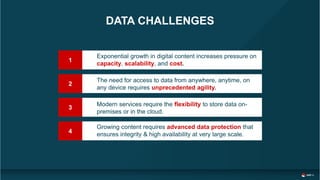
DATA CHALLENGES
Exponential growth in digital content increases pressure on
capacity, scalability, and cost.
The need for access to data from anywhere, anytime, on
any device requires unprecedented agility.
Modern services require the flexibility to store data on-
premises or in the cloud.
Growing content requires advanced data protection that
ensures integrity & high availability at very large scale.
1
2
3
4
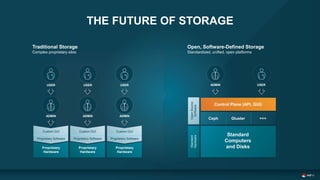
Traditional Storage
Complex proprietary silos
Open, Software-Defined Storage
Standardized, unified, open platforms
Custom GUI
Proprietary Software
Proprietary
Hardware
Standard
Computers
and Disks
Standard
Hardware
OpenSource
Software
Ceph Gluster +++
Control Plane (API, GUI)
ADMIN USER
THE FUTURE OF STORAGE
ADMIN
USER
ADMIN
USER
ADMIN
USER
Custom GUI
Proprietary Software
Proprietary
Hardware
Custom GUI
Proprietary Software
Proprietary
Hardware
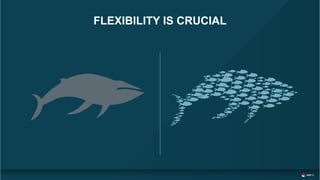
FLEXIBILITY IS CRUCIAL
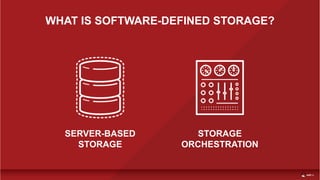
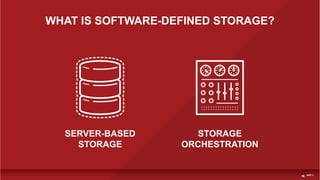
WHAT IS SOFTWARE-DEFINED STORAGE?
SERVER-BASED
STORAGE
STORAGE
ORCHESTRATION
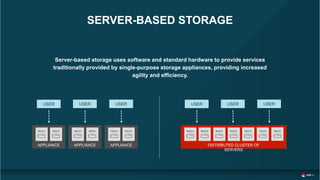
Server-based storage uses software and standard hardware to provide services
traditionally provided by single-purpose storage appliances, providing increased
agility and efficiency.
DISTRIBUTED CLUSTER OF
SERVERS
MEDIA MEDIA MEDIA MEDIA MEDIA MEDIA MEDIA
APPLIANCE
MEDIA MEDIA
APPLIANCE
MEDIA MEDIA
APPLIANCE
MEDIA MEDIA
USER USER USER
SERVER-BASED STORAGE
USER USER USER
STORAGE APPLIANCE
COMPUTE
NODE + + + +
+
STORAGE
NODE
COMPUTE
NODE + + + +
+ + + +
+
+
+
+
+
+
+
+
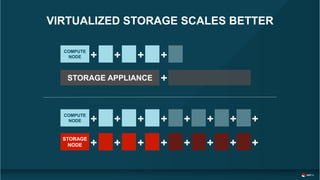
VIRTUALIZED STORAGE SCALES BETTER
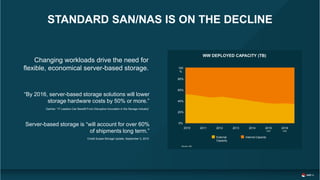
STANDARD SAN/NAS IS ON THE DECLINE
Server-based storage is “will account for over 60%
of shipments long term.”
“By 2016, server-based storage solutions will lower
storage hardware costs by 50% or more.”
Gartner: “IT Leaders Can Benefit From Disruptive Innovation in the Storage Industry”
Credit Suisse Storage Update, September 3, 2015
Changing workloads drive the need for
flexible, economical server-based storage.
WW DEPLOYED CAPACITY (TB)
2010 2011 2012 2013 2014 2015
(est)
2016
(est)
Source: IDC
0%
60%
20%
40%
80%
100
%
Internal CapacityExternal
Capacity
WHAT IS SOFTWARE-DEFINED STORAGE?
SERVER-BASED
STORAGE
STORAGE
ORCHESTRATION
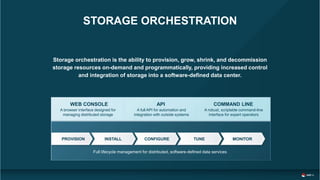
STORAGE ORCHESTRATION
Storage orchestration is the ability to provision, grow, shrink, and decommission
storage resources on-demand and programmatically, providing increased control
and integration of storage into a software-defined data center.
WEB CONSOLE
A browser interface designed for
managing distributed storage
API
A full API for automation and
integration with outside systems
COMMAND LINE
A robust, scriptable command-line
interface for expert operators
PROVISION INSTALL CONFIGURE TUNE MONITOR
Full lifecycle management for distributed, software-defined data services
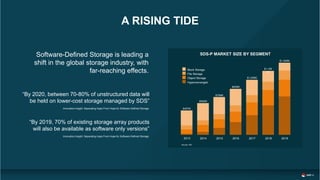
A RISING TIDE
“By 2020, between 70-80% of unstructured data will
be held on lower-cost storage managed by SDS”
“By 2019, 70% of existing storage array products
will also be available as software only versions”
Innovation Insight: Separating Hype From Hope for Software-Defined Storage
2013 2014 2015 2016 2017 2018 2019
$1,349M
$1,195
M
$1,029M
$859M
$706M
$592M
SDS-P MARKET SIZE BY SEGMENT
$457M
Block Storage
File Storage
Object Storage
Hyperconverged
Source: IDC
Software-Defined Storage is leading a
shift in the global storage industry, with
far-reaching effects.
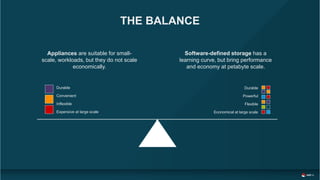
THE BALANCE
Inflexible
Expensive at large scale
Durable
Convenient
Flexible
Economical at large scale
Durable
Powerful
Appliances are suitable for small-
scale, workloads, but they do not scale
economically.
Software-defined storage has a
learning curve, but bring performance
and economy at petabyte scale.
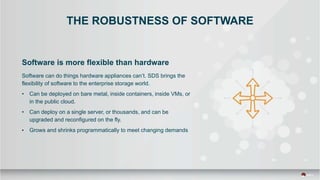
THE ROBUSTNESS OF SOFTWARE
Software is more flexible than hardware
Software can do things hardware appliances can’t. SDS brings the
flexibility of software to the enterprise storage world.
• Can be deployed on bare metal, inside containers, inside VMs, or
in the public cloud.
• Can deploy on a single server, or thousands, and can be
upgraded and reconfigured on the fly.
• Grows and shrinks programmatically to meet changing demands
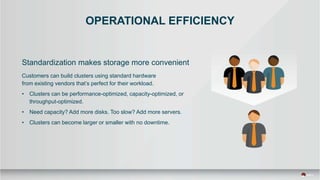
OPERATIONAL EFFICIENCY
Standardization makes storage more convenient
Customers can build clusters using standard hardware
from existing vendors that’s perfect for their workload.
• Clusters can be performance-optimized, capacity-optimized, or
throughput-optimized.
• Need capacity? Add more disks. Too slow? Add more servers.
• Clusters can become larger or smaller with no downtime.
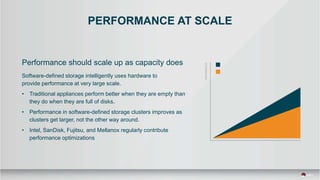
PERFORMANCE AT SCALE
Performance should scale up as capacity does
Software-defined storage intelligently uses hardware to
provide performance at very large scale.
• Traditional appliances perform better when they are empty than
they do when they are full of disks.
• Performance in software-defined storage clusters improves as
clusters get larger, not the other way around.
• Intel, SanDisk, Fujitsu, and Mellanox regularly contribute
performance optimizations
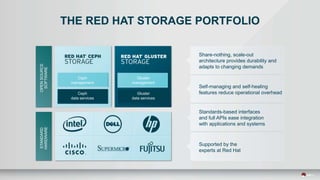
THE RED HAT STORAGE PORTFOLIO
Ceph
management
OPENSOURCE
SOFTWARE
Gluster
management
Ceph
data services
Gluster
data services
STANDARD
HARDWARE
Share-nothing, scale-out
architecture provides durability and
adapts to changing demands
Self-managing and self-healing
features reduce operational overhead
Standards-based interfaces
and full APIs ease integration
with applications and systems
Supported by the
experts at Red Hat
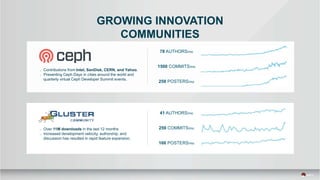
GROWING INNOVATION
COMMUNITIES
Over 11M downloads in the last 12 months
Increased development velocity, authorship, and
discussion has resulted in rapid feature expansion.
Contributions from Intel, SanDisk, CERN, and Yahoo.
Presenting Ceph Days in cities around the world and
quarterly virtual Ceph Developer Summit events.
78 AUTHORS/mo
1500 COMMITS/mo
258 POSTERS/mo
41 AUTHORS/mo
259 COMMITS/mo
166 POSTERS/mo
Why Software-Defined Storage Matters

Why Software-Defined Storage Matters

  • 1.
    WHY SOFTWARE-DEFINED STORAGE MATTERS RossTurk Red Hat Storage April 2016
  • 2.
    DATA CHALLENGES Exponential growthin digital content increases pressure on capacity, scalability, and cost. The need for access to data from anywhere, anytime, on any device requires unprecedented agility. Modern services require the flexibility to store data on- premises or in the cloud. Growing content requires advanced data protection that ensures integrity & high availability at very large scale. 1 2 3 4
  • 3.
    Traditional Storage Complex proprietarysilos Open, Software-Defined Storage Standardized, unified, open platforms Custom GUI Proprietary Software Proprietary Hardware Standard Computers and Disks Standard Hardware OpenSource Software Ceph Gluster +++ Control Plane (API, GUI) ADMIN USER THE FUTURE OF STORAGE ADMIN USER ADMIN USER ADMIN USER Custom GUI Proprietary Software Proprietary Hardware Custom GUI Proprietary Software Proprietary Hardware
  • 4.
  • 5.
    WHAT IS SOFTWARE-DEFINEDSTORAGE? SERVER-BASED STORAGE STORAGE ORCHESTRATION
  • 6.
    Server-based storage usessoftware and standard hardware to provide services traditionally provided by single-purpose storage appliances, providing increased agility and efficiency. DISTRIBUTED CLUSTER OF SERVERS MEDIA MEDIA MEDIA MEDIA MEDIA MEDIA MEDIA APPLIANCE MEDIA MEDIA APPLIANCE MEDIA MEDIA APPLIANCE MEDIA MEDIA USER USER USER SERVER-BASED STORAGE USER USER USER
  • 7.
    STORAGE APPLIANCE COMPUTE NODE ++ + + + STORAGE NODE COMPUTE NODE + + + + + + + + + + + + + + + + VIRTUALIZED STORAGE SCALES BETTER
  • 8.
    STANDARD SAN/NAS ISON THE DECLINE Server-based storage is “will account for over 60% of shipments long term.” “By 2016, server-based storage solutions will lower storage hardware costs by 50% or more.” Gartner: “IT Leaders Can Benefit From Disruptive Innovation in the Storage Industry” Credit Suisse Storage Update, September 3, 2015 Changing workloads drive the need for flexible, economical server-based storage. WW DEPLOYED CAPACITY (TB) 2010 2011 2012 2013 2014 2015 (est) 2016 (est) Source: IDC 0% 60% 20% 40% 80% 100 % Internal CapacityExternal Capacity
  • 9.
    WHAT IS SOFTWARE-DEFINEDSTORAGE? SERVER-BASED STORAGE STORAGE ORCHESTRATION
  • 10.
    STORAGE ORCHESTRATION Storage orchestrationis the ability to provision, grow, shrink, and decommission storage resources on-demand and programmatically, providing increased control and integration of storage into a software-defined data center. WEB CONSOLE A browser interface designed for managing distributed storage API A full API for automation and integration with outside systems COMMAND LINE A robust, scriptable command-line interface for expert operators PROVISION INSTALL CONFIGURE TUNE MONITOR Full lifecycle management for distributed, software-defined data services
  • 11.
    A RISING TIDE “By2020, between 70-80% of unstructured data will be held on lower-cost storage managed by SDS” “By 2019, 70% of existing storage array products will also be available as software only versions” Innovation Insight: Separating Hype From Hope for Software-Defined Storage Innovation Insight: Separating Hype From Hope for Software-Defined Storage 2013 2014 2015 2016 2017 2018 2019 $1,349M $1,195 M $1,029M $859M $706M $592M SDS-P MARKET SIZE BY SEGMENT $457M Block Storage File Storage Object Storage Hyperconverged Source: IDC Software-Defined Storage is leading a shift in the global storage industry, with far-reaching effects.
  • 12.
    THE BALANCE Inflexible Expensive atlarge scale Durable Convenient Flexible Economical at large scale Durable Powerful Appliances are suitable for small- scale, workloads, but they do not scale economically. Software-defined storage has a learning curve, but bring performance and economy at petabyte scale.
  • 13.
    THE ROBUSTNESS OFSOFTWARE Software is more flexible than hardware Software can do things hardware appliances can’t. SDS brings the flexibility of software to the enterprise storage world. • Can be deployed on bare metal, inside containers, inside VMs, or in the public cloud. • Can deploy on a single server, or thousands, and can be upgraded and reconfigured on the fly. • Grows and shrinks programmatically to meet changing demands
  • 14.
    OPERATIONAL EFFICIENCY Standardization makesstorage more convenient Customers can build clusters using standard hardware from existing vendors that’s perfect for their workload. • Clusters can be performance-optimized, capacity-optimized, or throughput-optimized. • Need capacity? Add more disks. Too slow? Add more servers. • Clusters can become larger or smaller with no downtime.
  • 15.
    PERFORMANCE AT SCALE Performanceshould scale up as capacity does Software-defined storage intelligently uses hardware to provide performance at very large scale. • Traditional appliances perform better when they are empty than they do when they are full of disks. • Performance in software-defined storage clusters improves as clusters get larger, not the other way around. • Intel, SanDisk, Fujitsu, and Mellanox regularly contribute performance optimizations
  • 16.
    THE RED HATSTORAGE PORTFOLIO Ceph management OPENSOURCE SOFTWARE Gluster management Ceph data services Gluster data services STANDARD HARDWARE Share-nothing, scale-out architecture provides durability and adapts to changing demands Self-managing and self-healing features reduce operational overhead Standards-based interfaces and full APIs ease integration with applications and systems Supported by the experts at Red Hat
  • 17.
    GROWING INNOVATION COMMUNITIES Over 11Mdownloads in the last 12 months Increased development velocity, authorship, and discussion has resulted in rapid feature expansion. Contributions from Intel, SanDisk, CERN, and Yahoo. Presenting Ceph Days in cities around the world and quarterly virtual Ceph Developer Summit events. 78 AUTHORS/mo 1500 COMMITS/mo 258 POSTERS/mo 41 AUTHORS/mo 259 COMMITS/mo 166 POSTERS/mo