
RED HAT SOFTWARE-DEFINED STORAGE
Dave Gordon
July, 2016
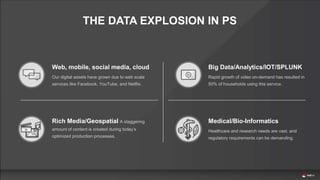
Web, mobile, social media, cloud
Our digital assets have grown due to web scale
services like Facebook, YouTube, and Netflix.
Rich Media/Geospatial A staggering
amount of content is created during today’s
optimized production processes.
Medical/Bio-Informatics
Healthcare and research needs are vast, and
regulatory requirements can be demanding.
Big Data/Analytics/IOT/SPLUNK
Rapid growth of video on-demand has resulted in
50% of households using this service.
THE DATA EXPLOSION IN PS
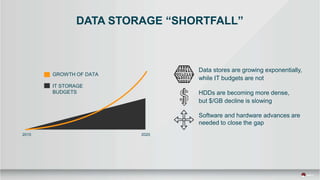
DATA STORAGE “SHORTFALL”
Data stores are growing exponentially,
while IT budgets are not
HDDs are becoming more dense,
but $/GB decline is slowing
Software and hardware advances are
needed to close the gap
GROWTH OF DATA
IT STORAGE
BUDGETS
20202010
WHAT DO WE DO WITH ALL
THAT DATA TODAY?
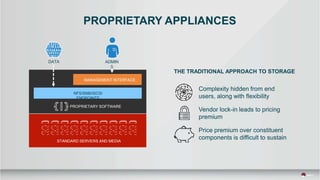
PROPRIETARY APPLIANCES
Complexity hidden from end
users, along with flexibility
Vendor lock-in leads to pricing
premium
Price premium over constituent
components is difficult to sustain
THE TRADITIONAL APPROACH TO STORAGE
ADMIN
S
MANAGEMENT INTERFACE
DATA
NFS/SMB/ISCSI
ENDPOINTS
STANDARD SERVERS AND MEDIA
PROPRIETARY SOFTWARE
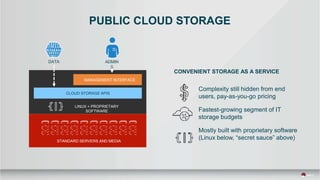
PUBLIC CLOUD STORAGE
Complexity still hidden from end
users, pay-as-you-go pricing
Fastest-growing segment of IT
storage budgets
Mostly built with proprietary software
(Linux below, “secret sauce” above)
CONVENIENT STORAGE AS A SERVICE
ADMIN
S
MANAGEMENT INTERFACE
DATA
CLOUD STORAGE APIS
STANDARD SERVERS AND MEDIA
LINUX + PROPRIETARY
SOFTWARE
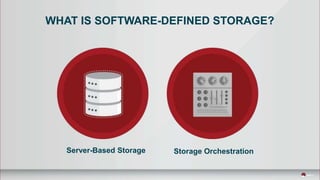
WHAT IS SOFTWARE-DEFINED
STORAGE?
Server-Based Storage
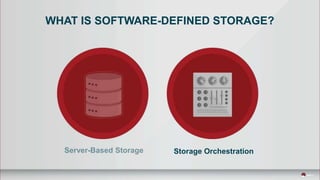
WHAT IS SOFTWARE-DEFINED STORAGE?
Storage Orchestration
Server-Based Storage
WHAT IS SOFTWARE-DEFINED STORAGE?
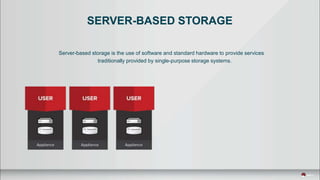
Server-based storage is the use of software and standard hardware to provide services
traditionally provided by single-purpose storage systems.
SERVER-BASED STORAGE
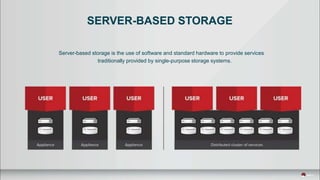
Server-based storage is the use of software and standard hardware to provide services
traditionally provided by single-purpose storage systems.
SERVER-BASED STORAGE
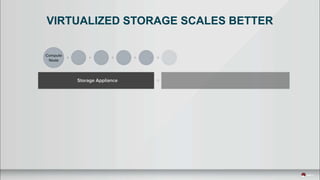
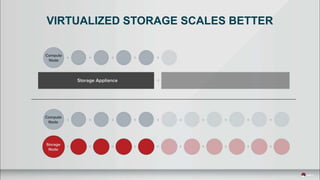
VIRTUALIZED STORAGE SCALES BETTER
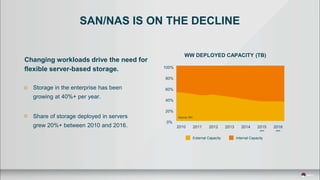
Changing workloads drive the need for
flexible server-based storage.
Storage in the enterprise has been
growing at 40%+ per year.
Share of storage deployed in servers
grew 20%+ between 2010 and 2016.
SAN/NAS IS ON THE DECLINE
2010 2011 2012 2013 2014 2015
(est)
2016
(est)
0%
60%
20%
40%
80%
100%
Internal CapacityExternal Capacity
WW DEPLOYED CAPACITY (TB)
Source: IDC
Storage Orchestration
WHAT IS SOFTWARE-DEFINED STORAGE?
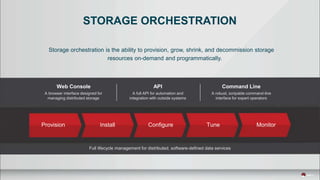
Storage orchestration is the ability to provision, grow, shrink, and decommission storage
resources on-demand and programmatically.
Web Console API Command Line
A browser interface designed for
managing distributed storage
A full API for automation and
integration with outside systems
A robust, scripable command-line
interface for expert operators
Full lifecycle management for distributed, software-defined data services
Provision Install Configure Tune Monitor
STORAGE ORCHESTRATION
WHY DOES SOFTWARE-
DEFINED STORAGE MATTER?
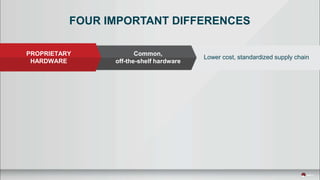
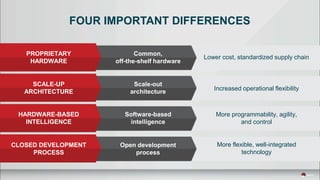
PROPRIETARY
HARDWARE
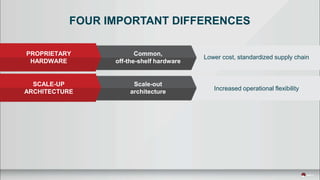
Common,
off-the-shelf hardware
Lower cost, standardized supply chain
FOUR IMPORTANT DIFFERENCES
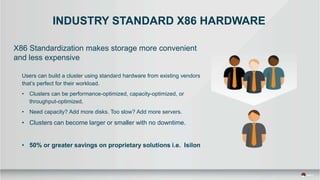
INDUSTRY STANDARD X86 HARDWARE
X86 Standardization makes storage more convenient
and less expensive
Users can build a cluster using standard hardware from existing vendors
that’s perfect for their workload.
• Clusters can be performance-optimized, capacity-optimized, or
throughput-optimized.
• Need capacity? Add more disks. Too slow? Add more servers.
• Clusters can become larger or smaller with no downtime.
• 50% or greater savings on proprietary solutions i.e. Isilon
PROPRIETARY
HARDWARE
SCALE-UP
ARCHITECTURE
Common,
off-the-shelf hardware
Scale-out
architecture
Lower cost, standardized supply chain
Increased operational flexibility
FOUR IMPORTANT DIFFERENCES
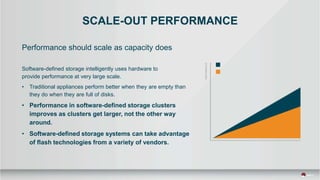
SCALE-OUT PERFORMANCE
Performance should scale as capacity does
Software-defined storage intelligently uses hardware to
provide performance at very large scale.
• Traditional appliances perform better when they are empty than
they do when they are full of disks.
• Performance in software-defined storage clusters
improves as clusters get larger, not the other way
around.
• Software-defined storage systems can take advantage
of flash technologies from a variety of vendors.
PROPRIETARY
HARDWARE
SCALE-UP
ARCHITECTURE
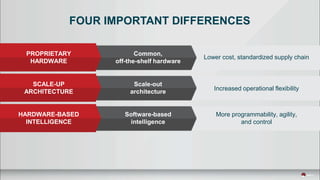
HARDWARE-BASED
INTELLIGENCE
Common,
off-the-shelf hardware
Scale-out
architecture
Software-based
intelligence
Lower cost, standardized supply chain
Increased operational flexibility
More programmability, agility,
and control
FOUR IMPORTANT DIFFERENCES
THE ROBUSTNESS OF SOFTWARE
Software is more flexible than hardware
Software can do things hardware appliances can’t. SDS brings the
flexibility of software to the enterprise storage world.
• Can be deployed on bare metal, inside containers, inside VMs, or
in the public cloud.
• Can deploy on a single server, or thousands, and can be
upgraded and reconfigured on the fly.
• Grows and shrinks programmatically to meet
changing demands in modern cloud-like computing
environments
PROPRIETARY
HARDWARE
SCALE-UP
ARCHITECTURE
HARDWARE-BASED
INTELLIGENCE
CLOSED DEVELOPMENT
PROCESS
Common,
off-the-shelf hardware
Scale-out
architecture
Software-based
intelligence
Open development
process
Lower cost, standardized supply chain
Increased operational flexibility
More programmability, agility,
and control
More flexible, well-integrated
technology
FOUR IMPORTANT DIFFERENCES
WHAT CAN IT BE USED FOR?
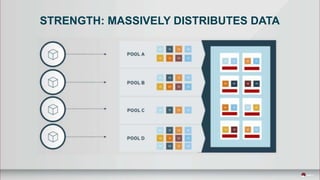
STRENGTH: MASSIVELY DISTRIBUTES DATA
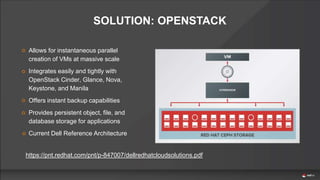
Allows for instantaneous parallel
creation of VMs at massive scale
Integrates easily and tightly with
OpenStack Cinder, Glance, Nova,
Keystone, and Manila
Offers instant backup capabilities
Provides persistent object, file, and
database storage for applications
Current Dell Reference Architecture
SOLUTION: OPENSTACK
https://pnt.redhat.com/pnt/p-847007/dellredhatcloudsolutions.pdf
STRENGTH: GROWS TO PETABYTE SCALE
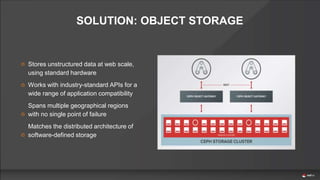
SOLUTION: OBJECT STORAGE
Stores unstructured data at web scale,
using standard hardware
Works with industry-standard APIs for a
wide range of application compatibility
Spans multiple geographical regions
with no single point of failure
Matches the distributed architecture of
software-defined storage
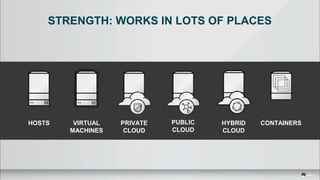
STRENGTH: WORKS IN LOTS OF PLACES
HOSTS VIRTUAL
MACHINES
PRIVATE
CLOUD
CONTAINERSPUBLIC
CLOUD
HYBRID
CLOUD
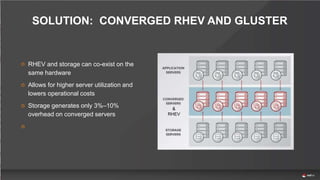
SOLUTION: CONVERGED RHEV AND GLUSTER
RHEV and storage can co-exist on the
same hardware
Allows for higher server utilization and
lowers operational costs
Storage generates only 3%–10%
overhead on converged servers
&
RHEV
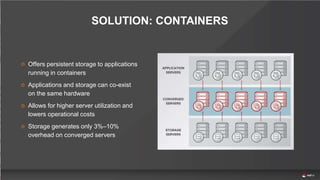
SOLUTION: CONTAINERS
Offers persistent storage to applications
running in containers
Applications and storage can co-exist
on the same hardware
Allows for higher server utilization and
lowers operational costs
Storage generates only 3%–10%
overhead on converged servers
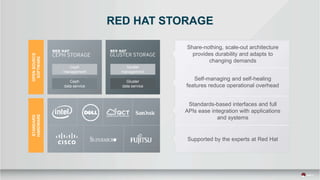
Gluster
management
Ceph
data service
Gluster
data service
Ceph
management
OPENSOURCE
SOFTWARE
STANDARD
HARDWARE
Share-nothing, scale-out architecture
provides durability and adapts to
changing demands
Self-managing and self-healing
features reduce operational overhead
Standards-based interfaces and full
APIs ease integration with applications
and systems
Supported by the experts at Red Hat
RED HAT STORAGE
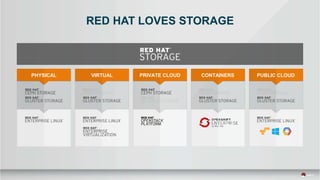
RED HAT LOVES STORAGE
PHYSICAL VIRTUAL PRIVATE CLOUD CONTAINERS PUBLIC CLOUD
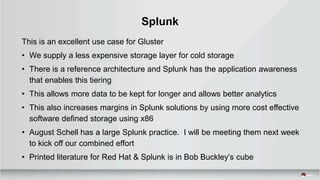
Splunk
This is an excellent use case for Gluster
• We supply a less expensive storage layer for cold storage
• There is a reference architecture and Splunk has the application awareness
that enables this tiering
• This allows more data to be kept for longer and allows better analytics
• This also increases margins in Splunk solutions by using more cost effective
software defined storage using x86
• August Schell has a large Splunk practice. I will be meeting them next week
to kick off our combined effort
• Printed literature for Red Hat & Splunk is in Bob Buckley’s cube
Dave Gordon- Red Hat PS Storage SSP
dagordon@redhat.com
C 540-589-0960
Bob Buckley- Red Hat PS Storage SA
bob@redhat.com
W 571-421-8160
Red Hat Storage
Resources
Jason Erickson- DLT Sr. Sales Rep
Jason.erickson@dlt.com
Direct 703-773-8975

Red Hat Software Defined Storage

  • 1.
    RED HAT SOFTWARE-DEFINEDSTORAGE Dave Gordon July, 2016
  • 2.
    Web, mobile, socialmedia, cloud Our digital assets have grown due to web scale services like Facebook, YouTube, and Netflix. Rich Media/Geospatial A staggering amount of content is created during today’s optimized production processes. Medical/Bio-Informatics Healthcare and research needs are vast, and regulatory requirements can be demanding. Big Data/Analytics/IOT/SPLUNK Rapid growth of video on-demand has resulted in 50% of households using this service. THE DATA EXPLOSION IN PS
  • 3.
    DATA STORAGE “SHORTFALL” Datastores are growing exponentially, while IT budgets are not HDDs are becoming more dense, but $/GB decline is slowing Software and hardware advances are needed to close the gap GROWTH OF DATA IT STORAGE BUDGETS 20202010
  • 4.
    WHAT DO WEDO WITH ALL THAT DATA TODAY?
  • 5.
    PROPRIETARY APPLIANCES Complexity hiddenfrom end users, along with flexibility Vendor lock-in leads to pricing premium Price premium over constituent components is difficult to sustain THE TRADITIONAL APPROACH TO STORAGE ADMIN S MANAGEMENT INTERFACE DATA NFS/SMB/ISCSI ENDPOINTS STANDARD SERVERS AND MEDIA PROPRIETARY SOFTWARE
  • 6.
    PUBLIC CLOUD STORAGE Complexitystill hidden from end users, pay-as-you-go pricing Fastest-growing segment of IT storage budgets Mostly built with proprietary software (Linux below, “secret sauce” above) CONVENIENT STORAGE AS A SERVICE ADMIN S MANAGEMENT INTERFACE DATA CLOUD STORAGE APIS STANDARD SERVERS AND MEDIA LINUX + PROPRIETARY SOFTWARE
  • 7.
  • 8.
    Server-Based Storage WHAT ISSOFTWARE-DEFINED STORAGE? Storage Orchestration
  • 9.
    Server-Based Storage WHAT ISSOFTWARE-DEFINED STORAGE?
  • 10.
    Server-based storage isthe use of software and standard hardware to provide services traditionally provided by single-purpose storage systems. SERVER-BASED STORAGE
  • 11.
    Server-based storage isthe use of software and standard hardware to provide services traditionally provided by single-purpose storage systems. SERVER-BASED STORAGE
  • 12.
  • 13.
  • 14.
    Changing workloads drivethe need for flexible server-based storage. Storage in the enterprise has been growing at 40%+ per year. Share of storage deployed in servers grew 20%+ between 2010 and 2016. SAN/NAS IS ON THE DECLINE 2010 2011 2012 2013 2014 2015 (est) 2016 (est) 0% 60% 20% 40% 80% 100% Internal CapacityExternal Capacity WW DEPLOYED CAPACITY (TB) Source: IDC
  • 15.
    Storage Orchestration WHAT ISSOFTWARE-DEFINED STORAGE?
  • 16.
    Storage orchestration isthe ability to provision, grow, shrink, and decommission storage resources on-demand and programmatically. Web Console API Command Line A browser interface designed for managing distributed storage A full API for automation and integration with outside systems A robust, scripable command-line interface for expert operators Full lifecycle management for distributed, software-defined data services Provision Install Configure Tune Monitor STORAGE ORCHESTRATION
  • 17.
  • 18.
    PROPRIETARY HARDWARE Common, off-the-shelf hardware Lower cost,standardized supply chain FOUR IMPORTANT DIFFERENCES
  • 19.
    INDUSTRY STANDARD X86HARDWARE X86 Standardization makes storage more convenient and less expensive Users can build a cluster using standard hardware from existing vendors that’s perfect for their workload. • Clusters can be performance-optimized, capacity-optimized, or throughput-optimized. • Need capacity? Add more disks. Too slow? Add more servers. • Clusters can become larger or smaller with no downtime. • 50% or greater savings on proprietary solutions i.e. Isilon
  • 20.
    PROPRIETARY HARDWARE SCALE-UP ARCHITECTURE Common, off-the-shelf hardware Scale-out architecture Lower cost,standardized supply chain Increased operational flexibility FOUR IMPORTANT DIFFERENCES
  • 21.
    SCALE-OUT PERFORMANCE Performance shouldscale as capacity does Software-defined storage intelligently uses hardware to provide performance at very large scale. • Traditional appliances perform better when they are empty than they do when they are full of disks. • Performance in software-defined storage clusters improves as clusters get larger, not the other way around. • Software-defined storage systems can take advantage of flash technologies from a variety of vendors.
  • 22.
    PROPRIETARY HARDWARE SCALE-UP ARCHITECTURE HARDWARE-BASED INTELLIGENCE Common, off-the-shelf hardware Scale-out architecture Software-based intelligence Lower cost,standardized supply chain Increased operational flexibility More programmability, agility, and control FOUR IMPORTANT DIFFERENCES
  • 23.
    THE ROBUSTNESS OFSOFTWARE Software is more flexible than hardware Software can do things hardware appliances can’t. SDS brings the flexibility of software to the enterprise storage world. • Can be deployed on bare metal, inside containers, inside VMs, or in the public cloud. • Can deploy on a single server, or thousands, and can be upgraded and reconfigured on the fly. • Grows and shrinks programmatically to meet changing demands in modern cloud-like computing environments
  • 24.
    PROPRIETARY HARDWARE SCALE-UP ARCHITECTURE HARDWARE-BASED INTELLIGENCE CLOSED DEVELOPMENT PROCESS Common, off-the-shelf hardware Scale-out architecture Software-based intelligence Opendevelopment process Lower cost, standardized supply chain Increased operational flexibility More programmability, agility, and control More flexible, well-integrated technology FOUR IMPORTANT DIFFERENCES
  • 25.
    WHAT CAN ITBE USED FOR?
  • 26.
  • 27.
    Allows for instantaneousparallel creation of VMs at massive scale Integrates easily and tightly with OpenStack Cinder, Glance, Nova, Keystone, and Manila Offers instant backup capabilities Provides persistent object, file, and database storage for applications Current Dell Reference Architecture SOLUTION: OPENSTACK https://pnt.redhat.com/pnt/p-847007/dellredhatcloudsolutions.pdf
  • 28.
    STRENGTH: GROWS TOPETABYTE SCALE
  • 29.
    SOLUTION: OBJECT STORAGE Storesunstructured data at web scale, using standard hardware Works with industry-standard APIs for a wide range of application compatibility Spans multiple geographical regions with no single point of failure Matches the distributed architecture of software-defined storage
  • 30.
    STRENGTH: WORKS INLOTS OF PLACES HOSTS VIRTUAL MACHINES PRIVATE CLOUD CONTAINERSPUBLIC CLOUD HYBRID CLOUD
  • 31.
    SOLUTION: CONVERGED RHEVAND GLUSTER RHEV and storage can co-exist on the same hardware Allows for higher server utilization and lowers operational costs Storage generates only 3%–10% overhead on converged servers & RHEV
  • 32.
    SOLUTION: CONTAINERS Offers persistentstorage to applications running in containers Applications and storage can co-exist on the same hardware Allows for higher server utilization and lowers operational costs Storage generates only 3%–10% overhead on converged servers
  • 34.
    Gluster management Ceph data service Gluster data service Ceph management OPENSOURCE SOFTWARE STANDARD HARDWARE Share-nothing,scale-out architecture provides durability and adapts to changing demands Self-managing and self-healing features reduce operational overhead Standards-based interfaces and full APIs ease integration with applications and systems Supported by the experts at Red Hat RED HAT STORAGE
  • 35.
    RED HAT LOVESSTORAGE PHYSICAL VIRTUAL PRIVATE CLOUD CONTAINERS PUBLIC CLOUD
  • 36.
    Splunk This is anexcellent use case for Gluster • We supply a less expensive storage layer for cold storage • There is a reference architecture and Splunk has the application awareness that enables this tiering • This allows more data to be kept for longer and allows better analytics • This also increases margins in Splunk solutions by using more cost effective software defined storage using x86 • August Schell has a large Splunk practice. I will be meeting them next week to kick off our combined effort • Printed literature for Red Hat & Splunk is in Bob Buckley’s cube
  • 37.
    Dave Gordon- RedHat PS Storage SSP dagordon@redhat.com C 540-589-0960 Bob Buckley- Red Hat PS Storage SA bob@redhat.com W 571-421-8160 Red Hat Storage Resources Jason Erickson- DLT Sr. Sales Rep Jason.erickson@dlt.com Direct 703-773-8975