1
GROUP MEMBERS
• Sidra Hussain 2011-PID-02
• Zaheer Ahmed 2011-PID-24
• Masood 2011-PID-07
2
Table of content
 Electronic devices
 Electronic sustainability
 electronic devices and their toxic components
 Challenges
 Electronic waste
 How to prevent electronic waste
 Waste prevention at organizational level
 Waste prevention at governmental level
 Facts about waste
3
Sustainability
the quality of not being harmful to the
environment or depleting natural resources, and thereby supporting
long term ecological balance:
4
Electronic Sustainability
• Recyclable product
• Optimizing energy consumption over its entire life cycle
• Look after the environment,
• The people living and working in it
• And how one’s business decisions, products and suppliers affect
those around them.
5
ELECTRONIC DEVICES
6
COMPONENT CONSTITUENT
Printed circuit boards Lead and cadmium
Cathode ray tubes (CRTs) Lead oxide and Cd
Switches & flat screen monitors Mercury
Computer batteries Cadmium
Capacitors and transformers PCB
Printed circuit boards, plastic
casings cable
Brominated flame retardant
Cable insulation/coating PVC
ELECTRONIC DEVICES AND THEIR TOXIC
COMPONENTS
8
ITEMS AND THEIR TOXIC COMPONENTS
ITEM COMPONENT
Refrigerator CFC/HCFC/HFC/HC, Rubber etc.
PC and Laptops CRT, batteries, circuit board, copper,
fluorescent lamp
Television Metal, CRT, Plastic, transformer,
circuit board, BFR
Washing Machine Rubber, electrical wires, metal and
motor etc.
REFRIGERATOR AND AIR-CONDITIONING
UNITS
• Environmental concerns:
chlorofluorocarbon (CFC) refrigerant.
Hydro chlorofluorocarbon (hcfc) refrigerant.
Effects:
• Ozone-depleting substances (Ods)
• Potent greenhouse gases release contributes
to global climate change.
How to recycled :
Safely remove these components prior to
shredding and recycling.
9
CELL PHONE
• The Impacts Are Not Small
• generate a negligible quantity of waste per unit.
• Millions of phones each year dumped in landfills
• Toxic exposures :
• Toxic materials contaminate air, soil, and water when the phones
are thrown away as waste.
10
CELL PHONE
• Environmental and human health
• impacts from mining metals, including rare earth metals that
current designs require.
• Cause of cancer
• The radio frequency energy emitted by mobile phones has been the
reason of Cancer.
11
SUSTAINABLE PHONES
• Design more user-friendly phones.
• Create safer phones.
12
• Rapidly increasing volume of e-waste
• Low level of awareness of the hazards of
incorrect disposal
• Recyclers recover precious metals and
improperly dispose off the rest
• Absence of proper mechanism for
Collection of e-waste material and its
Disposal
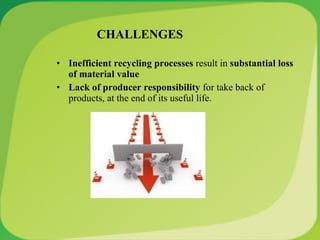
CHALLENGES
• Inefficient recycling processes result in substantial loss
of material value
• Lack of producer responsibility for take back of
products, at the end of its useful life.
CHALLENGES
• wastes generated from used electronic
devices
• not fit for their original intended use.
• E-wastes contain over 1000 different
substances
• Heavy metals: mercury, lead, arsenic,
beryllium, brominated flame retardant,
Hazardous: combustion– dioxins– toxic
gases fro inhalation and deposition
• Health Impacts – cancer, reproductive
disorders, endocrine disruption
15
ELECTRONIC WASTE
16
HOW MUCH E- WASTE WE GENRATE
WASTE IS TRASHED /RECYCLED
17
 80 to 85% of electronic products were
discarded in landfills which can release certain
toxics into the air.
 20 to 50 million metric tons of e-waste are
disposed worldwide every year.
 Cell phones and other electronic items contain
high amounts of precious metals like gold or
silver. Americans dump phones containing
over $60 million in gold/silver every year.
 Only 12.5% of e-waste is currently recycled.
FACTS ABOUT E-
WASTE
FACTS ABOUT E-WASTE
• Estimated 50 million tons of discarded electronics
every year and growing.
• 80% of used electronics going to landfills or
incinerators
• Limited supply of the natural resources needed to
make new electronic devices.
• Recycling 1 million laptops saves the energy
equivalent to the electricity used by 3,657 U.S.
homes in a year.
HOW TO PREVENT ELECTRONIC WASTE
• Eco design in electronic devices
• Miniaturization
• Energy efficiency of products
• Recycling
• Remanufacturing
20
Eco-Design of Products
Eco-design means starting off right:
Creating products out of environmentally
friendly materials, using efficient designs
that require fewer materials, and maximizing
reusability and recyclability.
Some practices in the consumer electronics
can result in lower environmental impact .
21
Miniaturization
Benefits :
Fewer raw materials to extract
Easier portability
Smaller floor space in manufacturing
Often less energy consuming
22
MINIATURIZATION IN PACAKGING
• Materials are further reduced
• and shipping and shelf-space optimized even more.
All of these steps save
• resources (and money) and
• result in less carbon emission.
23
Energy Efficiency of Products
Benefits :
reduces greenhouse gas emissions
hazardous waste
saves money.
run longer before needing recharging or new
batteries.
reduce power consumption
24
ENERGY EFFICIENCY OF PRODUCTS
• Panasonic has reduced the standby power consumption in its
plasma televisions by 96% since 2000, contributing to customer
energy savings of around 3.6 billion kilowatt-hours of electricity
(enough to power more than 300,000 households for a year).
25
MATERIAL EFFICENCY
 Increasing material efficiency of production
processes.
 Recycling and reusing
 Testing products
26
RECYCLING
Involve the process of Collection,
processing, marketing
Benefits :
•Saves resources, energy, money
•Reduce pollution of extracting
resources
•Reduce new landfills and incinerators
REMANUFACTURING
There are various levels of remanufacturing ranging from simple
•cosmetic improvements
• such as replacing decals, scratched or cracked enclosures,
• to updating software
•to troubleshooting nonworking units and replacing failed
components.
COMPUTER LIFE CYLCE PROCESS
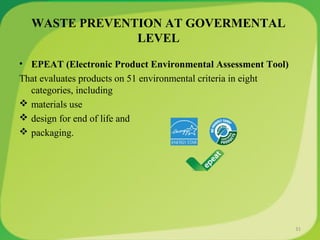
WASTE PREVENTION AT GOVERMENTAL
LEVEL
• EPEAT (Electronic Product Environmental Assessment Tool)
That evaluates products on 51 environmental criteria in eight
categories, including
 materials use
 design for end of life and
 packaging.
31
ROLE OF EPEAT-CERTIFIED PRODUCTS
• Reduced the use of materials by 75.5
million metric tons (equivalent to the
weight of more than 585 million
refrigerators)
• Reduced the use of toxic materials
• mercury, by 3,220 metric tons (equivalent
to the weight of 1.6 million bricks).
• the electricity savings are 42.2 billion
kilowatt hours enough to power 3.7
million U.S homes for a year.
32
RECYCLING PROGRAMS AT
ORGANIZATIONAL LEVEL
• Hewlett-Packard
400 million pounds of computer hardware
• Dell and Sony are also major electronics recyclers.
• Crutchfield
replaced polystyrene peanuts with biodegradable starch pellets
• Kodak’s
Total cameras recycled are 1.2 billion
33
REUSE PROCESS
REUSE PROCESSES AT CONSUMER ELECTRONICS
COMPANIES
34
35

Recycling basics 5

  • 1.
  • 2.
    GROUP MEMBERS • SidraHussain 2011-PID-02 • Zaheer Ahmed 2011-PID-24 • Masood 2011-PID-07 2
  • 3.
    Table of content Electronic devices  Electronic sustainability  electronic devices and their toxic components  Challenges  Electronic waste  How to prevent electronic waste  Waste prevention at organizational level  Waste prevention at governmental level  Facts about waste 3
  • 4.
    Sustainability the quality ofnot being harmful to the environment or depleting natural resources, and thereby supporting long term ecological balance: 4
  • 5.
    Electronic Sustainability • Recyclableproduct • Optimizing energy consumption over its entire life cycle • Look after the environment, • The people living and working in it • And how one’s business decisions, products and suppliers affect those around them. 5
  • 6.
  • 7.
    COMPONENT CONSTITUENT Printed circuitboards Lead and cadmium Cathode ray tubes (CRTs) Lead oxide and Cd Switches & flat screen monitors Mercury Computer batteries Cadmium Capacitors and transformers PCB Printed circuit boards, plastic casings cable Brominated flame retardant Cable insulation/coating PVC ELECTRONIC DEVICES AND THEIR TOXIC COMPONENTS
  • 8.
    8 ITEMS AND THEIRTOXIC COMPONENTS ITEM COMPONENT Refrigerator CFC/HCFC/HFC/HC, Rubber etc. PC and Laptops CRT, batteries, circuit board, copper, fluorescent lamp Television Metal, CRT, Plastic, transformer, circuit board, BFR Washing Machine Rubber, electrical wires, metal and motor etc.
  • 9.
    REFRIGERATOR AND AIR-CONDITIONING UNITS •Environmental concerns: chlorofluorocarbon (CFC) refrigerant. Hydro chlorofluorocarbon (hcfc) refrigerant. Effects: • Ozone-depleting substances (Ods) • Potent greenhouse gases release contributes to global climate change. How to recycled : Safely remove these components prior to shredding and recycling. 9
  • 10.
    CELL PHONE • TheImpacts Are Not Small • generate a negligible quantity of waste per unit. • Millions of phones each year dumped in landfills • Toxic exposures : • Toxic materials contaminate air, soil, and water when the phones are thrown away as waste. 10
  • 11.
    CELL PHONE • Environmentaland human health • impacts from mining metals, including rare earth metals that current designs require. • Cause of cancer • The radio frequency energy emitted by mobile phones has been the reason of Cancer. 11
  • 12.
    SUSTAINABLE PHONES • Designmore user-friendly phones. • Create safer phones. 12
  • 13.
    • Rapidly increasingvolume of e-waste • Low level of awareness of the hazards of incorrect disposal • Recyclers recover precious metals and improperly dispose off the rest • Absence of proper mechanism for Collection of e-waste material and its Disposal CHALLENGES
  • 14.
    • Inefficient recyclingprocesses result in substantial loss of material value • Lack of producer responsibility for take back of products, at the end of its useful life. CHALLENGES
  • 15.
    • wastes generatedfrom used electronic devices • not fit for their original intended use. • E-wastes contain over 1000 different substances • Heavy metals: mercury, lead, arsenic, beryllium, brominated flame retardant, Hazardous: combustion– dioxins– toxic gases fro inhalation and deposition • Health Impacts – cancer, reproductive disorders, endocrine disruption 15 ELECTRONIC WASTE
  • 16.
    16 HOW MUCH E-WASTE WE GENRATE
  • 17.
    WASTE IS TRASHED/RECYCLED 17
  • 18.
     80 to85% of electronic products were discarded in landfills which can release certain toxics into the air.  20 to 50 million metric tons of e-waste are disposed worldwide every year.  Cell phones and other electronic items contain high amounts of precious metals like gold or silver. Americans dump phones containing over $60 million in gold/silver every year.  Only 12.5% of e-waste is currently recycled. FACTS ABOUT E- WASTE
  • 19.
    FACTS ABOUT E-WASTE •Estimated 50 million tons of discarded electronics every year and growing. • 80% of used electronics going to landfills or incinerators • Limited supply of the natural resources needed to make new electronic devices. • Recycling 1 million laptops saves the energy equivalent to the electricity used by 3,657 U.S. homes in a year.
  • 20.
    HOW TO PREVENTELECTRONIC WASTE • Eco design in electronic devices • Miniaturization • Energy efficiency of products • Recycling • Remanufacturing 20
  • 21.
    Eco-Design of Products Eco-designmeans starting off right: Creating products out of environmentally friendly materials, using efficient designs that require fewer materials, and maximizing reusability and recyclability. Some practices in the consumer electronics can result in lower environmental impact . 21
  • 22.
    Miniaturization Benefits : Fewer rawmaterials to extract Easier portability Smaller floor space in manufacturing Often less energy consuming 22
  • 23.
    MINIATURIZATION IN PACAKGING •Materials are further reduced • and shipping and shelf-space optimized even more. All of these steps save • resources (and money) and • result in less carbon emission. 23
  • 24.
    Energy Efficiency ofProducts Benefits : reduces greenhouse gas emissions hazardous waste saves money. run longer before needing recharging or new batteries. reduce power consumption 24
  • 25.
    ENERGY EFFICIENCY OFPRODUCTS • Panasonic has reduced the standby power consumption in its plasma televisions by 96% since 2000, contributing to customer energy savings of around 3.6 billion kilowatt-hours of electricity (enough to power more than 300,000 households for a year). 25
  • 26.
    MATERIAL EFFICENCY  Increasingmaterial efficiency of production processes.  Recycling and reusing  Testing products 26
  • 27.
    RECYCLING Involve the processof Collection, processing, marketing Benefits : •Saves resources, energy, money •Reduce pollution of extracting resources •Reduce new landfills and incinerators
  • 28.
    REMANUFACTURING There are variouslevels of remanufacturing ranging from simple •cosmetic improvements • such as replacing decals, scratched or cracked enclosures, • to updating software •to troubleshooting nonworking units and replacing failed components.
  • 29.
  • 31.
    WASTE PREVENTION ATGOVERMENTAL LEVEL • EPEAT (Electronic Product Environmental Assessment Tool) That evaluates products on 51 environmental criteria in eight categories, including  materials use  design for end of life and  packaging. 31
  • 32.
    ROLE OF EPEAT-CERTIFIEDPRODUCTS • Reduced the use of materials by 75.5 million metric tons (equivalent to the weight of more than 585 million refrigerators) • Reduced the use of toxic materials • mercury, by 3,220 metric tons (equivalent to the weight of 1.6 million bricks). • the electricity savings are 42.2 billion kilowatt hours enough to power 3.7 million U.S homes for a year. 32
  • 33.
    RECYCLING PROGRAMS AT ORGANIZATIONALLEVEL • Hewlett-Packard 400 million pounds of computer hardware • Dell and Sony are also major electronics recyclers. • Crutchfield replaced polystyrene peanuts with biodegradable starch pellets • Kodak’s Total cameras recycled are 1.2 billion 33
  • 34.
    REUSE PROCESS REUSE PROCESSESAT CONSUMER ELECTRONICS COMPANIES 34
  • 35.

Editor's Notes

  • #28 Recycling is the collection, separation, processing and marketing of materials so they can be used again. Recycling is an important environmental practice. The materials collected in recycling programs are not garbage or waste – they are valuable commodities that represent an essential component of today’s marketplace. Recycled plastic soft drink bottles can be made into T-shirts, carpeting and filling for ski jackets. Recycled aluminum cans can be made into new aluminum cans. Recycled glass, which can be recycled forever, can be made into new glass. Recycled paper and cardboard can be made into paper, pencils and other products. Recycling saves natural resources, money and energy. Recycling helps reduce or eliminate pollution associated with the mining or extraction of natural resources. Recycling reduces the need for new landfills and incinerators – and given that is another way to protect the environment.
  • #30 Apple Computer recycling process example. “While the exact process for recycling a computer may vary from country to country, as a general rule, there are specific steps to turn an old computer into secondary glass, metal and plastic raw materials. The illustration below shows a typical take-back and recycling scenario: “At the recycler, used equipment is disassembled, and key components that can be reused are removed for reliability testing and refurbishment. Most often these reusable components are optical drives, hard-drives, memory cards and sometimes specific printed wiring boards. At this stage, parts and components that require additional treatment before recycling — typically batteries, toner cartridges and backlight lamps — are also separated from the main product. “Component disassembly line What’s left of the equipment is shredded and sorted into plastic, glass and metals. The glass and metal are sent to smelters for reprocessing into secondary raw glass and metal materials. These materials are then sold to producers for remanufacture into everyday products such as cars, electronics, toys, construction materials and furniture. “Mixed plastics are often used by metal and glass smelters as a fuel source for the glass and metal smelting process. More pure plastic blends such as ABS and PC can be liquefied and pelletized into a raw secondary plastic material ready for remolding into new products. With materials reprocessing and component reuse, Apple often achieves a recovery rate of 90% by weight of the original product.”