UNIT-2 EMERGING
BUILDING MATERIALS
“ECO FRIENDLY MATERIALS”
EMERGING BUILDING
MATERIALS
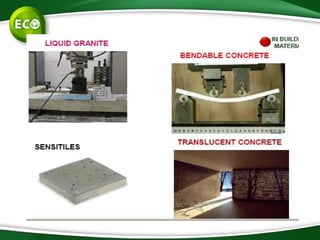
• Bendable concrete, Self healing
concrete, Translucent concrete
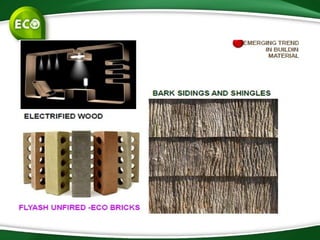
• Electrified wood
• Bio engineered bricks
• Sensitiles
• Carbon fibers
• Liquid granite
• Eco bricks
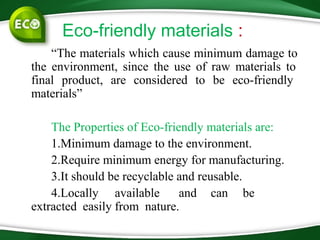
Eco-friendly materials :
“The materials which cause minimum damage to
the environment, since the use of raw materials to
final product, are considered to be eco-friendly
materials”
The Properties of Eco-friendly materials are:
1.Minimum damage to the environment.
2.Require minimum energy for manufacturing.
3.It should be recyclable and reusable.
4.Locally available and can be
extracted easily from nature.
WHY..??
• Phenomenal growth in the construction
industry that depends upon depletable
resources.
• Production of building materials leads to
irreversible environmental impacts.
• Using eco-friendly materials is the best
way to build a eco-friendly building.
PROPERTIES
Renewable Source Reuse of
Waste
product
ECO-FRIENDLY
MATERIALS& TECHNIQUES
Embodied Energy
Local Availability
Reduction in air,
land and water
pollution
Durability &
Life span
Aids Energy
Efficiency in
buildings
Biodegradable
Reuse/recycle
Eco-friendly materials :
Naturally available eco-friendly materials or
products developed using Eco-friendly raw-
materials are
1.Bamboo / timber
2.Sun dried bricks.
3.Mud used for houses, wall plastering.
Eco-friendly materials :
materials can also be
waste products of some
The Eco-friendly
manufactured using
industries.
theseThe following materials fall under
categories.
1.Fly ash Bricks
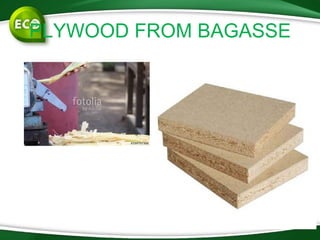
2.Ply-wood Manufactured from
Bagasse.
HOW TO FIND IF A BUILDING
MATERIAL IS ECO FRIENDLY OR
NOT…??
EXAMPLE:-
BUILDING MATERIAL – WOOD
ECO FRIENDLY??
NON ECO FRIENDLY?
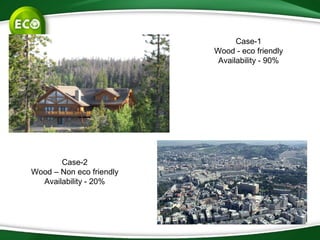
Case-1
Wood - eco friendly
Availability - 90%
Case-2
Wood – Non eco friendly
Availability - 20%
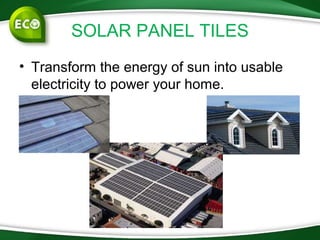
SOLAR PANEL TILES
• Transform the energy of sun into usable
electricity to power your home.
UNFIRED CLAY BRICKS
• Using earth materials & are air dried
instead of fired conventional bricks.
• Eco friendly.
• Benefit of reducing the energy used in
manufacturing & increases strength &
decreases shrinkage.
FLYASH BRICKS
PLYWOOD FROM BAGASSE
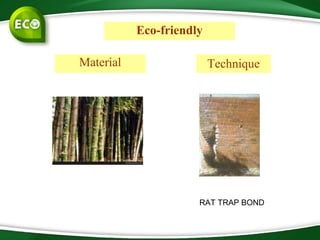
BAMBOO AS
REINFORCEMENT
Eco-friendly
Material Technique
RAT TRAP BOND
REDUCES POLLUTION
 Air Pollution-
Use of
materials with low VOC
emissions e.g. Cement
Paints
 Water
Pollution –
Materials that prevent
leaching.
Land Pollution- Materials
that reuse waste that
would otherwise have
resulted in landfill. e.g.
Flyash Bricks.
PERFORMANCE
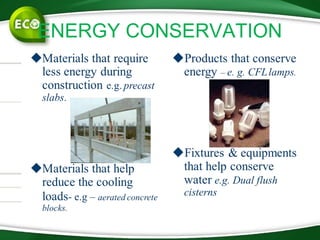
ENERGY CONSERVATION
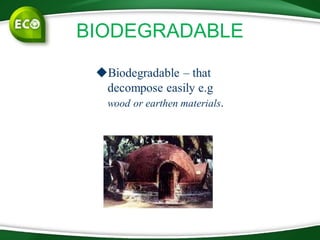
BIODEGRADABLE
CONVENTIONAL MATERIALS
• Ferro-cement boards for door and window shutters
• Ferro-cement Roofing Channels
• Fly-ash Sand Lime Bricks and Paver Blocks
• Gypsum Board, Tiles, Plaster, Blocks, gypsum plaster
fibre jute/sisal and glass fibre composites
• Laminated Wood Plastic Components
• Marble Mosaic Tiles
• MDF Boards and Mouldings
• Micro Concrete Roofing Tiles
• Partical Boards
• Polymerised water proof compound
• Bamboo, Bamboo Based Partcle Board & Ply Board, Bamboo
Matting
• Bricks sun dried
• Precast cement concrete blocks, lintels, slab. Structural and non-
structural modular elements
• Calcined Phospho Gypsum Wall Panels
• Calcium silicate boards and Tiles
• Cellular Light Weight Concrete Blocks
• Cement Paint
• Clay roofing tiles
• Water, polyurethane and acrylic based chemical admixtures for
corrosion removal, rust prevention, water proofing
• Epoxy Resin System, Flooring, sealants, adhesives and admixtures
• Polymerised water proof compound
• Portland Pozzolana Cement Flyash / Calcined
Clay Based
• Portland Slag Cement
• RCC Door Frames
• Ready Mix Cement Concrete
• Rubber Wood Finger Joint Board
• Stone dust
• Water proof compound, adhesive, Polymer,
Powder

Eco friendly materials

  • 1.
  • 2.
    EMERGING BUILDING MATERIALS • Bendableconcrete, Self healing concrete, Translucent concrete • Electrified wood • Bio engineered bricks • Sensitiles • Carbon fibers • Liquid granite • Eco bricks
  • 6.
    Eco-friendly materials : “Thematerials which cause minimum damage to the environment, since the use of raw materials to final product, are considered to be eco-friendly materials” The Properties of Eco-friendly materials are: 1.Minimum damage to the environment. 2.Require minimum energy for manufacturing. 3.It should be recyclable and reusable. 4.Locally available and can be extracted easily from nature.
  • 7.
    WHY..?? • Phenomenal growthin the construction industry that depends upon depletable resources. • Production of building materials leads to irreversible environmental impacts. • Using eco-friendly materials is the best way to build a eco-friendly building.
  • 8.
    PROPERTIES Renewable Source Reuseof Waste product ECO-FRIENDLY MATERIALS& TECHNIQUES Embodied Energy Local Availability Reduction in air, land and water pollution Durability & Life span Aids Energy Efficiency in buildings Biodegradable Reuse/recycle
  • 9.
    Eco-friendly materials : Naturallyavailable eco-friendly materials or products developed using Eco-friendly raw- materials are 1.Bamboo / timber 2.Sun dried bricks. 3.Mud used for houses, wall plastering.
  • 10.
    Eco-friendly materials : materialscan also be waste products of some The Eco-friendly manufactured using industries. theseThe following materials fall under categories. 1.Fly ash Bricks 2.Ply-wood Manufactured from Bagasse.
  • 11.
    HOW TO FINDIF A BUILDING MATERIAL IS ECO FRIENDLY OR NOT…?? EXAMPLE:- BUILDING MATERIAL – WOOD ECO FRIENDLY?? NON ECO FRIENDLY?
  • 12.
    Case-1 Wood - ecofriendly Availability - 90% Case-2 Wood – Non eco friendly Availability - 20%
  • 13.
    SOLAR PANEL TILES •Transform the energy of sun into usable electricity to power your home.
  • 14.
    UNFIRED CLAY BRICKS •Using earth materials & are air dried instead of fired conventional bricks. • Eco friendly. • Benefit of reducing the energy used in manufacturing & increases strength & decreases shrinkage.
  • 15.
  • 16.
  • 17.
  • 18.
  • 19.
    REDUCES POLLUTION  AirPollution- Use of materials with low VOC emissions e.g. Cement Paints  Water Pollution – Materials that prevent leaching. Land Pollution- Materials that reuse waste that would otherwise have resulted in landfill. e.g. Flyash Bricks.
  • 20.
  • 21.
  • 22.
  • 23.
    CONVENTIONAL MATERIALS • Ferro-cementboards for door and window shutters • Ferro-cement Roofing Channels • Fly-ash Sand Lime Bricks and Paver Blocks • Gypsum Board, Tiles, Plaster, Blocks, gypsum plaster fibre jute/sisal and glass fibre composites • Laminated Wood Plastic Components • Marble Mosaic Tiles • MDF Boards and Mouldings • Micro Concrete Roofing Tiles • Partical Boards • Polymerised water proof compound
  • 24.
    • Bamboo, BambooBased Partcle Board & Ply Board, Bamboo Matting • Bricks sun dried • Precast cement concrete blocks, lintels, slab. Structural and non- structural modular elements • Calcined Phospho Gypsum Wall Panels • Calcium silicate boards and Tiles • Cellular Light Weight Concrete Blocks • Cement Paint • Clay roofing tiles • Water, polyurethane and acrylic based chemical admixtures for corrosion removal, rust prevention, water proofing • Epoxy Resin System, Flooring, sealants, adhesives and admixtures
  • 25.
    • Polymerised waterproof compound • Portland Pozzolana Cement Flyash / Calcined Clay Based • Portland Slag Cement • RCC Door Frames • Ready Mix Cement Concrete • Rubber Wood Finger Joint Board • Stone dust • Water proof compound, adhesive, Polymer, Powder