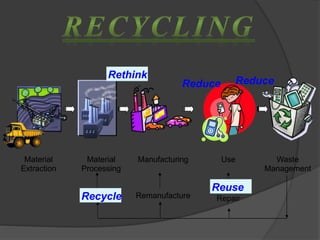
Material
Extraction
Material
Processing
Manufacturing Use Waste
Management
Recycle Remanufacture
Reuse
Repair
Reduce Reduce
Reuse
Recycle
Rethink
 Waste Recycling
○ Goals
○ Terminology
○ Recycling Advantage
○ Recycling Challenges
○ Examples of Recycling
- Aluminum Recycling
- Glass Recycling
- Paper Recycling
- Plastic Recycling
- Steel Recycling
Goals
Define terms related to waste reduction
Hazardous waste recycling
Discuss advantages associated with
waste reduction and recycling.
Discuss recycling of specific MSW
(Municipal Solid Waste) components
Discuss ways to increase recycling
TERMINOLOGY
 Reduction: Reduction in generation, reduction in amount of
material, increase lifetime, or eliminate the need
 Recycle - used, reused, or reclaimed, use of the material as
a source raw material, involves physical transformation
 Reused: The direct use or reuse of a secondary material
without prior reclamation
 Reclaimed: regeneration of wastes or recovery of
usable materials from wastes (e.g., regenerating spent
solvents in a solvent still). Wastes are regenerated when
they are processed to remove contaminants in a way
that restores them to their usable condition materials that
must be reclaimed/recycled prior to use or reuse
 Recovery - Process to recover useful material from mixed
waste (energy is an example)
Recycling Advantages
 Prevents the emission of many greenhouse
gases and water pollutants,
 Saves energy,
 Supplies valuable raw materials to industry,
 Creates jobs,
 Stimulates the development of greener
technologies,
 Conserves resources for our children’s future,
and
 Reduces the need for new landfills and
combustors.
Recycling Challenges
 Location of wastes (9000 curbside programs)
 Uncertainty of supply
 Administrative and institutional constraints
 Legal restrictions
 Uncertain markets
 Technical challenges to recycling
 Changes in materials (i.e. light weighting)
 Too many items in waste
 Actually encourages waste production (because
recycling will take care of it)
Examples of
Recycling
 Aluminum Recycling
 Steel Recycling
 Glass Recycling
 Paper Recycling
 Plastic Recycling
Aluminum Recycling
 About 51 percent of aluminum cans is being recycled
 Twenty years ago it took 19 aluminum cans to make
one pound, but today, aluminum beverage cans are
lighter and it takes 29 cans to make a pound.
 Americans throw away enough aluminum every three
months to rebuild our entire commercial air fleet.
 Making new aluminum cans from used cans takes 95
percent less energy and 20 recycled cans can be
made with the energy needed to produce one can
using virgin ore.
 Domestic recycling has declined recently, collection is
expensive
Glass Recycling
 Glass always lags other recyclables
 Alternative markets needed – grind for
construction fill, “glassphalt,” fiberglass
 Transportation of heavy glass is expensive
 Raw materials are inexpensive
 Contamination is an issue
 Reuse used to be common practice; however
as manufacturing plants became larger and
decreased in number, bottles had to be
carried further for refilling.
 More colored glass is imported than used
domestically
Paper Recycling
 Problems
 Chlorination produces dioxins/furans
 Inks are petrochemical based
 Acid used to break fibers shortens life
 Coating of high gloss paper
 Demand for high quality paper
 Glues, laminates, plastics, inks not water soluble
 Paper can only be reused 4-12 times, always need
a virgin source
Plastic Recycling
 Problems
 Light weight, bulky, low density
 Wide variety of polymers
 Concerns over contamination for reuse
 Difficult to differentiate among types
PET(Polyethylene terephthalate) and HDPE(High-
density polyethylene) have high prices due to
domestic and international demand
Curbside recycling is down, driving prices up
More expensive oil prices makes virgin plastic
more expensive
Steel Recycling
 Expanding economy – increased steel
demands; China and India biggest markets
 36.4% of steel is recycled
 Use of plastic for automobiles is a problem
 One ton steel recycled saves 2500 lb of iron
ore, 1000 lb of coal, 40 lb of limestone, and
significant energy savings
Recycling

Recycling

  • 1.
    Material Extraction Material Processing Manufacturing Use Waste Management RecycleRemanufacture Reuse Repair Reduce Reduce Reuse Recycle Rethink
  • 3.
     Waste Recycling ○Goals ○ Terminology ○ Recycling Advantage ○ Recycling Challenges ○ Examples of Recycling - Aluminum Recycling - Glass Recycling - Paper Recycling - Plastic Recycling - Steel Recycling
  • 4.
    Goals Define terms relatedto waste reduction Hazardous waste recycling Discuss advantages associated with waste reduction and recycling. Discuss recycling of specific MSW (Municipal Solid Waste) components Discuss ways to increase recycling
  • 5.
    TERMINOLOGY  Reduction: Reductionin generation, reduction in amount of material, increase lifetime, or eliminate the need  Recycle - used, reused, or reclaimed, use of the material as a source raw material, involves physical transformation  Reused: The direct use or reuse of a secondary material without prior reclamation  Reclaimed: regeneration of wastes or recovery of usable materials from wastes (e.g., regenerating spent solvents in a solvent still). Wastes are regenerated when they are processed to remove contaminants in a way that restores them to their usable condition materials that must be reclaimed/recycled prior to use or reuse  Recovery - Process to recover useful material from mixed waste (energy is an example)
  • 6.
    Recycling Advantages  Preventsthe emission of many greenhouse gases and water pollutants,  Saves energy,  Supplies valuable raw materials to industry,  Creates jobs,  Stimulates the development of greener technologies,  Conserves resources for our children’s future, and  Reduces the need for new landfills and combustors.
  • 7.
    Recycling Challenges  Locationof wastes (9000 curbside programs)  Uncertainty of supply  Administrative and institutional constraints  Legal restrictions  Uncertain markets  Technical challenges to recycling  Changes in materials (i.e. light weighting)  Too many items in waste  Actually encourages waste production (because recycling will take care of it)
  • 8.
    Examples of Recycling  AluminumRecycling  Steel Recycling  Glass Recycling  Paper Recycling  Plastic Recycling
  • 9.
    Aluminum Recycling  About51 percent of aluminum cans is being recycled  Twenty years ago it took 19 aluminum cans to make one pound, but today, aluminum beverage cans are lighter and it takes 29 cans to make a pound.  Americans throw away enough aluminum every three months to rebuild our entire commercial air fleet.  Making new aluminum cans from used cans takes 95 percent less energy and 20 recycled cans can be made with the energy needed to produce one can using virgin ore.  Domestic recycling has declined recently, collection is expensive
  • 10.
    Glass Recycling  Glassalways lags other recyclables  Alternative markets needed – grind for construction fill, “glassphalt,” fiberglass  Transportation of heavy glass is expensive  Raw materials are inexpensive  Contamination is an issue  Reuse used to be common practice; however as manufacturing plants became larger and decreased in number, bottles had to be carried further for refilling.  More colored glass is imported than used domestically
  • 11.
    Paper Recycling  Problems Chlorination produces dioxins/furans  Inks are petrochemical based  Acid used to break fibers shortens life  Coating of high gloss paper  Demand for high quality paper  Glues, laminates, plastics, inks not water soluble  Paper can only be reused 4-12 times, always need a virgin source
  • 12.
    Plastic Recycling  Problems Light weight, bulky, low density  Wide variety of polymers  Concerns over contamination for reuse  Difficult to differentiate among types PET(Polyethylene terephthalate) and HDPE(High- density polyethylene) have high prices due to domestic and international demand Curbside recycling is down, driving prices up More expensive oil prices makes virgin plastic more expensive
  • 13.
    Steel Recycling  Expandingeconomy – increased steel demands; China and India biggest markets  36.4% of steel is recycled  Use of plastic for automobiles is a problem  One ton steel recycled saves 2500 lb of iron ore, 1000 lb of coal, 40 lb of limestone, and significant energy savings