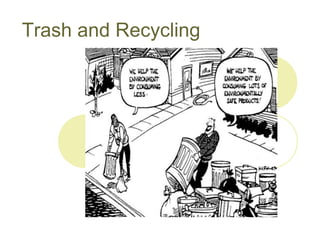
Trash and Recycling
How Much Do We Waste?
 What we generally think of as trash is Municipal Solid
Waste (MSW). This waste is also sometimes called post-
consumer waste. Although most visible, this is a very
small amount of the total trash we create.
 Much more is created in the process of mining and
manufacturing. For every ton of post-consumer
waste, there is 20 tons of pre-consumer waste
created along the way in the manufacturing process.
 (Beyond the Wasteland, Guy Dauncey:
http://www.earthfuture.com/lit/beyondthewasteland.asp)
Ecological Rucksack
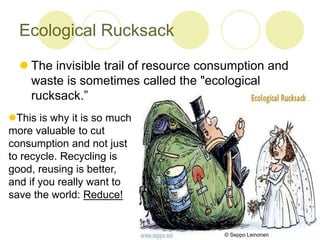
 The invisible trail of resource consumption and
waste is sometimes called the "ecological
rucksack.”
This is why it is so much
more valuable to cut
consumption and not just
to recycle. Recycling is
good, reusing is better,
and if you really want to
save the world: Reduce!
© Seppo Leinonen
Municipal Solid Waste
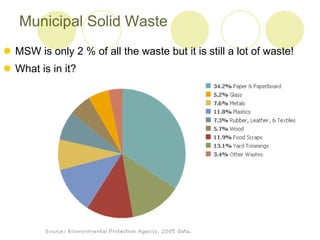
 MSW is only 2 % of all the waste but it is still a lot of waste!
 What is in it?
Recycling: Do you know these terms?
Recycling
Reusing
Reducing
Down-cycling
Recycling: A few helpful terms and definitions
 Recycling is making a new product out of an old one (e.g. making
paper out of old newspaper instead of virgin wood fiber)
 Reusing means simply extending the life of a product by reusing it
(e.g. reusing car parts, or bringing a reusable cloth bag to the store)
 Reducing is decreasing the amount of materials we use (e.g.
instead of having 15 pairs of shoes, just having 4). This is certainly
the most environmental choice and the one we should strive for.
 Down-cycling: not all products can be made into qualitatively
equal products when they are recycled. (e.g., plastic bottles cannot
be made into new plastic bottles, because recycled plastic is of lower
quality). But they can be made into park-benches. Down-cycling
also reduces the number of times a product can be recycled. This is
a particular problem with plastics and to a lesser extent true for paper
and glass. Metals can be recycled dozens of times without down-
cycling effects.
About Materials: Not all materials are created equal!
Aluminum
 A used aluminum can is recycled and back on
the grocery shelf as a new can, in as little as
60 days. That's closed loop recycling at its
finest!
 There is no limit to the amount of times an
aluminum can can be recycled.
 We use over 80,000,000,000 aluminum soda
cans every year.
 Recycling one aluminum can saves enough
energy to run a TV for three hours -- or the
equivalent of a half a gallon of gasoline.
©Copyright 2005 - 2009 Recycling-Revolution.com
About Materials: Not all materials are created equal!
Paper
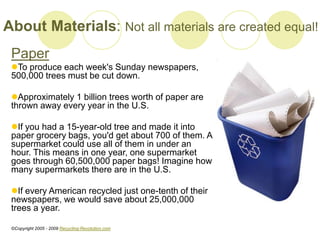
To produce each week's Sunday newspapers,
500,000 trees must be cut down.
Approximately 1 billion trees worth of paper are
thrown away every year in the U.S.
If you had a 15-year-old tree and made it into
paper grocery bags, you'd get about 700 of them. A
supermarket could use all of them in under an
hour. This means in one year, one supermarket
goes through 60,500,000 paper bags! Imagine how
many supermarkets there are in the U.S.
If every American recycled just one-tenth of their
newspapers, we would save about 25,000,000
trees a year.
©Copyright 2005 - 2009 Recycling-Revolution.com
About Materials: Not all materials are created equal!
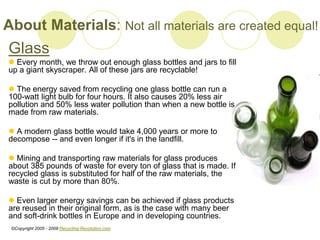
Glass
 Every month, we throw out enough glass bottles and jars to fill
up a giant skyscraper. All of these jars are recyclable!
 The energy saved from recycling one glass bottle can run a
100-watt light bulb for four hours. It also causes 20% less air
pollution and 50% less water pollution than when a new bottle is
made from raw materials.
 A modern glass bottle would take 4,000 years or more to
decompose -- and even longer if it's in the landfill.
 Mining and transporting raw materials for glass produces
about 385 pounds of waste for every ton of glass that is made. If
recycled glass is substituted for half of the raw materials, the
waste is cut by more than 80%.
 Even larger energy savings can be achieved if glass products
are reused in their original form, as is the case with many beer
and soft-drink bottles in Europe and in developing countries.
©Copyright 2005 - 2009 Recycling-Revolution.com
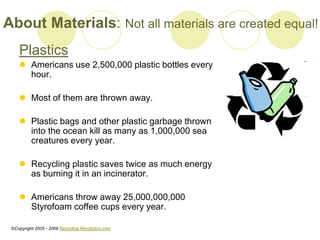
Plastics
 Americans use 2,500,000 plastic bottles every
hour.
 Most of them are thrown away.
 Plastic bags and other plastic garbage thrown
into the ocean kill as many as 1,000,000 sea
creatures every year.
 Recycling plastic saves twice as much energy
as burning it in an incinerator.
 Americans throw away 25,000,000,000
Styrofoam coffee cups every year.
About Materials: Not all materials are created equal!
©Copyright 2005 - 2009 Recycling-Revolution.com
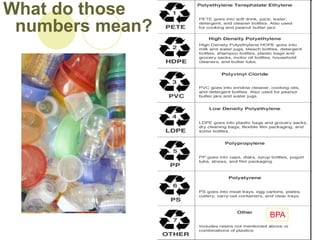
What do those
numbers mean?
BPA
Hazardous Waste
Some items contain hazardous material.
The following are common household
articles that contain hazardous materials.
Batteries
Florescent light bulbs
Cell Phones
Computers
Hazardous Waste
Batteries
 Each year billions of used batteries are disposed of into solid
waste facilities in the United States. This constitutes 88% of the
mercury and 54% of the cadmium deposited into our landfills
 Some batteries contain lead, mercury, and cadmium, with smaller
amounts of antimony, lithium, cobalt, silver, zinc, and other
chemicals. Some of these can cause serious pollution problems.
If you need to use batteries, use rechargeable.
It is even better to avoid batteries all together.
Other Recyclables
Organic Solid Waste: Composting
Another form of recycling is composting.
Composting is the aerobic biological
decomposition of organic matter, such as food
and yard wastes, into humus, a soil-like
material.
taken from http://www.epa.gov/epaoswer/non-hw/muncpl/reduce.htm
Organic Solid Waste: Composting
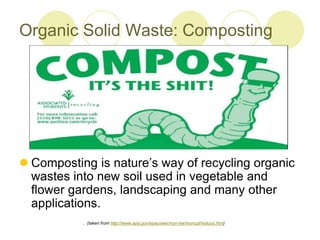
 Composting is nature’s way of recycling organic
wastes into new soil used in vegetable and
flower gardens, landscaping and many other
applications.
. (taken from http://www.epa.gov/epaoswer/non-hw/muncpl/reduce.htm)

4172050.ppt

  • 1.
  • 2.
    How Much DoWe Waste?  What we generally think of as trash is Municipal Solid Waste (MSW). This waste is also sometimes called post- consumer waste. Although most visible, this is a very small amount of the total trash we create.  Much more is created in the process of mining and manufacturing. For every ton of post-consumer waste, there is 20 tons of pre-consumer waste created along the way in the manufacturing process.  (Beyond the Wasteland, Guy Dauncey: http://www.earthfuture.com/lit/beyondthewasteland.asp)
  • 3.
    Ecological Rucksack  Theinvisible trail of resource consumption and waste is sometimes called the "ecological rucksack.” This is why it is so much more valuable to cut consumption and not just to recycle. Recycling is good, reusing is better, and if you really want to save the world: Reduce! © Seppo Leinonen
  • 4.
    Municipal Solid Waste MSW is only 2 % of all the waste but it is still a lot of waste!  What is in it?
  • 5.
    Recycling: Do youknow these terms? Recycling Reusing Reducing Down-cycling
  • 6.
    Recycling: A fewhelpful terms and definitions  Recycling is making a new product out of an old one (e.g. making paper out of old newspaper instead of virgin wood fiber)  Reusing means simply extending the life of a product by reusing it (e.g. reusing car parts, or bringing a reusable cloth bag to the store)  Reducing is decreasing the amount of materials we use (e.g. instead of having 15 pairs of shoes, just having 4). This is certainly the most environmental choice and the one we should strive for.  Down-cycling: not all products can be made into qualitatively equal products when they are recycled. (e.g., plastic bottles cannot be made into new plastic bottles, because recycled plastic is of lower quality). But they can be made into park-benches. Down-cycling also reduces the number of times a product can be recycled. This is a particular problem with plastics and to a lesser extent true for paper and glass. Metals can be recycled dozens of times without down- cycling effects.
  • 7.
    About Materials: Notall materials are created equal! Aluminum  A used aluminum can is recycled and back on the grocery shelf as a new can, in as little as 60 days. That's closed loop recycling at its finest!  There is no limit to the amount of times an aluminum can can be recycled.  We use over 80,000,000,000 aluminum soda cans every year.  Recycling one aluminum can saves enough energy to run a TV for three hours -- or the equivalent of a half a gallon of gasoline. ©Copyright 2005 - 2009 Recycling-Revolution.com
  • 8.
    About Materials: Notall materials are created equal! Paper To produce each week's Sunday newspapers, 500,000 trees must be cut down. Approximately 1 billion trees worth of paper are thrown away every year in the U.S. If you had a 15-year-old tree and made it into paper grocery bags, you'd get about 700 of them. A supermarket could use all of them in under an hour. This means in one year, one supermarket goes through 60,500,000 paper bags! Imagine how many supermarkets there are in the U.S. If every American recycled just one-tenth of their newspapers, we would save about 25,000,000 trees a year. ©Copyright 2005 - 2009 Recycling-Revolution.com
  • 9.
    About Materials: Notall materials are created equal! Glass  Every month, we throw out enough glass bottles and jars to fill up a giant skyscraper. All of these jars are recyclable!  The energy saved from recycling one glass bottle can run a 100-watt light bulb for four hours. It also causes 20% less air pollution and 50% less water pollution than when a new bottle is made from raw materials.  A modern glass bottle would take 4,000 years or more to decompose -- and even longer if it's in the landfill.  Mining and transporting raw materials for glass produces about 385 pounds of waste for every ton of glass that is made. If recycled glass is substituted for half of the raw materials, the waste is cut by more than 80%.  Even larger energy savings can be achieved if glass products are reused in their original form, as is the case with many beer and soft-drink bottles in Europe and in developing countries. ©Copyright 2005 - 2009 Recycling-Revolution.com
  • 10.
    Plastics  Americans use2,500,000 plastic bottles every hour.  Most of them are thrown away.  Plastic bags and other plastic garbage thrown into the ocean kill as many as 1,000,000 sea creatures every year.  Recycling plastic saves twice as much energy as burning it in an incinerator.  Americans throw away 25,000,000,000 Styrofoam coffee cups every year. About Materials: Not all materials are created equal! ©Copyright 2005 - 2009 Recycling-Revolution.com
  • 11.
  • 12.
    Hazardous Waste Some itemscontain hazardous material. The following are common household articles that contain hazardous materials. Batteries Florescent light bulbs Cell Phones Computers
  • 13.
    Hazardous Waste Batteries  Eachyear billions of used batteries are disposed of into solid waste facilities in the United States. This constitutes 88% of the mercury and 54% of the cadmium deposited into our landfills  Some batteries contain lead, mercury, and cadmium, with smaller amounts of antimony, lithium, cobalt, silver, zinc, and other chemicals. Some of these can cause serious pollution problems. If you need to use batteries, use rechargeable. It is even better to avoid batteries all together.
  • 14.
    Other Recyclables Organic SolidWaste: Composting Another form of recycling is composting. Composting is the aerobic biological decomposition of organic matter, such as food and yard wastes, into humus, a soil-like material. taken from http://www.epa.gov/epaoswer/non-hw/muncpl/reduce.htm
  • 15.
    Organic Solid Waste:Composting  Composting is nature’s way of recycling organic wastes into new soil used in vegetable and flower gardens, landscaping and many other applications. . (taken from http://www.epa.gov/epaoswer/non-hw/muncpl/reduce.htm)

Editor's Notes

  • #7 Have students define terms? – could have definition show up, then after they define it, the definition appears.
  • #13 Too wordy
  • #16 This is a duplicate quote