Recurrent	Convolutional	
Neural	Networks	for	
Text	Classification
Siwei Lai,	Liheng Xu,	Kang	Liu,	Jun	Zhao
AAAI	2015
読み手:周 双双
6/30/16 1
Background
- Text	classification	
◦ Feature	representation	in	previous	studies:		bag-of-words	(BoW)	model,	
where	unigrams,	bigrams	,	n-grams	or	some	exquisitely	designed	patterns.
◦ Disadvantages:	“ignore	the	contextual	information	or	word	order	in	texts	and	
remain	unsatisfactory	for	capturing	the	semantics	of	the	words.”
Word	embedding	and	deep	neural	network
6/30/16 2
Why	Recurrent	Convolutional	Neural	
Network?
◦ Recursive	Neural	Network	(RecursiveNN)
◦ Disadvantage:		”Its	performance	heavily	depends	on	the	performance	of	the	textual	tree	exhibits	a	
time	complexity	of	at	least	O(n2),	where	n	is	the	length	of	the	text.”
◦ Recurrent	Neural	Network(RecurrentNN)
◦ Disadvantage: “a	biased	model,	where	later	words	are	more	dominant	than	earlier	words”
◦ Convolutional	Neural	Network(CNN)
◦ Advantages:
◦ capture	the	semantic	of	texts	better	than	recursive	or	recurrent	NN.
◦ Time	complexity	of	CNN	is	O(n).
◦ Disadvantages:
◦ It	is	difficult	to	determine	the	window	size
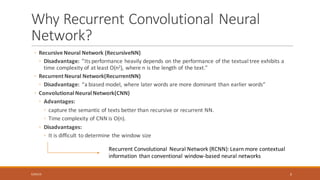
Recurrent	Convolutional	 Neural	Network	(RCNN):	Learn	more	contextual	
information	 than	conventional	window-based	neural	networks
6/30/16 3
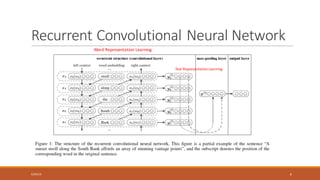
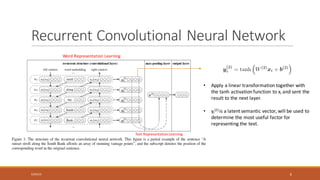
Recurrent	Convolutional	Neural	Network
Word	Representation	Learning
Text	Representation	Learning
6/30/16 4
Word	Representation	Learning	
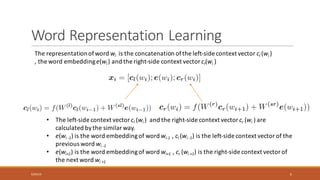
The	representation	of	word	wi is	the	concatenation	of	the	left-side	context	vector	cl	(wi )
,	the	word	embedding	e(wi )	and	the	right-side	context	vector	cr(wi )
• The	left-side	context	vector	cl	(wi )	 and	the	right-side	context	vector	cr (wi )	are	
calculated	by	the	similar	way.
• e(wi -1)	is	the	word	embedding	of	word	wi-1 ,	cl	(wi -1)	is	the	left-side	context	vector	of	the	
previous	word	wi -1
• e(wi+1)	is	the	word	embedding	of	word	wi+1 ,	cr (wi +1)	is	the	right-side	context	vector	of	
the	next	word	wi +1
6/30/16 5
Recurrent	Convolutional	Neural	Network
Word	Representation	Learning
Text	Representation	Learning
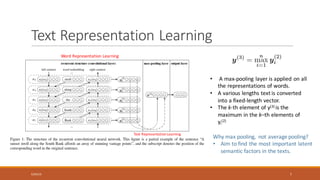
• Apply	a	linear	transformation	together	with	
the	tanh activation	function	to	xi and	sent	the	
result	to	the	next	layer.	
• yi
(2)	is	a	latent	semantic	vector,	will	be	used	to	
determine	the	most	useful	factor	for	
representing	the	text.
6/30/16 6
Text	Representation	Learning
Word	Representation	Learning
Text	Representation	Learning
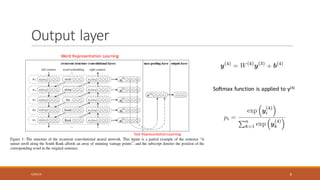
• A	max-pooling	layer	is	applied	on	all	
the	representations	of	words.
• A	various	lengths	text	is	converted	
into	a	fixed-length	vector.
• The	k-th element	of	y(3)	is	the	
maximum	in	the	k–th elements	of	
yi
(2)
Why	max	pooling,	 not	average	pooling?
• Aim	to	find	the	most	important	latent	
semantic	factors	in	the	texts.
6/30/16 7
Output	layer
Word	Representation	Learning
Text	Representation	Learning
Softmax function	is	applied	to	y(4)
6/30/16 8
Training	network	parameters
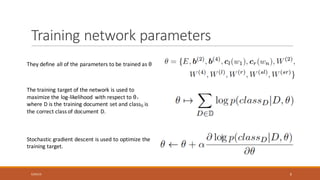
They	define	all	of	the	parameters	to	be	trained	as θ
The	training	target	of	the	network	is	used	to	
maximize	the	log-likelihood	 with	respect	to θ,
where	D	is	the	training	document	set	and	classD is	
the	correct	class	of	document	D.	
Stochastic	gradient	descent	is	used	to	optimize	the	
training	target.
6/30/16 9
Dataset	and	Experiments	settings
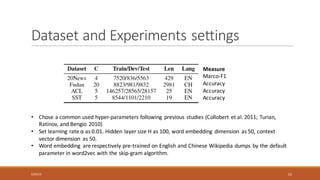
Measure
Marco-F1
Accuracy
Accuracy
Accuracy
• Chose	a	common	used	hyper-parameters	following	 previous	studies	(Collobert et	al.	2011;	Turian,	
Ratinov,	and	Bengio 2010)
• Set	learning	rate	α as	0.01.	Hidden	layer	size	H	as	100,	word	embedding	 dimension	 as	50,	context	
vector	dimension	 as	50.	
• Word	embedding	 are	respectively	pre-trained	on	English	and	Chinese	Wikipedia	dumps	by	the	default	
parameter	in	word2vec	with	the	skip-gram	algorithm.
6/30/16 10
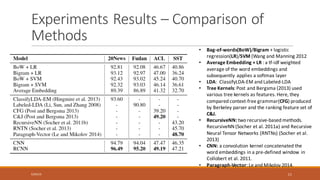
Experiments	Results	– Comparison	of	
Methods	
• Bag-of-words(BoW)/Bigram +	logistic	
regression(LR)/SVM (Wang	and	Manning	2012
• Average	Embedding	+	LR	: a	tf-idf weighted	
average	of	the	word	embeddings and	
subsequently	applies	a	softmax layer
• LDA:		ClassifyLDA-EM	and	Labeled-LDA
• Tree	Kernels:	Post	and	Bergsma	(2013)	used	
various	tree	kernels	as	features.	Here,	they	
compared	context-free	grammar(CFG)	produced	
by	Berkeley	parser	and	the	ranking	feature	set	of	
C&J.
• RecursiveNN:	two	recursive-based	methods.	
RecursiveNN (Socher et	al.	2011a)	and	Recursive	
Neural	Tensor	Networks	(RNTNs)	(Socher et	al.	
2013)
• CNN:	a	convolution	kernel	concatenated	the	
word	embeddings in	a	pre-defined	window	in	
Collobert et	al.	2011.	
• Paragraph-Vector:	Le	and	Mikolov 2014.
6/30/16 11
Experiments	Results	and	Discussion
6/30/16 12
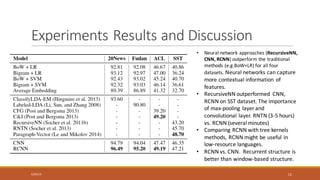
• Neural	network	approaches	(RecursiveNN,	
CNN,	RCNN)	outperform	the	traditional	
methods	(e.g.BoW+LR)	for	all	four	
datasets.	Neural	networks	can	capture	
more	contextual	information	 of	
features.
• RecursiveNN outperformed	 CNN,	
RCNN	on	SST	dataset.	The	importance	
of	max-pooling	 layer	and	
convolutional	layer.	RNTN	(3-5	hours)	
vs.	RCNN	(several	minutes)
• Comparing	RCNN	with	tree	kernels	
methods,	RCNN	might	be	useful	in	
low-resource	languages.			
• RCNN	vs.	CNN.		Recurrent	structure	is	
better	than	window-based	structure.
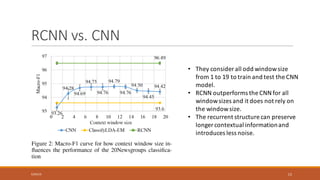
RCNN	vs.	CNN
6/30/16 13
• They	consider	all	odd	window	size	
from	1	to	19	to	train	and	test	the	CNN	
model.	
• RCNN	outperforms	the	CNN	for	all	
window	sizes	and	it	does	not	rely	on	
the	window	size.	
• The	recurrent	structure	can	preserve	
longer	contextual	information	and	
introduces	less	noise.
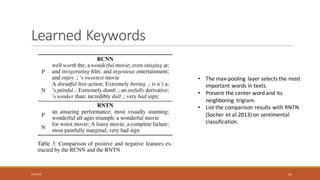
Learned	Keywords
6/30/16 14
• The	max-pooling	 layer	selects	the	most	
important	words	in	texts.
• Present	the	center	word	and	its	
neighboring	 trigram.	
• List	the	comparison	results	with	RNTN	
(Socher et	al.2013)	on	sentimental	
classification.
感想
◦ RCNN	Does	rely	on	a	syntactic	parser.
◦ RCNN	might	be	useful	in	low-resource	languages.	
◦ RCNN	has	a	lower	time	complexity	of	O(n).	
◦ Limitation	of	RCNN?
◦ Their	model	can	capture	the	key	components	in	texts	for	text	classification
Capture	the	key	components	for	disambiguation?
Plan	to	apply	RCNN	on	other	tasks
6/30/16 15
Source	codes:
https://github.com/knok/rcnn-text-classification

Recurrent Convolutional Neural Networks for Text Classification