Sequence Modeling: Recurrent
and Recursive Nets
1. Sequential Data and RNN Overview
2. Unfolding Computational Graphs
3. Recurrent Neural Networks
4. Bidirectional RNNs
5. Encoder-Decoder Sequence-to-Sequence Architectures
6. Deep Recurrent Networks
7. Recursive Neural Networks
8. The Challenge of Long-Term Dependencies
9. Echo-State Networks
10.Leaky Units and Other Strategies for Multiple Time
Scales
11.LSTM and Other Gated RNNs
12.Optimization for Long-Term Dependencies
13.Explicit Memory
• Often arise through measurement of time
series
• Acoustic features at successive time frames in
speech recognition
• Sequence of characters in an English sentence
• Parts of speech of successive words
• Snowfall measurements on successive days
• Rainfall measurements on successive days
• Daily values of currency exchange rate
• Nucleotide base pairs in a strand of DNA
Sequential Data Examples
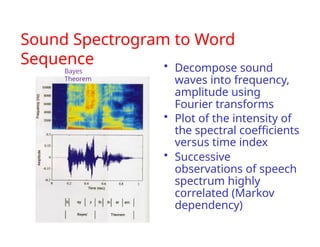
Sound Spectrogram to Word
Sequence • Decompose sound
waves into frequency,
amplitude using
Fourier transforms
• Plot of the intensity of
the spectral coefficients
versus time index
• Successive
observations of speech
spectrum highly
correlated (Markov
dependency)
Bayes
Theorem
Two common tasks with sequential
data
1. NLP: Named Entity Recognition
• Input: Jim bought 300 shares of Acme Corp. in 2006
• NER: [Jim]Person bought 300 shares of [Acme Corp.]Organization in [2006]Time
2. Machine Translation: Echte dicke kiste  Awesome sauce
3. Sequence-to-symbol
1. Sentiment:
• Best movie ever  Positive
2. Speaker recognition
• Sound spectrogram  Harry
1. Sequence-to-sequence
1. Speech recognition using a sound spectrogram
• decompose sound waves into frequency, amplitude using Fourier
transforms
 “Nineteenth Century”
Frequencies increase up the vertical axis, and time on the horizontal
axis. The lower frequencies are more dense because it is a male
voice.
Legend on right shows that the color intensity increases with density
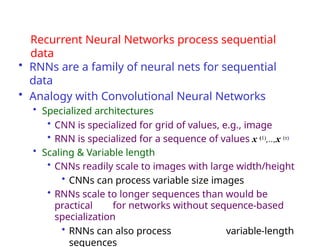
Recurrent Neural Networks process sequential
data
• RNNs are a family of neural nets for sequential
data
• Analogy with Convolutional Neural Networks
• Specialized architectures
• CNN is specialized for grid of values, e.g., image
• RNN is specialized for a sequence of values x (1),..,x (τ)
• Scaling & Variable length
• CNNs readily scale to images with large width/height
• CNNs can process variable size images
• RNNs scale to longer sequences than would be
practical for networks without sequence-based
specialization
• RNNs can also process variable-length
sequences
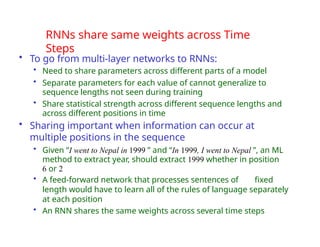
RNNs share same weights across Time
Steps
• To go from multi-layer networks to RNNs:
• Need to share parameters across different parts of a model
• Separate parameters for each value of cannot generalize to
sequence lengths not seen during training
• Share statistical strength across different sequence lengths and
across different positions in time
• Sharing important when information can occur at
multiple positions in the sequence
• Given “I went to Nepal in 1999 ” and “In 1999, I went to Nepal ”, an ML
method to extract year, should extract 1999 whether in position
6 or 2
• A feed-forward network that processes sentences of fixed
length would have to learn all of the rules of language separately
at each position
• An RNN shares the same weights across several time steps
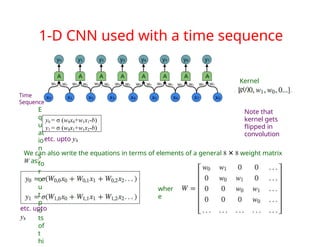
1-D CNN used with a time sequence
Kernel
g(t):
etc. upto y8
We can also write the equations in terms of elements of a general 8 ✕ 8 weight matrix
W as:
wher
e
Time
Sequence
E
q
u
at
io
n
s
fo
r
o
u
t
p
u
ts
of
t
hi
Note that
kernel gets
flipped in
convolution
y0 = σ (w0x0+w1x1-b)
y1 = σ (w0x1+w1x2-b)
etc. upto
y8
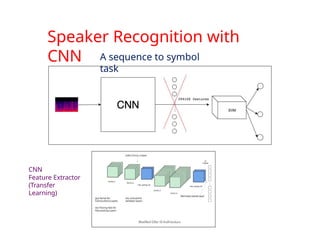
Speaker Recognition with
CNN
CNN
Feature Extractor
(Transfer
Learning)
A sequence to symbol
task
Deep Learning
Srihari
Time Delay Neural Networks
(TDNNs)
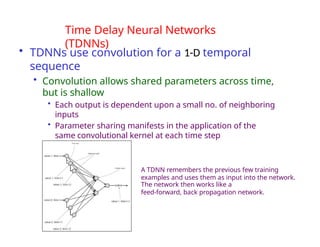
• TDNNs use convolution for a 1-D temporal
sequence
• Convolution allows shared parameters across time,
but is shallow
• Each output is dependent upon a small no. of neighboring
inputs
• Parameter sharing manifests in the application of the
same convolutional kernel at each time step
A TDNN remembers the previous few training
examples and uses them as input into the network.
The network then works like a
feed-forward, back propagation network.
Deep Learning
Srihari
RNN vs. TDNN
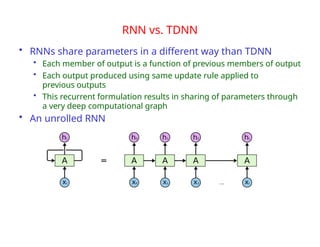
• RNNs share parameters in a different way than TDNN
• Each member of output is a function of previous members of output
• Each output produced using same update rule applied to
previous outputs
• This recurrent formulation results in sharing of parameters through
a very deep computational graph
• An unrolled RNN
Computational Graphs for
RNNs
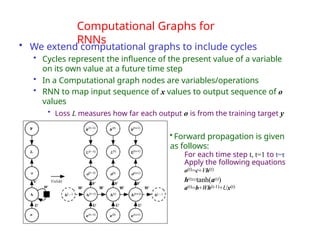
• We extend computational graphs to include cycles
• Cycles represent the influence of the present value of a variable
on its own value at a future time step
• In a Computational graph nodes are variables/operations
• RNN to map input sequence of x values to output sequence of o
values
• Loss L measures how far each output o is from the training target y
• Forward propagation is given
as follows:
For each time step t, t=1 to t=τ
Apply the following equations
o(t)=c+Vh(t)
h(t)=tanh(a(t))
a(t)=b+Wh(t-1)+Ux(t)
RNN operating on a
sequence
• RNNs operate on a sequence that contain vector x(t) with
time step index t, ranging from 1 to τ
• Sequence: x(1),..,x(τ)
• RNNs operate on minibatches of sequences of length τ
• Some remarks about sequences
• The steps need not refer to passage of time in the real world
• RNNs can be applied in two-dimensions across spatial data
such as image
• Even when applied to time sequences, network may have
connections going backwards in time, provided entire sequence is
observed before it is provided to network
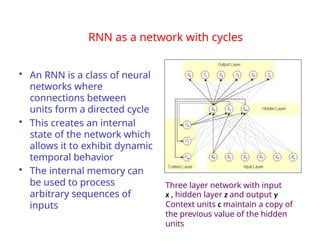
RNN as a network with cycles
• An RNN is a class of neural
networks where
connections between
units form a directed cycle
• This creates an internal
state of the network which
allows it to exhibit dynamic
temporal behavior
• The internal memory can
be used to process
arbitrary sequences of
inputs
Three layer network with input
x , hidden layer z and output y
Context units c maintain a copy of
the previous value of the hidden
units
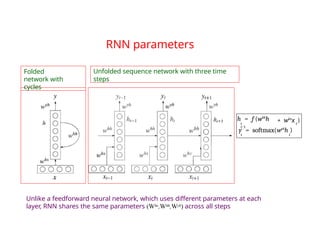
RNN parameters
Folded
network with
cycles
Unfolded sequence network with three time
steps
h = f (whh
h
t
t−1
t
+ whx
x )
y = softmax(wyh
h )
t t
Unlike a feedforward neural network, which uses different parameters at each
layer, RNN shares the same parameters (Whx,Whh,Wyh) across all steps
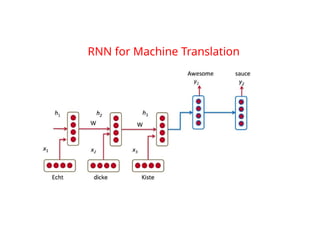
RNN for Machine Translation
Limitation of length of time steps
• Length of time steps is determined by length of input
• e.g., if word sequence to be processed is a sentence of six words,
RNN would be unfolded into a neural net with six time steps
or layers.
• One layer corresponds to a word
• Theoretically, RNN can make use of the
information in arbitrarily long sequences
• In practice, RNN is limited to looking back only a few steps
due to the vanishing gradient or exploding gradient problem
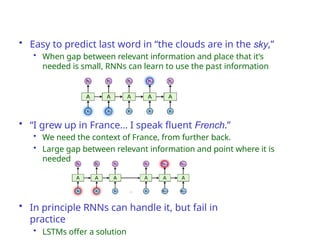
• Easy to predict last word in “the clouds are in the sky,”
• When gap between relevant information and place that it’s
needed is small, RNNs can learn to use the past information
• “I grew up in France… I speak fluent French.”
• We need the context of France, from further back.
• Large gap between relevant information and point where it is
needed
• In principle RNNs can handle it, but fail in
practice
• LSTMs offer a solution
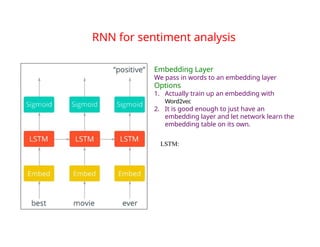
RNN for sentiment analysis
Embedding Layer
We pass in words to an embedding layer
Options
1. Actually train up an embedding with
Word2vec
2. It is good enough to just have an
embedding layer and let network learn the
embedding table on its own.
LSTM:
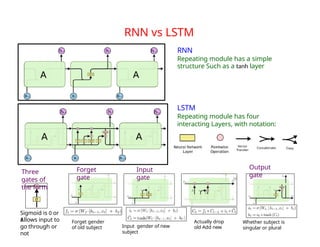
RNN vs LSTM
RNN
Repeating module has a simple
structure Such as a tanh layer
LSTM
Repeating module has four
interacting Layers, with notation:
Three
gates of
the form
Sigmoid is 0 or
1
Allows input to
go through or
not
Forget
gate
Forget gender
of old subject
Input
gate
Input gender of new
subject
Output
gate
Actually drop
old Add new
Whether subject is
singular or plural
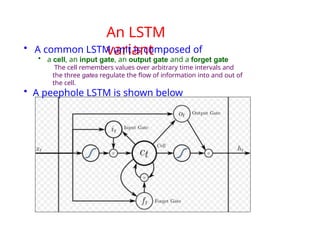
An LSTM
variant
• A common LSTM unit is composed of
• a cell, an input gate, an output gate and a forget gate
The cell remembers values over arbitrary time intervals and
the three gates regulate the flow of information into and out of
the cell.
• A peephole LSTM is shown below
Source:
http://www.cs.cmu.edu/~epxing/Class/10708-
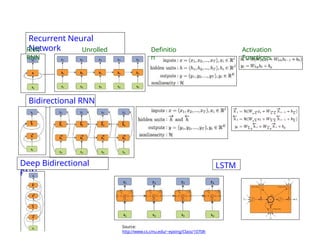
Recurrent Neural
Network Activation
Functions
RNN Unrolled
RNN
Definitio
n
Bidirectional RNN
Deep Bidirectional
RNN
LSTM
Attention Mechanisms
• Long range dependencies are still a problem with LSTMs
• With an attention mechanism we no longer try encode
the full source sentence into a fixed-length vector
• Rather, we allow the decoder to “attend” to different parts of the
source sentence at each step of the output generation
• Attention is simply a vector, often the outputs of dense
layer using softmax function.
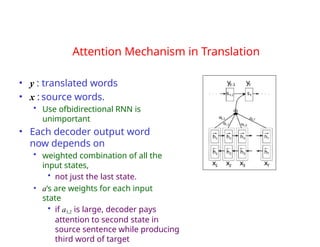
Attention Mechanism in Translation
• y : translated words
• x : source words.
• Use ofbidirectional RNN is
unimportant
• Each decoder output word
now depends on
• weighted combination of all the
input states,
• not just the last state.
• a‘s are weights for each input
state
• if a3,2 is large, decoder pays
attention to second state in
source sentence while producing
third word of target
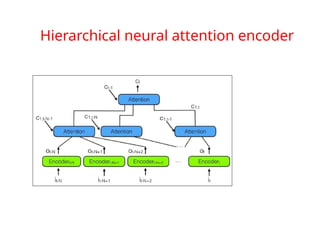
Hierarchical neural attention encoder
• In deep learning:
• Tasks of interest:
• Classification
• Feature
learning
• Method of
learning
• Backpropag
ation and
gradient
descent
• In graphical
models:
• Tasks of
interest:
• Transfer
learning
• Latent
variable
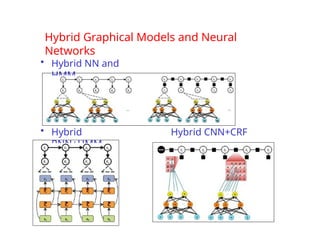
Hybrid Graphical Models and Neural
Networks
• Hybrid NN and
HMM
• Hybrid
RNN+HMM
Hybrid CNN+CRF
Topics in Sequence
Modeling
• Recurrent Neural Networks
1. Unfolding Computational Graphs
2. Recurrent Neural Networks
3. Bidirectional RNNs
4. Encoder-Decoder Sequence-to-Sequence Architectures
5. Deep Recurrent Networks
6. Recursive Neural Networks
7. The Challenge of Long-Term Dependencies
8. Echo-State Networks
9. Leaky Units and Other Strategies for Multiple Time
Scales
10.LSTM and Other Gated RNNs
11. Optimization for Long-Term Dependencies
12.Explicit Memory
Unfolding Computational
Graphs
• A Computational Graph is a way to formalize the structure
of a set of computations
• Such as mapping inputs and parameters to outputs and loss
• We can unfold a recursive or recurrent computation
into a computational graph that has a repetitive
structure
• Corresponding to a chain of events
• Unfolding this graph results in sharing of parameters
across a deep network structure
Example of unfolding a recurrent
equation
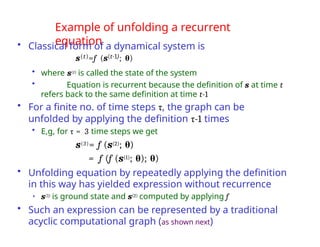
• Classical form of a dynamical system is
s(t)=f (s(t-1); θ)
• where s(t) is called the state of the system
• Equation is recurrent because the definition of s at time t
refers back to the same definition at time t-1
• For a finite no. of time steps τ, the graph can be
unfolded by applying the definition τ-1 times
• E,g, for τ = 3 time steps we get
s(3)= f (s(2); θ)
= f (f (s(1); θ); θ)
• Unfolding equation by repeatedly applying the definition
in this way has yielded expression without recurrence
• s(1) is ground state and s(2) computed by applying f
• Such an expression can be represented by a traditional
acyclic computational graph (as shown next)
Unfolded dynamical
system
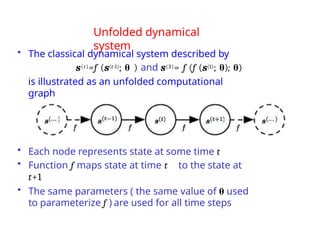
• The classical dynamical system described by
s(t)=f (s(t-1); θ ) and s(3)= f (f (s(1); θ); θ)
is illustrated as an unfolded computational
graph
• Each node represents state at some time t
• Function f maps state at time t to the state at
t+1
• The same parameters ( the same value of θ used
to parameterize f ) are used for all time steps
Dynamical system driven by external signal
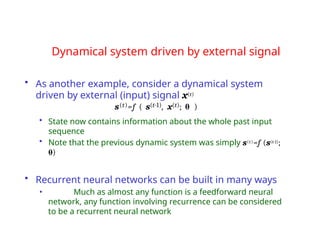
• As another example, consider a dynamical system
driven by external (input) signal x(t)
s(t)=f ( s(t-1), x(t); θ )
• State now contains information about the whole past input
sequence
• Note that the previous dynamic system was simply s(t)=f (s(t-1);
θ)
• Recurrent neural networks can be built in many ways
• Much as almost any function is a feedforward neural
network, any function involving recurrence can be considered
to be a recurrent neural network
Defining values of hidden units in
RNNs
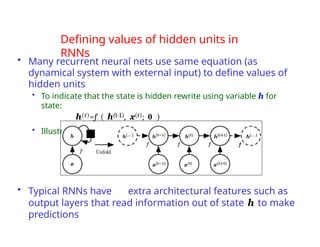
• Many recurrent neural nets use same equation (as
dynamical system with external input) to define values of
hidden units
• To indicate that the state is hidden rewrite using variable h for
state:
h(t)=f ( h(t-1), x(t); θ )
• Illustrated below:
• Typical RNNs have extra architectural features such as
output layers that read information out of state h to make
predictions
A recurrent network with no
outputs
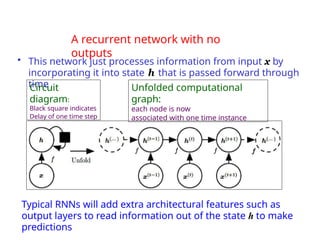
• This network just processes information from input x by
incorporating it into state h that is passed forward through
time
Circuit
diagram:
Black square indicates
Delay of one time step
Unfolded computational
graph:
each node is now
associated with one time instance
Typical RNNs will add extra architectural features such as
output layers to read information out of the state h to make
predictions
Predicting the Future from the Past
• When RNN is required to perform a task of predicting the
future from the past, network typically learns to use h(t) as
a lossy summary of the task-relevant aspects of the past
sequence of inputs upto t
• The summary is in general lossy since it maps a sequence
of arbitrary length (x(t), x(t-1),..,x(2),x(1)) to a fixed length
vector h(t)
Information Contained in Summary
• Depending on criterion, summary keeps some
aspects of past sequence more precisely than other
aspects
• Examples:
• RNN used in statistical language modeling,
typically to predict next word from past words
• it may not be necessary to store all information upto time t but
only enough information to predict rest of sentence
• Most demanding situation: we ask h(t) to be rich
enough to allow one to approximately recover the input
sequence as in autoencoders
Deep Learning
Srihari
Unfolding: from circuit diagram to computational
graph
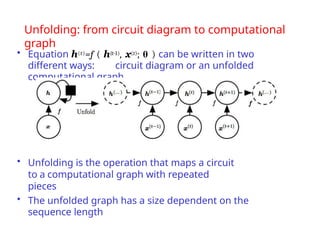
• Equation h(t)=f ( h(t-1), x(t); θ ) can be written in two
different ways: circuit diagram or an unfolded
computational graph
• Unfolding is the operation that maps a circuit
to a computational graph with repeated
pieces
• The unfolded graph has a size dependent on the
sequence length
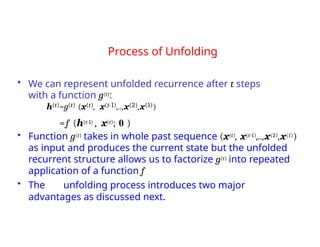
Process of Unfolding
• We can represent unfolded recurrence after t steps
with a function g(t):
h(t)=g(t) (x(t), x(t-1),..,x(2),x(1))
=f (h(t-1) , x(t); θ )
• Function g(t) takes in whole past sequence (x(t), x(t-1),..,x(2),x(1))
as input and produces the current state but the unfolded
recurrent structure allows us to factorize g(t) into repeated
application of a function f
• The unfolding process introduces two major
advantages as discussed next.
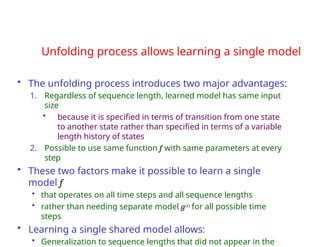
Unfolding process allows learning a single model
• The unfolding process introduces two major advantages:
1. Regardless of sequence length, learned model has same input
size
• because it is specified in terms of transition from one state
to another state rather than specified in terms of a variable
length history of states
2. Possible to use same function f with same parameters at every
step
• These two factors make it possible to learn a single
model f
• that operates on all time steps and all sequence lengths
• rather than needing separate model g(t) for all possible time
steps
• Learning a single shared model allows:
• Generalization to sequence lengths that did not appear in the
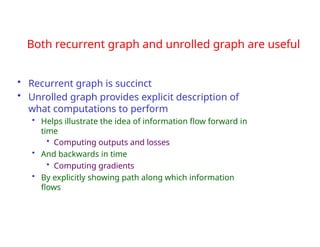
Both recurrent graph and unrolled graph are useful
• Recurrent graph is succinct
• Unrolled graph provides explicit description of
what computations to perform
• Helps illustrate the idea of information flow forward in
time
• Computing outputs and losses
• And backwards in time
• Computing gradients
• By explicitly showing path along which information
flows
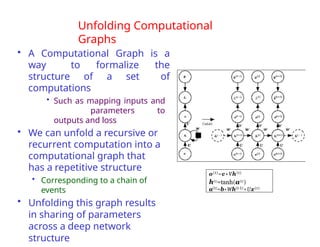
Unfolding Computational
Graphs
• A Computational Graph is a
way to formalize the
structure of a set of
computations
• Such as mapping inputs and
parameters to
outputs and loss
• We can unfold a recursive or
recurrent computation into a
computational graph that
has a repetitive structure
• Corresponding to a chain of
events
• Unfolding this graph results
in sharing of parameters
across a deep network
structure
o(t)=c+Vh(t)
h(t)=tanh(a(t))
a(t)=b+Wh(t-1)+Ux(t)
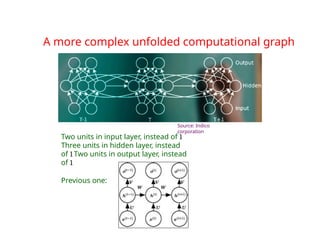
A more complex unfolded computational graph
Source: Indico
corporation
Two units in input layer, instead of 1
Three units in hidden layer, instead
of 1 Two units in output layer, instead
of 1
Previous one:
Topics in Sequence
Modeling
• Overview
1. Unfolding Computational Graphs
2. Recurrent Neural Networks
3. Bidirectional RNNs
4. Encoder-Decoder Sequence-to-Sequence Architectures
5. Deep Recurrent Networks
6. Recursive Neural Networks
7. The Challenge of Long-Term Dependencies
8. Echo-State Networks
9. Leaky Units and Other Strategies for Multiple Time
Scales
10.LSTM and Other Gated RNNs
11. Optimization for Long-Term Dependencies
12.Explicit Memory
Topics in Recurrent Neural Networks
1. Overview
• Design patterns for RNNs
• RNN with recurrence between hidden units
• Forward propagation equations
• Loss function for a sequence
• RNN with recurrence from output units to hidden units
2. Teacher forcing for output-to-hidden RNNs
• Backward Propagation through time (BPTT)
3. Computing the gradient in a RNN
4. RNNs as Directed Graphical Models
5. Modeling Sequences Conditioned on Context with
RNNs
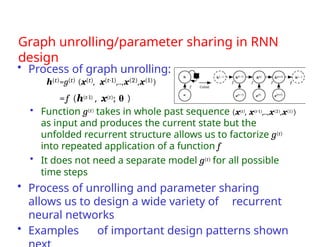
Graph unrolling/parameter sharing in RNN
design
• Process of graph unrolling:
h(t)=g(t) (x(t), x(t-1),..,x(2),x(1))
=f (h(t-1) , x(t); θ )
• Function g(t) takes in whole past sequence (x(t), x(t-1),..,x(2),x(1))
as input and produces the current state but the
unfolded recurrent structure allows us to factorize g(t)
into repeated application of a function f
• It does not need a separate model g(t) for all possible
time steps
• Process of unrolling and parameter sharing
allows us to design a wide variety of recurrent
neural networks
• Examples of important design patterns shown
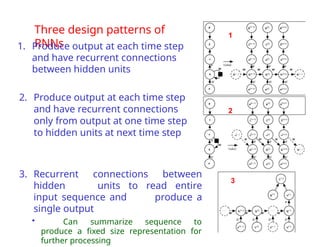
Three design patterns of
RNNs
1. Produce output at each time step
and have recurrent connections
between hidden units
2. Produce output at each time step
and have recurrent connections
only from output at one time step
to hidden units at next time step
3. Recurrent connections between
hidden units to read entire
input sequence and produce a
single output
• Can summarize sequence to
produce a fixed size representation for
further processing
5
2
3
1
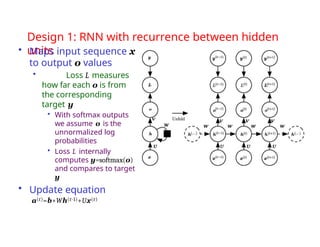
Design 1: RNN with recurrence between hidden
units
• Maps input sequence x
to output o values
• Loss L measures
how far each o is from
the corresponding
target y
• With softmax outputs
we assume o is the
unnormalized log
probabilities
• Loss L internally
computes y=softmax(o)
and compares to target
y
• Update equation
a(t)=b+Wh(t-1)+Ux(t)
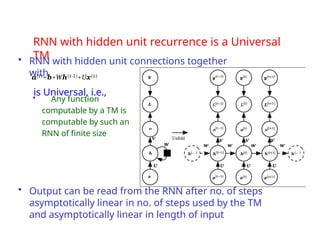
RNN with hidden unit recurrence is a Universal
TM
• RNN with hidden unit connections together
with
a(t)=b+Wh(t-1)+Ux(t)
is Universal, i.e.,
• Any function
computable by a TM is
computable by such an
RNN of finite size
• Output can be read from the RNN after no. of steps
asymptotically linear in no. of steps used by the TM
and asymptotically linear in length of input
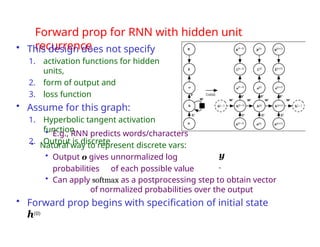
Forward prop for RNN with hidden unit
recurrence
• This design does not specify
1. activation functions for hidden
units,
2. form of output and
3. loss function
• Assume for this graph:
1. Hyperbolic tangent activation
function
2. Output is discrete
• E.g., RNN predicts words/characters
• Natural way to represent discrete vars:
• Output o gives unnormalized log
probabilities of each possible value
• Can apply softmax as a postprocessing step to obtain vector
of normalized probabilities over the output
• Forward prop begins with specification of initial state
h(0)
y
ˆ
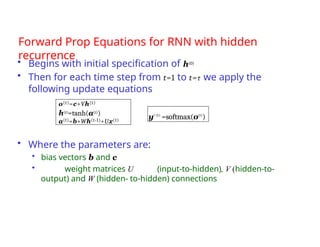
Forward Prop Equations for RNN with hidden
recurrence
• Begins with initial specification of h(0)
• Then for each time step from t=1 to t=τ we apply the
following update equations
• Where the parameters are:
• bias vectors b and c
• weight matrices U (input-to-hidden), V (hidden-to-
output) and W (hidden- to-hidden) connections
yˆ(t)
=softmax(o(t)
)
o(t)=c+Vh(t)
h(t)=tanh(a(t))
a(t)=b+Wh(t-1)+Ux(t)
• where pmodel is given by reading the entry for y(t) from the model’s
output
vecto
r
t
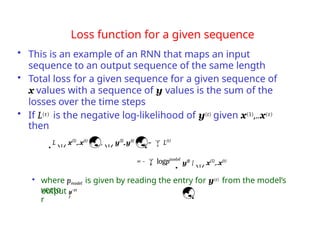
Loss function for a given sequence
• This is an example of an RNN that maps an input
sequence to an output sequence of the same length
• Total loss for a given sequence for a given sequence of
x values with a sequence of y values is the sum of the
losses over the time steps
• If L(t) is the negative log-likelihood of y(t) given x(1),..x(t)
then
Lx(1)
,..x(t)
,y(1)
,..y(t)
= L(t)
model
t
= - logp y(t)
|x(1)
,..x(t)

yˆ(t
)
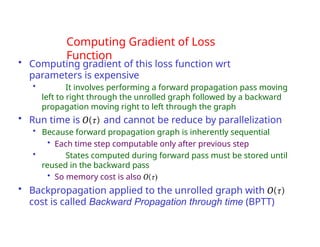
Computing Gradient of Loss
Function
• Computing gradient of this loss function wrt
parameters is expensive
• It involves performing a forward propagation pass moving
left to right through the unrolled graph followed by a backward
propagation moving right to left through the graph
• Run time is O(τ) and cannot be reduce by parallelization
• Because forward propagation graph is inherently sequential
• Each time step computable only after previous step
• States computed during forward pass must be stored until
reused in the backward pass
• So memory cost is also O(τ)
• Backpropagation applied to the unrolled graph with O(τ)
cost is called Backward Propagation through time (BPTT)
Backward Propagation through Time (BPTT)
• RNN with hidden unit recurrence is very powerful but
also expensive to train
• Is there an alternative?
Topics in Sequence
Modeling
• Recurrent Neural Networks
1. Unfolding Computational Graphs
2. Recurrent Neural Networks
3. Bidirectional RNNs
4. Encoder-Decoder Sequence-to-Sequence Architectures
5. Deep Recurrent Networks
6. Recursive Neural Networks
7. The Challenge of Long-Term Dependencies
8. Echo-State Networks
9. Leaky Units and Other Strategies for Multiple Time
Scales
10.LSTM and Other Gated RNNs
11. Optimization for Long-Term Dependencies
12.Explicit Memory
Topics in Recurrent Neural Networks
• Overview
• Design patterns for RNNs
• RNN with recurrence between hidden units
• Forward propagation equations
• Loss function for a sequence
• RNN with recurrence from output units to hidden units
1. Teacher forcing and Networks with Output
Recurrences
2. Computing the gradient in a RNN
3. Recurrent Networks as Graphical Models
4. Modeling Sequences Conditioned on Context with
RNNs
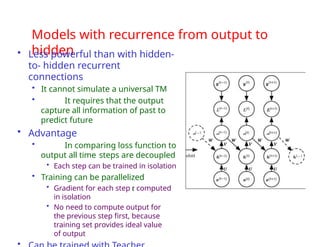
Models with recurrence from output to
hidden
• Less powerful than with hidden-
to- hidden recurrent
connections
• It cannot simulate a universal TM
• It requires that the output
capture all information of past to
predict future
• Advantage
• In comparing loss function to
output all time steps are decoupled
• Each step can be trained in isolation
• Training can be parallelized
• Gradient for each step t computed
in isolation
• No need to compute output for
the previous step first, because
training set provides ideal value
of output
•
Teacher Forcing
• Used for training models with recurrent
connections from their outputs
• Teacher forcing during training means
• Instead of summing activations from incoming
units (possibly erroneous)
• Each unit sums correct teacher activations as
input for the next iteration
Teacher Forcing Procedure
• Teacher forcing is a procedure for training RNNs with
output-to- hidden recurrence
• It emerges from the maximum likelihood criterion
• During training time model receives ground truth output
y(t) as input at time t+1
• We can see this by examining a sequence with two time steps
(next)
Maximum Likelihood in Teacher
Forcing
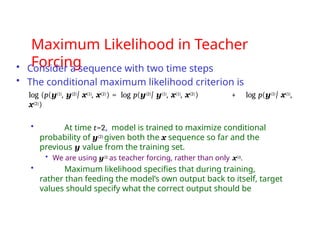
• Consider a sequence with two time steps
• The conditional maximum likelihood criterion is
log (p(y(1), y(2)| x(1), x(2)) = log p(y(2)| y(1), x(1), x(2)) + log p(y(1)| x(1),
x(2))
• At time t=2, model is trained to maximize conditional
probability of y(2) given both the x sequence so far and the
previous y value from the training set.
• We are using y(1) as teacher forcing, rather than only x(i).
• Maximum likelihood specifies that during training,
rather than feeding the model’s own output back to itself, target
values should specify what the correct output should be
Illustration of Teacher
Forcing
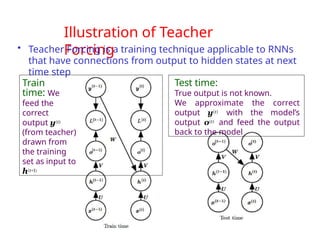
• Teacher Forcing is a training technique applicable to RNNs
that have connections from output to hidden states at next
time step
Train
time: We
feed the
correct
output y(t)
(from teacher)
drawn from
the training
set as input to
h(t+1)
Test time:
True output is not known.
We approximate the correct
output y(t) with the model’s
output o(t) and feed the output
back to the model
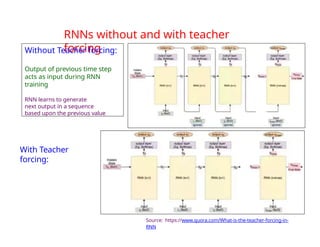
RNNs without and with teacher
forcing
Without Teacher forcing:
Output of previous time step
acts as input during RNN
training
RNN learns to generate
next output in a sequence
based upon the previous value
With Teacher
forcing:
Source: https://www.quora.com/What-is-the-teacher-forcing-in-
RNN
Visualizing Teacher Forcing
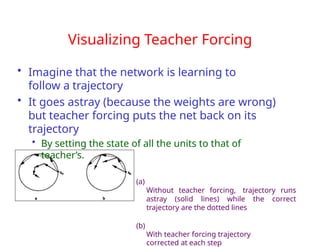
• Imagine that the network is learning to
follow a trajectory
• It goes astray (because the weights are wrong)
but teacher forcing puts the net back on its
trajectory
• By setting the state of all the units to that of
teacher’s.
(a)
Without teacher forcing, trajectory runs
astray (solid lines) while the correct
trajectory are the dotted lines
(b)
With teacher forcing trajectory
corrected at each step
Teacher forcing for hidden-to-hidden
• We originally motivated teacher forcing as allowing us to
avoid backpropagation through time in models that lack
hidden-to- hidden connections
• Teacher forcing can still be applied to models that have
hidden- to-hidden connections
• As long as they have connections from the output at one
time step to values computed at the next time step
• As soon aas the hidden units become functions of earlier
time steps, BPTT algorithm is necessary
Training with both Teacher Forcing and BPTT
• Some models may be trained with both Teacher forcing
and Backward Propagation through time (BPTT)
• When there are both hidden-to-hidden recurrences as well as
output-to- hidden recurrences
Disadvantage of Teacher
Forcing
• If network is to be used in an open-loop mode with
network outputs (or samples from the output
distribution) fed back as inputs
• In this case the kind of inputs that it will see during training
time could be quite different from that it will see at test time
• Solutions to mitigate this problem:
1. Train with both teacher-forced inputs and free running inputs
• E.g., predicting the correct target a no of steps in the future
through the unfolded recurrent output-to-input paths
• Thus network can learn to take into account input conditions not
seen during training
2. Mitigate the gap between inputs seen at training time and test
time by
generating values as input
• This approach exploits a curriculum learning strategy to gradually use
more of the generated values as input
Professor
Forcing
• Teacher Forcing trains RNNs by supplying observed
sequence values as inputs during training and using the
network’s own one-step-ahead predictions to do multi-step
sampling
• Professor Forcing algorithm
• Uses adversarial domain adaptation to encourage the
dynamics of the RNN to be the same when training the network and
when sampling from the network over multiple time steps.
• Applied to
• language modeling
• vocal synthesis on raw waveforms
• handwriting generation
• image generation
• Professor Forcing is an adversarial method for
learning generative models
• It is closely related to Generative Adversarial Networks
Topics in Recurrent Neural Networks
1. Overview
2. Teacher forcing and Networks with Output
Recurrence
3. Computing the gradient in a RNN
4. RNNs as Directed Graphical Models
5. Modeling Sequences Conditioned on Context with
RNNs
3
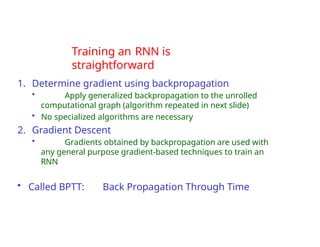
Training an RNN is
straightforward
1. Determine gradient using backpropagation
• Apply generalized backpropagation to the unrolled
computational graph (algorithm repeated in next slide)
• No specialized algorithms are necessary
2. Gradient Descent
• Gradients obtained by backpropagation are used with
any general purpose gradient-based techniques to train an
RNN
• Called BPTT: Back Propagation Through Time
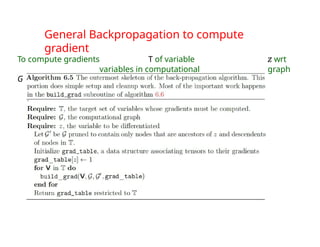
General Backpropagation to compute
gradient
To compute gradients T of variable z wrt
variables in computational graph
G
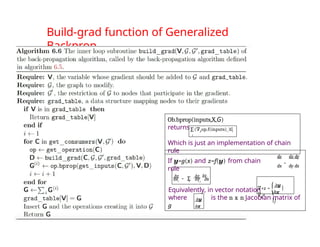
Build-grad function of Generalized
Backprop
dz dz dy
dx
=
dy dx
∂xi
∂yj
∂x
j
∂z
= ∑
∂z ∂yj
If y=g(x) and z=f(y) from chain
rule
Equivalently, in vector notation
where is the n x n Jacobian matrix of
g
x
⎜
⎝∂x
⎟⎠
⎛ ∂y
⎞
T
∇ z = ⎟
∇y
z
∂y
∂x
Ob.bprop(inputs,X,G)
returns
Which is just an implementation of chain
rule
∑(∇X
op.f(inputs)i
)Gi
i
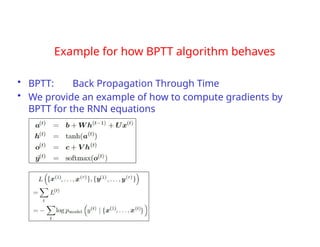
Example for how BPTT algorithm behaves
• BPTT: Back Propagation Through Time
• We provide an example of how to compute gradients by
BPTT for the RNN equations
Intuition of how BPTT algorithm
behaves
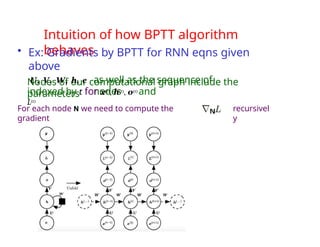
• Ex: Gradients by BPTT for RNN eqns given
above
Nodes of our computational graph include the
parameters
U, V, W, b, c as well as the sequence of
nodes
indexed by t for x(t), h(t), o(t) and
L(t)
For each node N we need to compute the
gradient
recursivel
y
Computing BPTT gradients
recursively
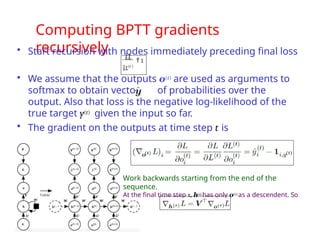
• Start recursion with nodes immediately preceding final loss
L
 1
L(t )
• We assume that the outputs o(t) are used as arguments to
softmax to obtain vector of probabilities over the
output. Also that loss is the negative log-likelihood of the
true target y(t) given the input so far.
• The gradient on the outputs at time step t is
Work backwards starting from the end of the
sequence.
At the final time step τ, h(τ) has only o(τ) as a descendent. So
Gradients over hidden units
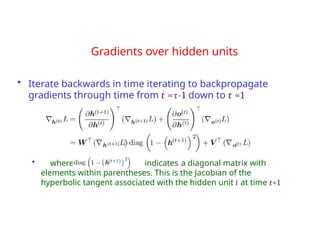
• Iterate backwards in time iterating to backpropagate
gradients through time from t =τ-1 down to t =1
• where indicates a diagonal matrix with
elements within parentheses. This is the Jacobian of the
hyperbolic tangent associated with the hidden unit i at time t+1
Gradients over
parameters
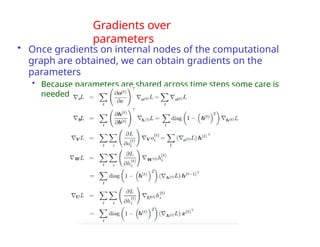
• Once gradients on internal nodes of the computational
graph are obtained, we can obtain gradients on the
parameters
• Because parameters are shared across time steps some care is
needed
10.2 Topics in Recurrent Neural Networks
1. Overview
2. Teacher forcing for output-to-hidden RNNs
3. Computing the gradient in a RNN
4. RNNs as Directed Graphical Models
5.Modeling Sequences Conditioned on
Context with RNNs
10.2.3 Topics in RNNs as Directed Graphical Models
• Motivation
• What are directed graphical models?
• RNNs as Directed Graphical Models
• Conditioning Predictions on Past Values
• Fully connected graphical model for a
sequence
• Hidden units as random variables
• Efficiency of RNN parameterization
• How to draw samples from the model
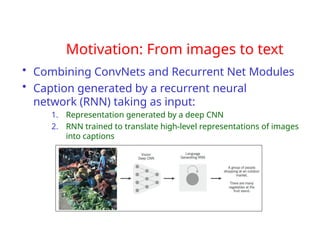
Motivation: From images to text
• Combining ConvNets and Recurrent Net Modules
• Caption generated by a recurrent neural
network (RNN) taking as input:
1. Representation generated by a deep CNN
2. RNN trained to translate high-level representations of images
into captions
Better translation of images to captions
• Different focus (lighter patches given more
attention)
• As it generates each word (bold), it exploits it
to achieve better translation of images to
captions
What is a Directed graphical
model?
• Specifies a joint distribution p(x)  p(x1
,..xn
) in
terms of
• where are conditional
distributions
• pa represents parents in a directed graph
• Computational efficiency is obtained by omitting
edges that do not correspond to strong interactions
• Model is generative:
• We can easily sample from a BN (ancestral sampling)
• We will see here that RNNs have an interpretation
as an efficient directed graphical model
i 1
conditional distributions (called a Bayesian
Network)
N
p(x)   p(xi
|
pa(xi
))
p(xi
| pa(xi
))
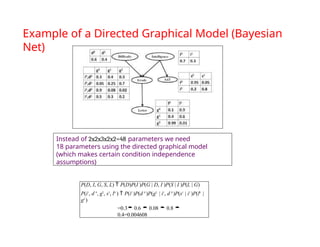
Example of a Directed Graphical Model (Bayesian
Net)
P(D, I, G, S, L)  P(D)P(I )P(G | D, I )P(S | I )P(L | G)
P(i1
, d 0
, g2
, s1
, l0
)  P(i1
)P(d 0
)P(g2
| i1
, d 0
)P(s1
| i1
)P(l0
|
g2
)
=0.3 0.6  0.08  0.8 
0.4=0.004608
Instead of 2x2x3x2x2=48 parameters we need
18 parameters using the directed graphical model
(which makes certain condition independence
assumptions)
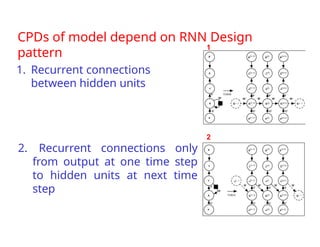
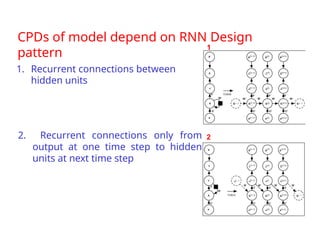
CPDs of model depend on RNN Design
pattern
1. Recurrent connections
between hidden units
2. Recurrent connections only
from output at one time step
to hidden units at next time
step
2
1
Loss function for
RNNs
• In feed-forward networks our goal is to
minimize
• Which is the cross-entropy between distribution
of training set (data) and probability distribution
defined by model
• Definition of cross entropy between distributions p and q is
H(p,q)=Ep[-log q]=H(p)+DKL(p||q)
• For discrete distributions H(p,q)=-Σxp(x)log q(x)
• As with a feedforward network, we wish to
interpret the output of the RNN as a probability
distribution
• With RNNs the losses L(t) are cross entropies
between training targets y(t) and outputs o(t)
• Mean squared error is the cross-entropy loss associated
Ex~pˆ data
log
pmodel
(x)
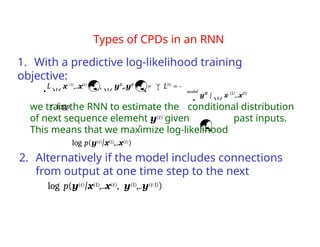
Types of CPDs in an RNN
1. With a predictive log-likelihood training
objective:
we train the RNN to estimate the conditional distribution
of next sequence element y(t) given past inputs.
This means that we maximize log-likelihood
log p(y(t)|x(1),..x(t))
2. Alternatively if the model includes connections
from output at one time step to the next
log p(y(t)|x(1),..x(t), y(1),..y(t-1))
model
Lx (1)
,..x(t)
,y(1)
,..y(t)
= L(t)
= -
logp
t
t
y(t)
|x (1)
,..x(t)

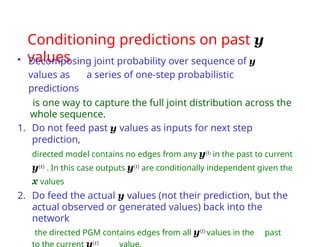
Conditioning predictions on past y
values
• Decomposing joint probability over sequence of y
values as a series of one-step probabilistic
predictions
is one way to capture the full joint distribution across the
whole sequence.
1. Do not feed past y values as inputs for next step
prediction,
directed model contains no edges from any y(i) in the past to current
y(t) . In this case outputs y(i) are conditionally independent given the
x values
2. Do feed the actual y values (not their prediction, but the
actual observed or generated values) back into the
network
the directed PGM contains edges from all y(i) values in the past
to the current y(t) value.
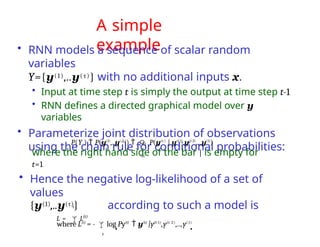
A simple
example
• RNN models a sequence of scalar random
variables
Y={y(1),..y(τ)} with no additional inputs x.
• Input at time step t is simply the output at time step t-1
• RNN defines a directed graphical model over y
variables
• Parameterize joint distribution of observations
using the chain rule for conditional probabilities:

P(Y )  P(y(1)
,..y()
)   P(y(t )
| y(t 1)
,y(t 2)
,..,y(1)
)
t 1
where the right hand side of the bar | is empty for
t=1
• Hence the negative log-likelihood of a set of
values
{y(1),..y(τ)} according to such a model is
L = L(t)
t
where L(t)
= - log Py(t)
 y(t)
|y(t-1)
,y(t-2)
,..,y(1)

t
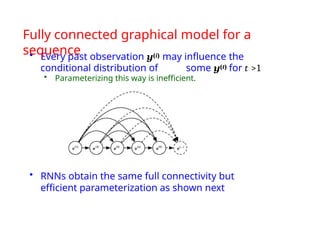
• Every past observation y(i) may influence the
conditional distribution of some y(t) for t >1
• Parameterizing this way is inefficient.
• RNNs obtain the same full connectivity but
efficient parameterization as shown next
Fully connected graphical model for a
sequence
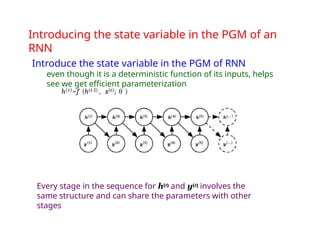
Introducing the state variable in the PGM of an
RNN
Introduce the state variable in the PGM of RNN
even though it is a deterministic function of its inputs, helps
see we get efficient parameterization
h(t)=f (h(t-1) , x(t); θ )
Every stage in the sequence for h(t) and y(t) involves the
same structure and can share the parameters with other
stages
Efficient parameterization in RNNs
• If y can take on k different values, the
tabular representation would have O(k τ)
parameters
• By comparison because of parameter sharing
the no of parameters in the RNN is O(1) as a function
of sequence length
• Even with efficient parameterization of PGM,
some operations are computationally
challenging
• Difficult to predict missing values in the
middle of the sequence
• Price RNNs pay for reduced no of parameters is
that oprimizing parameters may be difficult
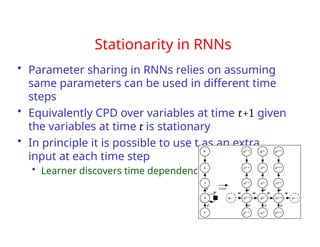
Stationarity in RNNs
• Parameter sharing in RNNs relies on assuming
same parameters can be used in different time
steps
• Equivalently CPD over variables at time t+1 given
the variables at time t is stationary
• In principle it is possible to use t as an extra
input at each time step
• Learner discovers time dependence
How to draw samples from the model
• Simply sample from the conditional distribution at
each time step
• One additional complication
• RNN must have some mechanism for determining
the length of the sequence
Methods for predicting end of
sequence
• This can be achieved in various ways
1. Adding a special symbol for end of sequence
• When the symbol is generated, the sampling process stops
2. Introduce an extra Bernoulli output
• It represents the decision to either continue generation
or halt generation at each time step
• More general than previous method as it can be added to any
RNN rather than only RNNs that output a sequence of symbols,
e.g., RNN that emits sequence of real numbers
3. Add an extra output to the model to predict τ
• Model can sample value of τ and then sample τ steps
worth of data
10.2 Topics in Recurrent Neural Networks
1. Overview
2. Teacher forcing for output-to-hidden RNNs
3. Computing the gradient in a RNN
4. RNNs as Directed Graphical Models
5. Modeling Sequences Conditioned on Context with
RNNs
Graphical models of RNNs without/with
inputs
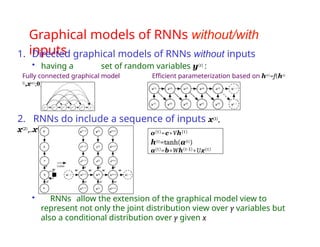
1. Directed graphical models of RNNs without inputs
• having a set of random variables y(t) :
Fully connected graphical model Efficient parameterization based on h(t)=f(h(t-
1),x(t);θ)
2. RNNs do include a sequence of inputs x(1),
x(2),..x(τ)
• RNNs allow the extension of the graphical model view to
represent not only the joint distribution view over y variables but
also a conditional distribution over y given x
o(t)=c+Vh(t)
h(t)=tanh(a(t))
a(t)=b+Wh(t-1)+Ux(t)
CPDs of model depend on RNN Design
pattern
2. Recurrent connections only from
output at one time step to hidden
units at next time step
5
1
1. Recurrent connections between
hidden units
2
Extending RNNs to represent conditional P(y|x)
• A model representing a variable P(y; θ) can be
reinterpreted as a model representing a conditional
distribution P(y|ω) with ω=θ
• We can extend such a model to represent a distribution
P(y|x) by using the same P(y|ω) as before but
making ω a function of x
• In the case of an RNN this can be achieved in several ways
• Most common choices are described next
Taking a single vector x as an extra input
• Instead of taking a sequence x(t), t =1,..,τ as input we can
take a single vector x as input
• When x is a fixed-size vector we can simply make it an
extra input of the RNN that generates the y sequence
• Common ways of providing an extra input to RNN are
1. An extra input at each time step, or
2. As the initial state h(0), or
3. Both
• The first and common approach is illustrated next
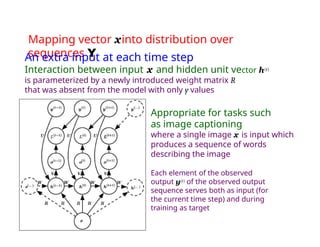
Mapping vector xinto distribution over
sequences Y
An extra input at each time step
Interaction between input x and hidden unit vector h(t)
is parameterized by a newly introduced weight matrix R
that was absent from the model with only y values
Appropriate for tasks such
as image captioning
where a single image x is input which
produces a sequence of words
describing the image
Each element of the observed
output y(t) of the observed output
sequence serves both as input (for
the current time step) and during
training as target
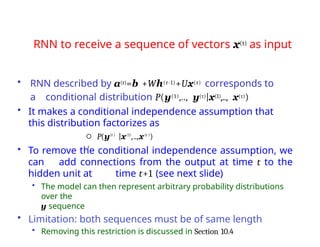
RNN to receive a sequence of vectors x(t) as input
• To remove the conditional independence assumption, we
can add connections from the output at time t to the
hidden unit at time t+1 (see next slide)
• The model can then represent arbitrary probability distributions
over the
y sequence
• Limitation: both sequences must be of same length
• Removing this restriction is discussed in Section 10.4
t
• RNN described by a(t)=b +Wh(t-1)+Ux(t) corresponds to
a conditional distribution P(y(1),.., y(τ)|x(1),.., x(τ))
• It makes a conditional independence assumption that
this distribution factorizes as
 P(y(t )
|x(1)
,..,x(t )
)
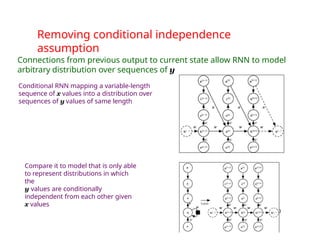
Removing conditional independence
assumption
0
1
Compare it to model that is only able
to represent distributions in which
the
y values are conditionally
independent from each other given
x values
Connections from previous output to current state allow RNN to model
arbitrary distribution over sequences of y
Conditional RNN mapping a variable-length
sequence of x values into a distribution over
sequences of y values of same length
Topics in Sequence
Modeling
• Overview
1. Unfolding Computational Graphs
2. Recurrent Neural Networks
3. Bidirectional RNNs
4. Encoder-Decoder Sequence-to-Sequence Architectures
5. Deep Recurrent Networks
6. Recursive Neural Networks
7. The Challenge of Long-Term Dependencies
8. Echo-State Networks
9. Leaky Units and Other Strategies for Multiple Time
Scales
10.LSTM and Other Gated RNNs
11. Optimization for Long-Term Dependencies
12.Explicit Memory
Need for bidirectionality
• In speech recognition, the correct interpretation of the
current sound may depend on the next few phonemes
because of co- articulation and the next few words
because of linguistic dependencies
• Also true of handwriting recognition
3
A birectional RNN
• Combine an RNN that moves forward through time
from the start of the sequence
• Another RNN that moves backward through time
beginning from the end of the sequence
• A bidirectional RNN consists of two RNNs which are stacked
on the top of each other.
• The one that processes the input in its original order and
the one that processes the reversed input sequence.
• The output is then computed based on the hidden state of both
RNNs.
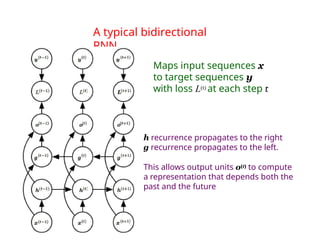
A typical bidirectional
RNN
h recurrence propagates to the right
g recurrence propagates to the left.
This allows output units o(t) to compute
a representation that depends both the
past and the future
Maps input sequences x
to target sequences y
with loss L(t) at each step t
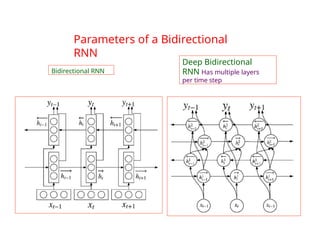
Parameters of a Bidirectional
RNN
6
Bidirectional RNN
Deep Bidirectional
RNN Has multiple layers
per time step
Topics in Sequence
Modeling
• Overview
1. Unfolding Computational Graphs
2. Recurrent Neural Networks
3. Bidirectional RNNs
4. Encoder-Decoder Sequence-to-Sequence Architectures
5. Deep Recurrent Networks
6. Recursive Neural Networks
7. The Challenge of Long-Term Dependencies
8. Echo-State Networks
9. Leaky Units and Other Strategies for Multiple Time
Scales
10.LSTM and Other Gated RNNs
11. Optimization for Long-Term
Dependencies
12.Explicit Memory
2
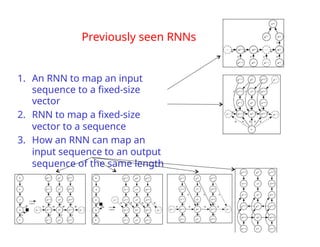
Previously seen RNNs
1. An RNN to map an input
sequence to a fixed-size
vector
2. RNN to map a fixed-size
vector to a sequence
3. How an RNN can map an
input sequence to an output
sequence of the same length
RNN when input/output are not same length
• Here we consider how an RNN can be trained to map an
input sequence to an output sequence which is not
necessarily the same length
• Comes up in applications such as speech recognition,
machine translation or question-answering where the input
and output sequences in the training set are generally not
of the same length (although their lengths might be
related)
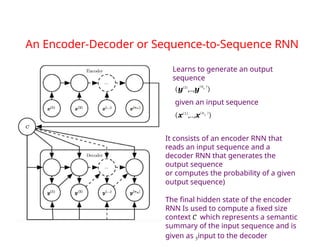
An Encoder-Decoder or Sequence-to-Sequence RNN
Learns to generate an output
sequence
(y(1)
,..,y
(ny
)
)
given an input sequence
(x(1)
,..,x(nx
)
)
It consists of an encoder RNN that
reads an input sequence and a
decoder RNN that generates the
output sequence
or computes the probability of a given
output sequence)
The final hidden state of the encoder
RNN Is used to compute a fixed size
context C which represents a semantic
summary of the input sequence and is
given as 5input to the decoder
Topics
• Recurrent Neural Networks
1. Unfolding Computational Graphs
2. Recurrent Neural Networks
3. Bidirectional RNNs
4. Encoder-Decoder Sequence-to-Sequence Architectures
5. Deep Recurrent Networks
6. Recursive Neural Networks
7. The Challenge of Long-Term Dependencies
8. Echo-State Networks
9. Leaky Units and Other Strategies for Multiple Time
Scales
10.LSTM and Other Gated RNNs
11. Optimization for Long-Term Dependencies
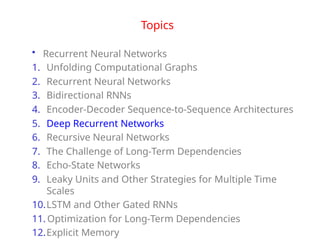
12.Explicit Memory
Computation in RNNs: parameter blocks
• The computation in most recurrent neural networks can
be decomposed into three blocks of parameters and
associated transformations:
1. From the input to the hidden state
2. From the previous hidden state to the next hidden state
3. From the hidden state to the output
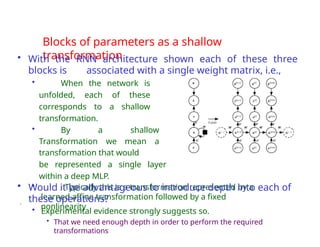
Blocks of parameters as a shallow
transformation
• With the RNN architecture shown each of these three
blocks is associated with a single weight matrix, i.e.,
• When the network is
unfolded, each of these
corresponds to a shallow
transformation.
• By a shallow
Transformation we mean a
transformation that would
be represented a single layer
within a deep MLP.
• Typically this is a transformation represented by a
learned affine transformation followed by a fixed
nonlinearity
• Would it be advantageous to introduce depth into each of
these operations?
• Experimental evidence strongly suggests so.
• That we need enough depth in order to perform the required
transformations
.
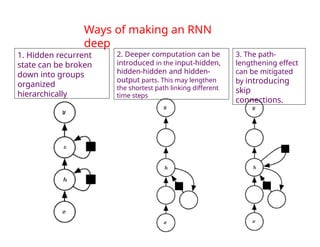
Ways of making an RNN
deep
5
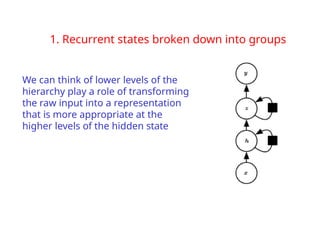
1. Hidden recurrent
state can be broken
down into groups
organized
hierarchically
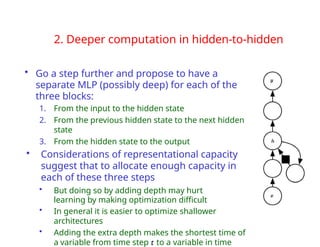
2. Deeper computation can be
introduced in the input-hidden,
hidden-hidden and hidden-
output parts. This may lengthen
the shortest path linking different
time steps
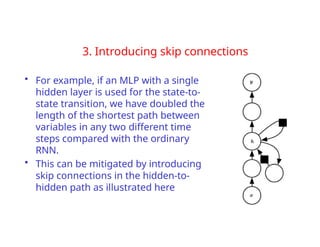
3. The path-
lengthening effect
can be mitigated
by introducing
skip
connections.
1. Recurrent states broken down into groups
We can think of lower levels of the
hierarchy play a role of transforming
the raw input into a representation
that is more appropriate at the
higher levels of the hidden state
2. Deeper computation in hidden-to-hidden
• Go a step further and propose to have a
separate MLP (possibly deep) for each of the
three blocks:
1. From the input to the hidden state
2. From the previous hidden state to the next hidden
state
3. From the hidden state to the output
• Considerations of representational capacity
suggest that to allocate enough capacity in
each of these three steps
• But doing so by adding depth may hurt
learning by making optimization difficult
• In general it is easier to optimize shallower
architectures
• Adding the extra depth makes the shortest time of
a variable from time step t to a variable in time
3. Introducing skip connections
• For example, if an MLP with a single
hidden layer is used for the state-to-
state transition, we have doubled the
length of the shortest path between
variables in any two different time
steps compared with the ordinary
RNN.
• This can be mitigated by introducing
skip connections in the hidden-to-
hidden path as illustrated here
Topics
• Sequence Modeling: Recurrent and Recursive Nets
1. Unfolding Computational Graphs
2. Recurrent Neural Networks
3. Bidirectional RNNs
4. Encoder-Decoder Sequence-to-Sequence Architectures
5. Deep Recurrent Networks
6. Recursive Neural Networks
7. The Challenge of Long-Term Dependencies
8. Echo-State Networks
9. Leaky Units and Other Strategies for Multiple Time
Scales
10.LSTM and Other Gated RNNs
11. Optimization for Long-Term Dependencies
12.Explicit Memory
Recursive Neural Networks
• They are yet another generalization of recurrent networks
with a different kind of computational graph
• It is structured as a deep tree, rather than the chain
structure of RNNs
• The typical computational graph for a recursive
network is shown next
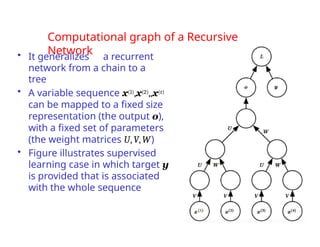
Computational graph of a Recursive
Network
• It generalizes a recurrent
network from a chain to a
tree
• A variable sequence x(1),x(2),,x(t)
can be mapped to a fixed size
representation (the output o),
with a fixed set of parameters
(the weight matrices U,V,W)
• Figure illustrates supervised
learning case in which target y
is provided that is associated
with the whole sequence
4
Advantage of Recursive over Recurrent Nets
• For a sequence of the same length τ, the depth (measured
as the no. of compositions of nonlinear operations) can be
reduced from τ to O(log τ), which might help deal with long-
term dependencies
• An open question is how best to structure the tree
Need for Recursive nets in NLP
• Deep learning based methods learn low-dimensional,
real- valued vectors for word tokens, mostly from a
large data corpus, successfully capturing syntactic and
semantic aspects of text
• For tasks where the inputs are larger text units, e.g.,
phrases, sentences or documents, a compositional
model is first needed to aggregate tokens into a
vector with fixed dimensionality that can be used for
other NLP tasks
• Models for achieving this fall into two categories:
recurrent models and recursive models
Recurrent Model for NLP
• Recurrent models deal successfully with time series data
• The recurrent models generally consider no linguistic
structure aside from the word order
• They were applied early on to NLP by modeling a sentence
as tokens processed sequentially and at each step
combining the current token with previously built
embeddings
• Recurrent models can be extended to bidirectional ones
from both left to right and right to left
• These models consider no linguistic structure aside from
word order
Recursive Models for NLP
• Recursive neural models (also referred to as tree models)
by contrast are structured by syntactic parse trees
• Instead of considering tokens sequentially, recursive
models combine neighbors based on the recursive
structure of parse trees, starting from the leaves and
proceeding recursively in a bottom-up fashion until the
root of the parse tree is reached
• Ex: for the phrase the food is delicious, following the operation
sequence ((the food) (is delicious)) rather than the sequential order
(((the food) is) delicious)
Advantage of Recursive Model for NLP
• They have the potential of capturing long-
distance dependencies
• Two tokens may be structurally closer to each other
even though they are far away in word sequence
• Ex: a verb and its corresponding direct object can be far
away in terms of tokens if many adjectives lie inbetween,
but they are adjacent in the parse tree
• However parsing is slow and domain dependent
Structure of the Tree
• One option is to have a tree structure that does not
depend on the data, such as a balanced binary tree
• In some application domains, external methods can
suggest the appropriate tree structure
• Ex: when processing natural language sentences, the tree
structure for the recursive network can be fixed to the structure of
the parse tree of the sentence provided by a natural language
parse
• Ideally, one would like the learner itself to discover and
infer the tree structure that is appropriate for any given
input
Variants of Recursive Net idea
• Associate data with a tree structure and associate inputs
and targets with individual nodes of the tree
• The computation performed for each node does not have to
be the artificial neuron computation (affine transformation of all
inputs followed by a monotone nonlinearity)
• Can use a tensor operations of bilinear forms
• Previously found useful to model linear relationships between
concepts when the concepts are represented by continuous
vectors
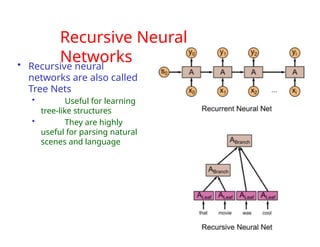
Recursive Neural
Networks
• Recursive neural
networks are also called
Tree Nets
• Useful for learning
tree-like structures
• They are highly
useful for parsing natural
scenes and language
12
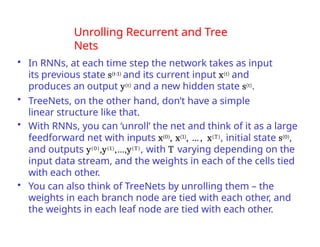
Unrolling Recurrent and Tree
Nets
• In RNNs, at each time step the network takes as input
its previous state s(t-1) and its current input x(t) and
produces an output y(t) and a new hidden state s(t).
• TreeNets, on the other hand, don’t have a simple
linear structure like that.
• With RNNs, you can ‘unroll’ the net and think of it as a large
feedforward net with inputs x(0), x(1), … , x(T), initial state s(0),
and outputs y(0),y(1),…,y(T), with T varying depending on the
input data stream, and the weights in each of the cells tied
with each other.
• You can also think of TreeNets by unrolling them – the
weights in each branch node are tied with each other, and
the weights in each leaf node are tied with each other.
Advantage of Recursive Nets
• The advantage of Recursive Nets is that they can be
very powerful in learning hierarchical, tree-like
structure.
• The disadvantages are, firstly, that the tree structure of
every input sample must be known at training time.
Topics in Sequence
Modeling
• Recurrent Neural Networks
1. Unfolding Computational Graphs
2. Recurrent Neural Networks
3. Bidirectional RNNs
4. Encoder-Decoder Sequence-to-Sequence Architectures
5. Deep Recurrent Networks
6. Recursive Neural Networks
7. The Challenge of Long-Term Dependencies
8. Echo-State Networks
9. Leaky Units and Other Strategies for Multiple Time
Scales
10.LSTM and Other Gated RNNs
11. Optimization for Long-Term Dependencies
12.Explicit Memory
Challenge of Long-Term Dependencies
• Neural network optimization face a difficulty
when computational graphs become deep,
e.g.,
• Feedforward networks with many layers
• RNNs that repeatedly apply the same operation at each
time step of a long temporal sequence
• Gradients propagated over many stages tend to either
vanish (most of the time) or explode (damaging
optimization)
• The difficulty with long-term dependencies arise from
exponentially smaller weights given to long-term
interactions (involving multiplication of many Jacobians)
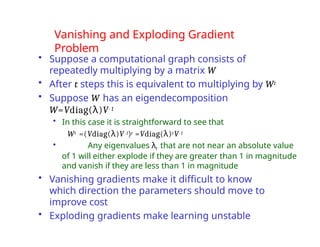
Vanishing and Exploding Gradient
Problem
• Suppose a computational graph consists of
repeatedly multiplying by a matrix W
• After t steps this is equivalent to multiplying by Wt
• Suppose W has an eigendecomposition
W=Vdiag(λ)V-1
• In this case it is straightforward to see that
Wt =(Vdiag(λ)V-1)t =Vdiag(λ)tV-1
• Any eigenvalues λi that are not near an absolute value
of 1 will either explode if they are greater than 1 in magnitude
and vanish if they are less than 1 in magnitude
• Vanishing gradients make it difficult to know
which direction the parameters should move to
improve cost
• Exploding gradients make learning unstable
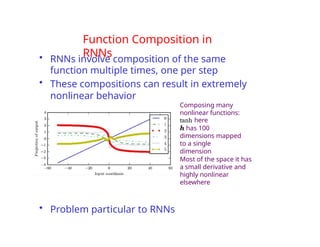
Function Composition in
RNNs
• RNNs involve composition of the same
function multiple times, one per step
• These compositions can result in extremely
nonlinear behavior
Composing many
nonlinear functions:
tanh here
h has 100
dimensions mapped
to a single
dimension
Most of the space it has
a small derivative and
highly nonlinear
elsewhere
• Problem particular to RNNs
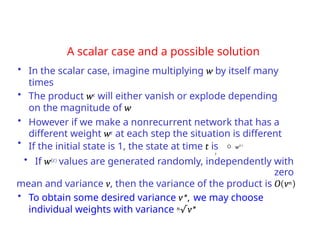
A scalar case and a possible solution
• In the scalar case, imagine multiplying w by itself many
times
• The product wt will either vanish or explode depending
on the magnitude of w
• However if we make a nonrecurrent network that has a
different weight wt at each step the situation is different
• If the initial state is 1, the state at time t is  w(t )
t
• If w(t) values are generated randomly, independently with
zero
mean and variance v, then the variance of the product is O(vn)
• To obtain some desired variance v*, we may choose
individual weights with variance n√v*
Deep
Learning
Srihar
i
Topics
• Recurrent Neural Networks
1. Unfolding Computational Graphs
2. Recurrent Neural Networks
3. Bidirectional RNNs
4. Encoder-Decoder Sequence-to-Sequence Architectures
5. Deep Recurrent Networks
6. Recursive Neural Networks
7. The Challenge of Long-Term Dependencies
8. Echo-State Networks
9. Leaky Units and Other Strategies for Multiple Time
Scales
10.LSTM and Other Gated RNNs
11.Optimization for Long-Term
Dependencies
12.Explicit Memory
2
Multiple Time
Scales
• Goal: to deal with long-term dependencies
• Design model so that
1. Some model parts operate at fine-grained
time scales
• Handle small details
2. Other parts operate at coarse time scales
• Transfer information from the distant past to the
present more efficiently
Building Fine and Coarse Time
Scales
• Strategies to build fine and coarse time
scales
1. Adding skip connections through time
2. Leaky units and a spectrum of different time
scales
• To integrate signals with different time constants
3. Removal of some connections to model
fine- grained time scales
Adding skip connections through time
• Add direct connections from variables in the distant
past to variables in the present
• In an ordinary RNN, recurrent connection goes from
time t to time t+1. Can construct RNNs with longer
delays
• Gradients can vanish/explode exponentially wrt no. of
time steps
• Introduce time delay of d to mitigate this problem
• Gradients diminish as a function of τ/d rather than τ
• Allows learning algorithm to capture longer
dependencies
• Not all long-term dependencies can be captured this way
Leaky units and a spectrum of time scales
• Rather than an integer skip of d time steps, the effect
can be obtained smoothly by adjusting a real-valued α
• Running Average
• Running average μ(t) of some value v(t) is μ(t)αμ(t-1)+(1-α)v(t)
• Called a linear self-correction
• When α is close to 1, running average remembers information
from the past for a long time and when it is close to 0,
information is rapidly discarded.
• Hidden units with linear self connections behave
similar to running average. They are called leaky units.
• Can obtain product of derivatives close to 1 by having
linear
self-connections and a weight near 1 on those
connections
Removing Connections
• Another approach to handle long-term dependencies
• Organize state of the RNN at multiple time scales
• Information flowing more easily through long distances at the
slower time scales
• It involves actively removing length one connections
and replacing them with longer connections
• Skip connections add edges
Topics in Sequence
Modeling
• Recurrent Neural Networks
1. Unfolding Computational Graphs
2. Recurrent Neural Networks
3. Bidirectional RNNs
4. Encoder-Decoder Sequence-to-Sequence Architectures
5. Deep Recurrent Networks
6. Recursive Neural Networks
7. The Challenge of Long-Term Dependencies
8. Echo-State Networks
9. Leaky Units and Other Strategies for Multiple Time
Scales
10.LSTM and Other Gated RNNs
11.Optimization for Long-Term Dependencies
12.Explicit Memory
Topics in LSTM and Other Gated RNNs
• From RNN to LSTM
• Problem of Long-Term Dependency
• BPTT and Vanishing Gradients
• Key intuition of LSTM as “state”
• LSTM Cell (three gates and two activations)
• LSTM usage example
• Equations for: forget gate, state update, output
gate
• Step-by-Step LSTM Walk-through
• Gated RNNs
Recurrent Neural
Networks
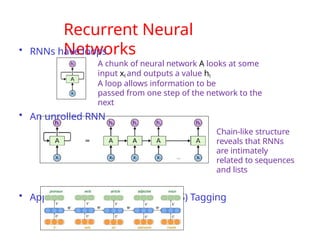
• RNNs have loops
A chunk of neural network A looks at some
input xt and outputs a value ht
A loop allows information to be
passed from one step of the network to the
next
• An unrolled RNN
Chain-like structure
reveals that RNNs
are intimately
related to sequences
and lists
• Application to Part of Speech (POS) Tagging
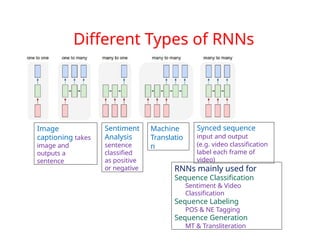
Different Types of RNNs
RNNs mainly used for
Sequence Classification
Sentiment & Video
Classification
Sequence Labeling
POS & NE Tagging
Sequence Generation
MT & Transliteration
Image
captioning takes
image and
outputs a
sentence
Sentiment
Analysis
sentence
classified
as positive
or negative
Machine
Translatio
n
Synced sequence
input and output
(e.g. video classification
label each frame of
video)
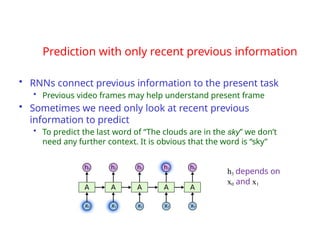
Prediction with only recent previous information
• RNNs connect previous information to the present task
• Previous video frames may help understand present frame
• Sometimes we need only look at recent previous
information to predict
• To predict the last word of “The clouds are in the sky” we don’t
need any further context. It is obvious that the word is “sky”
h3 depends on
x0 and x1
Long-Term
Dependency
• RNNs work upon the fact that the result of an
information is dependent on its previous state or
previous n time steps.
• They have difficulty in learning long range
dependencies.
• Example sentence: The man who ate my pizza has purple
hair
• Note: purple hair is for the man and not the pizza.
• So this is a long dependency
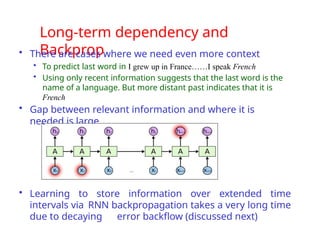
Long-term dependency and
Backprop
• There are cases where we need even more context
• To predict last word in I grew up in France……I speak French
• Using only recent information suggests that the last word is the
name of a language. But more distant past indicates that it is
French
• Gap between relevant information and where it is
needed is large
• Learning to store information over extended time
intervals via RNN backpropagation takes a very long time
due to decaying error backflow (discussed next)
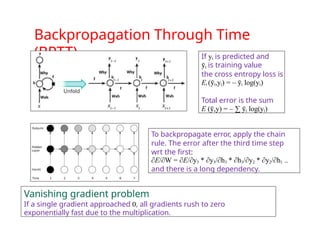
Backpropagation Through Time
(BPTT) If yt is predicted and
ȳt is training value
the cross entropy loss is
Et (ȳt,yt) = – ȳt log(yt)
Total error is the sum
E ( ,y)
ȳ = – ∑ ȳt log(yt)
To backpropagate error, apply the chain
rule. The error after the third time step
wrt the first:
∂E/∂W = ∂E/∂y3 * ∂y3/∂h3 * ∂h3/∂y2 * ∂y2/∂h1 ..
and there is a long dependency.
Vanishing gradient problem
If a single gradient approached 0, all gradients rush to zero
exponentially fast due to the multiplication.
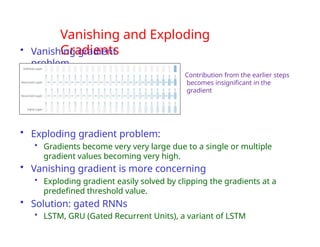
Vanishing and Exploding
Gradients
• Vanishing gradient
problem
• Exploding gradient problem:
• Gradients become very very large due to a single or multiple
gradient values becoming very high.
• Vanishing gradient is more concerning
• Exploding gradient easily solved by clipping the gradients at a
predefined threshold value.
• Solution: gated RNNs
• LSTM, GRU (Gated Recurrent Units), a variant of LSTM
Contribution from the earlier steps
becomes insignificant in the
gradient
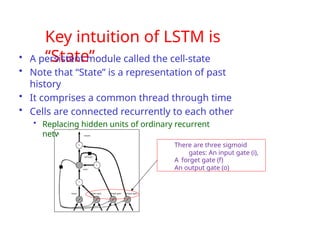
Key intuition of LSTM is
“State”
• A persistent module called the cell-state
• Note that “State” is a representation of past
history
• It comprises a common thread through time
• Cells are connected recurrently to each other
• Replacing hidden units of ordinary recurrent
networks
There are three sigmoid
gates: An input gate (i),
A forget gate (f)
An output gate (o)
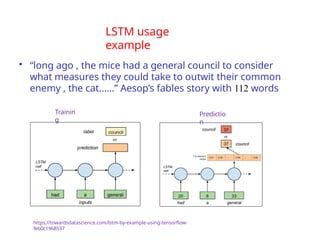
LSTM usage
example
• “long ago , the mice had a general council to consider
what measures they could take to outwit their common
enemy , the cat……” Aesop’s fables story with 112 words
Trainin
g
Predictio
n
https://towardsdatascience.com/lstm-by-example-using-tensorflow-
feb0c1968537
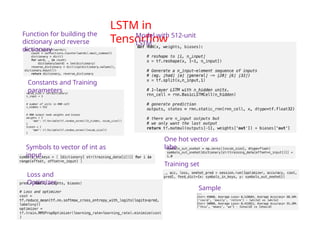
LSTM in
Tensorflow
Model with 512-unit
LSTM
Function for building the
dictionary and reverse
dictionary
Constants and Training
parameters
Loss and
Optimizer
Symbols to vector of int as
input
Training set
optimization
One hot vector as
labe
Sample
prediction
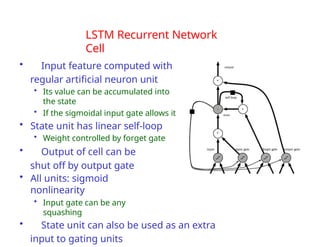
LSTM Recurrent Network
Cell
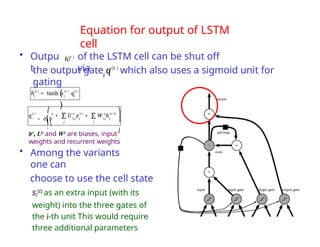
• Input feature computed with
regular artificial neuron unit
• Its value can be accumulated into
the state
• If the sigmoidal input gate allows it
• State unit has linear self-loop
• Weight controlled by forget gate
• Output of cell can be
shut off by output gate
• All units: sigmoid
nonlinearity
• Input gate can be any
squashing
• State unit can also be used as an extra
input to gating units
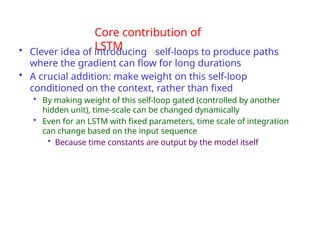
Core contribution of
LSTM
• Clever idea of introducing self-loops to produce paths
where the gradient can flow for long durations
• A crucial addition: make weight on this self-loop
conditioned on the context, rather than fixed
• By making weight of this self-loop gated (controlled by another
hidden unit), time-scale can be changed dynamically
• Even for an LSTM with fixed parameters, time scale of integration
can change based on the input sequence
• Because time constants are output by the model itself
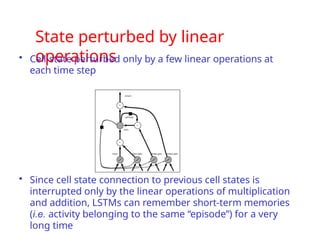
State perturbed by linear
operations
• Cell-state perturbed only by a few linear operations at
each time step
• Since cell state connection to previous cell states is
interrupted only by the linear operations of multiplication
and addition, LSTMs can remember short-term memories
(i.e. activity belonging to the same “episode”) for a very
long time
LSTM success
• LSTM found extremely successful in:
• Unconstrained handwriting recognition
• Speech recognition
• Handwriting generation, Machine
Translation
• Image Captioning, Parsing
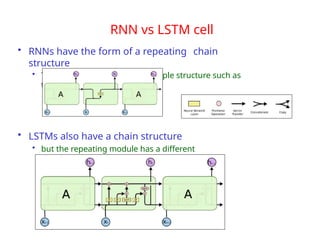
RNN vs LSTM cell
• RNNs have the form of a repeating chain
structure
• The repeating module has a simple structure such as
tanh
• LSTMs also have a chain structure
• but the repeating module has a different
structure
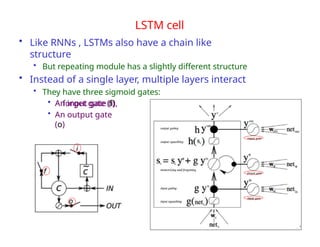
LSTM cell
• Like RNNs , LSTMs also have a chain like
structure
• But repeating module has a slightly different structure
• Instead of a single layer, multiple layers interact
• They have three sigmoid gates:
• An input gate (i),
• A forget gate (f)
• An output gate
(o)
19
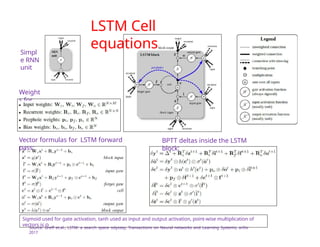
LSTM Cell
equations
Source: Greff et.al., LSTM: a search space odyssey, Transactions on Neural networks and Learning Systems, arXiv
2017
Simpl
e RNN
unit
Weight
s for
an
LSTM
layer:
Vector formulas for LSTM forward
pass:
BPTT deltas inside the LSTM
block:
Sigmoid used for gate activation, tanh used as input and output activation, point-wise multiplication of
vectors is ⊙
Accumulating Information over Longer Duration
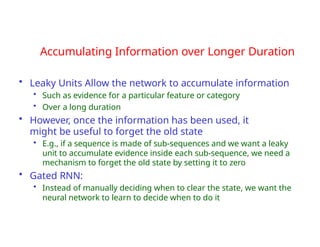
• Leaky Units Allow the network to accumulate information
• Such as evidence for a particular feature or category
• Over a long duration
• However, once the information has been used, it
might be useful to forget the old state
• E.g., if a sequence is made of sub-sequences and we want a leaky
unit to accumulate evidence inside each sub-sequence, we need a
mechanism to forget the old state by setting it to zero
• Gated RNN:
• Instead of manually deciding when to clear the state, we want the
neural network to learn to decide when to do it
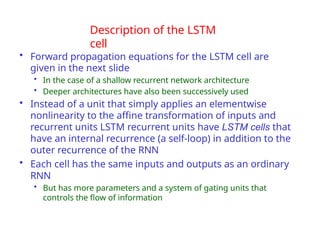
Description of the LSTM
cell
• Forward propagation equations for the LSTM cell are
given in the next slide
• In the case of a shallow recurrent network architecture
• Deeper architectures have also been successively used
• Instead of a unit that simply applies an elementwise
nonlinearity to the affine transformation of inputs and
recurrent units LSTM recurrent units have LSTM cells that
have an internal recurrence (a self-loop) in addition to the
outer recurrence of the RNN
• Each cell has the same inputs and outputs as an ordinary
RNN
• But has more parameters and a system of gating units that
controls the flow of information
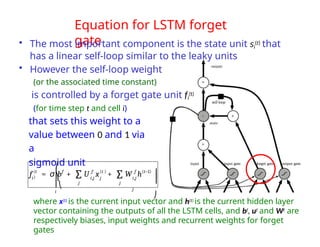
Equation for LSTM forget
gate
• The most important component is the state unit si
(t) that
has a linear self-loop similar to the leaky units
• However the self-loop weight
(or the associated time constant)
is controlled by a forget gate unit fi
(t)
(for time step t and cell i)
that sets this weight to a
value between 0 and 1 via
a
sigmoid unit
where x(t) is the current input vector and h(t) is the current hidden layer
vector containing the outputs of all the LSTM cells, and bf, uf and Wf are
respectively biases, input weights and recurrent weights for forget
gates
i
(t
)
f
f = σ b + i,j j
U x + W h
f (t ) f (t−1)
i,j
j
j
j
∑ ∑
⎜
⎜⎝
i
⎛
⎞ ⎟
⎟
⎠
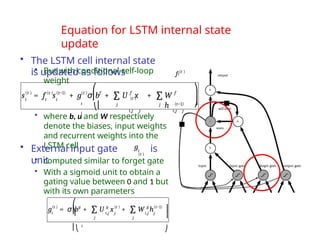
Equation for LSTM internal state
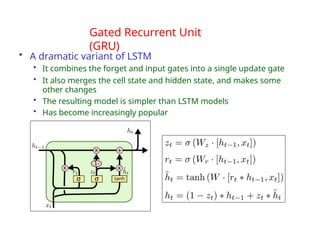
update
• The LSTM cell internal state
is updated as follows
• But with conditional self-loop
weight
• External input gate
unit
is
• computed similar to forget gate
• With a sigmoid unit to obtain a
gating value between 0 and 1 but
with its own parameters
i
f (t )
s(t )
i
= f s
i i
(t ) (t−1) (t ) f
+ g σ b + f
(t )
U x + W
h
f
(t−1)
i,j j i,j j
j j
∑ ∑
⎛
⎜
i
⎝⎜
i
⎞
⎠
⎟
⎟
i
(t ) g
g = σ b + U x + W h
i,j j i,j j
g (t ) g (t−1)
j
j
∑ ∑
⎜
⎛
⎞
⎜⎝
i
⎟
⎟
⎠
gi
• where b, u and W respectively
denote the biases, input weights
and recurrent weights into the
LSTM cell
(t )
Equation for output of LSTM
cell
• Outpu
t
of the LSTM cell can be shut off
via
b0, U0 and W0 are biases, input
weights and recurrent weights
• Among the variants
one can
choose to use the cell state
si
(t) as an extra input (with its
weight) into the three gates of
the i-th unit This would require
three additional parameters
i
h(t )
i
the output gate q(t )
which also uses a sigmoid unit for
gating
q(t )
i
o
+ U x
i,j j
o (t )
+ W h
i,j j
o (t−1)
∑
j j
∑
⎛
= σ⎜b
⎜⎝
i
⎞
⎟
⎟
⎠
i
(t )
(
)
h = tanh s q
i i
(t ) (t )
Power of LSTMs
• LSTM networks have been shown to learn long-term
dependencies more easily than simple recurrent
architectures
• First on artificial data sets
• Then on challenging sequential tasks
• Variants and alternatives to LSTM have been studied and
used and are discussed next
Other gated RNNs
• What pieces of the LSTM architecture are actually
necessary?
• What other successful architectures could be designed
that allow the network to dynamically control the
time scale and forgetting behavior of different
units?
• Some answers to these questions are given with the
recent work on gated RNNs, whose units are also
known as gated recurrent units or GRUs
• Main difference with LSTM
• Single gating unit simultaneously controls the forgetting
factor and decision to update state unit
GRUs
• GRUs have simpler structure and are easier to train.
• Their success is primarily due to the gating network signals
that control how the present input and previous memory
are used, to update the current activation and produce the
current state.
• These gates have their own sets of weights that are
adaptively updated in the learning phase.
• We have just two gates here, the reset and the update
gate
Idea of Gated RNNs
• Like leaky units, gated RNNs are based on the idea of
creating paths through time that have derivatives that
neither vanish nor explode
• Leaky units do this with connection weights that are
manually chosen or were parameters α
generalizing the concept of discrete skipped
connections
• Gated RNNs generalize this to connection weights
that may change with each time step
Update equations for Gated
RNNs
• Update equations are
• Where u stands for the update gate and r for reset gate. Their
value is defined as usual:
• Reset and update gates can individually ignore parts of the state
vector
• Update gates act conditional leaky integrators that can linearly
gate any dimension thus choosing to copy it (at one extreme of
sigmoid) or completely ignore it (at the other extreme) by
replacing it by the new target state value (towards which the
leaky integrator converges
• Reset gates control which parts of the state get used to compute
next target state, introducing an additional nonlinear effect in
the relationship between past state and future state
hi
(t
) = u h
i i
(t ) (t−1)
+ (1 − u (t−1)
i
)σ b + U x(t−1)
i,j j i,j j
+ W r h
(t−1) (t−1)
j
j j
∑ ∑
⎛
⎜
⎝⎜
i
⎞
⎟
⎟
⎠
i
(t ) u
u = σ b + i,j j
U x + i,j
W h
u (t ) u (t )
j
j
j
∑ ∑
⎜
⎜⎝
⎜ i
⎛
⎞ ⎟
⎠
⎟ and i
(t ) r
r = σ b + i,j j
r (t )
U x + W h
r
(t )
i,j j
j j
∑ ∑
⎛
⎜
⎜⎝
i
⎞
⎟
⎟
⎠
Core idea behind
LSTM
• The key to LSTM is the cell state, Ct , the horizontal line
running through the top of the diagram
• Like a conveyor belt
• Runs through
entire chain with minor
interactions
• LSTM does have the
ability to
remove/add
information to cell state
regulated by structures
called
gates
• Gates are an optional
way to let information
through
Step-by-step LSM walk
through
• Example of language model: predict next word
based on previous ones
• Cell state may include the gender of the present
subject
• First step: information to throw away from cell
state
Called forget gate layer
It looks at ht-1 and xt and outputs a
number between 0 and 1 for each
member of Ct-1 for whether to forget
In language model
consider trying to predict the next word based on all previous
ones The cell state may include the gender of the present
subject
so that the proper pronouns can be used
When we see a new subject we want to forget old subject
LSM walk through: Second
step
• Next step is to decide as to what new
information we’re going to store in the cell
state
This has two parts:
first a sigmoid layer called Input gate
layer: decides which values we will
update
Next a tanh layer creates a vector
of
that could
be
new candidate
values added to the
state.
In the third step we will combine these
two to create an update to the state
In the Language
model, we’d want to add
the gender of the new
subject to the cell state,
to replace the old One we
are forgetting
C!t
LSTM walk-through: Third
Step
• It’s now time to update old cell state Ct-1 into new cell state
Ct
• The previous step decided what we need to do
• We just need to do it
We multiply the old state by ft, forgetting
the things we decided to forget earlier.
This is the new candidate values, scaled
by how much we decided to update
each
state value
Then we add i * C!
In the Language
model, this is where we’d
actually drop the
information about the old
subject’s gender and add
the new information,
t t
LSTM walk-through: Fourth
Step
• Finally we decide what we are going to
output
For the Language model,
Since it just saw a subject it
might want to output
information
relevant to a verb, in case that
is what is coming next, e.g., it might output whether the
subject is singular or plural so that we know what form a
verb should be conjugated into if that’s what follows next.
This output will be based on our cell
state, but will be a filtered version.
First we run a sigmoid layer which
decides what parts of cell state we’re
going to output. Then we put the cell
state through tanh (to push values to be
between -1 and 1)
and multiply it by the output of the
sigmoid gate, so that we output only
the parts we decided to
Variants of
LSTM
• There are several minor variants of
LSTM
• LSTM with “peephole” connections
• Coupled forget and input
gates
Gated Recurrent Unit
(GRU)
• A dramatic variant of LSTM
• It combines the forget and input gates into a single update gate
• It also merges the cell state and hidden state, and makes some
other changes
• The resulting model is simpler than LSTM models
• Has become increasingly popular

10.0 SequenceModeling-merged-compressed_edited.pptx

  • 1.
  • 2.
    1. Sequential Dataand RNN Overview 2. Unfolding Computational Graphs 3. Recurrent Neural Networks 4. Bidirectional RNNs 5. Encoder-Decoder Sequence-to-Sequence Architectures 6. Deep Recurrent Networks 7. Recursive Neural Networks 8. The Challenge of Long-Term Dependencies 9. Echo-State Networks 10.Leaky Units and Other Strategies for Multiple Time Scales 11.LSTM and Other Gated RNNs 12.Optimization for Long-Term Dependencies 13.Explicit Memory
  • 3.
    • Often arisethrough measurement of time series • Acoustic features at successive time frames in speech recognition • Sequence of characters in an English sentence • Parts of speech of successive words • Snowfall measurements on successive days • Rainfall measurements on successive days • Daily values of currency exchange rate • Nucleotide base pairs in a strand of DNA Sequential Data Examples
  • 4.
    Sound Spectrogram toWord Sequence • Decompose sound waves into frequency, amplitude using Fourier transforms • Plot of the intensity of the spectral coefficients versus time index • Successive observations of speech spectrum highly correlated (Markov dependency) Bayes Theorem
  • 5.
    Two common taskswith sequential data 1. NLP: Named Entity Recognition • Input: Jim bought 300 shares of Acme Corp. in 2006 • NER: [Jim]Person bought 300 shares of [Acme Corp.]Organization in [2006]Time 2. Machine Translation: Echte dicke kiste  Awesome sauce 3. Sequence-to-symbol 1. Sentiment: • Best movie ever  Positive 2. Speaker recognition • Sound spectrogram  Harry 1. Sequence-to-sequence 1. Speech recognition using a sound spectrogram • decompose sound waves into frequency, amplitude using Fourier transforms  “Nineteenth Century” Frequencies increase up the vertical axis, and time on the horizontal axis. The lower frequencies are more dense because it is a male voice. Legend on right shows that the color intensity increases with density
  • 6.
    Recurrent Neural Networksprocess sequential data • RNNs are a family of neural nets for sequential data • Analogy with Convolutional Neural Networks • Specialized architectures • CNN is specialized for grid of values, e.g., image • RNN is specialized for a sequence of values x (1),..,x (τ) • Scaling & Variable length • CNNs readily scale to images with large width/height • CNNs can process variable size images • RNNs scale to longer sequences than would be practical for networks without sequence-based specialization • RNNs can also process variable-length sequences
  • 7.
    RNNs share sameweights across Time Steps • To go from multi-layer networks to RNNs: • Need to share parameters across different parts of a model • Separate parameters for each value of cannot generalize to sequence lengths not seen during training • Share statistical strength across different sequence lengths and across different positions in time • Sharing important when information can occur at multiple positions in the sequence • Given “I went to Nepal in 1999 ” and “In 1999, I went to Nepal ”, an ML method to extract year, should extract 1999 whether in position 6 or 2 • A feed-forward network that processes sentences of fixed length would have to learn all of the rules of language separately at each position • An RNN shares the same weights across several time steps
  • 8.
    1-D CNN usedwith a time sequence Kernel g(t): etc. upto y8 We can also write the equations in terms of elements of a general 8 ✕ 8 weight matrix W as: wher e Time Sequence E q u at io n s fo r o u t p u ts of t hi Note that kernel gets flipped in convolution y0 = σ (w0x0+w1x1-b) y1 = σ (w0x1+w1x2-b) etc. upto y8
  • 9.
    Speaker Recognition with CNN CNN FeatureExtractor (Transfer Learning) A sequence to symbol task
  • 10.
    Deep Learning Srihari Time DelayNeural Networks (TDNNs) • TDNNs use convolution for a 1-D temporal sequence • Convolution allows shared parameters across time, but is shallow • Each output is dependent upon a small no. of neighboring inputs • Parameter sharing manifests in the application of the same convolutional kernel at each time step A TDNN remembers the previous few training examples and uses them as input into the network. The network then works like a feed-forward, back propagation network.
  • 11.
    Deep Learning Srihari RNN vs.TDNN • RNNs share parameters in a different way than TDNN • Each member of output is a function of previous members of output • Each output produced using same update rule applied to previous outputs • This recurrent formulation results in sharing of parameters through a very deep computational graph • An unrolled RNN
  • 12.
    Computational Graphs for RNNs •We extend computational graphs to include cycles • Cycles represent the influence of the present value of a variable on its own value at a future time step • In a Computational graph nodes are variables/operations • RNN to map input sequence of x values to output sequence of o values • Loss L measures how far each output o is from the training target y • Forward propagation is given as follows: For each time step t, t=1 to t=τ Apply the following equations o(t)=c+Vh(t) h(t)=tanh(a(t)) a(t)=b+Wh(t-1)+Ux(t)
  • 13.
    RNN operating ona sequence • RNNs operate on a sequence that contain vector x(t) with time step index t, ranging from 1 to τ • Sequence: x(1),..,x(τ) • RNNs operate on minibatches of sequences of length τ • Some remarks about sequences • The steps need not refer to passage of time in the real world • RNNs can be applied in two-dimensions across spatial data such as image • Even when applied to time sequences, network may have connections going backwards in time, provided entire sequence is observed before it is provided to network
  • 14.
    RNN as anetwork with cycles • An RNN is a class of neural networks where connections between units form a directed cycle • This creates an internal state of the network which allows it to exhibit dynamic temporal behavior • The internal memory can be used to process arbitrary sequences of inputs Three layer network with input x , hidden layer z and output y Context units c maintain a copy of the previous value of the hidden units
  • 15.
    RNN parameters Folded network with cycles Unfoldedsequence network with three time steps h = f (whh h t t−1 t + whx x ) y = softmax(wyh h ) t t Unlike a feedforward neural network, which uses different parameters at each layer, RNN shares the same parameters (Whx,Whh,Wyh) across all steps
  • 16.
    RNN for MachineTranslation
  • 17.
    Limitation of lengthof time steps • Length of time steps is determined by length of input • e.g., if word sequence to be processed is a sentence of six words, RNN would be unfolded into a neural net with six time steps or layers. • One layer corresponds to a word • Theoretically, RNN can make use of the information in arbitrarily long sequences • In practice, RNN is limited to looking back only a few steps due to the vanishing gradient or exploding gradient problem
  • 18.
    • Easy topredict last word in “the clouds are in the sky,” • When gap between relevant information and place that it’s needed is small, RNNs can learn to use the past information • “I grew up in France… I speak fluent French.” • We need the context of France, from further back. • Large gap between relevant information and point where it is needed • In principle RNNs can handle it, but fail in practice • LSTMs offer a solution
  • 19.
    RNN for sentimentanalysis Embedding Layer We pass in words to an embedding layer Options 1. Actually train up an embedding with Word2vec 2. It is good enough to just have an embedding layer and let network learn the embedding table on its own. LSTM:
  • 20.
    RNN vs LSTM RNN Repeatingmodule has a simple structure Such as a tanh layer LSTM Repeating module has four interacting Layers, with notation: Three gates of the form Sigmoid is 0 or 1 Allows input to go through or not Forget gate Forget gender of old subject Input gate Input gender of new subject Output gate Actually drop old Add new Whether subject is singular or plural
  • 21.
    An LSTM variant • Acommon LSTM unit is composed of • a cell, an input gate, an output gate and a forget gate The cell remembers values over arbitrary time intervals and the three gates regulate the flow of information into and out of the cell. • A peephole LSTM is shown below
  • 22.
    Source: http://www.cs.cmu.edu/~epxing/Class/10708- Recurrent Neural Network Activation Functions RNNUnrolled RNN Definitio n Bidirectional RNN Deep Bidirectional RNN LSTM
  • 23.
    Attention Mechanisms • Longrange dependencies are still a problem with LSTMs • With an attention mechanism we no longer try encode the full source sentence into a fixed-length vector • Rather, we allow the decoder to “attend” to different parts of the source sentence at each step of the output generation • Attention is simply a vector, often the outputs of dense layer using softmax function.
  • 24.
    Attention Mechanism inTranslation • y : translated words • x : source words. • Use ofbidirectional RNN is unimportant • Each decoder output word now depends on • weighted combination of all the input states, • not just the last state. • a‘s are weights for each input state • if a3,2 is large, decoder pays attention to second state in source sentence while producing third word of target
  • 25.
  • 26.
    • In deeplearning: • Tasks of interest: • Classification • Feature learning • Method of learning • Backpropag ation and gradient descent • In graphical models: • Tasks of interest: • Transfer learning • Latent variable
  • 27.
    Hybrid Graphical Modelsand Neural Networks • Hybrid NN and HMM • Hybrid RNN+HMM Hybrid CNN+CRF
  • 28.
    Topics in Sequence Modeling •Recurrent Neural Networks 1. Unfolding Computational Graphs 2. Recurrent Neural Networks 3. Bidirectional RNNs 4. Encoder-Decoder Sequence-to-Sequence Architectures 5. Deep Recurrent Networks 6. Recursive Neural Networks 7. The Challenge of Long-Term Dependencies 8. Echo-State Networks 9. Leaky Units and Other Strategies for Multiple Time Scales 10.LSTM and Other Gated RNNs 11. Optimization for Long-Term Dependencies 12.Explicit Memory
  • 29.
    Unfolding Computational Graphs • AComputational Graph is a way to formalize the structure of a set of computations • Such as mapping inputs and parameters to outputs and loss • We can unfold a recursive or recurrent computation into a computational graph that has a repetitive structure • Corresponding to a chain of events • Unfolding this graph results in sharing of parameters across a deep network structure
  • 30.
    Example of unfoldinga recurrent equation • Classical form of a dynamical system is s(t)=f (s(t-1); θ) • where s(t) is called the state of the system • Equation is recurrent because the definition of s at time t refers back to the same definition at time t-1 • For a finite no. of time steps τ, the graph can be unfolded by applying the definition τ-1 times • E,g, for τ = 3 time steps we get s(3)= f (s(2); θ) = f (f (s(1); θ); θ) • Unfolding equation by repeatedly applying the definition in this way has yielded expression without recurrence • s(1) is ground state and s(2) computed by applying f • Such an expression can be represented by a traditional acyclic computational graph (as shown next)
  • 31.
    Unfolded dynamical system • Theclassical dynamical system described by s(t)=f (s(t-1); θ ) and s(3)= f (f (s(1); θ); θ) is illustrated as an unfolded computational graph • Each node represents state at some time t • Function f maps state at time t to the state at t+1 • The same parameters ( the same value of θ used to parameterize f ) are used for all time steps
  • 32.
    Dynamical system drivenby external signal • As another example, consider a dynamical system driven by external (input) signal x(t) s(t)=f ( s(t-1), x(t); θ ) • State now contains information about the whole past input sequence • Note that the previous dynamic system was simply s(t)=f (s(t-1); θ) • Recurrent neural networks can be built in many ways • Much as almost any function is a feedforward neural network, any function involving recurrence can be considered to be a recurrent neural network
  • 33.
    Defining values ofhidden units in RNNs • Many recurrent neural nets use same equation (as dynamical system with external input) to define values of hidden units • To indicate that the state is hidden rewrite using variable h for state: h(t)=f ( h(t-1), x(t); θ ) • Illustrated below: • Typical RNNs have extra architectural features such as output layers that read information out of state h to make predictions
  • 34.
    A recurrent networkwith no outputs • This network just processes information from input x by incorporating it into state h that is passed forward through time Circuit diagram: Black square indicates Delay of one time step Unfolded computational graph: each node is now associated with one time instance Typical RNNs will add extra architectural features such as output layers to read information out of the state h to make predictions
  • 35.
    Predicting the Futurefrom the Past • When RNN is required to perform a task of predicting the future from the past, network typically learns to use h(t) as a lossy summary of the task-relevant aspects of the past sequence of inputs upto t • The summary is in general lossy since it maps a sequence of arbitrary length (x(t), x(t-1),..,x(2),x(1)) to a fixed length vector h(t)
  • 36.
    Information Contained inSummary • Depending on criterion, summary keeps some aspects of past sequence more precisely than other aspects • Examples: • RNN used in statistical language modeling, typically to predict next word from past words • it may not be necessary to store all information upto time t but only enough information to predict rest of sentence • Most demanding situation: we ask h(t) to be rich enough to allow one to approximately recover the input sequence as in autoencoders
  • 37.
    Deep Learning Srihari Unfolding: fromcircuit diagram to computational graph • Equation h(t)=f ( h(t-1), x(t); θ ) can be written in two different ways: circuit diagram or an unfolded computational graph • Unfolding is the operation that maps a circuit to a computational graph with repeated pieces • The unfolded graph has a size dependent on the sequence length
  • 38.
    Process of Unfolding •We can represent unfolded recurrence after t steps with a function g(t): h(t)=g(t) (x(t), x(t-1),..,x(2),x(1)) =f (h(t-1) , x(t); θ ) • Function g(t) takes in whole past sequence (x(t), x(t-1),..,x(2),x(1)) as input and produces the current state but the unfolded recurrent structure allows us to factorize g(t) into repeated application of a function f • The unfolding process introduces two major advantages as discussed next.
  • 39.
    Unfolding process allowslearning a single model • The unfolding process introduces two major advantages: 1. Regardless of sequence length, learned model has same input size • because it is specified in terms of transition from one state to another state rather than specified in terms of a variable length history of states 2. Possible to use same function f with same parameters at every step • These two factors make it possible to learn a single model f • that operates on all time steps and all sequence lengths • rather than needing separate model g(t) for all possible time steps • Learning a single shared model allows: • Generalization to sequence lengths that did not appear in the
  • 40.
    Both recurrent graphand unrolled graph are useful • Recurrent graph is succinct • Unrolled graph provides explicit description of what computations to perform • Helps illustrate the idea of information flow forward in time • Computing outputs and losses • And backwards in time • Computing gradients • By explicitly showing path along which information flows
  • 41.
    Unfolding Computational Graphs • AComputational Graph is a way to formalize the structure of a set of computations • Such as mapping inputs and parameters to outputs and loss • We can unfold a recursive or recurrent computation into a computational graph that has a repetitive structure • Corresponding to a chain of events • Unfolding this graph results in sharing of parameters across a deep network structure o(t)=c+Vh(t) h(t)=tanh(a(t)) a(t)=b+Wh(t-1)+Ux(t)
  • 42.
    A more complexunfolded computational graph Source: Indico corporation Two units in input layer, instead of 1 Three units in hidden layer, instead of 1 Two units in output layer, instead of 1 Previous one:
  • 43.
    Topics in Sequence Modeling •Overview 1. Unfolding Computational Graphs 2. Recurrent Neural Networks 3. Bidirectional RNNs 4. Encoder-Decoder Sequence-to-Sequence Architectures 5. Deep Recurrent Networks 6. Recursive Neural Networks 7. The Challenge of Long-Term Dependencies 8. Echo-State Networks 9. Leaky Units and Other Strategies for Multiple Time Scales 10.LSTM and Other Gated RNNs 11. Optimization for Long-Term Dependencies 12.Explicit Memory
  • 44.
    Topics in RecurrentNeural Networks 1. Overview • Design patterns for RNNs • RNN with recurrence between hidden units • Forward propagation equations • Loss function for a sequence • RNN with recurrence from output units to hidden units 2. Teacher forcing for output-to-hidden RNNs • Backward Propagation through time (BPTT) 3. Computing the gradient in a RNN 4. RNNs as Directed Graphical Models 5. Modeling Sequences Conditioned on Context with RNNs
  • 45.
    Graph unrolling/parameter sharingin RNN design • Process of graph unrolling: h(t)=g(t) (x(t), x(t-1),..,x(2),x(1)) =f (h(t-1) , x(t); θ ) • Function g(t) takes in whole past sequence (x(t), x(t-1),..,x(2),x(1)) as input and produces the current state but the unfolded recurrent structure allows us to factorize g(t) into repeated application of a function f • It does not need a separate model g(t) for all possible time steps • Process of unrolling and parameter sharing allows us to design a wide variety of recurrent neural networks • Examples of important design patterns shown
  • 46.
    Three design patternsof RNNs 1. Produce output at each time step and have recurrent connections between hidden units 2. Produce output at each time step and have recurrent connections only from output at one time step to hidden units at next time step 3. Recurrent connections between hidden units to read entire input sequence and produce a single output • Can summarize sequence to produce a fixed size representation for further processing 5 2 3 1
  • 47.
    Design 1: RNNwith recurrence between hidden units • Maps input sequence x to output o values • Loss L measures how far each o is from the corresponding target y • With softmax outputs we assume o is the unnormalized log probabilities • Loss L internally computes y=softmax(o) and compares to target y • Update equation a(t)=b+Wh(t-1)+Ux(t)
  • 48.
    RNN with hiddenunit recurrence is a Universal TM • RNN with hidden unit connections together with a(t)=b+Wh(t-1)+Ux(t) is Universal, i.e., • Any function computable by a TM is computable by such an RNN of finite size • Output can be read from the RNN after no. of steps asymptotically linear in no. of steps used by the TM and asymptotically linear in length of input
  • 49.
    Forward prop forRNN with hidden unit recurrence • This design does not specify 1. activation functions for hidden units, 2. form of output and 3. loss function • Assume for this graph: 1. Hyperbolic tangent activation function 2. Output is discrete • E.g., RNN predicts words/characters • Natural way to represent discrete vars: • Output o gives unnormalized log probabilities of each possible value • Can apply softmax as a postprocessing step to obtain vector of normalized probabilities over the output • Forward prop begins with specification of initial state h(0) y ˆ
  • 50.
    Forward Prop Equationsfor RNN with hidden recurrence • Begins with initial specification of h(0) • Then for each time step from t=1 to t=τ we apply the following update equations • Where the parameters are: • bias vectors b and c • weight matrices U (input-to-hidden), V (hidden-to- output) and W (hidden- to-hidden) connections yˆ(t) =softmax(o(t) ) o(t)=c+Vh(t) h(t)=tanh(a(t)) a(t)=b+Wh(t-1)+Ux(t)
  • 51.
    • where pmodelis given by reading the entry for y(t) from the model’s output vecto r t Loss function for a given sequence • This is an example of an RNN that maps an input sequence to an output sequence of the same length • Total loss for a given sequence for a given sequence of x values with a sequence of y values is the sum of the losses over the time steps • If L(t) is the negative log-likelihood of y(t) given x(1),..x(t) then Lx(1) ,..x(t) ,y(1) ,..y(t) = L(t) model t = - logp y(t) |x(1) ,..x(t)  yˆ(t )
  • 52.
    Computing Gradient ofLoss Function • Computing gradient of this loss function wrt parameters is expensive • It involves performing a forward propagation pass moving left to right through the unrolled graph followed by a backward propagation moving right to left through the graph • Run time is O(τ) and cannot be reduce by parallelization • Because forward propagation graph is inherently sequential • Each time step computable only after previous step • States computed during forward pass must be stored until reused in the backward pass • So memory cost is also O(τ) • Backpropagation applied to the unrolled graph with O(τ) cost is called Backward Propagation through time (BPTT)
  • 53.
    Backward Propagation throughTime (BPTT) • RNN with hidden unit recurrence is very powerful but also expensive to train • Is there an alternative?
  • 54.
    Topics in Sequence Modeling •Recurrent Neural Networks 1. Unfolding Computational Graphs 2. Recurrent Neural Networks 3. Bidirectional RNNs 4. Encoder-Decoder Sequence-to-Sequence Architectures 5. Deep Recurrent Networks 6. Recursive Neural Networks 7. The Challenge of Long-Term Dependencies 8. Echo-State Networks 9. Leaky Units and Other Strategies for Multiple Time Scales 10.LSTM and Other Gated RNNs 11. Optimization for Long-Term Dependencies 12.Explicit Memory
  • 55.
    Topics in RecurrentNeural Networks • Overview • Design patterns for RNNs • RNN with recurrence between hidden units • Forward propagation equations • Loss function for a sequence • RNN with recurrence from output units to hidden units 1. Teacher forcing and Networks with Output Recurrences 2. Computing the gradient in a RNN 3. Recurrent Networks as Graphical Models 4. Modeling Sequences Conditioned on Context with RNNs
  • 56.
    Models with recurrencefrom output to hidden • Less powerful than with hidden- to- hidden recurrent connections • It cannot simulate a universal TM • It requires that the output capture all information of past to predict future • Advantage • In comparing loss function to output all time steps are decoupled • Each step can be trained in isolation • Training can be parallelized • Gradient for each step t computed in isolation • No need to compute output for the previous step first, because training set provides ideal value of output •
  • 57.
    Teacher Forcing • Usedfor training models with recurrent connections from their outputs • Teacher forcing during training means • Instead of summing activations from incoming units (possibly erroneous) • Each unit sums correct teacher activations as input for the next iteration
  • 58.
    Teacher Forcing Procedure •Teacher forcing is a procedure for training RNNs with output-to- hidden recurrence • It emerges from the maximum likelihood criterion • During training time model receives ground truth output y(t) as input at time t+1 • We can see this by examining a sequence with two time steps (next)
  • 59.
    Maximum Likelihood inTeacher Forcing • Consider a sequence with two time steps • The conditional maximum likelihood criterion is log (p(y(1), y(2)| x(1), x(2)) = log p(y(2)| y(1), x(1), x(2)) + log p(y(1)| x(1), x(2)) • At time t=2, model is trained to maximize conditional probability of y(2) given both the x sequence so far and the previous y value from the training set. • We are using y(1) as teacher forcing, rather than only x(i). • Maximum likelihood specifies that during training, rather than feeding the model’s own output back to itself, target values should specify what the correct output should be
  • 60.
    Illustration of Teacher Forcing •Teacher Forcing is a training technique applicable to RNNs that have connections from output to hidden states at next time step Train time: We feed the correct output y(t) (from teacher) drawn from the training set as input to h(t+1) Test time: True output is not known. We approximate the correct output y(t) with the model’s output o(t) and feed the output back to the model
  • 61.
    RNNs without andwith teacher forcing Without Teacher forcing: Output of previous time step acts as input during RNN training RNN learns to generate next output in a sequence based upon the previous value With Teacher forcing: Source: https://www.quora.com/What-is-the-teacher-forcing-in- RNN
  • 62.
    Visualizing Teacher Forcing •Imagine that the network is learning to follow a trajectory • It goes astray (because the weights are wrong) but teacher forcing puts the net back on its trajectory • By setting the state of all the units to that of teacher’s. (a) Without teacher forcing, trajectory runs astray (solid lines) while the correct trajectory are the dotted lines (b) With teacher forcing trajectory corrected at each step
  • 63.
    Teacher forcing forhidden-to-hidden • We originally motivated teacher forcing as allowing us to avoid backpropagation through time in models that lack hidden-to- hidden connections • Teacher forcing can still be applied to models that have hidden- to-hidden connections • As long as they have connections from the output at one time step to values computed at the next time step • As soon aas the hidden units become functions of earlier time steps, BPTT algorithm is necessary
  • 64.
    Training with bothTeacher Forcing and BPTT • Some models may be trained with both Teacher forcing and Backward Propagation through time (BPTT) • When there are both hidden-to-hidden recurrences as well as output-to- hidden recurrences
  • 65.
    Disadvantage of Teacher Forcing •If network is to be used in an open-loop mode with network outputs (or samples from the output distribution) fed back as inputs • In this case the kind of inputs that it will see during training time could be quite different from that it will see at test time • Solutions to mitigate this problem: 1. Train with both teacher-forced inputs and free running inputs • E.g., predicting the correct target a no of steps in the future through the unfolded recurrent output-to-input paths • Thus network can learn to take into account input conditions not seen during training 2. Mitigate the gap between inputs seen at training time and test time by generating values as input • This approach exploits a curriculum learning strategy to gradually use more of the generated values as input
  • 66.
    Professor Forcing • Teacher Forcingtrains RNNs by supplying observed sequence values as inputs during training and using the network’s own one-step-ahead predictions to do multi-step sampling • Professor Forcing algorithm • Uses adversarial domain adaptation to encourage the dynamics of the RNN to be the same when training the network and when sampling from the network over multiple time steps. • Applied to • language modeling • vocal synthesis on raw waveforms • handwriting generation • image generation • Professor Forcing is an adversarial method for learning generative models • It is closely related to Generative Adversarial Networks
  • 67.
    Topics in RecurrentNeural Networks 1. Overview 2. Teacher forcing and Networks with Output Recurrence 3. Computing the gradient in a RNN 4. RNNs as Directed Graphical Models 5. Modeling Sequences Conditioned on Context with RNNs 3
  • 68.
    Training an RNNis straightforward 1. Determine gradient using backpropagation • Apply generalized backpropagation to the unrolled computational graph (algorithm repeated in next slide) • No specialized algorithms are necessary 2. Gradient Descent • Gradients obtained by backpropagation are used with any general purpose gradient-based techniques to train an RNN • Called BPTT: Back Propagation Through Time
  • 69.
    General Backpropagation tocompute gradient To compute gradients T of variable z wrt variables in computational graph G
  • 70.
    Build-grad function ofGeneralized Backprop dz dz dy dx = dy dx ∂xi ∂yj ∂x j ∂z = ∑ ∂z ∂yj If y=g(x) and z=f(y) from chain rule Equivalently, in vector notation where is the n x n Jacobian matrix of g x ⎜ ⎝∂x ⎟⎠ ⎛ ∂y ⎞ T ∇ z = ⎟ ∇y z ∂y ∂x Ob.bprop(inputs,X,G) returns Which is just an implementation of chain rule ∑(∇X op.f(inputs)i )Gi i
  • 71.
    Example for howBPTT algorithm behaves • BPTT: Back Propagation Through Time • We provide an example of how to compute gradients by BPTT for the RNN equations
  • 72.
    Intuition of howBPTT algorithm behaves • Ex: Gradients by BPTT for RNN eqns given above Nodes of our computational graph include the parameters U, V, W, b, c as well as the sequence of nodes indexed by t for x(t), h(t), o(t) and L(t) For each node N we need to compute the gradient recursivel y
  • 73.
    Computing BPTT gradients recursively •Start recursion with nodes immediately preceding final loss L  1 L(t ) • We assume that the outputs o(t) are used as arguments to softmax to obtain vector of probabilities over the output. Also that loss is the negative log-likelihood of the true target y(t) given the input so far. • The gradient on the outputs at time step t is Work backwards starting from the end of the sequence. At the final time step τ, h(τ) has only o(τ) as a descendent. So
  • 74.
    Gradients over hiddenunits • Iterate backwards in time iterating to backpropagate gradients through time from t =τ-1 down to t =1 • where indicates a diagonal matrix with elements within parentheses. This is the Jacobian of the hyperbolic tangent associated with the hidden unit i at time t+1
  • 75.
    Gradients over parameters • Oncegradients on internal nodes of the computational graph are obtained, we can obtain gradients on the parameters • Because parameters are shared across time steps some care is needed
  • 76.
    10.2 Topics inRecurrent Neural Networks 1. Overview 2. Teacher forcing for output-to-hidden RNNs 3. Computing the gradient in a RNN 4. RNNs as Directed Graphical Models 5.Modeling Sequences Conditioned on Context with RNNs
  • 77.
    10.2.3 Topics inRNNs as Directed Graphical Models • Motivation • What are directed graphical models? • RNNs as Directed Graphical Models • Conditioning Predictions on Past Values • Fully connected graphical model for a sequence • Hidden units as random variables • Efficiency of RNN parameterization • How to draw samples from the model
  • 78.
    Motivation: From imagesto text • Combining ConvNets and Recurrent Net Modules • Caption generated by a recurrent neural network (RNN) taking as input: 1. Representation generated by a deep CNN 2. RNN trained to translate high-level representations of images into captions
  • 79.
    Better translation ofimages to captions • Different focus (lighter patches given more attention) • As it generates each word (bold), it exploits it to achieve better translation of images to captions
  • 80.
    What is aDirected graphical model? • Specifies a joint distribution p(x)  p(x1 ,..xn ) in terms of • where are conditional distributions • pa represents parents in a directed graph • Computational efficiency is obtained by omitting edges that do not correspond to strong interactions • Model is generative: • We can easily sample from a BN (ancestral sampling) • We will see here that RNNs have an interpretation as an efficient directed graphical model i 1 conditional distributions (called a Bayesian Network) N p(x)   p(xi | pa(xi )) p(xi | pa(xi ))
  • 81.
    Example of aDirected Graphical Model (Bayesian Net) P(D, I, G, S, L)  P(D)P(I )P(G | D, I )P(S | I )P(L | G) P(i1 , d 0 , g2 , s1 , l0 )  P(i1 )P(d 0 )P(g2 | i1 , d 0 )P(s1 | i1 )P(l0 | g2 ) =0.3 0.6  0.08  0.8  0.4=0.004608 Instead of 2x2x3x2x2=48 parameters we need 18 parameters using the directed graphical model (which makes certain condition independence assumptions)
  • 82.
    CPDs of modeldepend on RNN Design pattern 1. Recurrent connections between hidden units 2. Recurrent connections only from output at one time step to hidden units at next time step 2 1
  • 83.
    Loss function for RNNs •In feed-forward networks our goal is to minimize • Which is the cross-entropy between distribution of training set (data) and probability distribution defined by model • Definition of cross entropy between distributions p and q is H(p,q)=Ep[-log q]=H(p)+DKL(p||q) • For discrete distributions H(p,q)=-Σxp(x)log q(x) • As with a feedforward network, we wish to interpret the output of the RNN as a probability distribution • With RNNs the losses L(t) are cross entropies between training targets y(t) and outputs o(t) • Mean squared error is the cross-entropy loss associated Ex~pˆ data log pmodel (x)
  • 84.
    Types of CPDsin an RNN 1. With a predictive log-likelihood training objective: we train the RNN to estimate the conditional distribution of next sequence element y(t) given past inputs. This means that we maximize log-likelihood log p(y(t)|x(1),..x(t)) 2. Alternatively if the model includes connections from output at one time step to the next log p(y(t)|x(1),..x(t), y(1),..y(t-1)) model Lx (1) ,..x(t) ,y(1) ,..y(t) = L(t) = - logp t t y(t) |x (1) ,..x(t) 
  • 85.
    Conditioning predictions onpast y values • Decomposing joint probability over sequence of y values as a series of one-step probabilistic predictions is one way to capture the full joint distribution across the whole sequence. 1. Do not feed past y values as inputs for next step prediction, directed model contains no edges from any y(i) in the past to current y(t) . In this case outputs y(i) are conditionally independent given the x values 2. Do feed the actual y values (not their prediction, but the actual observed or generated values) back into the network the directed PGM contains edges from all y(i) values in the past to the current y(t) value.
  • 86.
    A simple example • RNNmodels a sequence of scalar random variables Y={y(1),..y(τ)} with no additional inputs x. • Input at time step t is simply the output at time step t-1 • RNN defines a directed graphical model over y variables • Parameterize joint distribution of observations using the chain rule for conditional probabilities:  P(Y )  P(y(1) ,..y() )   P(y(t ) | y(t 1) ,y(t 2) ,..,y(1) ) t 1 where the right hand side of the bar | is empty for t=1 • Hence the negative log-likelihood of a set of values {y(1),..y(τ)} according to such a model is L = L(t) t where L(t) = - log Py(t)  y(t) |y(t-1) ,y(t-2) ,..,y(1)  t
  • 87.
    • Every pastobservation y(i) may influence the conditional distribution of some y(t) for t >1 • Parameterizing this way is inefficient. • RNNs obtain the same full connectivity but efficient parameterization as shown next Fully connected graphical model for a sequence
  • 88.
    Introducing the statevariable in the PGM of an RNN Introduce the state variable in the PGM of RNN even though it is a deterministic function of its inputs, helps see we get efficient parameterization h(t)=f (h(t-1) , x(t); θ ) Every stage in the sequence for h(t) and y(t) involves the same structure and can share the parameters with other stages
  • 89.
    Efficient parameterization inRNNs • If y can take on k different values, the tabular representation would have O(k τ) parameters • By comparison because of parameter sharing the no of parameters in the RNN is O(1) as a function of sequence length • Even with efficient parameterization of PGM, some operations are computationally challenging • Difficult to predict missing values in the middle of the sequence • Price RNNs pay for reduced no of parameters is that oprimizing parameters may be difficult
  • 90.
    Stationarity in RNNs •Parameter sharing in RNNs relies on assuming same parameters can be used in different time steps • Equivalently CPD over variables at time t+1 given the variables at time t is stationary • In principle it is possible to use t as an extra input at each time step • Learner discovers time dependence
  • 91.
    How to drawsamples from the model • Simply sample from the conditional distribution at each time step • One additional complication • RNN must have some mechanism for determining the length of the sequence
  • 92.
    Methods for predictingend of sequence • This can be achieved in various ways 1. Adding a special symbol for end of sequence • When the symbol is generated, the sampling process stops 2. Introduce an extra Bernoulli output • It represents the decision to either continue generation or halt generation at each time step • More general than previous method as it can be added to any RNN rather than only RNNs that output a sequence of symbols, e.g., RNN that emits sequence of real numbers 3. Add an extra output to the model to predict τ • Model can sample value of τ and then sample τ steps worth of data
  • 93.
    10.2 Topics inRecurrent Neural Networks 1. Overview 2. Teacher forcing for output-to-hidden RNNs 3. Computing the gradient in a RNN 4. RNNs as Directed Graphical Models 5. Modeling Sequences Conditioned on Context with RNNs
  • 94.
    Graphical models ofRNNs without/with inputs 1. Directed graphical models of RNNs without inputs • having a set of random variables y(t) : Fully connected graphical model Efficient parameterization based on h(t)=f(h(t- 1),x(t);θ) 2. RNNs do include a sequence of inputs x(1), x(2),..x(τ) • RNNs allow the extension of the graphical model view to represent not only the joint distribution view over y variables but also a conditional distribution over y given x o(t)=c+Vh(t) h(t)=tanh(a(t)) a(t)=b+Wh(t-1)+Ux(t)
  • 95.
    CPDs of modeldepend on RNN Design pattern 2. Recurrent connections only from output at one time step to hidden units at next time step 5 1 1. Recurrent connections between hidden units 2
  • 96.
    Extending RNNs torepresent conditional P(y|x) • A model representing a variable P(y; θ) can be reinterpreted as a model representing a conditional distribution P(y|ω) with ω=θ • We can extend such a model to represent a distribution P(y|x) by using the same P(y|ω) as before but making ω a function of x • In the case of an RNN this can be achieved in several ways • Most common choices are described next
  • 97.
    Taking a singlevector x as an extra input • Instead of taking a sequence x(t), t =1,..,τ as input we can take a single vector x as input • When x is a fixed-size vector we can simply make it an extra input of the RNN that generates the y sequence • Common ways of providing an extra input to RNN are 1. An extra input at each time step, or 2. As the initial state h(0), or 3. Both • The first and common approach is illustrated next
  • 98.
    Mapping vector xintodistribution over sequences Y An extra input at each time step Interaction between input x and hidden unit vector h(t) is parameterized by a newly introduced weight matrix R that was absent from the model with only y values Appropriate for tasks such as image captioning where a single image x is input which produces a sequence of words describing the image Each element of the observed output y(t) of the observed output sequence serves both as input (for the current time step) and during training as target
  • 99.
    RNN to receivea sequence of vectors x(t) as input • To remove the conditional independence assumption, we can add connections from the output at time t to the hidden unit at time t+1 (see next slide) • The model can then represent arbitrary probability distributions over the y sequence • Limitation: both sequences must be of same length • Removing this restriction is discussed in Section 10.4 t • RNN described by a(t)=b +Wh(t-1)+Ux(t) corresponds to a conditional distribution P(y(1),.., y(τ)|x(1),.., x(τ)) • It makes a conditional independence assumption that this distribution factorizes as  P(y(t ) |x(1) ,..,x(t ) )
  • 100.
    Removing conditional independence assumption 0 1 Compareit to model that is only able to represent distributions in which the y values are conditionally independent from each other given x values Connections from previous output to current state allow RNN to model arbitrary distribution over sequences of y Conditional RNN mapping a variable-length sequence of x values into a distribution over sequences of y values of same length
  • 101.
    Topics in Sequence Modeling •Overview 1. Unfolding Computational Graphs 2. Recurrent Neural Networks 3. Bidirectional RNNs 4. Encoder-Decoder Sequence-to-Sequence Architectures 5. Deep Recurrent Networks 6. Recursive Neural Networks 7. The Challenge of Long-Term Dependencies 8. Echo-State Networks 9. Leaky Units and Other Strategies for Multiple Time Scales 10.LSTM and Other Gated RNNs 11. Optimization for Long-Term Dependencies 12.Explicit Memory
  • 102.
    Need for bidirectionality •In speech recognition, the correct interpretation of the current sound may depend on the next few phonemes because of co- articulation and the next few words because of linguistic dependencies • Also true of handwriting recognition 3
  • 103.
    A birectional RNN •Combine an RNN that moves forward through time from the start of the sequence • Another RNN that moves backward through time beginning from the end of the sequence • A bidirectional RNN consists of two RNNs which are stacked on the top of each other. • The one that processes the input in its original order and the one that processes the reversed input sequence. • The output is then computed based on the hidden state of both RNNs.
  • 104.
    A typical bidirectional RNN hrecurrence propagates to the right g recurrence propagates to the left. This allows output units o(t) to compute a representation that depends both the past and the future Maps input sequences x to target sequences y with loss L(t) at each step t
  • 105.
    Parameters of aBidirectional RNN 6 Bidirectional RNN Deep Bidirectional RNN Has multiple layers per time step
  • 106.
    Topics in Sequence Modeling •Overview 1. Unfolding Computational Graphs 2. Recurrent Neural Networks 3. Bidirectional RNNs 4. Encoder-Decoder Sequence-to-Sequence Architectures 5. Deep Recurrent Networks 6. Recursive Neural Networks 7. The Challenge of Long-Term Dependencies 8. Echo-State Networks 9. Leaky Units and Other Strategies for Multiple Time Scales 10.LSTM and Other Gated RNNs 11. Optimization for Long-Term Dependencies 12.Explicit Memory 2
  • 107.
    Previously seen RNNs 1.An RNN to map an input sequence to a fixed-size vector 2. RNN to map a fixed-size vector to a sequence 3. How an RNN can map an input sequence to an output sequence of the same length
  • 108.
    RNN when input/outputare not same length • Here we consider how an RNN can be trained to map an input sequence to an output sequence which is not necessarily the same length • Comes up in applications such as speech recognition, machine translation or question-answering where the input and output sequences in the training set are generally not of the same length (although their lengths might be related)
  • 109.
    An Encoder-Decoder orSequence-to-Sequence RNN Learns to generate an output sequence (y(1) ,..,y (ny ) ) given an input sequence (x(1) ,..,x(nx ) ) It consists of an encoder RNN that reads an input sequence and a decoder RNN that generates the output sequence or computes the probability of a given output sequence) The final hidden state of the encoder RNN Is used to compute a fixed size context C which represents a semantic summary of the input sequence and is given as 5input to the decoder
  • 110.
    Topics • Recurrent NeuralNetworks 1. Unfolding Computational Graphs 2. Recurrent Neural Networks 3. Bidirectional RNNs 4. Encoder-Decoder Sequence-to-Sequence Architectures 5. Deep Recurrent Networks 6. Recursive Neural Networks 7. The Challenge of Long-Term Dependencies 8. Echo-State Networks 9. Leaky Units and Other Strategies for Multiple Time Scales 10.LSTM and Other Gated RNNs 11. Optimization for Long-Term Dependencies 12.Explicit Memory
  • 111.
    Computation in RNNs:parameter blocks • The computation in most recurrent neural networks can be decomposed into three blocks of parameters and associated transformations: 1. From the input to the hidden state 2. From the previous hidden state to the next hidden state 3. From the hidden state to the output
  • 112.
    Blocks of parametersas a shallow transformation • With the RNN architecture shown each of these three blocks is associated with a single weight matrix, i.e., • When the network is unfolded, each of these corresponds to a shallow transformation. • By a shallow Transformation we mean a transformation that would be represented a single layer within a deep MLP. • Typically this is a transformation represented by a learned affine transformation followed by a fixed nonlinearity • Would it be advantageous to introduce depth into each of these operations? • Experimental evidence strongly suggests so. • That we need enough depth in order to perform the required transformations .
  • 113.
    Ways of makingan RNN deep 5 1. Hidden recurrent state can be broken down into groups organized hierarchically 2. Deeper computation can be introduced in the input-hidden, hidden-hidden and hidden- output parts. This may lengthen the shortest path linking different time steps 3. The path- lengthening effect can be mitigated by introducing skip connections.
  • 114.
    1. Recurrent statesbroken down into groups We can think of lower levels of the hierarchy play a role of transforming the raw input into a representation that is more appropriate at the higher levels of the hidden state
  • 115.
    2. Deeper computationin hidden-to-hidden • Go a step further and propose to have a separate MLP (possibly deep) for each of the three blocks: 1. From the input to the hidden state 2. From the previous hidden state to the next hidden state 3. From the hidden state to the output • Considerations of representational capacity suggest that to allocate enough capacity in each of these three steps • But doing so by adding depth may hurt learning by making optimization difficult • In general it is easier to optimize shallower architectures • Adding the extra depth makes the shortest time of a variable from time step t to a variable in time
  • 116.
    3. Introducing skipconnections • For example, if an MLP with a single hidden layer is used for the state-to- state transition, we have doubled the length of the shortest path between variables in any two different time steps compared with the ordinary RNN. • This can be mitigated by introducing skip connections in the hidden-to- hidden path as illustrated here
  • 117.
    Topics • Sequence Modeling:Recurrent and Recursive Nets 1. Unfolding Computational Graphs 2. Recurrent Neural Networks 3. Bidirectional RNNs 4. Encoder-Decoder Sequence-to-Sequence Architectures 5. Deep Recurrent Networks 6. Recursive Neural Networks 7. The Challenge of Long-Term Dependencies 8. Echo-State Networks 9. Leaky Units and Other Strategies for Multiple Time Scales 10.LSTM and Other Gated RNNs 11. Optimization for Long-Term Dependencies 12.Explicit Memory
  • 118.
    Recursive Neural Networks •They are yet another generalization of recurrent networks with a different kind of computational graph • It is structured as a deep tree, rather than the chain structure of RNNs • The typical computational graph for a recursive network is shown next
  • 119.
    Computational graph ofa Recursive Network • It generalizes a recurrent network from a chain to a tree • A variable sequence x(1),x(2),,x(t) can be mapped to a fixed size representation (the output o), with a fixed set of parameters (the weight matrices U,V,W) • Figure illustrates supervised learning case in which target y is provided that is associated with the whole sequence 4
  • 120.
    Advantage of Recursiveover Recurrent Nets • For a sequence of the same length τ, the depth (measured as the no. of compositions of nonlinear operations) can be reduced from τ to O(log τ), which might help deal with long- term dependencies • An open question is how best to structure the tree
  • 121.
    Need for Recursivenets in NLP • Deep learning based methods learn low-dimensional, real- valued vectors for word tokens, mostly from a large data corpus, successfully capturing syntactic and semantic aspects of text • For tasks where the inputs are larger text units, e.g., phrases, sentences or documents, a compositional model is first needed to aggregate tokens into a vector with fixed dimensionality that can be used for other NLP tasks • Models for achieving this fall into two categories: recurrent models and recursive models
  • 122.
    Recurrent Model forNLP • Recurrent models deal successfully with time series data • The recurrent models generally consider no linguistic structure aside from the word order • They were applied early on to NLP by modeling a sentence as tokens processed sequentially and at each step combining the current token with previously built embeddings • Recurrent models can be extended to bidirectional ones from both left to right and right to left • These models consider no linguistic structure aside from word order
  • 123.
    Recursive Models forNLP • Recursive neural models (also referred to as tree models) by contrast are structured by syntactic parse trees • Instead of considering tokens sequentially, recursive models combine neighbors based on the recursive structure of parse trees, starting from the leaves and proceeding recursively in a bottom-up fashion until the root of the parse tree is reached • Ex: for the phrase the food is delicious, following the operation sequence ((the food) (is delicious)) rather than the sequential order (((the food) is) delicious)
  • 124.
    Advantage of RecursiveModel for NLP • They have the potential of capturing long- distance dependencies • Two tokens may be structurally closer to each other even though they are far away in word sequence • Ex: a verb and its corresponding direct object can be far away in terms of tokens if many adjectives lie inbetween, but they are adjacent in the parse tree • However parsing is slow and domain dependent
  • 125.
    Structure of theTree • One option is to have a tree structure that does not depend on the data, such as a balanced binary tree • In some application domains, external methods can suggest the appropriate tree structure • Ex: when processing natural language sentences, the tree structure for the recursive network can be fixed to the structure of the parse tree of the sentence provided by a natural language parse • Ideally, one would like the learner itself to discover and infer the tree structure that is appropriate for any given input
  • 126.
    Variants of RecursiveNet idea • Associate data with a tree structure and associate inputs and targets with individual nodes of the tree • The computation performed for each node does not have to be the artificial neuron computation (affine transformation of all inputs followed by a monotone nonlinearity) • Can use a tensor operations of bilinear forms • Previously found useful to model linear relationships between concepts when the concepts are represented by continuous vectors
  • 127.
    Recursive Neural Networks • Recursiveneural networks are also called Tree Nets • Useful for learning tree-like structures • They are highly useful for parsing natural scenes and language 12
  • 128.
    Unrolling Recurrent andTree Nets • In RNNs, at each time step the network takes as input its previous state s(t-1) and its current input x(t) and produces an output y(t) and a new hidden state s(t). • TreeNets, on the other hand, don’t have a simple linear structure like that. • With RNNs, you can ‘unroll’ the net and think of it as a large feedforward net with inputs x(0), x(1), … , x(T), initial state s(0), and outputs y(0),y(1),…,y(T), with T varying depending on the input data stream, and the weights in each of the cells tied with each other. • You can also think of TreeNets by unrolling them – the weights in each branch node are tied with each other, and the weights in each leaf node are tied with each other.
  • 129.
    Advantage of RecursiveNets • The advantage of Recursive Nets is that they can be very powerful in learning hierarchical, tree-like structure. • The disadvantages are, firstly, that the tree structure of every input sample must be known at training time.
  • 130.
    Topics in Sequence Modeling •Recurrent Neural Networks 1. Unfolding Computational Graphs 2. Recurrent Neural Networks 3. Bidirectional RNNs 4. Encoder-Decoder Sequence-to-Sequence Architectures 5. Deep Recurrent Networks 6. Recursive Neural Networks 7. The Challenge of Long-Term Dependencies 8. Echo-State Networks 9. Leaky Units and Other Strategies for Multiple Time Scales 10.LSTM and Other Gated RNNs 11. Optimization for Long-Term Dependencies 12.Explicit Memory
  • 131.
    Challenge of Long-TermDependencies • Neural network optimization face a difficulty when computational graphs become deep, e.g., • Feedforward networks with many layers • RNNs that repeatedly apply the same operation at each time step of a long temporal sequence • Gradients propagated over many stages tend to either vanish (most of the time) or explode (damaging optimization) • The difficulty with long-term dependencies arise from exponentially smaller weights given to long-term interactions (involving multiplication of many Jacobians)
  • 132.
    Vanishing and ExplodingGradient Problem • Suppose a computational graph consists of repeatedly multiplying by a matrix W • After t steps this is equivalent to multiplying by Wt • Suppose W has an eigendecomposition W=Vdiag(λ)V-1 • In this case it is straightforward to see that Wt =(Vdiag(λ)V-1)t =Vdiag(λ)tV-1 • Any eigenvalues λi that are not near an absolute value of 1 will either explode if they are greater than 1 in magnitude and vanish if they are less than 1 in magnitude • Vanishing gradients make it difficult to know which direction the parameters should move to improve cost • Exploding gradients make learning unstable
  • 133.
    Function Composition in RNNs •RNNs involve composition of the same function multiple times, one per step • These compositions can result in extremely nonlinear behavior Composing many nonlinear functions: tanh here h has 100 dimensions mapped to a single dimension Most of the space it has a small derivative and highly nonlinear elsewhere • Problem particular to RNNs
  • 134.
    A scalar caseand a possible solution • In the scalar case, imagine multiplying w by itself many times • The product wt will either vanish or explode depending on the magnitude of w • However if we make a nonrecurrent network that has a different weight wt at each step the situation is different • If the initial state is 1, the state at time t is  w(t ) t • If w(t) values are generated randomly, independently with zero mean and variance v, then the variance of the product is O(vn) • To obtain some desired variance v*, we may choose individual weights with variance n√v*
  • 135.
    Deep Learning Srihar i Topics • Recurrent NeuralNetworks 1. Unfolding Computational Graphs 2. Recurrent Neural Networks 3. Bidirectional RNNs 4. Encoder-Decoder Sequence-to-Sequence Architectures 5. Deep Recurrent Networks 6. Recursive Neural Networks 7. The Challenge of Long-Term Dependencies 8. Echo-State Networks 9. Leaky Units and Other Strategies for Multiple Time Scales 10.LSTM and Other Gated RNNs 11.Optimization for Long-Term Dependencies 12.Explicit Memory 2
  • 136.
    Multiple Time Scales • Goal:to deal with long-term dependencies • Design model so that 1. Some model parts operate at fine-grained time scales • Handle small details 2. Other parts operate at coarse time scales • Transfer information from the distant past to the present more efficiently
  • 137.
    Building Fine andCoarse Time Scales • Strategies to build fine and coarse time scales 1. Adding skip connections through time 2. Leaky units and a spectrum of different time scales • To integrate signals with different time constants 3. Removal of some connections to model fine- grained time scales
  • 138.
    Adding skip connectionsthrough time • Add direct connections from variables in the distant past to variables in the present • In an ordinary RNN, recurrent connection goes from time t to time t+1. Can construct RNNs with longer delays • Gradients can vanish/explode exponentially wrt no. of time steps • Introduce time delay of d to mitigate this problem • Gradients diminish as a function of τ/d rather than τ • Allows learning algorithm to capture longer dependencies • Not all long-term dependencies can be captured this way
  • 139.
    Leaky units anda spectrum of time scales • Rather than an integer skip of d time steps, the effect can be obtained smoothly by adjusting a real-valued α • Running Average • Running average μ(t) of some value v(t) is μ(t)αμ(t-1)+(1-α)v(t) • Called a linear self-correction • When α is close to 1, running average remembers information from the past for a long time and when it is close to 0, information is rapidly discarded. • Hidden units with linear self connections behave similar to running average. They are called leaky units. • Can obtain product of derivatives close to 1 by having linear self-connections and a weight near 1 on those connections
  • 140.
    Removing Connections • Anotherapproach to handle long-term dependencies • Organize state of the RNN at multiple time scales • Information flowing more easily through long distances at the slower time scales • It involves actively removing length one connections and replacing them with longer connections • Skip connections add edges
  • 141.
    Topics in Sequence Modeling •Recurrent Neural Networks 1. Unfolding Computational Graphs 2. Recurrent Neural Networks 3. Bidirectional RNNs 4. Encoder-Decoder Sequence-to-Sequence Architectures 5. Deep Recurrent Networks 6. Recursive Neural Networks 7. The Challenge of Long-Term Dependencies 8. Echo-State Networks 9. Leaky Units and Other Strategies for Multiple Time Scales 10.LSTM and Other Gated RNNs 11.Optimization for Long-Term Dependencies 12.Explicit Memory
  • 142.
    Topics in LSTMand Other Gated RNNs • From RNN to LSTM • Problem of Long-Term Dependency • BPTT and Vanishing Gradients • Key intuition of LSTM as “state” • LSTM Cell (three gates and two activations) • LSTM usage example • Equations for: forget gate, state update, output gate • Step-by-Step LSTM Walk-through • Gated RNNs
  • 143.
    Recurrent Neural Networks • RNNshave loops A chunk of neural network A looks at some input xt and outputs a value ht A loop allows information to be passed from one step of the network to the next • An unrolled RNN Chain-like structure reveals that RNNs are intimately related to sequences and lists • Application to Part of Speech (POS) Tagging
  • 144.
    Different Types ofRNNs RNNs mainly used for Sequence Classification Sentiment & Video Classification Sequence Labeling POS & NE Tagging Sequence Generation MT & Transliteration Image captioning takes image and outputs a sentence Sentiment Analysis sentence classified as positive or negative Machine Translatio n Synced sequence input and output (e.g. video classification label each frame of video)
  • 145.
    Prediction with onlyrecent previous information • RNNs connect previous information to the present task • Previous video frames may help understand present frame • Sometimes we need only look at recent previous information to predict • To predict the last word of “The clouds are in the sky” we don’t need any further context. It is obvious that the word is “sky” h3 depends on x0 and x1
  • 146.
    Long-Term Dependency • RNNs workupon the fact that the result of an information is dependent on its previous state or previous n time steps. • They have difficulty in learning long range dependencies. • Example sentence: The man who ate my pizza has purple hair • Note: purple hair is for the man and not the pizza. • So this is a long dependency
  • 147.
    Long-term dependency and Backprop •There are cases where we need even more context • To predict last word in I grew up in France……I speak French • Using only recent information suggests that the last word is the name of a language. But more distant past indicates that it is French • Gap between relevant information and where it is needed is large • Learning to store information over extended time intervals via RNN backpropagation takes a very long time due to decaying error backflow (discussed next)
  • 148.
    Backpropagation Through Time (BPTT)If yt is predicted and ȳt is training value the cross entropy loss is Et (ȳt,yt) = – ȳt log(yt) Total error is the sum E ( ,y) ȳ = – ∑ ȳt log(yt) To backpropagate error, apply the chain rule. The error after the third time step wrt the first: ∂E/∂W = ∂E/∂y3 * ∂y3/∂h3 * ∂h3/∂y2 * ∂y2/∂h1 .. and there is a long dependency. Vanishing gradient problem If a single gradient approached 0, all gradients rush to zero exponentially fast due to the multiplication.
  • 149.
    Vanishing and Exploding Gradients •Vanishing gradient problem • Exploding gradient problem: • Gradients become very very large due to a single or multiple gradient values becoming very high. • Vanishing gradient is more concerning • Exploding gradient easily solved by clipping the gradients at a predefined threshold value. • Solution: gated RNNs • LSTM, GRU (Gated Recurrent Units), a variant of LSTM Contribution from the earlier steps becomes insignificant in the gradient
  • 150.
    Key intuition ofLSTM is “State” • A persistent module called the cell-state • Note that “State” is a representation of past history • It comprises a common thread through time • Cells are connected recurrently to each other • Replacing hidden units of ordinary recurrent networks There are three sigmoid gates: An input gate (i), A forget gate (f) An output gate (o)
  • 151.
    LSTM usage example • “longago , the mice had a general council to consider what measures they could take to outwit their common enemy , the cat……” Aesop’s fables story with 112 words Trainin g Predictio n https://towardsdatascience.com/lstm-by-example-using-tensorflow- feb0c1968537
  • 152.
    LSTM in Tensorflow Model with512-unit LSTM Function for building the dictionary and reverse dictionary Constants and Training parameters Loss and Optimizer Symbols to vector of int as input Training set optimization One hot vector as labe Sample prediction
  • 153.
    LSTM Recurrent Network Cell •Input feature computed with regular artificial neuron unit • Its value can be accumulated into the state • If the sigmoidal input gate allows it • State unit has linear self-loop • Weight controlled by forget gate • Output of cell can be shut off by output gate • All units: sigmoid nonlinearity • Input gate can be any squashing • State unit can also be used as an extra input to gating units
  • 154.
    Core contribution of LSTM •Clever idea of introducing self-loops to produce paths where the gradient can flow for long durations • A crucial addition: make weight on this self-loop conditioned on the context, rather than fixed • By making weight of this self-loop gated (controlled by another hidden unit), time-scale can be changed dynamically • Even for an LSTM with fixed parameters, time scale of integration can change based on the input sequence • Because time constants are output by the model itself
  • 155.
    State perturbed bylinear operations • Cell-state perturbed only by a few linear operations at each time step • Since cell state connection to previous cell states is interrupted only by the linear operations of multiplication and addition, LSTMs can remember short-term memories (i.e. activity belonging to the same “episode”) for a very long time
  • 156.
    LSTM success • LSTMfound extremely successful in: • Unconstrained handwriting recognition • Speech recognition • Handwriting generation, Machine Translation • Image Captioning, Parsing
  • 157.
    RNN vs LSTMcell • RNNs have the form of a repeating chain structure • The repeating module has a simple structure such as tanh • LSTMs also have a chain structure • but the repeating module has a different structure
  • 158.
    LSTM cell • LikeRNNs , LSTMs also have a chain like structure • But repeating module has a slightly different structure • Instead of a single layer, multiple layers interact • They have three sigmoid gates: • An input gate (i), • A forget gate (f) • An output gate (o) 19
  • 159.
    LSTM Cell equations Source: Greffet.al., LSTM: a search space odyssey, Transactions on Neural networks and Learning Systems, arXiv 2017 Simpl e RNN unit Weight s for an LSTM layer: Vector formulas for LSTM forward pass: BPTT deltas inside the LSTM block: Sigmoid used for gate activation, tanh used as input and output activation, point-wise multiplication of vectors is ⊙
  • 160.
    Accumulating Information overLonger Duration • Leaky Units Allow the network to accumulate information • Such as evidence for a particular feature or category • Over a long duration • However, once the information has been used, it might be useful to forget the old state • E.g., if a sequence is made of sub-sequences and we want a leaky unit to accumulate evidence inside each sub-sequence, we need a mechanism to forget the old state by setting it to zero • Gated RNN: • Instead of manually deciding when to clear the state, we want the neural network to learn to decide when to do it
  • 161.
    Description of theLSTM cell • Forward propagation equations for the LSTM cell are given in the next slide • In the case of a shallow recurrent network architecture • Deeper architectures have also been successively used • Instead of a unit that simply applies an elementwise nonlinearity to the affine transformation of inputs and recurrent units LSTM recurrent units have LSTM cells that have an internal recurrence (a self-loop) in addition to the outer recurrence of the RNN • Each cell has the same inputs and outputs as an ordinary RNN • But has more parameters and a system of gating units that controls the flow of information
  • 162.
    Equation for LSTMforget gate • The most important component is the state unit si (t) that has a linear self-loop similar to the leaky units • However the self-loop weight (or the associated time constant) is controlled by a forget gate unit fi (t) (for time step t and cell i) that sets this weight to a value between 0 and 1 via a sigmoid unit where x(t) is the current input vector and h(t) is the current hidden layer vector containing the outputs of all the LSTM cells, and bf, uf and Wf are respectively biases, input weights and recurrent weights for forget gates i (t ) f f = σ b + i,j j U x + W h f (t ) f (t−1) i,j j j j ∑ ∑ ⎜ ⎜⎝ i ⎛ ⎞ ⎟ ⎟ ⎠
  • 163.
    Equation for LSTMinternal state update • The LSTM cell internal state is updated as follows • But with conditional self-loop weight • External input gate unit is • computed similar to forget gate • With a sigmoid unit to obtain a gating value between 0 and 1 but with its own parameters i f (t ) s(t ) i = f s i i (t ) (t−1) (t ) f + g σ b + f (t ) U x + W h f (t−1) i,j j i,j j j j ∑ ∑ ⎛ ⎜ i ⎝⎜ i ⎞ ⎠ ⎟ ⎟ i (t ) g g = σ b + U x + W h i,j j i,j j g (t ) g (t−1) j j ∑ ∑ ⎜ ⎛ ⎞ ⎜⎝ i ⎟ ⎟ ⎠ gi • where b, u and W respectively denote the biases, input weights and recurrent weights into the LSTM cell (t )
  • 164.
    Equation for outputof LSTM cell • Outpu t of the LSTM cell can be shut off via b0, U0 and W0 are biases, input weights and recurrent weights • Among the variants one can choose to use the cell state si (t) as an extra input (with its weight) into the three gates of the i-th unit This would require three additional parameters i h(t ) i the output gate q(t ) which also uses a sigmoid unit for gating q(t ) i o + U x i,j j o (t ) + W h i,j j o (t−1) ∑ j j ∑ ⎛ = σ⎜b ⎜⎝ i ⎞ ⎟ ⎟ ⎠ i (t ) ( ) h = tanh s q i i (t ) (t )
  • 165.
    Power of LSTMs •LSTM networks have been shown to learn long-term dependencies more easily than simple recurrent architectures • First on artificial data sets • Then on challenging sequential tasks • Variants and alternatives to LSTM have been studied and used and are discussed next
  • 166.
    Other gated RNNs •What pieces of the LSTM architecture are actually necessary? • What other successful architectures could be designed that allow the network to dynamically control the time scale and forgetting behavior of different units? • Some answers to these questions are given with the recent work on gated RNNs, whose units are also known as gated recurrent units or GRUs • Main difference with LSTM • Single gating unit simultaneously controls the forgetting factor and decision to update state unit
  • 167.
    GRUs • GRUs havesimpler structure and are easier to train. • Their success is primarily due to the gating network signals that control how the present input and previous memory are used, to update the current activation and produce the current state. • These gates have their own sets of weights that are adaptively updated in the learning phase. • We have just two gates here, the reset and the update gate
  • 168.
    Idea of GatedRNNs • Like leaky units, gated RNNs are based on the idea of creating paths through time that have derivatives that neither vanish nor explode • Leaky units do this with connection weights that are manually chosen or were parameters α generalizing the concept of discrete skipped connections • Gated RNNs generalize this to connection weights that may change with each time step
  • 169.
    Update equations forGated RNNs • Update equations are • Where u stands for the update gate and r for reset gate. Their value is defined as usual: • Reset and update gates can individually ignore parts of the state vector • Update gates act conditional leaky integrators that can linearly gate any dimension thus choosing to copy it (at one extreme of sigmoid) or completely ignore it (at the other extreme) by replacing it by the new target state value (towards which the leaky integrator converges • Reset gates control which parts of the state get used to compute next target state, introducing an additional nonlinear effect in the relationship between past state and future state hi (t ) = u h i i (t ) (t−1) + (1 − u (t−1) i )σ b + U x(t−1) i,j j i,j j + W r h (t−1) (t−1) j j j ∑ ∑ ⎛ ⎜ ⎝⎜ i ⎞ ⎟ ⎟ ⎠ i (t ) u u = σ b + i,j j U x + i,j W h u (t ) u (t ) j j j ∑ ∑ ⎜ ⎜⎝ ⎜ i ⎛ ⎞ ⎟ ⎠ ⎟ and i (t ) r r = σ b + i,j j r (t ) U x + W h r (t ) i,j j j j ∑ ∑ ⎛ ⎜ ⎜⎝ i ⎞ ⎟ ⎟ ⎠
  • 170.
    Core idea behind LSTM •The key to LSTM is the cell state, Ct , the horizontal line running through the top of the diagram • Like a conveyor belt • Runs through entire chain with minor interactions • LSTM does have the ability to remove/add information to cell state regulated by structures called gates • Gates are an optional way to let information through
  • 171.
    Step-by-step LSM walk through •Example of language model: predict next word based on previous ones • Cell state may include the gender of the present subject • First step: information to throw away from cell state Called forget gate layer It looks at ht-1 and xt and outputs a number between 0 and 1 for each member of Ct-1 for whether to forget In language model consider trying to predict the next word based on all previous ones The cell state may include the gender of the present subject so that the proper pronouns can be used When we see a new subject we want to forget old subject
  • 172.
    LSM walk through:Second step • Next step is to decide as to what new information we’re going to store in the cell state This has two parts: first a sigmoid layer called Input gate layer: decides which values we will update Next a tanh layer creates a vector of that could be new candidate values added to the state. In the third step we will combine these two to create an update to the state In the Language model, we’d want to add the gender of the new subject to the cell state, to replace the old One we are forgetting C!t
  • 173.
    LSTM walk-through: Third Step •It’s now time to update old cell state Ct-1 into new cell state Ct • The previous step decided what we need to do • We just need to do it We multiply the old state by ft, forgetting the things we decided to forget earlier. This is the new candidate values, scaled by how much we decided to update each state value Then we add i * C! In the Language model, this is where we’d actually drop the information about the old subject’s gender and add the new information, t t
  • 174.
    LSTM walk-through: Fourth Step •Finally we decide what we are going to output For the Language model, Since it just saw a subject it might want to output information relevant to a verb, in case that is what is coming next, e.g., it might output whether the subject is singular or plural so that we know what form a verb should be conjugated into if that’s what follows next. This output will be based on our cell state, but will be a filtered version. First we run a sigmoid layer which decides what parts of cell state we’re going to output. Then we put the cell state through tanh (to push values to be between -1 and 1) and multiply it by the output of the sigmoid gate, so that we output only the parts we decided to
  • 175.
    Variants of LSTM • Thereare several minor variants of LSTM • LSTM with “peephole” connections • Coupled forget and input gates
  • 176.
    Gated Recurrent Unit (GRU) •A dramatic variant of LSTM • It combines the forget and input gates into a single update gate • It also merges the cell state and hidden state, and makes some other changes • The resulting model is simpler than LSTM models • Has become increasingly popular