Bhaskar Mitra, Microsoft (Bing Sciences)
Search Solutions, 26th November, 2015
A brief introduction…
• I have worked as a relevance engineer for Bing since 2007 (then
called as Live Search)
• Mostly on Web document ranking and query formulation
• Moved to an applied research scientist role in 2013
• In this talk I will present…
• Some personal learnings and takeaways from working on (neural and non-
neural) text embeddings for IR
• Highlight a few of my favourite insights/papers from the broader academic
community
*Thanks to Nick Craswell for suggesting the title “Vectorland”.
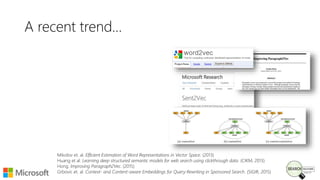
A recent trend…
Mikolov et. al. Efficient Estimation of Word Representations in Vector Space. (2013)
Huang et al. Learning deep structured semantic models for web search using clickthrough data. (CIKM, 2013)
Hong. Improving Paragraph2Vec. (2015)
Grbovic et. al. Context- and Content-aware Embeddings for Query Rewriting in Sponsored Search. (SIGIR, 2015)
Or as a learned RNN model once said*…
2vec or not 2vec that is…
Recaims alone of those the mercorrance down. Sir,
And let it be, if not, no, then; if you get
Great rebels most of a heaven, I cannot mose
where his hearts makes the Rome arrase.
And then it stands: fear them against your honour,
I am a sifel loved him; he swores.
My lord, yet most gentle in our ears?
Our ax I can respect of? If you
concear, and lend me to his punishment?
If I make upon thee. Let me see how after
Wortens of she: is it your sister, pardon! air,
I give my recair to depose?
*The text above was auto-generated using Andrej
Karpathy’s Char-RNN implementation trained on the
works of Shakespeare and then seeded with the starting
text “to vector or not to vector that is”. Special thanks to
Milad Shokouhi for his help with running the RNN model.
Learning to
represent
A lot of recent work in
neural models and
“Deep Learning” is
focused on learning
vector representations
for text, image, speech,
entities, and other
nuggets of information
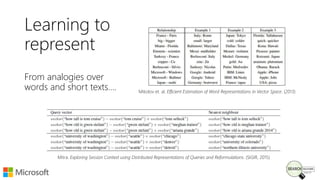
Learning to
represent
From analogies over
words and short texts…. Mikolov et. al. Efficient Estimation of Word Representations in Vector Space. (2013)
Mitra. Exploring Session Context using Distributed Representations of Queries and Reformulations. (SIGIR, 2015)
Learning to
represent
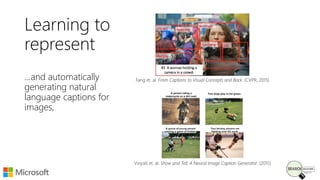
…and automatically
generating natural
language captions for
images,
Vinyals et. al. Show and Tell: A Neural Image Caption Generator. (2015)
Fang et. al. From Captions to Visual Concepts and Back. (CVPR, 2015)
Learning to
represent
…to building automated
conversational agents.
Vinyals et. al. A Neural Conversational Model. (ICML, 2015)
The basics...
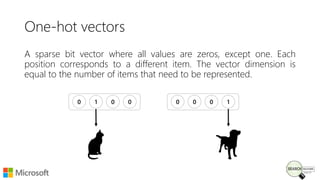
One-hot vectors
A sparse bit vector where all values are zeros, except one. Each
position corresponds to a different item. The vector dimension is
equal to the number of items that need to be represented.
0 1 0 0 0 0 0 1
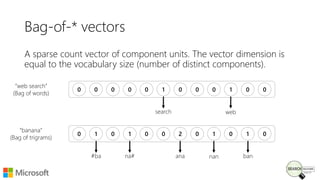
Bag-of-* vectors
A sparse count vector of component units. The vector dimension is
equal to the vocabulary size (number of distinct components).
0 0 0 0 0 1 0 0 0 1 0 0
“web search”
(Bag of words)
search web
0 1 0 1 0 0 2 0 1 0 1 0
“banana”
(Bag of trigrams)
ana nan#ba na# ban
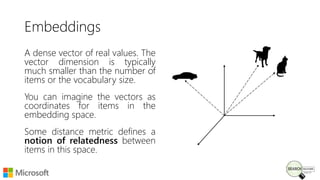
Embeddings
A dense vector of real values. The
vector dimension is typically
much smaller than the number of
items or the vocabulary size.
You can imagine the vectors as
coordinates for items in the
embedding space.
Some distance metric defines a
notion of relatedness between
items in this space.
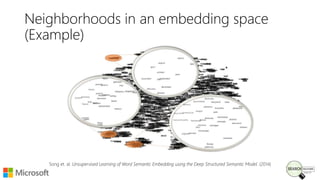
Neighborhoods in an embedding space
(Example)
Song et. al. Unsupervised Learning of Word Semantic Embedding using the Deep Structured Semantic Model. (2014)
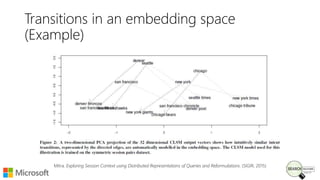
Transitions in an embedding space
(Example)
Mitra. Exploring Session Context using Distributed Representations of Queries and Reformulations. (SIGIR, 2015)
Using text embeddings in search
Example use-cases
for text embeddings
in search
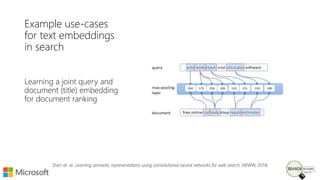
Learning a joint query and
document (title) embedding
for document ranking
Shen et. al. Learning semantic representations using convolutional neural networks for web search. (WWW, 2014)
Example use-cases
for text embeddings
in search
Gao et. al. Modeling Interestingness with Deep Neural Networks. (EMNLP, 2014)
Entity detection in document
(unstructured) body text
Example use-cases
for text embeddings
in search
Mitra and Craswell. Query Auto-Completion for Rare Prefixes. (CIKM, 2015)
Predicting suffixes (or next
word) for query auto-
completion for rare prefixes
Example use-cases
for text embeddings
in search
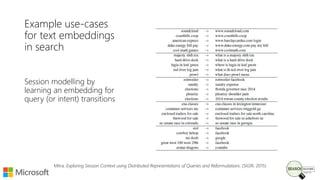
Mitra. Exploring Session Context using Distributed Representations of Queries and Reformulations. (SIGIR, 2015)
Session modelling by
learning an embedding for
query (or intent) transitions
Example use-cases
for text embeddings
in search
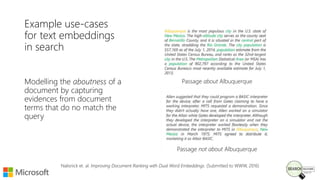
Nalisnick et. al. Improving Document Ranking with Dual Word Embeddings. (Submitted to WWW, 2016)
Modelling the aboutness of a
document by capturing
evidences from document
terms that do no match the
query
Passage about Albuquerque
Passage not about Albuquerque
Example use-cases
for text embeddings
in search
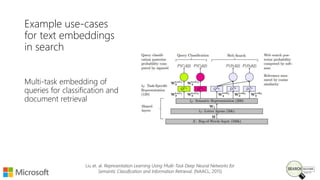
Liu et. al. Representation Learning Using Multi-Task Deep Neural Networks for
Semantic Classification and Information Retrieval. (NAACL, 2015)
Multi-task embedding of
queries for classification and
document retrieval
How do you learn an embedding?
How do you (typically) learn an embedding?
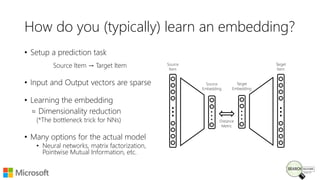
• Setup a prediction task
Source Item → Target Item
• Input and Output vectors are sparse
• Learning the embedding
≈ Dimensionality reduction
(*The bottleneck trick for NNs)
• Many options for the actual model
• Neural networks, matrix factorization,
Pointwise Mutual Information, etc.
Target
Item
Source
Item
Source
Embedding
Target
Embedding
Distance
Metric
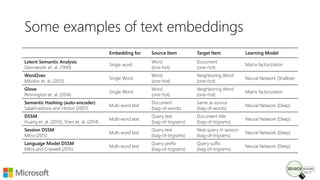
Some examples of text embeddings
Embedding for Source Item Target Item Learning Model
Latent Semantic Analysis
Deerwester et. al. (1990)
Single word
Word
(one-hot)
Document
(one-hot)
Matrix factorization
Word2vec
Mikolov et. al. (2013)
Single Word
Word
(one-hot)
Neighboring Word
(one-hot)
Neural Network (Shallow)
Glove
Pennington et. al. (2014)
Single Word
Word
(one-hot)
Neighboring Word
(one-hot)
Matrix factorization
Semantic Hashing (auto-encoder)
Salakhutdinov and Hinton (2007)
Multi-word text
Document
(bag-of-words)
Same as source
(bag-of-words)
Neural Network (Deep)
DSSM
Huang et. al. (2013), Shen et. al. (2014)
Multi-word text
Query text
(bag-of-trigrams)
Document title
(bag-of-trigrams)
Neural Network (Deep)
Session DSSM
Mitra (2015)
Multi-word text
Query text
(bag-of-trigrams)
Next query in session
(bag-of-trigrams)
Neural Network (Deep)
Language Model DSSM
Mitra and Craswell (2015)
Multi-word text
Query prefix
(bag-of-trigrams)
Query suffix
(bag-of-trigrams)
Neural Network (Deep)
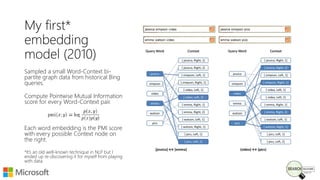
My first*
embedding
model (2010)
Sampled a small Word-Context bi-
partite graph data from historical Bing
queries.
Compute Pointwise Mutual Information
score for every Word-Context pair.
Each word embedding is the PMI score
with every possible Context node on
the right.
*It’s an old well-known technique in NLP but I
ended up re-discovering it for myself from playing
with data.
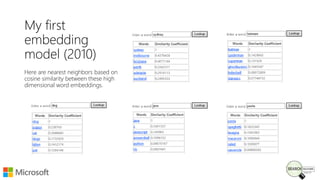
My first
embedding
model (2010)
Here are nearest neighbors based on
cosine similarity between these high
dimensional word embeddings.
You don’t need a neural network to
learn an embedding.
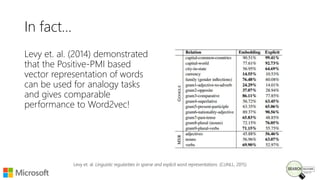
In fact…
Levy et. al. (2014) demonstrated
that the Positive-PMI based
vector representation of words
can be used for analogy tasks
and gives comparable
performance to Word2vec!
Levy et. al. Linguistic regularities in sparse and explicit word representations. (CoNLL, 2015)
The elegance is in the (machine
learning) model, but the magic is in
the structure of the information we
model.
…but
Neural Networks do have certain favorable attributes that lend them
well to learning embeddings
• Embeddings are a by-product of every Neural Network model!
• The output of any intermediate layer is a vector of real numbers – voila,
embedding (of something)!
• Often easier to batch train on large datasets than big matrix
factorizations or graph based approaches
• May be better at modelling non-linearities in the input space
Not all embeddings are created
equal.
The allure of a universal embedding
• The source-target training pairs strictly dictate what notion of
relatedness will be modelled in the embedding space
Is eminem more similar to rihanna or rap?
Is yale more similar to harvard or alumni?
Is seahawks more similar to broncos or seattle?
• Be very careful of using pre-trained embeddings as inputs to a
different model – you may be better off using either one-hot
representations or random initializations!
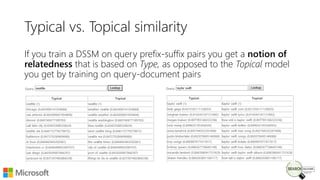
Typical vs. Topical similarity
If you train a DSSM on query prefix-suffix pairs you get a notion of
relatedness that is based on Type, as opposed to the Topical model
you get by training on query-document pairs
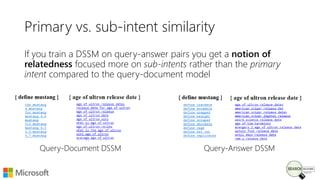
Primary vs. sub-intent similarity
If you train a DSSM on query-answer pairs you get a notion of
relatedness focused more on sub-intents rather than the primary
intent compared to the query-document model
Query-Document DSSM Query-Answer DSSM
What if I told you that everyone
who uses Word2vec is throwing half
the model away?
Using Word2vec for document ranking
Nalisnick, Mitra, Craswell and Caruana.
Improving Document Ranking with Dual
Word Embeddings. Submitted to WWW.
(2016)
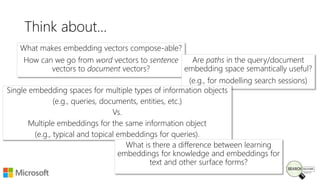
Think about…
What makes embedding vectors compose-able?
How can we go from word vectors to sentence
vectors to document vectors?
Are paths in the query/document
embedding space semantically useful?
(e.g., for modelling search sessions)
Single embedding spaces for multiple types of information objects
(e.g., queries, documents, entities, etc.)
Vs.
Multiple embeddings for the same information object
(e.g., typical and topical embeddings for queries).
What is there a difference between learning
embeddings for knowledge and embeddings for
text and other surface forms?
References
• Public code / toolkits I use
• Computational Network Toolkit (CNTK)
• Sent2vec (DSSM)
• Word2vec
• Random reading list
• Omar Levy’s presentation on analogies using non-neural embeddings
• Marek Rei’s Deep Learning Summer School notes
• Piotr Mirowski’s talk on Representation Learning for NLP
“A robot will be truly autonomous when you instruct it to go
to work and it decides to go to the beach instead.”
- Brad Templeton
Thank You for listening!
(Please send any questions to bmitra@microsoft.com)

Vectorland: Brief Notes from Using Text Embeddings for Search

  • 1.
    Bhaskar Mitra, Microsoft(Bing Sciences) Search Solutions, 26th November, 2015
  • 2.
    A brief introduction… •I have worked as a relevance engineer for Bing since 2007 (then called as Live Search) • Mostly on Web document ranking and query formulation • Moved to an applied research scientist role in 2013 • In this talk I will present… • Some personal learnings and takeaways from working on (neural and non- neural) text embeddings for IR • Highlight a few of my favourite insights/papers from the broader academic community *Thanks to Nick Craswell for suggesting the title “Vectorland”.
  • 3.
    A recent trend… Mikolovet. al. Efficient Estimation of Word Representations in Vector Space. (2013) Huang et al. Learning deep structured semantic models for web search using clickthrough data. (CIKM, 2013) Hong. Improving Paragraph2Vec. (2015) Grbovic et. al. Context- and Content-aware Embeddings for Query Rewriting in Sponsored Search. (SIGIR, 2015)
  • 4.
    Or as alearned RNN model once said*… 2vec or not 2vec that is… Recaims alone of those the mercorrance down. Sir, And let it be, if not, no, then; if you get Great rebels most of a heaven, I cannot mose where his hearts makes the Rome arrase. And then it stands: fear them against your honour, I am a sifel loved him; he swores. My lord, yet most gentle in our ears? Our ax I can respect of? If you concear, and lend me to his punishment? If I make upon thee. Let me see how after Wortens of she: is it your sister, pardon! air, I give my recair to depose? *The text above was auto-generated using Andrej Karpathy’s Char-RNN implementation trained on the works of Shakespeare and then seeded with the starting text “to vector or not to vector that is”. Special thanks to Milad Shokouhi for his help with running the RNN model.
  • 5.
    Learning to represent A lotof recent work in neural models and “Deep Learning” is focused on learning vector representations for text, image, speech, entities, and other nuggets of information
  • 6.
    Learning to represent From analogiesover words and short texts…. Mikolov et. al. Efficient Estimation of Word Representations in Vector Space. (2013) Mitra. Exploring Session Context using Distributed Representations of Queries and Reformulations. (SIGIR, 2015)
  • 7.
    Learning to represent …and automatically generatingnatural language captions for images, Vinyals et. al. Show and Tell: A Neural Image Caption Generator. (2015) Fang et. al. From Captions to Visual Concepts and Back. (CVPR, 2015)
  • 8.
    Learning to represent …to buildingautomated conversational agents. Vinyals et. al. A Neural Conversational Model. (ICML, 2015)
  • 9.
  • 10.
    One-hot vectors A sparsebit vector where all values are zeros, except one. Each position corresponds to a different item. The vector dimension is equal to the number of items that need to be represented. 0 1 0 0 0 0 0 1
  • 11.
    Bag-of-* vectors A sparsecount vector of component units. The vector dimension is equal to the vocabulary size (number of distinct components). 0 0 0 0 0 1 0 0 0 1 0 0 “web search” (Bag of words) search web 0 1 0 1 0 0 2 0 1 0 1 0 “banana” (Bag of trigrams) ana nan#ba na# ban
  • 12.
    Embeddings A dense vectorof real values. The vector dimension is typically much smaller than the number of items or the vocabulary size. You can imagine the vectors as coordinates for items in the embedding space. Some distance metric defines a notion of relatedness between items in this space.
  • 13.
    Neighborhoods in anembedding space (Example) Song et. al. Unsupervised Learning of Word Semantic Embedding using the Deep Structured Semantic Model. (2014)
  • 14.
    Transitions in anembedding space (Example) Mitra. Exploring Session Context using Distributed Representations of Queries and Reformulations. (SIGIR, 2015)
  • 15.
  • 16.
    Example use-cases for textembeddings in search Learning a joint query and document (title) embedding for document ranking Shen et. al. Learning semantic representations using convolutional neural networks for web search. (WWW, 2014)
  • 17.
    Example use-cases for textembeddings in search Gao et. al. Modeling Interestingness with Deep Neural Networks. (EMNLP, 2014) Entity detection in document (unstructured) body text
  • 18.
    Example use-cases for textembeddings in search Mitra and Craswell. Query Auto-Completion for Rare Prefixes. (CIKM, 2015) Predicting suffixes (or next word) for query auto- completion for rare prefixes
  • 19.
    Example use-cases for textembeddings in search Mitra. Exploring Session Context using Distributed Representations of Queries and Reformulations. (SIGIR, 2015) Session modelling by learning an embedding for query (or intent) transitions
  • 20.
    Example use-cases for textembeddings in search Nalisnick et. al. Improving Document Ranking with Dual Word Embeddings. (Submitted to WWW, 2016) Modelling the aboutness of a document by capturing evidences from document terms that do no match the query Passage about Albuquerque Passage not about Albuquerque
  • 21.
    Example use-cases for textembeddings in search Liu et. al. Representation Learning Using Multi-Task Deep Neural Networks for Semantic Classification and Information Retrieval. (NAACL, 2015) Multi-task embedding of queries for classification and document retrieval
  • 22.
    How do youlearn an embedding?
  • 23.
    How do you(typically) learn an embedding? • Setup a prediction task Source Item → Target Item • Input and Output vectors are sparse • Learning the embedding ≈ Dimensionality reduction (*The bottleneck trick for NNs) • Many options for the actual model • Neural networks, matrix factorization, Pointwise Mutual Information, etc. Target Item Source Item Source Embedding Target Embedding Distance Metric
  • 24.
    Some examples oftext embeddings Embedding for Source Item Target Item Learning Model Latent Semantic Analysis Deerwester et. al. (1990) Single word Word (one-hot) Document (one-hot) Matrix factorization Word2vec Mikolov et. al. (2013) Single Word Word (one-hot) Neighboring Word (one-hot) Neural Network (Shallow) Glove Pennington et. al. (2014) Single Word Word (one-hot) Neighboring Word (one-hot) Matrix factorization Semantic Hashing (auto-encoder) Salakhutdinov and Hinton (2007) Multi-word text Document (bag-of-words) Same as source (bag-of-words) Neural Network (Deep) DSSM Huang et. al. (2013), Shen et. al. (2014) Multi-word text Query text (bag-of-trigrams) Document title (bag-of-trigrams) Neural Network (Deep) Session DSSM Mitra (2015) Multi-word text Query text (bag-of-trigrams) Next query in session (bag-of-trigrams) Neural Network (Deep) Language Model DSSM Mitra and Craswell (2015) Multi-word text Query prefix (bag-of-trigrams) Query suffix (bag-of-trigrams) Neural Network (Deep)
  • 25.
    My first* embedding model (2010) Sampleda small Word-Context bi- partite graph data from historical Bing queries. Compute Pointwise Mutual Information score for every Word-Context pair. Each word embedding is the PMI score with every possible Context node on the right. *It’s an old well-known technique in NLP but I ended up re-discovering it for myself from playing with data.
  • 26.
    My first embedding model (2010) Hereare nearest neighbors based on cosine similarity between these high dimensional word embeddings.
  • 27.
    You don’t needa neural network to learn an embedding.
  • 28.
    In fact… Levy et.al. (2014) demonstrated that the Positive-PMI based vector representation of words can be used for analogy tasks and gives comparable performance to Word2vec! Levy et. al. Linguistic regularities in sparse and explicit word representations. (CoNLL, 2015)
  • 29.
    The elegance isin the (machine learning) model, but the magic is in the structure of the information we model.
  • 30.
    …but Neural Networks dohave certain favorable attributes that lend them well to learning embeddings • Embeddings are a by-product of every Neural Network model! • The output of any intermediate layer is a vector of real numbers – voila, embedding (of something)! • Often easier to batch train on large datasets than big matrix factorizations or graph based approaches • May be better at modelling non-linearities in the input space
  • 31.
    Not all embeddingsare created equal.
  • 32.
    The allure ofa universal embedding • The source-target training pairs strictly dictate what notion of relatedness will be modelled in the embedding space Is eminem more similar to rihanna or rap? Is yale more similar to harvard or alumni? Is seahawks more similar to broncos or seattle? • Be very careful of using pre-trained embeddings as inputs to a different model – you may be better off using either one-hot representations or random initializations!
  • 33.
    Typical vs. Topicalsimilarity If you train a DSSM on query prefix-suffix pairs you get a notion of relatedness that is based on Type, as opposed to the Topical model you get by training on query-document pairs
  • 34.
    Primary vs. sub-intentsimilarity If you train a DSSM on query-answer pairs you get a notion of relatedness focused more on sub-intents rather than the primary intent compared to the query-document model Query-Document DSSM Query-Answer DSSM
  • 35.
    What if Itold you that everyone who uses Word2vec is throwing half the model away?
  • 36.
    Using Word2vec fordocument ranking Nalisnick, Mitra, Craswell and Caruana. Improving Document Ranking with Dual Word Embeddings. Submitted to WWW. (2016)
  • 37.
    Think about… What makesembedding vectors compose-able? How can we go from word vectors to sentence vectors to document vectors? Are paths in the query/document embedding space semantically useful? (e.g., for modelling search sessions) Single embedding spaces for multiple types of information objects (e.g., queries, documents, entities, etc.) Vs. Multiple embeddings for the same information object (e.g., typical and topical embeddings for queries). What is there a difference between learning embeddings for knowledge and embeddings for text and other surface forms?
  • 38.
    References • Public code/ toolkits I use • Computational Network Toolkit (CNTK) • Sent2vec (DSSM) • Word2vec • Random reading list • Omar Levy’s presentation on analogies using non-neural embeddings • Marek Rei’s Deep Learning Summer School notes • Piotr Mirowski’s talk on Representation Learning for NLP
  • 39.
    “A robot willbe truly autonomous when you instruct it to go to work and it decides to go to the beach instead.” - Brad Templeton Thank You for listening! (Please send any questions to bmitra@microsoft.com)