




RECRUITMENT
Ms.Sadhana Banerji
Asst.Professor-NDIM
RECRUITMENT
DEFINITION: Recruitment is
the process of searching for
prospective employees and
stimulating them to apply for
jobs in the organization.
Purpose and Importance
 It determines the present and future requirements of
the organization in conjunction with human resource
planning.
 It helps to increase the pool of potential personnel.
 It increases the number of options to choose a
candidate.
 Identifying and preparing potential job applicants .
Contd….
 It reduces the probability that applicants ,once
selected and made available to the organization
,leave it after a short period of time.
Increase the pool of job candidates at minimum cost.
Nature of Recruitment
 It is understood as the process of searching for and
obtaining applicants for jobs, from among whom the
right people can be selected.
 The process of receipt of applications from the job
seekers.
Purpose and importance
 It determines the present and future requirements of
the organization in conjunction with human resource
planning.
 It helps to increase the pool of potential personnel.
 It increases the number of options to choose a
candidate.
 Identifying and preparing potential job applicants .
Contd….
 It reduces the probability that applicants ,once
selected and made available to the organization
,leave it after a short period of time.
Increase the pool of job candidates at minimum cost.
Recruitment policy
Policy ….
 It provides guidelines for actions.
 Recruitment policy spells out the objectives and
principles of the recruitment and provides a
framework for implementation of the recruitment
programmes.
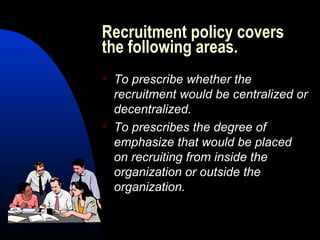
Recruitment policy covers
the following areas.
 To prescribe whether the
recruitment would be centralized or
decentralized.
 To prescribes the degree of
emphasize that would be placed
on recruiting from inside the
organization or outside the
organization.
Policy Contd…..
 To provide the weightage that
would be given to certain
categories of people such as local
population, physically –
handicapped personnel, personnel
from SC,ST ,OBC.
 To specify the degree of flexibility
with regards to age ,qualifications,
compensation structure.
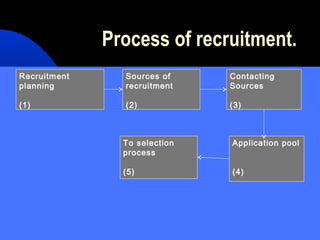
Process of recruitment.
Recruitment
planning
(1)
Sources of
recruitment
(2)
Contacting
Sources
(3)
Application pool
(4)
To selection
process
(5)
1.Recruitment planning.
 It involves the determination of number number of applicants
and type of applicants to be contacted.
A. Number of contacts- Organizations generally plan to
attract more and more applicants than what they intend to
select as they wish to have more option in selecting the right
candidates.
This option is required because some of the candidates may
not be interest in joining the organization, some of them may
not meet the criteria of selection.
Planning Contd…
B. Types of contacts.
 Refers to the type of personnel to be informed about
the job openings based on job description and job
specification.
 This determines how the prospective personnel may
be communicated about the jobs opening.
2.Sources of Recruitment
1) Internal
2) External
1)Internal source
 Persons who are already working in an
organization.
 Retrenched employees, retired employees,
dependants of deceased employees.
 Or some one from within the organization is
upgraded, transferred, promoted .
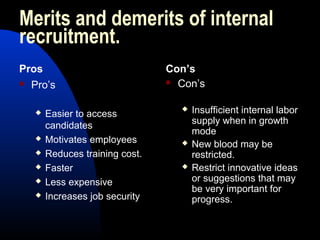
Merits and demerits of internal
recruitment.
Pros
 Pro’s
 Easier to access
candidates
 Motivates employees
 Reduces training cost.
 Faster
 Less expensive
 Increases job security
Con’s
 Con’s
 Insufficient internal labor
supply when in growth
mode
 New blood may be
restricted.
 Restrict innovative ideas
or suggestions that may
be very important for
progress.
Source….
2)External source
 File of unsolicited applications
 Advertisements
 University/ins. Campus
 Employment exchanges
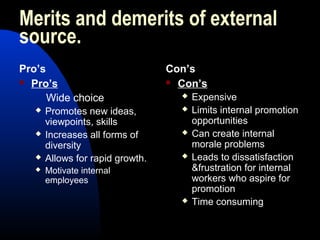
Merits and demerits of external
source.
Pro’s
 Pro’s
Wide choice
 Promotes new ideas,
viewpoints, skills
 Increases all forms of
diversity
 Allows for rapid growth.
 Motivate internal
employees
Con’s
 Con’s
 Expensive
 Limits internal promotion
opportunities
 Can create internal
morale problems
 Leads to dissatisfaction
&frustration for internal
workers who aspire for
promotion
 Time consuming
3.Methods of contacting
sources.
A. DIRECT METHOD
B. INDIRECT METHOD
C. THIRD PARTY
a) DIRECT RECRUITMENT
 CAMPUS RECRUITMENT
 INTERNSHIP(SUMMER PLACEMENT)
 WALK IN INTERVIEW
 DIRECT MAIL
b) INDIRECT RECRUITMENT
 Advertisements
 Newspaper
 Television and Radio ads.
The adv needs to cover information derived from the
job description &job specification in the following
broad areas:
1. The organization
2. The job
3. Qualification &experience
4. Rewards and opportunities
5. conditions
c) Recruitment through the third party
 Employment agencies &agencies
 Mgmt consultants/professional search firms known
as headhunters
 Professional associations
 Placement officers of educational and technical
institutes
4.Application pool
 What ever the method is adopted, the ultimate
objective is to attract as many as candidates as
possible so as to have flexibility in selection.
 Various applications received for a particular job are
pooled together which become the basis for
selection process.
Evaluation of
recruitment process
To ensure that the process has gone well in the light of
its stated objectives and costs.
 The costs generally incurred are.
 Salaries for recruiters.
 Management and professional time spent on
preparing job descriptions, specifications,
advertisement.
 Cost of producing literature.
Contd..
Questions are always asked as to whether the
recruitment methods used are valid and whether
the recruitment process itself is effective.
 Types of organizational image that has been created
in the prospective candidate.
 Number of application received.
 Number of application rejected..
 Cost of recruitment process.
 Total cost involved in recruitment programme .

Recruitment and its Sources

  • 1.
  • 2.
    RECRUITMENT DEFINITION: Recruitment is theprocess of searching for prospective employees and stimulating them to apply for jobs in the organization.
  • 3.
    Purpose and Importance It determines the present and future requirements of the organization in conjunction with human resource planning.  It helps to increase the pool of potential personnel.  It increases the number of options to choose a candidate.  Identifying and preparing potential job applicants .
  • 4.
    Contd….  It reducesthe probability that applicants ,once selected and made available to the organization ,leave it after a short period of time. Increase the pool of job candidates at minimum cost.
  • 6.
    Nature of Recruitment It is understood as the process of searching for and obtaining applicants for jobs, from among whom the right people can be selected.  The process of receipt of applications from the job seekers.
  • 7.
    Purpose and importance It determines the present and future requirements of the organization in conjunction with human resource planning.  It helps to increase the pool of potential personnel.  It increases the number of options to choose a candidate.  Identifying and preparing potential job applicants .
  • 8.
    Contd….  It reducesthe probability that applicants ,once selected and made available to the organization ,leave it after a short period of time. Increase the pool of job candidates at minimum cost.
  • 9.
  • 10.
    Policy ….  Itprovides guidelines for actions.  Recruitment policy spells out the objectives and principles of the recruitment and provides a framework for implementation of the recruitment programmes.
  • 12.
    Recruitment policy covers thefollowing areas.  To prescribe whether the recruitment would be centralized or decentralized.  To prescribes the degree of emphasize that would be placed on recruiting from inside the organization or outside the organization.
  • 13.
    Policy Contd…..  Toprovide the weightage that would be given to certain categories of people such as local population, physically – handicapped personnel, personnel from SC,ST ,OBC.  To specify the degree of flexibility with regards to age ,qualifications, compensation structure.
  • 14.
    Process of recruitment. Recruitment planning (1) Sourcesof recruitment (2) Contacting Sources (3) Application pool (4) To selection process (5)
  • 15.
    1.Recruitment planning.  Itinvolves the determination of number number of applicants and type of applicants to be contacted. A. Number of contacts- Organizations generally plan to attract more and more applicants than what they intend to select as they wish to have more option in selecting the right candidates. This option is required because some of the candidates may not be interest in joining the organization, some of them may not meet the criteria of selection.
  • 16.
    Planning Contd… B. Typesof contacts.  Refers to the type of personnel to be informed about the job openings based on job description and job specification.  This determines how the prospective personnel may be communicated about the jobs opening.
  • 17.
    2.Sources of Recruitment 1)Internal 2) External 1)Internal source  Persons who are already working in an organization.  Retrenched employees, retired employees, dependants of deceased employees.  Or some one from within the organization is upgraded, transferred, promoted .
  • 18.
    Merits and demeritsof internal recruitment. Pros  Pro’s  Easier to access candidates  Motivates employees  Reduces training cost.  Faster  Less expensive  Increases job security Con’s  Con’s  Insufficient internal labor supply when in growth mode  New blood may be restricted.  Restrict innovative ideas or suggestions that may be very important for progress.
  • 19.
    Source…. 2)External source  Fileof unsolicited applications  Advertisements  University/ins. Campus  Employment exchanges
  • 20.
    Merits and demeritsof external source. Pro’s  Pro’s Wide choice  Promotes new ideas, viewpoints, skills  Increases all forms of diversity  Allows for rapid growth.  Motivate internal employees Con’s  Con’s  Expensive  Limits internal promotion opportunities  Can create internal morale problems  Leads to dissatisfaction &frustration for internal workers who aspire for promotion  Time consuming
  • 21.
    3.Methods of contacting sources. A.DIRECT METHOD B. INDIRECT METHOD C. THIRD PARTY
  • 22.
    a) DIRECT RECRUITMENT CAMPUS RECRUITMENT  INTERNSHIP(SUMMER PLACEMENT)  WALK IN INTERVIEW  DIRECT MAIL
  • 23.
    b) INDIRECT RECRUITMENT Advertisements  Newspaper  Television and Radio ads. The adv needs to cover information derived from the job description &job specification in the following broad areas: 1. The organization 2. The job 3. Qualification &experience 4. Rewards and opportunities 5. conditions
  • 24.
    c) Recruitment throughthe third party  Employment agencies &agencies  Mgmt consultants/professional search firms known as headhunters  Professional associations  Placement officers of educational and technical institutes
  • 25.
    4.Application pool  Whatever the method is adopted, the ultimate objective is to attract as many as candidates as possible so as to have flexibility in selection.  Various applications received for a particular job are pooled together which become the basis for selection process.
  • 26.
    Evaluation of recruitment process Toensure that the process has gone well in the light of its stated objectives and costs.  The costs generally incurred are.  Salaries for recruiters.  Management and professional time spent on preparing job descriptions, specifications, advertisement.  Cost of producing literature.
  • 27.
    Contd.. Questions are alwaysasked as to whether the recruitment methods used are valid and whether the recruitment process itself is effective.  Types of organizational image that has been created in the prospective candidate.  Number of application received.  Number of application rejected..  Cost of recruitment process.  Total cost involved in recruitment programme .