Mr. T.SOMASUNDARAM
DEPARTMENT OF MANAGEMENT
KRISTU JAYANTI COLLEGE (AUTONOMOUS), BENGALURU
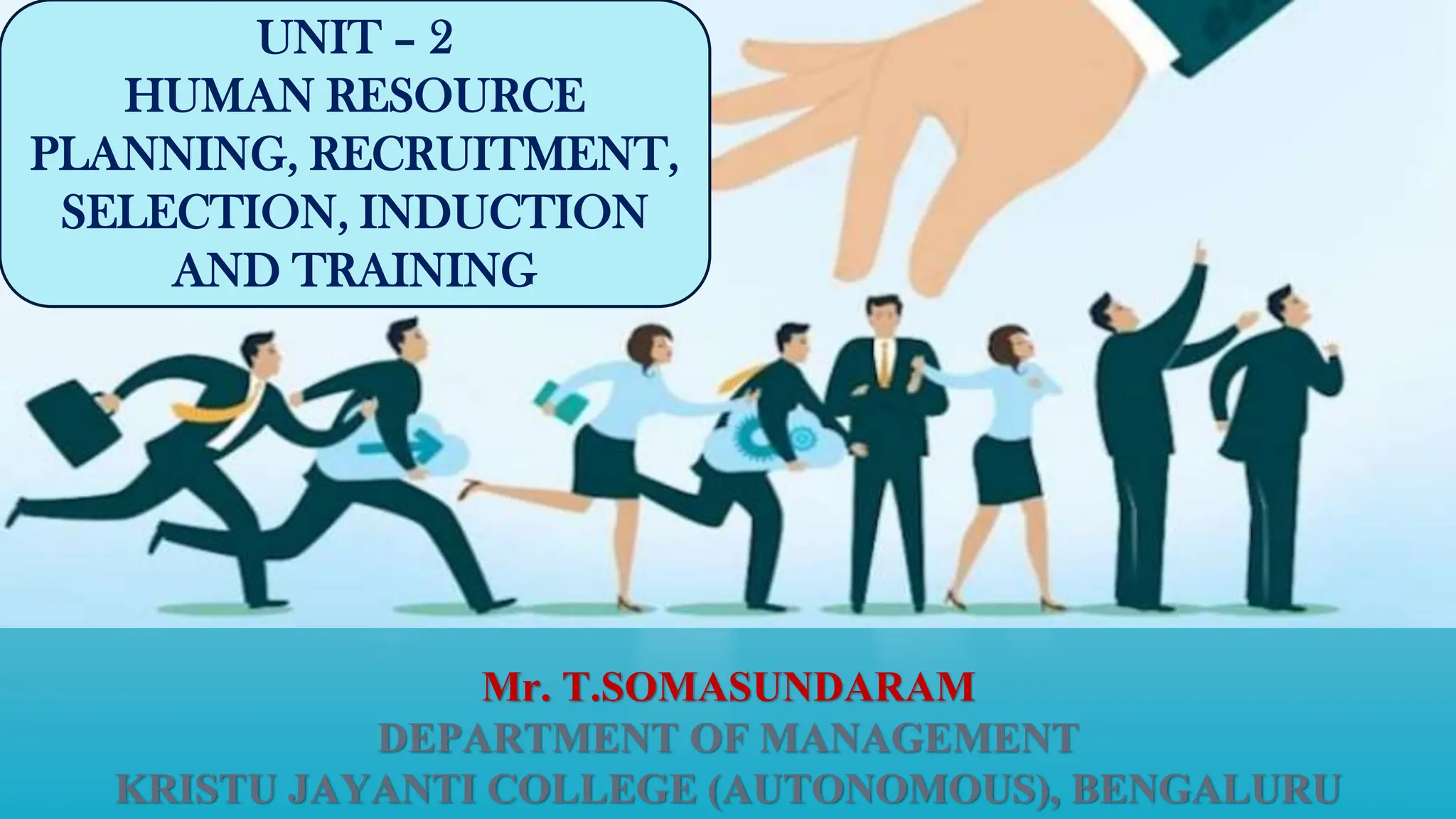
UNIT – 2
HUMAN RESOURCE
PLANNING, RECRUITMENT,
SELECTION, INDUCTION
AND TRAINING
UNIT – 2
HUMAN RESOURCE PLANNING, RECRUITMENT, SELECTION,
INDUCTION AND TRAINING
Human Resource Planning – meaning, importance, benefits,
stages of HRP, action plan in case of shortage and surplus of
workforce, Recruitment – meaning, methods, sources, process &
factors affecting recruitment, E-Recruitment – its process in IT &
service sector. Selection – meaning, process, types of selection
tests, types of interviews, emerging trends in recruitment &
selection. Placement & Induction – meaning, benefits of
induction, content of an induction program. Training – meaning
and importance, stages, methods (New training techniques),
developing competency.
HUMAN RESOURCE PLANNING (HRP)
Meaning:
Human Resource Planning is the process by which an organisation ensures that –
 It has the right number and kinds of people.
 At the right places.
 At the right time.
 Capable of effectively and efficiently completing those tasks that will help
the organisation achieve its overall strategic objectives.
 It is the process of assessing the future supply of and demand for human
resources.
 It also provides mechanisms to eliminate any gaps that may exist between
supply and demand.
HUMAN RESOURCE PLANNING (HRP)
Meaning:
 It is a process of determining what positions in the firm will have
to be filled and when.
 Human Resource planning translates the organization’s overall goal
into the number and types of workers needed to meet those goals.
 Without clear-cut planning, estimation of an organization’s human
resource need is reduced to mere guesswork.
 Thus, HR planning determines the number and types of employees
to be recruited into the organisation or phased out of it.
HUMAN RESOURCE PLANNING (HRP)
Definition:
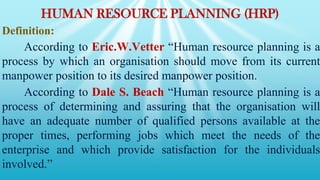
According to Eric.W.Vetter “Human resource planning is a
process by which an organisation should move from its current
manpower position to its desired manpower position.
According to Dale S. Beach “Human resource planning is a
process of determining and assuring that the organisation will
have an adequate number of qualified persons available at the
proper times, performing jobs which meet the needs of the
enterprise and which provide satisfaction for the individuals
involved.”
HUMAN RESOURCE PLANNING (HRP)
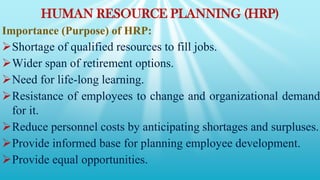
Importance (Purpose) of HRP:
Shortage of qualified resources to fill jobs.
Wider span of retirement options.
Need for life-long learning.
Resistance of employees to change and organizational demand
for it.
Reduce personnel costs by anticipating shortages and surpluses.
Provide informed base for planning employee development.
Provide equal opportunities.
HUMAN RESOURCE PLANNING (HRP)
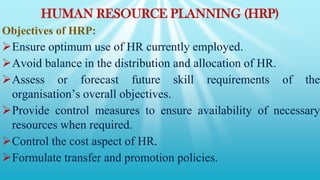
Objectives of HRP:
Ensure optimum use of HR currently employed.
Avoid balance in the distribution and allocation of HR.
Assess or forecast future skill requirements of the
organisation’s overall objectives.
Provide control measures to ensure availability of necessary
resources when required.
Control the cost aspect of HR.
Formulate transfer and promotion policies.
HUMAN RESOURCE PLANNING (HRP)
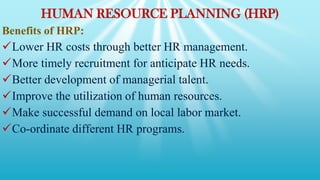
Benefits of HRP:
Lower HR costs through better HR management.
More timely recruitment for anticipate HR needs.
Better development of managerial talent.
Improve the utilization of human resources.
Make successful demand on local labor market.
Co-ordinate different HR programs.
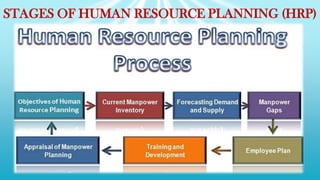
STAGES OF HUMAN RESOURCE PLANNING (HRP)
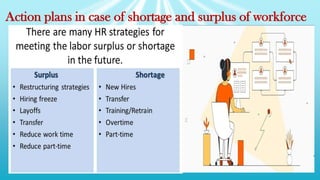
Action plans in case of shortage and surplus of workforce
Recruitment
RECRUITMENT
Meaning:
 Recruitment is a positive process of searching for prospective employees and
stimulating them to apply for the jobs in the organisation. When more persons
apply for jobs then there will be a scope for recruiting better persons.
 In simple words, the term recruitment refers to discovering the source from
where potential employees may be selected. It stimulates people to apply for
jobs; hence it is a positive process.
 Recruitment is concerned with reaching out, attracting, and ensuring a supply
of qualified personnel and making out selection of requisite manpower both in
their quantitative and qualitative aspect. It is the development and maintenance
of adequate man- power resources. This is the first stage of the process of
selection and is completed with placement.
RECRUITMENT
Definition:
According to Edwin B. Flippo, ‘Recruitment is the process
of searching the candidates for employment and stimulating them
to apply for jobs in the organisation’.
According to Dale S. Beach, ‘Recruitment is the
development and maintenance of adequate manpower resources.
It involves the creation of a pool of available labour upon whom
the organisation can draw when it needs additional employees.’
Sources of Recruitment
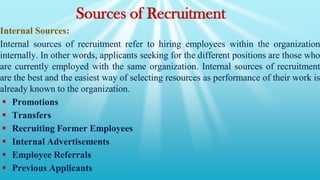
Internal Sources:
Internal sources of recruitment refer to hiring employees within the organization
internally. In other words, applicants seeking for the different positions are those who
are currently employed with the same organization. Internal sources of recruitment
are the best and the easiest way of selecting resources as performance of their work is
already known to the organization.
 Promotions
 Transfers
 Recruiting Former Employees
 Internal Advertisements
 Employee Referrals
 Previous Applicants
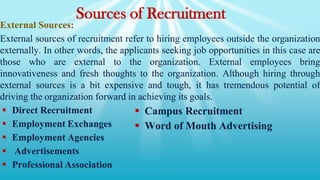
External Sources:
External sources of recruitment refer to hiring employees outside the organization
externally. In other words, the applicants seeking job opportunities in this case are
those who are external to the organization. External employees bring
innovativeness and fresh thoughts to the organization. Although hiring through
external sources is a bit expensive and tough, it has tremendous potential of
driving the organization forward in achieving its goals.
 Direct Recruitment
 Employment Exchanges
 Employment Agencies
 Advertisements
 Professional Association
Sources of Recruitment
 Campus Recruitment
 Word of Mouth Advertising
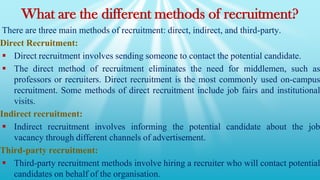
What are the different methods of recruitment?
There are three main methods of recruitment: direct, indirect, and third-party.
Direct Recruitment:
 Direct recruitment involves sending someone to contact the potential candidate.
 The direct method of recruitment eliminates the need for middlemen, such as
professors or recruiters. Direct recruitment is the most commonly used on-campus
recruitment. Some methods of direct recruitment include job fairs and institutional
visits.
Indirect recruitment:
 Indirect recruitment involves informing the potential candidate about the job
vacancy through different channels of advertisement.
Third-party recruitment:
 Third-party recruitment methods involve hiring a recruiter who will contact potential
candidates on behalf of the organisation.
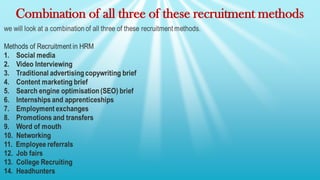
Combination of all three of these recruitment methods
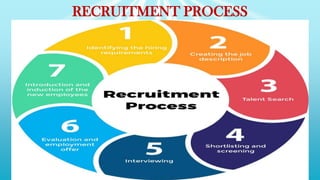
RECRUITMENT PROCESS
Factors affecting recruitment
19
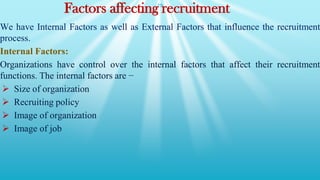
We have Internal Factors as well as External Factors that influence the recruitment
process.
Internal Factors:
Organizations have control over the internal factors that affect their recruitment
functions. The internal factors are −
 Size of organization
 Recruiting policy
 Image of organization
 Image of job
Factors affecting recruitment
20
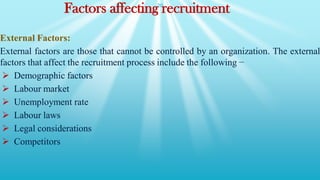
External Factors:
External factors are those that cannot be controlled by an organization. The external
factors that affect the recruitment process include the following −
 Demographic factors
 Labour market
 Unemployment rate
 Labour laws
 Legal considerations
 Competitors
E-Recruitment
E-Recruitment:
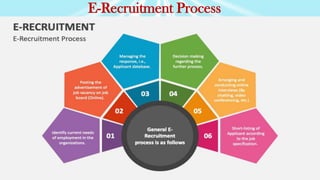
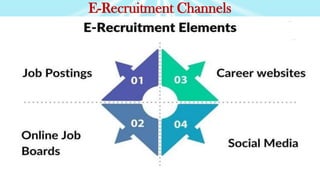
E-Recruitment also known as online recruitment, is the practice of
using technology and in particular web-based resources for tasks involved
with finding, attracting, assessing, interviewing and hiring new personnel.
Online recruitment can reach a larger pool of potential employees and
facilitate the selection process.
E-Recruitment Process
E-Recruitment Channels
E-Recruitment Process in IT & Service Sector
IT Sector:
• IT recruitment, is the act of securing talent for information technology
firms.
• It evaluates business needs, connect with the right candidates, and deliver
talent—all in a timely fashion.
There are two basic types of recruiting that both candidates and recruiters
utilize.
a) Passive recruiting is a style of recruiting where companies broadcast
open positions—on job boards, their website, or otherwise—to attract new
talent.
b) Active recruiting uses contingency firms, networking, database work,
direct mail campaigns, and more to reach out to the best candidates.
E-Recruitment Process in IT & Service Sector
Service Sector:
Recruitment process in service sector:
 Identifying the needs
 Planning
 Searching
 Identifying viable candidates
 Telephonic screening
 Face to face interview
 On boarding of candidates
Recruitment strategies in Service Industry:
Every service business owner knows the importance of recruiting “the best of the best”. In
large service industries, recruitment is the responsibility of Personnel and Human
Resources.
It includes –
 Refinement of recruiting advertisements and promotions.
 Comprehensively training recruiters.
 Incorporation of company policy into recruitment practices.
 Quantifying and qualifying projected recruitment needs.
 Designing and creating recruitment cycles for staffing balance.
 Identifying excellent recruitment candidates.
 Factoring recruitment costs with long term business budgets.
 Understanding elements of motivation during recruitment phases • Determining “cutting
edge” hiring practices.
 How salary affects quality of recruitment.
Selection
Introduction:
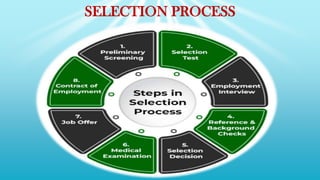
 After reviewing the applicants resumes, the manager turns to
selecting the best candidates for the job.
 Selection involves a series of steps by which the candidates are
screened for choosing the most suitable persons for vacant
posts.
 The process of selection leads to employment of persons who
possess the ability and qualification to perform the jobs which
have fallen vacant in an organization.
Selection
Definition:
“Selection is the process by which candidates for
employment are divided into class – those who will be offered
employment and those who will not” - Yoder
“Selection is the process of choosing from among the
candidates from within the organisation or from the outside, the
most suitable person for the current position or future position”.
- Koontz
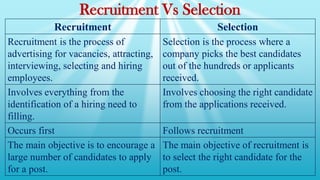
Recruitment Vs Selection
Recruitment Selection
Recruitment is the process of
advertising for vacancies, attracting,
interviewing, selecting and hiring
employees.
Selection is the process where a
company picks the best candidates
out of the hundreds or applicants
received.
Involves everything from the
identification of a hiring need to
filling.
Involves choosing the right candidate
from the applications received.
Occurs first Follows recruitment
The main objective is to encourage a
large number of candidates to apply
for a post.
The main objective of recruitment is
to select the right candidate for the
post.
SELECTION PROCESS
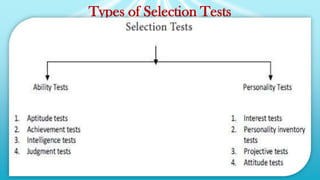
Types of Selection Tests
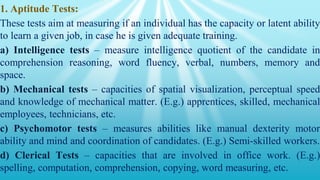
1. Aptitude Tests:
These tests aim at measuring if an individual has the capacity or latent ability
to learn a given job, in case he is given adequate training.
a) Intelligence tests – measure intelligence quotient of the candidate in
comprehension reasoning, word fluency, verbal, numbers, memory and
space.
b) Mechanical tests – capacities of spatial visualization, perceptual speed
and knowledge of mechanical matter. (E.g.) apprentices, skilled, mechanical
employees, technicians, etc.
c) Psychomotor tests – measures abilities like manual dexterity motor
ability and mind and coordination of candidates. (E.g.) Semi-skilled workers.
d) Clerical Tests – capacities that are involved in office work. (E.g.)
spelling, computation, comprehension, copying, word measuring, etc.
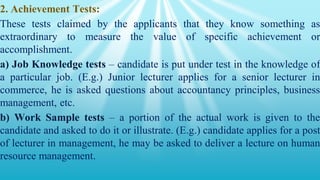
2. Achievement Tests:
These tests claimed by the applicants that they know something as
extraordinary to measure the value of specific achievement or
accomplishment.
a) Job Knowledge tests – candidate is put under test in the knowledge of
a particular job. (E.g.) Junior lecturer applies for a senior lecturer in
commerce, he is asked questions about accountancy principles, business
management, etc.
b) Work Sample tests – a portion of the actual work is given to the
candidate and asked to do it or illustrate. (E.g.) candidate applies for a post
of lecturer in management, he may be asked to deliver a lecture on human
resource management.
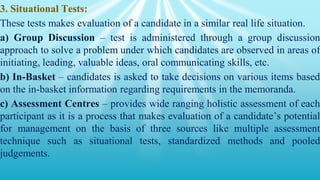
3. Situational Tests:
These tests makes evaluation of a candidate in a similar real life situation.
a) Group Discussion – test is administered through a group discussion
approach to solve a problem under which candidates are observed in areas of
initiating, leading, valuable ideas, oral communicating skills, etc.
b) In-Basket – candidates is asked to take decisions on various items based
on the in-basket information regarding requirements in the memoranda.
c) Assessment Centres – provides wide ranging holistic assessment of each
participant as it is a process that makes evaluation of a candidate’s potential
for management on the basis of three sources like multiple assessment
technique such as situational tests, standardized methods and pooled
judgements.
4. Judgement Tests: A situational judgement test (SJT) is a test used to
assess someone's decision making and judgement. The candidate will be
presented with a work-like situation and a number of possible
actions/responses they could take. The candidate must then choose their
most likely and least likely response if faced with this situation.
5. Interest Tests: Likes and dislikes of candidates in relation to work,
job, occupations, hobbies and recreational activities are determined
through this test.
6. Projective Tests: A projective test is a personality test in which
subjects are shown ambiguous images or given situations and asked to
interpret them. The subjects are to project their own emotions, attitudes,
and impulses onto the stimulus given.
7. Personality Tests:
These tests to evaluate the whole personality of the candidate such
as his emotional reactions and maturity and characteristic mood.
(E.g.) Self-confidence, optimism, sociability, initiative,
dominance, sympathy, integrity, stability, etc.
a) Objective Tests – this test are suitable for group testing and
can be scored objectively.
8. Attitude Tests: These tests is done to measure people's
attitudes. The purpose is to quantify peoples' beliefs and
behaviours to inform decisions, understand human differences,
and gain knowledge about personality types.
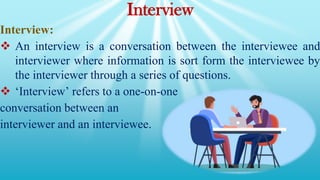
Interview:
 An interview is a conversation between the interviewee and
interviewer where information is sort form the interviewee by
the interviewer through a series of questions.
 ‘Interview’ refers to a one-on-one
conversation between an
interviewer and an interviewee.
Interview
Types of Interview
 Screening / Telephonic
Interview
 Selection Interview
 Traditional Interview
 Video Conferencing
Interview
 Case Interview
 Informational Interview
 Personal Interview
 Structured Interview
 Unstructured Interview
Group Interview
Working Interview
Panel Interview
Situational Interview
Behavioural Interview
Stress Interview
Off-site Interview
On-site Interview
Task Oriented / Testing
Interview
1. Screening / Telephonic Interview: It is an initial conversation that interviewers
have with candidates in the job selection process and these types of interviews are
proving to be a more cost effective way to screen candidates in person or phone call.
2. Selection Interview: It is a free-flowing and open-ended process used to
determine if you are suitable for a specific job opening.
3. Traditional Interview: You meet the interviewer at the business and have an
interview in an office or a conference room.
4. Video Conferencing Interview: It is a job interview that takes place remotely
and uses video technology as the communication medium with face-to-face
interviews.
5. Case Interview: The interviewer gives you a situation and the associated
problem, which is an imaginary or real-life problem and asking for a solution to the
problem.
Types of Interview
6. Informational Interview: This interviews are meant for learning the real-
life experience of an expert working in the field of the interviewer’s interest.
7. Personal / Individual Interview: It is usually a face-to-face meeting or
two-way communication between the recruiter and the candidate.
8. Structured Interview: Interviewers ask the same set of questions from all
candidates, which can be a open-ended or close-ended questions and
compares candidates based on their responses to these questions.
9. Unstructured Interview: Interviewers change questions based on the
candidate’s response to the previous questions and no set of format questions.
10. Group Interview: When an employee or team of employees interviews
multiple candidates simultaneously or when a team of employees forms a
panel to interview one candidate.
11. Working Interview: It is a hands-on interview where employers can see
a candidate’s ability to perform a specific job or task.
12. Panel Interview: It is a interview when two or more people interview the
candidate at the same time to assess the candidate on different grounds.
13. Situational Interview: This interviews are similar to behavioural
interview questions – but they focused on the future and ask hypothetical
questions.
14. Behavioural Interview: It focus on a candidate’s past experiences to
assess how they have navigated specific situations and utilized skills relevant
to the position. It is also known as Critical Behavioural Interview (CBI).
15. Stress Interview: This interview assess the candidate based on the
response to the stressful situations and to see how candidate react under
pressure.
16. Off-site Interview: These are informal interviews where the
candidate and interviewer meet at a place other than the office.
Interviewer may invite the candidate over lunch and aim is to assess your
personality outside the workplace.
17. On-Site Interview: It refers to an interview on the employer’s site.
(i.e.) conduct interviews on campus through On-Campus interview or as
part of On-campus job fairs.
18. Task Oriented / Testing Interview: This types of interviews are
structured in a way that allows you to demonstrate the creative and
analytical abilities in problem solving through varied tasks or exercises. It
may include short test to evaluate the technical knowledge and skills.
Internal Interviews
Promotional Interview
Appraisal Interview
Exit Interview
Problem Interview
Recent Trends in Recruitment and Selection
From reactive to proactive:
 It requires some level of workforce planning.
 With current level of HR analytics, it is relatively easy to increase the quality of
workforce planning.
From recruiting for job to recruiting for assignments:
 Organizations are more creatively using the opportunities of a more flexible
workforce.
 It helps to think less in terms of jobs and more in terms of assignments.
From selecting on skills to selecting on values and personality:
 Core organizations are looking for talent where there is good fit between the values
and the personality of organization and values and personality of candidates.
Community management as a recruitment tool: - practice to create communities
around organizations, a kind of ‘fan club’ is growing.
Recent Trends in Recruitment and Selection
Gamification in recruitment:
 Recruitment can be fun and people want to work for organizations where work
and fun are closely connected.
Gamification in Selection:
 Companies behind the games claim they can make a valuable profile of the
candidate based on his or her game behaviour and results.
 Playing a game is a lot more fun than being interviewed by people whom all ask
more or less the same questions.
The End of trainee-ships:
 Planning the careers of people years ahead does not fit in a time where speed of
change is continuously increasing.
 It need streetwise entrepreneurs who have learned to operate close to clients and
markets.
Introduction - Placement:
 Placement is a process of assigning a
specific job to each of the selected candidates.
 It involves assigning a specific rank and
responsibility to an individual.
 It implies matching the requirements of a job with the qualifications of the
candidate.
 Placement is understood assigning jobs to the selected candidates.
 Assigning jobs to employees may involves a new job or different jobs.
 Thus, placement may include initial assignment of job to new employee, on
transfer, promotion or demotion of the present employees.
Placement
Definition:
“Placement is the determination of the job to which an accepted candidate is to
be assigned and his assignment to that job. It is a matching of what the supervisor has
reason to think he can do with the job demands (job requirements) and it is matching
of what he imposes (in strain, working conditions etc.) and what he offers (in the
form of payroll companionship with others, promotional possibilities etc.).’’
-Pigors & Myres
Right placement of workers can have following advantages –
 Reduced labor turnover rate.
 Reduced absenteeism rate.
 Increased safety of workers and lower accidents.
 Increased morale of workers.
 Better human relations in the organizations.
Induction
Introduction:
 The new employee, on his joining the organisation, must be helped to get
adjusted and acquainted with the fellow employees and the work
environment.
 Rather than leaving him to make his own way through the organisation.
 It is much better to properly and systematically introduce him to the
company, its philosophy, its place in the industry or economy, its major
policies etc.
Definition:
“Induction is concerned with introducing or orienting a new employee to
the organisation. It is the welcoming process to make the new employee feel at
home and generate in him a feeling of belongingness to the organisation”
-Edwin B. Flippo
Contents of Induction Programme
Contents:
 Company’s history, mission, vision and philosophy.
 Products and services of the company.
 Company’s organisation structure.
 Location of departments and employee services.
 Employee’s activities like clubs, credit society.
 Personnel policies and procedures.
 Standing orders.
 Rules and Regulations.
 Terms and conditions of services.
 Grievance procedures.
 Safety measures.
 Benefits and services for employees.
 Training, promotions and transfer facility.
 Career advancement schemes.
 Counselling facility
Induction Process
The following are the steps in induction process:
Step 1: Welcoming the new employees.
Step 2: Induction with immediate superior.
Step 3: To impart detail instructions.
Benefits of Effective Induction to the organization:
 Saves a lot of money and time.
 Reduces employee turnover.
 Ensures operational efficiency.
Advantages:
 Makes the new employee feel respected and valued.
 Provides the necessary information.
 Helps in establishing good communication.
Training
Introduction:
 Training of employees takes place after orientation takes place.
 Training is the process of enhancing the skills, capabilities and knowledge
of employees for doing a particular job.
 Training process molds the thinking of employees and leads to quality
performance of employees.
 It is continuous and never ending in nature.
Definition:
“Training is the act of increasing the knowledge and skill of an employee
for doing a particular job.” - Edwin B.Flippo
“Training is a learning process whereby people acquire skills, concepts,
attitudes or knowledge to aid in the achievement of goals.” - Mathis & Jackson
Training
Importance of Training:
 Increased productivity.
 Less Supervision.
 Saves a lot of money and time.
 Reduces employee turnover and absenteeism.
 Ensures operational efficiency.
 Makes the new employee feel respected and valued.
 Provides the necessary information.
 Helps in establishing good communication.
 Employee Development.
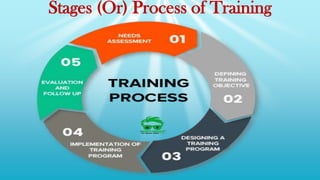
Stages (Or) Process of Training
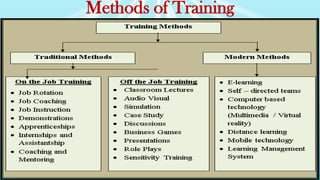
Methods of Training
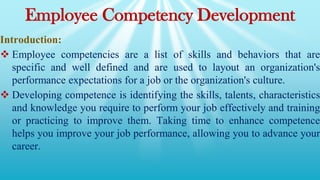
Employee Competency Development
Introduction:
 Employee competencies are a list of skills and behaviors that are
specific and well defined and are used to layout an organization's
performance expectations for a job or the organization's culture.
 Developing competence is identifying the skills, talents, characteristics
and knowledge you require to perform your job effectively and training
or practicing to improve them. Taking time to enhance competence
helps you improve your job performance, allowing you to advance your
career.
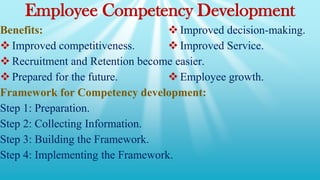
Employee Competency Development
Benefits:
 Improved competitiveness.
 Recruitment and Retention become easier.
 Prepared for the future.
Framework for Competency development:
Step 1: Preparation.
Step 2: Collecting Information.
Step 3: Building the Framework.
Step 4: Implementing the Framework.
 Improved decision-making.
 Improved Service.
 Employee growth.
Human Resource Planning (HRP) and its process

Human Resource Planning (HRP) and its process

  • 1.
    Mr. T.SOMASUNDARAM DEPARTMENT OFMANAGEMENT KRISTU JAYANTI COLLEGE (AUTONOMOUS), BENGALURU UNIT – 2 HUMAN RESOURCE PLANNING, RECRUITMENT, SELECTION, INDUCTION AND TRAINING
  • 2.
    UNIT – 2 HUMANRESOURCE PLANNING, RECRUITMENT, SELECTION, INDUCTION AND TRAINING Human Resource Planning – meaning, importance, benefits, stages of HRP, action plan in case of shortage and surplus of workforce, Recruitment – meaning, methods, sources, process & factors affecting recruitment, E-Recruitment – its process in IT & service sector. Selection – meaning, process, types of selection tests, types of interviews, emerging trends in recruitment & selection. Placement & Induction – meaning, benefits of induction, content of an induction program. Training – meaning and importance, stages, methods (New training techniques), developing competency.
  • 3.
    HUMAN RESOURCE PLANNING(HRP) Meaning: Human Resource Planning is the process by which an organisation ensures that –  It has the right number and kinds of people.  At the right places.  At the right time.  Capable of effectively and efficiently completing those tasks that will help the organisation achieve its overall strategic objectives.  It is the process of assessing the future supply of and demand for human resources.  It also provides mechanisms to eliminate any gaps that may exist between supply and demand.
  • 4.
    HUMAN RESOURCE PLANNING(HRP) Meaning:  It is a process of determining what positions in the firm will have to be filled and when.  Human Resource planning translates the organization’s overall goal into the number and types of workers needed to meet those goals.  Without clear-cut planning, estimation of an organization’s human resource need is reduced to mere guesswork.  Thus, HR planning determines the number and types of employees to be recruited into the organisation or phased out of it.
  • 5.
    HUMAN RESOURCE PLANNING(HRP) Definition: According to Eric.W.Vetter “Human resource planning is a process by which an organisation should move from its current manpower position to its desired manpower position. According to Dale S. Beach “Human resource planning is a process of determining and assuring that the organisation will have an adequate number of qualified persons available at the proper times, performing jobs which meet the needs of the enterprise and which provide satisfaction for the individuals involved.”
  • 6.
    HUMAN RESOURCE PLANNING(HRP) Importance (Purpose) of HRP: Shortage of qualified resources to fill jobs. Wider span of retirement options. Need for life-long learning. Resistance of employees to change and organizational demand for it. Reduce personnel costs by anticipating shortages and surpluses. Provide informed base for planning employee development. Provide equal opportunities.
  • 7.
    HUMAN RESOURCE PLANNING(HRP) Objectives of HRP: Ensure optimum use of HR currently employed. Avoid balance in the distribution and allocation of HR. Assess or forecast future skill requirements of the organisation’s overall objectives. Provide control measures to ensure availability of necessary resources when required. Control the cost aspect of HR. Formulate transfer and promotion policies.
  • 8.
    HUMAN RESOURCE PLANNING(HRP) Benefits of HRP: Lower HR costs through better HR management. More timely recruitment for anticipate HR needs. Better development of managerial talent. Improve the utilization of human resources. Make successful demand on local labor market. Co-ordinate different HR programs.
  • 9.
    STAGES OF HUMANRESOURCE PLANNING (HRP)
  • 10.
    Action plans incase of shortage and surplus of workforce
  • 11.
  • 12.
    RECRUITMENT Meaning:  Recruitment isa positive process of searching for prospective employees and stimulating them to apply for the jobs in the organisation. When more persons apply for jobs then there will be a scope for recruiting better persons.  In simple words, the term recruitment refers to discovering the source from where potential employees may be selected. It stimulates people to apply for jobs; hence it is a positive process.  Recruitment is concerned with reaching out, attracting, and ensuring a supply of qualified personnel and making out selection of requisite manpower both in their quantitative and qualitative aspect. It is the development and maintenance of adequate man- power resources. This is the first stage of the process of selection and is completed with placement.
  • 13.
    RECRUITMENT Definition: According to EdwinB. Flippo, ‘Recruitment is the process of searching the candidates for employment and stimulating them to apply for jobs in the organisation’. According to Dale S. Beach, ‘Recruitment is the development and maintenance of adequate manpower resources. It involves the creation of a pool of available labour upon whom the organisation can draw when it needs additional employees.’
  • 14.
    Sources of Recruitment InternalSources: Internal sources of recruitment refer to hiring employees within the organization internally. In other words, applicants seeking for the different positions are those who are currently employed with the same organization. Internal sources of recruitment are the best and the easiest way of selecting resources as performance of their work is already known to the organization.  Promotions  Transfers  Recruiting Former Employees  Internal Advertisements  Employee Referrals  Previous Applicants
  • 15.
    External Sources: External sourcesof recruitment refer to hiring employees outside the organization externally. In other words, the applicants seeking job opportunities in this case are those who are external to the organization. External employees bring innovativeness and fresh thoughts to the organization. Although hiring through external sources is a bit expensive and tough, it has tremendous potential of driving the organization forward in achieving its goals.  Direct Recruitment  Employment Exchanges  Employment Agencies  Advertisements  Professional Association Sources of Recruitment  Campus Recruitment  Word of Mouth Advertising
  • 16.
    What are thedifferent methods of recruitment? There are three main methods of recruitment: direct, indirect, and third-party. Direct Recruitment:  Direct recruitment involves sending someone to contact the potential candidate.  The direct method of recruitment eliminates the need for middlemen, such as professors or recruiters. Direct recruitment is the most commonly used on-campus recruitment. Some methods of direct recruitment include job fairs and institutional visits. Indirect recruitment:  Indirect recruitment involves informing the potential candidate about the job vacancy through different channels of advertisement. Third-party recruitment:  Third-party recruitment methods involve hiring a recruiter who will contact potential candidates on behalf of the organisation.
  • 17.
    Combination of allthree of these recruitment methods
  • 18.
  • 19.
    Factors affecting recruitment 19 Wehave Internal Factors as well as External Factors that influence the recruitment process. Internal Factors: Organizations have control over the internal factors that affect their recruitment functions. The internal factors are −  Size of organization  Recruiting policy  Image of organization  Image of job
  • 20.
    Factors affecting recruitment 20 ExternalFactors: External factors are those that cannot be controlled by an organization. The external factors that affect the recruitment process include the following −  Demographic factors  Labour market  Unemployment rate  Labour laws  Legal considerations  Competitors
  • 21.
    E-Recruitment E-Recruitment: E-Recruitment also knownas online recruitment, is the practice of using technology and in particular web-based resources for tasks involved with finding, attracting, assessing, interviewing and hiring new personnel. Online recruitment can reach a larger pool of potential employees and facilitate the selection process.
  • 22.
  • 23.
  • 24.
    E-Recruitment Process inIT & Service Sector IT Sector: • IT recruitment, is the act of securing talent for information technology firms. • It evaluates business needs, connect with the right candidates, and deliver talent—all in a timely fashion. There are two basic types of recruiting that both candidates and recruiters utilize. a) Passive recruiting is a style of recruiting where companies broadcast open positions—on job boards, their website, or otherwise—to attract new talent. b) Active recruiting uses contingency firms, networking, database work, direct mail campaigns, and more to reach out to the best candidates.
  • 25.
    E-Recruitment Process inIT & Service Sector Service Sector: Recruitment process in service sector:  Identifying the needs  Planning  Searching  Identifying viable candidates  Telephonic screening  Face to face interview  On boarding of candidates
  • 26.
    Recruitment strategies inService Industry: Every service business owner knows the importance of recruiting “the best of the best”. In large service industries, recruitment is the responsibility of Personnel and Human Resources. It includes –  Refinement of recruiting advertisements and promotions.  Comprehensively training recruiters.  Incorporation of company policy into recruitment practices.  Quantifying and qualifying projected recruitment needs.  Designing and creating recruitment cycles for staffing balance.  Identifying excellent recruitment candidates.  Factoring recruitment costs with long term business budgets.  Understanding elements of motivation during recruitment phases • Determining “cutting edge” hiring practices.  How salary affects quality of recruitment.
  • 28.
    Selection Introduction:  After reviewingthe applicants resumes, the manager turns to selecting the best candidates for the job.  Selection involves a series of steps by which the candidates are screened for choosing the most suitable persons for vacant posts.  The process of selection leads to employment of persons who possess the ability and qualification to perform the jobs which have fallen vacant in an organization.
  • 29.
    Selection Definition: “Selection is theprocess by which candidates for employment are divided into class – those who will be offered employment and those who will not” - Yoder “Selection is the process of choosing from among the candidates from within the organisation or from the outside, the most suitable person for the current position or future position”. - Koontz
  • 30.
    Recruitment Vs Selection RecruitmentSelection Recruitment is the process of advertising for vacancies, attracting, interviewing, selecting and hiring employees. Selection is the process where a company picks the best candidates out of the hundreds or applicants received. Involves everything from the identification of a hiring need to filling. Involves choosing the right candidate from the applications received. Occurs first Follows recruitment The main objective is to encourage a large number of candidates to apply for a post. The main objective of recruitment is to select the right candidate for the post.
  • 31.
  • 32.
  • 33.
    1. Aptitude Tests: Thesetests aim at measuring if an individual has the capacity or latent ability to learn a given job, in case he is given adequate training. a) Intelligence tests – measure intelligence quotient of the candidate in comprehension reasoning, word fluency, verbal, numbers, memory and space. b) Mechanical tests – capacities of spatial visualization, perceptual speed and knowledge of mechanical matter. (E.g.) apprentices, skilled, mechanical employees, technicians, etc. c) Psychomotor tests – measures abilities like manual dexterity motor ability and mind and coordination of candidates. (E.g.) Semi-skilled workers. d) Clerical Tests – capacities that are involved in office work. (E.g.) spelling, computation, comprehension, copying, word measuring, etc.
  • 34.
    2. Achievement Tests: Thesetests claimed by the applicants that they know something as extraordinary to measure the value of specific achievement or accomplishment. a) Job Knowledge tests – candidate is put under test in the knowledge of a particular job. (E.g.) Junior lecturer applies for a senior lecturer in commerce, he is asked questions about accountancy principles, business management, etc. b) Work Sample tests – a portion of the actual work is given to the candidate and asked to do it or illustrate. (E.g.) candidate applies for a post of lecturer in management, he may be asked to deliver a lecture on human resource management.
  • 35.
    3. Situational Tests: Thesetests makes evaluation of a candidate in a similar real life situation. a) Group Discussion – test is administered through a group discussion approach to solve a problem under which candidates are observed in areas of initiating, leading, valuable ideas, oral communicating skills, etc. b) In-Basket – candidates is asked to take decisions on various items based on the in-basket information regarding requirements in the memoranda. c) Assessment Centres – provides wide ranging holistic assessment of each participant as it is a process that makes evaluation of a candidate’s potential for management on the basis of three sources like multiple assessment technique such as situational tests, standardized methods and pooled judgements.
  • 36.
    4. Judgement Tests:A situational judgement test (SJT) is a test used to assess someone's decision making and judgement. The candidate will be presented with a work-like situation and a number of possible actions/responses they could take. The candidate must then choose their most likely and least likely response if faced with this situation. 5. Interest Tests: Likes and dislikes of candidates in relation to work, job, occupations, hobbies and recreational activities are determined through this test. 6. Projective Tests: A projective test is a personality test in which subjects are shown ambiguous images or given situations and asked to interpret them. The subjects are to project their own emotions, attitudes, and impulses onto the stimulus given.
  • 37.
    7. Personality Tests: Thesetests to evaluate the whole personality of the candidate such as his emotional reactions and maturity and characteristic mood. (E.g.) Self-confidence, optimism, sociability, initiative, dominance, sympathy, integrity, stability, etc. a) Objective Tests – this test are suitable for group testing and can be scored objectively. 8. Attitude Tests: These tests is done to measure people's attitudes. The purpose is to quantify peoples' beliefs and behaviours to inform decisions, understand human differences, and gain knowledge about personality types.
  • 38.
    Interview:  An interviewis a conversation between the interviewee and interviewer where information is sort form the interviewee by the interviewer through a series of questions.  ‘Interview’ refers to a one-on-one conversation between an interviewer and an interviewee. Interview
  • 39.
    Types of Interview Screening / Telephonic Interview  Selection Interview  Traditional Interview  Video Conferencing Interview  Case Interview  Informational Interview  Personal Interview  Structured Interview  Unstructured Interview Group Interview Working Interview Panel Interview Situational Interview Behavioural Interview Stress Interview Off-site Interview On-site Interview Task Oriented / Testing Interview
  • 40.
    1. Screening /Telephonic Interview: It is an initial conversation that interviewers have with candidates in the job selection process and these types of interviews are proving to be a more cost effective way to screen candidates in person or phone call. 2. Selection Interview: It is a free-flowing and open-ended process used to determine if you are suitable for a specific job opening. 3. Traditional Interview: You meet the interviewer at the business and have an interview in an office or a conference room. 4. Video Conferencing Interview: It is a job interview that takes place remotely and uses video technology as the communication medium with face-to-face interviews. 5. Case Interview: The interviewer gives you a situation and the associated problem, which is an imaginary or real-life problem and asking for a solution to the problem. Types of Interview
  • 41.
    6. Informational Interview:This interviews are meant for learning the real- life experience of an expert working in the field of the interviewer’s interest. 7. Personal / Individual Interview: It is usually a face-to-face meeting or two-way communication between the recruiter and the candidate. 8. Structured Interview: Interviewers ask the same set of questions from all candidates, which can be a open-ended or close-ended questions and compares candidates based on their responses to these questions. 9. Unstructured Interview: Interviewers change questions based on the candidate’s response to the previous questions and no set of format questions. 10. Group Interview: When an employee or team of employees interviews multiple candidates simultaneously or when a team of employees forms a panel to interview one candidate.
  • 42.
    11. Working Interview:It is a hands-on interview where employers can see a candidate’s ability to perform a specific job or task. 12. Panel Interview: It is a interview when two or more people interview the candidate at the same time to assess the candidate on different grounds. 13. Situational Interview: This interviews are similar to behavioural interview questions – but they focused on the future and ask hypothetical questions. 14. Behavioural Interview: It focus on a candidate’s past experiences to assess how they have navigated specific situations and utilized skills relevant to the position. It is also known as Critical Behavioural Interview (CBI). 15. Stress Interview: This interview assess the candidate based on the response to the stressful situations and to see how candidate react under pressure.
  • 43.
    16. Off-site Interview:These are informal interviews where the candidate and interviewer meet at a place other than the office. Interviewer may invite the candidate over lunch and aim is to assess your personality outside the workplace. 17. On-Site Interview: It refers to an interview on the employer’s site. (i.e.) conduct interviews on campus through On-Campus interview or as part of On-campus job fairs. 18. Task Oriented / Testing Interview: This types of interviews are structured in a way that allows you to demonstrate the creative and analytical abilities in problem solving through varied tasks or exercises. It may include short test to evaluate the technical knowledge and skills.
  • 44.
    Internal Interviews Promotional Interview AppraisalInterview Exit Interview Problem Interview
  • 45.
    Recent Trends inRecruitment and Selection From reactive to proactive:  It requires some level of workforce planning.  With current level of HR analytics, it is relatively easy to increase the quality of workforce planning. From recruiting for job to recruiting for assignments:  Organizations are more creatively using the opportunities of a more flexible workforce.  It helps to think less in terms of jobs and more in terms of assignments. From selecting on skills to selecting on values and personality:  Core organizations are looking for talent where there is good fit between the values and the personality of organization and values and personality of candidates. Community management as a recruitment tool: - practice to create communities around organizations, a kind of ‘fan club’ is growing.
  • 46.
    Recent Trends inRecruitment and Selection Gamification in recruitment:  Recruitment can be fun and people want to work for organizations where work and fun are closely connected. Gamification in Selection:  Companies behind the games claim they can make a valuable profile of the candidate based on his or her game behaviour and results.  Playing a game is a lot more fun than being interviewed by people whom all ask more or less the same questions. The End of trainee-ships:  Planning the careers of people years ahead does not fit in a time where speed of change is continuously increasing.  It need streetwise entrepreneurs who have learned to operate close to clients and markets.
  • 47.
    Introduction - Placement: Placement is a process of assigning a specific job to each of the selected candidates.  It involves assigning a specific rank and responsibility to an individual.  It implies matching the requirements of a job with the qualifications of the candidate.  Placement is understood assigning jobs to the selected candidates.  Assigning jobs to employees may involves a new job or different jobs.  Thus, placement may include initial assignment of job to new employee, on transfer, promotion or demotion of the present employees.
  • 48.
    Placement Definition: “Placement is thedetermination of the job to which an accepted candidate is to be assigned and his assignment to that job. It is a matching of what the supervisor has reason to think he can do with the job demands (job requirements) and it is matching of what he imposes (in strain, working conditions etc.) and what he offers (in the form of payroll companionship with others, promotional possibilities etc.).’’ -Pigors & Myres Right placement of workers can have following advantages –  Reduced labor turnover rate.  Reduced absenteeism rate.  Increased safety of workers and lower accidents.  Increased morale of workers.  Better human relations in the organizations.
  • 49.
    Induction Introduction:  The newemployee, on his joining the organisation, must be helped to get adjusted and acquainted with the fellow employees and the work environment.  Rather than leaving him to make his own way through the organisation.  It is much better to properly and systematically introduce him to the company, its philosophy, its place in the industry or economy, its major policies etc. Definition: “Induction is concerned with introducing or orienting a new employee to the organisation. It is the welcoming process to make the new employee feel at home and generate in him a feeling of belongingness to the organisation” -Edwin B. Flippo
  • 50.
    Contents of InductionProgramme Contents:  Company’s history, mission, vision and philosophy.  Products and services of the company.  Company’s organisation structure.  Location of departments and employee services.  Employee’s activities like clubs, credit society.  Personnel policies and procedures.  Standing orders.  Rules and Regulations.  Terms and conditions of services.  Grievance procedures.  Safety measures.  Benefits and services for employees.  Training, promotions and transfer facility.  Career advancement schemes.  Counselling facility
  • 51.
    Induction Process The followingare the steps in induction process: Step 1: Welcoming the new employees. Step 2: Induction with immediate superior. Step 3: To impart detail instructions. Benefits of Effective Induction to the organization:  Saves a lot of money and time.  Reduces employee turnover.  Ensures operational efficiency. Advantages:  Makes the new employee feel respected and valued.  Provides the necessary information.  Helps in establishing good communication.
  • 52.
    Training Introduction:  Training ofemployees takes place after orientation takes place.  Training is the process of enhancing the skills, capabilities and knowledge of employees for doing a particular job.  Training process molds the thinking of employees and leads to quality performance of employees.  It is continuous and never ending in nature. Definition: “Training is the act of increasing the knowledge and skill of an employee for doing a particular job.” - Edwin B.Flippo “Training is a learning process whereby people acquire skills, concepts, attitudes or knowledge to aid in the achievement of goals.” - Mathis & Jackson
  • 53.
    Training Importance of Training: Increased productivity.  Less Supervision.  Saves a lot of money and time.  Reduces employee turnover and absenteeism.  Ensures operational efficiency.  Makes the new employee feel respected and valued.  Provides the necessary information.  Helps in establishing good communication.  Employee Development.
  • 54.
  • 55.
  • 56.
    Employee Competency Development Introduction: Employee competencies are a list of skills and behaviors that are specific and well defined and are used to layout an organization's performance expectations for a job or the organization's culture.  Developing competence is identifying the skills, talents, characteristics and knowledge you require to perform your job effectively and training or practicing to improve them. Taking time to enhance competence helps you improve your job performance, allowing you to advance your career.
  • 57.
    Employee Competency Development Benefits: Improved competitiveness.  Recruitment and Retention become easier.  Prepared for the future. Framework for Competency development: Step 1: Preparation. Step 2: Collecting Information. Step 3: Building the Framework. Step 4: Implementing the Framework.  Improved decision-making.  Improved Service.  Employee growth.