
EFFECTIVE LISTENING
Ms. Sadhana Banerji
Asst.Professor
NDIM
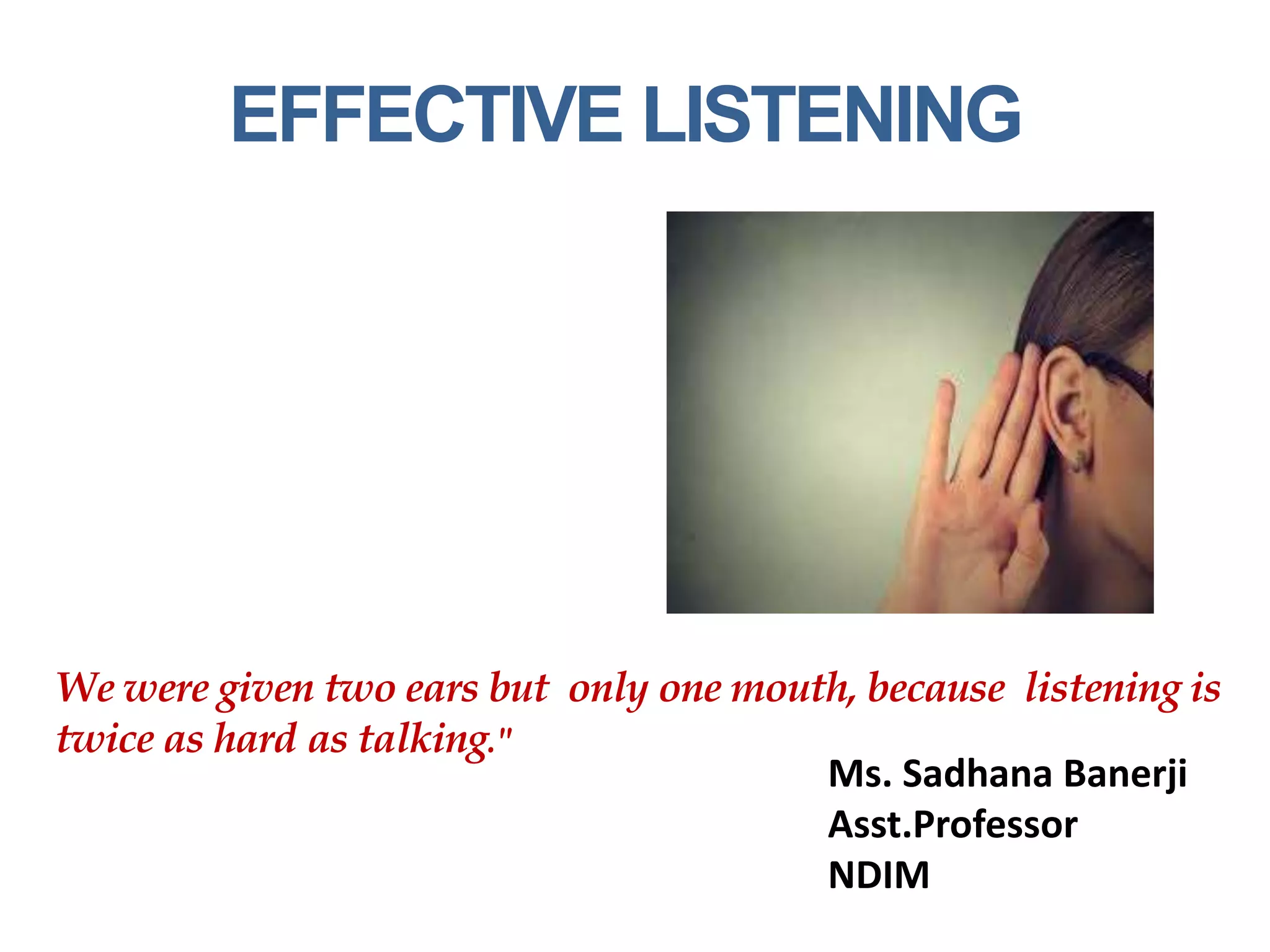
We were given two ears but only one mouth, because listening is
twice as hard as talking."
FLOW OF PRESENTATION
1. What isListening?
2. Difference between Hearing & Listening.
3. What is Effective Listening?
4. Processof Listening.
5. Barriers to Effective Listening.
6. Tipsof Improving EffectiveListening.
DEFINITION
According to ANDREW WOVIN(1988)
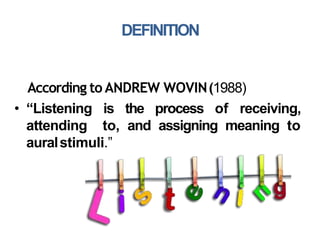
• “Listening is the process of receiving,
attending to, and assigning meaning to
auralstimuli.”
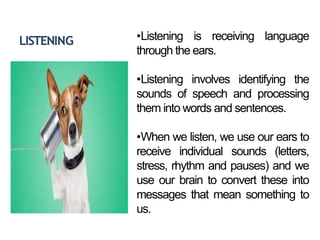
LISTENING •Listening is receiving language
through the ears.
•Listening involves identifying the
sounds of speech and processing
them into words and sentences.
•When we listen, we use our ears to
receive individual sounds (letters,
stress, rhythm and pauses) and we
use our brain to convert these into
messages that mean something to
us.
DIFFERENCEBETWEEN LISTENING&
HEARING:
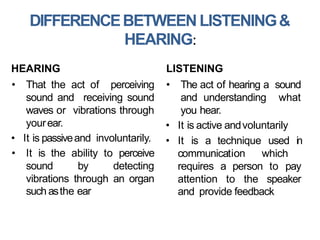
HEARING
• That the act of perceiving
sound and receiving sound
waves or vibrations through
yourear.
• It is passiveand involuntarily.
• It is the ability to perceive
sound by detecting
vibrations through an organ
such asthe ear
LISTENING
• The act of hearing a sound
and understanding what
you hear.
• It is active andvoluntarily
• It is a technique used in
communication which
requires a person to pay
attention to the speaker
and provide feedback
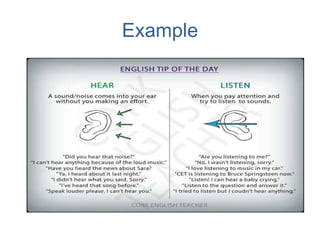
Example
EFFECTIVE LISTENING
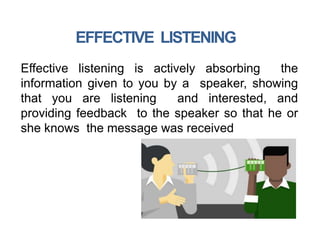
Effective listening is actively absorbing the
information given to you by a speaker, showing
that you are listening and interested, and
providing feedback to the speaker so that he or
she knows the message was received
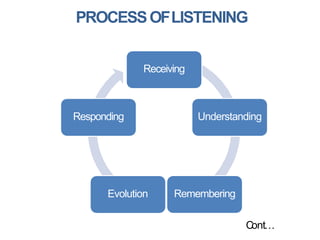
PROCESSOFLISTENING
Receiving
Understanding
RememberingEvolution
Responding
Cont…
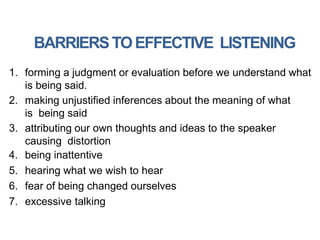
BARRIERSTOEFFECTIVE LISTENING
1. forming a judgment or evaluation before we understand what
is being said.
2. making unjustified inferences about the meaning of what
is being said
3. attributing our own thoughts and ideas to the speaker
causing distortion
4. being inattentive
5. hearing what we wish to hear
6. fear of being changed ourselves
7. excessive talking
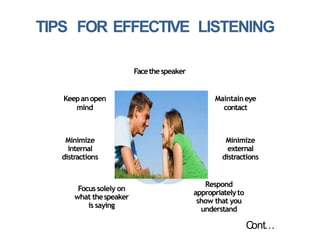
TIPS FOR EFFECTIVE LISTENING
Cont…
Facethespeaker
Maintaineye
contact
Minimize
external
distractions
Respond
appropriatelyto
show that you
understand
Focus solely on
what thespeaker
is saying
Minimize
internal
distractions
Keepanopen
mind
Cont…….
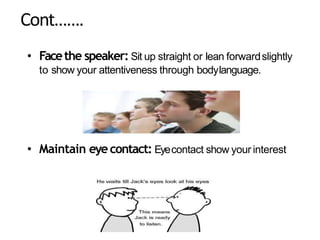
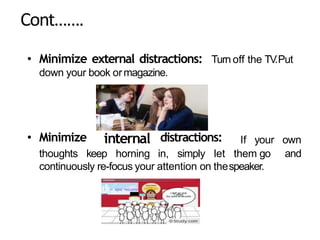
• Facethe speaker: Sit up straight or lean forwardslightly
to show your attentiveness through bodylanguage.
• Maintain eyecontact: Eyecontact show your interest
Cont…….
• Minimize external distractions: Turn off the TV.Put
down your book ormagazine.
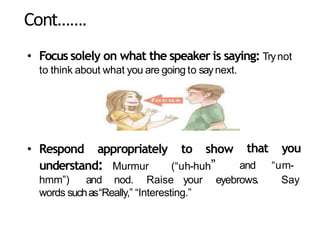
• Minimize internal distractions: If your own
andthoughts keep horning in, simply let them go
continuously re-focus your attention on thespeaker.
Cont…….
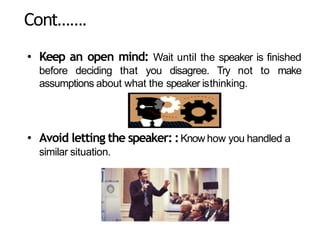
• Focus solely on what the speaker is saying: Trynot
to think about what you are going to saynext.
• Respond appropriately to show
understand: Murmur (“uh-huh”
that you
and “um-
hmm”) and nod. Raise your eyebrows. Say
words suchas“Really,” “Interesting.”
Cont…….
• Keep an open mind: Wait until the speaker is finished
before deciding that you disagree. Try not to make
assumptions about what the speaker isthinking.
• Avoid letting the speaker: :Know how you handled a
similar situation.
Cont…….
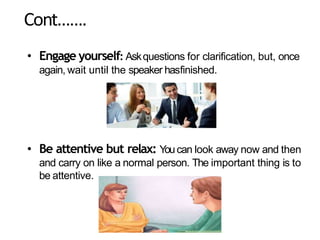
• Engage yourself: Askquestions for clarification, but, once
again, wait until the speaker hasfinished.
• Be attentive but relax: Youcan look away now and then
and carry on like a normal person. The important thing is to
be attentive.
Cont…….
• Listen to the words and try to picture what the
speaker is saying: Allow your mind to create a mental
model of the informationbeing communicated.
• Ask question: When speaker finished speech then you ask
question sospeaker feel that you are goodlistener.
Cont…….
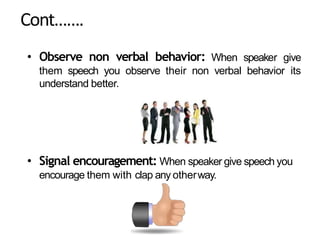
• Observe non verbal behavior: When speaker give
them speech you observe their non verbal behavior its
understand better.
• Signal encouragement: When speaker give speech you
encourage them with clap any otherway.

Effective listening (sadhana)

  • 1.
    EFFECTIVE LISTENING Ms. SadhanaBanerji Asst.Professor NDIM We were given two ears but only one mouth, because listening is twice as hard as talking."
  • 2.
    FLOW OF PRESENTATION 1.What isListening? 2. Difference between Hearing & Listening. 3. What is Effective Listening? 4. Processof Listening. 5. Barriers to Effective Listening. 6. Tipsof Improving EffectiveListening.
  • 4.
    DEFINITION According to ANDREWWOVIN(1988) • “Listening is the process of receiving, attending to, and assigning meaning to auralstimuli.”
  • 5.
    LISTENING •Listening isreceiving language through the ears. •Listening involves identifying the sounds of speech and processing them into words and sentences. •When we listen, we use our ears to receive individual sounds (letters, stress, rhythm and pauses) and we use our brain to convert these into messages that mean something to us.
  • 6.
    DIFFERENCEBETWEEN LISTENING& HEARING: HEARING • Thatthe act of perceiving sound and receiving sound waves or vibrations through yourear. • It is passiveand involuntarily. • It is the ability to perceive sound by detecting vibrations through an organ such asthe ear LISTENING • The act of hearing a sound and understanding what you hear. • It is active andvoluntarily • It is a technique used in communication which requires a person to pay attention to the speaker and provide feedback
  • 7.
  • 8.
    EFFECTIVE LISTENING Effective listeningis actively absorbing the information given to you by a speaker, showing that you are listening and interested, and providing feedback to the speaker so that he or she knows the message was received
  • 9.
  • 11.
    BARRIERSTOEFFECTIVE LISTENING 1. forminga judgment or evaluation before we understand what is being said. 2. making unjustified inferences about the meaning of what is being said 3. attributing our own thoughts and ideas to the speaker causing distortion 4. being inattentive 5. hearing what we wish to hear 6. fear of being changed ourselves 7. excessive talking
  • 12.
    TIPS FOR EFFECTIVELISTENING Cont… Facethespeaker Maintaineye contact Minimize external distractions Respond appropriatelyto show that you understand Focus solely on what thespeaker is saying Minimize internal distractions Keepanopen mind
  • 13.
    Cont……. • Facethe speaker:Sit up straight or lean forwardslightly to show your attentiveness through bodylanguage. • Maintain eyecontact: Eyecontact show your interest
  • 14.
    Cont……. • Minimize externaldistractions: Turn off the TV.Put down your book ormagazine. • Minimize internal distractions: If your own andthoughts keep horning in, simply let them go continuously re-focus your attention on thespeaker.
  • 15.
    Cont……. • Focus solelyon what the speaker is saying: Trynot to think about what you are going to saynext. • Respond appropriately to show understand: Murmur (“uh-huh” that you and “um- hmm”) and nod. Raise your eyebrows. Say words suchas“Really,” “Interesting.”
  • 16.
    Cont……. • Keep anopen mind: Wait until the speaker is finished before deciding that you disagree. Try not to make assumptions about what the speaker isthinking. • Avoid letting the speaker: :Know how you handled a similar situation.
  • 17.
    Cont……. • Engage yourself:Askquestions for clarification, but, once again, wait until the speaker hasfinished. • Be attentive but relax: Youcan look away now and then and carry on like a normal person. The important thing is to be attentive.
  • 18.
    Cont……. • Listen tothe words and try to picture what the speaker is saying: Allow your mind to create a mental model of the informationbeing communicated. • Ask question: When speaker finished speech then you ask question sospeaker feel that you are goodlistener.
  • 19.
    Cont……. • Observe nonverbal behavior: When speaker give them speech you observe their non verbal behavior its understand better. • Signal encouragement: When speaker give speech you encourage them with clap any otherway.