Grievance
Grievance
Introduction
Grievance means any discontentment or dissatisfaction in an
employee arising out of anything related to the enterprise
where he is working
It arises when an employee feels that something has happened
or is going to happen which is unfair, unjust or inequitable.
Thus, grievance represents a situation in which an employee
feels that something unfavorable has happened or is going to
happen
Nature
 A grievance may or may not be real.
 It may arises out of not one cause but due to
various causes.
 Every individual does not give expression
to his grievances.
Forms of Grievance :
a. Factual
b. Imaginary
c. Disguised
 Factual – When an employee is dissatisfied for
genuine or factual reason.
 Imaginary – When an employee’s dissatisfaction
is because of wrong perception, wrong attitude, or
wrong information.
 Disguised – An employee may have
dissatisfaction for reasons that are unknown to
himself.
Causes of Grievance
Grievances, if they are not identified and
redressed, may adversely affect workers,
managers and the organization as a whole
1. Resulting from working conditions.
2. Resulting from management policies.
3. Resulting from personal maladjustment.
1.Resulting from working
conditions
 Improper matching of the worker with the
job.
 Changes in schedule and procedures.
 Non – availability of proper tools,
machines, and equipments.
 Bad physical conditions of work place.
 Bad employer – employee relationships, etc.
2.Resulting from Management
Policy
 Wage payment
 Leave
 Overtime
 Seniority or promotion
 Transfer
 Lack of career development plan
 Lack of role clarity
3.Resulting from Personal
Maladjustments
 Over ambition
 Excessive self esteem
 Impractical attitude to life
Effects
The effects are:
1 On production include :
 Low quality of production.
 Low quantity of production and productivity.
 Increase in the wastage of material,
spoilage/breakage of machinery.
2. On the employees :
 Increases the rate of absenteeism and turnover.
 Reduces the level of commitment, sincerity and
punctuality.
 Increases the incidence of accidents.
 Reduces the level of employee morale.
3. On the managers :
 Strains the superior-subordinate relations.
 Increases the degree of supervision, control and
follow up.
 Increases, in indiscipline cases.
 Increase in unrest.
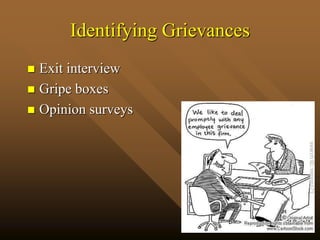
Identifying Grievances
 Exit interview
 Gripe boxes
 Opinion surveys
Exit Interview
 Employee usually quit organizations due to
dissatisfaction or better prospects
elsewhere.
 Exit interviews if conducted carefully can
provided important information about
employee’s grievances.
Gripe Boxes
 These are the boxes in which the employee
can drop there anonymous complaints.
 Different from “Suggestion Boxes” in
which employees drop their suggestions
with an intentions to receive rewards.
Opinion Survey
 Group meetings, periodical interviews with
employees through which one can get
information about employees
dissatisfaction.
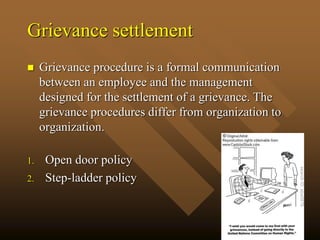
Grievance settlement
 Grievance procedure is a formal communication
between an employee and the management
designed for the settlement of a grievance. The
grievance procedures differ from organization to
organization.
1. Open door policy
2. Step-ladder policy
1.Open door policy
 Under this policy, the aggrieved employee is free
to meet the top executives of the organization and
get his grievances redressed.
 Such a policy works well only in small
organizations. However, in bigger organizations,
top management executives are usually busy with
other concerned matters of the company.
 Moreover, it is believed that open door policy is
suitable for executives; operational employees
may feel shy to go to top management.
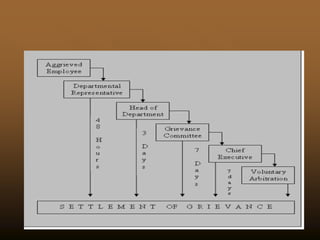
2.Step – ladder policy
 Under this policy, the aggrieved employee has to
follow a step by step procedure for getting his
grievance redressed.
 In this procedure, whenever an employee is
confronted with a grievance, he presents his
problem to his immediate supervisor.
 If the employee is not satisfied with superior’s
decision, then he discusses his grievance with the
departmental head.
 The departmental head discusses the problem
with joint grievance committees to find a solution.
Contd…
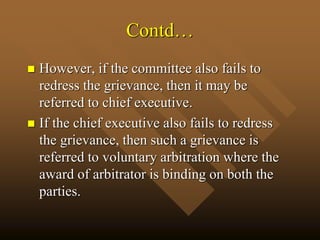
 However, if the committee also fails to
redress the grievance, then it may be
referred to chief executive.
 If the chief executive also fails to redress
the grievance, then such a grievance is
referred to voluntary arbitration where the
award of arbitrator is binding on both the
parties.
Need for a Grievance Handling
Procedure
a)Grievances may affect not only the employees and
managers but also the organization as a whole.
b)The management has to identify and redress the
grievances in a prompt manner.
c)If the individual grievances are left ignored and
unattended, there is a danger that these grievances
may result in collective disputes.
d)They affect the employee morale adversely.
Hence, it is essential to have a proper grievance
handling procedure for the smooth functioning of the
organization.
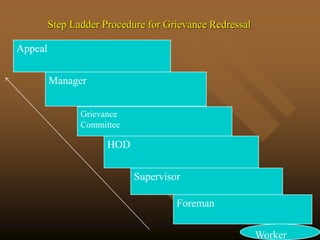
Step Ladder Procedure for Grievance Redressal
Foreman
Supervisor
HOD
Grievance
Committee
Manager
Worker
Appeal
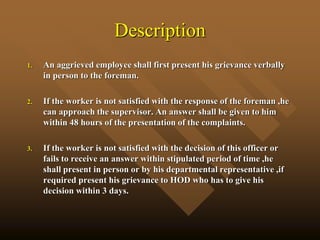
Description
1. An aggrieved employee shall first present his grievance verbally
in person to the foreman.
2. If the worker is not satisfied with the response of the foreman ,he
can approach the supervisor. An answer shall be given to him
within 48 hours of the presentation of the complaints.
3. If the worker is not satisfied with the decision of this officer or
fails to receive an answer within stipulated period of time ,he
shall present in person or by his departmental representative ,if
required present his grievance to HOD who has to give his
decision within 3 days.
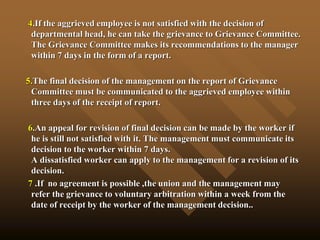
4.If the aggrieved employee is not satisfied with the decision of
departmental head, he can take the grievance to Grievance Committee.
The Grievance Committee makes its recommendations to the manager
within 7 days in the form of a report.
5.The final decision of the management on the report of Grievance
Committee must be communicated to the aggrieved employee within
three days of the receipt of report.
6.An appeal for revision of final decision can be made by the worker if
he is still not satisfied with it. The management must communicate its
decision to the worker within 7 days.
A dissatisfied worker can apply to the management for a revision of its
decision.
7 .If no agreement is possible ,the union and the management may
refer the grievance to voluntary arbitration within a week from the
date of receipt by the worker of the management decision..
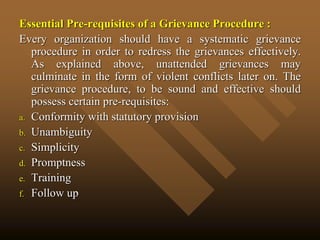
Essential Pre-requisites of a Grievance Procedure :
Every organization should have a systematic grievance
procedure in order to redress the grievances effectively.
As explained above, unattended grievances may
culminate in the form of violent conflicts later on. The
grievance procedure, to be sound and effective should
possess certain pre-requisites:
a. Conformity with statutory provision
b. Unambiguity
c. Simplicity
d. Promptness
e. Training
f. Follow up

Grievance

  • 1.
  • 2.
    Grievance Introduction Grievance means anydiscontentment or dissatisfaction in an employee arising out of anything related to the enterprise where he is working It arises when an employee feels that something has happened or is going to happen which is unfair, unjust or inequitable. Thus, grievance represents a situation in which an employee feels that something unfavorable has happened or is going to happen
  • 3.
    Nature  A grievancemay or may not be real.  It may arises out of not one cause but due to various causes.  Every individual does not give expression to his grievances.
  • 4.
    Forms of Grievance: a. Factual b. Imaginary c. Disguised  Factual – When an employee is dissatisfied for genuine or factual reason.  Imaginary – When an employee’s dissatisfaction is because of wrong perception, wrong attitude, or wrong information.  Disguised – An employee may have dissatisfaction for reasons that are unknown to himself.
  • 5.
    Causes of Grievance Grievances,if they are not identified and redressed, may adversely affect workers, managers and the organization as a whole 1. Resulting from working conditions. 2. Resulting from management policies. 3. Resulting from personal maladjustment.
  • 6.
    1.Resulting from working conditions Improper matching of the worker with the job.  Changes in schedule and procedures.  Non – availability of proper tools, machines, and equipments.  Bad physical conditions of work place.  Bad employer – employee relationships, etc.
  • 7.
    2.Resulting from Management Policy Wage payment  Leave  Overtime  Seniority or promotion  Transfer  Lack of career development plan  Lack of role clarity
  • 8.
    3.Resulting from Personal Maladjustments Over ambition  Excessive self esteem  Impractical attitude to life
  • 9.
    Effects The effects are: 1On production include :  Low quality of production.  Low quantity of production and productivity.  Increase in the wastage of material, spoilage/breakage of machinery.
  • 10.
    2. On theemployees :  Increases the rate of absenteeism and turnover.  Reduces the level of commitment, sincerity and punctuality.  Increases the incidence of accidents.  Reduces the level of employee morale. 3. On the managers :  Strains the superior-subordinate relations.  Increases the degree of supervision, control and follow up.  Increases, in indiscipline cases.  Increase in unrest.
  • 11.
    Identifying Grievances  Exitinterview  Gripe boxes  Opinion surveys
  • 12.
    Exit Interview  Employeeusually quit organizations due to dissatisfaction or better prospects elsewhere.  Exit interviews if conducted carefully can provided important information about employee’s grievances.
  • 13.
    Gripe Boxes  Theseare the boxes in which the employee can drop there anonymous complaints.  Different from “Suggestion Boxes” in which employees drop their suggestions with an intentions to receive rewards.
  • 14.
    Opinion Survey  Groupmeetings, periodical interviews with employees through which one can get information about employees dissatisfaction.
  • 15.
    Grievance settlement  Grievanceprocedure is a formal communication between an employee and the management designed for the settlement of a grievance. The grievance procedures differ from organization to organization. 1. Open door policy 2. Step-ladder policy
  • 16.
    1.Open door policy Under this policy, the aggrieved employee is free to meet the top executives of the organization and get his grievances redressed.  Such a policy works well only in small organizations. However, in bigger organizations, top management executives are usually busy with other concerned matters of the company.  Moreover, it is believed that open door policy is suitable for executives; operational employees may feel shy to go to top management.
  • 17.
    2.Step – ladderpolicy  Under this policy, the aggrieved employee has to follow a step by step procedure for getting his grievance redressed.  In this procedure, whenever an employee is confronted with a grievance, he presents his problem to his immediate supervisor.  If the employee is not satisfied with superior’s decision, then he discusses his grievance with the departmental head.  The departmental head discusses the problem with joint grievance committees to find a solution.
  • 18.
    Contd…  However, ifthe committee also fails to redress the grievance, then it may be referred to chief executive.  If the chief executive also fails to redress the grievance, then such a grievance is referred to voluntary arbitration where the award of arbitrator is binding on both the parties.
  • 19.
    Need for aGrievance Handling Procedure a)Grievances may affect not only the employees and managers but also the organization as a whole. b)The management has to identify and redress the grievances in a prompt manner. c)If the individual grievances are left ignored and unattended, there is a danger that these grievances may result in collective disputes. d)They affect the employee morale adversely. Hence, it is essential to have a proper grievance handling procedure for the smooth functioning of the organization.
  • 20.
    Step Ladder Procedurefor Grievance Redressal Foreman Supervisor HOD Grievance Committee Manager Worker Appeal
  • 22.
    Description 1. An aggrievedemployee shall first present his grievance verbally in person to the foreman. 2. If the worker is not satisfied with the response of the foreman ,he can approach the supervisor. An answer shall be given to him within 48 hours of the presentation of the complaints. 3. If the worker is not satisfied with the decision of this officer or fails to receive an answer within stipulated period of time ,he shall present in person or by his departmental representative ,if required present his grievance to HOD who has to give his decision within 3 days.
  • 23.
    4.If the aggrievedemployee is not satisfied with the decision of departmental head, he can take the grievance to Grievance Committee. The Grievance Committee makes its recommendations to the manager within 7 days in the form of a report. 5.The final decision of the management on the report of Grievance Committee must be communicated to the aggrieved employee within three days of the receipt of report. 6.An appeal for revision of final decision can be made by the worker if he is still not satisfied with it. The management must communicate its decision to the worker within 7 days. A dissatisfied worker can apply to the management for a revision of its decision. 7 .If no agreement is possible ,the union and the management may refer the grievance to voluntary arbitration within a week from the date of receipt by the worker of the management decision..
  • 24.
    Essential Pre-requisites ofa Grievance Procedure : Every organization should have a systematic grievance procedure in order to redress the grievances effectively. As explained above, unattended grievances may culminate in the form of violent conflicts later on. The grievance procedure, to be sound and effective should possess certain pre-requisites: a. Conformity with statutory provision b. Unambiguity c. Simplicity d. Promptness e. Training f. Follow up