MICRO PERSPECTIVE
IN TOURISM &
HOSPITALITY INDUSTRY
TOURIST ATTRACTION AND
THEME PARKS
TOURIST ATTRACTION AND THEME
PARKS
Introduction:
Theme parks are star players in the tourism industry, and play a special and
important role in generating tourism demand. Theme parks are the main
motivators for tourism trips to many destinations and core elements of the
tourism product.
Competition in the theme park market is growing also in terms of an
increasing number of parks, but also relative to other uses of leisure. But in
different areas, the theme park market in seems to be reaching its
saturation point and the parks have to cater for visitorswho are getting more
and more experienced and demanding.
Given these trends of growing theme park supply, environmental constraints
and increasingly discriminating consumer demand, it can be concluded
that theme parks, to survive in this competitive market, must optimize is,
given an ever-increasing number of parks and future trend of consumer
behavior.
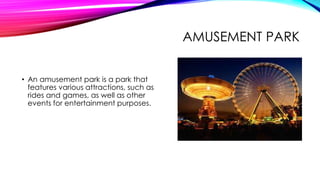
AMUSEMENT PARK
• An amusement park is a park that
features various attractions, such as
rides and games, as well as other
events for entertainment purposes.
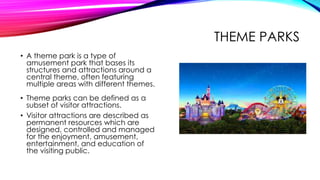
THEME PARKS
• A theme park is a type of
amusement park that bases its
structures and attractions around a
central theme, often featuring
multiple areas with different themes.
• Theme parks can be defined as a
subset of visitor attractions.
• Visitor attractions are described as
permanent resources which are
designed, controlled and managed
for the enjoyment, amusement,
entertainment, and education of
the visiting public.
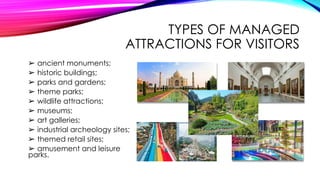
TYPES OF MANAGED
ATTRACTIONS FOR VISITORS
➢ ancient monuments;
➢ historic buildings;
➢ parks and gardens;
➢ theme parks;
➢ wildlife attractions;
➢ museums;
➢ art galleries;
➢ industrial archeology sites;
➢ themed retail sites;
➢ amusement and leisure
parks.
THE MAIN FEATURES THAT DISTINGUISH
THEME PARKS FROM OTHER KINDS OF
VISITOR ATTRACTIONS ARE:
• a single pay-one-price admission;
• charge;
• the fact that they are mostly artificially created;
• the requirement of high capital investments.
Theme parks attempt to create an atmosphere of another place and time,
and usually emphasize one dominant theme around which architecture,
landscape, rides, shows, food services, costumed personnel, retailing are
orchestrated.
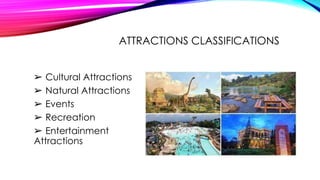
ATTRACTIONS CLASSIFICATIONS
➢ Cultural Attractions
➢ Natural Attractions
➢ Events
➢ Recreation
➢ Entertainment
Attractions
CULTURAL ATTRACTIONS
• Cultural attractions allow
travellers to experience
mankind's physical and
intellectual creations.
• Historical Sites, Archeological
Sites, Architecture
➢ Cuisine
➢ Monuments
➢ Industrial sites
➢ Museums
➢ Ethnic
➢ Concerts and Theatre
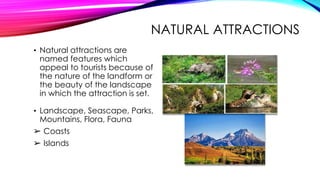
NATURAL ATTRACTIONS
• Natural attractions are
named features which
appeal to tourists because of
the nature of the landform or
the beauty of the landscape
in which the attraction is set.
• Landscape, Seascape, Parks,
Mountains, Flora, Fauna
➢ Coasts
➢ Islands
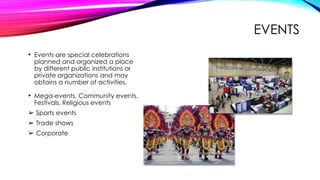
EVENTS
• Events are special celebrations
planned and organized a place
by different public institutions or
private organizations and may
obtains a number of activities.
• Mega-events, Community events,
Festivals, Religious events
➢ Sports events
➢ Trade shows
➢ Corporate
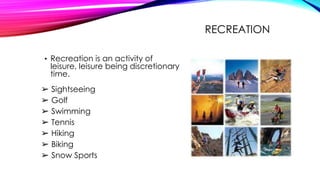
RECREATION
• Recreation is an activity of
leisure, leisure being discretionary
time.
➢ Sightseeing
➢ Golf
➢ Swimming
➢ Tennis
➢ Hiking
➢ Biking
➢ Snow Sports
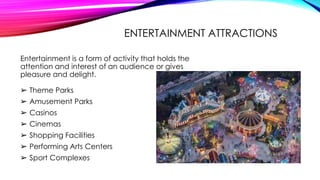
ENTERTAINMENT ATTRACTIONS
Entertainment is a form of activity that holds the
attention and interest of an audience or gives
pleasure and delight.
➢ Theme Parks
➢ Amusement Parks
➢ Casinos
➢ Cinemas
➢ Shopping Facilities
➢ Performing Arts Centers
➢ Sport Complexes
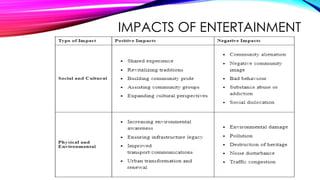
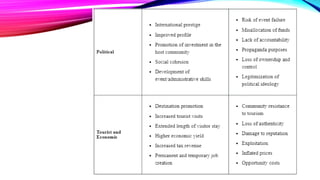
IMPACTS OF ENTERTAINMENT
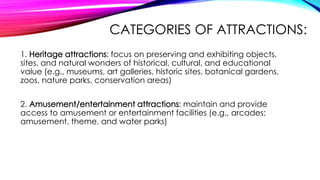
CATEGORIES OF ATTRACTIONS:
1. Heritage attractions: focus on preserving and exhibiting objects,
sites, and natural wonders of historical, cultural, and educational
value (e.g., museums, art galleries, historic sites, botanical gardens,
zoos, nature parks, conservation areas)
2. Amusement/entertainment attractions: maintain and provide
access to amusement or entertainment facilities (e.g., arcades;
amusement, theme, and water parks)
3. Recreational attractions: maintain and provide access to outdoor
or indoor facilities where people can participate in sports and
recreational activities (e.g., golf courses, skiing facilities, marinas,
bowling centers)
4. Commercial attractions: retail operations dealing in gifts,
handcrafted goods, and souvenirs that actively market to tourists
(e.g., craft stores listed in a tourist guide)
5. Industrial attractions: deal mainly in agriculture, forestry, and
manufacturing products that actively market to tourists (e.g.,
wineries, fish hatcheries, factories)
HERITAGE ATTRACTIONS
Heritage attractions: focus on preserving
and exhibiting objects, sites, and natural
wonders of historical, cultural, and
educational value (e.g., museums, art
galleries, historic sites, botanical gardens ,
zoos, nature parks, conservation areas)
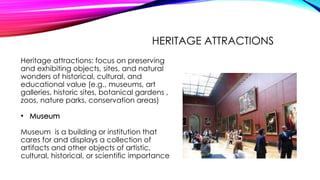
• Museum
Museum is a building or institution that
cares for and displays a collection of
artifacts and other objects of artistic,
cultural, historical, or scientific importance
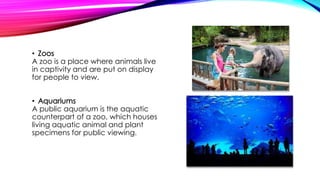
• Zoos
A zoo is a place where animals live
in captivity and are put on display
for people to view.
• Aquariums
A public aquarium is the aquatic
counterpart of a zoo, which houses
living aquatic animal and plant
specimens for public viewing.
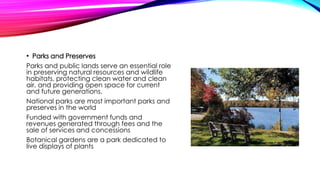
• Parks and Preserves
Parks and public lands serve an essential role
in preserving natural resources and wildlife
habitats, protecting clean water and clean
air, and providing open space for current
and future generations.
National parks are most important parks and
preserves in the world
Funded with government funds and
revenues generated through fees and the
sale of services and concessions
Botanical gardens are a park dedicated to
live displays of plants
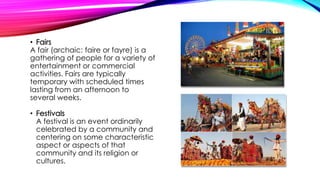
• Fairs
A fair (archaic: faire or fayre) is a
gathering of people for a variety of
entertainment or commercial
activities. Fairs are typically
temporary with scheduled times
lasting from an afternoon to
several weeks.
• Festivals
A festival is an event ordinarily
celebrated by a community and
centering on some characteristic
aspect or aspects of that
community and its religion or
cultures.
COMMERCIAL ATTRACTIONS:
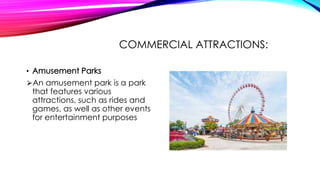
• Amusement Parks
⮚An amusement park is a park
that features various
attractions, such as rides and
games, as well as other events
for entertainment purposes
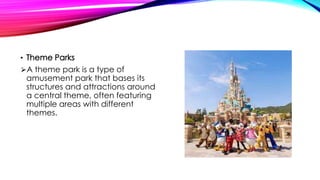
• Theme Parks
⮚A theme park is a type of
amusement park that bases its
structures and attractions around
a central theme, often featuring
multiple areas with different
themes.
GAMING
• Gaming is the practice or
activity of playing games for
stakes or GAMBLING, and
playing computer or video
games
SHOPPING
• Shopping can be part of
traveling or the reason for the
trip.
• Shopping is an activity in
which a customer browses the
available goods or services
presented by one or more
retailers with the potential
intent to purchase a suitable
selection of them.
• Many malls are transforming
themselves into tourist
attractions by adding rides
and entertainment attractions.

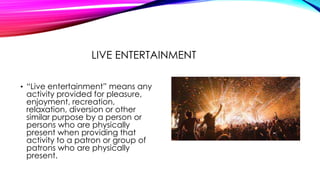
LIVE ENTERTAINMENT
• “Live entertainment” means any
activity provided for pleasure,
enjoyment, recreation,
relaxation, diversion or other
similar purpose by a person or
persons who are physically
present when providing that
activity to a patron or group of
patrons who are physically
present.
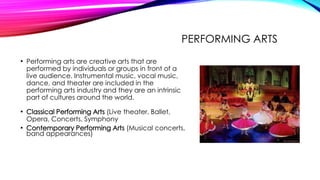
PERFORMING ARTS
• Performing arts are creative arts that are
performed by individuals or groups in front of a
live audience. Instrumental music, vocal music,
dance, and theater are included in the
performing arts industry and they are an intrinsic
part of cultures around the world.
• Classical Performing Arts (Live theater, Ballet,
Opera, Concerts, Symphony
• Contemporary Performing Arts (Musical concerts,
band appearances)
List down any Tourist Attraction
that you visited and discuss the
type of attractions it is.
Explain briefly on what you observed on the said attractions.
Example: Any comments. How do you feel? Did you satisfied with
the attractions?

Tourist attractions.pptx

  • 1.
    MICRO PERSPECTIVE IN TOURISM& HOSPITALITY INDUSTRY
  • 2.
  • 3.
    TOURIST ATTRACTION ANDTHEME PARKS Introduction: Theme parks are star players in the tourism industry, and play a special and important role in generating tourism demand. Theme parks are the main motivators for tourism trips to many destinations and core elements of the tourism product. Competition in the theme park market is growing also in terms of an increasing number of parks, but also relative to other uses of leisure. But in different areas, the theme park market in seems to be reaching its saturation point and the parks have to cater for visitorswho are getting more and more experienced and demanding. Given these trends of growing theme park supply, environmental constraints and increasingly discriminating consumer demand, it can be concluded that theme parks, to survive in this competitive market, must optimize is, given an ever-increasing number of parks and future trend of consumer behavior.
  • 4.
    AMUSEMENT PARK • Anamusement park is a park that features various attractions, such as rides and games, as well as other events for entertainment purposes.
  • 5.
    THEME PARKS • Atheme park is a type of amusement park that bases its structures and attractions around a central theme, often featuring multiple areas with different themes. • Theme parks can be defined as a subset of visitor attractions. • Visitor attractions are described as permanent resources which are designed, controlled and managed for the enjoyment, amusement, entertainment, and education of the visiting public.
  • 6.
    TYPES OF MANAGED ATTRACTIONSFOR VISITORS ➢ ancient monuments; ➢ historic buildings; ➢ parks and gardens; ➢ theme parks; ➢ wildlife attractions; ➢ museums; ➢ art galleries; ➢ industrial archeology sites; ➢ themed retail sites; ➢ amusement and leisure parks.
  • 7.
    THE MAIN FEATURESTHAT DISTINGUISH THEME PARKS FROM OTHER KINDS OF VISITOR ATTRACTIONS ARE: • a single pay-one-price admission; • charge; • the fact that they are mostly artificially created; • the requirement of high capital investments. Theme parks attempt to create an atmosphere of another place and time, and usually emphasize one dominant theme around which architecture, landscape, rides, shows, food services, costumed personnel, retailing are orchestrated.
  • 8.
    ATTRACTIONS CLASSIFICATIONS ➢ CulturalAttractions ➢ Natural Attractions ➢ Events ➢ Recreation ➢ Entertainment Attractions
  • 9.
    CULTURAL ATTRACTIONS • Culturalattractions allow travellers to experience mankind's physical and intellectual creations. • Historical Sites, Archeological Sites, Architecture ➢ Cuisine ➢ Monuments ➢ Industrial sites ➢ Museums ➢ Ethnic ➢ Concerts and Theatre
  • 10.
    NATURAL ATTRACTIONS • Naturalattractions are named features which appeal to tourists because of the nature of the landform or the beauty of the landscape in which the attraction is set. • Landscape, Seascape, Parks, Mountains, Flora, Fauna ➢ Coasts ➢ Islands
  • 11.
    EVENTS • Events arespecial celebrations planned and organized a place by different public institutions or private organizations and may obtains a number of activities. • Mega-events, Community events, Festivals, Religious events ➢ Sports events ➢ Trade shows ➢ Corporate
  • 12.
    RECREATION • Recreation isan activity of leisure, leisure being discretionary time. ➢ Sightseeing ➢ Golf ➢ Swimming ➢ Tennis ➢ Hiking ➢ Biking ➢ Snow Sports
  • 13.
    ENTERTAINMENT ATTRACTIONS Entertainment isa form of activity that holds the attention and interest of an audience or gives pleasure and delight. ➢ Theme Parks ➢ Amusement Parks ➢ Casinos ➢ Cinemas ➢ Shopping Facilities ➢ Performing Arts Centers ➢ Sport Complexes
  • 14.
  • 16.
    CATEGORIES OF ATTRACTIONS: 1.Heritage attractions: focus on preserving and exhibiting objects, sites, and natural wonders of historical, cultural, and educational value (e.g., museums, art galleries, historic sites, botanical gardens, zoos, nature parks, conservation areas) 2. Amusement/entertainment attractions: maintain and provide access to amusement or entertainment facilities (e.g., arcades; amusement, theme, and water parks)
  • 17.
    3. Recreational attractions:maintain and provide access to outdoor or indoor facilities where people can participate in sports and recreational activities (e.g., golf courses, skiing facilities, marinas, bowling centers) 4. Commercial attractions: retail operations dealing in gifts, handcrafted goods, and souvenirs that actively market to tourists (e.g., craft stores listed in a tourist guide) 5. Industrial attractions: deal mainly in agriculture, forestry, and manufacturing products that actively market to tourists (e.g., wineries, fish hatcheries, factories)
  • 18.
    HERITAGE ATTRACTIONS Heritage attractions:focus on preserving and exhibiting objects, sites, and natural wonders of historical, cultural, and educational value (e.g., museums, art galleries, historic sites, botanical gardens , zoos, nature parks, conservation areas) • Museum Museum is a building or institution that cares for and displays a collection of artifacts and other objects of artistic, cultural, historical, or scientific importance
  • 19.
    • Zoos A zoois a place where animals live in captivity and are put on display for people to view. • Aquariums A public aquarium is the aquatic counterpart of a zoo, which houses living aquatic animal and plant specimens for public viewing.
  • 20.
    • Parks andPreserves Parks and public lands serve an essential role in preserving natural resources and wildlife habitats, protecting clean water and clean air, and providing open space for current and future generations. National parks are most important parks and preserves in the world Funded with government funds and revenues generated through fees and the sale of services and concessions Botanical gardens are a park dedicated to live displays of plants
  • 21.
    • Fairs A fair(archaic: faire or fayre) is a gathering of people for a variety of entertainment or commercial activities. Fairs are typically temporary with scheduled times lasting from an afternoon to several weeks. • Festivals A festival is an event ordinarily celebrated by a community and centering on some characteristic aspect or aspects of that community and its religion or cultures.
  • 22.
    COMMERCIAL ATTRACTIONS: • AmusementParks ⮚An amusement park is a park that features various attractions, such as rides and games, as well as other events for entertainment purposes
  • 23.
    • Theme Parks ⮚Atheme park is a type of amusement park that bases its structures and attractions around a central theme, often featuring multiple areas with different themes.
  • 24.
    GAMING • Gaming isthe practice or activity of playing games for stakes or GAMBLING, and playing computer or video games
  • 25.
    SHOPPING • Shopping canbe part of traveling or the reason for the trip. • Shopping is an activity in which a customer browses the available goods or services presented by one or more retailers with the potential intent to purchase a suitable selection of them. • Many malls are transforming themselves into tourist attractions by adding rides and entertainment attractions.
  • 26.
    LIVE ENTERTAINMENT • “Liveentertainment” means any activity provided for pleasure, enjoyment, recreation, relaxation, diversion or other similar purpose by a person or persons who are physically present when providing that activity to a patron or group of patrons who are physically present.
  • 27.
    PERFORMING ARTS • Performingarts are creative arts that are performed by individuals or groups in front of a live audience. Instrumental music, vocal music, dance, and theater are included in the performing arts industry and they are an intrinsic part of cultures around the world. • Classical Performing Arts (Live theater, Ballet, Opera, Concerts, Symphony • Contemporary Performing Arts (Musical concerts, band appearances)
  • 28.
    List down anyTourist Attraction that you visited and discuss the type of attractions it is. Explain briefly on what you observed on the said attractions. Example: Any comments. How do you feel? Did you satisfied with the attractions?