Meaning of Recreational and Leisure
• The dictionary defines recreation as the process
of giving new life to something, of restoring
something.
• Leisure is defined as the productive, creative, or
contemplative use of free time.
Recreational Activities
• Recreational activities include all kinds of sports,
both team and individual such as baseball,
softball, football, basketball, tennis, badminton,
swimming, and skiing.
• Hiking, jogging, aerobics, and rock climbing are
active forms of recreation.
• Passive recreational activities include reading,
playing, fishing, and listening to music, gardening,
playing computer games, and watching television
or movies.
Varied Views of Recreation and Leisure
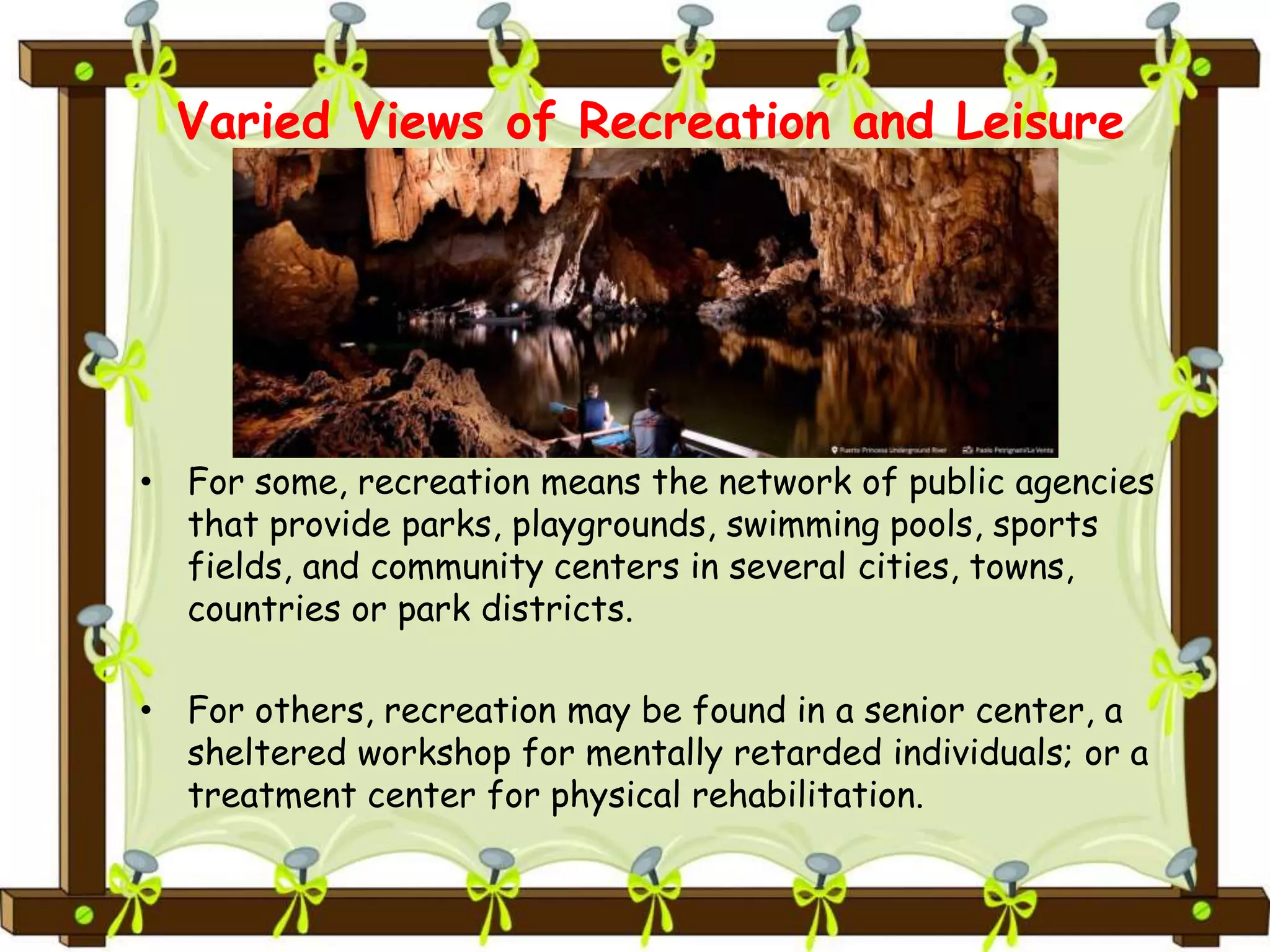
• For some, recreation means the network of public agencies
that provide parks, playgrounds, swimming pools, sports
fields, and community centers in several cities, towns,
countries or park districts.
• For others, recreation may be found in a senior center, a
sheltered workshop for mentally retarded individuals; or a
treatment center for physical rehabilitation.
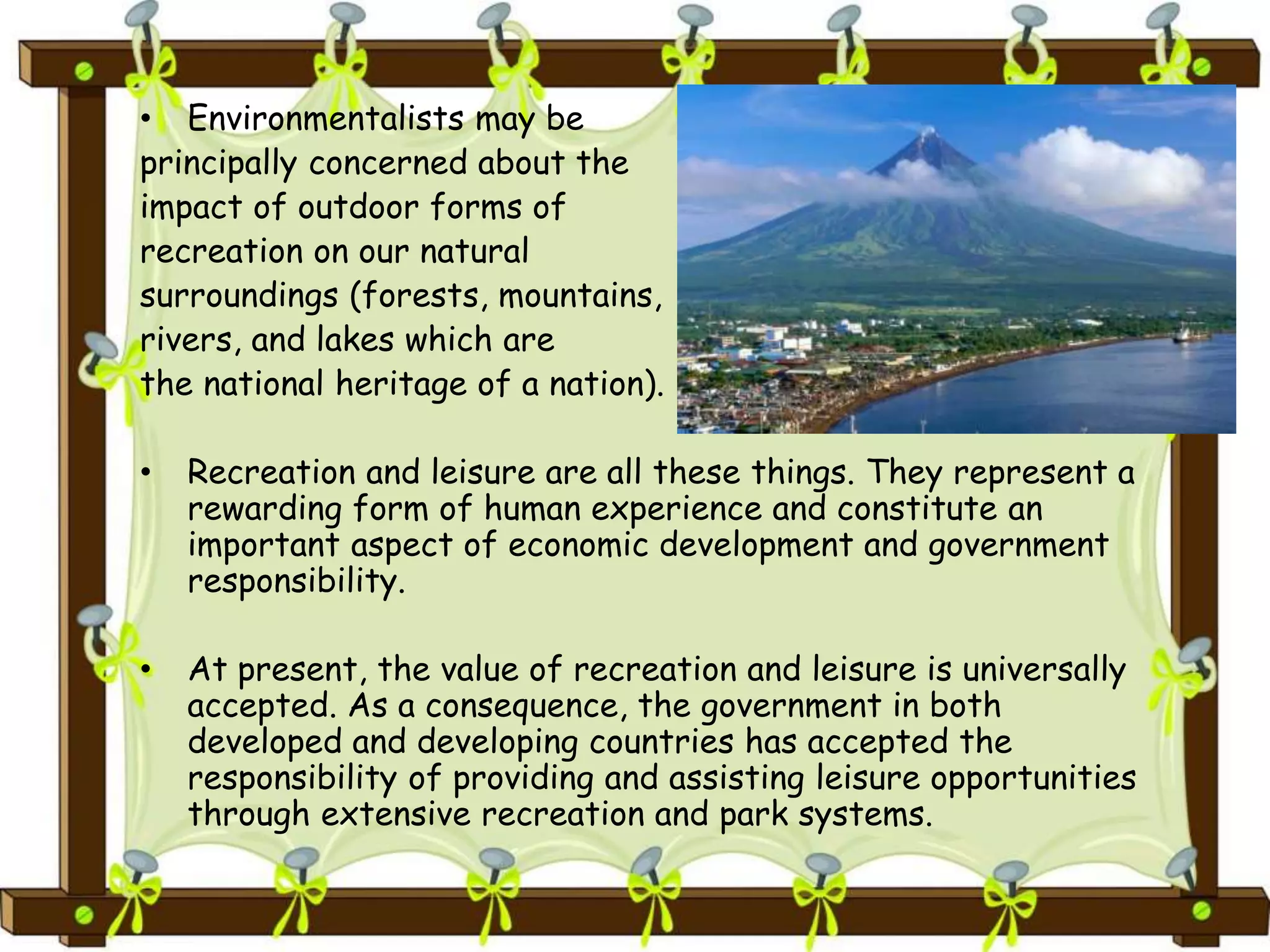
• Environmentalists may be
principally concerned about the
impact of outdoor forms of
recreation on our natural
surroundings (forests, mountains,
rivers, and lakes which are
the national heritage of a nation).
• Recreation and leisure are all these things. They represent a
rewarding form of human experience and constitute an
important aspect of economic development and government
responsibility.
• At present, the value of recreation and leisure is universally
accepted. As a consequence, the government in both
developed and developing countries has accepted the
responsibility of providing and assisting leisure opportunities
through extensive recreation and park systems.
Recreational Participation
• The most common notion of recreation is that it is
primarily a participation in sports and games.
• Recreation actually includes an extremely broad range of
leisure activities.
(travel and tourism, cultural entertainment, participation
in the arts, hobbies, membership in social clubs, or
interests groups, nature related activities such as hunting
and fishing, and attendance at parties, special events, and
fitness activities.)
• Recreation may be enjoyed with thousands of participants
or spectators or may be a solitary experience. It may be
very strenuous or may be primarily a mental activity. It
may act as a lifetime of interest and involvement or may
consists of a single, isolated experience.
Motivation for Recreational Participation
• Many participants take part in recreation as a form of
relaxation and release from the pressures of work and other
tensions.
• Another recreational motivation is the need to express
creativity, expose hidden talents, or pursue excellent in
various forms of personal expression.
• For some participants, active recreation offers a channel for
releasing hostility and aggression.
• Many individuals take part in recreational activities which
involve community service, provide leaders in fraternal or
religious organizations and promote health and physical
fitness.
• Deeply involve in various forms of elite culture such as music,
drama, dance, literature, and the fine arts.
Factors Promoting the Growth of Recreation
The following are the factors that help bring about the
growth of recreation:
1. Increase in discretionary time.
2. Influences of technology.
3. Public interest in health and fitness.
4. Co modification of leisure.
5. Therapeutic recreation service.
6. New leisure roles for women.
1. Increase in discretionary time
 A key factor underlying the growth of recreation has been
the growth of free or discretionary time in 20th century.
Due to advanced mechanical equipment and automated
processes in factories, agriculture and the service fields,
productive capacity increased remarkably during the
second half of the 19th century and the first half of the
20th century.
 In addition, more holidays and longer vacations are now
enjoyed by more employees, because of improved Social
Security benefits and pension plan as well as medical
advances which lead to a longer life, many employees can
now avail of fifteen or more years of full time leisure
after retirement.
 Another reason is that labor saving devices such as
automatic washing machines, lawnmowers, microwave oven,
and vacuum cleaners have greatly simplified the demands
of life.
2. Influences of Technology
 Sophisticated technology has provided new forms of
recreation for the people. Outdoor recreation uses
complex and expensive devices in activities such as
skydiving, hang gliding, scuba diving, boating, roller blading,
skiing, and now boarding.
 Computer dating provides a new form of social contacts
for single adults. Video games offer interactive
competition or exposure to new varieties of play settings
and “virtual realities”.
 The internet has become an important part of travel and
tourism by providing information and facilitates
reservations and vacations choices. Home-based recreation
has become dependent on varied forms of electronic
entertainment.
3. Public interest in health and fitness
 A key trend in the 20th century is the growth of public
interest in exercise and physical fitness programs.
 Many people are now concerned about improving their
health, vitality, and appearance through diet and exercise.
Those who exercise regularly look and feel better.
Research showed that the most successful fitness
programs were those that provided recreational interest
and satisfaction.
4. Commodification of leisure
 Various forms of recreation are being developed by profit-
seeking businesses. Giant corporations have taken control
of music, television, movie businesses, sports stadiums,
cruise ships, theme parks and other leisure operations.
 Many elaborate new facilities which offer varied forms of
recreation are being developed as part of the trend
toward commodification. In big cities, huge public fitness
centers which includes pools, aerobics, dance rooms, and
facilities for family play are being built and often charge
membership fees that cost several hundred dollars a year.
5. Therapeutic recreation service
 An important aspect of the growth of recreation has been
the increased awareness of the recreation needs of
persons with physical, mental or social disabilities. In
recent years there has been an increased recognition of
the need to provide recreational programs for special
populations such as the mentally retarded, mentally ill, and
physically challenged. Theses programs use therapeutic
recreation as a form of treatment.
 One of the sports programs for people with disabilities
that has received much attention in recent years is the
Special Olympics, an international program of physical
fitness, sports training, and athletic competition for
children, and adults with mental retarded.
6. New leisure roles for women
 At present, there is a strong drive for women to play a
more equal role in recreational opportunities.
 In the past, women were barred from a variety of athletic,
outdoor recreation, cultural, and social involvements.
 Women were treated as second-class citizens in leisure
opportunities with the emergence of a strong feminist
movement, this inequality was corrected.
 There is now growing interest in women’s tennis, gold,
gymnastic, track and field, and similar events in every level
of competition. Outstanding women athletes have helped
create a new image of feminine strength, determination,
and self-confidence.
Types of Organized Recreation
1. Government recreation agencies
2. Voluntary non-profit organizations
3. Private membership organizations
4. Commercial recreation enterprises
5. Employee recreation programs
6. Armed forces recreation
7. Campus recreation
8. Therapeutic recreation services
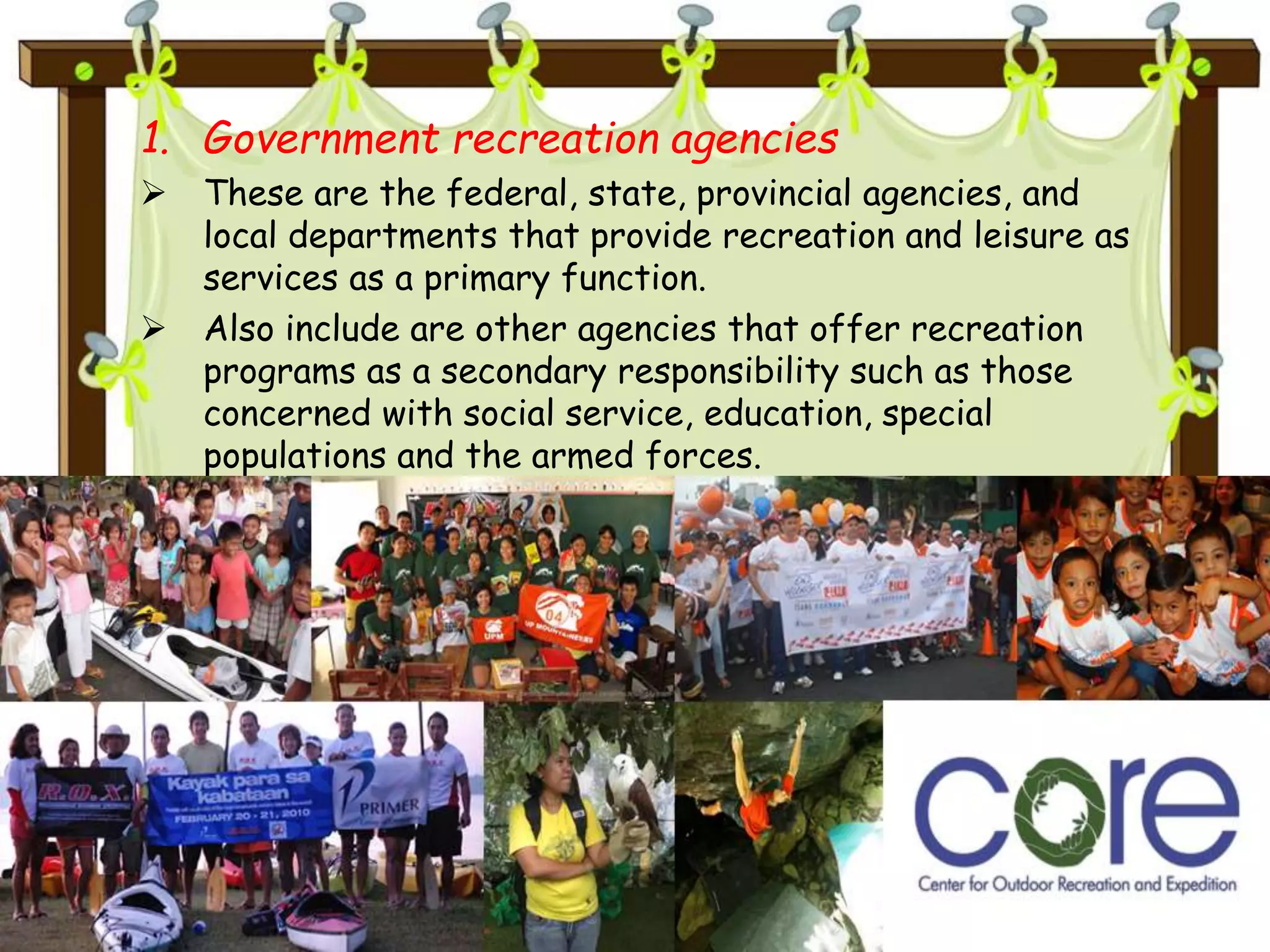
1. Government recreation agencies
 These are the federal, state, provincial agencies, and
local departments that provide recreation and leisure as
services as a primary function.
 Also include are other agencies that offer recreation
programs as a secondary responsibility such as those
concerned with social service, education, special
populations and the armed forces.
2. Voluntary non-profit organization
 These are the governmental, non-profit agencies,
both sectarian and non-sectarian which serve the
public at large with multiservice programs that
often include a substantial element of
recreational opportunity.
 The most popular voluntary organizations include
the Boy Scouts, Girl Scouts, YMCA, YWCA, and
YM-YWHA.
3. Private membership organizations
 They provide recreational and social activities
for their own members and in some cases assist
community recreation needs.
(golf, tennis, yacht, athletic, and country clubs.)
 Also included under this category are the
recreation sponsors connected to residence such
as swimming pools, sports or fitness complexes
or clubs attached to leisure villages, and
apartments or condominium retirements or
retirement communities.
4. Commercial recreation enterprises
 These are privately owned businesses which
operate to make a profit such as ski centers,
bowling alleys, night clubs, movie houses,
theaters, health spas or fitness centers, dancing
schools and theme parks.
5. Employee recreation programs
 They serve those who work for companies or
employees by providing recreation as a part of a
total personnel benefits package linked to other
services concerned with employee health and
fitness.
6. Armed forces recreation
 Although it is obviously a form of government-
sponsored activity, it is unique in its setting and
purpose. Each of the major branches of the
armed forces operates an extensive network of
recreation facilities and programs.
7. Campus recreation
 It includes intramural athletics or sports clubs,
social activities, travel programs, performing
arts groups, entertainment, lounges, film series
and other forms of recreation on college, and
university campuses.
8. Therapeutic recreation services
 Theses include any other program designed to
meet the needs of persons with physical or
mental disabilities, individuals with poor health,
dependent aging persons, social deviant persons
in correctional facilities, and similar special
groups.
Two Major Recreation Service Components
• In addition to the eight types of organized
recreation, sports, and tourism represent major
areas of recreational programming and
constitute powerful economic forces through
their attraction for people every age and
background.
• Uniquely, they have strong links to each to the
growing field of sports tourism and also overlap
heavily with outdoor recreation attractions.
Sports as Popular Recreation
• Sports are major areas of recreational
involvement. Of all the types of recreational
involvement, sports command the highest degree
of personal interest and emotional involvement.
• Sports are generally defined as physical
activities demanding exertion and skill, involving
competition, carried on with both formal rules
and general standards of etiquette and fair play.
TOURISM –
A Major Recreation Service Component
Tourism is a second major area of diversified
recreational involvement. Several major elements
in the tourism enterprise which are closely linked
to the growth of tourism as a form of recreation
are the theme parks, water parks, fun centers,
and sports tourism.
Theme Parks
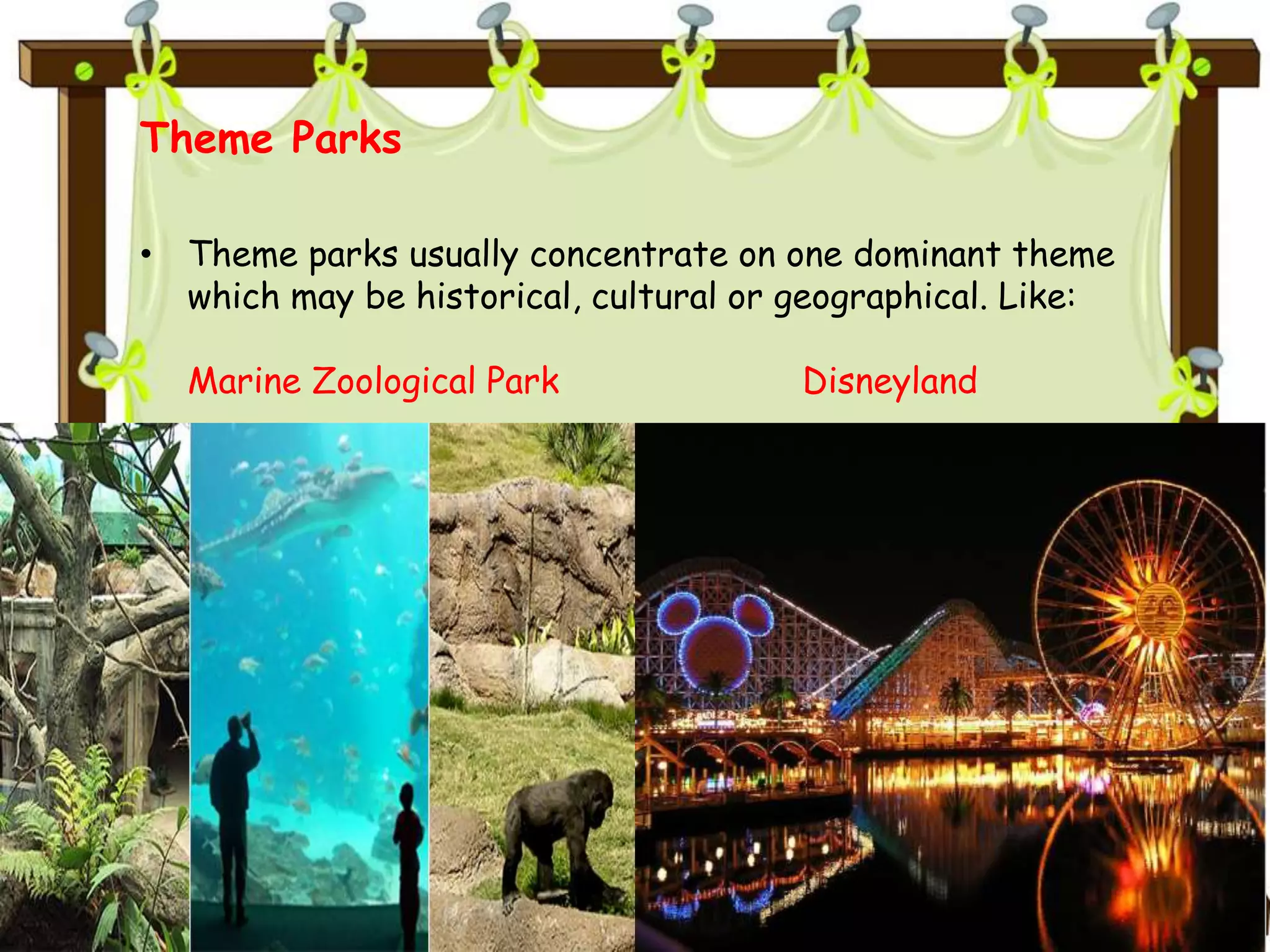
• Theme parks usually concentrate on one dominant theme
which may be historical, cultural or geographical. Like:
Marine Zoological Park Disneyland
Water Parks
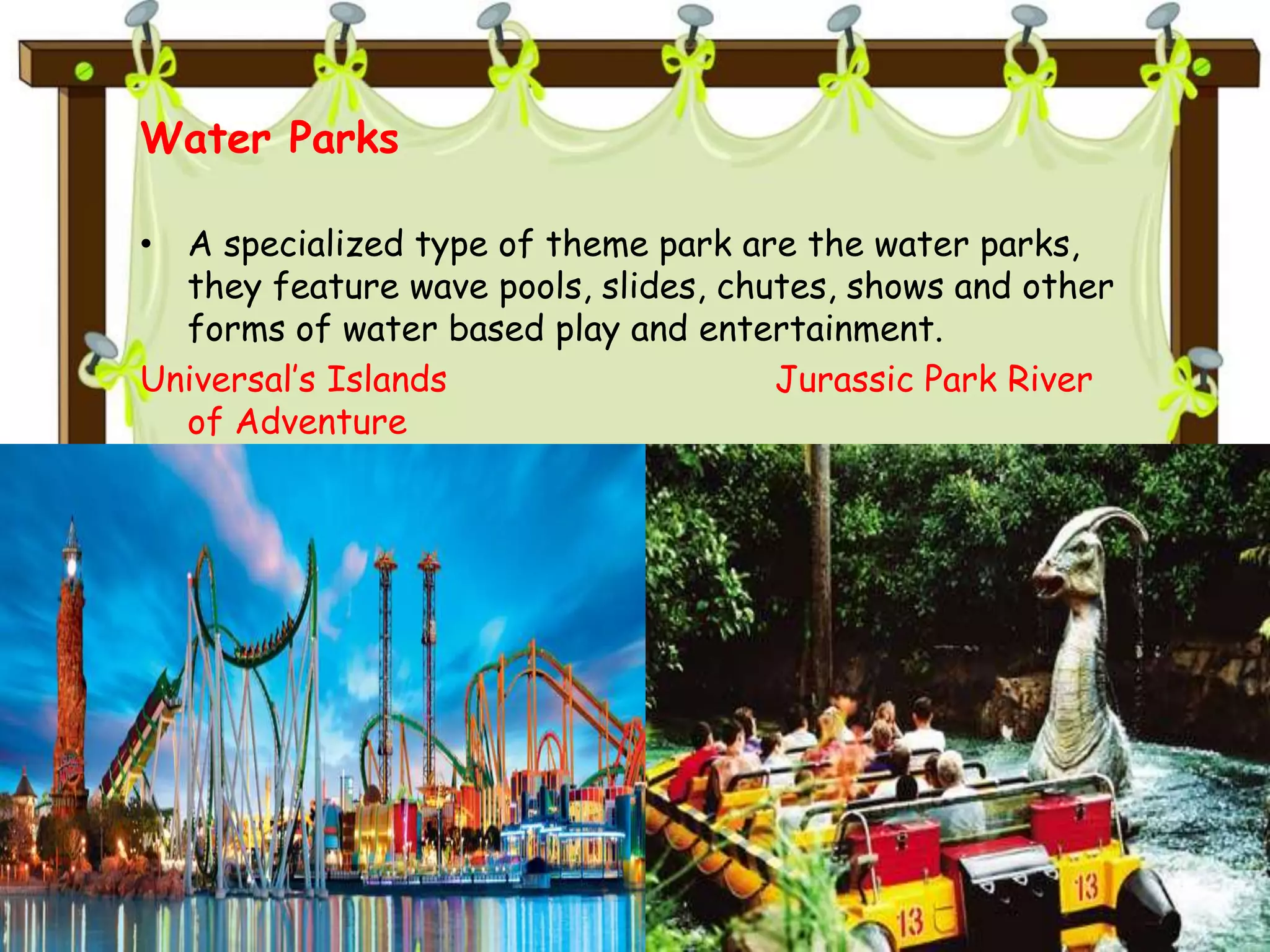
• A specialized type of theme park are the water parks,
they feature wave pools, slides, chutes, shows and other
forms of water based play and entertainment.
Universal’s Islands Jurassic Park River
of Adventure
Bilge Rat Barges Poseidon’s Fury
Sports Tourism
• The purpose of sports tourism is to
participate directly in a form of sport or attend
sports evens as a spectator. In the past, only the
team traveled the spectators remained behind to
read about their favorite game or to experience
the game through radio and television.
• The World Olympics is the biggest sports
event. It attracts millions of spectators and
generate millions of dollars in revenue.
The Need for Professional Leaderships
• At present, there is a growing need for qualified
professional leadership in the recreation field.
• Very often, people assume that the task of organizing and
conducting recreation programs is relatively simple and
that anyone can do it without specialized training.
• However, the professional’s assignment in the organized
recreation field tends to be more complex and difficult
than that of the volunteer leader or coach.
• It must involve carefully studied goals and objectives and
sophisticated planning techniques.
• Recreation Professionals should possess the skills
needed for direct leadership and supervision, group
dynamics and client assessment. They must have the
ability to carry out basic research and write meaningful
reports.
Emerging Professional Identity
• As employment in recreation agencies grew over the
past several decades, recreation gained public as a
flourishing career field.
• Millions of men and women became employed in
various specialized sectors of recreation and leisure
service.
• Many hold professional-level jobs as recreation
leaders, supervisors, planners, managers and resource
specialist. Through the efforts of national, state and
provincial societies, higher standards for practice were
developed and the first steps of certification and
accreditation were undertaken.
Challenges Facing the Recreation and Leisure
Service Field in the Twenty-First Century
Recreational professional must be able to deal creatively
with the following challenges.
1. Serve diverse society (race, age, gender);
2. Emphasize key social purposes of recreation in working
with at-risk youth, serving persons with disabilities, and
promoting community development;
3. Achieve fuller public understanding of the value of
recreation and parks, and of the leisure-service profession
4. Upgrade recreation and park programs and facilities
particularly in inner cities and for minority populations;
5. Adopt a benefits-based management approach,
researching, proving and publicizing positive outcomes of
recreation;
6. Promote recreation’s identity as health-related field;
7. Develop partnerships with environmental organizations to
protect and restore wildlands, waterways;
8. Employ marketing approach to achieve fiscal sufficiency
and gain public respect and support;
9. Expand and improve family-centered programs and
facilities;
10. Promote higher values and ethical practices in youth
sports competition;
11. Strive for fuller mainstreaming of persons with
disabilities in community recreation programs;
Principles of Tourism Chapter 10 (recreation and leisure)

Principles of Tourism Chapter 10 (recreation and leisure)

  • 2.
    Meaning of Recreationaland Leisure • The dictionary defines recreation as the process of giving new life to something, of restoring something. • Leisure is defined as the productive, creative, or contemplative use of free time.
  • 3.
    Recreational Activities • Recreationalactivities include all kinds of sports, both team and individual such as baseball, softball, football, basketball, tennis, badminton, swimming, and skiing. • Hiking, jogging, aerobics, and rock climbing are active forms of recreation. • Passive recreational activities include reading, playing, fishing, and listening to music, gardening, playing computer games, and watching television or movies.
  • 4.
    Varied Views ofRecreation and Leisure • For some, recreation means the network of public agencies that provide parks, playgrounds, swimming pools, sports fields, and community centers in several cities, towns, countries or park districts. • For others, recreation may be found in a senior center, a sheltered workshop for mentally retarded individuals; or a treatment center for physical rehabilitation.
  • 5.
    • Environmentalists maybe principally concerned about the impact of outdoor forms of recreation on our natural surroundings (forests, mountains, rivers, and lakes which are the national heritage of a nation). • Recreation and leisure are all these things. They represent a rewarding form of human experience and constitute an important aspect of economic development and government responsibility. • At present, the value of recreation and leisure is universally accepted. As a consequence, the government in both developed and developing countries has accepted the responsibility of providing and assisting leisure opportunities through extensive recreation and park systems.
  • 6.
    Recreational Participation • Themost common notion of recreation is that it is primarily a participation in sports and games. • Recreation actually includes an extremely broad range of leisure activities. (travel and tourism, cultural entertainment, participation in the arts, hobbies, membership in social clubs, or interests groups, nature related activities such as hunting and fishing, and attendance at parties, special events, and fitness activities.) • Recreation may be enjoyed with thousands of participants or spectators or may be a solitary experience. It may be very strenuous or may be primarily a mental activity. It may act as a lifetime of interest and involvement or may consists of a single, isolated experience.
  • 7.
    Motivation for RecreationalParticipation • Many participants take part in recreation as a form of relaxation and release from the pressures of work and other tensions. • Another recreational motivation is the need to express creativity, expose hidden talents, or pursue excellent in various forms of personal expression. • For some participants, active recreation offers a channel for releasing hostility and aggression. • Many individuals take part in recreational activities which involve community service, provide leaders in fraternal or religious organizations and promote health and physical fitness. • Deeply involve in various forms of elite culture such as music, drama, dance, literature, and the fine arts.
  • 8.
    Factors Promoting theGrowth of Recreation The following are the factors that help bring about the growth of recreation: 1. Increase in discretionary time. 2. Influences of technology. 3. Public interest in health and fitness. 4. Co modification of leisure. 5. Therapeutic recreation service. 6. New leisure roles for women.
  • 9.
    1. Increase indiscretionary time  A key factor underlying the growth of recreation has been the growth of free or discretionary time in 20th century. Due to advanced mechanical equipment and automated processes in factories, agriculture and the service fields, productive capacity increased remarkably during the second half of the 19th century and the first half of the 20th century.  In addition, more holidays and longer vacations are now enjoyed by more employees, because of improved Social Security benefits and pension plan as well as medical advances which lead to a longer life, many employees can now avail of fifteen or more years of full time leisure after retirement.  Another reason is that labor saving devices such as automatic washing machines, lawnmowers, microwave oven, and vacuum cleaners have greatly simplified the demands of life.
  • 10.
    2. Influences ofTechnology  Sophisticated technology has provided new forms of recreation for the people. Outdoor recreation uses complex and expensive devices in activities such as skydiving, hang gliding, scuba diving, boating, roller blading, skiing, and now boarding.  Computer dating provides a new form of social contacts for single adults. Video games offer interactive competition or exposure to new varieties of play settings and “virtual realities”.  The internet has become an important part of travel and tourism by providing information and facilitates reservations and vacations choices. Home-based recreation has become dependent on varied forms of electronic entertainment.
  • 11.
    3. Public interestin health and fitness  A key trend in the 20th century is the growth of public interest in exercise and physical fitness programs.  Many people are now concerned about improving their health, vitality, and appearance through diet and exercise. Those who exercise regularly look and feel better. Research showed that the most successful fitness programs were those that provided recreational interest and satisfaction.
  • 12.
    4. Commodification ofleisure  Various forms of recreation are being developed by profit- seeking businesses. Giant corporations have taken control of music, television, movie businesses, sports stadiums, cruise ships, theme parks and other leisure operations.  Many elaborate new facilities which offer varied forms of recreation are being developed as part of the trend toward commodification. In big cities, huge public fitness centers which includes pools, aerobics, dance rooms, and facilities for family play are being built and often charge membership fees that cost several hundred dollars a year.
  • 13.
    5. Therapeutic recreationservice  An important aspect of the growth of recreation has been the increased awareness of the recreation needs of persons with physical, mental or social disabilities. In recent years there has been an increased recognition of the need to provide recreational programs for special populations such as the mentally retarded, mentally ill, and physically challenged. Theses programs use therapeutic recreation as a form of treatment.  One of the sports programs for people with disabilities that has received much attention in recent years is the Special Olympics, an international program of physical fitness, sports training, and athletic competition for children, and adults with mental retarded.
  • 14.
    6. New leisureroles for women  At present, there is a strong drive for women to play a more equal role in recreational opportunities.  In the past, women were barred from a variety of athletic, outdoor recreation, cultural, and social involvements.  Women were treated as second-class citizens in leisure opportunities with the emergence of a strong feminist movement, this inequality was corrected.  There is now growing interest in women’s tennis, gold, gymnastic, track and field, and similar events in every level of competition. Outstanding women athletes have helped create a new image of feminine strength, determination, and self-confidence.
  • 15.
    Types of OrganizedRecreation 1. Government recreation agencies 2. Voluntary non-profit organizations 3. Private membership organizations 4. Commercial recreation enterprises 5. Employee recreation programs 6. Armed forces recreation 7. Campus recreation 8. Therapeutic recreation services
  • 16.
    1. Government recreationagencies  These are the federal, state, provincial agencies, and local departments that provide recreation and leisure as services as a primary function.  Also include are other agencies that offer recreation programs as a secondary responsibility such as those concerned with social service, education, special populations and the armed forces.
  • 17.
    2. Voluntary non-profitorganization  These are the governmental, non-profit agencies, both sectarian and non-sectarian which serve the public at large with multiservice programs that often include a substantial element of recreational opportunity.  The most popular voluntary organizations include the Boy Scouts, Girl Scouts, YMCA, YWCA, and YM-YWHA.
  • 18.
    3. Private membershiporganizations  They provide recreational and social activities for their own members and in some cases assist community recreation needs. (golf, tennis, yacht, athletic, and country clubs.)  Also included under this category are the recreation sponsors connected to residence such as swimming pools, sports or fitness complexes or clubs attached to leisure villages, and apartments or condominium retirements or retirement communities.
  • 19.
    4. Commercial recreationenterprises  These are privately owned businesses which operate to make a profit such as ski centers, bowling alleys, night clubs, movie houses, theaters, health spas or fitness centers, dancing schools and theme parks.
  • 20.
    5. Employee recreationprograms  They serve those who work for companies or employees by providing recreation as a part of a total personnel benefits package linked to other services concerned with employee health and fitness.
  • 21.
    6. Armed forcesrecreation  Although it is obviously a form of government- sponsored activity, it is unique in its setting and purpose. Each of the major branches of the armed forces operates an extensive network of recreation facilities and programs.
  • 22.
    7. Campus recreation It includes intramural athletics or sports clubs, social activities, travel programs, performing arts groups, entertainment, lounges, film series and other forms of recreation on college, and university campuses.
  • 23.
    8. Therapeutic recreationservices  Theses include any other program designed to meet the needs of persons with physical or mental disabilities, individuals with poor health, dependent aging persons, social deviant persons in correctional facilities, and similar special groups.
  • 24.
    Two Major RecreationService Components • In addition to the eight types of organized recreation, sports, and tourism represent major areas of recreational programming and constitute powerful economic forces through their attraction for people every age and background. • Uniquely, they have strong links to each to the growing field of sports tourism and also overlap heavily with outdoor recreation attractions.
  • 25.
    Sports as PopularRecreation • Sports are major areas of recreational involvement. Of all the types of recreational involvement, sports command the highest degree of personal interest and emotional involvement. • Sports are generally defined as physical activities demanding exertion and skill, involving competition, carried on with both formal rules and general standards of etiquette and fair play.
  • 26.
    TOURISM – A MajorRecreation Service Component Tourism is a second major area of diversified recreational involvement. Several major elements in the tourism enterprise which are closely linked to the growth of tourism as a form of recreation are the theme parks, water parks, fun centers, and sports tourism.
  • 27.
    Theme Parks • Themeparks usually concentrate on one dominant theme which may be historical, cultural or geographical. Like: Marine Zoological Park Disneyland
  • 28.
    Water Parks • Aspecialized type of theme park are the water parks, they feature wave pools, slides, chutes, shows and other forms of water based play and entertainment. Universal’s Islands Jurassic Park River of Adventure
  • 29.
    Bilge Rat BargesPoseidon’s Fury
  • 30.
    Sports Tourism • Thepurpose of sports tourism is to participate directly in a form of sport or attend sports evens as a spectator. In the past, only the team traveled the spectators remained behind to read about their favorite game or to experience the game through radio and television. • The World Olympics is the biggest sports event. It attracts millions of spectators and generate millions of dollars in revenue.
  • 31.
    The Need forProfessional Leaderships • At present, there is a growing need for qualified professional leadership in the recreation field. • Very often, people assume that the task of organizing and conducting recreation programs is relatively simple and that anyone can do it without specialized training. • However, the professional’s assignment in the organized recreation field tends to be more complex and difficult than that of the volunteer leader or coach. • It must involve carefully studied goals and objectives and sophisticated planning techniques.
  • 32.
    • Recreation Professionalsshould possess the skills needed for direct leadership and supervision, group dynamics and client assessment. They must have the ability to carry out basic research and write meaningful reports.
  • 33.
    Emerging Professional Identity •As employment in recreation agencies grew over the past several decades, recreation gained public as a flourishing career field. • Millions of men and women became employed in various specialized sectors of recreation and leisure service. • Many hold professional-level jobs as recreation leaders, supervisors, planners, managers and resource specialist. Through the efforts of national, state and provincial societies, higher standards for practice were developed and the first steps of certification and accreditation were undertaken.
  • 34.
    Challenges Facing theRecreation and Leisure Service Field in the Twenty-First Century Recreational professional must be able to deal creatively with the following challenges. 1. Serve diverse society (race, age, gender); 2. Emphasize key social purposes of recreation in working with at-risk youth, serving persons with disabilities, and promoting community development; 3. Achieve fuller public understanding of the value of recreation and parks, and of the leisure-service profession
  • 35.
    4. Upgrade recreationand park programs and facilities particularly in inner cities and for minority populations; 5. Adopt a benefits-based management approach, researching, proving and publicizing positive outcomes of recreation; 6. Promote recreation’s identity as health-related field; 7. Develop partnerships with environmental organizations to protect and restore wildlands, waterways; 8. Employ marketing approach to achieve fiscal sufficiency and gain public respect and support;
  • 36.
    9. Expand andimprove family-centered programs and facilities; 10. Promote higher values and ethical practices in youth sports competition; 11. Strive for fuller mainstreaming of persons with disabilities in community recreation programs;