HISTORY OF TOURISM
B y : J o h n E dwa r d E s t ayo

 EARLY TRAVEL:
 Earlier travel was essentially to seek food or to
escape danger.
 Travel was also undertaken for trade.
 Growth of cities along fertile river banks like Nile etc
encouraged water travel.
 Ancient empires like the Romans helped shape
modern travel.
INTRODUCTION

 THE EMPIRE ERA
 The Egyptians
 At its peak the travel for business and pleasure
flourished.
 Travel to outlining cities was necessary.
 Various amenities were offered to travelers.
 They travelled for pleasure and festivals were held every
year.
 People used to travel to attend these festivals.

 The Persians:
 They started travel initially for military use.
 Later facilities earlier used for military were
transformed to facilitate travel.
 Roads were built, markers were established to indicate
distances.
 Safety of travelers was given importance.
 Modes of transport like wagons, donkeys/mules were
introduced.

 The Greeks:
 Greeks were the first, who shaped the modern day
travel.
 Pleasure travel was popular.
 Travel was advanced by two developments:
 Currency exchange: Greek cities accepted foreign
currency, making it easier for travelers.
 Communication: The Greek empire covered the entire
Mediterranean thus the language was widely
understood.
 They provided all the amenities required.

 The Romans
 The prosperity of the roman empire was reflected in the
development of travel.
 The Romans included a large group of middle class who
had money and time to travel.
 They built excellent roads, transportation and
communication systems.
 They built rest houses.
RENAISSANCE AND GRAND TOUR
(AD 1763-1773)
• The rise of Italy as intellectual capital of Europe .
• GRAND TOUR – a tour to the principal cities and places
of interest in Europe, formerly said to be an essential
part of the education of the young man of ‘good
birth’ and ‘fortune’.
Main travelers were diplomats, business people,
and scholars
Mainly for career, education, culture, literary,
health, scientific, business, and economic reasons.

 Thomas Cook is the Father of Tourism.
 His first organized trip was ‘Leicester to
Loughborough ’ in 1841.
 It covered a distance of 22 km for 570 members.
 He acted as an agent by buying tickets in bulk and
selling it to others on a non profit basis.
 This gave him an idea to package tours in a
profitable manner.
FATHER OF TOURISM AND
TRAVEL
 He organized the travel arrangements,
accommodations, transport at the destinations and
return to the homeland.
 He organized the first ‘inclusive tour’ to Paris
Exhibition in 1855.
 ‘Hotel voucher’ was introduced by Thomas Cook in
1867 and ‘Circular Note’ in 1873 which made travel
easier.
 First ‘Round the world tour’ in 1872.
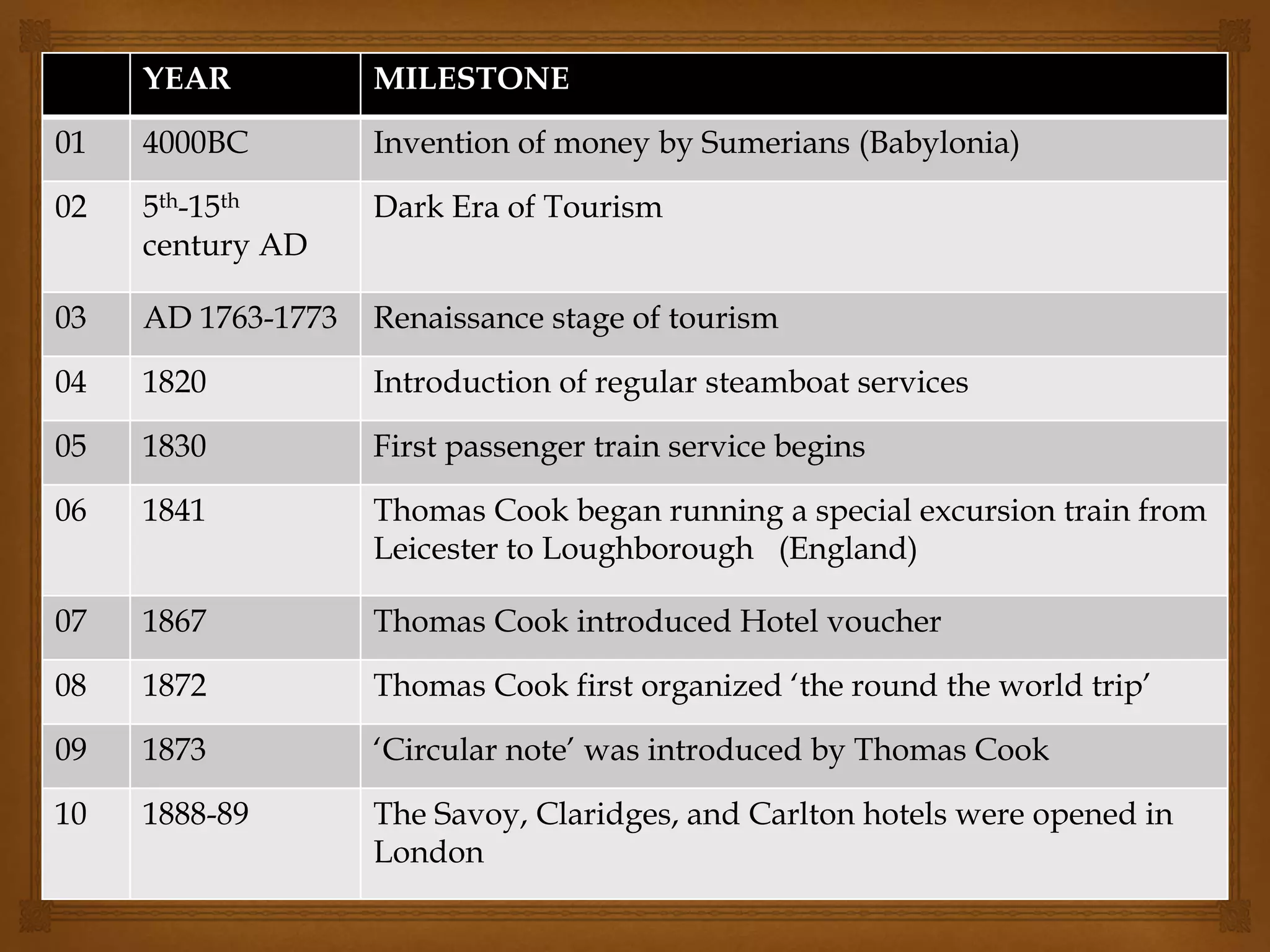
YEAR MILESTONE
01 4000BC Invention of money by Sumerians (Babylonia)
02 5th-15th
century AD
Dark Era of Tourism
03 AD 1763-1773 Renaissance stage of tourism
04 1820 Introduction of regular steamboat services
05 1830 First passenger train service begins
06 1841 Thomas Cook began running a special excursion train from
Leicester to Loughborough (England)
07 1867 Thomas Cook introduced Hotel voucher
08 1872 Thomas Cook first organized ‘the round the world trip’
09 1873 ‘Circular note’ was introduced by Thomas Cook
10 1888-89 The Savoy, Claridges, and Carlton hotels were opened in
London

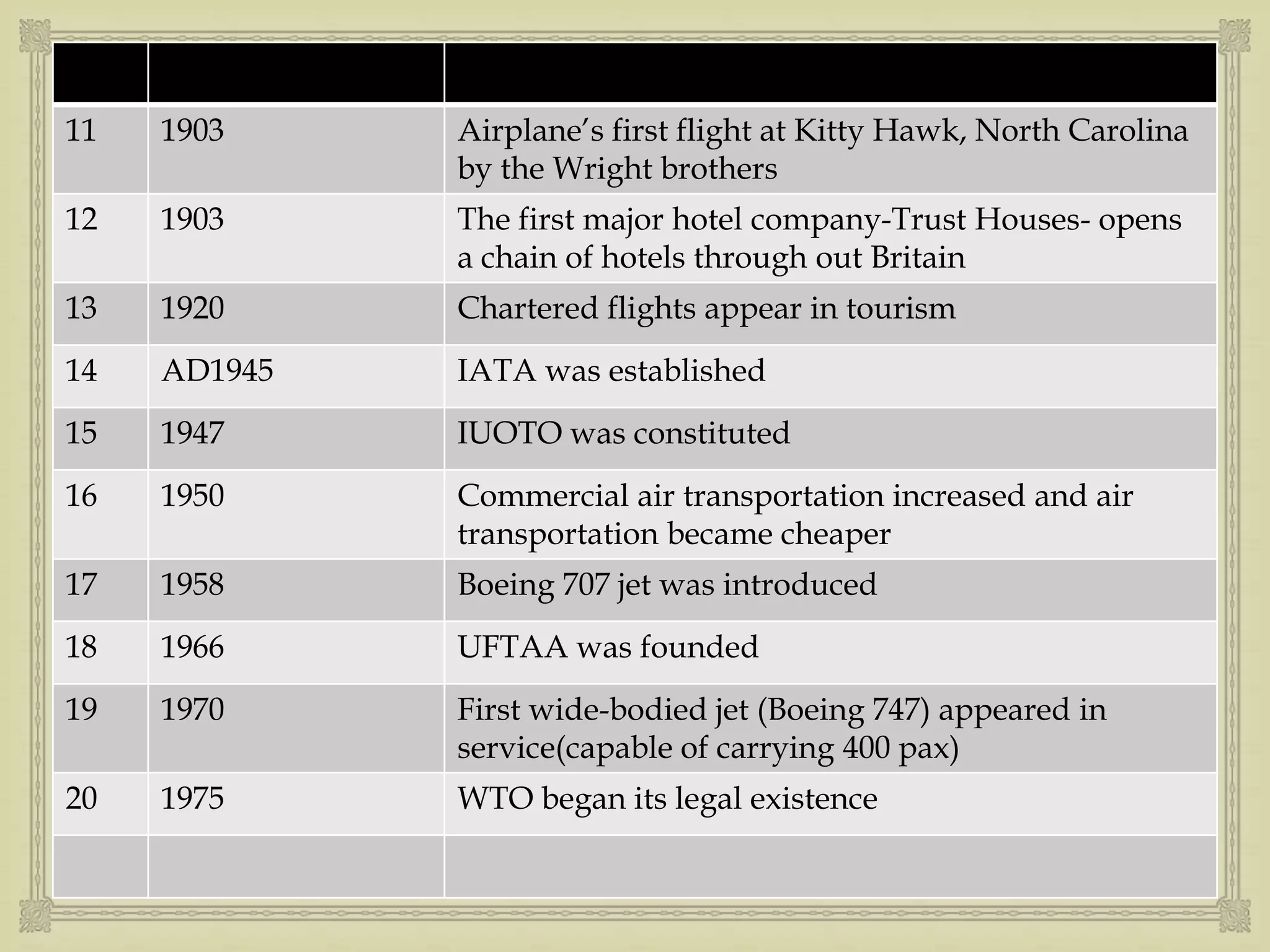
11 1903 Airplane’s first flight at Kitty Hawk, North Carolina
by the Wright brothers
12 1903 The first major hotel company-Trust Houses- opens
a chain of hotels through out Britain
13 1920 Chartered flights appear in tourism
14 AD1945 IATA was established
15 1947 IUOTO was constituted
16 1950 Commercial air transportation increased and air
transportation became cheaper
17 1958 Boeing 707 jet was introduced
18 1966 UFTAA was founded
19 1970 First wide-bodied jet (Boeing 747) appeared in
service(capable of carrying 400 pax)
20 1975 WTO began its legal existence

THANK YOU

History of tourism

  • 1.
    HISTORY OF TOURISM By : J o h n E dwa r d E s t ayo
  • 2.
      EARLY TRAVEL: Earlier travel was essentially to seek food or to escape danger.  Travel was also undertaken for trade.  Growth of cities along fertile river banks like Nile etc encouraged water travel.  Ancient empires like the Romans helped shape modern travel. INTRODUCTION
  • 3.
      THE EMPIREERA  The Egyptians  At its peak the travel for business and pleasure flourished.  Travel to outlining cities was necessary.  Various amenities were offered to travelers.  They travelled for pleasure and festivals were held every year.  People used to travel to attend these festivals.
  • 4.
      The Persians: They started travel initially for military use.  Later facilities earlier used for military were transformed to facilitate travel.  Roads were built, markers were established to indicate distances.  Safety of travelers was given importance.  Modes of transport like wagons, donkeys/mules were introduced.
  • 5.
      The Greeks: Greeks were the first, who shaped the modern day travel.  Pleasure travel was popular.  Travel was advanced by two developments:  Currency exchange: Greek cities accepted foreign currency, making it easier for travelers.  Communication: The Greek empire covered the entire Mediterranean thus the language was widely understood.  They provided all the amenities required.
  • 6.
      The Romans The prosperity of the roman empire was reflected in the development of travel.  The Romans included a large group of middle class who had money and time to travel.  They built excellent roads, transportation and communication systems.  They built rest houses.
  • 7.
    RENAISSANCE AND GRANDTOUR (AD 1763-1773) • The rise of Italy as intellectual capital of Europe . • GRAND TOUR – a tour to the principal cities and places of interest in Europe, formerly said to be an essential part of the education of the young man of ‘good birth’ and ‘fortune’. Main travelers were diplomats, business people, and scholars Mainly for career, education, culture, literary, health, scientific, business, and economic reasons.
  • 8.
      Thomas Cookis the Father of Tourism.  His first organized trip was ‘Leicester to Loughborough ’ in 1841.  It covered a distance of 22 km for 570 members.  He acted as an agent by buying tickets in bulk and selling it to others on a non profit basis.  This gave him an idea to package tours in a profitable manner. FATHER OF TOURISM AND TRAVEL
  • 9.
     He organizedthe travel arrangements, accommodations, transport at the destinations and return to the homeland.  He organized the first ‘inclusive tour’ to Paris Exhibition in 1855.  ‘Hotel voucher’ was introduced by Thomas Cook in 1867 and ‘Circular Note’ in 1873 which made travel easier.  First ‘Round the world tour’ in 1872.
  • 10.
    YEAR MILESTONE 01 4000BCInvention of money by Sumerians (Babylonia) 02 5th-15th century AD Dark Era of Tourism 03 AD 1763-1773 Renaissance stage of tourism 04 1820 Introduction of regular steamboat services 05 1830 First passenger train service begins 06 1841 Thomas Cook began running a special excursion train from Leicester to Loughborough (England) 07 1867 Thomas Cook introduced Hotel voucher 08 1872 Thomas Cook first organized ‘the round the world trip’ 09 1873 ‘Circular note’ was introduced by Thomas Cook 10 1888-89 The Savoy, Claridges, and Carlton hotels were opened in London
  • 11.
     11 1903 Airplane’sfirst flight at Kitty Hawk, North Carolina by the Wright brothers 12 1903 The first major hotel company-Trust Houses- opens a chain of hotels through out Britain 13 1920 Chartered flights appear in tourism 14 AD1945 IATA was established 15 1947 IUOTO was constituted 16 1950 Commercial air transportation increased and air transportation became cheaper 17 1958 Boeing 707 jet was introduced 18 1966 UFTAA was founded 19 1970 First wide-bodied jet (Boeing 747) appeared in service(capable of carrying 400 pax) 20 1975 WTO began its legal existence
  • 12.