At EL Education, we believe that the adoption of rigorous new literacy standards will results in teachers
and students doing more than they ever thought possible in terms of student achievement, academic
mindset, and high-quality work. But in order to achieve this goal, English Language Arts teachers need
more support than ever before in all areas of effective teaching – curriculum, pedagogy, and classroom
management.
How Can We Meet the Needs of ELA
Teachers and Their Students?
EL Education’s grant-funded Teacher Potential Project (TPP)
can help schools and districts get results in ELA. This unique
opportunity provides high-needs districts, schools and ELA
teachers with a substantial package of support for nearly no cost:
»	 A comprehensive, innovative, and engaging ELA curriculum,
aligned to new standards, that received the “Exemplary” rating
from EQuIP (Educators Evaluating the Quality of Instructional
Products). 1
»	 A full year of embedded professional development focused on
curriculum implementation, pedagogical decision making, and
classroom management.
»	 Access to a nationwide community of learners engaged in similar
experiences.
And for novice ELA teachers in particular:
»	 Timely and actionable feedback—which novice teachers report
they crave and often cannot access as much as is needed2
—
through our partnership with Teaching Channel Teams.
In addition to being a strong support to ELA teachers, those
who collaborate with them, and building leaders, this project is
a research study, funded by the US Department of Education’s
Investing in Innovation (i3) Fund. The study data about the
participating teachers’ job satisfaction, efficacy, and achievement
of their students can help participating districts make informed
decisions about supports and curriculum going forward. On
a broader level, this is an opportunity to be part of important
research that can help our nation respond more effectively to the
needs of ELA teachers and their students.
What are the Criteria for Participation?
Because this project is grant-funded, participating districts must
meet some foundational criteria:			
» At least 50% of students in schools being considered for the
project are receiving free or reduced lunch.
» At least two teachers with 0 to 2 years experience, assigned to
teach grades 4-8 ELA in each school considered for the project.
» ELA is provided for at least 90 minutes daily in elementary
grades (4-5) and at least 45 minutes daily in middle grades (6-8).
This project could be implemented in only novice ELA teachers’ classrooms in districts that have a large concentration of beginning
teachers. If you’re interested in the novice-focused version of this project, please contact Cheryl Dobbertin at cdobbertin@eleducation.org.
EL’s Teacher Potential Project:
Accelerating Students’ Literacy Achievement
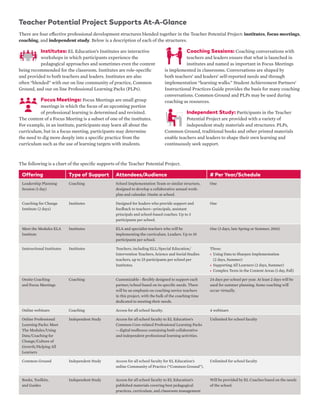
Teacher Potential Project Supports At-A-Glance
There are four effective professional development structures blended together in the Teacher Potential Project: institutes, focus meetings,
coaching, and independent study. Below is a description of each of the structures.
Institutes: EL Education’s Institutes are interactive
workshops in which participants experience the
pedagogical approaches and sometimes even the content
being recommended for the classroom. Institutes are role-specific
and provided to both teachers and leaders. Institutes are also
often “blended” with our on line community of practice, Common
Ground, and our on line Professional Learning Packs (PLPs).
Focus Meetings: Focus Meetings are small group
meetings in which the focus of an upcoming portion
of professional learning is determined and revisited.
The content of a Focus Meeting is a subset of one of the institutes.
For example, in an institute, participants may learn all about the
curriculum, but in a focus meeting, participants may determine
the need to dig more deeply into a specific practice from the
curriculum such as the use of learning targets with students.
Coaching Sessions: Coaching conversations with
teachers and leaders ensure that what is launched in
institutes and named as important in Focus Meetings
is implemented in classrooms. Conversations are shaped by
both teachers’ and leaders’ self-reported needs and through
implementation “learning walks.” Student Achievement Partners’
Instructional Practices Guide provides the basis for many coaching
conversations. Common Ground and PLPs may be used during
coaching as resources.
Independent Study: Participants in the Teacher
Potential Project are provided with a variety of
independent study materials and structures. PLPs,
Common Ground, traditional books and other printed materials
enable teachers and leaders to shape their own learning and
continuously seek support.
Offering Type of Support Attendees/Audience # Per Year/Schedule
Leadership Planning
Session (1 day)
Coaching School Implementation Team or similar structure,
designed to develop a collaborative annual work-
plan and calendar. Onsite at school.
One
Coaching for Change
Institute (2 days)
Institutes Designed for leaders who provide support and
feedback to teachers—principals, assistant
principals and school-based coaches. Up to 3
participants per school.
One
Meet the Modules ELA
Institute
Institutes ELA and specialist teachers who will be
implementing the curriculum. Leaders. Up to 10
participants per school.
One (3 days, late Spring or Summer, 2016)
Instructional Institutes Institutes Teachers, including ELL/Special Education/
Intervention Teachers, Science and Social Studies
teachers, up to 25 participants per school per
Institutes.
Three:
»	 Using Data to Sharpen Implementation
(2 days, Summer)
»	 Supporting All Learners (2 days, Summer)
»	 Complex Texts in the Content Areas (1 day, Fall)
Onsite Coaching
and Focus Meetings
Coaching Customizable - flexibly designed to support each
partner/school based on its specific needs. There
will be an emphasis on coaching novice teachers
in this project, with the bulk of the coaching time
dedicated to meeting their needs.
24 days per school per year. At least 2 days will be
used for summer planning. Some coaching will
occur virtually.
Online webinars Coaching Access for all school faculty. 4 webinars
Online Professional
Learning Packs: Meet
The Modules/Using
Data/Coaching for
Change/Culture of
Growth/Helping All
Learners
Independent Study Access for all school faculty to EL Education’s
Common Core-related Professional Learning Packs
-- digital toolboxes containing both collaborative
and independent professional learning activities.
Unlimited for school faculty
Common Ground Independent Study Access for all school faculty for EL Education’s
online Community of Practice (“Common Ground”).
Unlimited for school faculty
Books, Toolkits,
and Guides
Independent Study Access for all school faculty to EL Education’s
published materials covering best pedagogical
practices, curriculum, and classroom management
Will be provided by EL Coaches based on the needs
of the school.
The following is a chart of the specific supports of the Teacher Potential Project.
What Do Districts Agree To?
Districts interested in participating in this project beginning in the spring of 2016 agree to:								
» Identify teachers assigned to grades 4-8 ELA with 0 or 2 years of experience.
» Identify schools with least two novice ELA teachers in them as described above.
» Enter the identified schools into a lottery that will be conducted by Mathematica
Policy Research. As a result of the lottery, half of the schools originally entered will
receive the EL Education support for the ELA teachers. The other half will not and
will serve as control schools for the research. (See the chart below for benefits to all
project participants).
» Purchase the trade books needed to implement the curriculum (these student
materials are not funded by the grant).
» Download and duplicate or purchase the curricular materials for each participating
teacher and their students.
» Implement the curriculum as the primary instructional resource in ELA teachers’
classrooms/ELA instructional periods.
» Provide participating teachers with the time necessary for professional development in
the late Spring and Summer of 2016 (see the TPP-At-a-Glance chart), and some release
time for coaching and other needs during the 2016-17 school year. The grant provides
stipends based on school size that can offset the cost of summer professional
development.
» Provide Mathematica Policy Research with student achievement information, access
to novice ELA teachers’ classrooms for research-related observation, and support the
collection of a writing sample from both treatment and control schools.
For the District For the Treatment Schools For the Control Schools
One full year of robust ELA teacher support for
each treatment school in the project.
One full year of robust ELA teacher support and
some development of Common Core awareness in
content area teachers.
A choice of professional development:
»	 A 3-day Introduction to the Curriculum
Institute following the research period. Could
result in implementation of the curriculum
before the end of the 2016-17 school year.
»	 OR a 2-day Complex Texts in the Content Areas
Institute following the research period.
Building leadership development related to
observation and feedback.
Support for principals related to program
implementation, observation, and feedback.
Incentives for completing research-related
surveys, observations, and collecting writing
samples.
Training stipend for each treatment school,
based on each school’s size. Can be used to offset
summer PD costs or to provide teacher materials.
Opportunity to pilot new Common Core-aligned
curriculum in novice teachers’ classrooms or
school wide.
District literacy leaders are trained to support
wider implementation if desired.
Opportunity to pilot new Common Core-aligned
curriculum in novice teachers’ classrooms or
school wide.
Incentives for completing research-related
surveys, observations, and collecting writing
samples.
District literacy leaders are welcome to
engage in our high quality PD in order to
build capacity to support teachers following
end of project.
District literacy leaders are trained to support
wider implementation if desired.
What are the Benefits to Partnership?
1. Online, http://www.achieve.org/EQuIP
2. Ingersoll, R. Beginning Teacher Induction: What the Data Tell Us. Phi Delta Kappan International. Published online, May 16, 2012.
247 West 35th Street
Eighth Floor
New York, NY 10001
212-239-4455 tel
212-239-8287 fax
www.eleducation.org

EL-TPPFlyer-WS-116

  • 1.
    At EL Education,we believe that the adoption of rigorous new literacy standards will results in teachers and students doing more than they ever thought possible in terms of student achievement, academic mindset, and high-quality work. But in order to achieve this goal, English Language Arts teachers need more support than ever before in all areas of effective teaching – curriculum, pedagogy, and classroom management. How Can We Meet the Needs of ELA Teachers and Their Students? EL Education’s grant-funded Teacher Potential Project (TPP) can help schools and districts get results in ELA. This unique opportunity provides high-needs districts, schools and ELA teachers with a substantial package of support for nearly no cost: » A comprehensive, innovative, and engaging ELA curriculum, aligned to new standards, that received the “Exemplary” rating from EQuIP (Educators Evaluating the Quality of Instructional Products). 1 » A full year of embedded professional development focused on curriculum implementation, pedagogical decision making, and classroom management. » Access to a nationwide community of learners engaged in similar experiences. And for novice ELA teachers in particular: » Timely and actionable feedback—which novice teachers report they crave and often cannot access as much as is needed2 — through our partnership with Teaching Channel Teams. In addition to being a strong support to ELA teachers, those who collaborate with them, and building leaders, this project is a research study, funded by the US Department of Education’s Investing in Innovation (i3) Fund. The study data about the participating teachers’ job satisfaction, efficacy, and achievement of their students can help participating districts make informed decisions about supports and curriculum going forward. On a broader level, this is an opportunity to be part of important research that can help our nation respond more effectively to the needs of ELA teachers and their students. What are the Criteria for Participation? Because this project is grant-funded, participating districts must meet some foundational criteria: » At least 50% of students in schools being considered for the project are receiving free or reduced lunch. » At least two teachers with 0 to 2 years experience, assigned to teach grades 4-8 ELA in each school considered for the project. » ELA is provided for at least 90 minutes daily in elementary grades (4-5) and at least 45 minutes daily in middle grades (6-8). This project could be implemented in only novice ELA teachers’ classrooms in districts that have a large concentration of beginning teachers. If you’re interested in the novice-focused version of this project, please contact Cheryl Dobbertin at cdobbertin@eleducation.org. EL’s Teacher Potential Project: Accelerating Students’ Literacy Achievement
  • 2.
    Teacher Potential ProjectSupports At-A-Glance There are four effective professional development structures blended together in the Teacher Potential Project: institutes, focus meetings, coaching, and independent study. Below is a description of each of the structures. Institutes: EL Education’s Institutes are interactive workshops in which participants experience the pedagogical approaches and sometimes even the content being recommended for the classroom. Institutes are role-specific and provided to both teachers and leaders. Institutes are also often “blended” with our on line community of practice, Common Ground, and our on line Professional Learning Packs (PLPs). Focus Meetings: Focus Meetings are small group meetings in which the focus of an upcoming portion of professional learning is determined and revisited. The content of a Focus Meeting is a subset of one of the institutes. For example, in an institute, participants may learn all about the curriculum, but in a focus meeting, participants may determine the need to dig more deeply into a specific practice from the curriculum such as the use of learning targets with students. Coaching Sessions: Coaching conversations with teachers and leaders ensure that what is launched in institutes and named as important in Focus Meetings is implemented in classrooms. Conversations are shaped by both teachers’ and leaders’ self-reported needs and through implementation “learning walks.” Student Achievement Partners’ Instructional Practices Guide provides the basis for many coaching conversations. Common Ground and PLPs may be used during coaching as resources. Independent Study: Participants in the Teacher Potential Project are provided with a variety of independent study materials and structures. PLPs, Common Ground, traditional books and other printed materials enable teachers and leaders to shape their own learning and continuously seek support. Offering Type of Support Attendees/Audience # Per Year/Schedule Leadership Planning Session (1 day) Coaching School Implementation Team or similar structure, designed to develop a collaborative annual work- plan and calendar. Onsite at school. One Coaching for Change Institute (2 days) Institutes Designed for leaders who provide support and feedback to teachers—principals, assistant principals and school-based coaches. Up to 3 participants per school. One Meet the Modules ELA Institute Institutes ELA and specialist teachers who will be implementing the curriculum. Leaders. Up to 10 participants per school. One (3 days, late Spring or Summer, 2016) Instructional Institutes Institutes Teachers, including ELL/Special Education/ Intervention Teachers, Science and Social Studies teachers, up to 25 participants per school per Institutes. Three: » Using Data to Sharpen Implementation (2 days, Summer) » Supporting All Learners (2 days, Summer) » Complex Texts in the Content Areas (1 day, Fall) Onsite Coaching and Focus Meetings Coaching Customizable - flexibly designed to support each partner/school based on its specific needs. There will be an emphasis on coaching novice teachers in this project, with the bulk of the coaching time dedicated to meeting their needs. 24 days per school per year. At least 2 days will be used for summer planning. Some coaching will occur virtually. Online webinars Coaching Access for all school faculty. 4 webinars Online Professional Learning Packs: Meet The Modules/Using Data/Coaching for Change/Culture of Growth/Helping All Learners Independent Study Access for all school faculty to EL Education’s Common Core-related Professional Learning Packs -- digital toolboxes containing both collaborative and independent professional learning activities. Unlimited for school faculty Common Ground Independent Study Access for all school faculty for EL Education’s online Community of Practice (“Common Ground”). Unlimited for school faculty Books, Toolkits, and Guides Independent Study Access for all school faculty to EL Education’s published materials covering best pedagogical practices, curriculum, and classroom management Will be provided by EL Coaches based on the needs of the school. The following is a chart of the specific supports of the Teacher Potential Project.
  • 3.
    What Do DistrictsAgree To? Districts interested in participating in this project beginning in the spring of 2016 agree to: » Identify teachers assigned to grades 4-8 ELA with 0 or 2 years of experience. » Identify schools with least two novice ELA teachers in them as described above. » Enter the identified schools into a lottery that will be conducted by Mathematica Policy Research. As a result of the lottery, half of the schools originally entered will receive the EL Education support for the ELA teachers. The other half will not and will serve as control schools for the research. (See the chart below for benefits to all project participants). » Purchase the trade books needed to implement the curriculum (these student materials are not funded by the grant). » Download and duplicate or purchase the curricular materials for each participating teacher and their students. » Implement the curriculum as the primary instructional resource in ELA teachers’ classrooms/ELA instructional periods. » Provide participating teachers with the time necessary for professional development in the late Spring and Summer of 2016 (see the TPP-At-a-Glance chart), and some release time for coaching and other needs during the 2016-17 school year. The grant provides stipends based on school size that can offset the cost of summer professional development. » Provide Mathematica Policy Research with student achievement information, access to novice ELA teachers’ classrooms for research-related observation, and support the collection of a writing sample from both treatment and control schools. For the District For the Treatment Schools For the Control Schools One full year of robust ELA teacher support for each treatment school in the project. One full year of robust ELA teacher support and some development of Common Core awareness in content area teachers. A choice of professional development: » A 3-day Introduction to the Curriculum Institute following the research period. Could result in implementation of the curriculum before the end of the 2016-17 school year. » OR a 2-day Complex Texts in the Content Areas Institute following the research period. Building leadership development related to observation and feedback. Support for principals related to program implementation, observation, and feedback. Incentives for completing research-related surveys, observations, and collecting writing samples. Training stipend for each treatment school, based on each school’s size. Can be used to offset summer PD costs or to provide teacher materials. Opportunity to pilot new Common Core-aligned curriculum in novice teachers’ classrooms or school wide. District literacy leaders are trained to support wider implementation if desired. Opportunity to pilot new Common Core-aligned curriculum in novice teachers’ classrooms or school wide. Incentives for completing research-related surveys, observations, and collecting writing samples. District literacy leaders are welcome to engage in our high quality PD in order to build capacity to support teachers following end of project. District literacy leaders are trained to support wider implementation if desired. What are the Benefits to Partnership?
  • 4.
    1. Online, http://www.achieve.org/EQuIP 2.Ingersoll, R. Beginning Teacher Induction: What the Data Tell Us. Phi Delta Kappan International. Published online, May 16, 2012. 247 West 35th Street Eighth Floor New York, NY 10001 212-239-4455 tel 212-239-8287 fax www.eleducation.org