WORKING WITH SOCIO-AFFECTIVE LANGUAGE LEARNING
STRATEGIES: CHALLENGES AND OPPORTUNITIES
Bogotá, Colombia - July 11th, 2022
Presenter
Yamith José Fandiño Parra
Ph.D. Candidate in Education and Society at La Salle
University of Colombia
https://orcid.org/0000-0002-5567-5465
yfandino@unisalle.edu.co
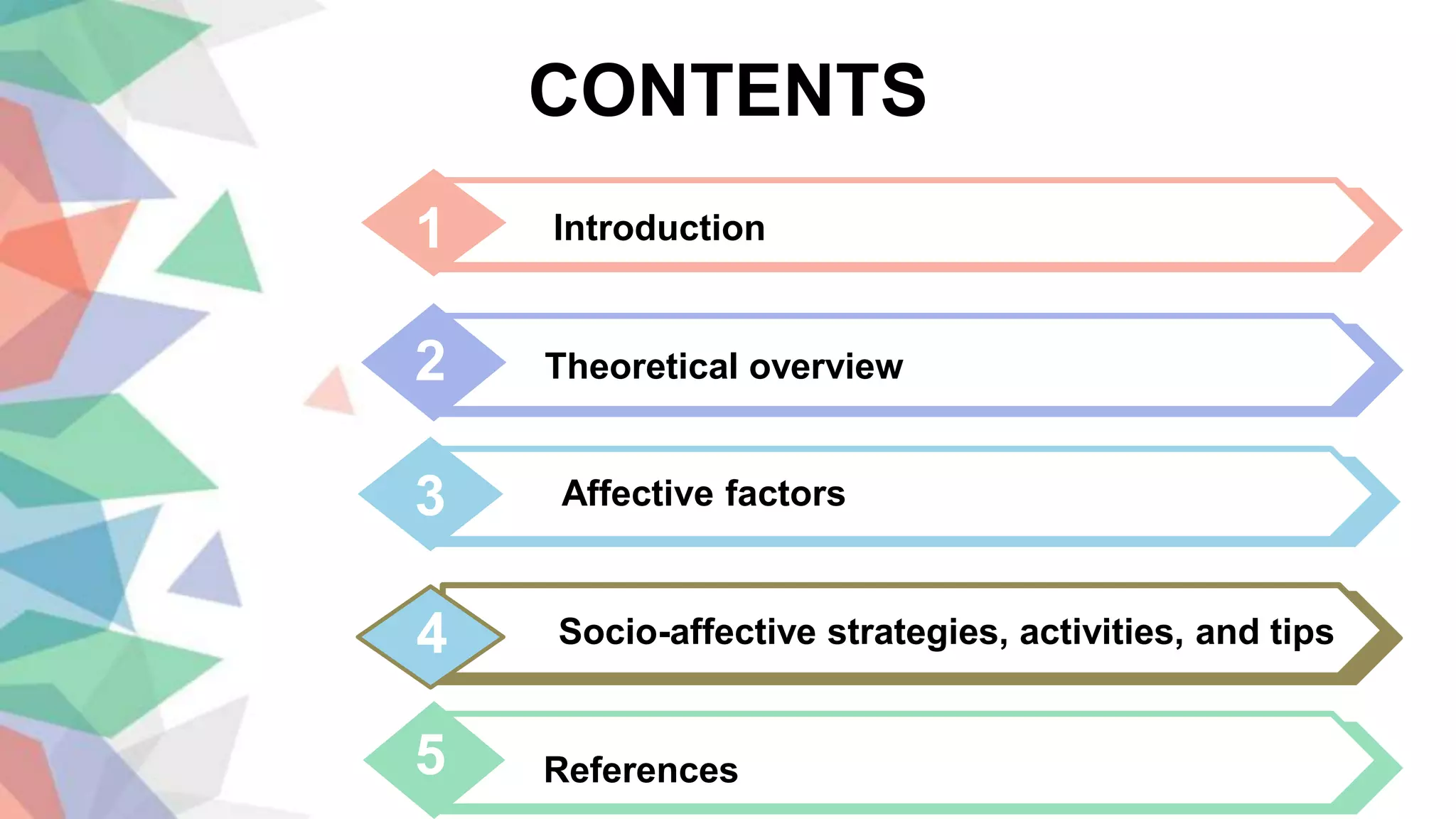
CONTENTS
1 Introduction
2 Theoretical overview
3 Affective factors
5 References
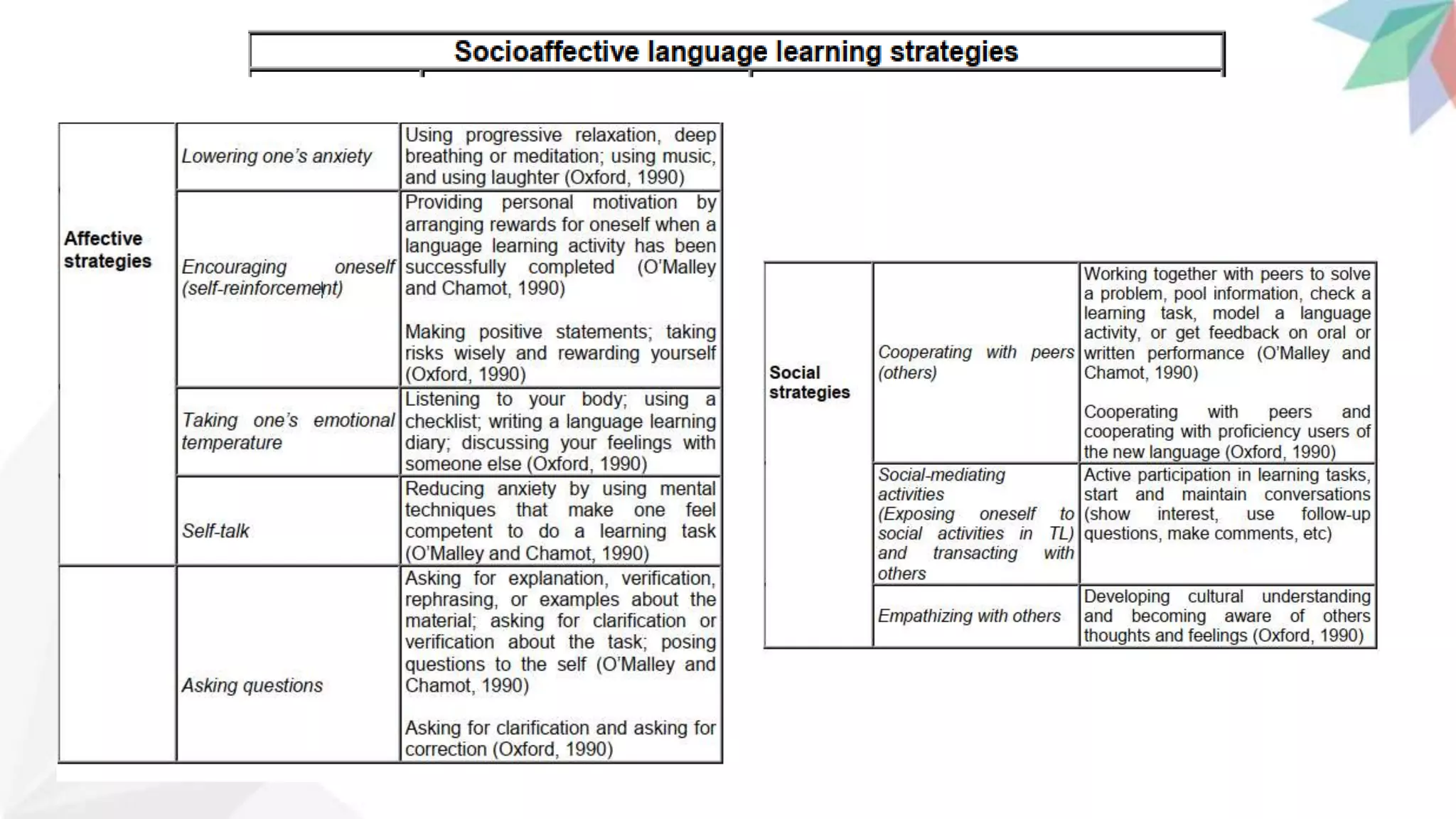
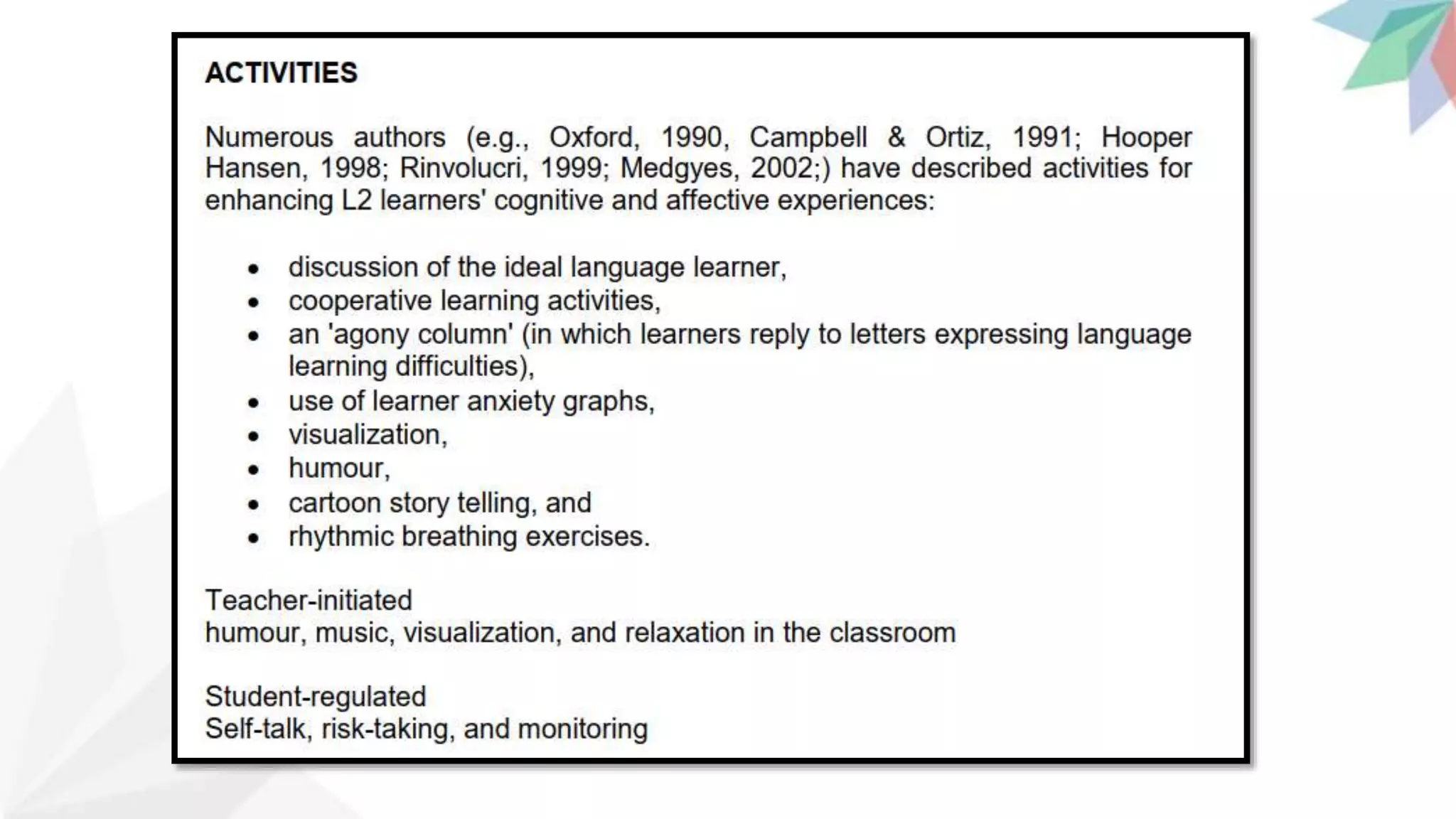
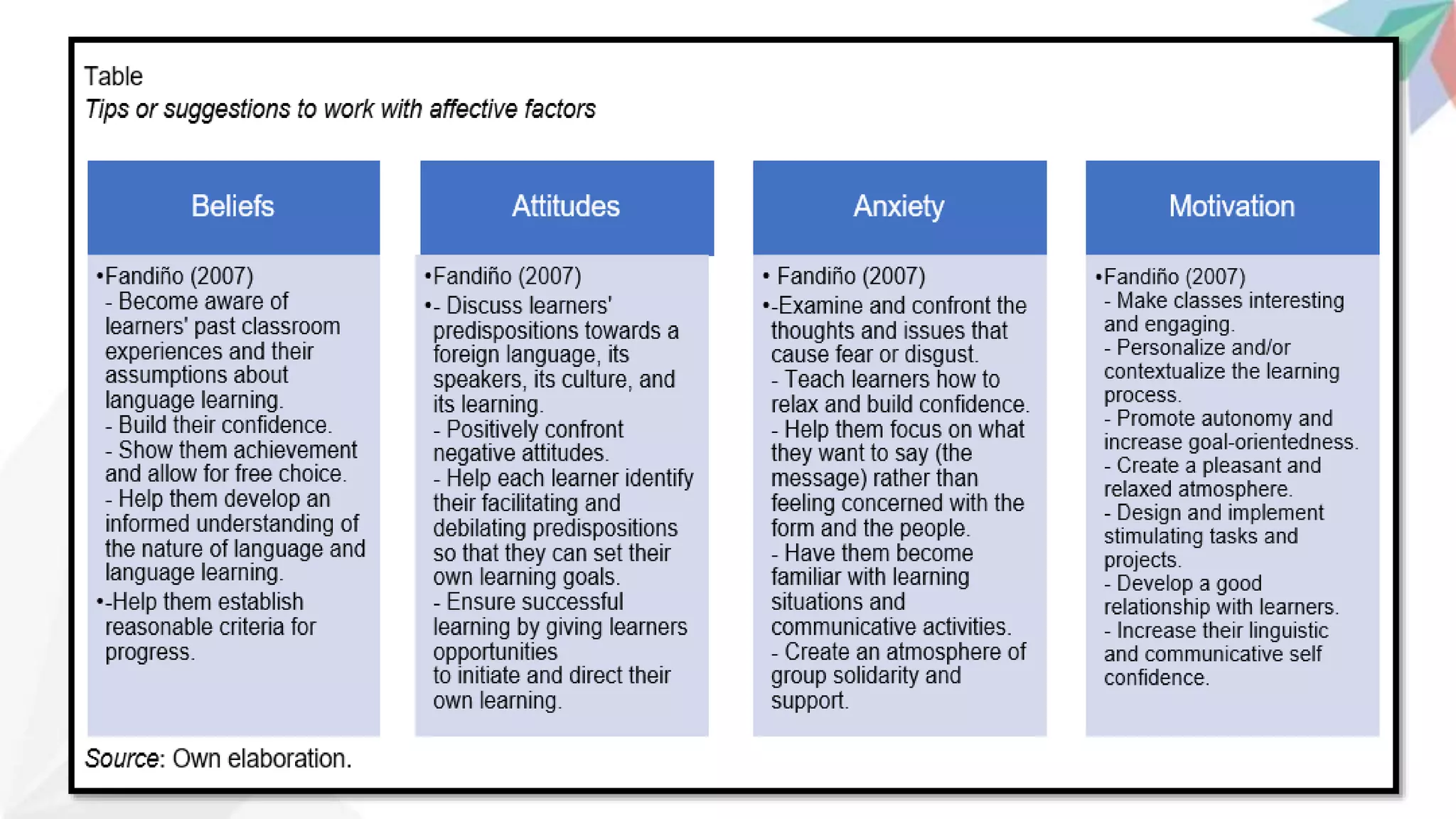
Socio-affective strategies, activities, and tips
4
INTRODUCTION
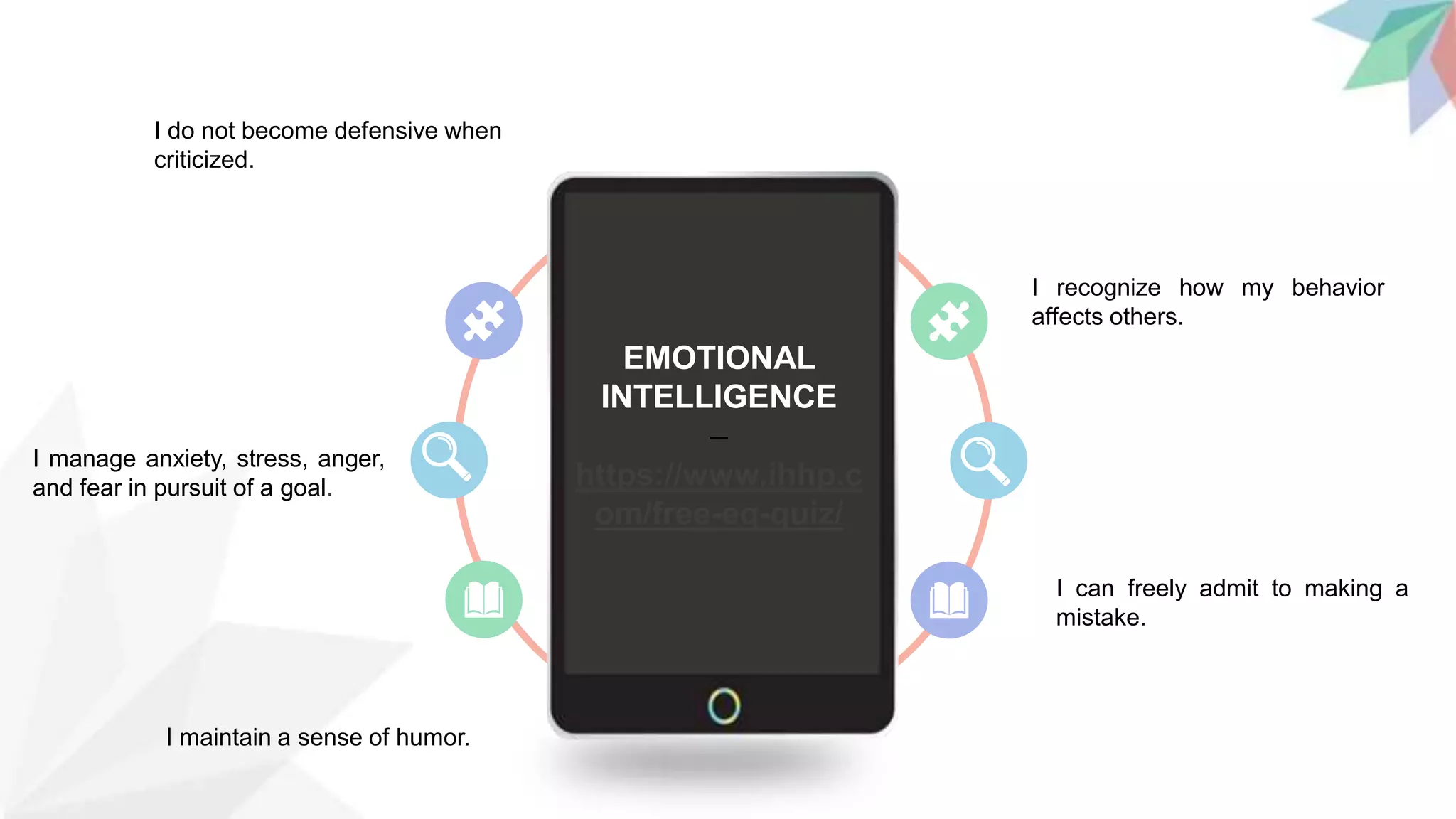
I do not become defensive when
criticized.
I recognize how my behavior
affects others.
I manage anxiety, stress, anger,
and fear in pursuit of a goal.
I maintain a sense of humor.
I can freely admit to making a
mistake.
EMOTIONAL
INTELLIGENCE
–
https://www.ihhp.c
om/free-eq-quiz/
THEORETICAL OVERVIEW
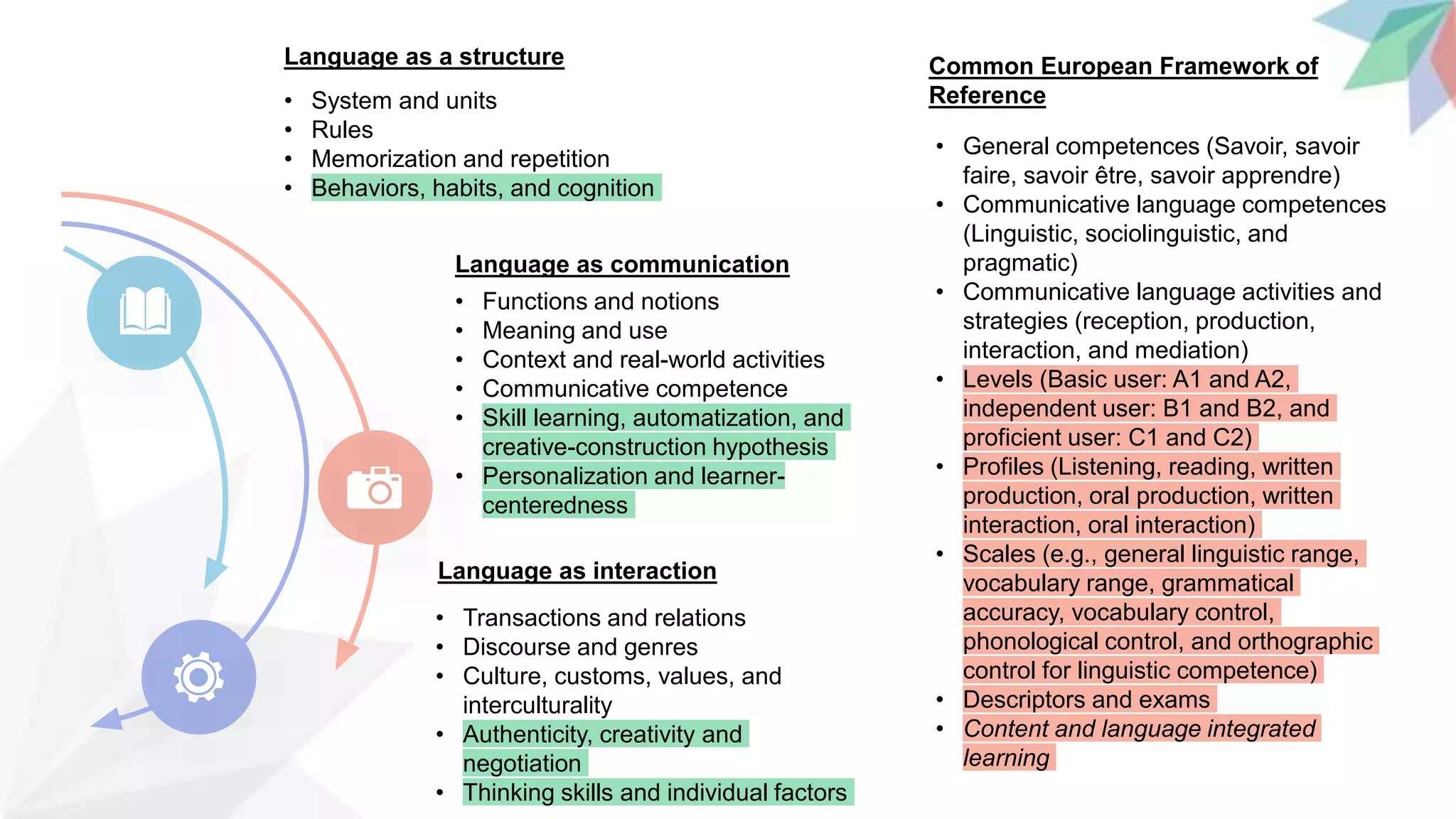
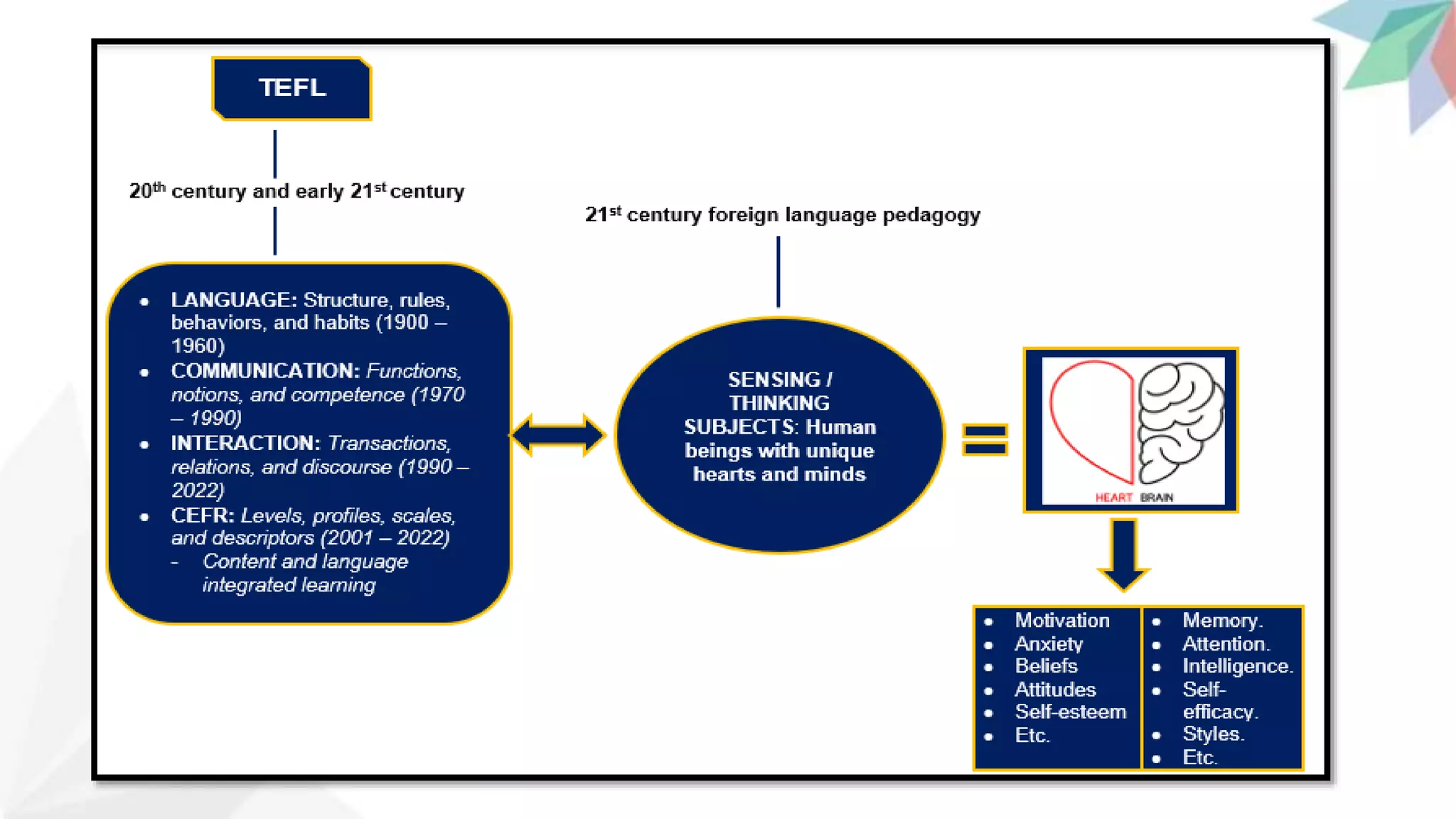
• System and units
• Rules
• Memorization and repetition
• Behaviors, habits, and cognition
Language as a structure
• Functions and notions
• Meaning and use
• Context and real-world activities
• Communicative competence
• Skill learning, automatization, and
creative-construction hypothesis
• Personalization and learner-
centeredness
Language as communication
• Transactions and relations
• Discourse and genres
• Culture, customs, values, and
interculturality
• Authenticity, creativity and
negotiation
• Thinking skills and individual factors
Language as interaction
• General competences (Savoir, savoir
faire, savoir être, savoir apprendre)
• Communicative language competences
(Linguistic, sociolinguistic, and
pragmatic)
• Communicative language activities and
strategies (reception, production,
interaction, and mediation)
• Levels (Basic user: A1 and A2,
independent user: B1 and B2, and
proficient user: C1 and C2)
• Profiles (Listening, reading, written
production, oral production, written
interaction, oral interaction)
• Scales (e.g., general linguistic range,
vocabulary range, grammatical
accuracy, vocabulary control,
phonological control, and orthographic
control for linguistic competence)
• Descriptors and exams
• Content and language integrated
learning
Common European Framework of
Reference
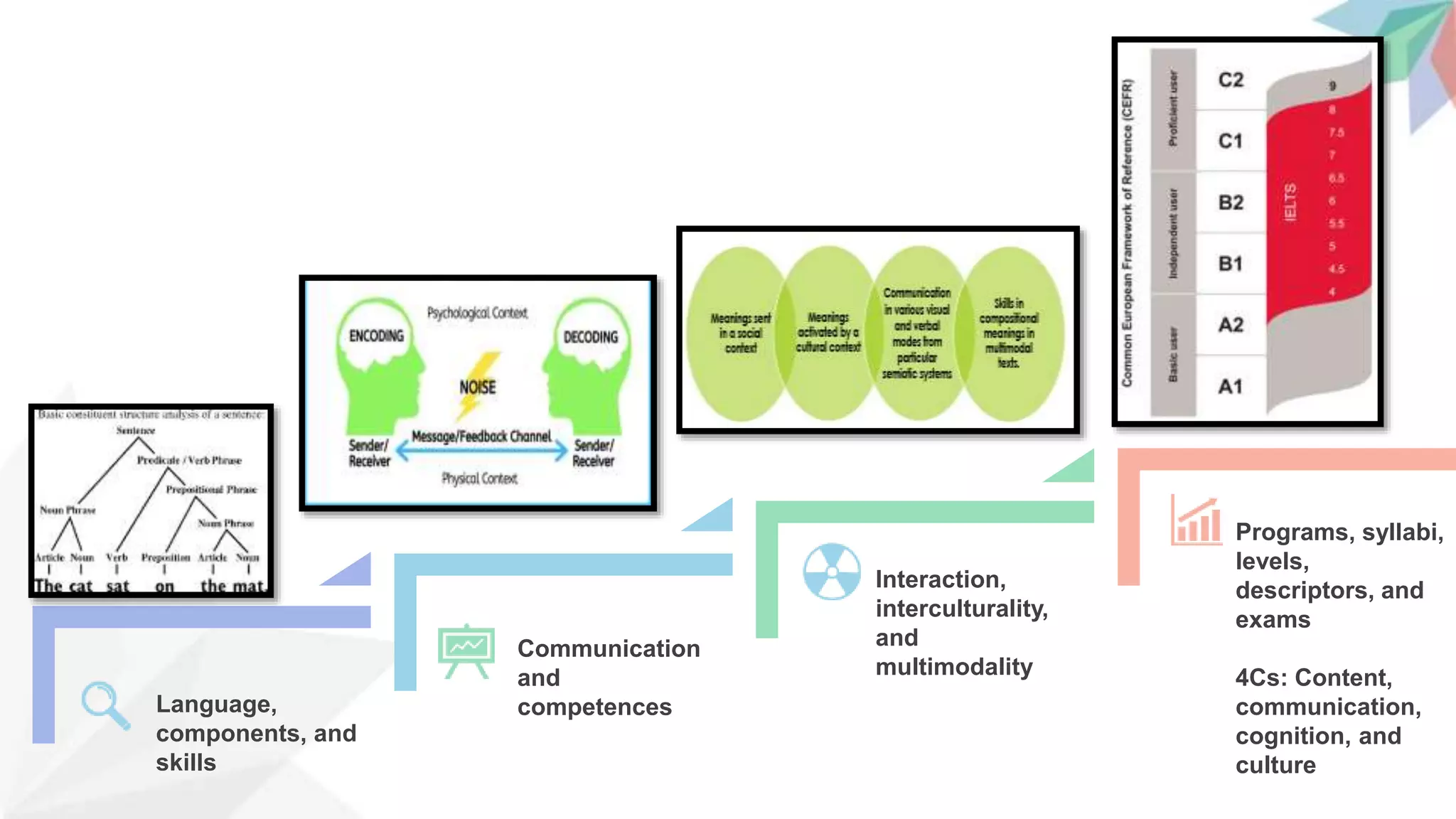
Language,
components, and
skills
Communication
and
competences
Interaction,
interculturality,
and
multimodality
Programs, syllabi,
levels,
descriptors, and
exams
4Cs: Content,
communication,
cognition, and
culture
AFFECTIVE FACTORS
Why?
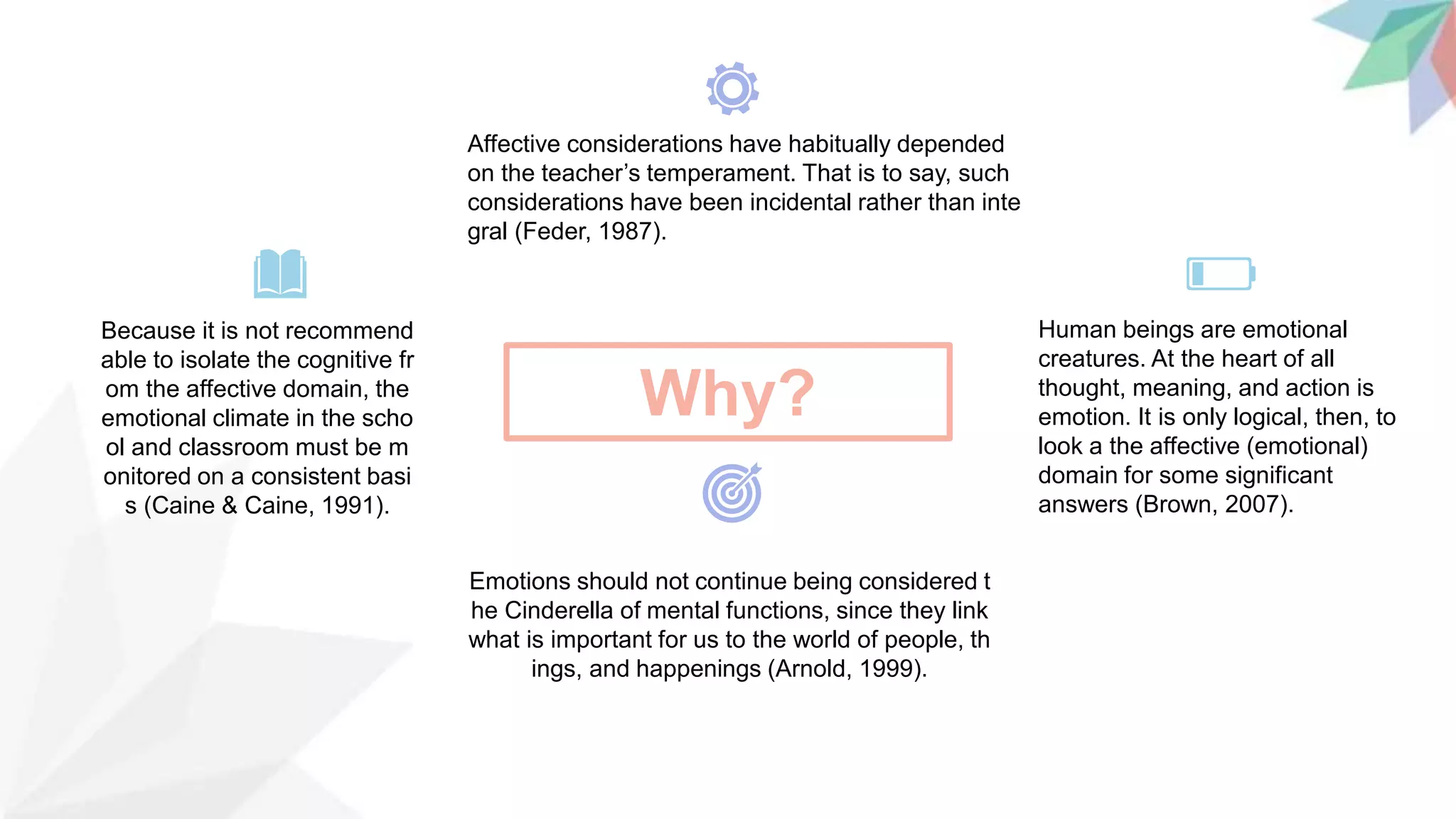
Because it is not recommend
able to isolate the cognitive fr
om the affective domain, the
emotional climate in the scho
ol and classroom must be m
onitored on a consistent basi
s (Caine & Caine, 1991).
Emotions should not continue being considered t
he Cinderella of mental functions, since they link
what is important for us to the world of people, th
ings, and happenings (Arnold, 1999).
Affective considerations have habitually depended
on the teacher’s temperament. That is to say, such
considerations have been incidental rather than inte
gral (Feder, 1987).
Human beings are emotional
creatures. At the heart of all
thought, meaning, and action is
emotion. It is only logical, then, to
look a the affective (emotional)
domain for some significant
answers (Brown, 2007).
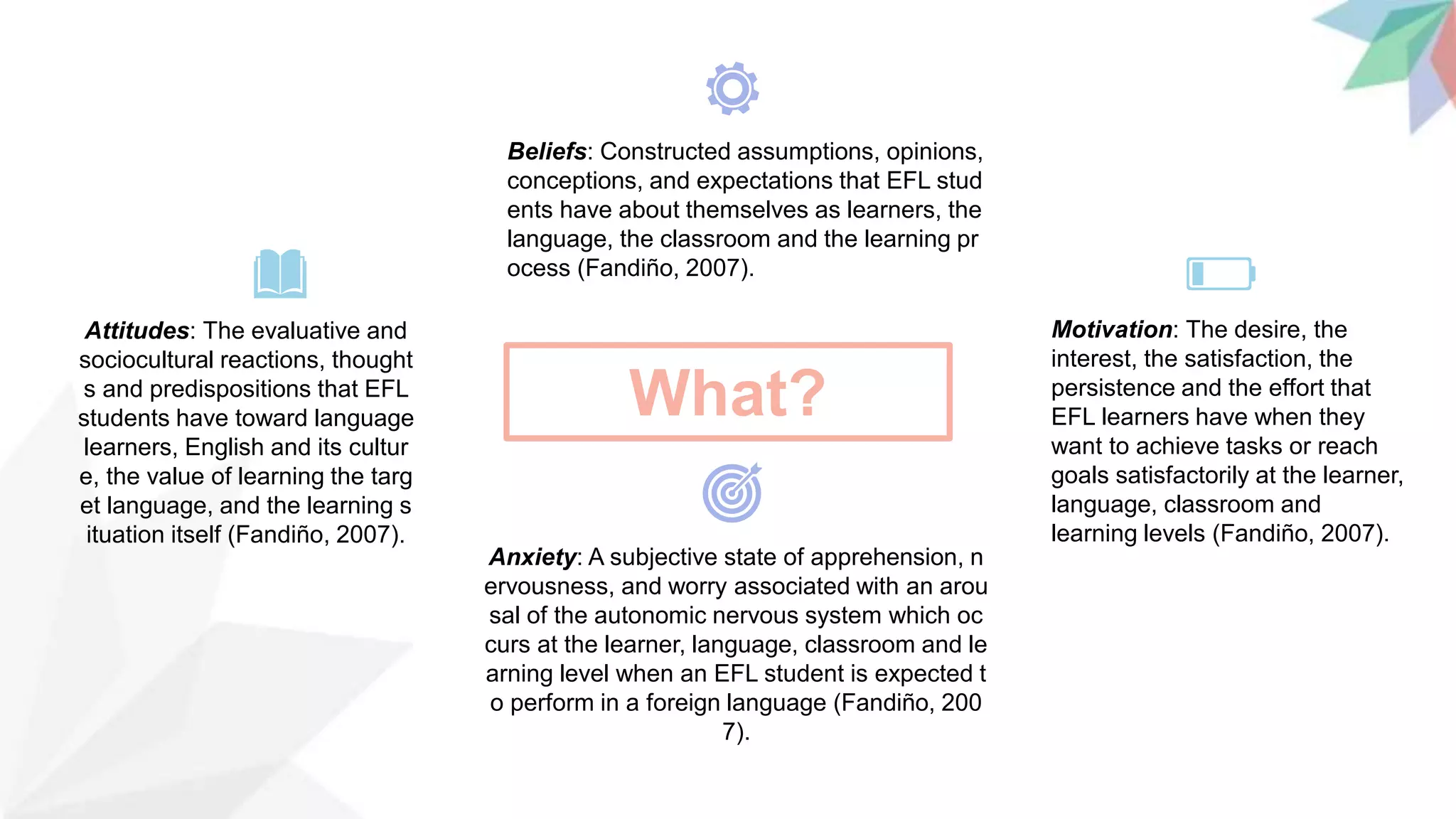
What?
Attitudes: The evaluative and
sociocultural reactions, thought
s and predispositions that EFL
students have toward language
learners, English and its cultur
e, the value of learning the targ
et language, and the learning s
ituation itself (Fandiño, 2007).
Anxiety: A subjective state of apprehension, n
ervousness, and worry associated with an arou
sal of the autonomic nervous system which oc
curs at the learner, language, classroom and le
arning level when an EFL student is expected t
o perform in a foreign language (Fandiño, 200
7).
Beliefs: Constructed assumptions, opinions,
conceptions, and expectations that EFL stud
ents have about themselves as learners, the
language, the classroom and the learning pr
ocess (Fandiño, 2007).
Motivation: The desire, the
interest, the satisfaction, the
persistence and the effort that
EFL learners have when they
want to achieve tasks or reach
goals satisfactorily at the learner,
language, classroom and
learning levels (Fandiño, 2007).
SOCIOAFFECTIVE
AREAS, STRATEGIES, ACTIVITIES,
AND TIPS
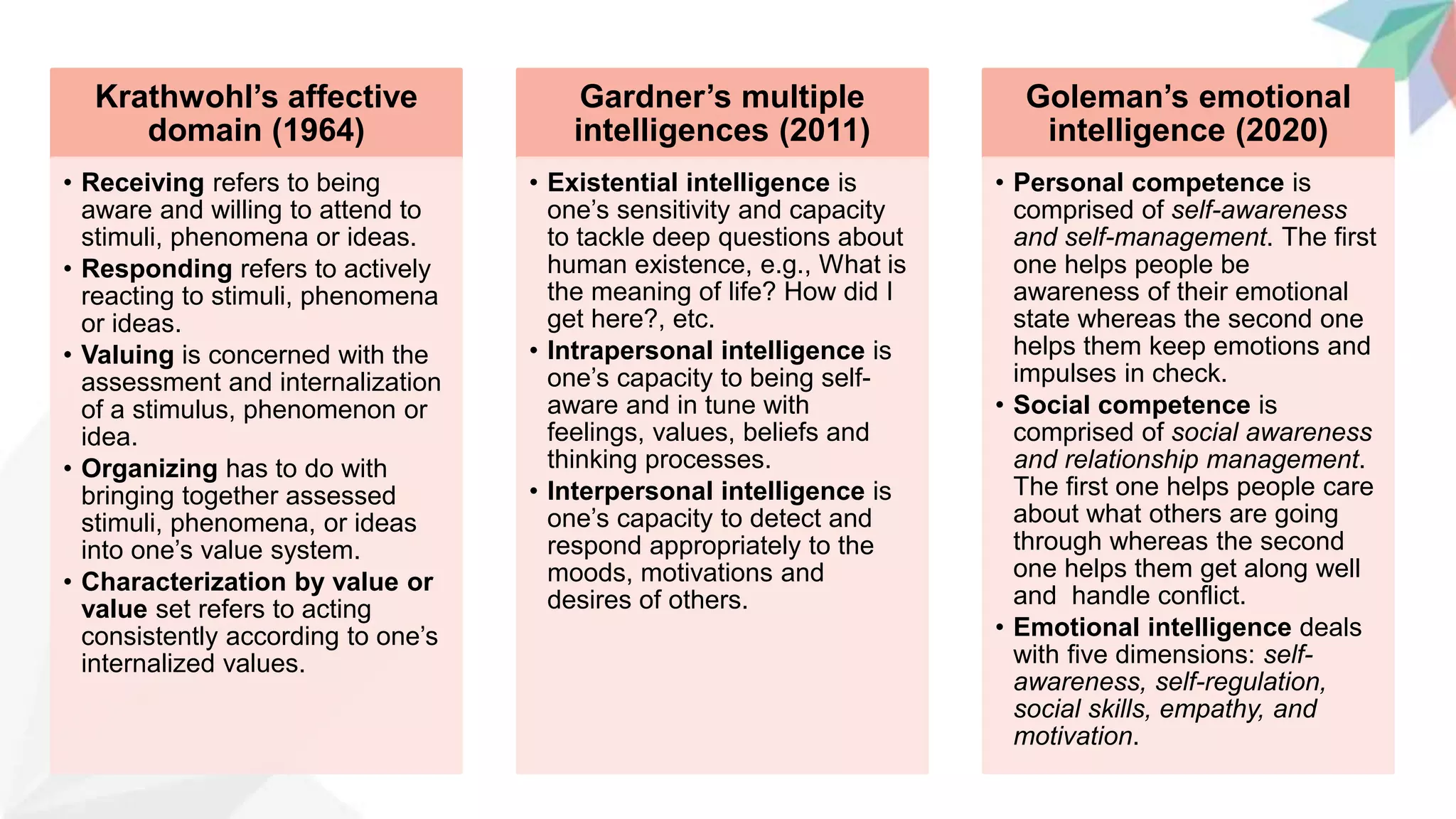
Krathwohl’s affective
domain (1964)
• Receiving refers to being
aware and willing to attend to
stimuli, phenomena or ideas.
• Responding refers to actively
reacting to stimuli, phenomena
or ideas.
• Valuing is concerned with the
assessment and internalization
of a stimulus, phenomenon or
idea.
• Organizing has to do with
bringing together assessed
stimuli, phenomena, or ideas
into one’s value system.
• Characterization by value or
value set refers to acting
consistently according to one’s
internalized values.
Gardner’s multiple
intelligences (2011)
• Existential intelligence is
one’s sensitivity and capacity
to tackle deep questions about
human existence, e.g., What is
the meaning of life? How did I
get here?, etc.
• Intrapersonal intelligence is
one’s capacity to being self-
aware and in tune with
feelings, values, beliefs and
thinking processes.
• Interpersonal intelligence is
one’s capacity to detect and
respond appropriately to the
moods, motivations and
desires of others.
Goleman’s emotional
intelligence (2020)
• Personal competence is
comprised of self-awareness
and self-management. The first
one helps people be
awareness of their emotional
state whereas the second one
helps them keep emotions and
impulses in check.
• Social competence is
comprised of social awareness
and relationship management.
The first one helps people care
about what others are going
through whereas the second
one helps them get along well
and handle conflict.
• Emotional intelligence deals
with five dimensions: self-
awareness, self-regulation,
social skills, empathy, and
motivation.
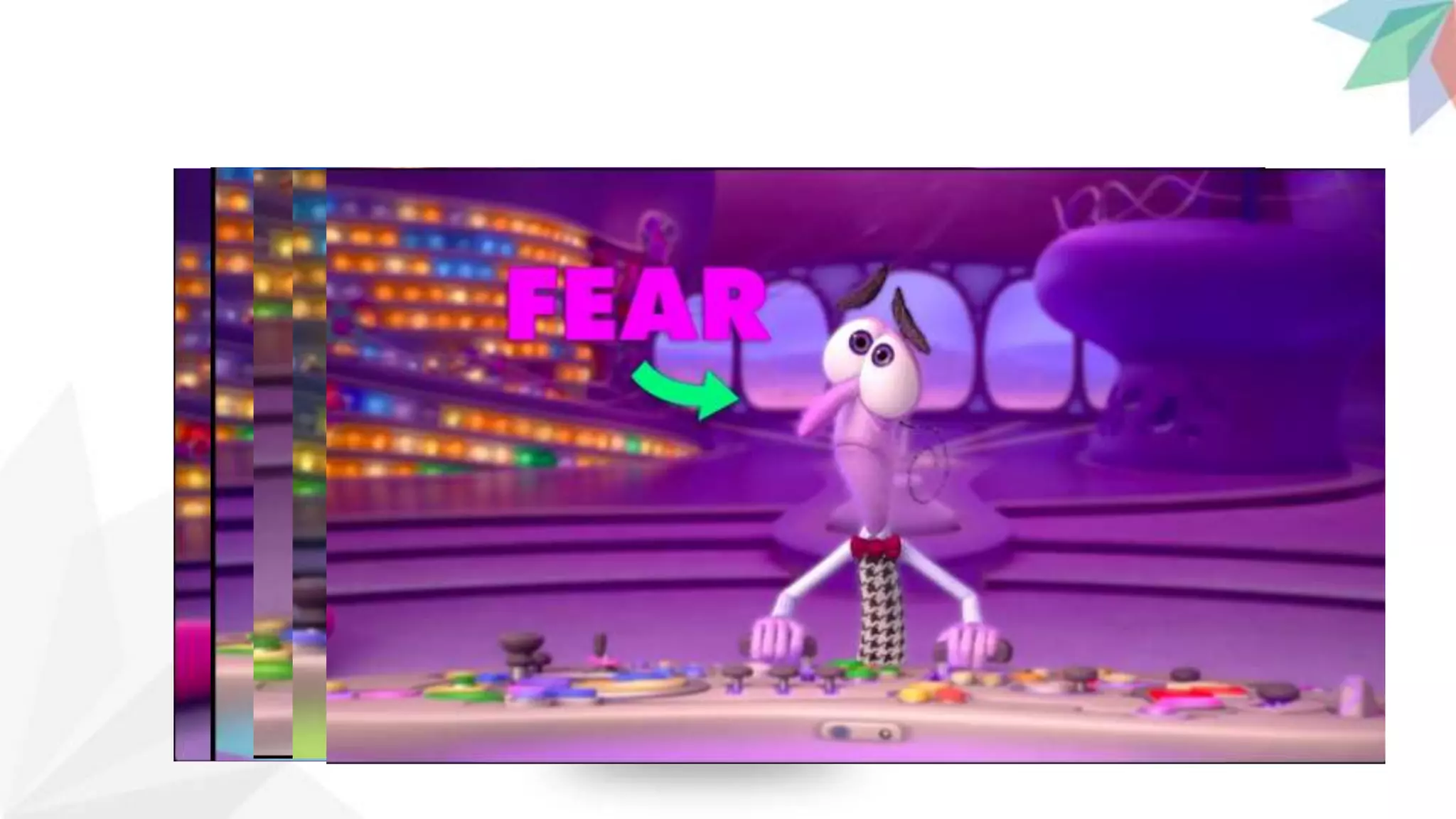
Inside Out reminds us to emb
race the wholeness of ourselv
es, give ourselves permission
to not be “ok”, and that we mu
st give those around us a chan
ce to work through their emoti
onal realizations. It’s not about
trying to avoid uncomfortable f
eelings but rather go towards t
hem to get honest with ourselv
es and grow (Gooden, 2020).
REFERENCES
● Arnold, J. (1999). Affect in language learning. Cambridge University Press.
● Brown, D. (2007). Principles of language learning and teaching (5th ed.). Pearson Education.
● Caine, R.N., & Caine, G. (1991). Making Connections: Teaching and the human brain. Addison Wesley.
● Castro, P. (2018). Sentipensando la praxis universitaria: un lugar para la sensibilidad a partir de la relación entre
maestro/educando (Master’s thesis). Facultad de educación, Universidad de San Buenaventura, Colombia.
● Council of Europe. (2020). Common European Framework of Reference for Languages: Learning, teaching,
assessment – Companion volume. Council of Europe Publishing.
● Fandiño, Y. (2007). The explicit teaching of socioaffective language learning strategies to beginner EFL students at
the Centro Colombo Americano: An action research study (Master’s degree thesis) School of education sciences, La
Salle University, Colombia.
● Feder, M. (1987). Choices, Changes and Challenges: A Skills-Building Game for the ESL Classroom (Master’s
thesis). The School for International Training, Brattleboro, Vermont.
● Galeano, E. (1989). El libro de los abrazos. Editorial Siglo XXI.
● Gardner, H. (2011). Frames of mind: The theory of multiple intelligences. Hachette Uk.
● Goleman, D. (2020). Emotional intelligence. Why it can matter more than IQ (25th anniversary). Bloomsbury
publishing.
● Gooden, T. (2020, June 5). 5 life lessons Inside out teaches about emotions. https://nerdist.com/article/inside-out-life-
lessons-emotions/#:~:text=Inside%20Out%20reminds%20us%20to,honest%20with%20ourselves%20and%20grow.
● Krathwohl, D.R., Bloom, B.S., & Masia, B.B. (1964). Taxonomy of Educational Objectives, the Classification of
Educational Goals. Handbook II: Affective Domain. David McKay Co., Inc
● Moncayo, V. (2009). Presentación. Fals Borda: hombre hicotea y sentipensante. In O. Fals Borda, Una sociología
sentipensante para América Latina (pp. 9-19). Editorial Siglo XXI.
● Richards, J., & Rodgers, T. (2001). Approaches and methods in language teaching (2nd edition). Cambridge
University Press.
● Torre, S. (2001). Sentipensar: Estrategias para un aprendizaje creativo. Editorial Mimeo.
● Williams, M., & Burden, R. (1997). Psychology for language teachers: A social constructivist approach. Cambridge
University Press.

WORKING WITH SOCIO-AFFECTIVE LANGUAGE LEARNING STRATEGIES: CHALLENGES AND OPPORTUNITIES IN TEFL

  • 1.
    WORKING WITH SOCIO-AFFECTIVELANGUAGE LEARNING STRATEGIES: CHALLENGES AND OPPORTUNITIES Bogotá, Colombia - July 11th, 2022
  • 2.
    Presenter Yamith José FandiñoParra Ph.D. Candidate in Education and Society at La Salle University of Colombia https://orcid.org/0000-0002-5567-5465 yfandino@unisalle.edu.co
  • 3.
    CONTENTS 1 Introduction 2 Theoreticaloverview 3 Affective factors 5 References Socio-affective strategies, activities, and tips 4
  • 4.
  • 5.
    I do notbecome defensive when criticized. I recognize how my behavior affects others. I manage anxiety, stress, anger, and fear in pursuit of a goal. I maintain a sense of humor. I can freely admit to making a mistake. EMOTIONAL INTELLIGENCE – https://www.ihhp.c om/free-eq-quiz/
  • 6.
  • 8.
    • System andunits • Rules • Memorization and repetition • Behaviors, habits, and cognition Language as a structure • Functions and notions • Meaning and use • Context and real-world activities • Communicative competence • Skill learning, automatization, and creative-construction hypothesis • Personalization and learner- centeredness Language as communication • Transactions and relations • Discourse and genres • Culture, customs, values, and interculturality • Authenticity, creativity and negotiation • Thinking skills and individual factors Language as interaction • General competences (Savoir, savoir faire, savoir être, savoir apprendre) • Communicative language competences (Linguistic, sociolinguistic, and pragmatic) • Communicative language activities and strategies (reception, production, interaction, and mediation) • Levels (Basic user: A1 and A2, independent user: B1 and B2, and proficient user: C1 and C2) • Profiles (Listening, reading, written production, oral production, written interaction, oral interaction) • Scales (e.g., general linguistic range, vocabulary range, grammatical accuracy, vocabulary control, phonological control, and orthographic control for linguistic competence) • Descriptors and exams • Content and language integrated learning Common European Framework of Reference
  • 9.
  • 13.
  • 14.
    Why? Because it isnot recommend able to isolate the cognitive fr om the affective domain, the emotional climate in the scho ol and classroom must be m onitored on a consistent basi s (Caine & Caine, 1991). Emotions should not continue being considered t he Cinderella of mental functions, since they link what is important for us to the world of people, th ings, and happenings (Arnold, 1999). Affective considerations have habitually depended on the teacher’s temperament. That is to say, such considerations have been incidental rather than inte gral (Feder, 1987). Human beings are emotional creatures. At the heart of all thought, meaning, and action is emotion. It is only logical, then, to look a the affective (emotional) domain for some significant answers (Brown, 2007).
  • 15.
    What? Attitudes: The evaluativeand sociocultural reactions, thought s and predispositions that EFL students have toward language learners, English and its cultur e, the value of learning the targ et language, and the learning s ituation itself (Fandiño, 2007). Anxiety: A subjective state of apprehension, n ervousness, and worry associated with an arou sal of the autonomic nervous system which oc curs at the learner, language, classroom and le arning level when an EFL student is expected t o perform in a foreign language (Fandiño, 200 7). Beliefs: Constructed assumptions, opinions, conceptions, and expectations that EFL stud ents have about themselves as learners, the language, the classroom and the learning pr ocess (Fandiño, 2007). Motivation: The desire, the interest, the satisfaction, the persistence and the effort that EFL learners have when they want to achieve tasks or reach goals satisfactorily at the learner, language, classroom and learning levels (Fandiño, 2007).
  • 18.
  • 19.
    Krathwohl’s affective domain (1964) •Receiving refers to being aware and willing to attend to stimuli, phenomena or ideas. • Responding refers to actively reacting to stimuli, phenomena or ideas. • Valuing is concerned with the assessment and internalization of a stimulus, phenomenon or idea. • Organizing has to do with bringing together assessed stimuli, phenomena, or ideas into one’s value system. • Characterization by value or value set refers to acting consistently according to one’s internalized values. Gardner’s multiple intelligences (2011) • Existential intelligence is one’s sensitivity and capacity to tackle deep questions about human existence, e.g., What is the meaning of life? How did I get here?, etc. • Intrapersonal intelligence is one’s capacity to being self- aware and in tune with feelings, values, beliefs and thinking processes. • Interpersonal intelligence is one’s capacity to detect and respond appropriately to the moods, motivations and desires of others. Goleman’s emotional intelligence (2020) • Personal competence is comprised of self-awareness and self-management. The first one helps people be awareness of their emotional state whereas the second one helps them keep emotions and impulses in check. • Social competence is comprised of social awareness and relationship management. The first one helps people care about what others are going through whereas the second one helps them get along well and handle conflict. • Emotional intelligence deals with five dimensions: self- awareness, self-regulation, social skills, empathy, and motivation.
  • 24.
    Inside Out remindsus to emb race the wholeness of ourselv es, give ourselves permission to not be “ok”, and that we mu st give those around us a chan ce to work through their emoti onal realizations. It’s not about trying to avoid uncomfortable f eelings but rather go towards t hem to get honest with ourselv es and grow (Gooden, 2020).
  • 25.
  • 26.
    ● Arnold, J.(1999). Affect in language learning. Cambridge University Press. ● Brown, D. (2007). Principles of language learning and teaching (5th ed.). Pearson Education. ● Caine, R.N., & Caine, G. (1991). Making Connections: Teaching and the human brain. Addison Wesley. ● Castro, P. (2018). Sentipensando la praxis universitaria: un lugar para la sensibilidad a partir de la relación entre maestro/educando (Master’s thesis). Facultad de educación, Universidad de San Buenaventura, Colombia. ● Council of Europe. (2020). Common European Framework of Reference for Languages: Learning, teaching, assessment – Companion volume. Council of Europe Publishing. ● Fandiño, Y. (2007). The explicit teaching of socioaffective language learning strategies to beginner EFL students at the Centro Colombo Americano: An action research study (Master’s degree thesis) School of education sciences, La Salle University, Colombia. ● Feder, M. (1987). Choices, Changes and Challenges: A Skills-Building Game for the ESL Classroom (Master’s thesis). The School for International Training, Brattleboro, Vermont. ● Galeano, E. (1989). El libro de los abrazos. Editorial Siglo XXI. ● Gardner, H. (2011). Frames of mind: The theory of multiple intelligences. Hachette Uk. ● Goleman, D. (2020). Emotional intelligence. Why it can matter more than IQ (25th anniversary). Bloomsbury publishing. ● Gooden, T. (2020, June 5). 5 life lessons Inside out teaches about emotions. https://nerdist.com/article/inside-out-life- lessons-emotions/#:~:text=Inside%20Out%20reminds%20us%20to,honest%20with%20ourselves%20and%20grow. ● Krathwohl, D.R., Bloom, B.S., & Masia, B.B. (1964). Taxonomy of Educational Objectives, the Classification of Educational Goals. Handbook II: Affective Domain. David McKay Co., Inc ● Moncayo, V. (2009). Presentación. Fals Borda: hombre hicotea y sentipensante. In O. Fals Borda, Una sociología sentipensante para América Latina (pp. 9-19). Editorial Siglo XXI. ● Richards, J., & Rodgers, T. (2001). Approaches and methods in language teaching (2nd edition). Cambridge University Press. ● Torre, S. (2001). Sentipensar: Estrategias para un aprendizaje creativo. Editorial Mimeo. ● Williams, M., & Burden, R. (1997). Psychology for language teachers: A social constructivist approach. Cambridge University Press.