EFL TEACHERS: REVISITING METHODS
AND APPROACHES IN ELT
LA SALLE UNIVERSITY
BA IN SPANISH AND FOREIGN LANGUAGES
YAMITH JOSÉ FANDIÑO PARRA
INTRODUCTION
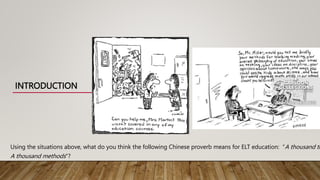
Using the situations above, what do you think the following Chinese proverb means for ELT education: “A thousand te
A thousand methods”?
INTRODUCTION
INTRODUCTION
I. CONCEPTS
What is a teaching methodology?
• Pedagogical practices in general (including theoretical underpinning and related
research). Whatever considerations are involved in how to teach are methodological
(Brown, 2000b).
• Within the general area of methodology, people talk about approaches, methods,
techniques, procedures and models, all of which go into the practice of English teaching
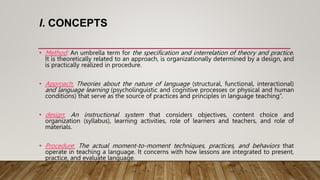
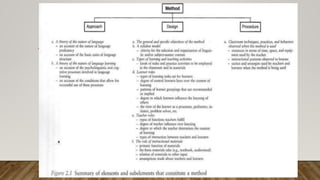
• Method: An umbrella term for the specification and interrelation of theory and practice.
It is theoretically related to an approach, is organizationally determined by a design, and
is practically realized in procedure.
• Approach: Theories about the nature of language (structural, functional, interactional)
and language learning (psycholinguistic and cognitive processes or physical and human
conditions) that serve as the source of practices and principles in language teaching”.
• design: An instructional system that considers objectives, content choice and
organization (syllabus), learning activities, role of learners and teachers, and role of
materials.
• Procedure: The actual moment-to-moment techniques, practices, and behaviors that
operate in teaching a language. It concerns with how lessons are integrated to present,
practice, and evaluate language.
I. CONCEPTS
II. OVERVIEW OF TEACHING METHODS IN ELT
II. OVERVIEW OF
TEACHING
METHODS IN ELT
II. OVERVIEW OF TEACHING METHODS IN ELT
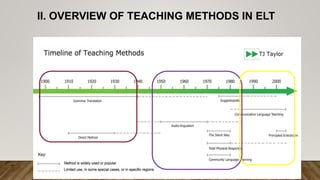
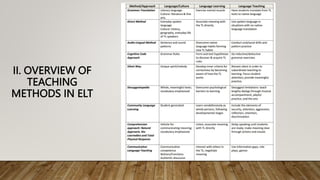
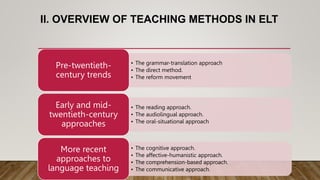
• The grammar-translation approach
• The direct method.
• The reform movement
Pre-twentieth-
century trends
• The reading approach.
• The audiolingual approach.
• The oral-situational approach
Early and mid-
twentieth-century
approaches
• The cognitive approach.
• The affective-humanistic approach.
• The comprehension-based approach.
• The communicative approach.
More recent
approaches to
language teaching
II. OVERVIEW OF TEACHING METHODS IN ELT
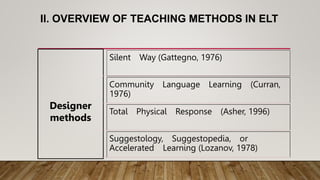
Designer
methods
Silent Way (Gattegno, 1976)
Community Language Learning (Curran,
1976)
Total Physical Response (Asher, 1996)
Suggestology, Suggestopedia, or
Accelerated Learning (Lozanov, 1978)
III. TEACHING METHODS TODAY IN ELT
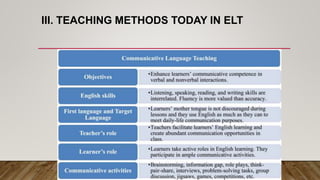
Communicative
language teaching (90’s
– 00’s)
Topic-based language teaching
Task-based language teaching
Project-based language teaching
Problem-based language teaching
Content and language
integrated learning
(00’s – 10’s)
Content
Cognition
Communication
Culture
IV. SELECTING A METHOD OR AN APPROACH
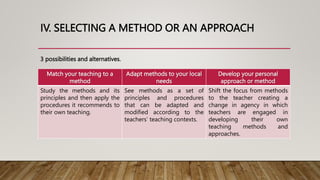
Match your teaching to a
method
Adapt methods to your local
needs
Develop your personal
approach or method
Study the methods and its
principles and then apply the
procedures it recommends to
their own teaching.
See methods as a set of
principles and procedures
that can be adapted and
modified according to the
teachers’ teaching contexts.
Shift the focus from methods
to the teacher creating a
change in agency in which
teachers are engaged in
developing their own
teaching methods and
approaches.
3 possibilities and alternatives.
IV. SELECTING A METHOD OR AN APPROACH
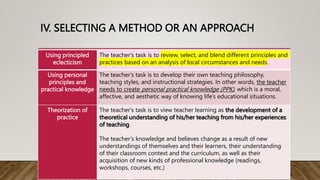
Using principled
eclecticism
The teacher's task is to review, select, and blend different principles and
practices based on an analysis of local circumstances and needs.
Using personal
principles and
practical knowledge
The teacher's task is to develop their own teaching philosophy,
teaching styles, and instructional strategies. In other words, the teacher
needs to create personal practical knowledge (PPK), which is a moral,
affective, and aesthetic way of knowing life’s educational situations.
Theorization of
practice
The teacher's task is to view teacher learning as the development of a
theoretical understanding of his/her teaching from his/her experiences
of teaching.
The teacher’s knowledge and believes change as a result of new
understandings of themselves and their learners, their understanding
of their classroom context and the curriculum, as well as their
acquisition of new kinds of professional knowledge (readings,
workshops, courses, etc.)
IV. SELECTING A METHOD OR AN APPROACH
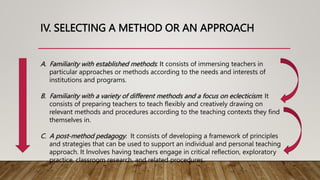
A. Familiarity with established methods: It consists of immersing teachers in
particular approaches or methods according to the needs and interests of
institutions and programs.
B. Familiarity with a variety of different methods and a focus on eclecticism: It
consists of preparing teachers to teach flexibly and creatively drawing on
relevant methods and procedures according to the teaching contexts they find
themselves in.
C. A post-method pedagogy: It consists of developing a framework of principles
and strategies that can be used to support an individual and personal teaching
approach. It Involves having teachers engage in critical reflection, exploratory
practice, classroom research, and related procedures.
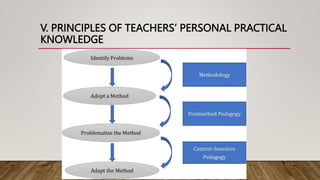
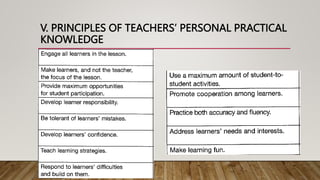
V. PRINCIPLES OF TEACHERS’ PERSONAL PRACTICAL
KNOWLEDGE
V. PRINCIPLES OF TEACHERS’ PERSONAL PRACTICAL
KNOWLEDGE
6. REFLECTION
Based on the contents from this presentation, answer the following
questions:
- Do you agree that methods might be more suitable for novice teachers?
In what other situations might you recommend use of methods?
- Post method perspectives on teaching consider that teachers should
develop personal practical knowledge (a set of procedures that guides
their teaching). To what extent do you agree with this statement?
7. REFERENCE
Celce-Murcia, M. (2014). An Overview of Language Teaching Methods and Approaches. In M.
Celce-Murcia, D. Brinton, & M. Snow (eds.), Teaching English as a second or foreign language
(pp. 2-14). Heinle & Heinle.
Richards, J., & Rodgers, T. (2017). Teachers, approaches, and methods. In J. Richards, and T.
Rodgers, Approaches and methods in language teaching (3rd edition). Cambridge University
Press.

EFL teachers Revisiting methods and approaches.pptx

  • 1.
    EFL TEACHERS: REVISITINGMETHODS AND APPROACHES IN ELT LA SALLE UNIVERSITY BA IN SPANISH AND FOREIGN LANGUAGES YAMITH JOSÉ FANDIÑO PARRA
  • 2.
    INTRODUCTION Using the situationsabove, what do you think the following Chinese proverb means for ELT education: “A thousand te A thousand methods”?
  • 3.
  • 4.
  • 5.
    I. CONCEPTS What isa teaching methodology? • Pedagogical practices in general (including theoretical underpinning and related research). Whatever considerations are involved in how to teach are methodological (Brown, 2000b). • Within the general area of methodology, people talk about approaches, methods, techniques, procedures and models, all of which go into the practice of English teaching
  • 6.
    • Method: Anumbrella term for the specification and interrelation of theory and practice. It is theoretically related to an approach, is organizationally determined by a design, and is practically realized in procedure. • Approach: Theories about the nature of language (structural, functional, interactional) and language learning (psycholinguistic and cognitive processes or physical and human conditions) that serve as the source of practices and principles in language teaching”. • design: An instructional system that considers objectives, content choice and organization (syllabus), learning activities, role of learners and teachers, and role of materials. • Procedure: The actual moment-to-moment techniques, practices, and behaviors that operate in teaching a language. It concerns with how lessons are integrated to present, practice, and evaluate language. I. CONCEPTS
  • 8.
    II. OVERVIEW OFTEACHING METHODS IN ELT
  • 9.
  • 10.
    II. OVERVIEW OFTEACHING METHODS IN ELT • The grammar-translation approach • The direct method. • The reform movement Pre-twentieth- century trends • The reading approach. • The audiolingual approach. • The oral-situational approach Early and mid- twentieth-century approaches • The cognitive approach. • The affective-humanistic approach. • The comprehension-based approach. • The communicative approach. More recent approaches to language teaching
  • 11.
    II. OVERVIEW OFTEACHING METHODS IN ELT Designer methods Silent Way (Gattegno, 1976) Community Language Learning (Curran, 1976) Total Physical Response (Asher, 1996) Suggestology, Suggestopedia, or Accelerated Learning (Lozanov, 1978)
  • 12.
  • 13.
    III. TEACHING METHODSTODAY IN ELT Communicative language teaching (90’s – 00’s) Topic-based language teaching Task-based language teaching Project-based language teaching Problem-based language teaching Content and language integrated learning (00’s – 10’s) Content Cognition Communication Culture
  • 14.
    IV. SELECTING AMETHOD OR AN APPROACH Match your teaching to a method Adapt methods to your local needs Develop your personal approach or method Study the methods and its principles and then apply the procedures it recommends to their own teaching. See methods as a set of principles and procedures that can be adapted and modified according to the teachers’ teaching contexts. Shift the focus from methods to the teacher creating a change in agency in which teachers are engaged in developing their own teaching methods and approaches. 3 possibilities and alternatives.
  • 15.
    IV. SELECTING AMETHOD OR AN APPROACH Using principled eclecticism The teacher's task is to review, select, and blend different principles and practices based on an analysis of local circumstances and needs. Using personal principles and practical knowledge The teacher's task is to develop their own teaching philosophy, teaching styles, and instructional strategies. In other words, the teacher needs to create personal practical knowledge (PPK), which is a moral, affective, and aesthetic way of knowing life’s educational situations. Theorization of practice The teacher's task is to view teacher learning as the development of a theoretical understanding of his/her teaching from his/her experiences of teaching. The teacher’s knowledge and believes change as a result of new understandings of themselves and their learners, their understanding of their classroom context and the curriculum, as well as their acquisition of new kinds of professional knowledge (readings, workshops, courses, etc.)
  • 16.
    IV. SELECTING AMETHOD OR AN APPROACH A. Familiarity with established methods: It consists of immersing teachers in particular approaches or methods according to the needs and interests of institutions and programs. B. Familiarity with a variety of different methods and a focus on eclecticism: It consists of preparing teachers to teach flexibly and creatively drawing on relevant methods and procedures according to the teaching contexts they find themselves in. C. A post-method pedagogy: It consists of developing a framework of principles and strategies that can be used to support an individual and personal teaching approach. It Involves having teachers engage in critical reflection, exploratory practice, classroom research, and related procedures.
  • 17.
    V. PRINCIPLES OFTEACHERS’ PERSONAL PRACTICAL KNOWLEDGE
  • 18.
    V. PRINCIPLES OFTEACHERS’ PERSONAL PRACTICAL KNOWLEDGE
  • 19.
    6. REFLECTION Based onthe contents from this presentation, answer the following questions: - Do you agree that methods might be more suitable for novice teachers? In what other situations might you recommend use of methods? - Post method perspectives on teaching consider that teachers should develop personal practical knowledge (a set of procedures that guides their teaching). To what extent do you agree with this statement?
  • 20.
    7. REFERENCE Celce-Murcia, M.(2014). An Overview of Language Teaching Methods and Approaches. In M. Celce-Murcia, D. Brinton, & M. Snow (eds.), Teaching English as a second or foreign language (pp. 2-14). Heinle & Heinle. Richards, J., & Rodgers, T. (2017). Teachers, approaches, and methods. In J. Richards, and T. Rodgers, Approaches and methods in language teaching (3rd edition). Cambridge University Press.