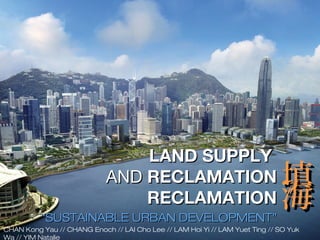
LAND SUPPLY
                             AND RECLAMATION                                  填
                                 RECLAMATION
          “SUSTAINABLE URBAN DEVELOPMENT”
                                                                              海
CHAN Kong Yau // CHANG Enoch // LAI Cho Lee // LAM Hoi Yi // LAM Yuet Ting // SO Yuk
Wa // YIM Natalie
INTRODUCTION
•   Reclamation is the creation of
    new land from lakes, rivers or
    the sea

•   Crucial to the socioeconomic
    development of Hong Kong

•   less than 25% of Hong Kong’s
    land is developed

•   6% of Hong Kong’s land is
    reclaimed
HISTORY
          Reclamation for agricultural purposes -
206-9 BCE
          beaches reclaimed for salt production
           British occupation of Hong Kong;
           private land owners reclaimed land
      1841 without planning or governmental
           authorization, leading to the irregular
           coastline
Bonham Reclamation Scheme - first
          official reclamation project adding land
     1851
          to Sheung Wan and the West island
          area


          文咸填海計劃


          Intensive reclamation from Kennedy
1860-1900
          Town to Causeway Bay
          Non-government authorized
          reclamation around the peninsula and
  1867-76
          Yau Tsim Mong area by private land
          owners
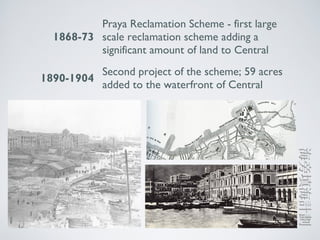
Praya Reclamation Scheme - first large
  1868-73 scale reclamation scheme adding a
          significant amount of land to Central
          Second project of the scheme; 59 acres
1890-1904
          added to the waterfront of Central


                                                   海旁填海計劃
1916 Reclamation for Kai Tak Airport
        Expansion of peninsula due to
   1917
        construction of East Rail Line
        Praya East Reclamation Scheme -
        expansion between Central and Wan
1921-31
        Chai. Allowed for cross-harbor pipeline
        for fresh water supply from NT
                            Wan Chai, 1920
    海旁東填海計劃
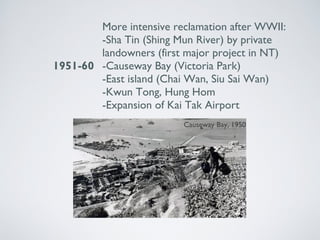
More intensive reclamation after WWII:
        -Sha Tin (Shing Mun River) by private
        landowners (first major project in NT)
1951-60 -Causeway Bay (Victoria Park)
        -East island (Chai Wan, Siu Sai Wan)
        -Kwun Tong, Hung Hom
        -Expansion of Kai Tak Airport
                         Causeway Bay, 1950
Tuen Mun and Castle Peak Bay
                1961-70 reclamation (New Town Development
                        Scheme)
                        Tsuen Wan, Kwai Chung, Sha Tin,
                        expansion of Kowloon peninsula,
                1971-80
                        Aberdeen, Ap Lei Chau, Cyberport -
                        mainly for residential development
Sha Tin, 1973         Sha Tin, late 1970s   Sha Tin, today
-Tai Po Industrial area
                   -East of Hong Kong island (Taikoo, Sai
           1981-90
                   Wan Ho, Shao Kei Wan, Heng Fa
                   Chuen)
                     Airport Core Programme (Port and
                     Airport Development Strategy) -
                     reclamation for the site of HKIA (Chek
          1989-98
                     Lap Kok) and improving transportation
                     infrastructure - North Lantau, Tung
Chek Lap Kok before and after reclamation. WestWest Kowloon, 1995
                     Chung, Central and         Kowloon
Central, Wan Chai, Kowloon peninsula,
          1991-2000 Kai Tak and expansion of outlaying
                    islands
                       Protection of Harbour Ordinance, Cap.
                  1997 531 was passed, setting many
                       constraints on harbor reclamation
                2003-9 Penny’s Bay Reclamation
                 2003- Central Phase III/Wan Chai Phase II
Penny’s Bay, 2010                Central, today
GENERAL TREND and remarks.
•   Around the coastlines on either side of the harbor

•   New Territories with the new town development with continual
    development around the harbor

•   Further urban development and the creation of urban
    infrastructure

•   Implementation of the PHO to limit development

•   General struggle with essential balance between socioeconomic
    development and sustainability and environmental sustainability

•   Reclamation is a result of land supply challenges
WHY RECLAIM LAND?
•   Land use challenges lead to the need of reclamation

•   Financial prosperity - helps facilitate economic
    development of Hong Kong as it allows urban development

•   Extra supply of land - 40% of the land are country parks and
    nature reserves

•   More land would mean cheaper land

•   Land is mountainous - hard to develop on
EFFECTS OF RECLAMATION
•   Marine pollution - endangering
    marine life

•   Increase in air pollution

•   Further increases the urban heat
    island effect and disrupts airflow into
    these area

•   Loss of cultural and historical
    heritage

    •   Beyond the narrowing of the
        harbour - i.e. destruction of the
        Queen’s Pier, which is historically
        significant
•   Harbour is getting smaller - less
    vessels are allowed through
    which can hinder relevant
    industries

•   Increase in job opportunities

•   Is a solution for waste
    management - major issue in
    Hong Kong

•   Increase space for visually
    appealing recreative facilities (i.e.
    greenery and promenade) to
    increase social and living
    standards

•   Helps develop the tourism
    industry
TOWN PLANNING ORDINANCE
               城市規劃條例
BACKGROUND of Hong
• Town Planning Ordinance (TPO), Cap. 131, is a part
    Kong law that has been amended throughout the years

•   Designation of land use by regulating land use

•   Meeting the specific development criteria for different land use
    whilst preserving natural environment

•   Some sites only allow agricultural or conservation related
    activity

•   Preserving the natural character of Hong Kong’s landscape and
    natural habitats

•   Accommodating the scientific interest in these areas
COUNTRY PARKS ORDINANCE
              郊野公園條例
           WILD ANIMALS
  PROTECTION ORDINANCE
            保護野生動物條例
BACKGROUND
•   Country Parks Ordinance (CPO), Cap. 208, is a part of Hong
    Kong law

•   Enacted in 1976

•   Aims to preserve natural environment - promotes
    environmental sustainability

•   Platform for educational purposes

•   Addresses recreational needs of the community -
    increases social sustainability
BACKGROUND
•   Wild Animals Protection Ordinance (WAPO), Cap. 170, is a part
    of Hong Kong law that has been amended throughout the years

•   Reduce the loss of natural habitats due to urbanization

•   Decrease in biodiversity

•   Protect wild animals and their habitats

•   Set up restricted areas to isolate from any disturbance
POLICY GAPS
•   Conserving these areas does not eliminate disturbance

    •   People are attracted to natural environments

    •   Visitors may not be educated about wildlife protection

    •   May disrupt the natural environment through feeding animals
        and littering
POLICY GAPS

•   Lack of administration in restricted areas - policy is
    counterproductive

    •   Such as Tai Long Sai Wan

    •   Large area of flat land near Tai Long Sai Wan demolished in
        construction

    •   Dilemma - improved administration may disrupt natural
        environment; original purpose is not maintained
Recommendations

•   Foster closer communication and planning between
    governmental departments for future development projects

    •   Prevent human interference (i.e. noise pollution or
        construction) in nearby areas that are restricted

•   Strategize better conservation techniques to improve
    administration without disrupting the environment

•   Increase in public education about environmental protection
PROTECTION OF HARBOUR ORDINANCE
                      保護海港條例
BACKGROUND
•   Protection of Harbour Ordinance (PHO), Cap. 531 is a part
    of Hong Kong law

•   Proposed in 1996 by The Society for Protection of Harbour
    (SPH)

•   Officially approved in 1997 by the Legislative Council

•   Aims to limit reclamation activity outside the Victoria
    harbour

•   Protection and preservation of the heritage for the public
CONSTRAINTS

•   Supervises and affects all reclamation projects proposed
    after 1997

•   Not applicable to projects already approved or commenced
    (i.e. first two phases of Central-Wanchai reclamation
    unaffected as they were approved in the 1980s)

•   Major hindrance to all development - causing delays and
    increasing costs to relevant projects
Central-wan chai Reclamation
•   Feasibility report completed in 1989; construction
    commenced in 1993

•   Former Land Development Policy Committee agreed to
    divide the project into five separate phases:

    •   Central I-III

    •   Wan Chai I-II

•   So far, projects have provided improved transport
    infrastructure for the HKIA, Tamar naval base and HKCEC
•   Improve transportation infrastructure to alleviate
    congestion during busy hours

•   Central-Wan Chai Bypass, connecting to Eastern Corridor
    Link

•   Aims to provide extra land for the MTR Railway

    •   Shatin-Central Link

    •   North Island Line

•   Promenade to be constructed above - increase social
    standards and creates a more pleasant environment

•   Targeted completion date: 2017
•   The Society for Protection of Harbour raised a judicial
    review to oppose Wan Chai II

•   Final Appeal announced that the SPH won and the
    government had to stop the project

•   Project is now currently under review
KAITAK RECLAMATION

•   Hong Kong’s official airport until 1998

•   Covers 328 hectares

•   Has since been temporarily used for fill banks, bus depots, car
    parks, car sales exhibitions and recreational grounds

•   Many plans and proposals for what to do with Kai Tak since
    1998 (Outline Zoning Plan)
•   Repeatedly refused and reconsidered due to:

    •   Town Planning Ordinance

    •   Protection of Harbour Ordinance

    •   Pending the completion of the study of South East Kowloon
        Development

    •   Objections from the public and other parties during exhibition
        periods of these plans

•   Though initially approved Chief Executive in Council in 2002, plans
    were refused after public inspection
•   1998 - Outline Zoning Plan proposed
    reclamation of 299 hectares

•   2001 - Proposed reclamation reduced to
    133 hectares

•   2004 - PHO restricted ANY further
    reclamation

    •   Development strategies used zero
        reclamation as a starting point

•   Kai Tak Planning Review in 2004 due to
    the change of criteria by the PHO;
    finalized scheme after extensive planning
    and public participation - approved in
    2007
•   The plan for the project
    considered...
    Urban design, landscape and cultural
    heritage
    Traffic and transport review
    Infrastructure and utilities
    Marine uses
    Infrastructural capacity and
    development threshold
    Development requirements

•   Final plan will consist of a cruise
    terminal, parks, housing, a hospital,
    a stadium, district cooling systems
    and space for MTR development
POLICY GAPS.
•   PHO aims to promote social and environmental sustainability
    by restricting reclamation in the harbour but is hindering the
    progression of many projects

    •   Causes many delays → increase of costs

•   Governmental departments are still proposing projects with
    reclamation as a way to address land supply issues

•   Different departments within the government are not in
    alignment of each other, causing inconsistencies, conflict and
    waste of time
Recommendations.

•   Must compromise between the government’s notions to
    develop Hong Kong and the environmentalists/people who
    wish to preserve cultural heritage

•   Redevelop older areas in Kowloon (i.e. former government
    buildings, Kai Tak, etc.)

•   Strategically develop land reserves - there are about 386
    hectares of land in NT and about 360 in other areas of
    Hong Kong
•   Town Planning Board should have comprehensive consultation with all
    relevant parties before commencing such projects

    •   Comprehensive planning has been shown to be effective especially in
        ensuring sustainability (i.e. Kai Tak) by addressing various social,
        economic and environmental challenges Hong Kong is put in

•   WWF states that damage done by reclamation is irreversible - should
    be only considered as a last resort

•   The Environmental Protection Department can improve the criteria
    used in the Environmental Impact Assessment Report which should be
    same as the international standard.

•   Standardized development strategy and criteria (for example, zero-
    reclamation as a starting point?) written with comprehensive
    consultation with different departments and the public for future
    projects can save time in planning, consultation and reduce conflicts.
FUTURE OF LAND SUPPLY ISSUES
 •   CE announced in latest Policy Address (2011-12) to innovate to
     expend land resources and to build up a land reserve

 •   $300 million allocated for conducting studies relevant to
     reclamation and rock cavern development

 •   Civil Engineering and Development Department has conducted an
     extensive feasibility report on land supply options as part of the
     Enhancing Land Supply Strategy

     •   Prepared for public engagement

     •   Flexibility in land supply strategies
Reclamation Outside of Victoria
           Harbour
•   Considering reclamation outside
    of the harbour

•   ‘Public digest’ - parts of the
    study based on public
    feedback/involvements

•   Key challenge: Mitigation of the
    impact on marine ecosystem
•   64% of Hong Kong is well-suited for rock cavern

•
    development
    Challenges include ecosystems, and people not
                                                            CAVERNS
    willing to live their daily lives in caverns
•   For facilities such as parking, storage, water/sewage
    treatment, etc. such that there is more space on land
•   Must consider the three
    aspects of sustainability,
    feasibility and impacts on the
    community
•   Example: HKU’s
    Centennial Campus caused
    the relocation of the
    Western Salt Water
    Service Reservoirs
thank you.

Reclamation presentation 2

  • 1.
    LAND SUPPLY AND RECLAMATION 填 RECLAMATION “SUSTAINABLE URBAN DEVELOPMENT” 海 CHAN Kong Yau // CHANG Enoch // LAI Cho Lee // LAM Hoi Yi // LAM Yuet Ting // SO Yuk Wa // YIM Natalie
  • 2.
    INTRODUCTION • Reclamation is the creation of new land from lakes, rivers or the sea • Crucial to the socioeconomic development of Hong Kong • less than 25% of Hong Kong’s land is developed • 6% of Hong Kong’s land is reclaimed
  • 3.
    HISTORY Reclamation for agricultural purposes - 206-9 BCE beaches reclaimed for salt production British occupation of Hong Kong; private land owners reclaimed land 1841 without planning or governmental authorization, leading to the irregular coastline
  • 4.
    Bonham Reclamation Scheme- first official reclamation project adding land 1851 to Sheung Wan and the West island area 文咸填海計劃 Intensive reclamation from Kennedy 1860-1900 Town to Causeway Bay Non-government authorized reclamation around the peninsula and 1867-76 Yau Tsim Mong area by private land owners
  • 5.
    Praya Reclamation Scheme- first large 1868-73 scale reclamation scheme adding a significant amount of land to Central Second project of the scheme; 59 acres 1890-1904 added to the waterfront of Central 海旁填海計劃
  • 6.
    1916 Reclamation forKai Tak Airport Expansion of peninsula due to 1917 construction of East Rail Line Praya East Reclamation Scheme - expansion between Central and Wan 1921-31 Chai. Allowed for cross-harbor pipeline for fresh water supply from NT Wan Chai, 1920 海旁東填海計劃
  • 7.
    More intensive reclamationafter WWII: -Sha Tin (Shing Mun River) by private landowners (first major project in NT) 1951-60 -Causeway Bay (Victoria Park) -East island (Chai Wan, Siu Sai Wan) -Kwun Tong, Hung Hom -Expansion of Kai Tak Airport Causeway Bay, 1950
  • 8.
    Tuen Mun andCastle Peak Bay 1961-70 reclamation (New Town Development Scheme) Tsuen Wan, Kwai Chung, Sha Tin, expansion of Kowloon peninsula, 1971-80 Aberdeen, Ap Lei Chau, Cyberport - mainly for residential development Sha Tin, 1973 Sha Tin, late 1970s Sha Tin, today
  • 9.
    -Tai Po Industrialarea -East of Hong Kong island (Taikoo, Sai 1981-90 Wan Ho, Shao Kei Wan, Heng Fa Chuen) Airport Core Programme (Port and Airport Development Strategy) - reclamation for the site of HKIA (Chek 1989-98 Lap Kok) and improving transportation infrastructure - North Lantau, Tung Chek Lap Kok before and after reclamation. WestWest Kowloon, 1995 Chung, Central and Kowloon
  • 10.
    Central, Wan Chai,Kowloon peninsula, 1991-2000 Kai Tak and expansion of outlaying islands Protection of Harbour Ordinance, Cap. 1997 531 was passed, setting many constraints on harbor reclamation 2003-9 Penny’s Bay Reclamation 2003- Central Phase III/Wan Chai Phase II Penny’s Bay, 2010 Central, today
  • 11.
    GENERAL TREND andremarks. • Around the coastlines on either side of the harbor • New Territories with the new town development with continual development around the harbor • Further urban development and the creation of urban infrastructure • Implementation of the PHO to limit development • General struggle with essential balance between socioeconomic development and sustainability and environmental sustainability • Reclamation is a result of land supply challenges
  • 13.
    WHY RECLAIM LAND? • Land use challenges lead to the need of reclamation • Financial prosperity - helps facilitate economic development of Hong Kong as it allows urban development • Extra supply of land - 40% of the land are country parks and nature reserves • More land would mean cheaper land • Land is mountainous - hard to develop on
  • 14.
    EFFECTS OF RECLAMATION • Marine pollution - endangering marine life • Increase in air pollution • Further increases the urban heat island effect and disrupts airflow into these area • Loss of cultural and historical heritage • Beyond the narrowing of the harbour - i.e. destruction of the Queen’s Pier, which is historically significant
  • 15.
    Harbour is getting smaller - less vessels are allowed through which can hinder relevant industries • Increase in job opportunities • Is a solution for waste management - major issue in Hong Kong • Increase space for visually appealing recreative facilities (i.e. greenery and promenade) to increase social and living standards • Helps develop the tourism industry
  • 16.
    TOWN PLANNING ORDINANCE 城市規劃條例
  • 17.
    BACKGROUND of Hong •Town Planning Ordinance (TPO), Cap. 131, is a part Kong law that has been amended throughout the years • Designation of land use by regulating land use • Meeting the specific development criteria for different land use whilst preserving natural environment • Some sites only allow agricultural or conservation related activity • Preserving the natural character of Hong Kong’s landscape and natural habitats • Accommodating the scientific interest in these areas
  • 18.
    COUNTRY PARKS ORDINANCE 郊野公園條例 WILD ANIMALS PROTECTION ORDINANCE 保護野生動物條例
  • 19.
    BACKGROUND • Country Parks Ordinance (CPO), Cap. 208, is a part of Hong Kong law • Enacted in 1976 • Aims to preserve natural environment - promotes environmental sustainability • Platform for educational purposes • Addresses recreational needs of the community - increases social sustainability
  • 20.
    BACKGROUND • Wild Animals Protection Ordinance (WAPO), Cap. 170, is a part of Hong Kong law that has been amended throughout the years • Reduce the loss of natural habitats due to urbanization • Decrease in biodiversity • Protect wild animals and their habitats • Set up restricted areas to isolate from any disturbance
  • 21.
    POLICY GAPS • Conserving these areas does not eliminate disturbance • People are attracted to natural environments • Visitors may not be educated about wildlife protection • May disrupt the natural environment through feeding animals and littering
  • 22.
    POLICY GAPS • Lack of administration in restricted areas - policy is counterproductive • Such as Tai Long Sai Wan • Large area of flat land near Tai Long Sai Wan demolished in construction • Dilemma - improved administration may disrupt natural environment; original purpose is not maintained
  • 23.
    Recommendations • Foster closer communication and planning between governmental departments for future development projects • Prevent human interference (i.e. noise pollution or construction) in nearby areas that are restricted • Strategize better conservation techniques to improve administration without disrupting the environment • Increase in public education about environmental protection
  • 24.
    PROTECTION OF HARBOURORDINANCE 保護海港條例
  • 25.
    BACKGROUND • Protection of Harbour Ordinance (PHO), Cap. 531 is a part of Hong Kong law • Proposed in 1996 by The Society for Protection of Harbour (SPH) • Officially approved in 1997 by the Legislative Council • Aims to limit reclamation activity outside the Victoria harbour • Protection and preservation of the heritage for the public
  • 26.
    CONSTRAINTS • Supervises and affects all reclamation projects proposed after 1997 • Not applicable to projects already approved or commenced (i.e. first two phases of Central-Wanchai reclamation unaffected as they were approved in the 1980s) • Major hindrance to all development - causing delays and increasing costs to relevant projects
  • 27.
    Central-wan chai Reclamation • Feasibility report completed in 1989; construction commenced in 1993 • Former Land Development Policy Committee agreed to divide the project into five separate phases: • Central I-III • Wan Chai I-II • So far, projects have provided improved transport infrastructure for the HKIA, Tamar naval base and HKCEC
  • 29.
    Improve transportation infrastructure to alleviate congestion during busy hours • Central-Wan Chai Bypass, connecting to Eastern Corridor Link • Aims to provide extra land for the MTR Railway • Shatin-Central Link • North Island Line • Promenade to be constructed above - increase social standards and creates a more pleasant environment • Targeted completion date: 2017
  • 31.
    The Society for Protection of Harbour raised a judicial review to oppose Wan Chai II • Final Appeal announced that the SPH won and the government had to stop the project • Project is now currently under review
  • 32.
    KAITAK RECLAMATION • Hong Kong’s official airport until 1998 • Covers 328 hectares • Has since been temporarily used for fill banks, bus depots, car parks, car sales exhibitions and recreational grounds • Many plans and proposals for what to do with Kai Tak since 1998 (Outline Zoning Plan)
  • 34.
    Repeatedly refused and reconsidered due to: • Town Planning Ordinance • Protection of Harbour Ordinance • Pending the completion of the study of South East Kowloon Development • Objections from the public and other parties during exhibition periods of these plans • Though initially approved Chief Executive in Council in 2002, plans were refused after public inspection
  • 36.
    1998 - Outline Zoning Plan proposed reclamation of 299 hectares • 2001 - Proposed reclamation reduced to 133 hectares • 2004 - PHO restricted ANY further reclamation • Development strategies used zero reclamation as a starting point • Kai Tak Planning Review in 2004 due to the change of criteria by the PHO; finalized scheme after extensive planning and public participation - approved in 2007
  • 37.
    The plan for the project considered... Urban design, landscape and cultural heritage Traffic and transport review Infrastructure and utilities Marine uses Infrastructural capacity and development threshold Development requirements • Final plan will consist of a cruise terminal, parks, housing, a hospital, a stadium, district cooling systems and space for MTR development
  • 38.
    POLICY GAPS. • PHO aims to promote social and environmental sustainability by restricting reclamation in the harbour but is hindering the progression of many projects • Causes many delays → increase of costs • Governmental departments are still proposing projects with reclamation as a way to address land supply issues • Different departments within the government are not in alignment of each other, causing inconsistencies, conflict and waste of time
  • 39.
    Recommendations. • Must compromise between the government’s notions to develop Hong Kong and the environmentalists/people who wish to preserve cultural heritage • Redevelop older areas in Kowloon (i.e. former government buildings, Kai Tak, etc.) • Strategically develop land reserves - there are about 386 hectares of land in NT and about 360 in other areas of Hong Kong
  • 40.
    Town Planning Board should have comprehensive consultation with all relevant parties before commencing such projects • Comprehensive planning has been shown to be effective especially in ensuring sustainability (i.e. Kai Tak) by addressing various social, economic and environmental challenges Hong Kong is put in • WWF states that damage done by reclamation is irreversible - should be only considered as a last resort • The Environmental Protection Department can improve the criteria used in the Environmental Impact Assessment Report which should be same as the international standard. • Standardized development strategy and criteria (for example, zero- reclamation as a starting point?) written with comprehensive consultation with different departments and the public for future projects can save time in planning, consultation and reduce conflicts.
  • 41.
    FUTURE OF LANDSUPPLY ISSUES • CE announced in latest Policy Address (2011-12) to innovate to expend land resources and to build up a land reserve • $300 million allocated for conducting studies relevant to reclamation and rock cavern development • Civil Engineering and Development Department has conducted an extensive feasibility report on land supply options as part of the Enhancing Land Supply Strategy • Prepared for public engagement • Flexibility in land supply strategies
  • 42.
    Reclamation Outside ofVictoria Harbour • Considering reclamation outside of the harbour • ‘Public digest’ - parts of the study based on public feedback/involvements • Key challenge: Mitigation of the impact on marine ecosystem
  • 43.
    64% of Hong Kong is well-suited for rock cavern • development Challenges include ecosystems, and people not CAVERNS willing to live their daily lives in caverns • For facilities such as parking, storage, water/sewage treatment, etc. such that there is more space on land • Must consider the three aspects of sustainability, feasibility and impacts on the community • Example: HKU’s Centennial Campus caused the relocation of the Western Salt Water Service Reservoirs
  • 44.