Angus Proctor
Independent Environmental Consultant
Practicing
Environmental
Consultancy since           provided services to private clients such as: China Light &
                             Power; KCRC ; several developers from small to large; and
1995                         government departments including: Territorial
1995-2003 Hong Kong          Dev’ment; Planning; Water Services; Drainage Services;
                             Agriculture, Fisheries & Conservation; Transport;
                             Education; Housing.
2003-’06 United Kingdom,    included two long-term secondments to private water
Algeria and Italy.           companies - Wessex Water and Anglian Water. Other
                             projects included: a national survey of Commercial and
                             Industrial Waste for the Environment Agency; rapid
                             environmental assessment of a combined
                             desalination/power plant in Algeria (World Bank
                             project); and peer review of a regeneration project for the
                             Parco del Po, Italy.
2006-’10 New Zealand        as a consultant to local authorities on waste management
                             projects and to a private offshore Oil/Gas drilling
                             company before moving to the public sector to manage a
                             team of civil engineers for Metrowater (Auckland City
                             Council’s water and wastewater service) providing peer
                             review to the City Council, including stormwater
                             management.
Hong Kong –
changes of land use
Lessons learned –                    Sewer rehabilitation HK island – expedient
Stakeholders need to assess and       connections; loss of gradient resulting from
quantify both:                        reclamation; failure to upgrade to meet
•the impact of new development
                                      demand
on the environment; and,             Tin Shui Wai (new town 300k people)
•the impact of the environment on     development on historic tidal fishponds
the new development                  Village Flood Protection Scheme – rapid ad
This requires reliable historic       hoc land-use changes causing new flooding
records/data or baseline              problems
monitoring                           Yuen Long Bypass Floodway upper catchment
                                      development causing flooding in YL new town
Inter-departmental                    required additional manmade flood channels
communication - vital but not        Drainage Master Plans (DMPs) an assessment
normal                                of all HK and NT catchments to model flood
                                      risk and best mitigation
                                     Wetland Compensation Study all aspects of
                                      wetlands from natural origins, varieties,
                                      benefits, destruction, BMP mitigation
Tin Shui Wai – turning a problem
into an amenity
                  Reclamation of an extensive
                    area of fishponds on the edge
                    of HK’s only Ramsar
                    ‘Wetland of International
                    Importance’ resulted in a
                    loss of habitat and the
                    encroachment of the
                    disturbance of a large city to
                    the edge of the protected
                    area. Additionally, upper
                    catchment effluent would be
                    incremented by city
                    pollutant run-off.
Tin Shui Wai
               HK’s Millennium Project –
                the Wetland Park
               Enhanced remaining wetland
               Tourist attraction – a reason
                to visit TSW
               Educational destination
               Buffer between the new town
                and the protected area
               Treats run-off before it
                enters the protected area
               An amenity that senior
                politicians queued up to
                officially open
Yuen Long
Yuen Long new town
 (towards the lower end of
 a catchment with a steep
 origin) required extensive
 drainage to develop.
Aesthetics weren’t high on
 the design agenda
Zero ecological or amenity
 value
Reflect long-wave heat
 radiation
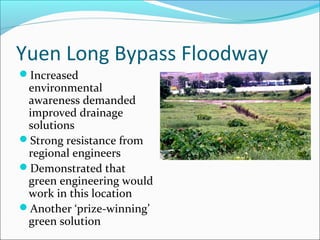
Yuen Long Bypass Floodway
Increased
 environmental
 awareness demanded
 improved drainage
 solutions
Strong resistance from
 regional engineers
Demonstrated that
 green engineering would
 work in this location
Another ‘prize-winning’
 green solution
Drainage Master Plans
Every river and stream
 catchment across the
 HK-SAR risk assessed,
 modelled and
 environmentally scoped.
Wetland Compensation
Bolting the stable door,
 after the horse has run?
NENT Landfill
Latest in lining and
 effluent treatment (1990s)
Photo shows heavy
 pollution about 50m
 downstream of the landfill
 boundary
Keep a safe political
 distance from new
 technology promising to
 solve all problems
The onus must be on the
 proponent to be
 transparent and
 responsive to problems
United Kingdom –
sea level rise
Government choosing which land
it will pay to defend and which will
be left to nature, sea level rise and
increased storminess

Shingle sea defences breached
during a storm (right)

Cost-benefit analysis (cost of
long-term maintenance and
upgrading vs economic benefit of
the defended land)
Social cost – peoples’ homes,
livelihoods, ancestry
Italy – Po River Delta
Flood prone area
1950s flooding caused exodus of inhabitants despite
 rich alluvial soils and ancient history. Area now
 impoverished
NO development allowed within river levees
New development must have sufficient freeboard
 built in. Houses built on mounds 3m high.
New Zealand – development
charges
 Developers pay charges in advance to council based on the size of
  the development:
 Water Supply and Wastewater based on the proposed use (in the
  case of a commercial/industrial development) and/or
  population/’fulltime earners’.
 Stormwater based on the impermeable area of the development (a
  combination of roof area plus any hardstanding/concreted surfaces)

 A credit may be allowed:
     If in the case of redevelopment, existing infrastructure has been
      installed.
     Where a developer designs in and implements water saving devices or
      stormwater detention or re-use
 I designed and implemented a programme for retrospective cost
  recovery which materialised NZ$500,000 in a year of missed revenue
Remarks
There is rarely a ‘single silver bullet’ to solve environmental
 issues – be wary of such claims: “anything that sounds too
 good to be true, usually is”!
Problems such as flooding require a holistic whole-of-
 catchment approach e.g. Drainage Master Plans (HK) or
 Integrated Catchment Management Plans (NZ)
Developers must contribute to the cost of the
 infrastructure required to support development.
 Developers should bear the cost of impact assessments,
 but should be kept at arms length from the reporting.
Developers should be given credit against pre-emptive
 charges when implementing energy or water saving or
 stormwater detention devices
Services
Experience-based, independent peer review of EIAs,
 with particular focus on:
  EM&A – environmental monitoring and auditing
    effectiveness during construction and operation
Developer charges processes and recovery
Quick turn-around independent review and advice of
 HSE issues arising from developments

Lgu services amp

  • 1.
  • 2.
    Practicing Environmental Consultancy since  provided services to private clients such as: China Light & Power; KCRC ; several developers from small to large; and 1995 government departments including: Territorial 1995-2003 Hong Kong Dev’ment; Planning; Water Services; Drainage Services; Agriculture, Fisheries & Conservation; Transport; Education; Housing. 2003-’06 United Kingdom,  included two long-term secondments to private water Algeria and Italy. companies - Wessex Water and Anglian Water. Other projects included: a national survey of Commercial and Industrial Waste for the Environment Agency; rapid environmental assessment of a combined desalination/power plant in Algeria (World Bank project); and peer review of a regeneration project for the Parco del Po, Italy. 2006-’10 New Zealand  as a consultant to local authorities on waste management projects and to a private offshore Oil/Gas drilling company before moving to the public sector to manage a team of civil engineers for Metrowater (Auckland City Council’s water and wastewater service) providing peer review to the City Council, including stormwater management.
  • 3.
    Hong Kong – changesof land use Lessons learned –  Sewer rehabilitation HK island – expedient Stakeholders need to assess and connections; loss of gradient resulting from quantify both: reclamation; failure to upgrade to meet •the impact of new development demand on the environment; and,  Tin Shui Wai (new town 300k people) •the impact of the environment on development on historic tidal fishponds the new development  Village Flood Protection Scheme – rapid ad This requires reliable historic hoc land-use changes causing new flooding records/data or baseline problems monitoring  Yuen Long Bypass Floodway upper catchment development causing flooding in YL new town Inter-departmental required additional manmade flood channels communication - vital but not  Drainage Master Plans (DMPs) an assessment normal of all HK and NT catchments to model flood risk and best mitigation  Wetland Compensation Study all aspects of wetlands from natural origins, varieties, benefits, destruction, BMP mitigation
  • 4.
    Tin Shui Wai– turning a problem into an amenity Reclamation of an extensive area of fishponds on the edge of HK’s only Ramsar ‘Wetland of International Importance’ resulted in a loss of habitat and the encroachment of the disturbance of a large city to the edge of the protected area. Additionally, upper catchment effluent would be incremented by city pollutant run-off.
  • 5.
    Tin Shui Wai HK’s Millennium Project – the Wetland Park Enhanced remaining wetland Tourist attraction – a reason to visit TSW Educational destination Buffer between the new town and the protected area Treats run-off before it enters the protected area An amenity that senior politicians queued up to officially open
  • 6.
    Yuen Long Yuen Longnew town (towards the lower end of a catchment with a steep origin) required extensive drainage to develop. Aesthetics weren’t high on the design agenda Zero ecological or amenity value Reflect long-wave heat radiation
  • 7.
    Yuen Long BypassFloodway Increased environmental awareness demanded improved drainage solutions Strong resistance from regional engineers Demonstrated that green engineering would work in this location Another ‘prize-winning’ green solution
  • 8.
    Drainage Master Plans Everyriver and stream catchment across the HK-SAR risk assessed, modelled and environmentally scoped.
  • 9.
    Wetland Compensation Bolting thestable door, after the horse has run?
  • 10.
    NENT Landfill Latest inlining and effluent treatment (1990s) Photo shows heavy pollution about 50m downstream of the landfill boundary Keep a safe political distance from new technology promising to solve all problems The onus must be on the proponent to be transparent and responsive to problems
  • 11.
    United Kingdom – sealevel rise Government choosing which land it will pay to defend and which will be left to nature, sea level rise and increased storminess Shingle sea defences breached during a storm (right) Cost-benefit analysis (cost of long-term maintenance and upgrading vs economic benefit of the defended land) Social cost – peoples’ homes, livelihoods, ancestry
  • 12.
    Italy – PoRiver Delta Flood prone area 1950s flooding caused exodus of inhabitants despite rich alluvial soils and ancient history. Area now impoverished NO development allowed within river levees New development must have sufficient freeboard built in. Houses built on mounds 3m high.
  • 13.
    New Zealand –development charges  Developers pay charges in advance to council based on the size of the development:  Water Supply and Wastewater based on the proposed use (in the case of a commercial/industrial development) and/or population/’fulltime earners’.  Stormwater based on the impermeable area of the development (a combination of roof area plus any hardstanding/concreted surfaces)  A credit may be allowed:  If in the case of redevelopment, existing infrastructure has been installed.  Where a developer designs in and implements water saving devices or stormwater detention or re-use  I designed and implemented a programme for retrospective cost recovery which materialised NZ$500,000 in a year of missed revenue
  • 14.
    Remarks There is rarelya ‘single silver bullet’ to solve environmental issues – be wary of such claims: “anything that sounds too good to be true, usually is”! Problems such as flooding require a holistic whole-of- catchment approach e.g. Drainage Master Plans (HK) or Integrated Catchment Management Plans (NZ) Developers must contribute to the cost of the infrastructure required to support development. Developers should bear the cost of impact assessments, but should be kept at arms length from the reporting. Developers should be given credit against pre-emptive charges when implementing energy or water saving or stormwater detention devices
  • 15.
    Services Experience-based, independent peerreview of EIAs, with particular focus on: EM&A – environmental monitoring and auditing effectiveness during construction and operation Developer charges processes and recovery Quick turn-around independent review and advice of HSE issues arising from developments