Spatial planning and urban resilience in the 
context of flood risk 
A comparative study of Kaohsiung, Tainan and Rotterdam 
Pei-Wen Lu 
Delft University of Technology, Faculty of Architecture and The Built Environment , Department of Urbanism
has been 
increasingly 
affective to 
urban 
development 
The 
uncertainty 
of 
Setting of 
the study
The notion of 
resilience is 
important. It is 
often used in a mix 
of mitigation and 
adaptation 
Setting of 
the study
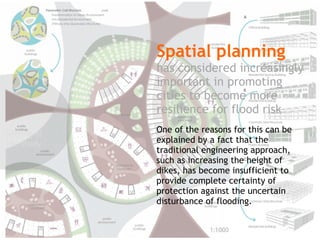
Spatial planning 
has considered increasingly 
important in promoting 
cities to become more 
resilience for flood risk 
One of the reasons for this can be 
explained by a fact that the 
traditional engineering approach, 
such as increasing the height of 
dikes, has become insufficient to 
provide complete certainty of 
protection against the uncertain 
disturbance of flooding. 
Setting of 
the study
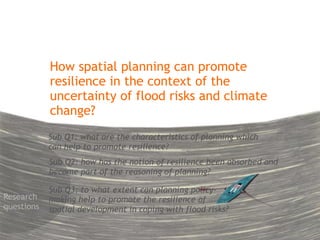
How spatial planning can promote 
resilience in the context of the 
uncertainty of flood risks and climate 
change? 
Sub Q1: what are the characteristics of planning which 
can help to promote resilience? 
Sub Q2: how has the notion of resilience been absorbed and 
become part of the reasoning of planning? 
Sub Q3: to what extent can planning policy-making 
help to promote the resilience of 
spatial development in coping with flood risks? 
Research 
questions
European or International? 
[Spatial planning]: 
In Europe, scholars have 
had a broader 
understanding of planning 
that involves a conformity 
between policies and 
physical developments as 
well as the process that 
stakeholders address 
together and initiate a 
certain decision for 
spatial development (e.g., 
Healey, 1997, 2006, 2007, 
Albrechts et al., 2003, 
Albrechts, 2004, 2010, 
Mastop and Faludi, 1997, 
Faludi, 2000, Nadin, 2007, 
2010, Nadin and Stead, 
2008, Allmendinger and 
Haughton, 2010). Studies 
of spatial planning often 
focus on the importance 
of the process of decision-making 
that leads to a 
consequence of physical 
development. 
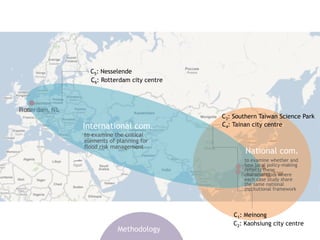
Cross-continental research: 
Methodology
National com. 
International com. 
C3: Southern Taiwan Science Park 
C4: Tainan city centre 
C1: Meinong 
C2: Kaohsiung city centre 
C5: Nesselende 
C6: Rotterdam city centre 
to examine whether and 
how local policy-making 
reflects these 
characteristics where 
each case study share 
the same national 
institutional framework 
to examine the critical 
elements of planning for 
flood risk management 
Methodology
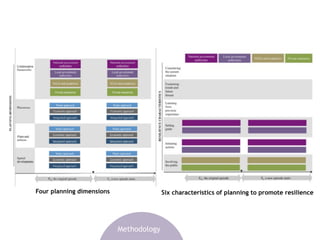
Four planning dimensions Six characteristics of planning to promote resilience 
Methodology
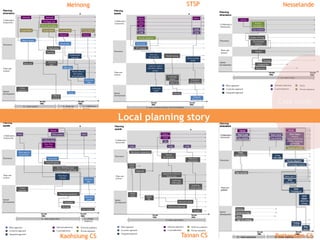
Meinong STSP Nesselande 
Collaborative 
frameworks 
WRAs 
Flexible zoning 
Local Water approach 
planning National authorities 
story 
NGOs & academics 
Economic approach Local authorities 
Private enterprise 
Integrated approach 
Planning 
aspects 
Discourses 
Spatial 
developments 
Housing 
Flood risks 
Land use control 
(elevation, ditches, 
ponds) 
WRB 
ICT industry 
Landscape 
ponds 
Restricted 
development 
CEPD 
NSC 
UDB 
Cambridge 
project 
WRAs 
WRB 
UDB 
Solar city 
the end 
1990s 
the end 
2000s 
Private enterprises 
Zengwen 
River levee 
New town 
development 
Flood-resistant 
buffer 
Plans and 
policies 
E: water resistance and new town development 
Planning 
dimensions 
Discourses 
Water scarcity 
Collaborative 
frameworks 
Spatial 
developments 
Flood risks 
WRASB 
Sand mining 
WRASB 
Reservoir 
Dike plan 
Local NGOs 
Retention 
plan 
Levees 
WRA07 
Master Plan of 
the Culture 
Town Meinong ! 
Villas & 
housing 
Water approach 
Economic approach Local authorities 
NGOs & academics 
National authorities 
Integrated approach 
Private enterprise 
Local NGOs Local NGOs 
Tourism 
Artificial 
lakes 
WRA07 
Urban 
expansion 
Tai-Sugar cop. 
Private developers 
Local NGOs 
Groundwater 
reservoir 
Plans and 
policies 
the end 
1990s 
E1: water scarcity E3: collaborative 
planning 
E2: flood risk 
management 
the end 
2000s 
WRAP 
PWB &HEB 
E1: urban regeneration 
Planning 
aspects 
Collaborative 
frameworks 
Discourses 
Spatial 
developments 
Housing 
Flood risks 
Kao. Multifunctional 
Commerce and Trade Park 
UDB & EDB 
Kao. Port 
Authority 
Retention 
plan 
Retention 
ponds 
Gov. projects 
PWB 
Water quality 
& pollution 
Water approach 
Economic approach Local authorities 
NGOs & academics 
National authorities 
Integrated approach 
Private enterprise 
Trade & logistic 
Waterfront landscape 
HEB 
the end 
1990s 
the end 
2000s 
Waterfront 
wetlands 
Urban 
expansion 
E2: climate 
adaptation 
landmarks 
Plans and 
policies 
TBROC 
UDB UDB UDB 
E: urban regeneration 
Collaborative 
frameworks 
Water approach 
Economic approach Local authorities 
NGOs & academics 
National authorities 
Integrated approach 
Private enterprise 
Planning 
aspects 
Discourses 
Spatial 
developments 
Old district regeneration 
TB 
Waterfront 
regeneration 
Waterfront landscape 
CEPD 
Sparkling 
Tainan Canal 
China 
Town Haian 
Rd. 
the end 
1990s 
the end 
2000s 
China 
Town 
Haian Rd. 
Tourism 
development 
Anping Port National 
Scenic Area 
Landscape 
white paper 
Bridges 
Innovative shops 
Plans and 
policies 
E: new urban fringe 
Planning 
dimensions 
Collaborative 
frameworks 
Discourses 
Spatial 
developments 
Private 
developers 
Quality of living 
VROM 
VINEX 
Housing 
National authorities NGOs 
Water approach 
Economic approach Local authorities 
Integrated approach 
Private enterprise 
Enlarged lake 
Metro line 
the end 
1990s 
the end 
2000s 
City of RTM 
Recreational 
hotspots 
Plans and 
policies 
Case study 
Kaohsiung CS Tainan CS Rotterdam CS
Meinong STSP Nesselande 
Polder landscape 
Metro line 
Case study 
Economic downturn due to the decline of the harbour Monitoring for 
Economic development of the city 
Support and promote urban wetlands 
the end 
1990s 
E1: urban regeneration 
emergency actions 
Typhoon Morakot 
& Typhoon Fanapi 
Economic growth 
Climate adaptation 
Retention ponds 
Rescue plans 
International 
collaboration 
the end 
2000s 
Waterfront landscape projects 
Coastal area regeneration projects 
Local authorities 
E2: climate 
adaptation 
NGOs & academics 
National authorities 
Private enterprise 
Considering 
the current 
situation 
Examining 
trends and 
future 
threats 
Learning 
from 
previous 
experience 
Setting 
goals 
Initiating 
actions 
Involving 
the public 
Considering 
the current 
situation 
Examining 
trends and 
future 
threats 
Learning 
from 
previous 
experience 
Setting 
goals 
Initiating 
actions 
Involving 
the public 
the end 
1990s 
E1: water scarcity E3: collaborative 
planning 
E2: flood risk 
management 
the end 
2000s 
Water scarcity 
River dike is not 
robust for water 
safety 
Tourism and sand mining 
To ensure water supply 
Meinong reservoir (abandoned) and artificial 
lakes 
Flood risk 
management 
Construction of a 
new river levee 
Typhoon Morakot 
Typhoon Morakot 
Minimise flood risks 
Implement 
integrated strategies 
Support Integrated 
strategies 
Local participation 
Local authorities 
NGOs & academics 
National authorities 
Private enterprise 
RESILIENCE CHARACTERISTICS 
The STSP is located in areas where are vulnerable in flooding 
Science park development cannot be damaged by flooding 
Flooding experiences in this low-land area 
Typhoon Morakot 
New town development 
To restore river dikes 
To promote housing development projects 
Local authorities 
NGOs & academics 
National authorities 
Private enterprise 
the end 
1990s 
E: water resistance and new town development 
the end 
2000s 
Water proof for spatial development 
The water safety of the ICT industry development need to be ensured 
The development of the ICT industry 
To build water retention ponds 
To implement land use control (zoning, elevation management) 
Considering 
the current 
situation 
Examining 
trends and 
future 
threats 
Learning 
from 
previous 
experience 
Setting 
goals 
Initiating 
actions 
Involving 
the public 
RESILIENCE CHARACTERISTICS 
Mistakable implementation of the inner city 
Challenge 2008: National development plan 2002-2007 and the Double Tourists Plan 
Redevelopment projects of the inner city 
Local authorities 
NGOs & academics 
National authorities 
Private enterprise 
E: urban regeneration 
the end 
1990s 
the end 
2000s 
Historical resources (buildings) 
Historical resources and cultural atmosphere 
Economic/ tourism industry development 
Waterfront regeneration projects 
Considering 
the current 
situation 
Examining 
trends and 
future 
threats 
Learning 
from 
previous 
experience 
Setting 
goals 
Initiating 
actions 
Involving 
the public 
RESILIENCE CHARACTERISTICS 
Local authorities 
NGOs & academics 
National authorities 
Private enterprise 
Double the size of the Zevenhuizerplas 
E: new urban fringe 
the end 
1990s 
the end 
2000s 
Housing development 
To compete other VINEX projects 
Landscape and recreational activies 
Considering 
the current 
situation 
Examining 
trends and 
future 
threats 
Learning 
from 
previous 
experience 
Setting 
goals 
Initiating 
actions 
Involving 
the public 
RESILIENCE CHARACTERISTICS 
Reviewing river dike situation 
Scientific scenarios 
Flooding may occur more frequent and more severe 
Near-flooding experiences in the 1990s 
Knowledge for climate 
Be waterproof /climateproof 
Urban growth 
Marketing the expertise of the city 
Scientific studies 
International network 
Experimental practices 
Business communities 
Scientific research institutes 
Local authorities 
NGOs & academics 
National authorities 
Private enterprise 
Social segregation 
Economic downturn of the harbour 
Economic crisis 
To promote housing development 
The extension of the city centre 
the end 
1990s 
the end 
2000s 
Urban regeneration 
The Erasmus Bridge 
Metro system 
E2 : E1 : urban regeneration climate adaptation 
Considering 
the current 
situation 
Examining 
trends and 
future 
threats 
Learning 
from 
previous 
experience 
Setting 
goals 
Initiating 
actions 
Involving 
the public 
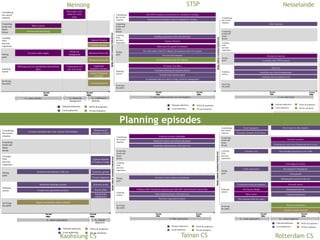
Planning episodes 
Kaohsiung CS Tainan CS Rotterdam CS
KAOHSI UNG TAI NAN 
Meinong Kaohsiung city centre the STSP Tainan city 
Local authorities 
centre 
NGOs & academics 
National authorities 
Private enterprise 
RESILIENCE CHARACTERISTICS 
E1 E2 E3 E1 E2 E1 E1 
Considering 
the current 
situation 
Examining 
trends and 
future 
threats 
Learning 
from 
previous 
experience 
Setting 
goals 
Initiating 
actions 
Involvi ng 
the public 
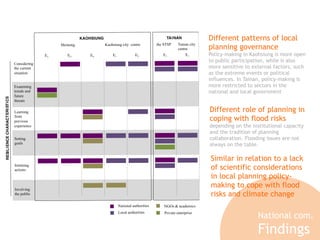
Different patterns of local 
planning governance 
Policy-making in Kaohsiung is more open 
to public participation, while is also 
more sensitive to external factors, such 
as the extreme events or political 
influences. In Tainan, policy-making is 
more restricted to sectors in the 
national and local government 
Different role of planning in 
coping with flood risks 
depending on the institutional capacity 
and the tradition of planning 
collaboration. Flooding issues are not 
always on the table. 
Similar in relation to a lack 
of scientific considerations 
in local planning policy-making 
to cope with flood 
risks and climate change 
National com. 
Findings
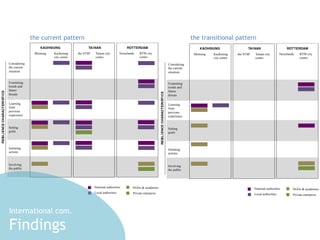
the current pattern the transitional pattern 
KAOHSIUNG TAINAN ROTTERDAM 
Meinong Kaohsiung 
city centre 
the STSP Tainan city 
centre 
Nesselande RTM city 
centre 
RESILIENCE CHARACTERISTICS 
Local authorities 
NGOs & academics 
National authorities 
Private enterprise 
Considering 
the current 
situation 
Examining 
trends and 
future 
threats 
Learning 
from 
previous 
experience 
Setting 
goals 
Initiating 
actions 
Involving 
the public 
International com. 
Findings 
KAOHSIUNG TAINAN ROTTERDAM 
Meinong Kaohsiung 
city centre 
the STSP Tainan city 
centre 
Nesselande RTM city 
centre 
RESILIENCE CHARACTERISTICS 
Local authorities 
NGOs & academics 
National authorities 
Private enterprise 
Considering 
the current 
situation 
Examining 
trends and 
future 
threats 
Learning 
from 
previous 
experience 
Setting 
goals 
Initiating 
actions 
Involving 
the public
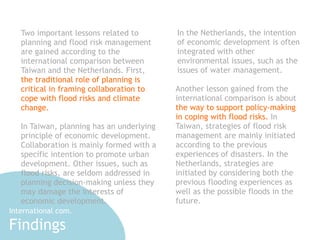
In the Netherlands, the intention 
of economic development is often 
integrated with other 
environmental issues, such as the 
issues of water management. 
Another lesson gained from the 
international comparison is about 
the way to support policy-making 
in coping with flood risks. In 
Taiwan, strategies of flood risk 
management are mainly initiated 
according to the previous 
experiences of disasters. In the 
Netherlands, strategies are 
initiated by considering both the 
previous flooding experiences as 
well as the possible floods in the 
future. 
Two important lessons related to 
planning and flood risk management 
are gained according to the 
international comparison between 
Taiwan and the Netherlands. First, 
the traditional role of planning is 
critical in framing collaboration to 
cope with flood risks and climate 
change. 
!I 
n Taiwan, planning has an underlying 
principle of economic development. 
Collaboration is mainly formed with a 
specific intention to promote urban 
development. Other issues, such as 
flood risks, are seldom addressed in 
planning decision-making unless they 
may damage the interests of 
economic development. 
International com. 
Findings
14 
Preparation actions are more 
addressed in the Dutch context 
that focuses on assessment, 
such as monitoring current 
conditions, producing future 
simulations and investigating 
possible solutions for future 
risks. 
Actions for performance are 
the primarily focus of policy-making 
in Taiwan for flood risk 
management.These actions are 
more related to develop the 
capacities of response and 
recovery, so a city may react 
and retain basic functions, 
rearrange key resources, and 
propose redevelopment 
strategies for recovery. 
International com. 
Findings
Conclusion 
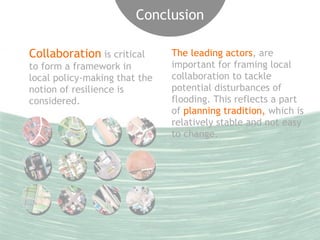
Collaboration is critical 
to form a framework in 
local policy-making that the 
notion of resilience is 
considered. 
The leading actors, are 
important for framing local 
collaboration to tackle 
potential disturbances of 
flooding. This reflects a part 
of planning tradition, which is 
relatively stable and not easy 
to change.
Conclusion 
Taiwan and the Netherlands are also different in terms 
of the role of the state in managing flooding issues. 
Both Taiwan and the Netherlands are experiencing a transition 
in planning governance. The reform in Taiwan is mainly 
addressed in the institutions. The institutional reform has a 
clear intention of land use redistribution, which is more focus 
on physical development. 
The reform in the Netherlands is more about the scope of 
planning. The reform leads to a more open framework of 
cross-actor collaboration and is not necessarily linked to 
physical development.
17 
Conclusion 
Urban resilience is often addressed in combination with 
other concepts, such as adaptation and mitigation. The word 
resilience has not always appeared in policy-making. In fact, it 
appears only rarely. 
Spatial planning is as important in the Netherlands as it is in 
Taiwan. In this context, it is important for policy-makers in 
Taiwan to have a broadened understanding of planning 
considering both the process of decision-making and the 
implementation in local practices in facing the complex issues 
like climate-related flood risks.
Thank you 
Pei-Wen Lu 
b88208035@gmail.com

Spatial planning and urban resilience in the context of flood risk - A comparative study of Kaohsiung, Tainan and Rotterdam

  • 1.
    Spatial planning andurban resilience in the context of flood risk A comparative study of Kaohsiung, Tainan and Rotterdam Pei-Wen Lu Delft University of Technology, Faculty of Architecture and The Built Environment , Department of Urbanism
  • 2.
    has been increasingly affective to urban development The uncertainty of Setting of the study
  • 3.
    The notion of resilience is important. It is often used in a mix of mitigation and adaptation Setting of the study
  • 4.
    Spatial planning hasconsidered increasingly important in promoting cities to become more resilience for flood risk One of the reasons for this can be explained by a fact that the traditional engineering approach, such as increasing the height of dikes, has become insufficient to provide complete certainty of protection against the uncertain disturbance of flooding. Setting of the study
  • 5.
    How spatial planningcan promote resilience in the context of the uncertainty of flood risks and climate change? Sub Q1: what are the characteristics of planning which can help to promote resilience? Sub Q2: how has the notion of resilience been absorbed and become part of the reasoning of planning? Sub Q3: to what extent can planning policy-making help to promote the resilience of spatial development in coping with flood risks? Research questions
  • 6.
    European or International? [Spatial planning]: In Europe, scholars have had a broader understanding of planning that involves a conformity between policies and physical developments as well as the process that stakeholders address together and initiate a certain decision for spatial development (e.g., Healey, 1997, 2006, 2007, Albrechts et al., 2003, Albrechts, 2004, 2010, Mastop and Faludi, 1997, Faludi, 2000, Nadin, 2007, 2010, Nadin and Stead, 2008, Allmendinger and Haughton, 2010). Studies of spatial planning often focus on the importance of the process of decision-making that leads to a consequence of physical development. Cross-continental research: Methodology
  • 7.
    National com. Internationalcom. C3: Southern Taiwan Science Park C4: Tainan city centre C1: Meinong C2: Kaohsiung city centre C5: Nesselende C6: Rotterdam city centre to examine whether and how local policy-making reflects these characteristics where each case study share the same national institutional framework to examine the critical elements of planning for flood risk management Methodology
  • 8.
    Four planning dimensionsSix characteristics of planning to promote resilience Methodology
  • 9.
    Meinong STSP Nesselande Collaborative frameworks WRAs Flexible zoning Local Water approach planning National authorities story NGOs & academics Economic approach Local authorities Private enterprise Integrated approach Planning aspects Discourses Spatial developments Housing Flood risks Land use control (elevation, ditches, ponds) WRB ICT industry Landscape ponds Restricted development CEPD NSC UDB Cambridge project WRAs WRB UDB Solar city the end 1990s the end 2000s Private enterprises Zengwen River levee New town development Flood-resistant buffer Plans and policies E: water resistance and new town development Planning dimensions Discourses Water scarcity Collaborative frameworks Spatial developments Flood risks WRASB Sand mining WRASB Reservoir Dike plan Local NGOs Retention plan Levees WRA07 Master Plan of the Culture Town Meinong ! Villas & housing Water approach Economic approach Local authorities NGOs & academics National authorities Integrated approach Private enterprise Local NGOs Local NGOs Tourism Artificial lakes WRA07 Urban expansion Tai-Sugar cop. Private developers Local NGOs Groundwater reservoir Plans and policies the end 1990s E1: water scarcity E3: collaborative planning E2: flood risk management the end 2000s WRAP PWB &HEB E1: urban regeneration Planning aspects Collaborative frameworks Discourses Spatial developments Housing Flood risks Kao. Multifunctional Commerce and Trade Park UDB & EDB Kao. Port Authority Retention plan Retention ponds Gov. projects PWB Water quality & pollution Water approach Economic approach Local authorities NGOs & academics National authorities Integrated approach Private enterprise Trade & logistic Waterfront landscape HEB the end 1990s the end 2000s Waterfront wetlands Urban expansion E2: climate adaptation landmarks Plans and policies TBROC UDB UDB UDB E: urban regeneration Collaborative frameworks Water approach Economic approach Local authorities NGOs & academics National authorities Integrated approach Private enterprise Planning aspects Discourses Spatial developments Old district regeneration TB Waterfront regeneration Waterfront landscape CEPD Sparkling Tainan Canal China Town Haian Rd. the end 1990s the end 2000s China Town Haian Rd. Tourism development Anping Port National Scenic Area Landscape white paper Bridges Innovative shops Plans and policies E: new urban fringe Planning dimensions Collaborative frameworks Discourses Spatial developments Private developers Quality of living VROM VINEX Housing National authorities NGOs Water approach Economic approach Local authorities Integrated approach Private enterprise Enlarged lake Metro line the end 1990s the end 2000s City of RTM Recreational hotspots Plans and policies Case study Kaohsiung CS Tainan CS Rotterdam CS
  • 10.
    Meinong STSP Nesselande Polder landscape Metro line Case study Economic downturn due to the decline of the harbour Monitoring for Economic development of the city Support and promote urban wetlands the end 1990s E1: urban regeneration emergency actions Typhoon Morakot & Typhoon Fanapi Economic growth Climate adaptation Retention ponds Rescue plans International collaboration the end 2000s Waterfront landscape projects Coastal area regeneration projects Local authorities E2: climate adaptation NGOs & academics National authorities Private enterprise Considering the current situation Examining trends and future threats Learning from previous experience Setting goals Initiating actions Involving the public Considering the current situation Examining trends and future threats Learning from previous experience Setting goals Initiating actions Involving the public the end 1990s E1: water scarcity E3: collaborative planning E2: flood risk management the end 2000s Water scarcity River dike is not robust for water safety Tourism and sand mining To ensure water supply Meinong reservoir (abandoned) and artificial lakes Flood risk management Construction of a new river levee Typhoon Morakot Typhoon Morakot Minimise flood risks Minimise flood risks Implement integrated strategies Support Integrated strategies Local participation Local authorities NGOs & academics National authorities Private enterprise RESILIENCE CHARACTERISTICS The STSP is located in areas where are vulnerable in flooding Science park development cannot be damaged by flooding Flooding experiences in this low-land area Typhoon Morakot New town development To restore river dikes To promote housing development projects Local authorities NGOs & academics National authorities Private enterprise the end 1990s E: water resistance and new town development the end 2000s Water proof for spatial development The water safety of the ICT industry development need to be ensured The development of the ICT industry To build water retention ponds To implement land use control (zoning, elevation management) Considering the current situation Examining trends and future threats Learning from previous experience Setting goals Initiating actions Involving the public RESILIENCE CHARACTERISTICS Mistakable implementation of the inner city Challenge 2008: National development plan 2002-2007 and the Double Tourists Plan Redevelopment projects of the inner city Local authorities NGOs & academics National authorities Private enterprise E: urban regeneration the end 1990s the end 2000s Historical resources (buildings) Historical resources and cultural atmosphere Economic/ tourism industry development Waterfront regeneration projects Considering the current situation Examining trends and future threats Learning from previous experience Setting goals Initiating actions Involving the public RESILIENCE CHARACTERISTICS Local authorities NGOs & academics National authorities Private enterprise Double the size of the Zevenhuizerplas E: new urban fringe the end 1990s the end 2000s Housing development To compete other VINEX projects Landscape and recreational activies Considering the current situation Examining trends and future threats Learning from previous experience Setting goals Initiating actions Involving the public RESILIENCE CHARACTERISTICS Reviewing river dike situation Scientific scenarios Flooding may occur more frequent and more severe Near-flooding experiences in the 1990s Knowledge for climate Be waterproof /climateproof Urban growth Marketing the expertise of the city Scientific studies International network Experimental practices Business communities Scientific research institutes Local authorities NGOs & academics National authorities Private enterprise Social segregation Economic downturn of the harbour Economic crisis To promote housing development The extension of the city centre the end 1990s the end 2000s Urban regeneration The Erasmus Bridge Metro system E2 : E1 : urban regeneration climate adaptation Considering the current situation Examining trends and future threats Learning from previous experience Setting goals Initiating actions Involving the public Planning episodes Kaohsiung CS Tainan CS Rotterdam CS
  • 11.
    KAOHSI UNG TAINAN Meinong Kaohsiung city centre the STSP Tainan city Local authorities centre NGOs & academics National authorities Private enterprise RESILIENCE CHARACTERISTICS E1 E2 E3 E1 E2 E1 E1 Considering the current situation Examining trends and future threats Learning from previous experience Setting goals Initiating actions Involvi ng the public Different patterns of local planning governance Policy-making in Kaohsiung is more open to public participation, while is also more sensitive to external factors, such as the extreme events or political influences. In Tainan, policy-making is more restricted to sectors in the national and local government Different role of planning in coping with flood risks depending on the institutional capacity and the tradition of planning collaboration. Flooding issues are not always on the table. Similar in relation to a lack of scientific considerations in local planning policy-making to cope with flood risks and climate change National com. Findings
  • 12.
    the current patternthe transitional pattern KAOHSIUNG TAINAN ROTTERDAM Meinong Kaohsiung city centre the STSP Tainan city centre Nesselande RTM city centre RESILIENCE CHARACTERISTICS Local authorities NGOs & academics National authorities Private enterprise Considering the current situation Examining trends and future threats Learning from previous experience Setting goals Initiating actions Involving the public International com. Findings KAOHSIUNG TAINAN ROTTERDAM Meinong Kaohsiung city centre the STSP Tainan city centre Nesselande RTM city centre RESILIENCE CHARACTERISTICS Local authorities NGOs & academics National authorities Private enterprise Considering the current situation Examining trends and future threats Learning from previous experience Setting goals Initiating actions Involving the public
  • 13.
    In the Netherlands,the intention of economic development is often integrated with other environmental issues, such as the issues of water management. Another lesson gained from the international comparison is about the way to support policy-making in coping with flood risks. In Taiwan, strategies of flood risk management are mainly initiated according to the previous experiences of disasters. In the Netherlands, strategies are initiated by considering both the previous flooding experiences as well as the possible floods in the future. Two important lessons related to planning and flood risk management are gained according to the international comparison between Taiwan and the Netherlands. First, the traditional role of planning is critical in framing collaboration to cope with flood risks and climate change. !I n Taiwan, planning has an underlying principle of economic development. Collaboration is mainly formed with a specific intention to promote urban development. Other issues, such as flood risks, are seldom addressed in planning decision-making unless they may damage the interests of economic development. International com. Findings
  • 14.
    14 Preparation actionsare more addressed in the Dutch context that focuses on assessment, such as monitoring current conditions, producing future simulations and investigating possible solutions for future risks. Actions for performance are the primarily focus of policy-making in Taiwan for flood risk management.These actions are more related to develop the capacities of response and recovery, so a city may react and retain basic functions, rearrange key resources, and propose redevelopment strategies for recovery. International com. Findings
  • 15.
    Conclusion Collaboration iscritical to form a framework in local policy-making that the notion of resilience is considered. The leading actors, are important for framing local collaboration to tackle potential disturbances of flooding. This reflects a part of planning tradition, which is relatively stable and not easy to change.
  • 16.
    Conclusion Taiwan andthe Netherlands are also different in terms of the role of the state in managing flooding issues. Both Taiwan and the Netherlands are experiencing a transition in planning governance. The reform in Taiwan is mainly addressed in the institutions. The institutional reform has a clear intention of land use redistribution, which is more focus on physical development. The reform in the Netherlands is more about the scope of planning. The reform leads to a more open framework of cross-actor collaboration and is not necessarily linked to physical development.
  • 17.
    17 Conclusion Urbanresilience is often addressed in combination with other concepts, such as adaptation and mitigation. The word resilience has not always appeared in policy-making. In fact, it appears only rarely. Spatial planning is as important in the Netherlands as it is in Taiwan. In this context, it is important for policy-makers in Taiwan to have a broadened understanding of planning considering both the process of decision-making and the implementation in local practices in facing the complex issues like climate-related flood risks.
  • 18.
    Thank you Pei-WenLu b88208035@gmail.com